EULabCap methods and indicators: technical
updates and survey calendar
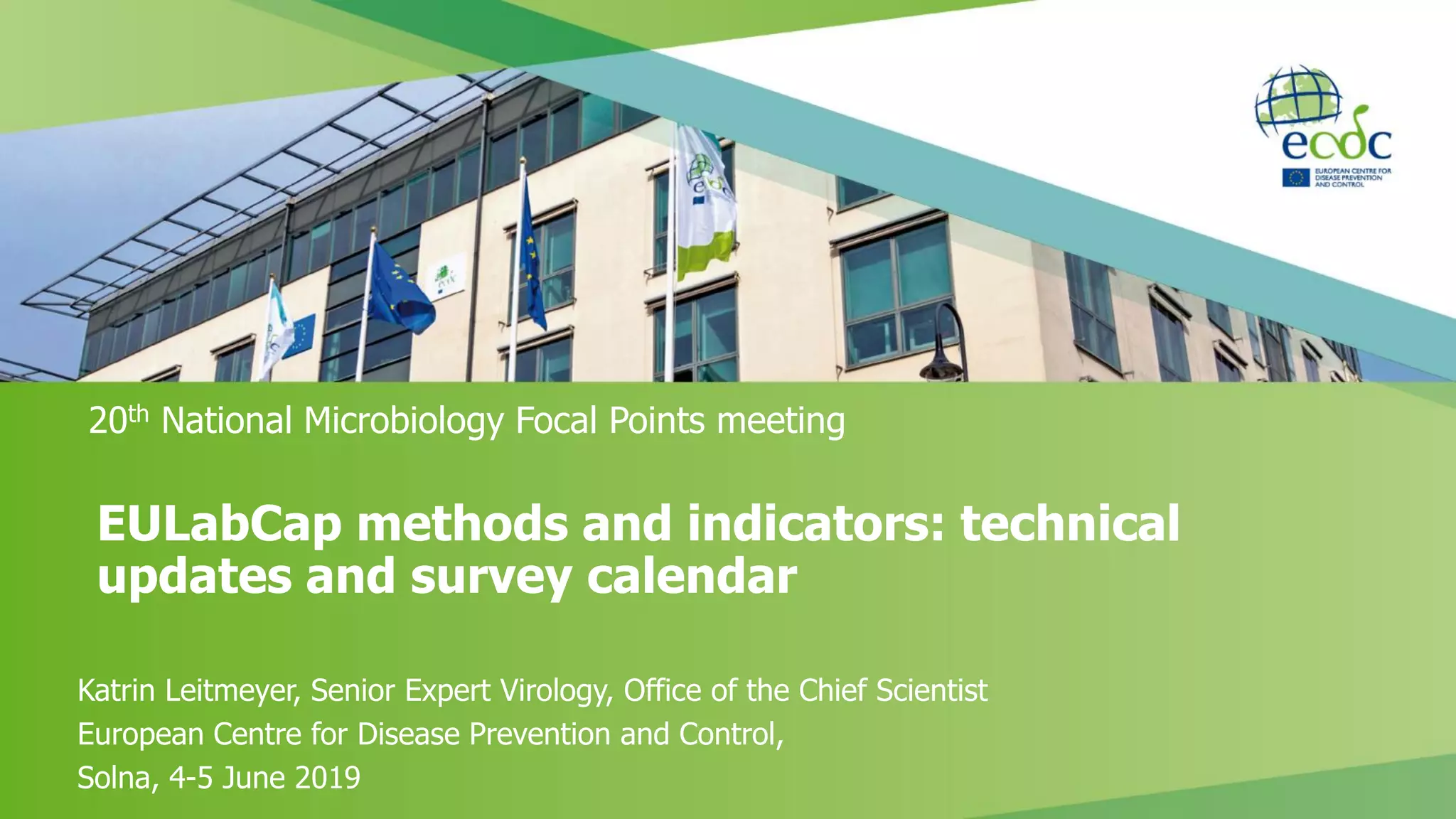
20th National Microbiology Focal Points meeting
Katrin Leitmeyer, Senior Expert Virology, Office of the Chief Scientist
European Centre for Disease Prevention and Control,
Solna, 4-5 June 2019
Technical updates
In 2017 we thoroughly revised EULabCap tool, for the data calls 2016-
2018.
The following areas were identified for future revision:
• Target 1.3 - Diagnostic testing utilisation (median) score based on
absolute numbers?
• Target 2.3 - Molecular typing for surveillance update according to
the “Roadmap”
• Target 3.2 - Active participation in EU disease networks score
only active networks
• Target 3.4 - (Re)-emerging diseases laboratory preparedness and
response support  update according to 2018 EC Decision
surveillance list of EU notifiable diseases, new threats
2
Target 1.3
Diagnostic testing utilisation
3
Revision – indicator 1.32
(ECDC)
Number of blood culture sets tested/1000 hospital bed-days reported by
EARS-net participating hospitals.
0 = information not reported to EARS-Net, or not reported in the country
1 = low blood culture test utilisation rate/1 000 hospital bed days (first EU quartile)
2 = fair to high blood culture utilisation rate/1000 hospital bed-days (upper three EU
quartiles).
Proposed change:
 Score on absolute numbers (insufficient, intermediate, optimal)
But what is possible ?
4
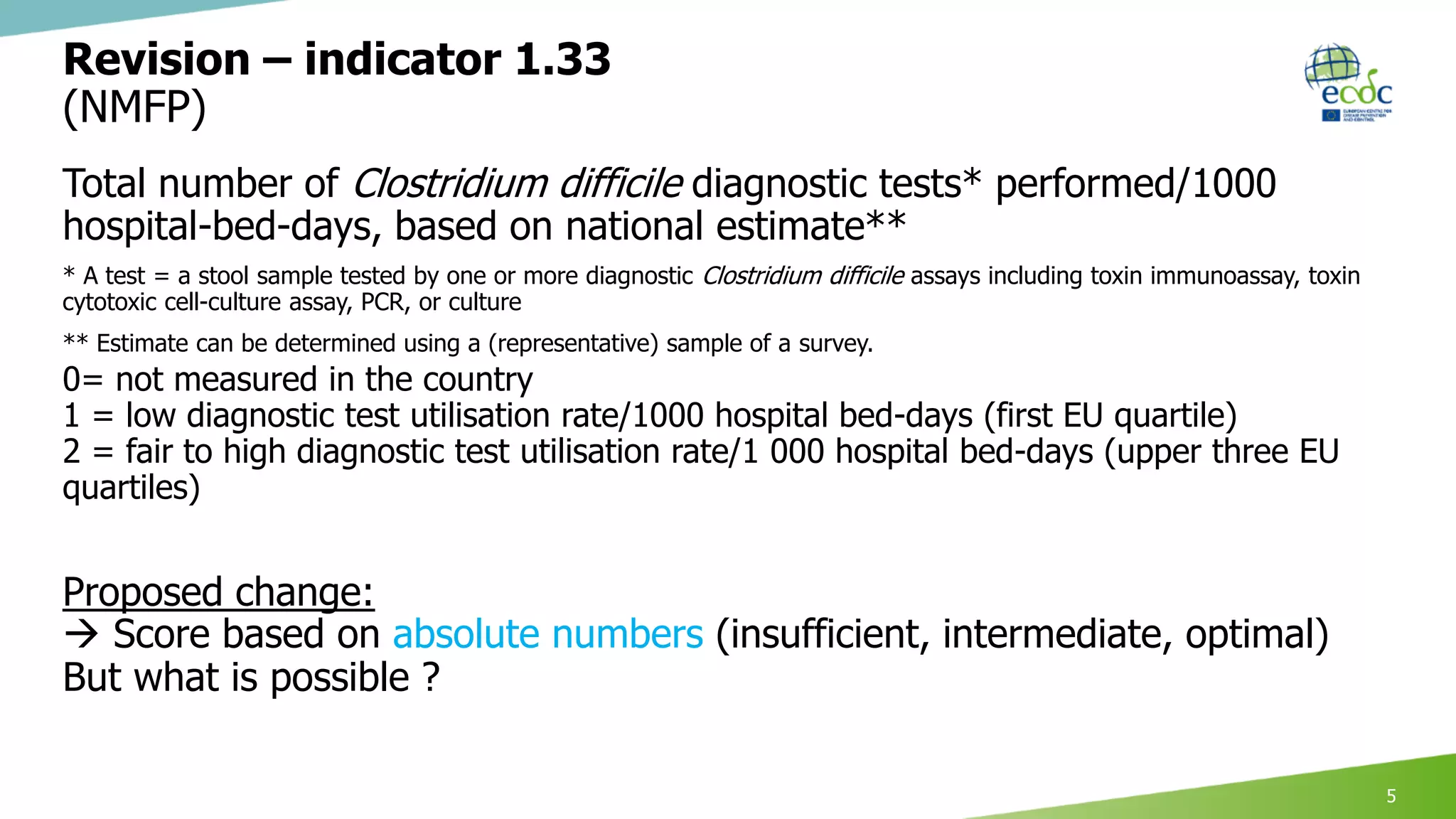
Revision – indicator 1.33
(NMFP)
Total number of Clostridium difficile diagnostic tests* performed/1000
hospital-bed-days, based on national estimate**
* A test = a stool sample tested by one or more diagnostic Clostridium difficile assays including toxin immunoassay, toxin
cytotoxic cell-culture assay, PCR, or culture
** Estimate can be determined using a (representative) sample of a survey.
0= not measured in the country
1 = low diagnostic test utilisation rate/1000 hospital bed-days (first EU quartile)
2 = fair to high diagnostic test utilisation rate/1 000 hospital bed-days (upper three EU
quartiles)
Proposed change:
 Score based on absolute numbers (insufficient, intermediate, optimal)
But what is possible ?
5
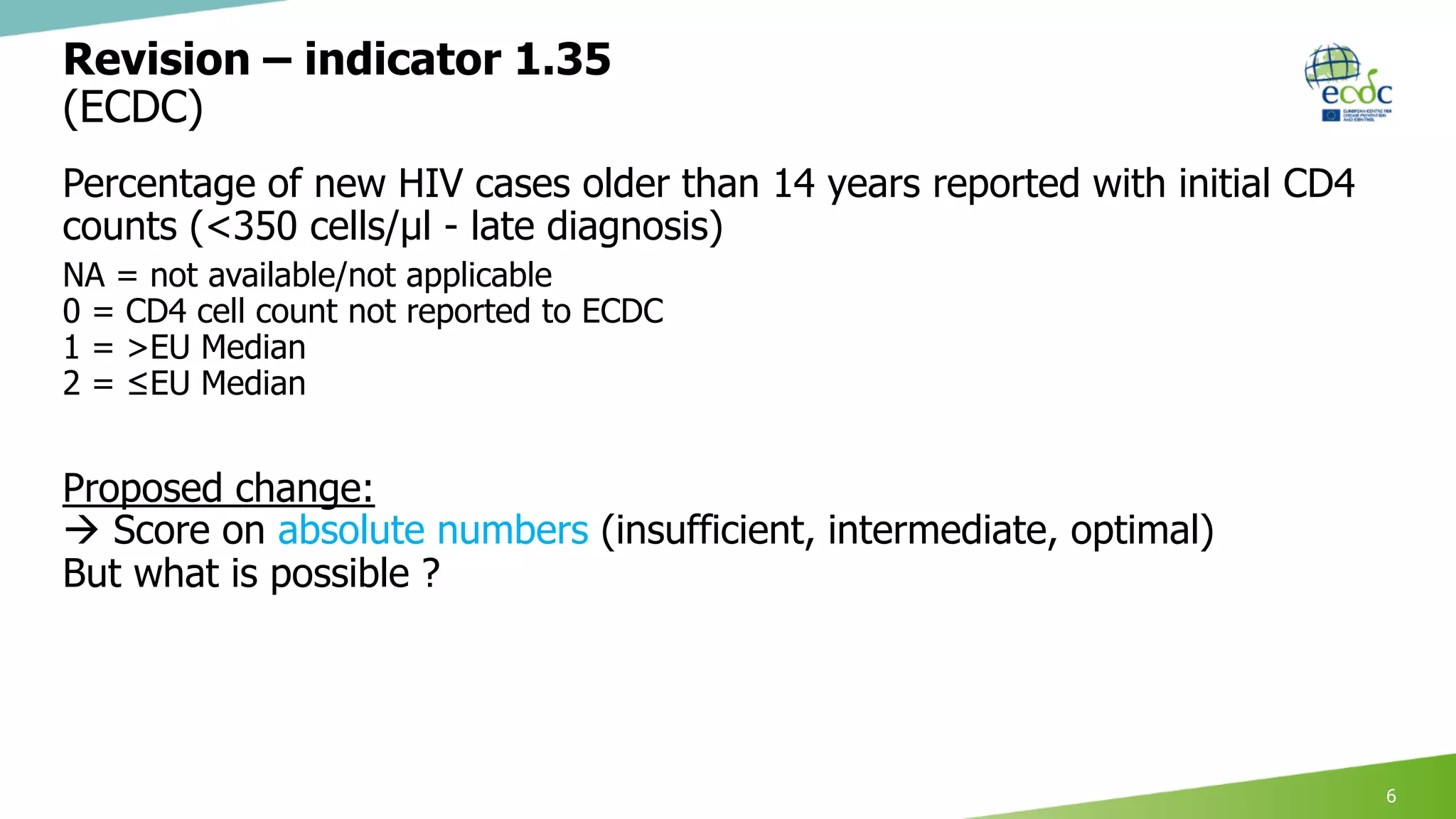
Revision – indicator 1.35
(ECDC)
Percentage of new HIV cases older than 14 years reported with initial CD4
counts (<350 cells/µl - late diagnosis)
NA = not available/not applicable
0 = CD4 cell count not reported to ECDC
1 = >EU Median
2 = ≤EU Median
Proposed change:
 Score on absolute numbers (insufficient, intermediate, optimal)
But what is possible ?
6
Target 2.3
Molecular typing for surveillance
7
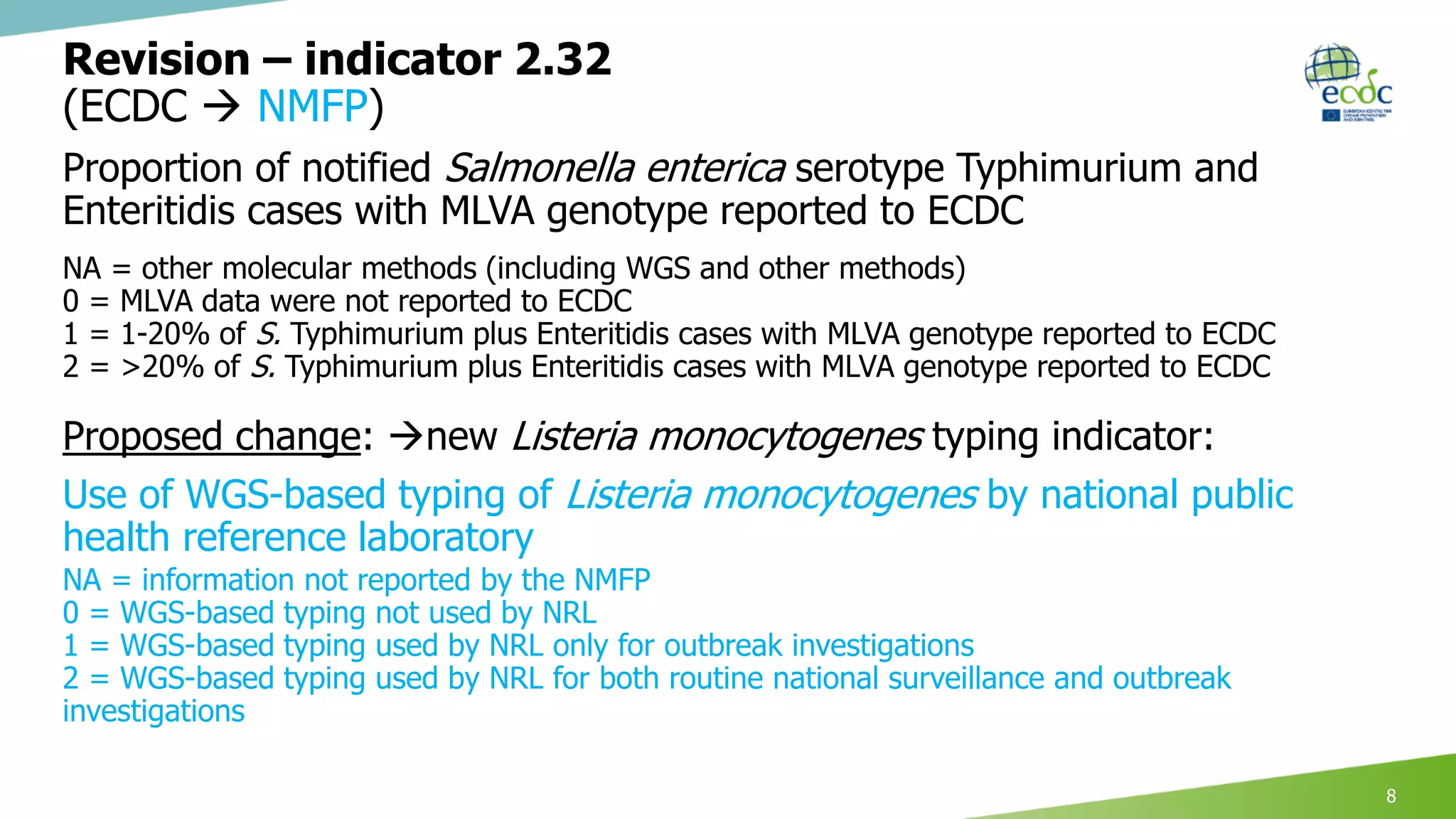
Revision – indicator 2.32
(ECDC  NMFP)
Proportion of notified Salmonella enterica serotype Typhimurium and
Enteritidis cases with MLVA genotype reported to ECDC
NA = other molecular methods (including WGS and other methods)
0 = MLVA data were not reported to ECDC
1 = 1-20% of S. Typhimurium plus Enteritidis cases with MLVA genotype reported to ECDC
2 = >20% of S. Typhimurium plus Enteritidis cases with MLVA genotype reported to ECDC
Proposed change: new Listeria monocytogenes typing indicator:
Use of WGS-based typing of Listeria monocytogenes by national public
health reference laboratory
NA = information not reported by the NMFP
0 = WGS-based typing not used by NRL
1 = WGS-based typing used by NRL only for outbreak investigations
2 = WGS-based typing used by NRL for both routine national surveillance and outbreak
investigations
8
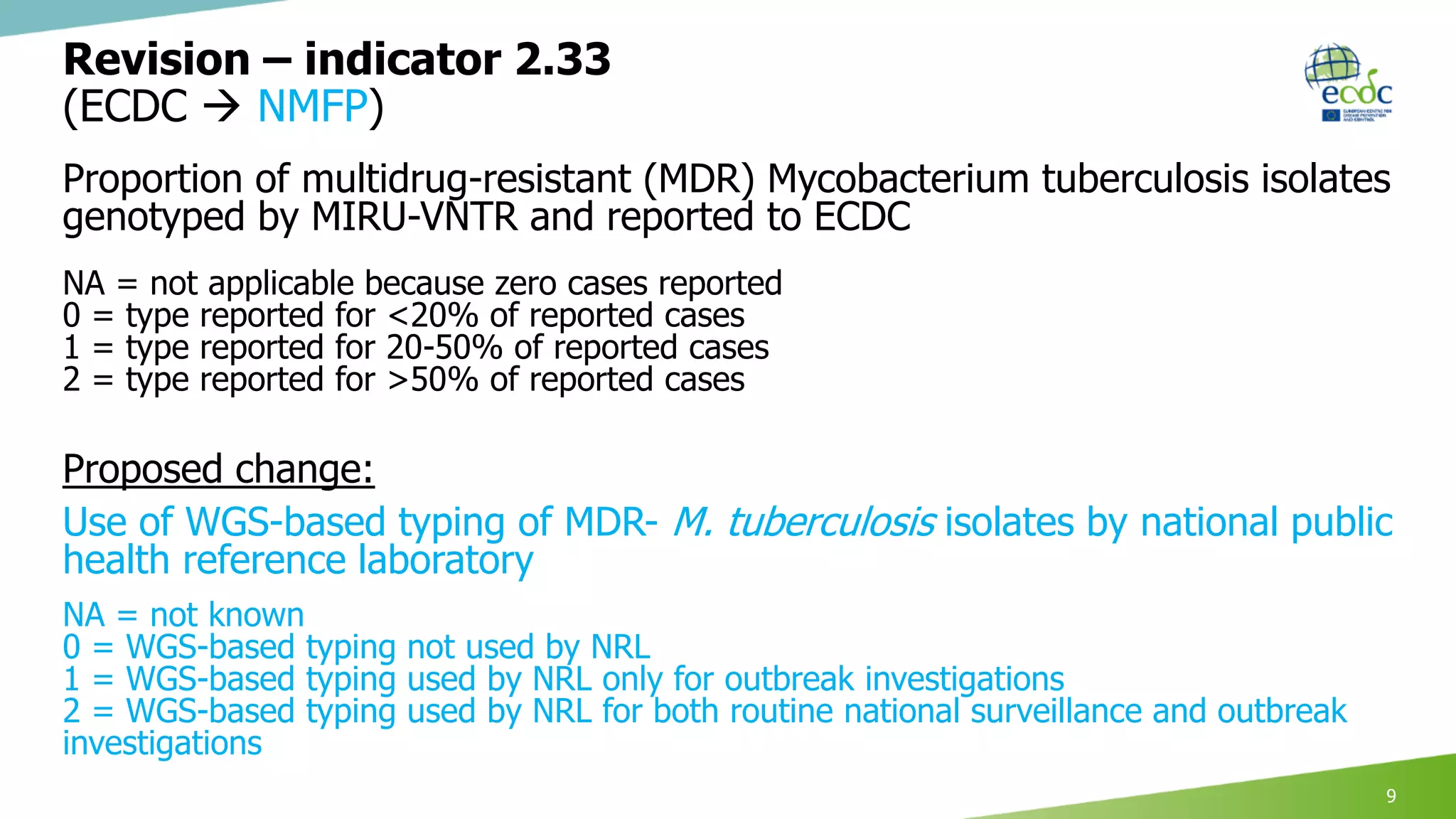
Revision – indicator 2.33
(ECDC  NMFP)
Proportion of multidrug-resistant (MDR) Mycobacterium tuberculosis isolates
genotyped by MIRU-VNTR and reported to ECDC
NA = not applicable because zero cases reported
0 = type reported for <20% of reported cases
1 = type reported for 20-50% of reported cases
2 = type reported for >50% of reported cases
Proposed change:
Use of WGS-based typing of MDR- M. tuberculosis isolates by national public
health reference laboratory
NA = not known
0 = WGS-based typing not used by NRL
1 = WGS-based typing used by NRL only for outbreak investigations
2 = WGS-based typing used by NRL for both routine national surveillance and outbreak
investigations
9
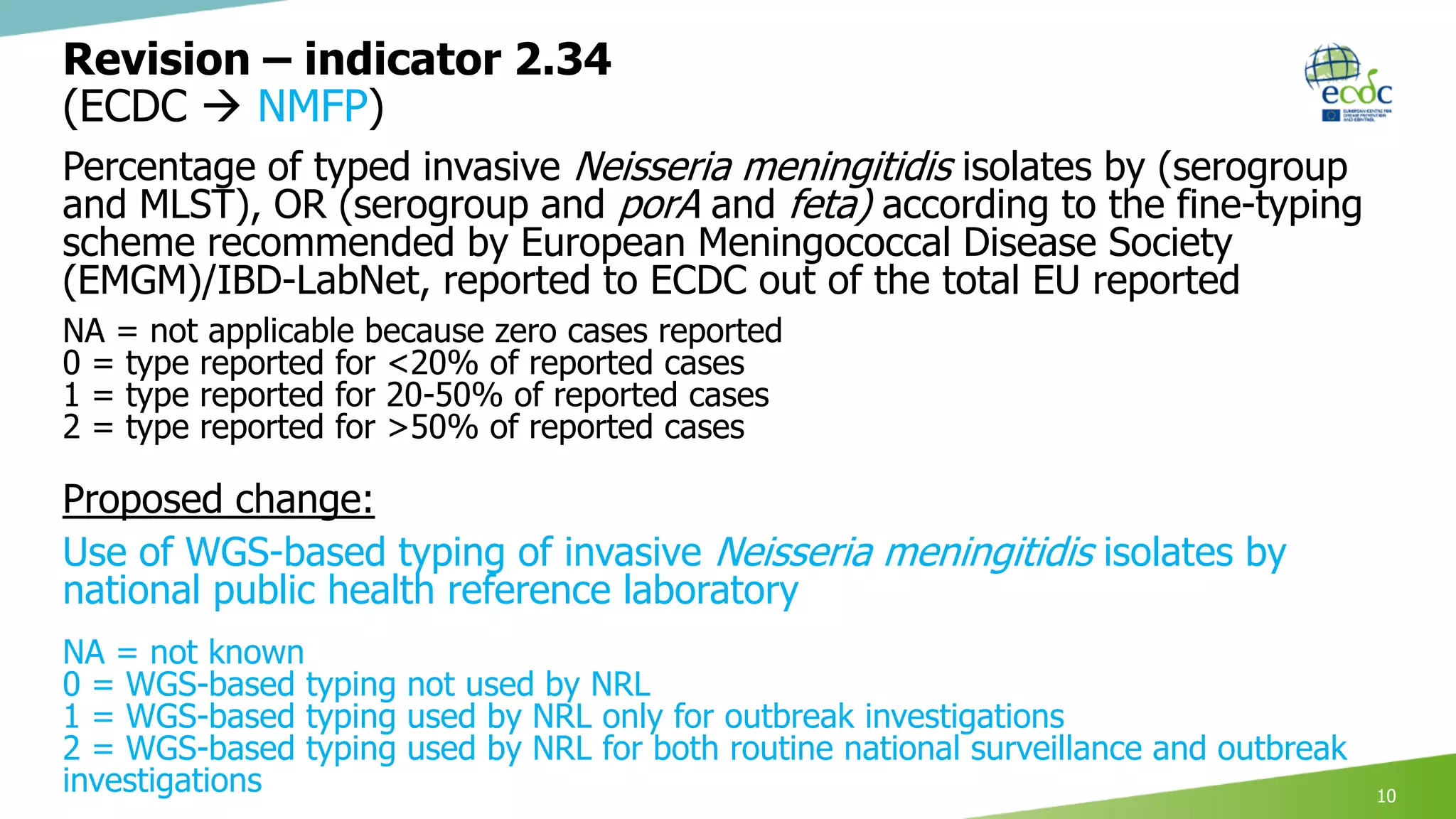
Revision – indicator 2.34
(ECDC  NMFP)
Percentage of typed invasive Neisseria meningitidis isolates by (serogroup
and MLST), OR (serogroup and porA and feta) according to the fine-typing
scheme recommended by European Meningococcal Disease Society
(EMGM)/IBD-LabNet, reported to ECDC out of the total EU reported
NA = not applicable because zero cases reported
0 = type reported for <20% of reported cases
1 = type reported for 20-50% of reported cases
2 = type reported for >50% of reported cases
Proposed change:
Use of WGS-based typing of invasive Neisseria meningitidis isolates by
national public health reference laboratory
NA = not known
0 = WGS-based typing not used by NRL
1 = WGS-based typing used by NRL only for outbreak investigations
2 = WGS-based typing used by NRL for both routine national surveillance and outbreak
investigations 10
Target 3.2
Active participation in EU disease
networks
11
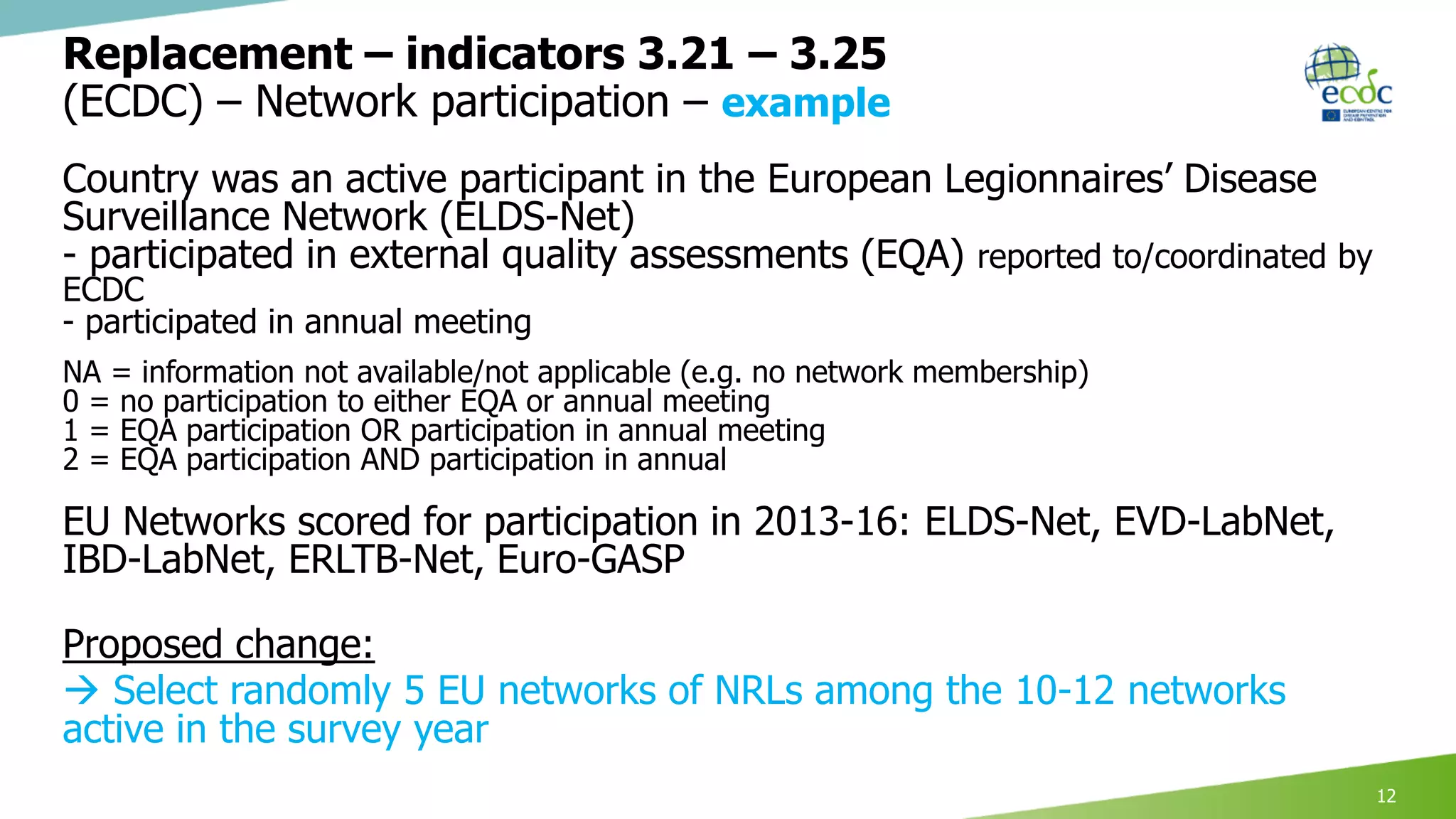
Replacement – indicators 3.21 – 3.25
(ECDC) – Network participation – example
Country was an active participant in the European Legionnaires’ Disease
Surveillance Network (ELDS-Net)
- participated in external quality assessments (EQA) reported to/coordinated by
ECDC
- participated in annual meeting
NA = information not available/not applicable (e.g. no network membership)
0 = no participation to either EQA or annual meeting
1 = EQA participation OR participation in annual meeting
2 = EQA participation AND participation in annual
EU Networks scored for participation in 2013-16: ELDS-Net, EVD-LabNet,
IBD-LabNet, ERLTB-Net, Euro-GASP
Proposed change:
 Select randomly 5 EU networks of NRLs among the 10-12 networks
active in the survey year
12
Target 3.4
(Re)emerging diseases laboratory
preparedness and response support
13
Revision– indicator 3.42
(ECDC)
Diagnostic and characterization capability for avian influenza A(H7Nx) and
A(H5Nx) viruses available at national level in accordance with ECDC/WHO
surveillance guidance
NA = information not reported by the NMFP
0 = no specific diagnostic capability
1 = HA identification available
2 = HA and NA identification available
Proposed change:
Diagnostic and characterization capability for avian influenza and A(H5Nx),
A(H7Nx) and A(H9Nx) viruses available at national level in accordance with
ECDC/WHO surveillance guidance
14
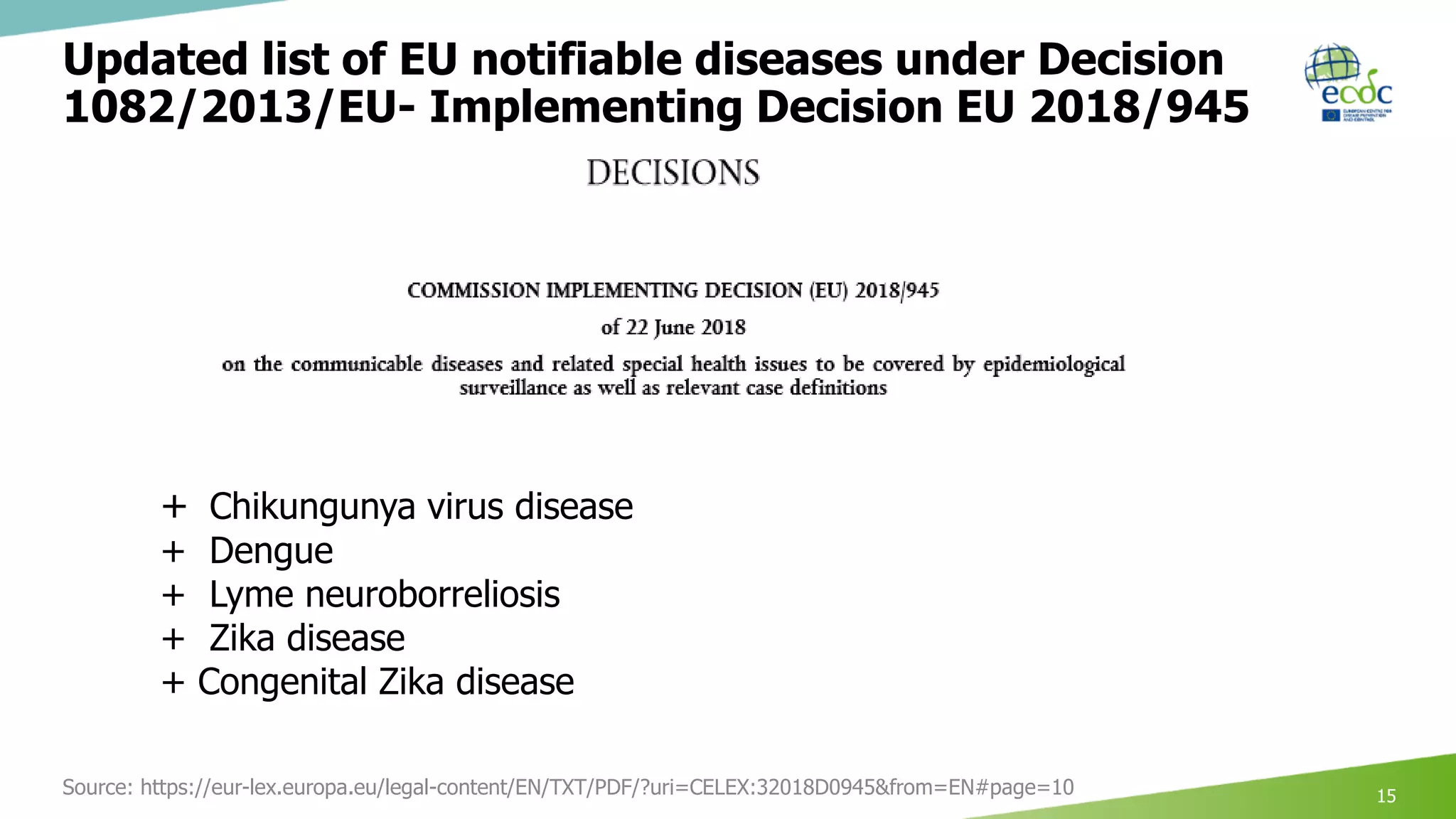
Updated list of EU notifiable diseases under Decision
1082/2013/EU- Implementing Decision EU 2018/945
Source: https://eur-lex.europa.eu/legal-content/EN/TXT/PDF/?uri=CELEX:32018D0945&from=EN#page=10 15
+ Chikungunya virus disease
+ Dengue
+ Lyme neuroborreliosis
+ Zika disease
+ Congenital Zika disease
Revision– indicator 3.44
(ECDC)
One or more reference virology laboratories in your country have detection
capability for human infection with the following 5 rare and/or imported
viruses: Chikungunya/Dengue/Hantavirus/Tick borne encephalitis/West Nile
0 = for less than 2 viruses
1 = for at least 2 out of 5 viruses
2 = for all 5 viruses
Proposed change:
One or more national reference laboratories in your country have detection and
identification capability for human infection with the following 5 (re)-emerging
pathogens: Yellow fever virus/Crimean-Congo haemorrhagic fever
virus/Hantavirus/ Usutu virus/Candida auris
0 = for less than 2 pathogens
1 = for at least 2 out of 5 pathogens
2 = for all 5 pathogens
16
TIMELINE - 2018 Survey
17
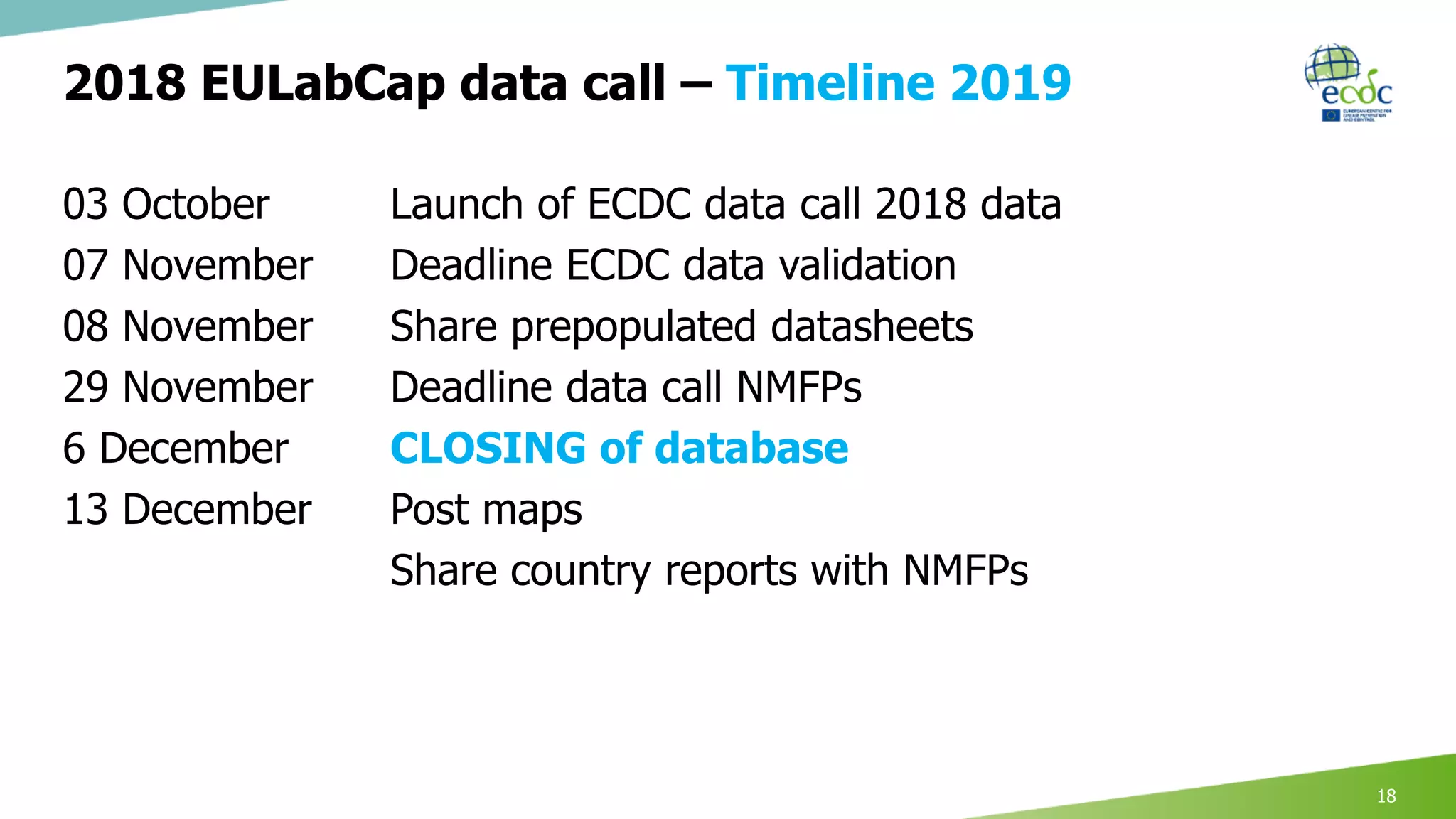
2018 EULabCap data call – Timeline 2019
03 October Launch of ECDC data call 2018 data
07 November Deadline ECDC data validation
08 November Share prepopulated datasheets
29 November Deadline data call NMFPs
6 December CLOSING of database
13 December Post maps
Share country reports with NMFPs
18
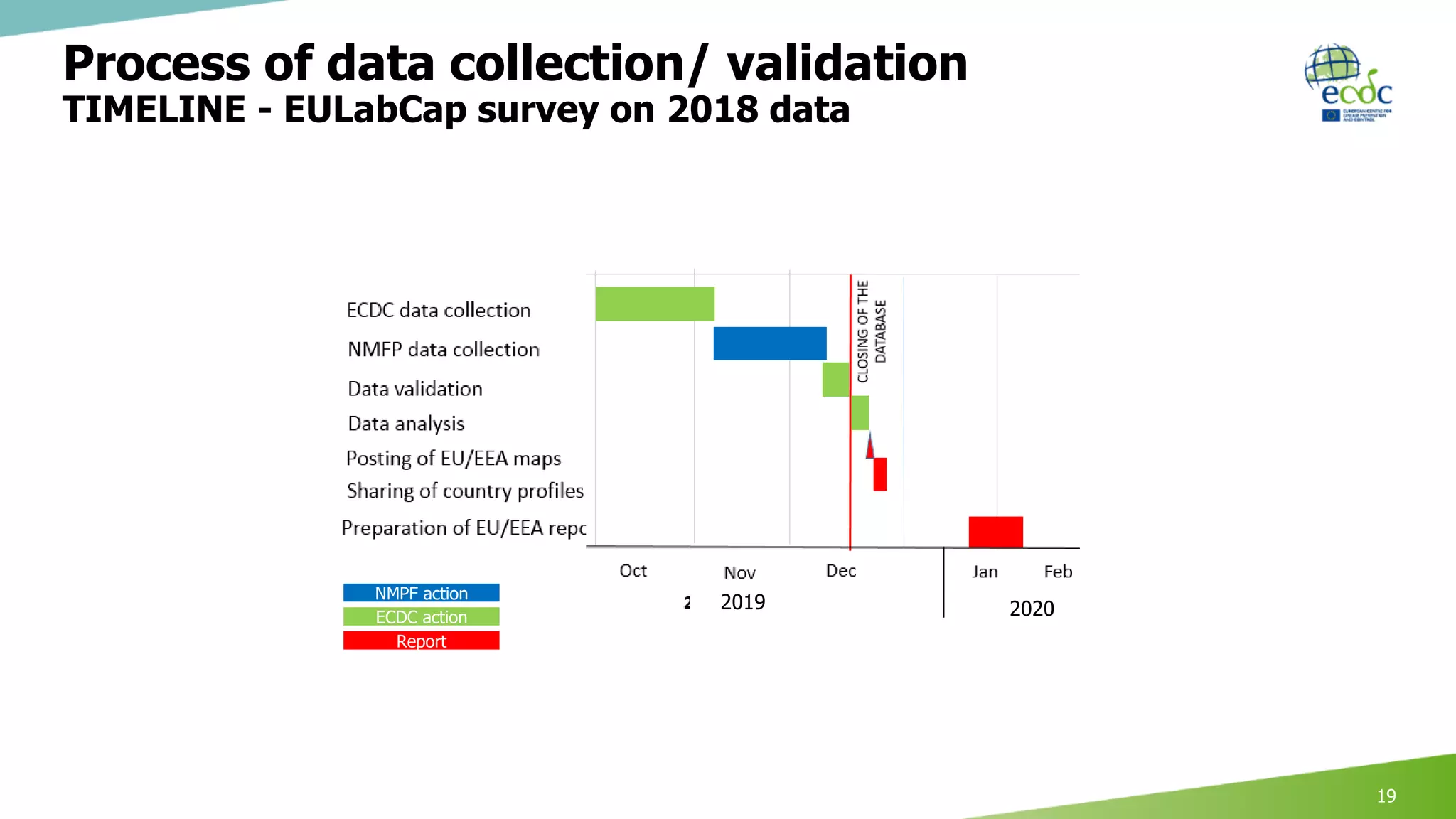
Process of data collection/ validation
TIMELINE - EULabCap survey on 2018 data
19
ECDC action
NMPF action
Report
2019 2020
Thank you
20

EULabCap methods and indicators: technical updates and survey calendar

  • 1.
    EULabCap methods andindicators: technical updates and survey calendar 20th National Microbiology Focal Points meeting Katrin Leitmeyer, Senior Expert Virology, Office of the Chief Scientist European Centre for Disease Prevention and Control, Solna, 4-5 June 2019
  • 2.
    Technical updates In 2017we thoroughly revised EULabCap tool, for the data calls 2016- 2018. The following areas were identified for future revision: • Target 1.3 - Diagnostic testing utilisation (median) score based on absolute numbers? • Target 2.3 - Molecular typing for surveillance update according to the “Roadmap” • Target 3.2 - Active participation in EU disease networks score only active networks • Target 3.4 - (Re)-emerging diseases laboratory preparedness and response support  update according to 2018 EC Decision surveillance list of EU notifiable diseases, new threats 2
  • 3.
  • 4.
    Revision – indicator1.32 (ECDC) Number of blood culture sets tested/1000 hospital bed-days reported by EARS-net participating hospitals. 0 = information not reported to EARS-Net, or not reported in the country 1 = low blood culture test utilisation rate/1 000 hospital bed days (first EU quartile) 2 = fair to high blood culture utilisation rate/1000 hospital bed-days (upper three EU quartiles). Proposed change:  Score on absolute numbers (insufficient, intermediate, optimal) But what is possible ? 4
  • 5.
    Revision – indicator1.33 (NMFP) Total number of Clostridium difficile diagnostic tests* performed/1000 hospital-bed-days, based on national estimate** * A test = a stool sample tested by one or more diagnostic Clostridium difficile assays including toxin immunoassay, toxin cytotoxic cell-culture assay, PCR, or culture ** Estimate can be determined using a (representative) sample of a survey. 0= not measured in the country 1 = low diagnostic test utilisation rate/1000 hospital bed-days (first EU quartile) 2 = fair to high diagnostic test utilisation rate/1 000 hospital bed-days (upper three EU quartiles) Proposed change:  Score based on absolute numbers (insufficient, intermediate, optimal) But what is possible ? 5
  • 6.
    Revision – indicator1.35 (ECDC) Percentage of new HIV cases older than 14 years reported with initial CD4 counts (<350 cells/µl - late diagnosis) NA = not available/not applicable 0 = CD4 cell count not reported to ECDC 1 = >EU Median 2 = ≤EU Median Proposed change:  Score on absolute numbers (insufficient, intermediate, optimal) But what is possible ? 6
  • 7.
    Target 2.3 Molecular typingfor surveillance 7
  • 8.
    Revision – indicator2.32 (ECDC  NMFP) Proportion of notified Salmonella enterica serotype Typhimurium and Enteritidis cases with MLVA genotype reported to ECDC NA = other molecular methods (including WGS and other methods) 0 = MLVA data were not reported to ECDC 1 = 1-20% of S. Typhimurium plus Enteritidis cases with MLVA genotype reported to ECDC 2 = >20% of S. Typhimurium plus Enteritidis cases with MLVA genotype reported to ECDC Proposed change: new Listeria monocytogenes typing indicator: Use of WGS-based typing of Listeria monocytogenes by national public health reference laboratory NA = information not reported by the NMFP 0 = WGS-based typing not used by NRL 1 = WGS-based typing used by NRL only for outbreak investigations 2 = WGS-based typing used by NRL for both routine national surveillance and outbreak investigations 8
  • 9.
    Revision – indicator2.33 (ECDC  NMFP) Proportion of multidrug-resistant (MDR) Mycobacterium tuberculosis isolates genotyped by MIRU-VNTR and reported to ECDC NA = not applicable because zero cases reported 0 = type reported for <20% of reported cases 1 = type reported for 20-50% of reported cases 2 = type reported for >50% of reported cases Proposed change: Use of WGS-based typing of MDR- M. tuberculosis isolates by national public health reference laboratory NA = not known 0 = WGS-based typing not used by NRL 1 = WGS-based typing used by NRL only for outbreak investigations 2 = WGS-based typing used by NRL for both routine national surveillance and outbreak investigations 9
  • 10.
    Revision – indicator2.34 (ECDC  NMFP) Percentage of typed invasive Neisseria meningitidis isolates by (serogroup and MLST), OR (serogroup and porA and feta) according to the fine-typing scheme recommended by European Meningococcal Disease Society (EMGM)/IBD-LabNet, reported to ECDC out of the total EU reported NA = not applicable because zero cases reported 0 = type reported for <20% of reported cases 1 = type reported for 20-50% of reported cases 2 = type reported for >50% of reported cases Proposed change: Use of WGS-based typing of invasive Neisseria meningitidis isolates by national public health reference laboratory NA = not known 0 = WGS-based typing not used by NRL 1 = WGS-based typing used by NRL only for outbreak investigations 2 = WGS-based typing used by NRL for both routine national surveillance and outbreak investigations 10
  • 11.
    Target 3.2 Active participationin EU disease networks 11
  • 12.
    Replacement – indicators3.21 – 3.25 (ECDC) – Network participation – example Country was an active participant in the European Legionnaires’ Disease Surveillance Network (ELDS-Net) - participated in external quality assessments (EQA) reported to/coordinated by ECDC - participated in annual meeting NA = information not available/not applicable (e.g. no network membership) 0 = no participation to either EQA or annual meeting 1 = EQA participation OR participation in annual meeting 2 = EQA participation AND participation in annual EU Networks scored for participation in 2013-16: ELDS-Net, EVD-LabNet, IBD-LabNet, ERLTB-Net, Euro-GASP Proposed change:  Select randomly 5 EU networks of NRLs among the 10-12 networks active in the survey year 12
  • 13.
    Target 3.4 (Re)emerging diseaseslaboratory preparedness and response support 13
  • 14.
    Revision– indicator 3.42 (ECDC) Diagnosticand characterization capability for avian influenza A(H7Nx) and A(H5Nx) viruses available at national level in accordance with ECDC/WHO surveillance guidance NA = information not reported by the NMFP 0 = no specific diagnostic capability 1 = HA identification available 2 = HA and NA identification available Proposed change: Diagnostic and characterization capability for avian influenza and A(H5Nx), A(H7Nx) and A(H9Nx) viruses available at national level in accordance with ECDC/WHO surveillance guidance 14
  • 15.
    Updated list ofEU notifiable diseases under Decision 1082/2013/EU- Implementing Decision EU 2018/945 Source: https://eur-lex.europa.eu/legal-content/EN/TXT/PDF/?uri=CELEX:32018D0945&from=EN#page=10 15 + Chikungunya virus disease + Dengue + Lyme neuroborreliosis + Zika disease + Congenital Zika disease
  • 16.
    Revision– indicator 3.44 (ECDC) Oneor more reference virology laboratories in your country have detection capability for human infection with the following 5 rare and/or imported viruses: Chikungunya/Dengue/Hantavirus/Tick borne encephalitis/West Nile 0 = for less than 2 viruses 1 = for at least 2 out of 5 viruses 2 = for all 5 viruses Proposed change: One or more national reference laboratories in your country have detection and identification capability for human infection with the following 5 (re)-emerging pathogens: Yellow fever virus/Crimean-Congo haemorrhagic fever virus/Hantavirus/ Usutu virus/Candida auris 0 = for less than 2 pathogens 1 = for at least 2 out of 5 pathogens 2 = for all 5 pathogens 16
  • 17.
    TIMELINE - 2018Survey 17
  • 18.
    2018 EULabCap datacall – Timeline 2019 03 October Launch of ECDC data call 2018 data 07 November Deadline ECDC data validation 08 November Share prepopulated datasheets 29 November Deadline data call NMFPs 6 December CLOSING of database 13 December Post maps Share country reports with NMFPs 18
  • 19.
    Process of datacollection/ validation TIMELINE - EULabCap survey on 2018 data 19 ECDC action NMPF action Report 2019 2020
  • 20.