


Clinical trials data sharing
Prof Lisa Askie
Director, Systematic Reviews and Health Technology Assessment
NHMRC Clinical Trials Centre
University of Sydney, Australia
Co-convenor, Cochrane Prospective Meta-analysis Methods Group
Member, Cochrane Individual Participant Data Meta-analysis Methods Group
Manager, Australian New Zealand Clinical Trials Registry
Cochrane Review author
Clinical trialist
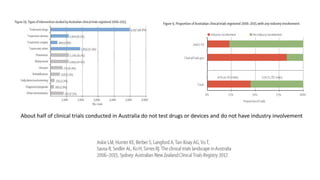
About half of clinical trials conducted in Australia do not test drugs or devices and do not have industry involvement
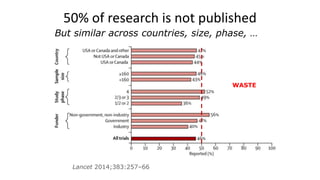
50% of research is not published
Lancet 2014;383:257–66
But similar across countries, size, phase, …
WASTE
National Database for
Clinical Trials Related
to Mental Illness
(NDCT)
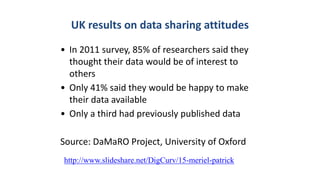
UK results on data sharing attitudes
• In 2011 survey, 85% of researchers said they
thought their data would be of interest to
others
• Only 41% said they would be happy to make
their data available
• Only a third had previously published data
Source: DaMaRO Project, University of Oxford
http://www.slideshare.net/DigCurv/15-meriel-patrick
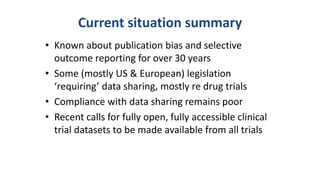
Current situation summary
• Known about publication bias and selective
outcome reporting for over 30 years
• Some (mostly US & European) legislation
‘requiring’ data sharing, mostly re drug trials
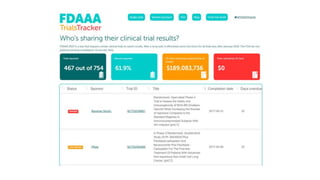
• Compliance with data sharing remains poor
• Recent calls for fully open, fully accessible clinical
trial datasets to be made available from all trials
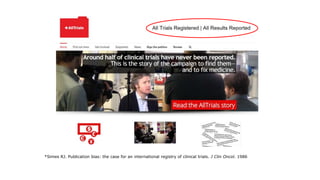
*Simes RJ. Publication bias: the case for an international registry of clinical trials. J Clin Oncol. 1986
The University of Sydney Page 12
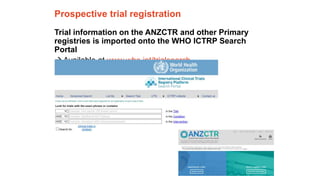
Prospective trial registration
Trial information on the ANZCTR and other Primary
registries is imported onto the WHO ICTRP Search
Portal
Available at www.who.int/trialsearch
Better enforcement measures and /
or incentives to share data??
The University of Sydney Page 14
The University of Sydney Page 15
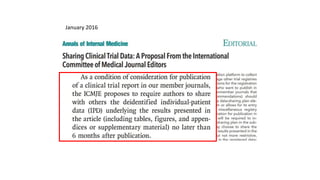
January 2016
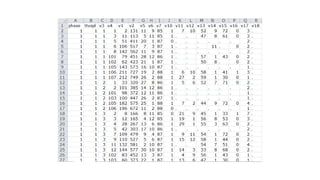
Common problems with trial data
• inconsistent data coding both within (at
different time points) and across trials
• lack of a detailed and robust data dictionary
and/or meta-data
• data errors, inconsistencies with published
results - often unresolvable, MIA data manager
• different definitions of key outcomes
Data curation not just data sharing
FAIR Guiding Principles for Scientific
Data Management and Stewardship
Findability
Accessibility
Interoperability
Reusability
Why curate my clinical trial data?
• costly, time consuming, ongoing resourcing
• no academic or commercial recognition
(in reality system penalises collaboration and
sharing)
• what incentives can be implemented?
April 2017
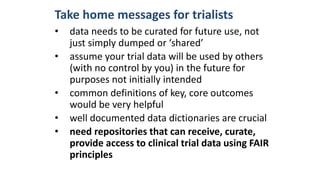
Take home messages for trialists
• data needs to be curated for future use, not
just simply dumped or ‘shared’
• assume your trial data will be used by others
(with no control by you) in the future for
purposes not initially intended
• common definitions of key, core outcomes
would be very helpful
• well documented data dictionaries are crucial
• need repositories that can receive, curate,
provide access to clinical trial data using FAIR
principles
Clinical trials data sharing

Clinical trials data sharing

  • 1.
    Clinical trials datasharing Prof Lisa Askie Director, Systematic Reviews and Health Technology Assessment NHMRC Clinical Trials Centre University of Sydney, Australia Co-convenor, Cochrane Prospective Meta-analysis Methods Group Member, Cochrane Individual Participant Data Meta-analysis Methods Group Manager, Australian New Zealand Clinical Trials Registry Cochrane Review author Clinical trialist
  • 3.
    About half ofclinical trials conducted in Australia do not test drugs or devices and do not have industry involvement
  • 4.
    50% of researchis not published Lancet 2014;383:257–66 But similar across countries, size, phase, … WASTE
  • 7.
    National Database for ClinicalTrials Related to Mental Illness (NDCT)
  • 9.
    UK results ondata sharing attitudes • In 2011 survey, 85% of researchers said they thought their data would be of interest to others • Only 41% said they would be happy to make their data available • Only a third had previously published data Source: DaMaRO Project, University of Oxford http://www.slideshare.net/DigCurv/15-meriel-patrick
  • 10.
    Current situation summary •Known about publication bias and selective outcome reporting for over 30 years • Some (mostly US & European) legislation ‘requiring’ data sharing, mostly re drug trials • Compliance with data sharing remains poor • Recent calls for fully open, fully accessible clinical trial datasets to be made available from all trials
  • 11.
    *Simes RJ. Publicationbias: the case for an international registry of clinical trials. J Clin Oncol. 1986
  • 12.
    The University ofSydney Page 12 Prospective trial registration Trial information on the ANZCTR and other Primary registries is imported onto the WHO ICTRP Search Portal Available at www.who.int/trialsearch
  • 13.
    Better enforcement measuresand / or incentives to share data??
  • 14.
    The University ofSydney Page 14
  • 15.
    The University ofSydney Page 15
  • 18.
  • 22.
    Common problems withtrial data • inconsistent data coding both within (at different time points) and across trials • lack of a detailed and robust data dictionary and/or meta-data • data errors, inconsistencies with published results - often unresolvable, MIA data manager • different definitions of key outcomes
  • 24.
    Data curation notjust data sharing
  • 25.
    FAIR Guiding Principlesfor Scientific Data Management and Stewardship Findability Accessibility Interoperability Reusability
  • 26.
    Why curate myclinical trial data? • costly, time consuming, ongoing resourcing • no academic or commercial recognition (in reality system penalises collaboration and sharing) • what incentives can be implemented?
  • 27.
  • 29.
    Take home messagesfor trialists • data needs to be curated for future use, not just simply dumped or ‘shared’ • assume your trial data will be used by others (with no control by you) in the future for purposes not initially intended • common definitions of key, core outcomes would be very helpful • well documented data dictionaries are crucial • need repositories that can receive, curate, provide access to clinical trial data using FAIR principles

Editor's Notes

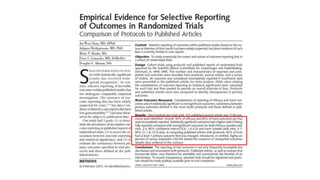
  • #6 The second key issue is selective outcome reporting. This refers to either: non-reporting of pre-specified trial outcomes; or reporting of non-pre-specified trial outcomes. This study by An-Wen Chan and colleagues found that 50% of efficacy and 65% of harm outcomes per trial were incompletely reported, and that statistically significant outcomes had higher odds of being fully reported compared with non-significant outcomes.
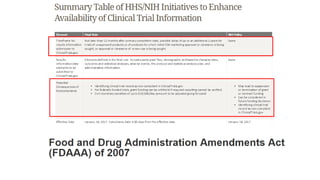
  • #7 However, the good news is that the US Department of Health and Human Services has recently decided to take a stronger stance on this and get tough on transparency. As of January 2017, those researchers not complying with mandatory results reporting may be subject to substantial fines, and may also have all future NIH grant funding withheld.
  • #8 SOAR - Duke Clinical Research Institute YODA – Yale ACCESS – CVS Project Data Sphere- Project Data Sphere, LLC (PDS), an independent, not-for-profit initiative of the CEO Roundtable on Cancer's Life Sciences Consortium (LSC), operates the Project Data Sphere platform, a free digital library-laboratory that provides one place where the research community can broadly share, integrate and analyze historical, patient-level data from academic and industry phase III cancer clinical trials.
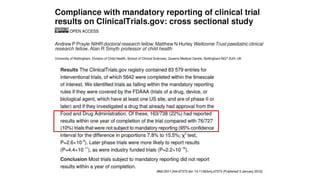
  • #9 Despite US legislation mandating results reporting for specific types of trials, compliance has been poor. This study by Prayle and colleagues found that only 22% of studies subject to mandatory results reporting actually complied.
  • #10 http://www.slideshare.net/DigCurv/15-meriel-patrick
  • #19 Since 2005, the International Committee of Medical Journal Editors (known as ICMJE) has required authors to prospectively register their trials in order to be considered for publication in a member journal. More recently, in January this year, the ICMJE issued a proposal to require that authors include a plan for data sharing as a component of clinical trial registration. Furthermore, they also propose that as a condition of consideration for publication in a member journal, authors must share with others the de-identified individual participant data underlying the results presented in the article no later than 6 months after publication.