ECDC Strategy for laboratory
EQA 2017 ̶ 2020
16th National Microbiology Focal Points meeting
Barbara Albiger, Senior Expert Scientific Quality
Office of the Chief Scientist
European Centre for Disease Prevention and Control
16th NMFP, Stockholm, 4-5 May 2017
1
Rationale
• The EQA schemes are in strong competition for limited
resources, due to foreseen restrictions of the EU budget for
health.
• In the recent years, public health microbiology and
surveillance have witnessed the rapid development of
molecular typing methods and the increasing use of whole
genome sequencing (WGS). These bring new challenges
and opportunities to the execution of ECDC EQA schemes.
• Review of past EQA exercise processes and publication
outputs has identified areas for further improvement to
guarantee optimal public health added value
2
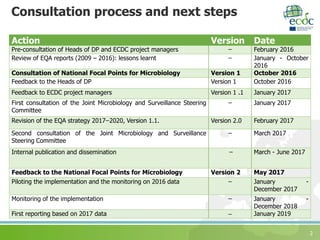
Consultation process and next steps
Action Version Date
Pre-consultation of Heads of DP and ECDC project managers ̶ February 2016
Review of EQA reports (2009 – 2016): lessons learnt ̶ January - October
2016
Consultation of National Focal Points for Microbiology Version 1 October 2016
Feedback to the Heads of DP Version 1 October 2016
Feedback to ECDC project managers Version 1 .1 January 2017
First consultation of the Joint Microbiology and Surveillance Steering
Committee
̶ January 2017
Revision of the EQA strategy 2017 ̶ 2020, Version 1.1. Version 2.0 February 2017
Second consultation of the Joint Microbiology and Surveillance
Steering Committee
̶ March 2017
Internal publication and dissemination ̶ March - June 2017
Feedback to the National Focal Points for Microbiology Version 2 May 2017
Piloting the implementation and the monitoring on 2016 data ̶ January -
December 2017
Monitoring of the implementation ̶ January -
December 2018
First reporting based on 2017 data ̶ January 2019
3
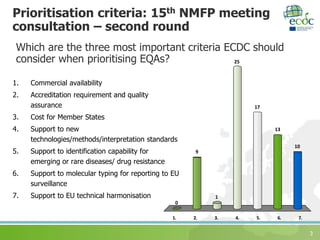
1. 2. 3. 4. 5. 6. 7.
0
9
1
10
13
17
25
Prioritisation criteria: 15th NMFP meeting
consultation – second round
Which are the three most important criteria ECDC should
consider when prioritising EQAs?
1. Commercial availability
2. Accreditation requirement and quality
assurance
3. Cost for Member States
4. Support to new
technologies/methods/interpretation standards
5. Support to identification capability for
emerging or rare diseases/ drug resistance
6. Support to molecular typing for reporting to EU
surveillance
7. Support to EU technical harmonisation
4
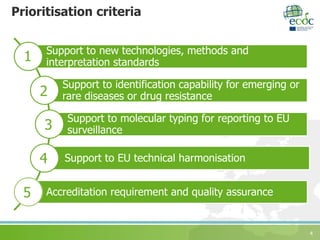
Prioritisation criteria
Support to new technologies, methods and
interpretation standards
Support to identification capability for emerging or
rare diseases or drug resistance
Support to molecular typing for reporting to EU
surveillance
Support to EU technical harmonisation
Accreditation requirement and quality assurance
1
2
3
4
5
5
Vision
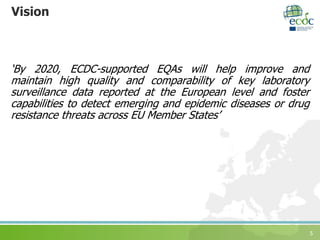
‘By 2020, ECDC-supported EQAs will help improve and
maintain high quality and comparability of key laboratory
surveillance data reported at the European level and foster
capabilities to detect emerging and epidemic diseases or drug
resistance threats across EU Member States’
6
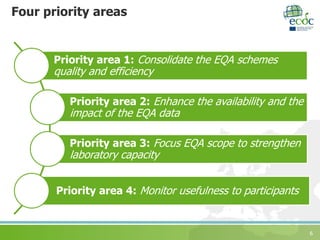
Four priority areas
Priority area 1: Consolidate the EQA schemes
quality and efficiency
Priority area 2: Enhance the availability and the
impact of the EQA data
Priority area 3: Focus EQA scope to strengthen
laboratory capacity
Priority area 4: Monitor usefulness to participants
7
Priority areas, strategic objectives and
indicators
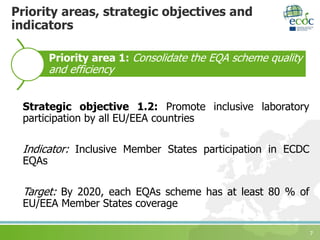
Priority area 1: Consolidate the EQA scheme quality
and efficiency
Strategic objective 1.2: Promote inclusive laboratory
participation by all EU/EEA countries
Indicator: Inclusive Member States participation in ECDC
EQAs
Target: By 2020, each EQAs scheme has at least 80 % of
EU/EEA Member States coverage
8
Priority areas, strategic objectives and
indicators cont’
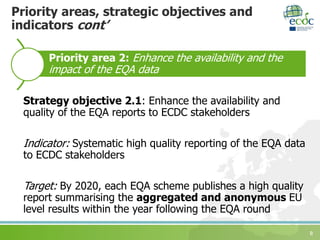
Priority area 2: Enhance the availability and the
impact of the EQA data
Strategy objective 2.1: Enhance the availability and
quality of the EQA reports to ECDC stakeholders
Indicator: Systematic high quality reporting of the EQA data
to ECDC stakeholders
Target: By 2020, each EQA scheme publishes a high quality
report summarising the aggregated and anonymous EU
level results within the year following the EQA round
9
Priority areas, strategic objectives and
indicators cont’
Priority area 3: Focus EQA scope to strengthen
laboratory capacity
Strategy objective 3.1: Link the identified needs to the
country support and training activities at generic and disease
specific levels
Indicator: ECDC country support and training activities
planned within a year to address EQA identified technical
needs
Target: By 2020, each ECDC EQA leads to planning country
support or training activities within a year, if applicable
10
Priority areas, strategic objectives and
indicators cont’
Priority area 4: Monitor usefulness to participants
Strategy objective 4.1: Monitor the EU public health
added-value of the ECDC EQAs
Indicator: Monitoring of the corrective measures and
accreditation input
Target: By 2020, each ECDC EQAs documents if they led to
corrective measures and were included in the Member
States laboratory accreditation dossier
11
EQA as EULabCap indicators
• ECDC EQAs are an integral part of a quality improvement
cycle and capability strengthening process that is collectively
developed across the EU within ECDC Disease Networks
• Proposal for inclusion in the EULabCap monitoring 2016 -
onwards
− Dimension 3: surveillance/ epidemic response support
− Indicators target 3.2: Active participation in EU/EAA
disease networks, to score MS participation in each
annual network EQA
12
EQA as EULabCap indicators
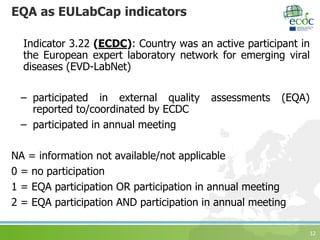
Indicator 3.22 (ECDC): Country was an active participant in
the European expert laboratory network for emerging viral
diseases (EVD-LabNet)
– participated in external quality assessments (EQA)
reported to/coordinated by ECDC
– participated in annual meeting
NA = information not available/not applicable
0 = no participation
1 = EQA participation OR participation in annual meeting
2 = EQA participation AND participation in annual meeting
13
Thank you for listening,
ECDC.Microbiology@ecdc.europa.eu
All ECDC presentations will be available on SlideShare:
http://www.slideshare.net/tag/16NMFP2017

ECDC Strategy for laboratory EQA 2017-2020

  • 1.
    ECDC Strategy forlaboratory EQA 2017 ̶ 2020 16th National Microbiology Focal Points meeting Barbara Albiger, Senior Expert Scientific Quality Office of the Chief Scientist European Centre for Disease Prevention and Control 16th NMFP, Stockholm, 4-5 May 2017
  • 2.
    1 Rationale • The EQAschemes are in strong competition for limited resources, due to foreseen restrictions of the EU budget for health. • In the recent years, public health microbiology and surveillance have witnessed the rapid development of molecular typing methods and the increasing use of whole genome sequencing (WGS). These bring new challenges and opportunities to the execution of ECDC EQA schemes. • Review of past EQA exercise processes and publication outputs has identified areas for further improvement to guarantee optimal public health added value
  • 3.
    2 Consultation process andnext steps Action Version Date Pre-consultation of Heads of DP and ECDC project managers ̶ February 2016 Review of EQA reports (2009 – 2016): lessons learnt ̶ January - October 2016 Consultation of National Focal Points for Microbiology Version 1 October 2016 Feedback to the Heads of DP Version 1 October 2016 Feedback to ECDC project managers Version 1 .1 January 2017 First consultation of the Joint Microbiology and Surveillance Steering Committee ̶ January 2017 Revision of the EQA strategy 2017 ̶ 2020, Version 1.1. Version 2.0 February 2017 Second consultation of the Joint Microbiology and Surveillance Steering Committee ̶ March 2017 Internal publication and dissemination ̶ March - June 2017 Feedback to the National Focal Points for Microbiology Version 2 May 2017 Piloting the implementation and the monitoring on 2016 data ̶ January - December 2017 Monitoring of the implementation ̶ January - December 2018 First reporting based on 2017 data ̶ January 2019
  • 4.
    3 1. 2. 3.4. 5. 6. 7. 0 9 1 10 13 17 25 Prioritisation criteria: 15th NMFP meeting consultation – second round Which are the three most important criteria ECDC should consider when prioritising EQAs? 1. Commercial availability 2. Accreditation requirement and quality assurance 3. Cost for Member States 4. Support to new technologies/methods/interpretation standards 5. Support to identification capability for emerging or rare diseases/ drug resistance 6. Support to molecular typing for reporting to EU surveillance 7. Support to EU technical harmonisation
  • 5.
    4 Prioritisation criteria Support tonew technologies, methods and interpretation standards Support to identification capability for emerging or rare diseases or drug resistance Support to molecular typing for reporting to EU surveillance Support to EU technical harmonisation Accreditation requirement and quality assurance 1 2 3 4 5
  • 6.
    5 Vision ‘By 2020, ECDC-supportedEQAs will help improve and maintain high quality and comparability of key laboratory surveillance data reported at the European level and foster capabilities to detect emerging and epidemic diseases or drug resistance threats across EU Member States’
  • 7.
    6 Four priority areas Priorityarea 1: Consolidate the EQA schemes quality and efficiency Priority area 2: Enhance the availability and the impact of the EQA data Priority area 3: Focus EQA scope to strengthen laboratory capacity Priority area 4: Monitor usefulness to participants
  • 8.
    7 Priority areas, strategicobjectives and indicators Priority area 1: Consolidate the EQA scheme quality and efficiency Strategic objective 1.2: Promote inclusive laboratory participation by all EU/EEA countries Indicator: Inclusive Member States participation in ECDC EQAs Target: By 2020, each EQAs scheme has at least 80 % of EU/EEA Member States coverage
  • 9.
    8 Priority areas, strategicobjectives and indicators cont’ Priority area 2: Enhance the availability and the impact of the EQA data Strategy objective 2.1: Enhance the availability and quality of the EQA reports to ECDC stakeholders Indicator: Systematic high quality reporting of the EQA data to ECDC stakeholders Target: By 2020, each EQA scheme publishes a high quality report summarising the aggregated and anonymous EU level results within the year following the EQA round
  • 10.
    9 Priority areas, strategicobjectives and indicators cont’ Priority area 3: Focus EQA scope to strengthen laboratory capacity Strategy objective 3.1: Link the identified needs to the country support and training activities at generic and disease specific levels Indicator: ECDC country support and training activities planned within a year to address EQA identified technical needs Target: By 2020, each ECDC EQA leads to planning country support or training activities within a year, if applicable
  • 11.
    10 Priority areas, strategicobjectives and indicators cont’ Priority area 4: Monitor usefulness to participants Strategy objective 4.1: Monitor the EU public health added-value of the ECDC EQAs Indicator: Monitoring of the corrective measures and accreditation input Target: By 2020, each ECDC EQAs documents if they led to corrective measures and were included in the Member States laboratory accreditation dossier
  • 12.
    11 EQA as EULabCapindicators • ECDC EQAs are an integral part of a quality improvement cycle and capability strengthening process that is collectively developed across the EU within ECDC Disease Networks • Proposal for inclusion in the EULabCap monitoring 2016 - onwards − Dimension 3: surveillance/ epidemic response support − Indicators target 3.2: Active participation in EU/EAA disease networks, to score MS participation in each annual network EQA
  • 13.
    12 EQA as EULabCapindicators Indicator 3.22 (ECDC): Country was an active participant in the European expert laboratory network for emerging viral diseases (EVD-LabNet) – participated in external quality assessments (EQA) reported to/coordinated by ECDC – participated in annual meeting NA = information not available/not applicable 0 = no participation 1 = EQA participation OR participation in annual meeting 2 = EQA participation AND participation in annual meeting
  • 14.
    13 Thank you forlistening, ECDC.Microbiology@ecdc.europa.eu All ECDC presentations will be available on SlideShare: http://www.slideshare.net/tag/16NMFP2017