ECDC projects and collaborations on
digital surveillance
Bruno Ciancio, Surveillance and Response Support Unit, ECDC.
June 4th, 2019
What can eHealth bring to EU surveillance
• Better data quality for key variables
• Reduced cost for complementary studies
• Wider breadth of data
• Reduced reporting workload
• More effective epi-lab integration
2
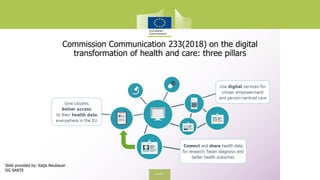
Commission Communication 233(2018) on the digital
transformation of health and care: three pillars
Slide provided by: Katja Neubauer
DG SANTE
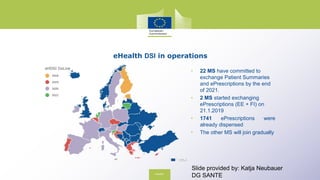
eHealth DSI in operations
• 22 MS have committed to
exchange Patient Summaries
and ePrescriptions by the end
of 2021.
• 2 MS started exchanging
ePrescriptions (EE + FI) on
21.1.2019
• 1741 ePrescriptions were
already dispensed
• The other MS will join gradually
Slide provided by: Katja Neubauer
DG SANTE
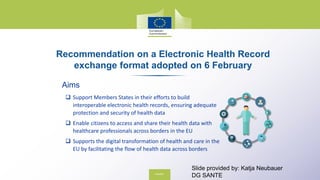
Recommendation on a Electronic Health Record
exchange format adopted on 6 February
Aims
 Support Members States in their efforts to build
interoperable electronic health records, ensuring adequate
protection and security of health data
 Enable citizens to access and share their health data with
healthcare professionals across borders in the EU
 Supports the digital transformation of health and care in the
EU by facilitating the flow of health data across borders
Slide provided by: Katja Neubauer
DG SANTE
Objectives of ECDC proof-of-concept studies
1. To evaluate the feasibility of linking and extracting a subset of healthcare data from multiple
sources at national level and of establishing ongoing data flows to ECDC for surveillance
purposes.
2. To gain a deep understanding of current obstacles concerning technologies, data, and legal
issues when attempting to link, retrieve, and analyse health care data from multiple sources
and countries.
3. To develop a checklist of technical, data, and legal requirements for enabling national and EU
level surveillance analyses, using existing health care information systems.
4. To identify opportunities, such as the existence of suitable networks of healthcare information
systems, that can be used for addressing specific surveillance questions.
6
Two studies selected
1. Surveillance of pan-drug resistance (PDR)
2. Verify if higher data completeness than currently in TESSy can be
achieved for ten priority diseases under EU surveillance, using data
from electronic medical records (focus on risk factors variables).
7
POC study 1: surveillance of AMR
1. Objective
1. detect/characterise/monitor PDR cases at national and EU level
2. Surveillance system characteristics
1. Comprehensive, automatic, EU surveillance of AMR
2. Ongoing reporting and feedback
3. Data sources: LIMS +/- EHR
8
POC study 1: opportunities
• PDR surveillance is ’solely’ lab-based
• Several EU/EEA countries use WHONet software for their AMR data
processing
• Allows wider data collection than EARS-Net
• Provides a possible common data format
• WHONet could allow building a simple, extensible infrastructure for
”pulling” the AMR data from local level – and with it the PDR data
• Data linkage to discharge registries and especially beyond might
prove a harder problem
PDR surveillance data flow - idealized
10
Local laboratory
(hospital)
National database
ECDC
Reference lab
Legend
Automatic
notification
Isolate
shipping
Reference lab
confirmation
of PDR
Alert/
response
including
follow-up
POC study 2: surveillance for risk factors analyses
Objective: describe disease cases by relevant risk factors
Surveillance system characteristics
1. Population-based, sentinel, automatic EU surveillance system
2. Variables: clinical presentation, laboratory diagnosis methods and
results, date of disease onset, disease outcome, vaccination status,
underlying conditions, likely transmission route.
3. Data sources: EHR+/-LIMS, immunisation information systems,
vital statistics (?).
11
POC study 2: opportunities
No need for comprehensive systems
Hospitals and study sites could be recruited from ongoing ECDC active
surveillance projects
No need for real-time data
Can explore obstacles to data linkage
12
Implementation model
2019
• Study protocols
• Criteria for country/site participation
• Engagement of countries (5-10/POC)
• Protocol for capturing obstacles and feasibility issues
2020-23
• Call for tender (~ 1M €/year)
• 70% of budget to countries/sites
• 30% of budget for coordination, EU data flows, analysis, meetings,
sustainability plan.
13
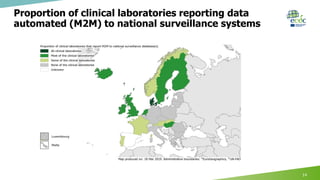
Proportion of clinical laboratories reporting data
automated (M2M) to national surveillance systems
14
Conclusions
1. Commitment of ECDC and national public health authorities to
proactively engage with eHealth network and other eHealth
initiatives
2. Acknowledge current obstacles and work together to address them
3. Invest resources and develop expertise on eHealth for public health
15
Reserve slides
16
Commission Communication 233(2018) on the
digital transformation of health and care
• Sets out the Commission agenda on „eHealth“
• Adopted on 25 April 2018
• Context: Digital Single Market Strategy
• Developed and implemented in close collaboration between DG
CNECT, RTD and SANTE
Slide provided by: Katja Neubauer
DG SANTE
The eHealth Digital Service Infrastructure
enabling exchange of patient data across
borders
• Patient Summaries give health professionals access to
verified key health data of a patient during an unplanned
care encounter while abroad.
• ePrescriptions enables patients to receive equivalent
medication while abroad to what they would receive in
their home country.
Slide provided by: Katja Neubauer
DG SANTE

ECDC projects and collaborations on digital surveillance

  • 1.
    ECDC projects andcollaborations on digital surveillance Bruno Ciancio, Surveillance and Response Support Unit, ECDC. June 4th, 2019
  • 2.
    What can eHealthbring to EU surveillance • Better data quality for key variables • Reduced cost for complementary studies • Wider breadth of data • Reduced reporting workload • More effective epi-lab integration 2
  • 3.
    Commission Communication 233(2018)on the digital transformation of health and care: three pillars Slide provided by: Katja Neubauer DG SANTE
  • 4.
    eHealth DSI inoperations • 22 MS have committed to exchange Patient Summaries and ePrescriptions by the end of 2021. • 2 MS started exchanging ePrescriptions (EE + FI) on 21.1.2019 • 1741 ePrescriptions were already dispensed • The other MS will join gradually Slide provided by: Katja Neubauer DG SANTE
  • 5.
    Recommendation on aElectronic Health Record exchange format adopted on 6 February Aims  Support Members States in their efforts to build interoperable electronic health records, ensuring adequate protection and security of health data  Enable citizens to access and share their health data with healthcare professionals across borders in the EU  Supports the digital transformation of health and care in the EU by facilitating the flow of health data across borders Slide provided by: Katja Neubauer DG SANTE
  • 6.
    Objectives of ECDCproof-of-concept studies 1. To evaluate the feasibility of linking and extracting a subset of healthcare data from multiple sources at national level and of establishing ongoing data flows to ECDC for surveillance purposes. 2. To gain a deep understanding of current obstacles concerning technologies, data, and legal issues when attempting to link, retrieve, and analyse health care data from multiple sources and countries. 3. To develop a checklist of technical, data, and legal requirements for enabling national and EU level surveillance analyses, using existing health care information systems. 4. To identify opportunities, such as the existence of suitable networks of healthcare information systems, that can be used for addressing specific surveillance questions. 6
  • 7.
    Two studies selected 1.Surveillance of pan-drug resistance (PDR) 2. Verify if higher data completeness than currently in TESSy can be achieved for ten priority diseases under EU surveillance, using data from electronic medical records (focus on risk factors variables). 7
  • 8.
    POC study 1:surveillance of AMR 1. Objective 1. detect/characterise/monitor PDR cases at national and EU level 2. Surveillance system characteristics 1. Comprehensive, automatic, EU surveillance of AMR 2. Ongoing reporting and feedback 3. Data sources: LIMS +/- EHR 8
  • 9.
    POC study 1:opportunities • PDR surveillance is ’solely’ lab-based • Several EU/EEA countries use WHONet software for their AMR data processing • Allows wider data collection than EARS-Net • Provides a possible common data format • WHONet could allow building a simple, extensible infrastructure for ”pulling” the AMR data from local level – and with it the PDR data • Data linkage to discharge registries and especially beyond might prove a harder problem
  • 10.
    PDR surveillance dataflow - idealized 10 Local laboratory (hospital) National database ECDC Reference lab Legend Automatic notification Isolate shipping Reference lab confirmation of PDR Alert/ response including follow-up
  • 11.
    POC study 2:surveillance for risk factors analyses Objective: describe disease cases by relevant risk factors Surveillance system characteristics 1. Population-based, sentinel, automatic EU surveillance system 2. Variables: clinical presentation, laboratory diagnosis methods and results, date of disease onset, disease outcome, vaccination status, underlying conditions, likely transmission route. 3. Data sources: EHR+/-LIMS, immunisation information systems, vital statistics (?). 11
  • 12.
    POC study 2:opportunities No need for comprehensive systems Hospitals and study sites could be recruited from ongoing ECDC active surveillance projects No need for real-time data Can explore obstacles to data linkage 12
  • 13.
    Implementation model 2019 • Studyprotocols • Criteria for country/site participation • Engagement of countries (5-10/POC) • Protocol for capturing obstacles and feasibility issues 2020-23 • Call for tender (~ 1M €/year) • 70% of budget to countries/sites • 30% of budget for coordination, EU data flows, analysis, meetings, sustainability plan. 13
  • 14.
    Proportion of clinicallaboratories reporting data automated (M2M) to national surveillance systems 14
  • 15.
    Conclusions 1. Commitment ofECDC and national public health authorities to proactively engage with eHealth network and other eHealth initiatives 2. Acknowledge current obstacles and work together to address them 3. Invest resources and develop expertise on eHealth for public health 15
  • 16.
  • 17.
    Commission Communication 233(2018)on the digital transformation of health and care • Sets out the Commission agenda on „eHealth“ • Adopted on 25 April 2018 • Context: Digital Single Market Strategy • Developed and implemented in close collaboration between DG CNECT, RTD and SANTE Slide provided by: Katja Neubauer DG SANTE
  • 18.
    The eHealth DigitalService Infrastructure enabling exchange of patient data across borders • Patient Summaries give health professionals access to verified key health data of a patient during an unplanned care encounter while abroad. • ePrescriptions enables patients to receive equivalent medication while abroad to what they would receive in their home country. Slide provided by: Katja Neubauer DG SANTE