
Induction year programme
Ingrid Koni
17.04.2015
Tartu
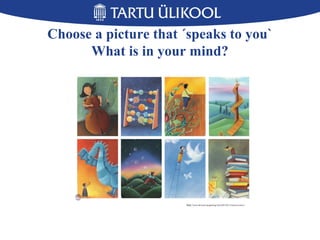
http://www.bit-tech.net/gaming/retro/2012/01/13/dixit-review/1
Choose a picture that ´speaks to you`
What is in your mind?
The Estonian Teachers’ Standard (2014) emphasises the
creation of an attitude and understanding of the teacher as a
reflective practitioner and a life-long learner.
Teacher education in Estonia has for some years focused on
developing support structures for novice teachers in the early
stages of their career. In 2004, the induction year programme
was implemented in Estonia as part of teacher education.
Induction year
• The induction year is an important period in-between pre-
service teacher education and in-service teacher education
courses.
• The induction year is based on constructivist reflective
teaching principles used in combination with learning at
the working place.
Aims of the induction programme
• •Supporting the adjustment of novice teachers to the school as
organisation,
• •Developing basic competences in new teachers,
• Providing support in solving problems.
The induction system provides opportunities for school
development and also feedback to the institutions for initial
teacher education to improve the quality of their curricula.
Induction year
• Induction year centers (University of Tartu and University
of Tallinn) organise young teachers´ support programmes,
mentors´ training, common seminars and consult
kindergartens and schools during the induction year.
• The university centers together monitor, analyse and plan
changes of the programme, but also train involved persons
into the programme.
Funding
Both induction year and mentors´ in-service training courses
last 160 hours and are financed by the Ministry of Education
and Research in Estonia.
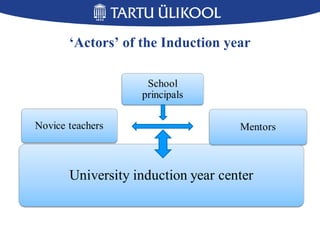
‘Actors’ of the Induction year
The mentor has three important tasks in
the Estonian school system:
• to support the professional development of a novice
teacher,
• to support the socialization of a novice teacher to the
school as an organization,
• to participate in school development.
The general idea and principles of the
induction year should support:
• Application of learning school ideology;
• Creation and development of teachers´ networking;
• Possibilities for deep reflection;
• Positive experiences of learning collaboratively.
Types of support for new teachers
• Personal and emotional support - group mentoring, support
programme sessions for self reflection, self evaluation and
self analysis
• Social support – on school level and through group
mentoring
• Professional support – competence based (mentors and
academics)
Target groups
• Teachers of
– Pre-school childcare institutions
– Primary schools
– General education schools
– Vocational training institutions
– Special education teachers
• The managers and members of executive staff of
– Pre-school childcare institutions
– General education schools
– Vocational training institutions
• Other members of educational institution staff (secretaries,
financial managers, assistant teachers)
Meeting schedule and general topics
Module Schedule General topics
Opening
seminar
1 day
End of September
An introduction to the induction year;
getting to know the participants.
Joys and concerns as a teacher.
Module I 2 days
1st school holiday in October
Joys and concerns as a teacher.
Forming cooperation skills in an
institution.
Module II 2 days
2nd school holiday in January
Joys and concerns as a teacher.
Managing a group; relations in a group.
Module III 2 days
3rd school holiday in March
Joys and concerns as a teacher.
Teacher as the designer of the learning
environment and the supporter of pupils’
development.
Closing seminar 1 days
End of May
Joys and concerns as a teacher.
Summing up the induction year. Self-
analysis and self-help for the teacher.
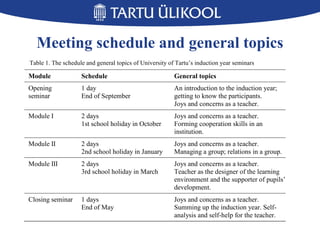
Table 1. The schedule and general topics of University of Tartu’s induction year seminars
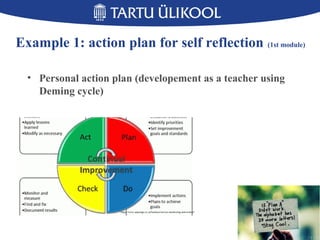
Example 1: action plan for self reflection (1st module)
• Personal action plan (developement as a teacher using
Deming cycle)
https://www.spaceage.co.za/business/service-monitoring-and-control/
15
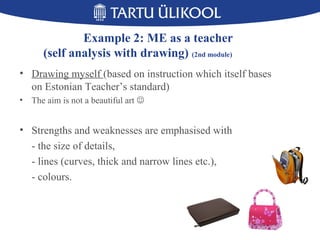
Example 2: ME as a teacher
(self analysis with drawing) (2nd module)
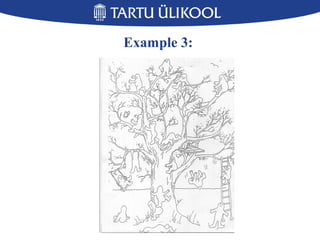
• Drawing myself (based on instruction which itself bases
on Estonian Teacher’s standard)
• The aim is not a beautiful art 
• Strengths and weaknesses are emphasised with
- the size of details,
- lines (curves, thick and narrow lines etc.),
- colours.
Example 3:
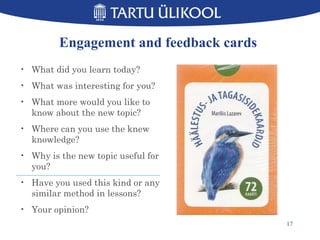
Engagement and feedback cards
• What did you learn today?
• What was interesting for you?
• What more would you like to
know about the new topic?
• Where can you use the knew
knowledge?
• Why is the new topic useful for
you?
• Have you used this kind or any
similar method in lessons?
• Your opinion?
17
18
18181818
Something new from this morning?
Thank you!

Induction year programme for teachers in Estonia

  • 1.
    Induction year programme IngridKoni 17.04.2015 Tartu
  • 2.
  • 3.
    The Estonian Teachers’Standard (2014) emphasises the creation of an attitude and understanding of the teacher as a reflective practitioner and a life-long learner. Teacher education in Estonia has for some years focused on developing support structures for novice teachers in the early stages of their career. In 2004, the induction year programme was implemented in Estonia as part of teacher education.
  • 4.
    Induction year • Theinduction year is an important period in-between pre- service teacher education and in-service teacher education courses. • The induction year is based on constructivist reflective teaching principles used in combination with learning at the working place.
  • 5.
    Aims of theinduction programme • •Supporting the adjustment of novice teachers to the school as organisation, • •Developing basic competences in new teachers, • Providing support in solving problems. The induction system provides opportunities for school development and also feedback to the institutions for initial teacher education to improve the quality of their curricula.
  • 6.
    Induction year • Inductionyear centers (University of Tartu and University of Tallinn) organise young teachers´ support programmes, mentors´ training, common seminars and consult kindergartens and schools during the induction year. • The university centers together monitor, analyse and plan changes of the programme, but also train involved persons into the programme.
  • 7.
    Funding Both induction yearand mentors´ in-service training courses last 160 hours and are financed by the Ministry of Education and Research in Estonia.
  • 8.
    ‘Actors’ of theInduction year
  • 9.
    The mentor hasthree important tasks in the Estonian school system: • to support the professional development of a novice teacher, • to support the socialization of a novice teacher to the school as an organization, • to participate in school development.
  • 10.
    The general ideaand principles of the induction year should support: • Application of learning school ideology; • Creation and development of teachers´ networking; • Possibilities for deep reflection; • Positive experiences of learning collaboratively.
  • 11.
    Types of supportfor new teachers • Personal and emotional support - group mentoring, support programme sessions for self reflection, self evaluation and self analysis • Social support – on school level and through group mentoring • Professional support – competence based (mentors and academics)
  • 12.
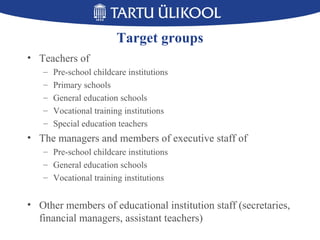
    Target groups • Teachersof – Pre-school childcare institutions – Primary schools – General education schools – Vocational training institutions – Special education teachers • The managers and members of executive staff of – Pre-school childcare institutions – General education schools – Vocational training institutions • Other members of educational institution staff (secretaries, financial managers, assistant teachers)
  • 13.
    Meeting schedule andgeneral topics Module Schedule General topics Opening seminar 1 day End of September An introduction to the induction year; getting to know the participants. Joys and concerns as a teacher. Module I 2 days 1st school holiday in October Joys and concerns as a teacher. Forming cooperation skills in an institution. Module II 2 days 2nd school holiday in January Joys and concerns as a teacher. Managing a group; relations in a group. Module III 2 days 3rd school holiday in March Joys and concerns as a teacher. Teacher as the designer of the learning environment and the supporter of pupils’ development. Closing seminar 1 days End of May Joys and concerns as a teacher. Summing up the induction year. Self- analysis and self-help for the teacher. Table 1. The schedule and general topics of University of Tartu’s induction year seminars
  • 14.
    Example 1: actionplan for self reflection (1st module) • Personal action plan (developement as a teacher using Deming cycle) https://www.spaceage.co.za/business/service-monitoring-and-control/
  • 15.
    15 Example 2: MEas a teacher (self analysis with drawing) (2nd module) • Drawing myself (based on instruction which itself bases on Estonian Teacher’s standard) • The aim is not a beautiful art  • Strengths and weaknesses are emphasised with - the size of details, - lines (curves, thick and narrow lines etc.), - colours.
  • 16.
  • 17.
    Engagement and feedbackcards • What did you learn today? • What was interesting for you? • What more would you like to know about the new topic? • Where can you use the knew knowledge? • Why is the new topic useful for you? • Have you used this kind or any similar method in lessons? • Your opinion? 17
  • 18.
  • 19.

Editor's Notes

  • #3 We use these dixit cards in story telling, as ice breakers, as self analysis, and so on...
  • #9 The responsible ‘actors’ of the Induction year are: (1) school principals, whose responsibility is to facilitate an environment that supports the novice teachers’ professional development and to appoint mentors; (2) mentors, who work directly with novice teachers, supporting (not assessing) their professional development and socialization in a school context; (3) novice teachers who are ultimately responsible for maintaining their own professional development; and (4) university induction year centers, where mentor training and induction seminars of the support program for novice teachers take place (Eisenschmidt, 2006). IY – university induction year centers
  • #14 In all these activities we base on The Estonian Teachers’ Standard (2014) and national curriculum. Closing seminar: formative assessment, lecture „how to prevent teacher burnout“.