ADVERSE DRUG
REACTIONS
Presented By:
Kajal Rajdev
M.Pharm (IInd Semester)
Department of Pharmacology
ISF College of Pharmacy
Moga, Punjab
Checked and Confirmed By:
Dr. Sidharth Mehan
Associate Professor
Department of Pharmacology
ISF College of Pharmacy
(ISFCP)
 Definition of ADR
 Classification of ADR
 Detection of ADR
 Reporting of ADR
 Causality Assesment
 Prevention of ADRs
 Terminology of ADRs
CONTENTS
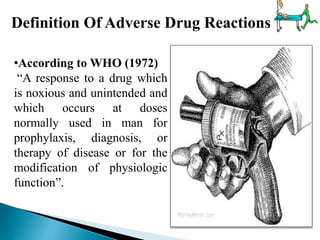
Definition Of Adverse Drug Reactions
•According to WHO (1972)
“A response to a drug which
is noxious and unintended and
which occurs at doses
normally used in man for
prophylaxis, diagnosis, or
therapy of disease or for the
modification of physiologic
function”.
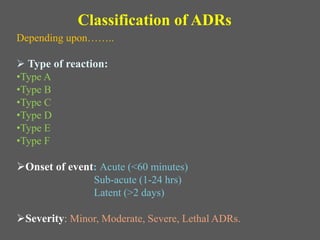
Classification of ADRs
Depending upon……..
 Type of reaction:
•Type A
•Type B
•Type C
•Type D
•Type E
•Type F
Onset of event: Acute (<60 minutes)
Sub-acute (1-24 hrs)
Latent (>2 days)
Severity: Minor, Moderate, Severe, Lethal ADRs.
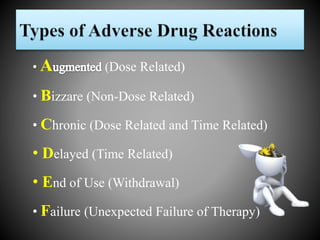
• A (Dose Related)
• Bizzare (Non-Dose Related)
• Chronic (Dose Related and Time Related)
• Delayed (Time Related)
• End of Use (Withdrawal)
• Failure (Unexpected Failure of Therapy)
Features
• Common Related to the pharmacologic action of the drug – exaggerated
pharmacologic response
• Predictable
• Low mortality
Example
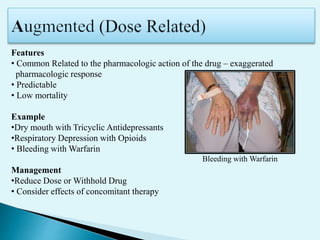
•Dry mouth with Tricyclic Antidepressants
•Respiratory Depression with Opioids
• Bleeding with Warfarin
Management
•Reduce Dose or Withhold Drug
• Consider effects of concomitant therapy
Bleeding with Warfarin
Features
•Uncommon
•Not related to the pharmacologic action of the drug
•Unpredictable
•High mortality
Example
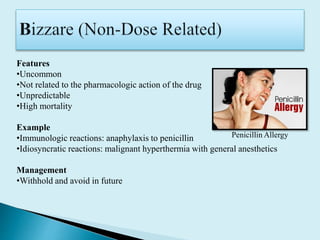
•Immunologic reactions: anaphylaxis to penicillin
•Idiosyncratic reactions: malignant hyperthermia with general anesthetics
Management
•Withhold and avoid in future
Penicillin Allergy
Features
•Uncommon
•Related to the cumulative dose
Example
•Hypothalamic-pituitary-adrenal axis suppression
by corticosteroids.
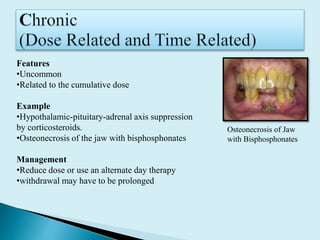
•Osteonecrosis of the jaw with bisphosphonates
Management
•Reduce dose or use an alternate day therapy
•withdrawal may have to be prolonged
Osteonecrosis of Jaw
with Bisphosphonates
Features
•Uncommon
•Usually dose related
•Occurs or becomes apparent sometime after use of the drug
Example
•Carcinogenesis
•Teratogenesis
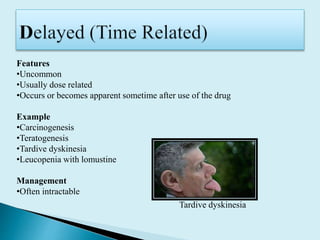
•Tardive dyskinesia
•Leucopenia with lomustine
Management
•Often intractable
Tardive dyskinesia
Features
•Uncommon
•Occurs soon after withdrawal of the drug
Example
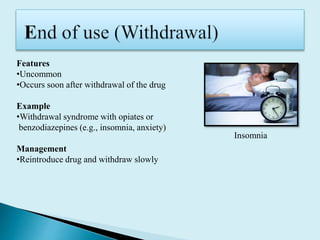
•Withdrawal syndrome with opiates or
benzodiazepines (e.g., insomnia, anxiety)
Management
•Reintroduce drug and withdraw slowly
Insomnia
Features
•Common
•Dose related
•Often caused by drug interactions
Example
•Inadequate dosage of an oral contraceptive when used with an enzyme inducer.
•Resistance to antimicrobial agents
Management
•Increase dosage
•Consider effects of concomitant therapy
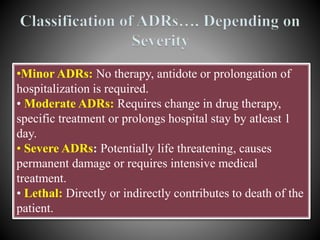
•Minor ADRs: No therapy, antidote or prolongation of
hospitalization is required.
• Moderate ADRs: Requires change in drug therapy,
specific treatment or prolongs hospital stay by atleast 1
day.
• Severe ADRs: Potentially life threatening, causes
permanent damage or requires intensive medical
treatment.
• Lethal: Directly or indirectly contributes to death of the
patient.
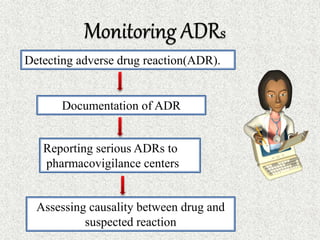
Detecting adverse drug reaction(ADR).
Assessing causality between drug and
suspected reaction
Documentation of ADR
Reporting serious ADRs to
pharmacovigilance centers
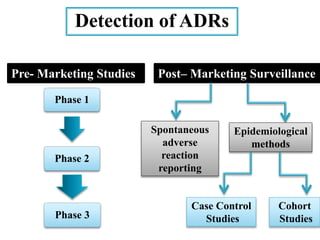
Detection of ADRs
Pre- Marketing Studies Post– Marketing Surveillance
Spontaneous
adverse
reaction
reporting
Epidemiological
methods
Case Control
Studies
Cohort
Studies
Phase 1
Phase 2
Phase 3
PRE- MARKETING STUDIES
•During the development of new medicines, their safety is tested in
animal models.
• A great deal of risk information may be obtained from such tests, such
as the level of acute toxicity and which organs will be affected in case
of toxicity.
• If animal test do not reveal worrying results, safety tests proceed onto
testing in human.
• Clinical trials are carried out in three different phases prior to
submission of a marketing authorisation application
• Consequence of above is that at the time of general marketing of a new
medicine only the most common (Type A) adverse reactions will be
known.
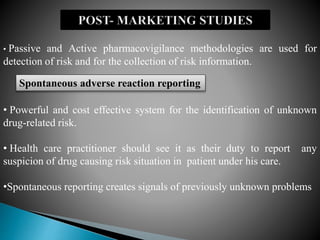
• Passive and Active pharmacovigilance methodologies are used for
detection of risk and for the collection of risk information.
Spontaneous adverse reaction reporting
• Powerful and cost effective system for the identification of unknown
drug-related risk.
• Health care practitioner should see it as their duty to report any
suspicion of drug causing risk situation in patient under his care.
•Spontaneous reporting creates signals of previously unknown problems
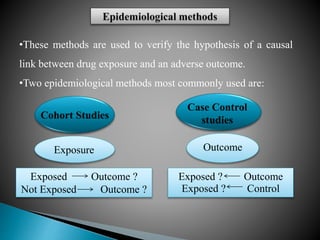
•These methods are used to verify the hypothesis of a causal
link between drug exposure and an adverse outcome.
•Two epidemiological methods most commonly used are:
Cohort Studies
Case Control
studies
Exposure Outcome
Exposed Outcome ?
Not Exposed Outcome ?
Exposed ? Outcome
Exposed ? Control
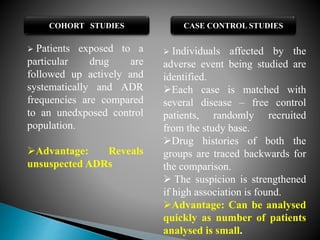
COHORT STUDIES CASE CONTROL STUDIES
 Patients exposed to a
particular drug are
followed up actively and
systematically and ADR
frequencies are compared
to an unedxposed control
population.
Advantage: Reveals
unsuspected ADRs
 Individuals affected by the
adverse event being studied are
identified.
Each case is matched with
several disease – free control
patients, randomly recruited
from the study base.
Drug histories of both the
groups are traced backwards for
the comparison.
 The suspicion is strengthened
if high association is found.
Advantage: Can be analysed
quickly as number of patients
analysed is small.
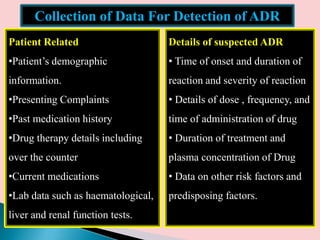
Collection of Data For Detection of ADR
Patient Related
•Patient’s demographic
information.
•Presenting Complaints
•Past medication history
•Drug therapy details including
over the counter
•Current medications
•Lab data such as haematological,
liver and renal function tests.
Details of suspected ADR
• Time of onset and duration of
reaction and severity of reaction
• Details of dose , frequency, and
time of administration of drug
• Duration of treatment and
plasma concentration of Drug
• Data on other risk factors and
predisposing factors.
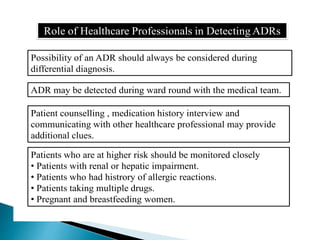
Role of Healthcare Professionals in Detecting ADRs
Possibility of an ADR should always be considered during
differential diagnosis.
ADR may be detected during ward round with the medical team.
Patient counselling , medication history interview and
communicating with other healthcare professional may provide
additional clues.
Patients who are at higher risk should be monitored closely
• Patients with renal or hepatic impairment.
• Patients who had histrory of allergic reactions.
• Patients taking multiple drugs.
• Pregnant and breastfeeding women.
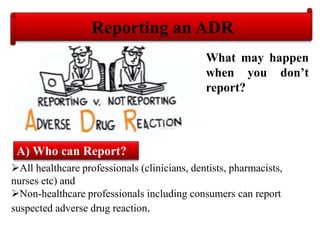
Reporting an ADR
All healthcare professionals (clinicians, dentists, pharmacists,
nurses etc) and
Non-healthcare professionals including consumers can report
suspected adverse drug reaction.
What may happen
when you don’t
report?
A) Who can Report?
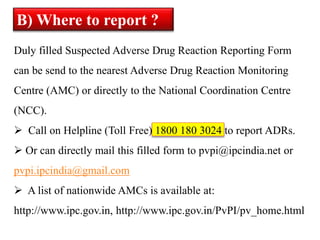
Duly filled Suspected Adverse Drug Reaction Reporting Form
can be send to the nearest Adverse Drug Reaction Monitoring
Centre (AMC) or directly to the National Coordination Centre
(NCC).
 Call on Helpline (Toll Free) 1800 180 3024 to report ADRs.
 Or can directly mail this filled form to pvpi@ipcindia.net or
pvpi.ipcindia@gmail.com
 A list of nationwide AMCs is available at:
http://www.ipc.gov.in, http://www.ipc.gov.in/PvPI/pv_home.html
B) Where to report ?
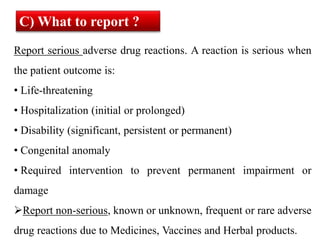
Report serious adverse drug reactions. A reaction is serious when
the patient outcome is:
• Life-threatening
• Hospitalization (initial or prolonged)
• Disability (significant, persistent or permanent)
• Congenital anomaly
• Required intervention to prevent permanent impairment or
damage
Report non-serious, known or unknown, frequent or rare adverse
drug reactions due to Medicines, Vaccines and Herbal products.
C) What to report ?
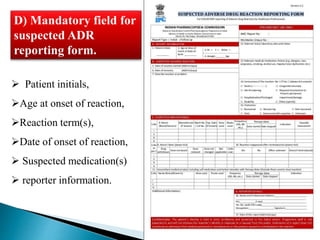
 Patient initials,
Age at onset of reaction,
Reaction term(s),
Date of onset of reaction,
 Suspected medication(s)
 reporter information.
D) Mandatory field for
suspected ADR
reporting form.
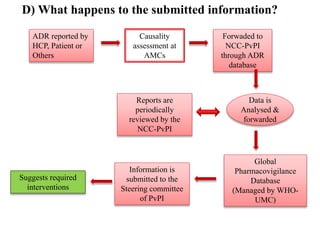
D) What happens to the submitted information?
ADR reported by
HCP, Patient or
Others
Causality
assessment at
AMCs
Forwaded to
NCC-PvPI
through ADR
database
Data is
Analysed &
forwarded
Global
Pharmacovigilance
Database
(Managed by WHO-
UMC)
Reports are
periodically
reviewed by the
NCC-PvPI
Information is
submitted to the
Steering committee
of PvPI
Suggests required
interventions
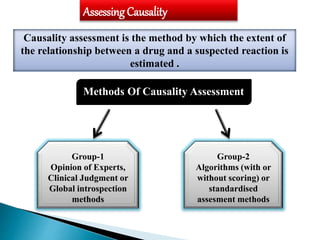
Assessing Causality
Causality assessment is the method by which the extent of
the relationship between a drug and a suspected reaction is
estimated .
Methods Of Causality Assessment
Group-1
Opinion of Experts,
Clinical Judgment or
Global introspection
methods
Group-2
Algorithms (with or
without scoring) or
standardised
assesment methods
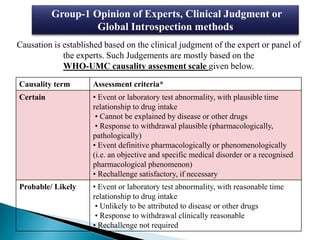
Group-1 Opinion of Experts, Clinical Judgment or
Global Introspection methods
Causation is established based on the clinical judgment of the expert or panel of
the experts. Such Judgements are mostly based on the
WHO-UMC causality assesment scale given below.
Causality term Assessment criteria*
Certain • Event or laboratory test abnormality, with plausible time
relationship to drug intake
• Cannot be explained by disease or other drugs
• Response to withdrawal plausible (pharmacologically,
pathologically)
• Event definitive pharmacologically or phenomenologically
(i.e. an objective and specific medical disorder or a recognised
pharmacological phenomenon)
• Rechallenge satisfactory, if necessary
Probable/ Likely • Event or laboratory test abnormality, with reasonable time
relationship to drug intake
• Unlikely to be attributed to disease or other drugs
• Response to withdrawal clinically reasonable
• Rechallenge not required
Causality term Assessment criteria*
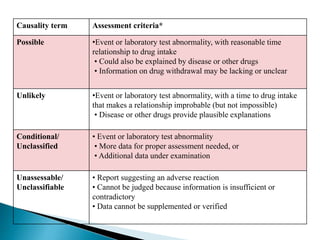
Possible •Event or laboratory test abnormality, with reasonable time
relationship to drug intake
• Could also be explained by disease or other drugs
• Information on drug withdrawal may be lacking or unclear
Unlikely •Event or laboratory test abnormality, with a time to drug intake
that makes a relationship improbable (but not impossible)
• Disease or other drugs provide plausible explanations
Conditional/
Unclassified
• Event or laboratory test abnormality
• More data for proper assessment needed, or
• Additional data under examination
Unassessable/
Unclassifiable
• Report suggesting an adverse reaction
• Cannot be judged because information is insufficient or
contradictory
• Data cannot be supplemented or verified
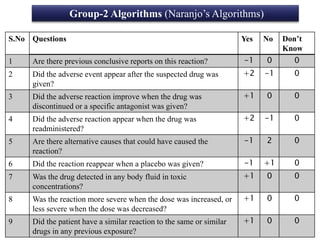
Group-2 Algorithms (Naranjo’s Algorithms)
S.No Questions Yes No Don’t
Know
1 Are there previous conclusive reports on this reaction? -1 0 0
2 Did the adverse event appear after the suspected drug was
given?
+2 -1 0
3 Did the adverse reaction improve when the drug was
discontinued or a specific antagonist was given?
+1 0 0
4 Did the adverse reaction appear when the drug was
readministered?
+2 -1 0
5 Are there alternative causes that could have caused the
reaction?
-1 2 0
6 Did the reaction reappear when a placebo was given? -1 +1 0
7 Was the drug detected in any body fluid in toxic
concentrations?
+1 0 0
8 Was the reaction more severe when the dose was increased, or
less severe when the dose was decreased?
+1 0 0
9 Did the patient have a similar reaction to the same or similar
drugs in any previous exposure?
+1 0 0
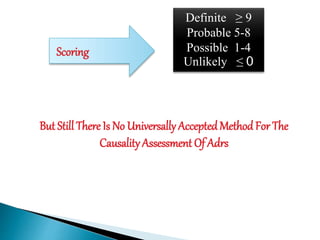
But Still There Is No Universally AcceptedMethodFor The
Causality Assessment Of Adrs
Definite ≥ 9
Probable 5-8
Possible 1-4
Unlikely ≤ 0
Scoring
•
•
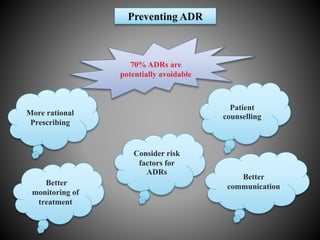
More rational
Prescribing
Better
communication
Consider risk
factors for
ADRs
Patient
counselling
Better
monitoring of
treatment
70% ADRs are
potentially avoidable
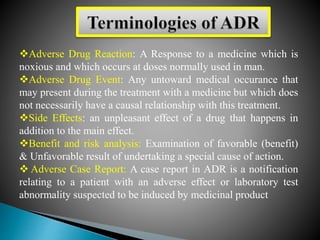
Adverse Drug Reaction: A Response to a medicine which is
noxious and which occurs at doses normally used in man.
Adverse Drug Event: Any untoward medical occurance that
may present during the treatment with a medicine but which does
not necessarily have a causal relationship with this treatment.
Side Effects: an unpleasant effect of a drug that happens in
addition to the main effect.
Benefit and risk analysis: Examination of favorable (benefit)
& Unfavorable result of undertaking a special cause of action.
 Adverse Case Report: A case report in ADR is a notification
relating to a patient with an adverse effect or laboratory test
abnormality suspected to be induced by medicinal product
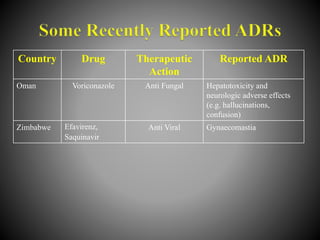
Country Drug Therapeutic
Action
Reported ADR
Oman Voriconazole Anti Fungal Hepatotoxicity and
neurologic adverse effects
(e.g. hallucinations,
confusion)
Zimbabwe Efavirenz,
Saquinavir
Anti Viral Gynaecomastia
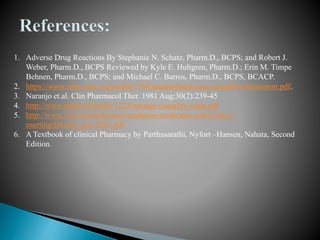
1. Adverse Drug Reactions By Stephanie N. Schatz, Pharm.D., BCPS; and Robert J.
Weber, Pharm.D., BCPS Reviewed by Kyle E. Hultgren, Pharm.D.; Erin M. Timpe
Behnen, Pharm.D., BCPS; and Michael C. Barros, Pharm.D., BCPS, BCACP.
2. https://www.who-umc.org/media/2768/standardised-case-causality-assessment.pdf.
3. Naranjo et.al. Clin Pharmacol Ther. 1981 Aug;30(2):239-45
4. http://www.ephor.nl/media/1223/naranjo-causality-scale.pdf
5. http://www.who.int/medicines/regulation/medicines-safety/npvc-
meeting/Bloolet_poci2016.pdf
6. A Textbook of clinical Pharmacy by Parthasarathi, Nyfort –Hansen, Nahata, Second
Edition.
If you suspect an ADR do not assume someone
else will report it……

ADRppt.pptx

  • 1.
    ADVERSE DRUG REACTIONS Presented By: KajalRajdev M.Pharm (IInd Semester) Department of Pharmacology ISF College of Pharmacy Moga, Punjab Checked and Confirmed By: Dr. Sidharth Mehan Associate Professor Department of Pharmacology ISF College of Pharmacy (ISFCP)
  • 2.
     Definition ofADR  Classification of ADR  Detection of ADR  Reporting of ADR  Causality Assesment  Prevention of ADRs  Terminology of ADRs CONTENTS
  • 3.
    Definition Of AdverseDrug Reactions •According to WHO (1972) “A response to a drug which is noxious and unintended and which occurs at doses normally used in man for prophylaxis, diagnosis, or therapy of disease or for the modification of physiologic function”.
  • 4.
    Classification of ADRs Dependingupon……..  Type of reaction: •Type A •Type B •Type C •Type D •Type E •Type F Onset of event: Acute (<60 minutes) Sub-acute (1-24 hrs) Latent (>2 days) Severity: Minor, Moderate, Severe, Lethal ADRs.
  • 5.
    • A (DoseRelated) • Bizzare (Non-Dose Related) • Chronic (Dose Related and Time Related) • Delayed (Time Related) • End of Use (Withdrawal) • Failure (Unexpected Failure of Therapy)
  • 6.
    Features • Common Relatedto the pharmacologic action of the drug – exaggerated pharmacologic response • Predictable • Low mortality Example •Dry mouth with Tricyclic Antidepressants •Respiratory Depression with Opioids • Bleeding with Warfarin Management •Reduce Dose or Withhold Drug • Consider effects of concomitant therapy Bleeding with Warfarin
  • 7.
    Features •Uncommon •Not related tothe pharmacologic action of the drug •Unpredictable •High mortality Example •Immunologic reactions: anaphylaxis to penicillin •Idiosyncratic reactions: malignant hyperthermia with general anesthetics Management •Withhold and avoid in future Penicillin Allergy
  • 8.
    Features •Uncommon •Related to thecumulative dose Example •Hypothalamic-pituitary-adrenal axis suppression by corticosteroids. •Osteonecrosis of the jaw with bisphosphonates Management •Reduce dose or use an alternate day therapy •withdrawal may have to be prolonged Osteonecrosis of Jaw with Bisphosphonates
  • 9.
    Features •Uncommon •Usually dose related •Occursor becomes apparent sometime after use of the drug Example •Carcinogenesis •Teratogenesis •Tardive dyskinesia •Leucopenia with lomustine Management •Often intractable Tardive dyskinesia
  • 10.
    Features •Uncommon •Occurs soon afterwithdrawal of the drug Example •Withdrawal syndrome with opiates or benzodiazepines (e.g., insomnia, anxiety) Management •Reintroduce drug and withdraw slowly Insomnia
  • 11.
    Features •Common •Dose related •Often causedby drug interactions Example •Inadequate dosage of an oral contraceptive when used with an enzyme inducer. •Resistance to antimicrobial agents Management •Increase dosage •Consider effects of concomitant therapy
  • 12.
    •Minor ADRs: Notherapy, antidote or prolongation of hospitalization is required. • Moderate ADRs: Requires change in drug therapy, specific treatment or prolongs hospital stay by atleast 1 day. • Severe ADRs: Potentially life threatening, causes permanent damage or requires intensive medical treatment. • Lethal: Directly or indirectly contributes to death of the patient.
  • 13.
    Detecting adverse drugreaction(ADR). Assessing causality between drug and suspected reaction Documentation of ADR Reporting serious ADRs to pharmacovigilance centers
  • 14.
    Detection of ADRs Pre-Marketing Studies Post– Marketing Surveillance Spontaneous adverse reaction reporting Epidemiological methods Case Control Studies Cohort Studies Phase 1 Phase 2 Phase 3
  • 15.
    PRE- MARKETING STUDIES •Duringthe development of new medicines, their safety is tested in animal models. • A great deal of risk information may be obtained from such tests, such as the level of acute toxicity and which organs will be affected in case of toxicity. • If animal test do not reveal worrying results, safety tests proceed onto testing in human. • Clinical trials are carried out in three different phases prior to submission of a marketing authorisation application • Consequence of above is that at the time of general marketing of a new medicine only the most common (Type A) adverse reactions will be known.
  • 16.
    • Passive andActive pharmacovigilance methodologies are used for detection of risk and for the collection of risk information. Spontaneous adverse reaction reporting • Powerful and cost effective system for the identification of unknown drug-related risk. • Health care practitioner should see it as their duty to report any suspicion of drug causing risk situation in patient under his care. •Spontaneous reporting creates signals of previously unknown problems
  • 17.
    •These methods areused to verify the hypothesis of a causal link between drug exposure and an adverse outcome. •Two epidemiological methods most commonly used are: Cohort Studies Case Control studies Exposure Outcome Exposed Outcome ? Not Exposed Outcome ? Exposed ? Outcome Exposed ? Control
  • 18.
    COHORT STUDIES CASECONTROL STUDIES  Patients exposed to a particular drug are followed up actively and systematically and ADR frequencies are compared to an unedxposed control population. Advantage: Reveals unsuspected ADRs  Individuals affected by the adverse event being studied are identified. Each case is matched with several disease – free control patients, randomly recruited from the study base. Drug histories of both the groups are traced backwards for the comparison.  The suspicion is strengthened if high association is found. Advantage: Can be analysed quickly as number of patients analysed is small.
  • 19.
    Collection of DataFor Detection of ADR Patient Related •Patient’s demographic information. •Presenting Complaints •Past medication history •Drug therapy details including over the counter •Current medications •Lab data such as haematological, liver and renal function tests. Details of suspected ADR • Time of onset and duration of reaction and severity of reaction • Details of dose , frequency, and time of administration of drug • Duration of treatment and plasma concentration of Drug • Data on other risk factors and predisposing factors.
  • 20.
    Role of HealthcareProfessionals in Detecting ADRs Possibility of an ADR should always be considered during differential diagnosis. ADR may be detected during ward round with the medical team. Patient counselling , medication history interview and communicating with other healthcare professional may provide additional clues. Patients who are at higher risk should be monitored closely • Patients with renal or hepatic impairment. • Patients who had histrory of allergic reactions. • Patients taking multiple drugs. • Pregnant and breastfeeding women.
  • 21.
    Reporting an ADR Allhealthcare professionals (clinicians, dentists, pharmacists, nurses etc) and Non-healthcare professionals including consumers can report suspected adverse drug reaction. What may happen when you don’t report? A) Who can Report?
  • 22.
    Duly filled SuspectedAdverse Drug Reaction Reporting Form can be send to the nearest Adverse Drug Reaction Monitoring Centre (AMC) or directly to the National Coordination Centre (NCC).  Call on Helpline (Toll Free) 1800 180 3024 to report ADRs.  Or can directly mail this filled form to pvpi@ipcindia.net or pvpi.ipcindia@gmail.com  A list of nationwide AMCs is available at: http://www.ipc.gov.in, http://www.ipc.gov.in/PvPI/pv_home.html B) Where to report ?
  • 23.
    Report serious adversedrug reactions. A reaction is serious when the patient outcome is: • Life-threatening • Hospitalization (initial or prolonged) • Disability (significant, persistent or permanent) • Congenital anomaly • Required intervention to prevent permanent impairment or damage Report non-serious, known or unknown, frequent or rare adverse drug reactions due to Medicines, Vaccines and Herbal products. C) What to report ?
  • 24.
     Patient initials, Ageat onset of reaction, Reaction term(s), Date of onset of reaction,  Suspected medication(s)  reporter information. D) Mandatory field for suspected ADR reporting form.
  • 25.
    D) What happensto the submitted information? ADR reported by HCP, Patient or Others Causality assessment at AMCs Forwaded to NCC-PvPI through ADR database Data is Analysed & forwarded Global Pharmacovigilance Database (Managed by WHO- UMC) Reports are periodically reviewed by the NCC-PvPI Information is submitted to the Steering committee of PvPI Suggests required interventions
  • 26.
    Assessing Causality Causality assessmentis the method by which the extent of the relationship between a drug and a suspected reaction is estimated . Methods Of Causality Assessment Group-1 Opinion of Experts, Clinical Judgment or Global introspection methods Group-2 Algorithms (with or without scoring) or standardised assesment methods
  • 27.
    Group-1 Opinion ofExperts, Clinical Judgment or Global Introspection methods Causation is established based on the clinical judgment of the expert or panel of the experts. Such Judgements are mostly based on the WHO-UMC causality assesment scale given below. Causality term Assessment criteria* Certain • Event or laboratory test abnormality, with plausible time relationship to drug intake • Cannot be explained by disease or other drugs • Response to withdrawal plausible (pharmacologically, pathologically) • Event definitive pharmacologically or phenomenologically (i.e. an objective and specific medical disorder or a recognised pharmacological phenomenon) • Rechallenge satisfactory, if necessary Probable/ Likely • Event or laboratory test abnormality, with reasonable time relationship to drug intake • Unlikely to be attributed to disease or other drugs • Response to withdrawal clinically reasonable • Rechallenge not required
  • 28.
    Causality term Assessmentcriteria* Possible •Event or laboratory test abnormality, with reasonable time relationship to drug intake • Could also be explained by disease or other drugs • Information on drug withdrawal may be lacking or unclear Unlikely •Event or laboratory test abnormality, with a time to drug intake that makes a relationship improbable (but not impossible) • Disease or other drugs provide plausible explanations Conditional/ Unclassified • Event or laboratory test abnormality • More data for proper assessment needed, or • Additional data under examination Unassessable/ Unclassifiable • Report suggesting an adverse reaction • Cannot be judged because information is insufficient or contradictory • Data cannot be supplemented or verified
  • 29.
    Group-2 Algorithms (Naranjo’sAlgorithms) S.No Questions Yes No Don’t Know 1 Are there previous conclusive reports on this reaction? -1 0 0 2 Did the adverse event appear after the suspected drug was given? +2 -1 0 3 Did the adverse reaction improve when the drug was discontinued or a specific antagonist was given? +1 0 0 4 Did the adverse reaction appear when the drug was readministered? +2 -1 0 5 Are there alternative causes that could have caused the reaction? -1 2 0 6 Did the reaction reappear when a placebo was given? -1 +1 0 7 Was the drug detected in any body fluid in toxic concentrations? +1 0 0 8 Was the reaction more severe when the dose was increased, or less severe when the dose was decreased? +1 0 0 9 Did the patient have a similar reaction to the same or similar drugs in any previous exposure? +1 0 0
  • 30.
    But Still ThereIs No Universally AcceptedMethodFor The Causality Assessment Of Adrs Definite ≥ 9 Probable 5-8 Possible 1-4 Unlikely ≤ 0 Scoring
  • 31.
    • • More rational Prescribing Better communication Consider risk factorsfor ADRs Patient counselling Better monitoring of treatment 70% ADRs are potentially avoidable
  • 32.
    Adverse Drug Reaction:A Response to a medicine which is noxious and which occurs at doses normally used in man. Adverse Drug Event: Any untoward medical occurance that may present during the treatment with a medicine but which does not necessarily have a causal relationship with this treatment. Side Effects: an unpleasant effect of a drug that happens in addition to the main effect. Benefit and risk analysis: Examination of favorable (benefit) & Unfavorable result of undertaking a special cause of action.  Adverse Case Report: A case report in ADR is a notification relating to a patient with an adverse effect or laboratory test abnormality suspected to be induced by medicinal product
  • 33.
    Country Drug Therapeutic Action ReportedADR Oman Voriconazole Anti Fungal Hepatotoxicity and neurologic adverse effects (e.g. hallucinations, confusion) Zimbabwe Efavirenz, Saquinavir Anti Viral Gynaecomastia
  • 34.
    1. Adverse DrugReactions By Stephanie N. Schatz, Pharm.D., BCPS; and Robert J. Weber, Pharm.D., BCPS Reviewed by Kyle E. Hultgren, Pharm.D.; Erin M. Timpe Behnen, Pharm.D., BCPS; and Michael C. Barros, Pharm.D., BCPS, BCACP. 2. https://www.who-umc.org/media/2768/standardised-case-causality-assessment.pdf. 3. Naranjo et.al. Clin Pharmacol Ther. 1981 Aug;30(2):239-45 4. http://www.ephor.nl/media/1223/naranjo-causality-scale.pdf 5. http://www.who.int/medicines/regulation/medicines-safety/npvc- meeting/Bloolet_poci2016.pdf 6. A Textbook of clinical Pharmacy by Parthasarathi, Nyfort –Hansen, Nahata, Second Edition.
  • 35.
    If you suspectan ADR do not assume someone else will report it……