PHARMACOVIGILANCE
REPORTING METHODS
&
SIGNAL DETECTION
IN THE USA
Hafsa Hafeez, Alok Kumar, Emmanuel Egom, Muhammed Tanvir, Syed Ahmad Ali Shah
Academy of Applied Pharmaceutical Sciences, Toronto, Canada
Course: Global Clinical Research and Pharmacovigilance
Professor: Peivand Pirouzi
June 25, 2015
INTRODUCTION
 The process of informing about the adverse drug
reaction to the concerned individual/authority is
known as reporting.
 There are different methods used in
Pharmacovigilance for reporting the adverse drug
reactions.
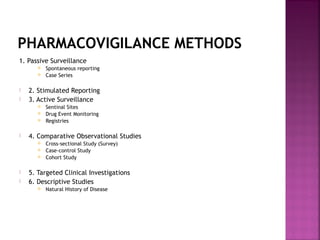
PHARMACOVIGILANCE METHODS
1. Passive Surveillance
 Spontaneous reporting
 Case Series
 2. Stimulated Reporting
 3. Active Surveillance
 Sentinal Sites
 Drug Event Monitoring
 Registries
 4. Comparative Observational Studies
 Cross-sectional Study (Survey)
 Case-control Study
 Cohort Study
 5. Targeted Clinical Investigations
 6. Descriptive Studies
 Natural History of Disease
1. Passive Surveillance
SPONTANEOUS REPORTING
 A report of an adverse drug reaction received
directly from healthcare
professionals/consumers/patients.
 The report could be sent either to the nearest
pharmacovigilance centre or to the manufacturer.
 This is also known as voluntary reporting.
 Very important method of reporting.
 The number of spontaneous AE reports submitted
to FDA continues to grow, with over 600,000
reports in 2010, heading for over 700,000 in 2011.
ADVANTAGES
 Large population can be covered.
 Hospital as well as outpatient data can be obtained.
 Inexpensive
 All medicines can be covered
 Patient analysis is possible
DISADVANTAGES
 Major weakness is under reporting (figures may vary
between countries as well as minor and major
adverse reactions.
 Overworked hospital staff may not consider reporting
of ADR on a priority basis.
1. May not notice the ADR if symptoms are not serious
2. If symptoms are serious, they may not recognize
them as the effect of a particular drug.
1.Passive Surveillance
Case Series
Series of case reports can provide evidence of
an association between a drug and an
adverse event, but they are generally more
useful for generating hypotheses than for
verifying an association between drug
exposure and outcome.
2. Stimulated Reporting
 Several methods have been used to
encourage and facilitate reporting by health
professionals in specific situations (e.g., in-
hospital settings) for new products or for
limited time periods. Such methods include
on-line reporting of adverse events and
systematic stimulation of reporting of
adverse events based on a predesigned
method. These methods have been shown to
improve reporting, althought have their
limitations as well.
3. Active Surveillance
 Active surveillance, in contrast to passive
surveillance, seeks to ascertain completely the
number of adverse events via a continuous
preorganized process. An example of active
surveillance is the follow-up of patients treated with
a particular drug through a risk management
program. Patients who fill a prescription for this drug
may be asked to complete a brief survey form and
give permission for later contact. In general, it is
more feasible to get comprehensive data on
individual adverse event reports through an active
surveillance system than through a passive reporting
system.
Active Surveillance
 Sentinal Sites
 Active surveillance can be achieved by reviewing
medical records or interviewing patients and/or
physicians in a sample of sentinel sites to
ensure complete and accurate data on reported
adverse events from these sites. The selected
sites can provide information, such as data from
specific patient subgroups, that would not be
available in a passive spontaneous reporting
system.
Specialized cohorts, networks
 There currently are a number of networks established
nationally and internationally focused on
ascertainment and evaluation of adverse drug
effects.
 Such as the International Severe Adverse Events
Consortium (iSAEC) and the Drug Induced Liver Injury
Network (DILIN) focus on specific organ targets or
patterns of adverse drug reactions. They have served
as major sources of high quality AE reports as well as
collaborative research efforts into the mechanisms,
predisposition (pharmacogenomic and other), and
pathogenesis of adverse drug reactions.
5. Targeted Clinical Investigations
 When significant risks are identified from
preapproval clinical trials, further clinical
studies might be called for to evaluate the
mechanism of action for the adverse
reaction. In some instances,
pharmacodynamic and pharmacokinetic
studies might be conducted to determine
whether a particular dosing instruction can
put patients at an increased risk of adverse
events.
6. Descriptive Studies
 Descriptive studies are an important
component of pharmacovigilance, although
not for the detection or verification of
adverse events associated with drug
exposures. These studies are primarily used
to obtain the background rate of outcome
events and/or establish the prevalence of
the use of drugs in specified populations.
6. Descriptive Studies
Natural History of Disease
 The science of epidemiology originally
focused on the natural history of disease,
including the characteristics of diseased
patients and the distribution of disease in
selected populations, as well as estimating
the incidence and prevalence of potential
outcomes of interest. These outcomes of
interest now include a description of disease
treatment patterns and adverse events
PHARMACOVIGILANCE IN THE USA
 FDA’s Center for Drug Evaluation and Research
(CDER) is a consumer watchdog America’s healthcare
system, specifically the Division of Pharmacovigilance
 CDER regulates prescription drugs, generic drugs and
over the counter drugs
 Division of Pharmacovigilance
•Evaluate the safety of drug and therapeutic biologic
products
•Advance public health by detecting and analyzing safe
ty 
signals from all available data sources, utilizing evidenc
e- based methods
•Recommend appropriate regulatory actions, including 
labeling changes, Risk Evaluation and Mitigation Strateg
ies  (REMS), etc.
• Communicate relevant safety information
PV in USA Cont’d…
 Postmarketing Reports get to the FDA
through spontaneous (voluntary) reporting by
patients, consumer, and healthcare
professionals through FDA MedWatch (5% of
total reports) and direct (mandatory)
reporting from the manufacturers (95%)
 Regulatory requirements mandate all ADRs
received by the manufacturers to be
reported to the FDA
PHARMACOVIGILANCE IN THE USA
Cont’d…
 All ADRs are entered into the FDA Adverse
Event Reporting System (FAERS) Database.
 FDA Adverse Event Reporting System
• Computerized database 
• Spontaneous and Mandatory reports
• Contains human drug and therapeutic
biologic reports
• > 7 million reports since 1969
• Nearly 1 million new reports in 2012
WHAT & WHEN TO REPORT
 Sometimes ADR may be difficult to detect/ important
information might be missing.
1. Collect the essential information and report the ADR
as soon as you suspect that drug therapy has
caused negative unintended effect.
2. Speed is another important factor.
GOOD REPORTING PRACTICE
 The report from the consumer should be crosschecked
with the health care practitioner familiar with the
patient’s adverse event to obtain further medical
information and to retrieve relevant medical records.
 The adverse reaction report must include the
following:
1) An identifiable patient.
2) A suspected health product.
3) An identifiable reporter.
4) A reaction.
Good Reporting Practice Cont’d…
 The report should also include other
information which are as follows:
Concomitant medication, medical history,
course of the event, suspect medication
details, dechallenge/rechallenge, outcome of
the event, lab details, etc.
 Making the process of reporting user
friendly.
 It is always better to have fewer reports with
high quality data than many reports with
poor data quality.
 In the USA, the MedWatch system allows
you to enter the information mentioned
above through a form online, mail or fax
MANDATORY REPORTING
 System under which manufacturer is required by law
to inform health authorities when a specified illness is
diagnosed.
 They are intended primarily for accountability, collect
information about serious adverse events and disclose
some information to the public.
 Mandatory systems are intended to hold healthcare
facilities accountable for preventable adverse events
that result in serious injury or death.
Mandatory Reporting Cont’d…
 In Canada reporting system consists of two
components, reporting by manufacturers on a
mandatory basis (regulatory requirement) and
reporting by Canadian health professionals and
patients/consumers on a voluntary basis.
 The manufacturers in most of the countries submit all
reports of ADR through QPPV (Qualified Person for
Pharmacovigilance) to regulatory authority.
 The problem of under-reporting to some extent can be
addressed by making the process of reporting the
adverse reaction mandatory by law.
Mandatory Reporting Cont’d…
 While this may not achieve 100% compliance, it may
prompt a significant number of health professionals to
report who would not have otherwise reported.
 Countries like France, Sweden, Austria, Norway, and
Italy have this system for adverse reaction reporting by
health professionals.
SIGNAL
 WHO Definition:
Reported information on a possible causal
relationship between an adverse event and
a drug, the relationship being unknown or
incompletely documented previously (new
information related to safety).
 Mapping is based on spontaneous reports in
the safety database.
SIGNAL
 Usually more than one report is required to
generate a signal
 It is a matter of looking for patterns or clusters
of reports that stand out from the background
SIGNAL DETECTION
 Speed of SD depends on the following factors:
1. Number of users
2. Frequency of ADR
3. Reporting rate
4. Quality of documentation
 Automated SD has helped in detecting signals early.
 SD has an important role to play in enhancing safety
of the drug.
 It is an integral part of every adverse event reporting
system.
TYPES OF SIGNALS
 Quantitative (depending on number of case reports)
 Qualitative
1. Consistency of data
2. Exposure – response relationship
3. Biological plausibility (pathological and
pharmacological mechanisms)
4. Experimental findings
5. Analogy (previous experience with this drug)
6. Nature and quality of data
Sources of Possible Safety Signals
in the USA
 Routine pharmacovigilance 
– FAERS
– Datamining
– Periodic Safety Update Reports
 Study results 
 Medical literature
 Media
 New Drug Application (NDA) safety database
 Outside inquiry
 Foreign Regulatory Agencies
 Others
SIGNAL VALIDATION &
STRENTHENING
Validation
 Get more information from reporter
 Take opinion from health professionals/specialists
 Causality assessment
Strengthening
 Get more information from literature, manufacturer,
database (international database), reports from clinical
trials.
 Analogy with other related drugs.
“Absence of supporting data does not indicate that it was
a false signal.”
THANK YOU
References
 Fine, A. (2013). Introduction to Post ­marketing Drug Safety
Surveillance: Pharmacovigilance in FDA/CDER (PowerPoint
slides), Retreived from:
http://www.fda.gov/downloads/AboutFDA/WorkingatFDA/Fellow
shipInternshipGraduateFacultyPrograms/PharmacyStudentExperie
ntialProgramCDER/UCM340626.pdf
 FDA Science Board (2011). FDA Science Board Subcommittee:
Review of the FDA/CDER Pharmacovigilance Program, Retreived
from:
http://www.fda.gov/downloads/AdvisoryCommittees/Committee
sMeetingMaterials/ScienceBoardtotheFoodandDrugAdministration
/UCM276888.pdf
 Cobert, Barton L, and Barton L Cobert. Cobert's Manual Of Drug
Safety And Pharmacovigilance. Sudbury, Mass.: Jones & Bartlett
Learning, 2012.

Reporting Methods _ Global Pharmacovigilance1

  • 1.
    PHARMACOVIGILANCE REPORTING METHODS & SIGNAL DETECTION INTHE USA Hafsa Hafeez, Alok Kumar, Emmanuel Egom, Muhammed Tanvir, Syed Ahmad Ali Shah Academy of Applied Pharmaceutical Sciences, Toronto, Canada Course: Global Clinical Research and Pharmacovigilance Professor: Peivand Pirouzi June 25, 2015
  • 2.
    INTRODUCTION  The processof informing about the adverse drug reaction to the concerned individual/authority is known as reporting.  There are different methods used in Pharmacovigilance for reporting the adverse drug reactions.
  • 3.
    PHARMACOVIGILANCE METHODS 1. PassiveSurveillance  Spontaneous reporting  Case Series  2. Stimulated Reporting  3. Active Surveillance  Sentinal Sites  Drug Event Monitoring  Registries  4. Comparative Observational Studies  Cross-sectional Study (Survey)  Case-control Study  Cohort Study  5. Targeted Clinical Investigations  6. Descriptive Studies  Natural History of Disease
  • 4.
    1. Passive Surveillance SPONTANEOUSREPORTING  A report of an adverse drug reaction received directly from healthcare professionals/consumers/patients.  The report could be sent either to the nearest pharmacovigilance centre or to the manufacturer.  This is also known as voluntary reporting.  Very important method of reporting.  The number of spontaneous AE reports submitted to FDA continues to grow, with over 600,000 reports in 2010, heading for over 700,000 in 2011.
  • 5.
    ADVANTAGES  Large populationcan be covered.  Hospital as well as outpatient data can be obtained.  Inexpensive  All medicines can be covered  Patient analysis is possible
  • 6.
    DISADVANTAGES  Major weaknessis under reporting (figures may vary between countries as well as minor and major adverse reactions.  Overworked hospital staff may not consider reporting of ADR on a priority basis. 1. May not notice the ADR if symptoms are not serious 2. If symptoms are serious, they may not recognize them as the effect of a particular drug.
  • 7.
    1.Passive Surveillance Case Series Seriesof case reports can provide evidence of an association between a drug and an adverse event, but they are generally more useful for generating hypotheses than for verifying an association between drug exposure and outcome.
  • 8.
    2. Stimulated Reporting Several methods have been used to encourage and facilitate reporting by health professionals in specific situations (e.g., in- hospital settings) for new products or for limited time periods. Such methods include on-line reporting of adverse events and systematic stimulation of reporting of adverse events based on a predesigned method. These methods have been shown to improve reporting, althought have their limitations as well.
  • 9.
    3. Active Surveillance Active surveillance, in contrast to passive surveillance, seeks to ascertain completely the number of adverse events via a continuous preorganized process. An example of active surveillance is the follow-up of patients treated with a particular drug through a risk management program. Patients who fill a prescription for this drug may be asked to complete a brief survey form and give permission for later contact. In general, it is more feasible to get comprehensive data on individual adverse event reports through an active surveillance system than through a passive reporting system.
  • 10.
    Active Surveillance  SentinalSites  Active surveillance can be achieved by reviewing medical records or interviewing patients and/or physicians in a sample of sentinel sites to ensure complete and accurate data on reported adverse events from these sites. The selected sites can provide information, such as data from specific patient subgroups, that would not be available in a passive spontaneous reporting system.
  • 11.
    Specialized cohorts, networks There currently are a number of networks established nationally and internationally focused on ascertainment and evaluation of adverse drug effects.  Such as the International Severe Adverse Events Consortium (iSAEC) and the Drug Induced Liver Injury Network (DILIN) focus on specific organ targets or patterns of adverse drug reactions. They have served as major sources of high quality AE reports as well as collaborative research efforts into the mechanisms, predisposition (pharmacogenomic and other), and pathogenesis of adverse drug reactions.
  • 12.
    5. Targeted ClinicalInvestigations  When significant risks are identified from preapproval clinical trials, further clinical studies might be called for to evaluate the mechanism of action for the adverse reaction. In some instances, pharmacodynamic and pharmacokinetic studies might be conducted to determine whether a particular dosing instruction can put patients at an increased risk of adverse events.
  • 13.
    6. Descriptive Studies Descriptive studies are an important component of pharmacovigilance, although not for the detection or verification of adverse events associated with drug exposures. These studies are primarily used to obtain the background rate of outcome events and/or establish the prevalence of the use of drugs in specified populations.
  • 14.
    6. Descriptive Studies NaturalHistory of Disease  The science of epidemiology originally focused on the natural history of disease, including the characteristics of diseased patients and the distribution of disease in selected populations, as well as estimating the incidence and prevalence of potential outcomes of interest. These outcomes of interest now include a description of disease treatment patterns and adverse events
  • 15.
    PHARMACOVIGILANCE IN THEUSA  FDA’s Center for Drug Evaluation and Research (CDER) is a consumer watchdog America’s healthcare system, specifically the Division of Pharmacovigilance  CDER regulates prescription drugs, generic drugs and over the counter drugs  Division of Pharmacovigilance •Evaluate the safety of drug and therapeutic biologic products •Advance public health by detecting and analyzing safe ty  signals from all available data sources, utilizing evidenc e- based methods •Recommend appropriate regulatory actions, including  labeling changes, Risk Evaluation and Mitigation Strateg ies  (REMS), etc. • Communicate relevant safety information
  • 16.
    PV in USACont’d…  Postmarketing Reports get to the FDA through spontaneous (voluntary) reporting by patients, consumer, and healthcare professionals through FDA MedWatch (5% of total reports) and direct (mandatory) reporting from the manufacturers (95%)  Regulatory requirements mandate all ADRs received by the manufacturers to be reported to the FDA
  • 17.
    PHARMACOVIGILANCE IN THEUSA Cont’d…  All ADRs are entered into the FDA Adverse Event Reporting System (FAERS) Database.  FDA Adverse Event Reporting System • Computerized database  • Spontaneous and Mandatory reports • Contains human drug and therapeutic biologic reports • > 7 million reports since 1969 • Nearly 1 million new reports in 2012
  • 18.
    WHAT & WHENTO REPORT  Sometimes ADR may be difficult to detect/ important information might be missing. 1. Collect the essential information and report the ADR as soon as you suspect that drug therapy has caused negative unintended effect. 2. Speed is another important factor.
  • 19.
    GOOD REPORTING PRACTICE The report from the consumer should be crosschecked with the health care practitioner familiar with the patient’s adverse event to obtain further medical information and to retrieve relevant medical records.  The adverse reaction report must include the following: 1) An identifiable patient. 2) A suspected health product. 3) An identifiable reporter. 4) A reaction.
  • 20.
    Good Reporting PracticeCont’d…  The report should also include other information which are as follows: Concomitant medication, medical history, course of the event, suspect medication details, dechallenge/rechallenge, outcome of the event, lab details, etc.  Making the process of reporting user friendly.  It is always better to have fewer reports with high quality data than many reports with poor data quality.  In the USA, the MedWatch system allows you to enter the information mentioned above through a form online, mail or fax
  • 21.
    MANDATORY REPORTING  Systemunder which manufacturer is required by law to inform health authorities when a specified illness is diagnosed.  They are intended primarily for accountability, collect information about serious adverse events and disclose some information to the public.  Mandatory systems are intended to hold healthcare facilities accountable for preventable adverse events that result in serious injury or death.
  • 22.
    Mandatory Reporting Cont’d… In Canada reporting system consists of two components, reporting by manufacturers on a mandatory basis (regulatory requirement) and reporting by Canadian health professionals and patients/consumers on a voluntary basis.  The manufacturers in most of the countries submit all reports of ADR through QPPV (Qualified Person for Pharmacovigilance) to regulatory authority.  The problem of under-reporting to some extent can be addressed by making the process of reporting the adverse reaction mandatory by law.
  • 23.
    Mandatory Reporting Cont’d… While this may not achieve 100% compliance, it may prompt a significant number of health professionals to report who would not have otherwise reported.  Countries like France, Sweden, Austria, Norway, and Italy have this system for adverse reaction reporting by health professionals.
  • 24.
    SIGNAL  WHO Definition: Reportedinformation on a possible causal relationship between an adverse event and a drug, the relationship being unknown or incompletely documented previously (new information related to safety).  Mapping is based on spontaneous reports in the safety database.
  • 25.
    SIGNAL  Usually morethan one report is required to generate a signal  It is a matter of looking for patterns or clusters of reports that stand out from the background
  • 26.
    SIGNAL DETECTION  Speedof SD depends on the following factors: 1. Number of users 2. Frequency of ADR 3. Reporting rate 4. Quality of documentation  Automated SD has helped in detecting signals early.  SD has an important role to play in enhancing safety of the drug.  It is an integral part of every adverse event reporting system.
  • 27.
    TYPES OF SIGNALS Quantitative (depending on number of case reports)  Qualitative 1. Consistency of data 2. Exposure – response relationship 3. Biological plausibility (pathological and pharmacological mechanisms) 4. Experimental findings 5. Analogy (previous experience with this drug) 6. Nature and quality of data
  • 28.
    Sources of PossibleSafety Signals in the USA  Routine pharmacovigilance  – FAERS – Datamining – Periodic Safety Update Reports  Study results   Medical literature  Media  New Drug Application (NDA) safety database  Outside inquiry  Foreign Regulatory Agencies  Others
  • 29.
    SIGNAL VALIDATION & STRENTHENING Validation Get more information from reporter  Take opinion from health professionals/specialists  Causality assessment Strengthening  Get more information from literature, manufacturer, database (international database), reports from clinical trials.  Analogy with other related drugs. “Absence of supporting data does not indicate that it was a false signal.”
  • 30.
  • 31.
    References  Fine, A. (2013).Introduction to Post ­marketing Drug Safety Surveillance: Pharmacovigilance in FDA/CDER (PowerPoint slides), Retreived from: http://www.fda.gov/downloads/AboutFDA/WorkingatFDA/Fellow shipInternshipGraduateFacultyPrograms/PharmacyStudentExperie ntialProgramCDER/UCM340626.pdf  FDA Science Board (2011). FDA Science Board Subcommittee: Review of the FDA/CDER Pharmacovigilance Program, Retreived from: http://www.fda.gov/downloads/AdvisoryCommittees/Committee sMeetingMaterials/ScienceBoardtotheFoodandDrugAdministration /UCM276888.pdf  Cobert, Barton L, and Barton L Cobert. Cobert's Manual Of Drug Safety And Pharmacovigilance. Sudbury, Mass.: Jones & Bartlett Learning, 2012.