CATARACT
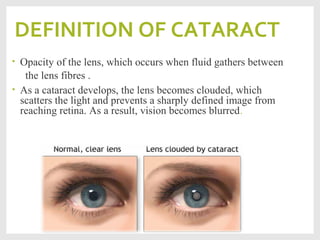
DEFINITION OF CATARACT
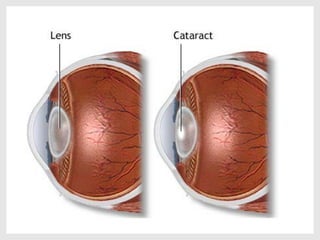
• Opacity of the lens, which occurs when fluid gathers between
the lens fibres .
• As a cataract develops, the lens becomes clouded, which
scatters the light and prevents a sharply defined image from
reaching retina. As a result, vision becomes blurred.
CAUSES OF CATARACT
• Old age (commonest)
• Ocular & systemic diseases
• Diabetes Mellitus
• Uveitis
• Previous ocular surgery
• Systemic medication
• Steroids
• Phenothiazines
• Trauma & intraocular
foreign bodies
• Ionizing radiation
• X-ray
• UV
• Congenital
• Dominant
• Sporadic
• Part of a syndrome
• Abnormal galactose
metabolism
• Hypoglycemia
• Inherited abnormality
• Myotonic dystrophy
• Marfan’s syndrome
• Rubella
• High myopia
4
CATARACT
DIVIDED TO :
• ACQUIRED CATARACT
Age - related cataract
Presenile cataract
Traumatic cataract
Drug induced cataract
Secondary cataract
• CONGENITAL CATARACT
Systemic association
Non-systemic association
AGE -RELATED CATARACT
It is the Most commonly occurred.
Classified according to:
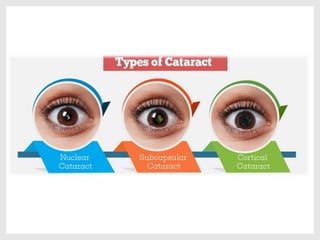
Morphological Classification
• Nuclear
• Cortical
• Subcapsular
Maturity classification
• Immature Cataract
• Mature Cataract
• Hypermature Cataract
SYMPTOMS
• Reduced visual acuity (near and distant object)
• Glare in sunshine or with street/car lights.
• Distortion of lines.
• Diplopia.
• Altered colours ( white objects appear yellowish)
• Not associated with pain, discharge or redness of the eye
• haloes
GRADUAL LOSS OF VISION
Cataract
Glaucoma
Diabetic retinopathy
Hypertensive retinopathy
Age related macular degeneration
Retinitis pigmentosa
Trachoma
Onchocerciasis (river blindness)
Vitamin A deficiency
TREATMENT
• Glasses: Cataract alters the refractive power of the
natural lens so glasses may allow good vision to be
maintained.
• Surgical removal: when visual acuity can't be improved
with glasses.
• Surgical techniques
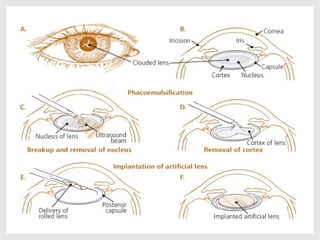
• Phacoemulsification method.
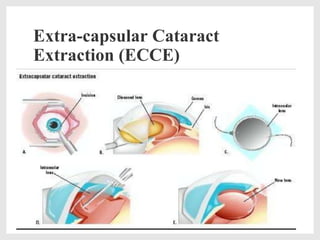
• Extracapsular method.
• Intracapsular method
PHACOEMULSIFICATION
.
Extra-capsular Cataract
Extraction (ECCE)
Intra-capsular Cataract
Extraction
POSTOPERATIVE CARE AFTER
CATARACT SURGERY
• Steroid drops (inflammation)
• Antibiotic drops (infection)
• Avoid
• Very strenuous exertion (rise the pressure in the eyeball)
• Ocular trauma.
COMPLICATIONS OF CATARACT
SURGERY
• permanent severe reduction of vision.
•Most cases within two weeks of surgery.
•Low grade infection with pathogen
• Suprachoroidal haemorrhage .
•Severe intraoperative bleeding can lead to serious and
permanent reduction in vision.
• Uveitis
• Ocular perforation.
• Postoperative refractive error
• Posterior capsular rupture and vitreous loss
•Retinal detachment.
•Glaucoma
•Posterior capsular opacification
Congenital Cataract
•Occur in about 3:10000 live birth.
•2/3 of case are bilateral (half of the cause can be
identified)
•The most common cause is genetic mutation usually AD
•It can cause ambylopia in infants.
•It is divided to:
1. Systemic association
2. Non-systemic association
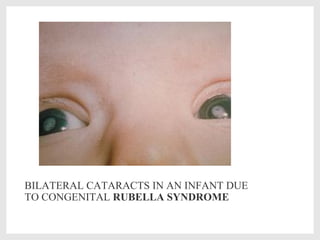
BILATERAL CATARACTS IN AN INFANT DUE
TO CONGENITAL RUBELLA SYNDROME
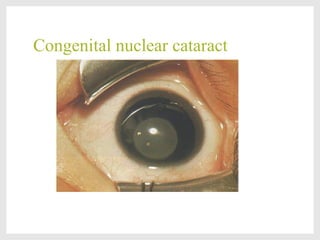
Congenital nuclear cataract
MANAGEMENT IN
CONGENITAL CATARACT
•Bilateral congenital cataract require urgent surgery
(lensectomy and vitrectomy) and the fitting of the contact
lens to correct the aphakia.
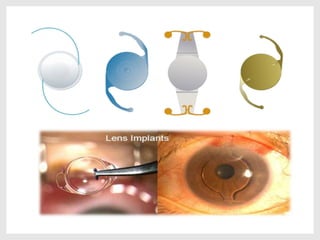
•After the age of 2 years there is a general agreement to use
intraocular lenses (IOLs), but before is still controversial
•Uniocular congenital cataract treatment remains
controversial.
•Follow-up for children with congenital cataract should
continue because of the risk for developing
•Glaucoma
•Amblyopia
•Strabismus
THANKYOU

Cataract

  • 1.
  • 2.
    DEFINITION OF CATARACT •Opacity of the lens, which occurs when fluid gathers between the lens fibres . • As a cataract develops, the lens becomes clouded, which scatters the light and prevents a sharply defined image from reaching retina. As a result, vision becomes blurred.
  • 4.
    CAUSES OF CATARACT •Old age (commonest) • Ocular & systemic diseases • Diabetes Mellitus • Uveitis • Previous ocular surgery • Systemic medication • Steroids • Phenothiazines • Trauma & intraocular foreign bodies • Ionizing radiation • X-ray • UV • Congenital • Dominant • Sporadic • Part of a syndrome • Abnormal galactose metabolism • Hypoglycemia • Inherited abnormality • Myotonic dystrophy • Marfan’s syndrome • Rubella • High myopia 4
  • 7.
    CATARACT DIVIDED TO : •ACQUIRED CATARACT Age - related cataract Presenile cataract Traumatic cataract Drug induced cataract Secondary cataract • CONGENITAL CATARACT Systemic association Non-systemic association
  • 8.
    AGE -RELATED CATARACT Itis the Most commonly occurred. Classified according to: Morphological Classification • Nuclear • Cortical • Subcapsular Maturity classification • Immature Cataract • Mature Cataract • Hypermature Cataract
  • 9.
    SYMPTOMS • Reduced visualacuity (near and distant object) • Glare in sunshine or with street/car lights. • Distortion of lines. • Diplopia. • Altered colours ( white objects appear yellowish) • Not associated with pain, discharge or redness of the eye • haloes
  • 10.
    GRADUAL LOSS OFVISION Cataract Glaucoma Diabetic retinopathy Hypertensive retinopathy Age related macular degeneration Retinitis pigmentosa Trachoma Onchocerciasis (river blindness) Vitamin A deficiency
  • 11.
    TREATMENT • Glasses: Cataractalters the refractive power of the natural lens so glasses may allow good vision to be maintained. • Surgical removal: when visual acuity can't be improved with glasses. • Surgical techniques • Phacoemulsification method. • Extracapsular method. • Intracapsular method
  • 12.
  • 14.
  • 15.
  • 16.
    POSTOPERATIVE CARE AFTER CATARACTSURGERY • Steroid drops (inflammation) • Antibiotic drops (infection) • Avoid • Very strenuous exertion (rise the pressure in the eyeball) • Ocular trauma.
  • 17.
    COMPLICATIONS OF CATARACT SURGERY •permanent severe reduction of vision. •Most cases within two weeks of surgery. •Low grade infection with pathogen • Suprachoroidal haemorrhage . •Severe intraoperative bleeding can lead to serious and permanent reduction in vision.
  • 18.
    • Uveitis • Ocularperforation. • Postoperative refractive error • Posterior capsular rupture and vitreous loss •Retinal detachment. •Glaucoma •Posterior capsular opacification
  • 19.
    Congenital Cataract •Occur inabout 3:10000 live birth. •2/3 of case are bilateral (half of the cause can be identified) •The most common cause is genetic mutation usually AD •It can cause ambylopia in infants. •It is divided to: 1. Systemic association 2. Non-systemic association
  • 20.
    BILATERAL CATARACTS INAN INFANT DUE TO CONGENITAL RUBELLA SYNDROME
  • 21.
  • 22.
    MANAGEMENT IN CONGENITAL CATARACT •Bilateralcongenital cataract require urgent surgery (lensectomy and vitrectomy) and the fitting of the contact lens to correct the aphakia. •After the age of 2 years there is a general agreement to use intraocular lenses (IOLs), but before is still controversial •Uniocular congenital cataract treatment remains controversial. •Follow-up for children with congenital cataract should continue because of the risk for developing •Glaucoma •Amblyopia •Strabismus
  • 25.