P 3 Business analysisenvironmental modelsRevision Class
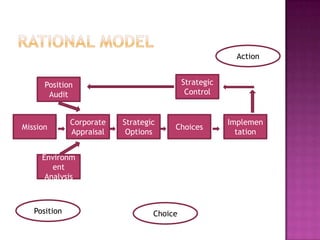
Rational modelActionStrategic ControlPosition AuditMissionCorporate AppraisalStrategic OptionsChoicesImplementationEnvironment AnalysisPositionChoice
Strategy lensesA way to understand an organization’s strategyAs design: logical process, forces and constraints weighed carefully, analytic and evaluative techniques to establish clear strategic direction. Implementation of planned action.As experience: adaptation of past strategies, what has gone before.As ideas: innovation, variety and diversity for generating new ideas.Example: Jaguar, BMW, Mercedes convertible
pestelShows macro-environmental influences that might affect organizationPolitical: government stability, taxation policy, foreign trade regulations, social welfare policiesEconomic: business cycles, GNP trends, interest rates, money supply, inflation, unemployment, disposable income.Socio-cultural: population demographics, income distribution, social mobility, lifestyle changes, attitudes to work and leisure, consumerism, levels of education.
pestelTechnological: govt spending on research, govt and industry focus on technological effort, new discoveries & developments, speed of technology transfer, rates of obsolescence.Environmental: EPLs, waste disposal, energy consumptionLegal: competition law, employment law, health and safety, product safety
5 forcesThis framework helps identify the sources of competition in an industry or sector:Forces strong – profits are weakForces weak – profits are strongTHREAT OF ENTRY: economies of scale, capital requirement, access to supply or distribution channels, customer or supplier loyalty, experience, expected retaliation, legislation or government action, differentiation
5 forcesTHREAT OF SUBSTITUTES: e-mail substitutes postal service, travel substitutes, product substitutes eye glasses, lenses, laser treatment, herbal medicine, medicine free way of life.POWER OF BUYER OR SUPPLIER: (buyer power) volume purchase, cost of switching, threat of acquiring the supplier (supplier power) few suppliers, switching cost high, competing directly with buyersRIVALRY: competitors: offer similar products to similar markets, more competition less profit, low growth affects profits, price wars, low differentiation.
Porter’s diamondCompetitive environment will differ between countries.Some nations are more competitive than others.The determinants of national advantage:Firm Strategy, structure, rivalryDemand ConditionsFactor ConditionsRelated & Support Industries
Porter’s diamondFactor conditions: human resources, physical resources, knowledge, capital, infrastructure.Home demand conditions: Japanese customers high expectations of electronic equipment provided impetus for those industries in Japan.Related and Support Industries: one successful industry may lead to advantage in related and support industry. Italy: leather foot wear, leather machinery, design services. Singapore, port services, ship repair services. Pakistan, textiles, cotton, ginning, weaving.
Porter’s diamondFirm strategy, industry and rivalry: bases of advantage. Germany: systematic, hierarchical processes, contributed to reliability and technical excellence in engineering industries. Domestic rivalry: Pharmaceutical industries in Switzerland.
Scenario planningScenarios are detailed and plausible views of how the business environment of an organization might develop in the future based on groupings of key environmental influences and drivers of change about which there is a high level of uncertainty.When environment has high level of uncertainty due to complexity or rapid change
Scenario planningApproach to understand the future impact of the environment10 years, 20 years or even morePredicting plausible futuresImproves organizational learningHow environment unfolds and influences strategies
Scenario planningKey drivers for change:Market globalization: similar needs, global customers, transferable marketingCost globalization: scale economies, sourcing efficiencies, country specific costs, high product development costsGlobalization of competition: interdependence, competitors global, high exports/importsGlobalization of govt policies: trade policies, technical standards, host government policies
Cycle of competitionIncumbentEntrantBuilds BarriersAttacks soft market segmentsNo responseWidens attack to adjacent segmentsReinforces barriersStarts price warsAttacks entrant’s home marketRestart the cycle in adjacent market

Environmental Models

  • 1.
    P 3 Businessanalysisenvironmental modelsRevision Class
  • 2.
    Rational modelActionStrategic ControlPositionAuditMissionCorporate AppraisalStrategic OptionsChoicesImplementationEnvironment AnalysisPositionChoice
  • 3.
    Strategy lensesA wayto understand an organization’s strategyAs design: logical process, forces and constraints weighed carefully, analytic and evaluative techniques to establish clear strategic direction. Implementation of planned action.As experience: adaptation of past strategies, what has gone before.As ideas: innovation, variety and diversity for generating new ideas.Example: Jaguar, BMW, Mercedes convertible
  • 4.
    pestelShows macro-environmental influencesthat might affect organizationPolitical: government stability, taxation policy, foreign trade regulations, social welfare policiesEconomic: business cycles, GNP trends, interest rates, money supply, inflation, unemployment, disposable income.Socio-cultural: population demographics, income distribution, social mobility, lifestyle changes, attitudes to work and leisure, consumerism, levels of education.
  • 5.
    pestelTechnological: govt spendingon research, govt and industry focus on technological effort, new discoveries & developments, speed of technology transfer, rates of obsolescence.Environmental: EPLs, waste disposal, energy consumptionLegal: competition law, employment law, health and safety, product safety
  • 6.
    5 forcesThis frameworkhelps identify the sources of competition in an industry or sector:Forces strong – profits are weakForces weak – profits are strongTHREAT OF ENTRY: economies of scale, capital requirement, access to supply or distribution channels, customer or supplier loyalty, experience, expected retaliation, legislation or government action, differentiation
  • 7.
    5 forcesTHREAT OFSUBSTITUTES: e-mail substitutes postal service, travel substitutes, product substitutes eye glasses, lenses, laser treatment, herbal medicine, medicine free way of life.POWER OF BUYER OR SUPPLIER: (buyer power) volume purchase, cost of switching, threat of acquiring the supplier (supplier power) few suppliers, switching cost high, competing directly with buyersRIVALRY: competitors: offer similar products to similar markets, more competition less profit, low growth affects profits, price wars, low differentiation.
  • 8.
    Porter’s diamondCompetitive environmentwill differ between countries.Some nations are more competitive than others.The determinants of national advantage:Firm Strategy, structure, rivalryDemand ConditionsFactor ConditionsRelated & Support Industries
  • 9.
    Porter’s diamondFactor conditions:human resources, physical resources, knowledge, capital, infrastructure.Home demand conditions: Japanese customers high expectations of electronic equipment provided impetus for those industries in Japan.Related and Support Industries: one successful industry may lead to advantage in related and support industry. Italy: leather foot wear, leather machinery, design services. Singapore, port services, ship repair services. Pakistan, textiles, cotton, ginning, weaving.
  • 10.
    Porter’s diamondFirm strategy,industry and rivalry: bases of advantage. Germany: systematic, hierarchical processes, contributed to reliability and technical excellence in engineering industries. Domestic rivalry: Pharmaceutical industries in Switzerland.
  • 11.
    Scenario planningScenarios aredetailed and plausible views of how the business environment of an organization might develop in the future based on groupings of key environmental influences and drivers of change about which there is a high level of uncertainty.When environment has high level of uncertainty due to complexity or rapid change
  • 12.
    Scenario planningApproach tounderstand the future impact of the environment10 years, 20 years or even morePredicting plausible futuresImproves organizational learningHow environment unfolds and influences strategies
  • 13.
    Scenario planningKey driversfor change:Market globalization: similar needs, global customers, transferable marketingCost globalization: scale economies, sourcing efficiencies, country specific costs, high product development costsGlobalization of competition: interdependence, competitors global, high exports/importsGlobalization of govt policies: trade policies, technical standards, host government policies
  • 14.
    Cycle of competitionIncumbentEntrantBuildsBarriersAttacks soft market segmentsNo responseWidens attack to adjacent segmentsReinforces barriersStarts price warsAttacks entrant’s home marketRestart the cycle in adjacent market