Understanding Corporate Annual Reports 
Financial Accounting 1A – Online 
 
Samanvitha Basole (group leader) 
Lori Kroon 
Kevin Seng 
Steve Tran 
 
Dr. Seyedin 
References:  
www.ibm.com/financial guide 
             ​www.sec.gov 
 
A. What is an annual report? 
An annual report is a formal report on a company's performance in the preceding year. It 
reports how the company did financially and often explains the scope of its business mission and 
management philosophy. A public company produces an annual report for its stockholders, the 
people and institutions who own the company. 
 
B. Name the federal government agency that requires a publicly held corporation to keep 
shareholders informed of its state of business. 
The Securities and Exchange Commission (SEC), a U.S. government agency, requires a 
public company to keep stockholders informed regularly on the state of its business. 
 
C. What is the purpose of auditing financial statements?  
The purpose of an audit is to attempt to determine whether a company's financial 
statements report the company's financial status accurately and reliably. 
 
D. What is the name of rules and regulations used to prepare financial statements? 
The rules and regulation that is prepare for the financial statement would be Association, 
such as Financial Accounting Standards Board (FASB ), a private organization of accounting 
professionals, the Securities and Exchange Commission (SEC), and the U.S. Gov’t agency, 
which is helped to develop the rules and guidelines. Those rules and regulation is needed because 
it help ensure that the financial information report is reliable and consistent.   
 
E. Name two other primary financial information sources? 
The two primary financial information source is the SEC FORM 10­K, which requires 
companies to submit yearly. Next would be the interim financial report to stockholders and file 
an unaudited SEC Form 10­Q quarterly, which provides an aggregated data from the quarter to 
year of date.  
 
F. What type of information is provided in the statement of earnings (also called income 
statement or profit and loss statement)? Please be as brief as possible. 
The information that is provided in the statement of earnings would be examining the 
company’s profitability. It indicates how much revenue the company brings into the business by 
providing goods or services, or both to its customer for the set time, which is usual in the 
one­year period. In addition, it provides the costs and expenses associated with the earning of the 
revenue during the period. Next, the statement earning includes the following: 
 ­ Revenue 
­ Gross Profit 
­ Operating income 
­ Net earnings 
­ Earnings per share 
 
G. What type of information is provided in the statement of financial position (also called 
balance sheet)? Please be as brief as possible. 
The statement of financial position reports the entity’s financial status as of a specific 
date.  It includes the company’s assets, liabilities, and the owner’s equity.  
 
H. What type of information is provided in the statement of cash flows? Please be as brief 
as possible. 
Statement of cash flow provides the flow of cash going in and out of a company during a 
period. 
 
I.  Briefly explain the purpose of Public Company Accounting Oversight Board (PCAOB). 
PCAOB is a non profit corporation created by congress to review and oversee the audits 
of public companies to verify the accuracy of the audit reports. 
 
J. Under the new rules of the Sarbanes ­ Oxley Act of 2002, to whom does an auditor 
report? 
Under the rules of the Sarbanes ­ Oxley Act of 2002, an auditor must report all of its 
work paper and other information related to any audit report to the Public Company Accounting 
Oversight Board (“Board). The Board consist of five financially­literate members and are 
appointed for five­year terms. 
 
K. What caused the new rules to be created? 
The Sarbanes ­ Oxley Act of 2002 was created to improve the accuracy of corporate 
disclosure. In the early 2000s, there were numerous of companies, such as Enron and Worldcom, 
that were having high profile financial scandals. These acts improve corporate governance and 
accountability and forces all companies to comply by its rules. Additionally, the acts pose much 
stronger consequences than previous acts if companies fail to comply to its rules.  
 
L. Under the news rules of the Sarbanes ­ Oxley Act of 2002, name eight types of services 
that are “unlawful” if provided to a publicly held company by its auditor. 
The news of the Sarbanes ­ Oxley Act of 2002 find the following services “unlawful” if 
provided to publicly held company  by its auditor: 
­ Bookkeeping or other services related to the accounting records of the audit client 
­ Financial Information system design and implementation 
­ Appraisal or Valuation Services 
­ Actuarial services 
­ Internal Audit Outsourcing services 
­ Broker or dealer service 
­ Legal Services and Expert services 
 
M. What is the mission of SEC?  
The mission of the U.S. Securities and Exchange Commission is to protect investors, 
maintain fair, orderly, and efficient markets, and facilitate capital formation. 
 
N. How many commissioners does SEC have and who appoints them?  
The SEC has five Commissioners who are appointed by the President of the United States 
with the advice and consent of the Senate. 
 
O. How many divisions and offices does SEC have? 
 The SEC has 5 divisions, and it has 22 offices. 
 
P. Briefly explain the Securities Act of 1933 and the Securities Exchange Act of 1934. 
The primary purpose of the '33 Act is to ensure that buyers of securities receive complete 
and accurate information before they invest in securities. The Securities Exchange Act of 1934 is 
a law governing the ​secondary trading​ of securities in the United States of America. These 
securities include ​stocks​, ​bonds​, and ​debentures​. The act “requires that any offer or sale of 
securities​ using the means and instrumentalities of interstate commerce be registered with the 
SEC pursuant to the 1933 Act, unless an exemption from registration exists under the 
law”(Wikipedia).  
 
Reference: 
http://www.cisco.com/web/about/ac49/ac20/ac19/ar2013/docs/2013_Annual_Report.pdf 
 
1. What is the address of CISCO's website?  
The CISCO website address is.   www.cisco.com. 
 
2. When was the 2013 annual shareholders' meeting?  
The meeting was held on Tuesday, November 19, 2013 at 10 a.m. Pacific Time. 
 
3. Where was the 2013 annual shareholders' meeting?  
The meeting was held at the following address:  
Cisco Systems, Inc.  
Building 9 
260 East Tasman Drive  
San Jose, CA 95134. 
 
4. Who is the corporation's transfer agent?  
CISCO’s transfer agent is Computershare Investor Services.  
 
5. Where is the agent located?  
The transfer agent is located at the following address: 
Computershare Investor Services 
P.O. Box 43078  
Providence, RI 
 02940­3078. 
 
6. What is CISCO's stock ticker symbol (Sym)?  
CISCO's stock ticker symbol is CSCO. 
 
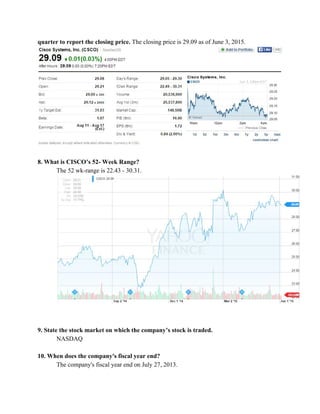
7.   Go to​ ​http://finance.yahoo.com​, type in the company’s ticker symbol to obtain and state 
the closing price of the common stock. You may choose any day you wish in this academic 
quarter to report the closing price. ​The closing price is 29.09 as of June 3, 2015.
 
 
8. What is CISCO’s 52­ Week Range? 
The 52 wk­range is 22.43 ­ 30.31. 


9. State the stock market on which the company’s stock is traded. 
NASDAQ 
 
10. ​When does the company's fiscal year end?  
  The company's fiscal year end on July 27, 2013. 
 
11. What is the name of the Certified Public Accounting firm that audited the annual 
report? 
The independent registered accounting firm is  
PricewaterhouseCoopers LLP located in San Jose, California. 
  
12. What goals, objectives, and predictions are expressed in the “Letter to the 
Stockholders”? 
In the “Letter to the Stockholders”, Cisco tells their stockholders that they want to 
manage their business as a portfolio and increase their strategic position in the market. Cisco also 
want to improve their ways of helping customers solve their business requirements. The 
company admit they had a flat fiscal year. But by acquiring numerous companies, Cisco believe 
they will win large multi­year service deals and more customers. With these ambitious objectives 
and new partners, Cisco aim to be the number one IT company.   
 
13. What is the company’s Current Ratio? What does it express? 
Cisco’s Current Ratio is calculated by dividing the total current assets by the total current 
liabilities: 
Total Current Assets = $65,521 million, Total Current Liabilities = $22,192 million 
$65,521 million / $22,192 million = 2.95. 
Cisco’s current ratio is 2.95. The current ratio measures a company’s ability to pay current 
liabilities with its current asset. The company’s Current Ratio expresses how much liquidity 
Cisco has. Cisco has a strong current ratio which indicates that the business has enough assets to 
maintain business operations.  
 
14. What is the company’s Working Capital? What does it express? 
Cisco’s Working Capital is calculated by total current assets less total current liabilities: 
Total Current Assets  $65,521 million 
Total Current Liabilities  $22,192​ million 
Working Capital  $43,329​ million  
The Working Capital expresses how much money has at its disposal to money it needs to 
pay out in the near future. A positive working capital ensure the firm that it has enough funds to 
manage short­term debt and operational expenses.  
 
15. What is the company’s debt to stockholders’ equity Ratio? What does it express? 
CISCO’s total liabilities are $42,063 
  CISCO’s SE is $59,120 
   Debt to SE ratio is 42,063/59,120 
  Debt to SE ratio = 71.1% 
  This number expresses the ratio of debt relative to equity financing. This ratio 
shows whether the company raises capital, financing, through debt or equity.  
 
16. What is the company’s Accounts Receivable Turnover?  What does it express? 
  The company’s accounts receivable turnover is calculated by the total revenue over the 
average net accounts receivable. Next, the average net accounts receivable is calculated by 
adding the beginning accounts receivable to the ending accounts receivable and dividing by 2.  
Accounts Receivable Turnover = Sales for period / Average Accounts Receivable for 
period 
  
2013 
Net Sales  $48,607 million 
Accounts Receivable (net): 
Beginning of year $9,799 million 
End of year  $7,925​ million 
Total  $17,724​ million 
Average (Total/2)  $8,862 million 
  
Accounts Receivable Turnover = $48,607 million / $8,862 million 
Accounts Receivable Turnover = 5.48 
  
$48,607 / $8862 = 5.48, which measures and expresses the ability to collect, cash from 
the credit customers. Accounts Receivable Turnover is used to measure of how quickly 
customers pay their bills. 
 
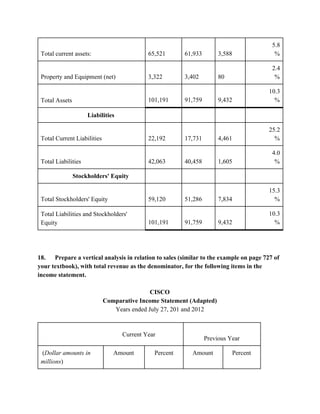
17. Comparative Balance Sheet­ Horizontal Analysis 
 
CISCO 
Balance Sheet (Adapted) 
July 27, 2013 and July 28, 2012 
  
Increase 
(Decrease) 
(Dollar amounts in millions) 
201
3 
20
12 
A
mount 
Perc
entage 
Assets             
Total current assets: 
 
65,521 
 
61,933 
 
3,588 
5.8
% 
Property and Equipment (net) 
 
3,322 
 
3,402 
 
80 
2.4
% 
Total Assets 
 
101,191 
 
91,759 
 
9,432 
10.3
% 
Liabilities             
Total Current Liabilities 
 
22,192 
 
17,731 
 
4,461 
25.2
% 
Total Liabilities 
 
42,063 
 
40,458 
 
1,605 
4.0
% 
Stockholders' Equity             
Total Stockholders' Equity 
 
59,120 
 
51,286 
 
7,834 
15.3
% 
Total Liabilities and Stockholders' 
Equity 
 
101,191 
 
91,759 
 
9,432 
10.3
% 
         
 
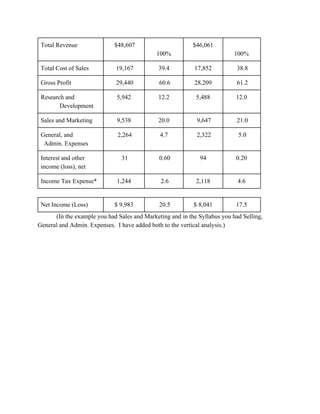
18.      Prepare a vertical analysis in relation to sales (similar to the example on page 727 of 
your textbook), with total revenue as the denominator, for the following items in the 
income statement. 
 
CISCO 
Comparative Income Statement (Adapted) 
Years ended July 27, 201 and 2012  
  
                                                    Current Year 
  
Previous Year 
 (​Dollar amounts in 
millions​) 
Amount  Percent  Amount  Percent 
Total Revenue   $48,607    
100% 
$46,061     
100% 
Total Cost of Sales    19,167  39.4   17,852    38.8 
Gross Profit    29,440   60.6  28,209    61.2 
Research and 
  Development 
5,942   12.2   5,488   12.0  
Sales and Marketing  9,538   20.0    9,647   21.0 
General, and 
  Admin. Expenses 
 2,264  4.7   2,322   5.0 
Interest and other 
income (loss), net 
 31   0.60  94   0.20  
Income Tax Expense*  1,244    2.6  2,118   4.6  
 
Net Income (Loss)  $ 9,983    20.5  $ 8,041   17.5  
(In the example you had Sales and Marketing and in the Syllabus you had Selling, 
General and Admin. Expenses.  I have added both to the vertical analysis.) 
 

Accounting Report for CISCO