KIESO – WEYGANDT – WARFIELD – YOUNG – WIECEK - MCCONOMY
INTERMEDIATE
ACCOUNTING
ELEVENTH CANADIAN EDITION
VOLUME 2
Prepared by:
Tammy Crowell CPA, CA, MBA
Dalhousie University
CHAPTER 22:
STATEMENT OF CASH FLOWS
2
Cash Flows from a Business Perspective
• A lack of cash flow is one of the main
causes of bankruptcy
• A sign of a healthy company is positive cash
flows from operations
• Over the years, the statement of cash
flows has grown in importance
• Helps users answer many questions such as:
• Will the company be able to pay dividends?
• How was the acquisition of the new subsidiary
financed?
3
Purpose and Usefulness of the
Statement of Cash Flows
• The information helps users (investors,
creditors, and others) assess the following:
1. Liquidity and solvency – i.e., the entity’s ability
to generate future cash flows and its needs for
cash resources
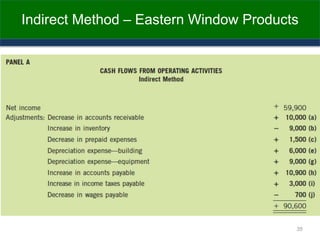
2. The amounts, timing, and uncertainty of future
cash flows
3. The reasons why net income and net cash
flow from operating activities differ
4
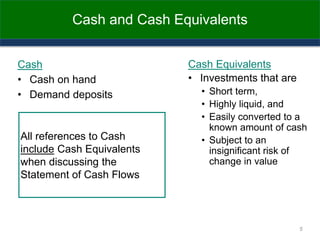
Cash and Cash Equivalents
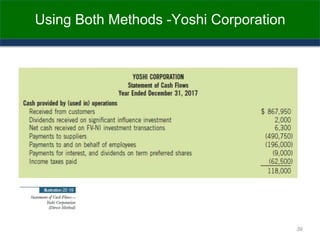
Cash
• Cash on hand
• Demand deposits
Cash Equivalents
• Investments that are
• Short term,
• Highly liquid, and
• Easily converted to a
known amount of cash
• Subject to an
insignificant risk of
change in value
All references to Cash
include Cash Equivalents
when discussing the
Statement of Cash Flows
5
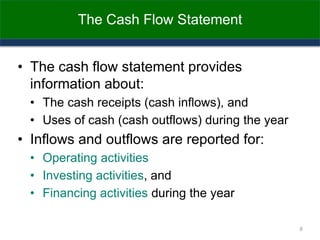
The Cash Flow Statement
• The cash flow statement provides
information about:
• The cash receipts (cash inflows), and
• Uses of cash (cash outflows) during the year
• Inflows and outflows are reported for:
• Operating activities
• Investing activities, and
• Financing activities during the year
6
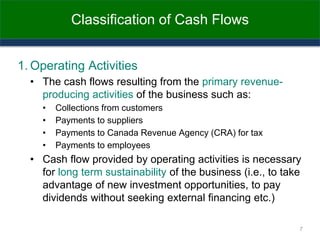
Classification of Cash Flows
1. Operating Activities
• The cash flows resulting from the primary revenue-
producing activities of the business such as:
• Collections from customers
• Payments to suppliers
• Payments to Canada Revenue Agency (CRA) for tax
• Payments to employees
• Cash flow provided by operating activities is necessary
for long term sustainability of the business (i.e., to take
advantage of new investment opportunities, to pay
dividends without seeking external financing etc.)
7
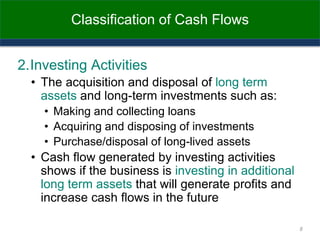
Classification of Cash Flows
2.Investing Activities
• The acquisition and disposal of long term
assets and long-term investments such as:
• Making and collecting loans
• Acquiring and disposing of investments
• Purchase/disposal of long-lived assets
• Cash flow generated by investing activities
shows if the business is investing in additional
long term assets that will generate profits and
increase cash flows in the future
8
Classification of Cash Flows
3.Financing Activities
• Changes in long-term debt or equity capital
such as:
• Issuing or repayment of debt
• Issuing new shares or repurchase of currently
outstanding shares
• Provides information to assess potential for
future claims to entity’s cash and major
changes in the form of financing
9
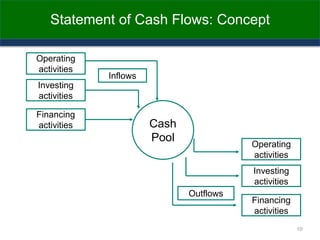
Statement of Cash Flows: Concept
Operating
activities
Investing
activities
Financing
activities
Inflows
Cash
Pool
Operating
activities
Investing
activities
Financing
activities
Outflows
10
Classification of Cash Flows
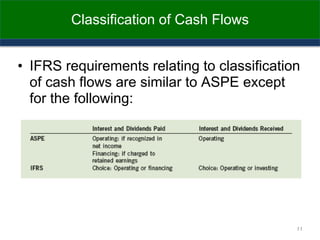
• IFRS requirements relating to classification
of cash flows are similar to ASPE except
for the following:
11
Classification of Cash Flows
• Income statement gains and losses on
disposal of long-term assets must be
adjusted in determining cash flows from
operations
• These result from investing activities, not
operating activities
• The amount of the cash flow is the proceeds
on disposal not the gain or loss included in
income
12
Classification of Cash Flows
• Income statement gains and losses on
redemption of long-term debt must be
adjusted in determining cash flows from
operations
• These result from financing activities, not
operating activities, and
• The amount of the cash flow is the amount
paid to redeem the debt not the gain or loss
included in income
13
Significant Non-Cash Transactions
• Transactions that do not involve the direct receipt or
disbursement of cash in the period such as:
• Asset purchased and paid for by assuming debt, or issuance
of shares
• Exchanges of non-monetary assets
• Conversion of debt to equity
• Issuance of shares to retire debt
• Non-cash transactions are not reported on the
Statement of Cash Flows
• If material, they are reported as notes to the statement
or in a supplementary schedule to the financial
statements
14
Format of the Statement of Cash Flows
• Two methods of preparing the operating cash
flow section of the Statement of Cash Flows:
1. Indirect method
• Derives operating cash flows from accrual
basis income statement
2. Direct method
• Determines operating cash flows directly for
each operating source or use of cash
15
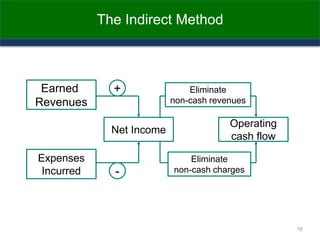
The Indirect Method
Net Income
+
-
Earned
Revenues
Expenses
Incurred
Operating
cash flow
Eliminate
non-cash revenues
Eliminate
non-cash charges
16
The Indirect Method
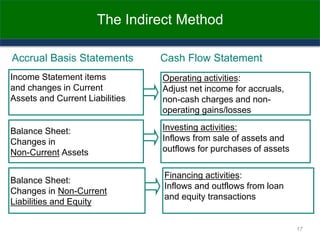
Accrual Basis Statements Cash Flow Statement
Income Statement items
and changes in Current
Assets and Current Liabilities
Operating activities:
Adjust net income for accruals,
non-cash charges and non-
operating gains/losses
Balance Sheet:
Changes in
Non-Current Assets
Investing activities:
Inflows from sale of assets and
outflows for purchases of assets
Balance Sheet:
Changes in Non-Current
Liabilities and Equity
Financing activities:
Inflows and outflows from loan
and equity transactions
17
Format of the Statement of
Cash Flows (Indirect Method)
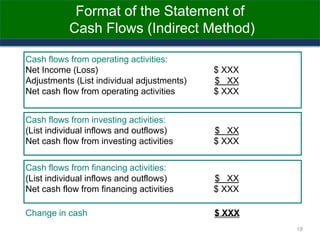
Cash flows from operating activities:
Net Income (Loss) $ XXX
Adjustments (List individual adjustments) $ XX
Net cash flow from operating activities $ XXX
Cash flows from investing activities:
(List individual inflows and outflows) $ XX
Net cash flow from investing activities $ XXX
Cash flows from financing activities:
(List individual inflows and outflows) $ XX
Net cash flow from financing activities $ XXX
Change in cash $ XXX
18
The Direct Method
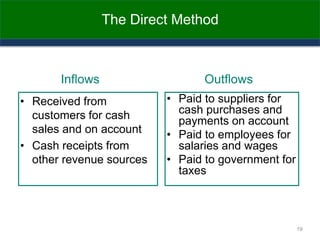
• Received from
customers for cash
sales and on account
• Cash receipts from
other revenue sources
Outflows
Inflows
• Paid to suppliers for
cash purchases and
payments on account
• Paid to employees for
salaries and wages
• Paid to government for
taxes
19
Format of the Statement of Cash Flows
(Direct Method)
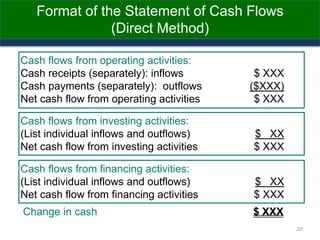
Cash flows from operating activities:
Cash receipts (separately): inflows $ XXX
Cash payments (separately): outflows ($XXX)
Net cash flow from operating activities $ XXX
Cash flows from financing activities:
(List individual inflows and outflows) $ XX
Net cash flow from financing activities $ XXX
Cash flows from investing activities:
(List individual inflows and outflows) $ XX
Net cash flow from investing activities $ XXX
Change in cash $ XXX
20
Format of the Statement of Cash Flows
• Both IFRS and ASPE encourage the use of the
direct method as it provides additional information
• More consistent with the objective of the statement of
cash flows
• Information about specific sources of cash inflows and
purposes of cash outflows helps in estimating future
cash flows
• Lending officers and other investors also prefer
the direct method
21
Direct Method - Example
Given:
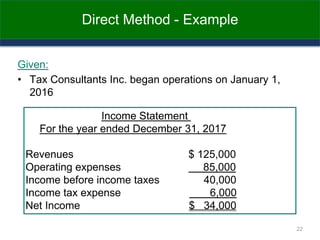
• Tax Consultants Inc. began operations on January 1,
2016
Income Statement
For the year ended December 31, 2017
Revenues $ 125,000
Operating expenses 85,000
Income before income taxes 40,000
Income tax expense 6,000
Net Income $ 34,000
22
Direct Method - Example
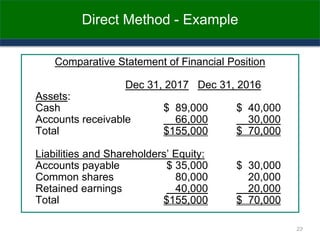
Comparative Statement of Financial Position
Dec 31, 2017 Dec 31, 2016
Assets:
Cash $ 89,000 $ 40,000
Accounts receivable 66,000 30,000
Total $155,000 $ 70,000
Liabilities and Shareholders’ Equity:
Accounts payable $ 35,000 $ 30,000
Common shares 80,000 20,000
Retained earnings 40,000 20,000
Total $155,000 $ 70,000
23
Direct Method – Example
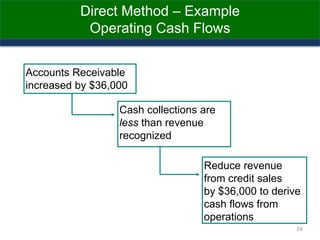
Operating Cash Flows
Accounts Receivable
increased by $36,000
Cash collections are
less than revenue
recognized
Reduce revenue
from credit sales
by $36,000 to derive
cash flows from
operations
24
Direct Method – Example
Operating Cash Flows
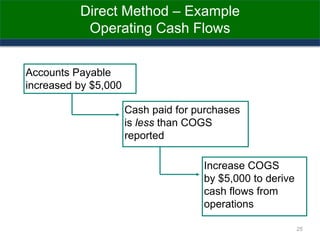
Accounts Payable
increased by $5,000
Cash paid for purchases
is less than COGS
reported
Increase COGS
by $5,000 to derive
cash flows from
operations
25
Direct Method – Example
Operating Cash Flows
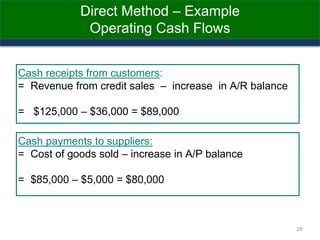
Cash receipts from customers:
= Revenue from credit sales – increase in A/R balance
= $125,000 – $36,000 = $89,000
Cash payments to suppliers:
= Cost of goods sold – increase in A/P balance
= $85,000 – $5,000 = $80,000
26
Direct Method – Example
Operating Cash Flows
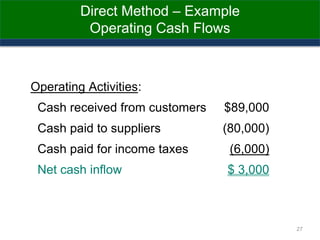
Operating Activities:
Cash received from customers $89,000
Cash paid to suppliers (80,000)
Cash paid for income taxes (6,000)
Net cash inflow $ 3,000
27
Investing and
Financing Cash Flows
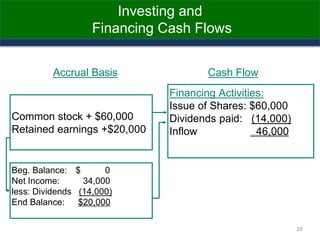
Accrual Basis
Common stock + $60,000
Retained earnings +$20,000
Beg. Balance: $ 0
Net Income: 34,000
less: Dividends (14,000)
End Balance: $20,000
Cash Flow
Financing Activities:
Issue of Shares: $60,000
Dividends paid: (14,000)
Inflow 46,000
28
Direct Method – Example
Summary
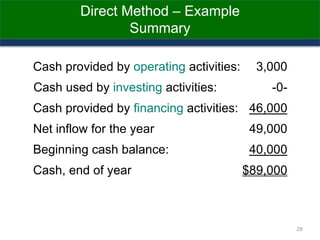
Cash provided by operating activities: 3,000
Cash used by investing activities: -0-
Cash provided by financing activities: 46,000
Net inflow for the year 49,000
Beginning cash balance: 40,000
Cash, end of year $89,000
29
Indirect Method – Eastern Window Products
The company’s comparative financial statements are
provided in Illustration 22-10
Determine cash flows from operating activities
Under the indirect method you will start with net income
and adjust working capital to arrive at cash inflows and
outflows
The adjustments made for operating activities are
provided in Illustration 22-11 Panel A
30
Indirect Method – Eastern Window Products
• For each current asset and current liability, the
change in the account will require an adjustment
to net income to arrive at operating cash flow
• Receivables have gone down so this will be
added to net income as receipts from customers
were $10,000 more than revenues reported
31
Indirect Method – Eastern Window Products
• Inventory has increased by $9,000 reducing
transferred costs to cost of goods sold, requiring
net income to be reduced by this amount to
obtain the effect on cash from operating activities
• Prepaid Expenses have decreased by $1,500,
requiring net income to be increased by this
amount to obtain the effect on cash from
operating activities, as a greater amount was
expensed as compared to cash payments
32
Indirect Method – Eastern Window Products
• Accumulated depreciation has gone up entirely
due to depreciation, a non-cash expense, which
needs to be added back to the income statement
to arrive at a cash basis
• Accounts payable have increased therefore cash
payments must have been less than amounts
expensed, and needs to be added back to net
income
33
Indirect Method – Eastern Window Products
• Income taxes payable and wages payable have
increased, therefore the expense is higher than the
payments, requiring an add back to net income
• Net income accounts for $59,900 of the increase in
retained earnings, with the remainder of the
change being dividends
• This is required to be treated as a financing outflow
under ASPE and is permitted under IFRS with the
alternative recognition as an operating outflow
34
Indirect Method – Eastern Window Products
35
Using Both Methods -Yoshi Corporation
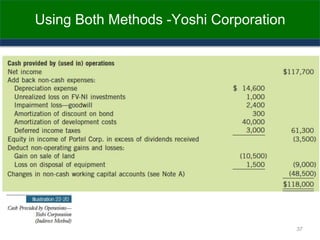
• Using the indirect method, all changes in working
capital items as well as non-cash items are
adjusted to and from net income to arrive at cash
flow from operating activities
• See Illustration 22-20 on the next slide for cash
flows using the indirect method
36
37
Using Both Methods -Yoshi Corporation
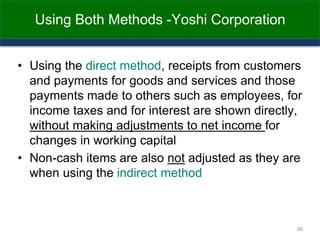
• Using the direct method, receipts from customers
and payments for goods and services and those
payments made to others such as employees, for
income taxes and for interest are shown directly,
without making adjustments to net income for
changes in working capital
• Non-cash items are also not adjusted as they are
when using the indirect method
38
Using Both Methods -Yoshi Corporation
39
Using Both Methods -Yoshi Corporation
• Some accounts require further analysis in
determining their impact on operating cash flows,
such as:
• FV-NI Investments
• Accounts Receivable
• Allowance for Doubtful Accounts
• Investments
• Property, Plant and Equipment
Appendix 22A provides a Work Sheet approach which could
be used for the additional analysis required for a complex SCF
40
Disclosure Requirements
• IFRS and ASPE require similar disclosures on certain items,
including the disclosure of:
1. Significant non-cash investing and financing transactions
2. Policy on what makes up cash and cash equivalents
3. Reconciliation of cash and cash equivalents to balance
sheet accounts
• IFRS has more strict requirements relating to disclosure of
some items, including:
1. Income taxes
2. Interest and dividends (paid and received)
3. Restrictions on cash and cash equivalents
41
Analyzing the Statement of Cash Flows
• Operating cash flows indicate the extent to which
cash receipts from customers and other
operating sources were able to cover cash
payments to suppliers of goods and services and
to employees, and for other operating
expenditures
42
Analyzing the Statement of Cash Flows
• The investing activities section will show outflows
for new business assets
• It is important to understand whether the new
investment just maintains the existing capacity of
a company
OR
• Whether the investment increases the potential
for higher levels of operating cash flows in the
future
43
Analyzing the Statement of Cash Flows
• The financing activities section captures what
changes took place to the firm’s capital structure
and whether the entity increased or reduced the
claims of creditors to cash in the future
44
Free Cash Flow
• Free cash flow (FCF) is a non-GAAP measure used
by many companies to indicate discretionary cash
available for new investments, paying dividends,
retiring debt, repurchasing shares, or improving
liquidity
• FCF is typically calculated as:
• Net operating cash flows
• Less: capital expenditures to sustain current level
operations
• As it is a non-GAAP measure, some companies
calculate FCF differently
45
Copyright © 2016 John Wiley & Sons Canada, Ltd. All rights
reserved. Reproduction or translation of this work beyond that
permitted by Access Copyright (The Canadian Copyright
Licensing Agency) is unlawful. Requests for further information
should be addressed to the Permissions Department, John
Wiley & Sons Canada, Ltd. The purchaser may make back-up
copies for his or her own use only and not for distribution or
resale. The author and the publisher assume no responsibility
for errors, omissions, or damages caused by the use of these
programs or from the use of the information contained herein.
COPYRIGHT

3. STATEMENT OF CASH FLOWS.pptx

  • 1.
    KIESO – WEYGANDT– WARFIELD – YOUNG – WIECEK - MCCONOMY INTERMEDIATE ACCOUNTING ELEVENTH CANADIAN EDITION VOLUME 2 Prepared by: Tammy Crowell CPA, CA, MBA Dalhousie University
  • 2.
  • 3.
    Cash Flows froma Business Perspective • A lack of cash flow is one of the main causes of bankruptcy • A sign of a healthy company is positive cash flows from operations • Over the years, the statement of cash flows has grown in importance • Helps users answer many questions such as: • Will the company be able to pay dividends? • How was the acquisition of the new subsidiary financed? 3
  • 4.
    Purpose and Usefulnessof the Statement of Cash Flows • The information helps users (investors, creditors, and others) assess the following: 1. Liquidity and solvency – i.e., the entity’s ability to generate future cash flows and its needs for cash resources 2. The amounts, timing, and uncertainty of future cash flows 3. The reasons why net income and net cash flow from operating activities differ 4
  • 5.
    Cash and CashEquivalents Cash • Cash on hand • Demand deposits Cash Equivalents • Investments that are • Short term, • Highly liquid, and • Easily converted to a known amount of cash • Subject to an insignificant risk of change in value All references to Cash include Cash Equivalents when discussing the Statement of Cash Flows 5
  • 6.
    The Cash FlowStatement • The cash flow statement provides information about: • The cash receipts (cash inflows), and • Uses of cash (cash outflows) during the year • Inflows and outflows are reported for: • Operating activities • Investing activities, and • Financing activities during the year 6
  • 7.
    Classification of CashFlows 1. Operating Activities • The cash flows resulting from the primary revenue- producing activities of the business such as: • Collections from customers • Payments to suppliers • Payments to Canada Revenue Agency (CRA) for tax • Payments to employees • Cash flow provided by operating activities is necessary for long term sustainability of the business (i.e., to take advantage of new investment opportunities, to pay dividends without seeking external financing etc.) 7
  • 8.
    Classification of CashFlows 2.Investing Activities • The acquisition and disposal of long term assets and long-term investments such as: • Making and collecting loans • Acquiring and disposing of investments • Purchase/disposal of long-lived assets • Cash flow generated by investing activities shows if the business is investing in additional long term assets that will generate profits and increase cash flows in the future 8
  • 9.
    Classification of CashFlows 3.Financing Activities • Changes in long-term debt or equity capital such as: • Issuing or repayment of debt • Issuing new shares or repurchase of currently outstanding shares • Provides information to assess potential for future claims to entity’s cash and major changes in the form of financing 9
  • 10.
    Statement of CashFlows: Concept Operating activities Investing activities Financing activities Inflows Cash Pool Operating activities Investing activities Financing activities Outflows 10
  • 11.
    Classification of CashFlows • IFRS requirements relating to classification of cash flows are similar to ASPE except for the following: 11
  • 12.
    Classification of CashFlows • Income statement gains and losses on disposal of long-term assets must be adjusted in determining cash flows from operations • These result from investing activities, not operating activities • The amount of the cash flow is the proceeds on disposal not the gain or loss included in income 12
  • 13.
    Classification of CashFlows • Income statement gains and losses on redemption of long-term debt must be adjusted in determining cash flows from operations • These result from financing activities, not operating activities, and • The amount of the cash flow is the amount paid to redeem the debt not the gain or loss included in income 13
  • 14.
    Significant Non-Cash Transactions •Transactions that do not involve the direct receipt or disbursement of cash in the period such as: • Asset purchased and paid for by assuming debt, or issuance of shares • Exchanges of non-monetary assets • Conversion of debt to equity • Issuance of shares to retire debt • Non-cash transactions are not reported on the Statement of Cash Flows • If material, they are reported as notes to the statement or in a supplementary schedule to the financial statements 14
  • 15.
    Format of theStatement of Cash Flows • Two methods of preparing the operating cash flow section of the Statement of Cash Flows: 1. Indirect method • Derives operating cash flows from accrual basis income statement 2. Direct method • Determines operating cash flows directly for each operating source or use of cash 15
  • 16.
    The Indirect Method NetIncome + - Earned Revenues Expenses Incurred Operating cash flow Eliminate non-cash revenues Eliminate non-cash charges 16
  • 17.
    The Indirect Method AccrualBasis Statements Cash Flow Statement Income Statement items and changes in Current Assets and Current Liabilities Operating activities: Adjust net income for accruals, non-cash charges and non- operating gains/losses Balance Sheet: Changes in Non-Current Assets Investing activities: Inflows from sale of assets and outflows for purchases of assets Balance Sheet: Changes in Non-Current Liabilities and Equity Financing activities: Inflows and outflows from loan and equity transactions 17
  • 18.
    Format of theStatement of Cash Flows (Indirect Method) Cash flows from operating activities: Net Income (Loss) $ XXX Adjustments (List individual adjustments) $ XX Net cash flow from operating activities $ XXX Cash flows from investing activities: (List individual inflows and outflows) $ XX Net cash flow from investing activities $ XXX Cash flows from financing activities: (List individual inflows and outflows) $ XX Net cash flow from financing activities $ XXX Change in cash $ XXX 18
  • 19.
    The Direct Method •Received from customers for cash sales and on account • Cash receipts from other revenue sources Outflows Inflows • Paid to suppliers for cash purchases and payments on account • Paid to employees for salaries and wages • Paid to government for taxes 19
  • 20.
    Format of theStatement of Cash Flows (Direct Method) Cash flows from operating activities: Cash receipts (separately): inflows $ XXX Cash payments (separately): outflows ($XXX) Net cash flow from operating activities $ XXX Cash flows from financing activities: (List individual inflows and outflows) $ XX Net cash flow from financing activities $ XXX Cash flows from investing activities: (List individual inflows and outflows) $ XX Net cash flow from investing activities $ XXX Change in cash $ XXX 20
  • 21.
    Format of theStatement of Cash Flows • Both IFRS and ASPE encourage the use of the direct method as it provides additional information • More consistent with the objective of the statement of cash flows • Information about specific sources of cash inflows and purposes of cash outflows helps in estimating future cash flows • Lending officers and other investors also prefer the direct method 21
  • 22.
    Direct Method -Example Given: • Tax Consultants Inc. began operations on January 1, 2016 Income Statement For the year ended December 31, 2017 Revenues $ 125,000 Operating expenses 85,000 Income before income taxes 40,000 Income tax expense 6,000 Net Income $ 34,000 22
  • 23.
    Direct Method -Example Comparative Statement of Financial Position Dec 31, 2017 Dec 31, 2016 Assets: Cash $ 89,000 $ 40,000 Accounts receivable 66,000 30,000 Total $155,000 $ 70,000 Liabilities and Shareholders’ Equity: Accounts payable $ 35,000 $ 30,000 Common shares 80,000 20,000 Retained earnings 40,000 20,000 Total $155,000 $ 70,000 23
  • 24.
    Direct Method –Example Operating Cash Flows Accounts Receivable increased by $36,000 Cash collections are less than revenue recognized Reduce revenue from credit sales by $36,000 to derive cash flows from operations 24
  • 25.
    Direct Method –Example Operating Cash Flows Accounts Payable increased by $5,000 Cash paid for purchases is less than COGS reported Increase COGS by $5,000 to derive cash flows from operations 25
  • 26.
    Direct Method –Example Operating Cash Flows Cash receipts from customers: = Revenue from credit sales – increase in A/R balance = $125,000 – $36,000 = $89,000 Cash payments to suppliers: = Cost of goods sold – increase in A/P balance = $85,000 – $5,000 = $80,000 26
  • 27.
    Direct Method –Example Operating Cash Flows Operating Activities: Cash received from customers $89,000 Cash paid to suppliers (80,000) Cash paid for income taxes (6,000) Net cash inflow $ 3,000 27
  • 28.
    Investing and Financing CashFlows Accrual Basis Common stock + $60,000 Retained earnings +$20,000 Beg. Balance: $ 0 Net Income: 34,000 less: Dividends (14,000) End Balance: $20,000 Cash Flow Financing Activities: Issue of Shares: $60,000 Dividends paid: (14,000) Inflow 46,000 28
  • 29.
    Direct Method –Example Summary Cash provided by operating activities: 3,000 Cash used by investing activities: -0- Cash provided by financing activities: 46,000 Net inflow for the year 49,000 Beginning cash balance: 40,000 Cash, end of year $89,000 29
  • 30.
    Indirect Method –Eastern Window Products The company’s comparative financial statements are provided in Illustration 22-10 Determine cash flows from operating activities Under the indirect method you will start with net income and adjust working capital to arrive at cash inflows and outflows The adjustments made for operating activities are provided in Illustration 22-11 Panel A 30
  • 31.
    Indirect Method –Eastern Window Products • For each current asset and current liability, the change in the account will require an adjustment to net income to arrive at operating cash flow • Receivables have gone down so this will be added to net income as receipts from customers were $10,000 more than revenues reported 31
  • 32.
    Indirect Method –Eastern Window Products • Inventory has increased by $9,000 reducing transferred costs to cost of goods sold, requiring net income to be reduced by this amount to obtain the effect on cash from operating activities • Prepaid Expenses have decreased by $1,500, requiring net income to be increased by this amount to obtain the effect on cash from operating activities, as a greater amount was expensed as compared to cash payments 32
  • 33.
    Indirect Method –Eastern Window Products • Accumulated depreciation has gone up entirely due to depreciation, a non-cash expense, which needs to be added back to the income statement to arrive at a cash basis • Accounts payable have increased therefore cash payments must have been less than amounts expensed, and needs to be added back to net income 33
  • 34.
    Indirect Method –Eastern Window Products • Income taxes payable and wages payable have increased, therefore the expense is higher than the payments, requiring an add back to net income • Net income accounts for $59,900 of the increase in retained earnings, with the remainder of the change being dividends • This is required to be treated as a financing outflow under ASPE and is permitted under IFRS with the alternative recognition as an operating outflow 34
  • 35.
    Indirect Method –Eastern Window Products 35
  • 36.
    Using Both Methods-Yoshi Corporation • Using the indirect method, all changes in working capital items as well as non-cash items are adjusted to and from net income to arrive at cash flow from operating activities • See Illustration 22-20 on the next slide for cash flows using the indirect method 36
  • 37.
    37 Using Both Methods-Yoshi Corporation
  • 38.
    Using Both Methods-Yoshi Corporation • Using the direct method, receipts from customers and payments for goods and services and those payments made to others such as employees, for income taxes and for interest are shown directly, without making adjustments to net income for changes in working capital • Non-cash items are also not adjusted as they are when using the indirect method 38
  • 39.
    Using Both Methods-Yoshi Corporation 39
  • 40.
    Using Both Methods-Yoshi Corporation • Some accounts require further analysis in determining their impact on operating cash flows, such as: • FV-NI Investments • Accounts Receivable • Allowance for Doubtful Accounts • Investments • Property, Plant and Equipment Appendix 22A provides a Work Sheet approach which could be used for the additional analysis required for a complex SCF 40
  • 41.
    Disclosure Requirements • IFRSand ASPE require similar disclosures on certain items, including the disclosure of: 1. Significant non-cash investing and financing transactions 2. Policy on what makes up cash and cash equivalents 3. Reconciliation of cash and cash equivalents to balance sheet accounts • IFRS has more strict requirements relating to disclosure of some items, including: 1. Income taxes 2. Interest and dividends (paid and received) 3. Restrictions on cash and cash equivalents 41
  • 42.
    Analyzing the Statementof Cash Flows • Operating cash flows indicate the extent to which cash receipts from customers and other operating sources were able to cover cash payments to suppliers of goods and services and to employees, and for other operating expenditures 42
  • 43.
    Analyzing the Statementof Cash Flows • The investing activities section will show outflows for new business assets • It is important to understand whether the new investment just maintains the existing capacity of a company OR • Whether the investment increases the potential for higher levels of operating cash flows in the future 43
  • 44.
    Analyzing the Statementof Cash Flows • The financing activities section captures what changes took place to the firm’s capital structure and whether the entity increased or reduced the claims of creditors to cash in the future 44
  • 45.
    Free Cash Flow •Free cash flow (FCF) is a non-GAAP measure used by many companies to indicate discretionary cash available for new investments, paying dividends, retiring debt, repurchasing shares, or improving liquidity • FCF is typically calculated as: • Net operating cash flows • Less: capital expenditures to sustain current level operations • As it is a non-GAAP measure, some companies calculate FCF differently 45
  • 46.
    Copyright © 2016John Wiley & Sons Canada, Ltd. All rights reserved. Reproduction or translation of this work beyond that permitted by Access Copyright (The Canadian Copyright Licensing Agency) is unlawful. Requests for further information should be addressed to the Permissions Department, John Wiley & Sons Canada, Ltd. The purchaser may make back-up copies for his or her own use only and not for distribution or resale. The author and the publisher assume no responsibility for errors, omissions, or damages caused by the use of these programs or from the use of the information contained herein. COPYRIGHT

Editor's Notes

  • #4 LO1 Understand the business importance of cash flows and describe the purpose and uses of the statement of cash flows.
  • #5 LO1 Understand the business importance of cash flows and describe the purpose and uses of the statement of cash flows.
  • #6 LO2 Define cash and cash equivalents.
  • #7 LO3 Identify the major classifications of cash flows and explain the significance of each classification.
  • #8 LO3 Identify the major classifications of cash flows and explain the significance of each classification.
  • #9 LO3 Identify the major classifications of cash flows and explain the significance of each classification.
  • #10 LO3 Identify the major classifications of cash flows and explain the significance of each classification.
  • #11 LO3 Identify the major classifications of cash flows and explain the significance of each classification.
  • #12 LO3 Identify the major classifications of cash flows and explain the significance of each classification.
  • #13 LO3 Identify the major classifications of cash flows and explain the significance of each classification.
  • #14 LO3 Identify the major classifications of cash flows and explain the significance of each classification.
  • #15 LO3 Identify the major classifications of cash flows and explain the significance of each classification.
  • #16 LO4 Prepare the operating activities section of a statement of cash flows using the direct versus the indirect method.
  • #17 LO4 Prepare the operating activities section of a statement of cash flows using the direct versus the indirect method.
  • #18 LO4 Prepare the operating activities section of a statement of cash flows using the direct versus the indirect method.
  • #19 LO4 Prepare the operating activities section of a statement of cash flows using the direct versus the indirect method.
  • #20 LO4 Prepare the operating activities section of a statement of cash flows using the direct versus the indirect method.
  • #21 LO4 Prepare the operating activities section of a statement of cash flows using the direct versus the indirect method.
  • #22 LO4 Prepare the operating activities section of a statement of cash flows using the direct versus the indirect method.
  • #23 LO5 Prepare a statement of cash flows using the direct method.
  • #24 LO5 Prepare a statement of cash flows using the direct method.
  • #25 LO5 Prepare a statement of cash flows using the direct method.
  • #26 LO5 Prepare a statement of cash flows using the direct method.
  • #27 LO5 Prepare a statement of cash flows using the direct method.
  • #28 LO5 Prepare a statement of cash flows using the direct method.
  • #29 LO5 Prepare a statement of cash flows using the direct method.
  • #30 LO5 Prepare a statement of cash flows using the direct method.
  • #31 LO6 Prepare a statement of cash flows using the indirect method.
  • #32 LO6 Prepare a statement of cash flows using the indirect method.
  • #33 LO6 Prepare a statement of cash flows using the indirect method.
  • #34 LO6 Prepare a statement of cash flows using the indirect method.
  • #35 LO6 Prepare a statement of cash flows using the indirect method.
  • #36 LO6 Prepare a statement of cash flows using the indirect method.
  • #37 LO7 Prepare a more complex statement of cash flows using both methods.
  • #38 LO7 Prepare a more complex statement of cash flows using both methods.
  • #39 LO7 Prepare a more complex statement of cash flows using both methods.
  • #40 LO7 Prepare a more complex statement of cash flows using both methods.
  • #41 LO7 Prepare a more complex statement of cash flows using both methods.
  • #42 LO8 Identify the financial presentation and disclosure requirements for the statement of cash flows.
  • #43 LO9 Read and interpret a statement of cash flows.
  • #44 LO9 Read and interpret a statement of cash flows.
  • #45 LO9 Read and interpret a statement of cash flows.
  • #46 LO9 Read and interpret a statement of cash flows.