-TRADITIONAL
BUILDING IN DELHI
CASE STUDY
-BY-KIRTI GARG
-B.VOC.[INTERIOR]
-3RD SEM
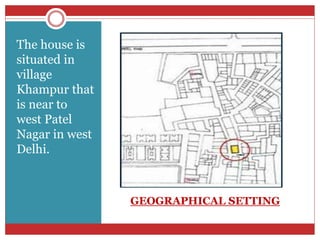
GEOGRAPHICAL SETTING
The house is
situated in
village
Khampur that
is near to
west Patel
Nagar in west
Delhi.
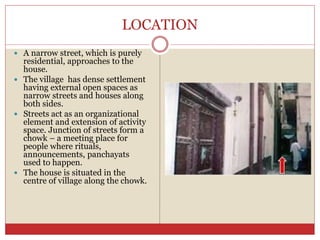
LOCATION
 A narrow street, which is purely
residential, approaches to the
house.
 The village has dense settlement
having external open spaces as
narrow streets and houses along
both sides.
 Streets act as an organizational
element and extension of activity
space. Junction of streets form a
chowk – a meeting place for
people where rituals,
announcements, panchayats
used to happen.
 The house is situated in the
centre of village along the chowk.
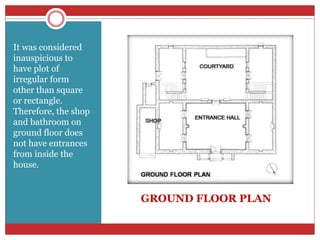
GROUND FLOOR PLAN
It was considered
inauspicious to
have plot of
irregular form
other than square
or rectangle.
Therefore, the shop
and bathroom on
ground floor does
not have entrances
from inside the
house.
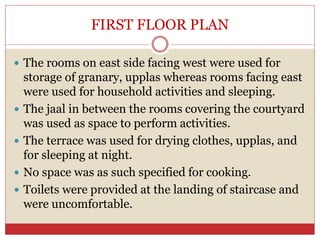
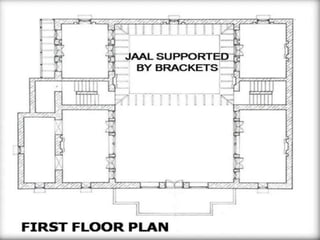
FIRST FLOOR PLAN
 The rooms on east side facing west were used for
storage of granary, upplas whereas rooms facing east
were used for household activities and sleeping.
 The jaal in between the rooms covering the courtyard
was used as space to perform activities.
 The terrace was used for drying clothes, upplas, and
for sleeping at night.
 No space was as such specified for cooking.
 Toilets were provided at the landing of staircase and
were uncomfortable.
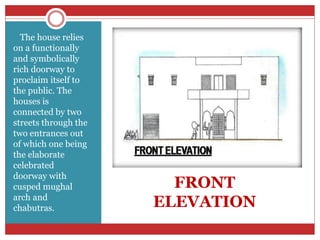
FRONT
ELEVATION
The house relies
on a functionally
and symbolically
rich doorway to
proclaim itself to
the public. The
houses is
connected by two
streets through the
two entrances out
of which one being
the elaborate
celebrated
doorway with
cusped mughal
arch and
chabutras.
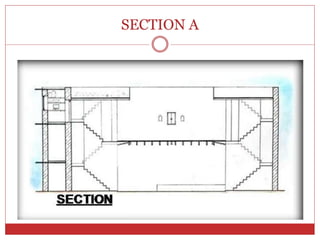
SECTION A
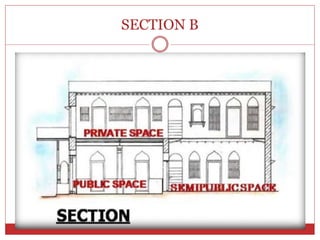
SECTION B
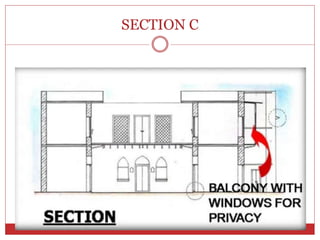
SECTION C
ZONING
 Vertical zoning existed in the house.
 Since the house was situated along the chowk where
rituals and panchayats used to happen, the ground floor
was predominantly occupied by males and outsiders and
was semi private area whereas the entrance being the
public space where males used to have meetings with
haukas.
 The first floor was used by females and was private space.
 Balcony provided on first floor was enclosed by windows
for privacy.
 No outsider could directly approach the first floor.
CLIMATE EFFECTS
 Delhi has composite climate.
 The house is located slightly north of west with the
elaborate entrance facing north and the other
entrance facing east.
 The walls out of stone with thickness of 400-500 mm
increase the thermal capacity (time lag) providing
cooler environment inside the house.
 A large number of openings and a courtyard increase
the air exchange rate and promote heat loss in
summer and decrease humidity in monsoon.
CLIMATE EFFECTS
 The chajja acts as a shading device for rooms on first
floor. Ventilators, toilets, windows and datts exhaust
the hot air.
 During evening, air is cool and therefore it settles
down creating a reservoir of cool air due to which
people prefer to sleep on terrace.
 Shop and bathroom area act as a barrier (baffle wall)
and divert the airflow to the entrance leading to the
courtyard.
CONSTRUCTION
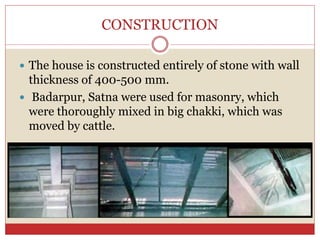
 The house is constructed entirely of stone with wall
thickness of 400-500 mm.
 Badarpur, Satna were used for masonry, which
were thoroughly mixed in big chakki, which was
moved by cattle.
CONSTRUCTION
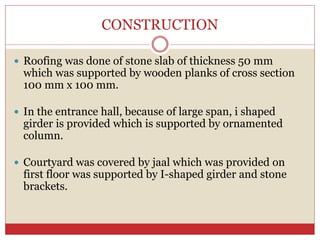
 Roofing was done of stone slab of thickness 50 mm
which was supported by wooden planks of cross section
100 mm x 100 mm.
 In the entrance hall, because of large span, i shaped
girder is provided which is supported by ornamented
column.
 Courtyard was covered by jaal which was provided on
first floor was supported by I-shaped girder and stone
brackets.
CONCLUSION
 The house speaks itself about the culture, the lifestyle, and the
influence of people living there.
 The built form is the resultant of various factors which include
climate, site conditions, family size, movement, need of
privacy, need of storage, need for shelter, social interaction,
material and technology and many more.
 Traditional Houses being the direct expression of changing
values, images, perception, and ways of life become a fruitful
study.
 Different cultures and sub cultures coexist in our cities with
consequent need for different housing and settlement pattern.
 The influence of man, particularly his personality, in
traditional building is less than what we find today, and such
influences do not exist individual or personal but of groups.

case study- traditinal building.pptx

  • 1.
    -TRADITIONAL BUILDING IN DELHI CASESTUDY -BY-KIRTI GARG -B.VOC.[INTERIOR] -3RD SEM
  • 2.
    GEOGRAPHICAL SETTING The houseis situated in village Khampur that is near to west Patel Nagar in west Delhi.
  • 3.
    LOCATION  A narrowstreet, which is purely residential, approaches to the house.  The village has dense settlement having external open spaces as narrow streets and houses along both sides.  Streets act as an organizational element and extension of activity space. Junction of streets form a chowk – a meeting place for people where rituals, announcements, panchayats used to happen.  The house is situated in the centre of village along the chowk.
  • 4.
    GROUND FLOOR PLAN Itwas considered inauspicious to have plot of irregular form other than square or rectangle. Therefore, the shop and bathroom on ground floor does not have entrances from inside the house.
  • 5.
    FIRST FLOOR PLAN The rooms on east side facing west were used for storage of granary, upplas whereas rooms facing east were used for household activities and sleeping.  The jaal in between the rooms covering the courtyard was used as space to perform activities.  The terrace was used for drying clothes, upplas, and for sleeping at night.  No space was as such specified for cooking.  Toilets were provided at the landing of staircase and were uncomfortable.
  • 7.
    FRONT ELEVATION The house relies ona functionally and symbolically rich doorway to proclaim itself to the public. The houses is connected by two streets through the two entrances out of which one being the elaborate celebrated doorway with cusped mughal arch and chabutras.
  • 8.
  • 9.
  • 10.
  • 11.
    ZONING  Vertical zoningexisted in the house.  Since the house was situated along the chowk where rituals and panchayats used to happen, the ground floor was predominantly occupied by males and outsiders and was semi private area whereas the entrance being the public space where males used to have meetings with haukas.  The first floor was used by females and was private space.  Balcony provided on first floor was enclosed by windows for privacy.  No outsider could directly approach the first floor.
  • 12.
    CLIMATE EFFECTS  Delhihas composite climate.  The house is located slightly north of west with the elaborate entrance facing north and the other entrance facing east.  The walls out of stone with thickness of 400-500 mm increase the thermal capacity (time lag) providing cooler environment inside the house.  A large number of openings and a courtyard increase the air exchange rate and promote heat loss in summer and decrease humidity in monsoon.
  • 13.
    CLIMATE EFFECTS  Thechajja acts as a shading device for rooms on first floor. Ventilators, toilets, windows and datts exhaust the hot air.  During evening, air is cool and therefore it settles down creating a reservoir of cool air due to which people prefer to sleep on terrace.  Shop and bathroom area act as a barrier (baffle wall) and divert the airflow to the entrance leading to the courtyard.
  • 14.
    CONSTRUCTION  The houseis constructed entirely of stone with wall thickness of 400-500 mm.  Badarpur, Satna were used for masonry, which were thoroughly mixed in big chakki, which was moved by cattle.
  • 15.
    CONSTRUCTION  Roofing wasdone of stone slab of thickness 50 mm which was supported by wooden planks of cross section 100 mm x 100 mm.  In the entrance hall, because of large span, i shaped girder is provided which is supported by ornamented column.  Courtyard was covered by jaal which was provided on first floor was supported by I-shaped girder and stone brackets.
  • 16.
    CONCLUSION  The housespeaks itself about the culture, the lifestyle, and the influence of people living there.  The built form is the resultant of various factors which include climate, site conditions, family size, movement, need of privacy, need of storage, need for shelter, social interaction, material and technology and many more.  Traditional Houses being the direct expression of changing values, images, perception, and ways of life become a fruitful study.  Different cultures and sub cultures coexist in our cities with consequent need for different housing and settlement pattern.  The influence of man, particularly his personality, in traditional building is less than what we find today, and such influences do not exist individual or personal but of groups.