Cast Study on Paracetamol
toxicity
Neeraj Ojha
Bpharm
Introduction:
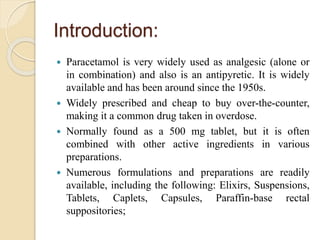
яВЧ Paracetamol is very widely used as analgesic (alone or
in combination) and also is an antipyretic. It is widely
available and has been around since the 1950s.
яВЧ Widely prescribed and cheap to buy over-the-counter,
making it a common drug taken in overdose.
яВЧ Normally found as a 500 mg tablet, but it is often
combined with other active ingredients in various
preparations.
яВЧ Numerous formulations and preparations are readily
available, including the following: Elixirs, Suspensions,
Tablets, Caplets, Capsules, Paraffin-base rectal
suppositories;
Contd.
яВЧ Usual dose: Maximim 4.0 gm in 24 hrs. After taken
orally, paracetamol is well absorbed from the stomach
and small intestine and reaches a peak plasma
concentration in one hour. It is metabolised by
conjugation with glucuronic acid and sulphate prior to
urinary excretion.
яВЧ Paracetamol overdose may occur intentionally and
accidentally; the latter due to the high number of
combination products available over-the-counter.
яВЧ If 10 gm or more paracetamol ingested, the overdose
will occur. Following the overdose, only mild
symptoms, such as nausea and vomiting, may occur
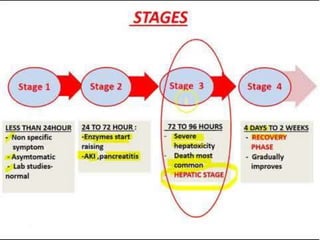
initially, but these are followed by fatal hepatic damage.
Route of exposure:
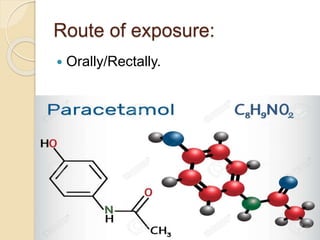
яВЧ Orally/Rectally.
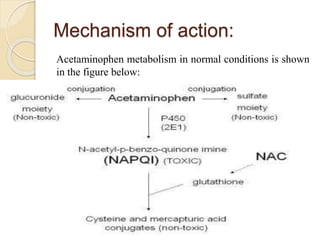
Mechanism of action:
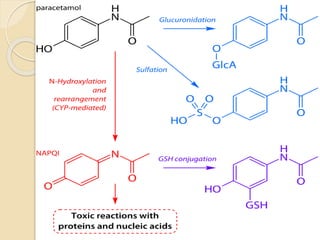
Acetaminophen metabolism in normal conditions is shown
in the figure below:
Contd.
яВЧ Acetaminophen in normal individuals is inactivated by
sulfation (approximately 52%) and glucuronide conjugation
(42%). About 2% of the drug is excreted unchanged. The
remaining 4% is biotransformed by the cytochrome P-450
mixed-function oxidase system. The P-450 isozyme
responsible for acetaminophen biotransformation is CYP2E1.
Metabolism by CYP2E1 results in a potentially toxic
metabolite that is normally detoxiямБed by conjugation with
glutathione and excreted as the mercapturate.
яВЧ Acetaminophen also acts on hypothalamus to produce
antipyresis. It may work peripherally to block the pain
impulse generation; may also inhibit Prostaglandin synthesis
in CNS by inhibiting COX-1 and COX-2 nonselectively.
Mechanism of toxicity:
яВЧ Ingested acetaminophen is rapidly absorbed from the stomach
and small intestine. The serum concentration peaks 1-2 hours
post ingestion. Therapeutic levels are 5-20 ┬╡g/mL (33-132
┬╡mol/L). Peak plasma levels occur within 4 hours after
ingestion of an overdose of an immediate-release
preparation.
яВЧ Acetaminophen is primarily metabolized by conjugation in
the liver to nontoxic, water-soluble compounds that are
eliminated in the urine. In acute overdose or when the
maximum daily dose is exceeded over a prolonged period,
metabolism by conjugation becomes saturated, and excess
APAP is oxidatively metabolized by the CYP enzymes
(CYP2E1, 1A2, 2A6, and 3A4) to the hepatotoxic reactive
metabolite N-acetyl-p -benzoquinoneimine (NAPQI).
Mechanism of toxicity
яВЧ NAPQI has an extremely short half-life and is rapidly
conjugated with glutathione, a sulfhydryl donor, and is then
renally excreted. Under conditions of excessive NAPQI
formation or a reduction in glutathione stores by
approximately 70%, NAPQI covalently binds to the cysteinyl
sulfhydryl groups of hepatocellular proteins, forming
NAPQI-protein adducts. This causes an ensuing cascade of
oxidative damage and mitochondrial dysfunction. The
subsequent inflammatory response propagates hepatocellular
injury and death. Necrosis primarily occurs in the
centrilobular (zone III) region, owing to the greater
production of NAPQI by these cells.
яВЧ Thus, the production of NAPQI, in excess of an adequate
store of conjugating glutathione in the liver tissue, is
associated with hepatocellular damage, necrosis, and hepatic
Treatment:
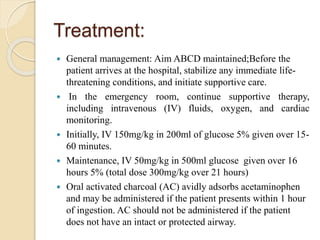
яВЧ General management: Aim ABCD maintained;Before the
patient arrives at the hospital, stabilize any immediate life-
threatening conditions, and initiate supportive care.
яВЧ In the emergency room, continue supportive therapy,
including intravenous (IV) fluids, oxygen, and cardiac
monitoring.
яВЧ Initially, IV 150mg/kg in 200ml of glucose 5% given over 15-
60 minutes.
яВЧ Maintenance, IV 50mg/kg in 500ml glucose given over 16
hours 5% (total dose 300mg/kg over 21 hours)
яВЧ Oral activated charcoal (AC) avidly adsorbs acetaminophen
and may be administered if the patient presents within 1 hour
of ingestion. AC should not be administered if the patient
does not have an intact or protected airway.
Specific management:
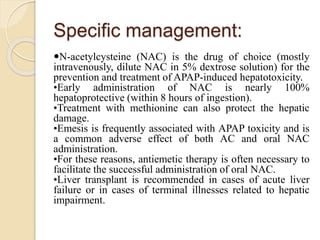
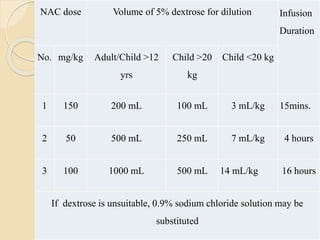
яВЧN-acetylcysteine (NAC) is the drug of choice (mostly
intravenously, dilute NAC in 5% dextrose solution) for the
prevention and treatment of APAP-induced hepatotoxicity.
тАвEarly administration of NAC is nearly 100%
hepatoprotective (within 8 hours of ingestion).
тАвTreatment with methionine can also protect the hepatic
damage.
тАвEmesis is frequently associated with APAP toxicity and is
a common adverse effect of both AC and oral NAC
administration.
тАвFor these reasons, antiemetic therapy is often necessary to
facilitate the successful administration of oral NAC.
тАвLiver transplant is recommended in cases of acute liver
failure or in cases of terminal illnesses related to hepatic
impairment.
NAC dose Volume of 5% dextrose for dilution Infusion
Duration
No. mg/kg Adult/Child >12
yrs
Child >20
kg
Child <20 kg
1 150 200 mL 100 mL 3 mL/kg 15mins.
2 50 500 mL 250 mL 7 mL/kg 4 hours
3 100 1000 mL 500 mL 14 mL/kg 16 hours
If dextrose is unsuitable, 0.9% sodium chloride solution may be
substituted
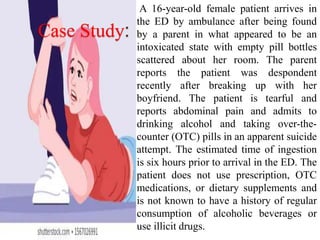
Case Study:
A 16-year-old female patient arrives in
the ED by ambulance after being found
by a parent in what appeared to be an
intoxicated state with empty pill bottles
scattered about her room. The parent
reports the patient was despondent
recently after breaking up with her
boyfriend. The patient is tearful and
reports abdominal pain and admits to
drinking alcohol and taking over-the-
counter (OTC) pills in an apparent suicide
attempt. The estimated time of ingestion
is six hours prior to arrival in the ED. The
patient does not use prescription, OTC
medications, or dietary supplements and
is not known to have a history of regular
consumption of alcoholic beverages or
use illicit drugs.
Subjective detail:
яВЧ Sex: Female;
яВЧ Age: 16 yrs;
яВЧ Estimated time of ingestion: 6 hrs prior to bringing her
to ED;
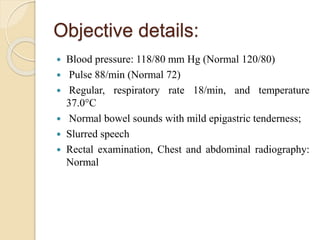
Objective details:
яВЧ Blood pressure: 118/80 mm Hg (Normal 120/80)
яВЧ Pulse 88/min (Normal 72)
яВЧ Regular, respiratory rate 18/min, and temperature
37.0┬░C
яВЧ Normal bowel sounds with mild epigastric tenderness;
яВЧ Slurred speech
яВЧ Rectal examination, Chest and abdominal radiography:
Normal
Assessment:
яВЧ She was awake and oriented, responded to questions
appropriately with slightly slurred speech.
яВЧ The patient was given 1.5 g/kg oral activated charcoal as a
slurry in a sorbitol cathartic and placed in the intensive
monitoring section of the ED while the laboratory tests were
being performed. Forty minutes later, the laboratory results
returned and showed a mildly increased white blood cell
count, liver transaminase values were elevated at
approximately three times the upper limit of normal, and an
acetaminophen concentration was 308 ug/mL. She denied
taking any other medications with the acetaminophen and
alcohol. Based on the RumackтАУMathew nomogram, a
plasma acetaminophen concentration of 308 ug/mL at
approximately six hours after ingestion is well within the
тАЬprobable hepatic toxicityтАЭ range, and therefore treatment
with NAC was required.
Planning:
яВЧ Glucose: hypoglycaemia is common in hepatic necrosis and
capillary blood glucose should be checked hourly;
яВЧ Clotting screen: prothrombin time is the best indicator of
severity of liver failure and the INR should be checked 12-
hourly;
яВЧ Arterial blood gas; acidosis can occur at a very early stage,
even when the patient is asymptomatic;
яВЧ The patient received the ямБrst dose of IV NAC in the ED and
was admitted to the medical ward to complete the treatment
course of IV NAC. Transient increases of hepatic
transaminases were measured over the ensuing two days of
the hospitalization. The patient was seen by the Psychiatry
Consultation service, which determined she was not actively
suicidal;
Contd.
яВЧ She was discharged from the hospital two days after
admission with scheduled psychiatric and medical
follow-up appointments;
яВЧ She was warned of emesis as emesis is frequently
associated with APAP toxicity and is a common adverse
effect of both AC and oral NAC administration; so, an
anti-emetic therapy was recommended as well.

Case Study on Paracetamol toxicity

  • 1.
    Cast Study onParacetamol toxicity Neeraj Ojha Bpharm
  • 2.
    Introduction: яВЧ Paracetamol isvery widely used as analgesic (alone or in combination) and also is an antipyretic. It is widely available and has been around since the 1950s. яВЧ Widely prescribed and cheap to buy over-the-counter, making it a common drug taken in overdose. яВЧ Normally found as a 500 mg tablet, but it is often combined with other active ingredients in various preparations. яВЧ Numerous formulations and preparations are readily available, including the following: Elixirs, Suspensions, Tablets, Caplets, Capsules, Paraffin-base rectal suppositories;
  • 3.
    Contd. яВЧ Usual dose:Maximim 4.0 gm in 24 hrs. After taken orally, paracetamol is well absorbed from the stomach and small intestine and reaches a peak plasma concentration in one hour. It is metabolised by conjugation with glucuronic acid and sulphate prior to urinary excretion. яВЧ Paracetamol overdose may occur intentionally and accidentally; the latter due to the high number of combination products available over-the-counter. яВЧ If 10 gm or more paracetamol ingested, the overdose will occur. Following the overdose, only mild symptoms, such as nausea and vomiting, may occur initially, but these are followed by fatal hepatic damage.
  • 4.
    Route of exposure: яВЧOrally/Rectally.
  • 5.
    Mechanism of action: Acetaminophenmetabolism in normal conditions is shown in the figure below:
  • 6.
    Contd. яВЧ Acetaminophen innormal individuals is inactivated by sulfation (approximately 52%) and glucuronide conjugation (42%). About 2% of the drug is excreted unchanged. The remaining 4% is biotransformed by the cytochrome P-450 mixed-function oxidase system. The P-450 isozyme responsible for acetaminophen biotransformation is CYP2E1. Metabolism by CYP2E1 results in a potentially toxic metabolite that is normally detoxiямБed by conjugation with glutathione and excreted as the mercapturate. яВЧ Acetaminophen also acts on hypothalamus to produce antipyresis. It may work peripherally to block the pain impulse generation; may also inhibit Prostaglandin synthesis in CNS by inhibiting COX-1 and COX-2 nonselectively.
  • 7.
    Mechanism of toxicity: яВЧIngested acetaminophen is rapidly absorbed from the stomach and small intestine. The serum concentration peaks 1-2 hours post ingestion. Therapeutic levels are 5-20 ┬╡g/mL (33-132 ┬╡mol/L). Peak plasma levels occur within 4 hours after ingestion of an overdose of an immediate-release preparation. яВЧ Acetaminophen is primarily metabolized by conjugation in the liver to nontoxic, water-soluble compounds that are eliminated in the urine. In acute overdose or when the maximum daily dose is exceeded over a prolonged period, metabolism by conjugation becomes saturated, and excess APAP is oxidatively metabolized by the CYP enzymes (CYP2E1, 1A2, 2A6, and 3A4) to the hepatotoxic reactive metabolite N-acetyl-p -benzoquinoneimine (NAPQI).
  • 8.
    Mechanism of toxicity яВЧNAPQI has an extremely short half-life and is rapidly conjugated with glutathione, a sulfhydryl donor, and is then renally excreted. Under conditions of excessive NAPQI formation or a reduction in glutathione stores by approximately 70%, NAPQI covalently binds to the cysteinyl sulfhydryl groups of hepatocellular proteins, forming NAPQI-protein adducts. This causes an ensuing cascade of oxidative damage and mitochondrial dysfunction. The subsequent inflammatory response propagates hepatocellular injury and death. Necrosis primarily occurs in the centrilobular (zone III) region, owing to the greater production of NAPQI by these cells. яВЧ Thus, the production of NAPQI, in excess of an adequate store of conjugating glutathione in the liver tissue, is associated with hepatocellular damage, necrosis, and hepatic
  • 11.
    Treatment: яВЧ General management:Aim ABCD maintained;Before the patient arrives at the hospital, stabilize any immediate life- threatening conditions, and initiate supportive care. яВЧ In the emergency room, continue supportive therapy, including intravenous (IV) fluids, oxygen, and cardiac monitoring. яВЧ Initially, IV 150mg/kg in 200ml of glucose 5% given over 15- 60 minutes. яВЧ Maintenance, IV 50mg/kg in 500ml glucose given over 16 hours 5% (total dose 300mg/kg over 21 hours) яВЧ Oral activated charcoal (AC) avidly adsorbs acetaminophen and may be administered if the patient presents within 1 hour of ingestion. AC should not be administered if the patient does not have an intact or protected airway.
  • 12.
    Specific management: яВЧN-acetylcysteine (NAC)is the drug of choice (mostly intravenously, dilute NAC in 5% dextrose solution) for the prevention and treatment of APAP-induced hepatotoxicity. тАвEarly administration of NAC is nearly 100% hepatoprotective (within 8 hours of ingestion). тАвTreatment with methionine can also protect the hepatic damage. тАвEmesis is frequently associated with APAP toxicity and is a common adverse effect of both AC and oral NAC administration. тАвFor these reasons, antiemetic therapy is often necessary to facilitate the successful administration of oral NAC. тАвLiver transplant is recommended in cases of acute liver failure or in cases of terminal illnesses related to hepatic impairment.
  • 13.
    NAC dose Volumeof 5% dextrose for dilution Infusion Duration No. mg/kg Adult/Child >12 yrs Child >20 kg Child <20 kg 1 150 200 mL 100 mL 3 mL/kg 15mins. 2 50 500 mL 250 mL 7 mL/kg 4 hours 3 100 1000 mL 500 mL 14 mL/kg 16 hours If dextrose is unsuitable, 0.9% sodium chloride solution may be substituted
  • 14.
    Case Study: A 16-year-oldfemale patient arrives in the ED by ambulance after being found by a parent in what appeared to be an intoxicated state with empty pill bottles scattered about her room. The parent reports the patient was despondent recently after breaking up with her boyfriend. The patient is tearful and reports abdominal pain and admits to drinking alcohol and taking over-the- counter (OTC) pills in an apparent suicide attempt. The estimated time of ingestion is six hours prior to arrival in the ED. The patient does not use prescription, OTC medications, or dietary supplements and is not known to have a history of regular consumption of alcoholic beverages or use illicit drugs.
  • 15.
    Subjective detail: яВЧ Sex:Female; яВЧ Age: 16 yrs; яВЧ Estimated time of ingestion: 6 hrs prior to bringing her to ED;
  • 16.
    Objective details: яВЧ Bloodpressure: 118/80 mm Hg (Normal 120/80) яВЧ Pulse 88/min (Normal 72) яВЧ Regular, respiratory rate 18/min, and temperature 37.0┬░C яВЧ Normal bowel sounds with mild epigastric tenderness; яВЧ Slurred speech яВЧ Rectal examination, Chest and abdominal radiography: Normal
  • 17.
    Assessment: яВЧ She wasawake and oriented, responded to questions appropriately with slightly slurred speech. яВЧ The patient was given 1.5 g/kg oral activated charcoal as a slurry in a sorbitol cathartic and placed in the intensive monitoring section of the ED while the laboratory tests were being performed. Forty minutes later, the laboratory results returned and showed a mildly increased white blood cell count, liver transaminase values were elevated at approximately three times the upper limit of normal, and an acetaminophen concentration was 308 ug/mL. She denied taking any other medications with the acetaminophen and alcohol. Based on the RumackтАУMathew nomogram, a plasma acetaminophen concentration of 308 ug/mL at approximately six hours after ingestion is well within the тАЬprobable hepatic toxicityтАЭ range, and therefore treatment with NAC was required.
  • 18.
    Planning: яВЧ Glucose: hypoglycaemiais common in hepatic necrosis and capillary blood glucose should be checked hourly; яВЧ Clotting screen: prothrombin time is the best indicator of severity of liver failure and the INR should be checked 12- hourly; яВЧ Arterial blood gas; acidosis can occur at a very early stage, even when the patient is asymptomatic; яВЧ The patient received the ямБrst dose of IV NAC in the ED and was admitted to the medical ward to complete the treatment course of IV NAC. Transient increases of hepatic transaminases were measured over the ensuing two days of the hospitalization. The patient was seen by the Psychiatry Consultation service, which determined she was not actively suicidal;
  • 19.
    Contd. яВЧ She wasdischarged from the hospital two days after admission with scheduled psychiatric and medical follow-up appointments; яВЧ She was warned of emesis as emesis is frequently associated with APAP toxicity and is a common adverse effect of both AC and oral NAC administration; so, an anti-emetic therapy was recommended as well.