PARACETAMOL
POISONING
DR. JOE ANN RODRIGO
INTRODUCTION
• Acetaminophen toxicity is the second most
common cause of liver transplantation
worldwide and the most common cause of
liver transplantation in the US.
• These slides reviews the etiology,
evaluation, and treatment of
Acetaminophen overdose and highlights
the importance of both managing and
preventing this problem.
INTRODUCTION
• Acetaminophen is an antipyretic analgesic
with a mechanism of action different from
NSAIDs.
• It inhibit cyclooxygenase (COX) in the brain
selectively. This results in its ability to treat
fever and pain.
• It may also inhibit prostaglandin synthesis in
the central nervous system (CNS).
Acetaminophen directly acts on the
hypothalamus producing an antipyretic effect.
RUMACK MATTHEW
NORMOGRAM
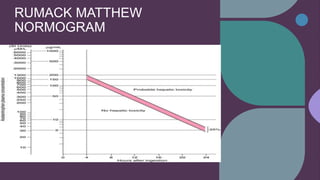
RUMACK –MATTHEW
NORMOGRAM
• Rumack-Matthew nomogram for single acute
acetaminophen ingestions.
• Semilogarithmic plot of plasma acetaminophen levels vs
time. Cautions for use of this nomogram:
• The time coordinates refer to time after ingestion.
• Serum levels drawn before 4 hours may not represent peak
levels.
• The graph should be used only in relation to a single acute
ingestion.
• The lower solid line 25% below the standard nomogram is
included to allow for possible errors in acetaminophen plasma
assays and estimated time from ingestion of an overdose.
DOSAGE :
• The recommended dose of Acetaminophen
for adults is 650 mg to 1000 mg every 4 to 6
hours, not to exceed 4 grams/day.
• In children, the dose is 15 mg/kg every 6
hours, up to 60 mg/kg/day.
• Toxicity develops at 7.5 g/day to 10 g/day or
140 mg/kg.
• Acetaminophen is rapidly absorbed from the
gastrointestinal (GI) tract and reaches
therapeutic levels in 30 minutes to 2 hours.
PATHO-PHYSIOLOGY :
• The principal toxic metabolite
of acetaminophen, N-acetyl-p-benzoquinone
imine (NAPQI), is produced by the hepatic
cytochrome P-450 enzyme system.
• Glutathione stores in the liver detoxify this
metabolite. An acute overdose depletes
glutathione stores in the liver.
• As a result, NAPQI accumulates, causing
hepatocellular necrosis and possibly damage to
other organs (eg, kidneys, pancreas).
HALF –LIFE :
• Acetaminophen has an elimination half-
life of 2 hours but can be as long as 17
hours in patients with hepatic
dysfunction.
• It is metabolized by the liver, where it is
conjugated to nontoxic, water-soluble
metabolites that are excreted in the
urine.
HISTOPATHOLOGY
• The histological features of acetaminophen
toxicity will reveal cytolysis and the presence
of centrilobular necrosis.
• The injury to the latter is chiefly due to the
elevated levels of N-acetyl-p-benzoquinone
imine (NAPQI) in this zone.
STAGES :
• The clinical course of acetaminophen toxicity is
divided into four stages.
• During the FIRST stage (30 min to 24 hours),
• the patient may be asymptomatic or may have emesis.
• In the SECOND stage (18 hours to 72 hours),
• There may be emesis plus right upper quadrant pain and
hypotension.
• In the THIRD stage (72 hours to 96 hours),
• Liver dysfunction is significant with renal failure, coagulopathies,
metabolic acidosis, and encephalopathy. Gastrointestinal (GI)
symptoms reappear, and death is most common at this stage.
• The FOURTH stage (4 days to 3 weeks) is marked by recovery.
EVALUATION
• The diagnosis of Acetaminophen toxicity is based
on serum levels of the drug, even if there are no
symptoms.
• Other laboratory studies needed include ,
• Liver function tests
- Coagulation profile (PT/INR).
If the ingestion is severe, LFTs can rise within 8 to
12 hours of ingestion.
• Normally LFTs remain elevated in the second
stage at 18 to 72 hours.
TREATMENT
• The treatment of acetaminophen poisoning
depends on when the drug was ingested. If
the patient presents within 1 hour of ingestion,
GI decontamination may be attempted.
• In alert patients, activated charcoal can be
used.
GI DECONTAMINATION
The three general methods of GI
decontamination involves
- Removing toxins from gut
- Binding toxins in the stomache
- Enhancing transit through intestines
ACTIVATED CHARCOAL
• Decontamination can be achieved by
Activated Charcoal.
• It works by adsorbing substances in
the gut lumen.
• Benefit of activated charcoal is
greater when administered soon after
drug ingestion.
DOSE OF ACTIVATED
CHARCOAL
• Activated charcoal – PEDIATRIC DOSE
1gm/kg PO
• Adult dose - 50-100 grams
TREATMENT :
• All patients with high levels of acetaminophen
need admission and treatment with N-acetyl-
cysteine (NAC) and activated charcoal.
• This agent is fully protective against liver
toxicity if given within 8 hours after ingestion.
• It prevents the binding of NAPQI to hepatic
macromolecules, acts as a substitute for
glutathione, is a precursor for sulfate, and
reduces NAPQI back to Acetaminophen.
DOSAGE OF NAC :
• 150 mg/kg in 200ml 0f 5% Dextrose over 15
mins then,
• 50 mg/kg in 500ml of 5% Dextrose over 4
hours then,
• 100mg/kg in 1 Litre Dextrose over 16 hours
• INJ.VITAMIN K – 10mg – IV stat.
ORAL ADMINISTRATION
• Loading dose - 140 mg/kg PO followed
by
• 70mg/kg every 4 hours for 17 total
doses
•
ADMINISTRATION :
• NAC can be administered both intravenously (IV) and
orally.
• The IV form has been shown to decrease the length
of the hospital stay and may be better tolerated by the
patient as the oral form has a foul rotten egg odor and
taste.
• The oral form also requires 17 doses given 4 hours
apart, with the total treatment time being 72 hours. In
comparison, the IV form requires only 20 hours of
treatment.
• The IV form also is preferred in pregnant patients
and when there is a fulminant hepatic failure.
CONTD……
• Patients who continue to have detoriation
such as renal failure, metabolic acidosis,
encephalopathy, and coagulopathy should
have a referral to a transplant surgeon.
• In patients who present 24 hours after the
ingestion of acetaminophen, NAC
administration should still be attempted and
may improve survival.
MOA :
• NAC act as an antioxidant that diminishes
Hepatic necrosis,
• Decreases neutrophil infiltration,
• Improves microcirculatory blood flow, and
increases tissue oxygen delivery.
• Hemodialysis can also be an effective
treatment, especially with concurrent renal
failure.
DIFFERENTIAL DIAGNOSIS
• Hepatorenal syndrome
• Viral hepatitis
• Wilson disease
• Pancreatitis
• Emergent management of pancreatitis
• Acute tubular necrosis
• Amatoxin toxicity
• Cytomegalovirus infection
• Gastroenteritis
• Peptic ulcer disease
• Viral hepatitis
• Wilson disease
PROGNOSIS :
• If the patient is diagnosed and treated promptly,
the mortality for acetaminophen toxicity is less
than 2%.
• However, if patients present late and have
developed severe liver failure, the mortality is
high.
• About 1% to 3% of patients with severe liver
failure need to undergo a liver transplant as a life-
saving measure.
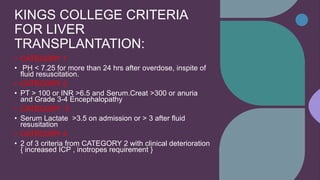
KINGS COLLEGE CRITERIA
FOR LIVER
TRANSPLANTATION:
• CATEGORY 1
• PH < 7.25 for more than 24 hrs after overdose, inspite of
fluid resuscitation.
• CATEGORY 2
• PT > 100 or INR >6.5 and Serum.Creat >300 or anuria
and Grade 3-4 Encephalopathy
• CATEGORY 3
• Serum Lactate >3.5 on admission or > 3 after fluid
resusitation
• CATEGORY 4
• 2 of 3 criteria from CATEGORY 2 with clinical deterioration
{ increased ICP , inotropes requirement }
INDICATIONS FOR
HEMODIALYSIS
• Despite instigating N-acetylcysteine
treatment, due to evidence of
mitochondrial dysfunction together with
an exceedingly high paracetamol level.
• Fluctuating Consciousness
• Persistent Lactic Acidosis despite fluid
resuscitation
COMPLICATIONS :
• Acetaminophen can cause dangerous skin
reactions.
• These include Stevens-Johnson syndrome
(SJS),
• Toxic Epidermal Necrolysis (TEN),
• Acute generalized exanthematous pustulosis
(AGEP).
• These conditions are extremely painful and
can lead to blindness and death.
Acetaminophen can lead to acute liver failure,
which may only be treated with an emergency
PARACETAMOL POISONING.pptx

PARACETAMOL POISONING.pptx

  • 1.
  • 2.
    INTRODUCTION • Acetaminophen toxicityis the second most common cause of liver transplantation worldwide and the most common cause of liver transplantation in the US. • These slides reviews the etiology, evaluation, and treatment of Acetaminophen overdose and highlights the importance of both managing and preventing this problem.
  • 3.
    INTRODUCTION • Acetaminophen isan antipyretic analgesic with a mechanism of action different from NSAIDs. • It inhibit cyclooxygenase (COX) in the brain selectively. This results in its ability to treat fever and pain. • It may also inhibit prostaglandin synthesis in the central nervous system (CNS). Acetaminophen directly acts on the hypothalamus producing an antipyretic effect.
  • 4.
  • 5.
    RUMACK –MATTHEW NORMOGRAM • Rumack-Matthewnomogram for single acute acetaminophen ingestions. • Semilogarithmic plot of plasma acetaminophen levels vs time. Cautions for use of this nomogram: • The time coordinates refer to time after ingestion. • Serum levels drawn before 4 hours may not represent peak levels. • The graph should be used only in relation to a single acute ingestion. • The lower solid line 25% below the standard nomogram is included to allow for possible errors in acetaminophen plasma assays and estimated time from ingestion of an overdose.
  • 6.
    DOSAGE : • Therecommended dose of Acetaminophen for adults is 650 mg to 1000 mg every 4 to 6 hours, not to exceed 4 grams/day. • In children, the dose is 15 mg/kg every 6 hours, up to 60 mg/kg/day. • Toxicity develops at 7.5 g/day to 10 g/day or 140 mg/kg. • Acetaminophen is rapidly absorbed from the gastrointestinal (GI) tract and reaches therapeutic levels in 30 minutes to 2 hours.
  • 7.
    PATHO-PHYSIOLOGY : • Theprincipal toxic metabolite of acetaminophen, N-acetyl-p-benzoquinone imine (NAPQI), is produced by the hepatic cytochrome P-450 enzyme system. • Glutathione stores in the liver detoxify this metabolite. An acute overdose depletes glutathione stores in the liver. • As a result, NAPQI accumulates, causing hepatocellular necrosis and possibly damage to other organs (eg, kidneys, pancreas).
  • 8.
    HALF –LIFE : •Acetaminophen has an elimination half- life of 2 hours but can be as long as 17 hours in patients with hepatic dysfunction. • It is metabolized by the liver, where it is conjugated to nontoxic, water-soluble metabolites that are excreted in the urine.
  • 9.
    HISTOPATHOLOGY • The histologicalfeatures of acetaminophen toxicity will reveal cytolysis and the presence of centrilobular necrosis. • The injury to the latter is chiefly due to the elevated levels of N-acetyl-p-benzoquinone imine (NAPQI) in this zone.
  • 10.
    STAGES : • Theclinical course of acetaminophen toxicity is divided into four stages. • During the FIRST stage (30 min to 24 hours), • the patient may be asymptomatic or may have emesis. • In the SECOND stage (18 hours to 72 hours), • There may be emesis plus right upper quadrant pain and hypotension. • In the THIRD stage (72 hours to 96 hours), • Liver dysfunction is significant with renal failure, coagulopathies, metabolic acidosis, and encephalopathy. Gastrointestinal (GI) symptoms reappear, and death is most common at this stage. • The FOURTH stage (4 days to 3 weeks) is marked by recovery.
  • 11.
    EVALUATION • The diagnosisof Acetaminophen toxicity is based on serum levels of the drug, even if there are no symptoms. • Other laboratory studies needed include , • Liver function tests - Coagulation profile (PT/INR). If the ingestion is severe, LFTs can rise within 8 to 12 hours of ingestion. • Normally LFTs remain elevated in the second stage at 18 to 72 hours.
  • 12.
    TREATMENT • The treatmentof acetaminophen poisoning depends on when the drug was ingested. If the patient presents within 1 hour of ingestion, GI decontamination may be attempted. • In alert patients, activated charcoal can be used.
  • 13.
    GI DECONTAMINATION The threegeneral methods of GI decontamination involves - Removing toxins from gut - Binding toxins in the stomache - Enhancing transit through intestines
  • 14.
    ACTIVATED CHARCOAL • Decontaminationcan be achieved by Activated Charcoal. • It works by adsorbing substances in the gut lumen. • Benefit of activated charcoal is greater when administered soon after drug ingestion.
  • 15.
    DOSE OF ACTIVATED CHARCOAL •Activated charcoal – PEDIATRIC DOSE 1gm/kg PO • Adult dose - 50-100 grams
  • 16.
    TREATMENT : • Allpatients with high levels of acetaminophen need admission and treatment with N-acetyl- cysteine (NAC) and activated charcoal. • This agent is fully protective against liver toxicity if given within 8 hours after ingestion. • It prevents the binding of NAPQI to hepatic macromolecules, acts as a substitute for glutathione, is a precursor for sulfate, and reduces NAPQI back to Acetaminophen.
  • 17.
    DOSAGE OF NAC: • 150 mg/kg in 200ml 0f 5% Dextrose over 15 mins then, • 50 mg/kg in 500ml of 5% Dextrose over 4 hours then, • 100mg/kg in 1 Litre Dextrose over 16 hours • INJ.VITAMIN K – 10mg – IV stat.
  • 18.
    ORAL ADMINISTRATION • Loadingdose - 140 mg/kg PO followed by • 70mg/kg every 4 hours for 17 total doses •
  • 19.
    ADMINISTRATION : • NACcan be administered both intravenously (IV) and orally. • The IV form has been shown to decrease the length of the hospital stay and may be better tolerated by the patient as the oral form has a foul rotten egg odor and taste. • The oral form also requires 17 doses given 4 hours apart, with the total treatment time being 72 hours. In comparison, the IV form requires only 20 hours of treatment. • The IV form also is preferred in pregnant patients and when there is a fulminant hepatic failure.
  • 20.
    CONTD…… • Patients whocontinue to have detoriation such as renal failure, metabolic acidosis, encephalopathy, and coagulopathy should have a referral to a transplant surgeon. • In patients who present 24 hours after the ingestion of acetaminophen, NAC administration should still be attempted and may improve survival.
  • 21.
    MOA : • NACact as an antioxidant that diminishes Hepatic necrosis, • Decreases neutrophil infiltration, • Improves microcirculatory blood flow, and increases tissue oxygen delivery. • Hemodialysis can also be an effective treatment, especially with concurrent renal failure.
  • 22.
    DIFFERENTIAL DIAGNOSIS • Hepatorenalsyndrome • Viral hepatitis • Wilson disease • Pancreatitis • Emergent management of pancreatitis • Acute tubular necrosis • Amatoxin toxicity • Cytomegalovirus infection • Gastroenteritis • Peptic ulcer disease • Viral hepatitis • Wilson disease
  • 23.
    PROGNOSIS : • Ifthe patient is diagnosed and treated promptly, the mortality for acetaminophen toxicity is less than 2%. • However, if patients present late and have developed severe liver failure, the mortality is high. • About 1% to 3% of patients with severe liver failure need to undergo a liver transplant as a life- saving measure.
  • 24.
    KINGS COLLEGE CRITERIA FORLIVER TRANSPLANTATION: • CATEGORY 1 • PH < 7.25 for more than 24 hrs after overdose, inspite of fluid resuscitation. • CATEGORY 2 • PT > 100 or INR >6.5 and Serum.Creat >300 or anuria and Grade 3-4 Encephalopathy • CATEGORY 3 • Serum Lactate >3.5 on admission or > 3 after fluid resusitation • CATEGORY 4 • 2 of 3 criteria from CATEGORY 2 with clinical deterioration { increased ICP , inotropes requirement }
  • 25.
    INDICATIONS FOR HEMODIALYSIS • Despiteinstigating N-acetylcysteine treatment, due to evidence of mitochondrial dysfunction together with an exceedingly high paracetamol level. • Fluctuating Consciousness • Persistent Lactic Acidosis despite fluid resuscitation
  • 26.
    COMPLICATIONS : • Acetaminophencan cause dangerous skin reactions. • These include Stevens-Johnson syndrome (SJS), • Toxic Epidermal Necrolysis (TEN), • Acute generalized exanthematous pustulosis (AGEP). • These conditions are extremely painful and can lead to blindness and death. Acetaminophen can lead to acute liver failure, which may only be treated with an emergency