

PCM OVERDOSE
INSANIAH MEDICAL STUDENTS
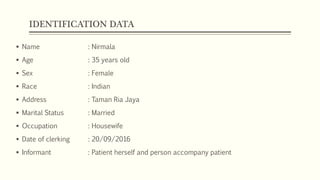
IDENTIFICATION DATA
 Name : Nirmala
 Age : 35 years old
 Sex : Female
 Race : Indian
 Address : Taman Ria Jaya
 Marital Status : Married
 Occupation : Housewife
 Date of clerking : 20/09/2016
 Informant : Patient herself and person accompany patient
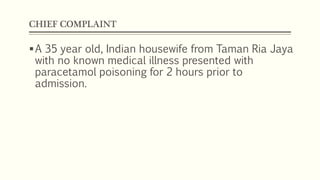
CHIEF COMPLAINT
A 35 year old, Indian housewife from Taman Ria Jaya
with no known medical illness presented with
paracetamol poisoning for 2 hours prior to
admission.
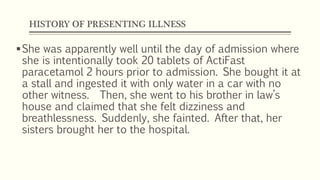
HISTORY OF PRESENTING ILLNESS
She was apparently well until the day of admission where
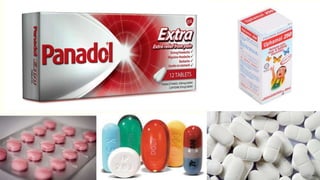
she is intentionally took 20 tablets of ActiFast
paracetamol 2 hours prior to admission. She bought it at
a stall and ingested it with only water in a car with no
other witness. Then, she went to his brother in law’s
house and claimed that she felt dizziness and
breathlessness. Suddenly, she fainted. After that, her
sisters brought her to the hospital.
HISTORY OF PRESENTING ILLNESS
Besides, she felt sad due to her family problem. She had
a feeling of suicide and had attempted it by ingested 20
tablets of PCM. However, there is no history of psychiatry
illness.
Otherwise, no nausea and vomiting, no diarrhoea, no
abdominal pain. No altered bowel habit. No headache.
No palpitation, no chest pain, no sweating. No loss of
appetite and loss of weight. No fever.
PAST MEDICAL AND SURGICAL HISTORY
No known medical illness
No history of surgery
ALLERGY HISTORY
No known drug and food allergy
SYSTEMIC REVIEW
The patient denies any fever, weight change. Denies
any sore throat, ear pain, rhinorrhea. Denies any
double vision, blurred vision or eye pain. Denies any
cough or pleuritic chest pain. The patient denies any
nausea, vomiting or diarrhea. The patient does not
have any dysuria, frequency or urgency. She denies
any bleeding or easy bruising.
PERSONAL AND SOCIAL HISTORY
She had married and blessed with 3 children.
Her husband works as a businessman.
It took about 5-10 minutes from her house to
Hospital Sultan Abdul Halim.
PHYSICAL EXAMINATION
 General condition
 On inspection, she was alert and conscious. She looks unwell. She had vacant look apathy
to surrounding. There were no sign of gross deformity. She was not in respiratory distress.
She was nutritionally and hydrationally adequate. No pallor. No jaundice. She has medium
body build. She is uncooperative patient.
 Vital signs
 Pulse rate : 132 beat per minute, regular rhythm, good volume
 Respiratory rate : 22 breaths per minutes
 Blood pressure : 173/94 mmHg
 Temperature : 37.4 0 C
 Capillary filling : < 2 seconds
 SPO2 : 100%
PHYSICAL EXAMINATION
 Hands
From inspection of the hands, the palms were dry, warm and pink. There are no pallor
and no palmar erythema. For the inspection of the fingers and nails, there are no peripheral
cyanosis, no finger clubbing, no leuconychia and no koilonychia. Otherwise, no scratch
marks, no skin pigmentation, no spider naevi or petechial noted on her both arms and
forearms.
 Head and Face
From inspection of the eyes, the conjuctiva is not pale and the sclera is not in jaundiced.
For the inspection of the mouth, the lips are pink in colour, symmetry in position and no
lesions. There are no redness, bleeding, and swelling for the gums. The tongue appeared
pink in colour, normal texture, no lesions and non tender. Generally the oral hygiene is
normal.
PHYSICAL EXAMINATION
 Neck
Neck examination revealed no swelling, no cervical and supraclavicular lymph
nodes been palpable. Carotid artery is palpable. Otherwise, no carotid bruit heard.
 Chest Wall and Axillae
There are no spider naevi, gynaecomastia, and axillary hair loss. Movement of the
chest is symmetrical bilaterally. Heart sounds revealed dual rhythm and no murmur
heard.
 Lower Limbs
There is no pitting oedema.
SPECIFIC ABDOMINAL EXAMINATION
 Inspection
The abdomen is symmetrical and not distended. There is no abnormal movement found with
each respiration. The umbilicus is inverted and centrally located. There are no striae, no prominent
and dilated veins, no bruising, no pigmentation, no visible peristalsis, no pulsation and no localized
masses be seen.
 Palpation and Percussion
Upon superficial palpation, there is no tenderness at the abdominal region.
Upon deep palpation, there are no hepatosplenomegaly. The kidney was not ballotable. There is
no palpable mass found on the abdomen. Other parts of the abdomen are soft and normal.
Upon percussion, the abdomen was resonance.
 Auscultation
Bowel sound is not hyperactive. Otherwise, no renal bruit and aortic bruit heard.
Overview
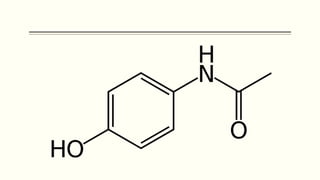
 Paracetamol, also known as Acetaminophen (US and Canada) and by its chemical
name, N -acetyl-p-aminophenol (APAP)
 Acetaminophen toxicity occurs relatively frequently.
 American Association of Poison Control Centres (AAPCC) reports that
acetaminophen is one of the most common pharmaceuticals associated with both
intentional and unintentional poisoning and toxicity.
 Hepatic failure and death are uncommon outcomes, although paracetamol remains
the most important single cause of acute fulminant hepatic failure in Western
countries
PCM METABOLISM
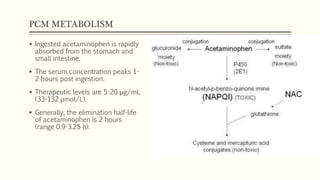
 Ingested acetaminophen is rapidly
absorbed from the stomach and
small intestine.
 The serum concentration peaks 1-
2 hours post ingestion.
 Therapeutic levels are 5-20 µg/mL
(33-132 µmol/L).
 Generally, the elimination half-life
of acetaminophen is 2 hours
(range 0.9-3.25 h).
PCM METABOLISM
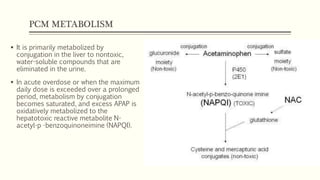
 It is primarily metabolized by
conjugation in the liver to nontoxic,
water-soluble compounds that are
eliminated in the urine.
 In acute overdose or when the maximum
daily dose is exceeded over a prolonged
period, metabolism by conjugation
becomes saturated, and excess APAP is
oxidatively metabolized to the
hepatotoxic reactive metabolite N-
acetyl-p -benzoquinoneimine (NAPQI).
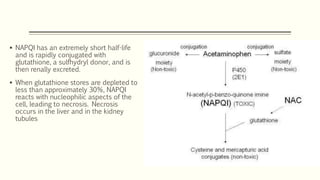
 NAPQI has an extremely short half-life
and is rapidly conjugated with
glutathione, a sulfhydryl donor, and is
then renally excreted.
 When glutathione stores are depleted to
less than approximately 30%, NAPQI
reacts with nucleophilic aspects of the
cell, leading to necrosis. Necrosis
occurs in the liver and in the kidney
tubules
Risk factor of toxicity
 Toxicity is increased in patients with induction of the P450 system through drugs
such as
 Rifampicin
 Phenobarbital
 Phenytoin
 Carbamazepine
 alcohol.
 This also occurs in patients with low glutathione reserves, as a product of:
 Genetic variation.
 HIV-positive status.
 Malnutrition.
 Alcohol-related or other liver disease.
 The minimum hepatotoxic dose of APAP as a single acute ingestion is
 150 mg/kg for a child
 7.5-10 g for an adult. (20 tab)
 doses of >250mg/kg associated with massive hepatic necrosis and liver failure
Clinical features
 Stage 1 (0-24hrs)
 asymptomatic or GI upset only
 Stage 2 (24-48 hrs)
 resolution or nausea and vomiting
 RUQ pain and tenderness
 progressive elevation of transaminases, bilirubin, PT
 Stage 3 (48-96 hrs)
 hepatic failure (jaundice, coagulopathy, encephalopathy)
 Stage 4
 death from hepatic failure
 normalisation of LFT’s and complete resolution of hepatic architecture by 3 months
Assessment
History
 Number of tablets, formulation, any concomitant tablets (include herbal remedies as
substances, such as St John's wort - an enzyme inducer).
 Time of overdose.
 Suicide risk - was a note left?
 Any alcohol taken (acute alcohol ingestion will inhibit liver enzymes and may reduce
the production of the toxin NAPQI, whereas chronic alcoholism may increase it).
Examination
 Usually there is very little to find, until the patient develops ALF.
 If ALF develops, the following may be seen:
 Jaundice
 hepatic flap
 Encephalopathy
 tender hepatomegaly.
INVESTIGATION
• Plasma paracetamol level.
• Confirms presence after exposure and if acute ingestion has occurred.
• Should be done not < 4 hours after ingestion
• best predictor for hepatotoxicity
• At least one additional plasma-paracetamol concentration 4-6 hours after the 1st
• If the ingested paracetamol is an extended release
• Liver Function Test (AST, ALT) and bilirubin levels
• baseline values in acute overdoses and essential in late presenters or chronic overdoses.
• Coagulation profile (PT, PTT, INR).
• Elevations indicate significant hepatocyte injury.
• FBC
• helpful in fulminant hepatic failure and bleeding diathesis.
• Electrolytes
• may reveal a large anion gap in significant exposures.
• Renal function
• NAPQI is also produced in the kidney.
MANAGEMENT
• Decontamination
• Gastric emptying/lavage: within 1 hour of ingestion
• Activated charcoal 1g/kg: within > 4 hours of ingestion
• Gastric irrigation: rare
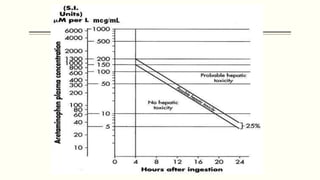
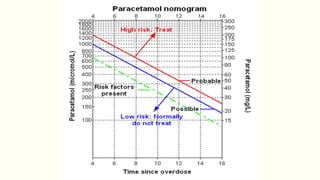
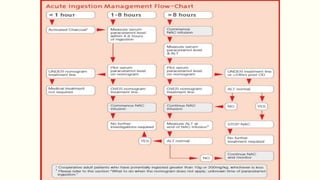
• Plot serum paracetamol level normogram
• Above toxic level:
• Give N-acetylcysteine (NAC, Mucomyst)
Within 8-10 hours of acute ingestion: Max. protective action
Other indication:
• Ingested >150mg/kg
• Serum paracetamol not done/available within 8 hours
• Pt. with unknown time of ingestion & with serum paracetamol level > 10μg/L
• Laboratory evidence of hepatotoxicity with history of excessive paracetamol
ingestion
Dose:
IV NAC: given as infusion in D5%
1st: 150mg/kg in 200ml over 15mins
2nd: 50mg/kg in 500ml over 4 hours
3rd: 100mg/kg in 1000ml over 16 hours
Oral:
140mg/kg stat
Followed by 70mg/kg every 4 hourly for 17 additional doses
Hepatic failure: longer administration duration >72 hours
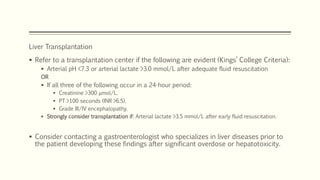
Liver Transplantation
 Refer to a transplantation center if the following are evident (Kings’ College Criteria):
 Arterial pH <7.3 or arterial lactate >3.0 mmol/L after adequate fluid resuscitation
OR
 If all three of the following occur in a 24-hour period:
 Creatinine >300 μmol/L.
 PT >100 seconds (INR >6.5).
 Grade III/IV encephalopathy.
 Strongly consider transplantation if: Arterial lactate >3.5 mmol/L after early fluid resuscitation.
 Consider contacting a gastroenterologist who specializes in liver diseases prior to
the patient developing these findings after significant overdose or hepatotoxicity.
 Admission.
 Any patient who is suicidal, requires treatment with NAC, and/or has evidence of hepatotoxicity.
 All patients with abnormal vital signs, acidemia, or end-organ damage should be admitted to the
ICU.
 Discharge.
 Accidental ingestions with no evidence of acute poisoning and a non-toxic APAP level.

Paracetamol overdose

  • 1.
  • 2.
    IDENTIFICATION DATA  Name: Nirmala  Age : 35 years old  Sex : Female  Race : Indian  Address : Taman Ria Jaya  Marital Status : Married  Occupation : Housewife  Date of clerking : 20/09/2016  Informant : Patient herself and person accompany patient
  • 3.
    CHIEF COMPLAINT A 35year old, Indian housewife from Taman Ria Jaya with no known medical illness presented with paracetamol poisoning for 2 hours prior to admission.
  • 4.
    HISTORY OF PRESENTINGILLNESS She was apparently well until the day of admission where she is intentionally took 20 tablets of ActiFast paracetamol 2 hours prior to admission. She bought it at a stall and ingested it with only water in a car with no other witness. Then, she went to his brother in law’s house and claimed that she felt dizziness and breathlessness. Suddenly, she fainted. After that, her sisters brought her to the hospital.
  • 5.
    HISTORY OF PRESENTINGILLNESS Besides, she felt sad due to her family problem. She had a feeling of suicide and had attempted it by ingested 20 tablets of PCM. However, there is no history of psychiatry illness. Otherwise, no nausea and vomiting, no diarrhoea, no abdominal pain. No altered bowel habit. No headache. No palpitation, no chest pain, no sweating. No loss of appetite and loss of weight. No fever.
  • 6.
    PAST MEDICAL ANDSURGICAL HISTORY No known medical illness No history of surgery
  • 7.
    ALLERGY HISTORY No knowndrug and food allergy
  • 8.
    SYSTEMIC REVIEW The patientdenies any fever, weight change. Denies any sore throat, ear pain, rhinorrhea. Denies any double vision, blurred vision or eye pain. Denies any cough or pleuritic chest pain. The patient denies any nausea, vomiting or diarrhea. The patient does not have any dysuria, frequency or urgency. She denies any bleeding or easy bruising.
  • 9.
    PERSONAL AND SOCIALHISTORY She had married and blessed with 3 children. Her husband works as a businessman. It took about 5-10 minutes from her house to Hospital Sultan Abdul Halim.
  • 10.
    PHYSICAL EXAMINATION  Generalcondition  On inspection, she was alert and conscious. She looks unwell. She had vacant look apathy to surrounding. There were no sign of gross deformity. She was not in respiratory distress. She was nutritionally and hydrationally adequate. No pallor. No jaundice. She has medium body build. She is uncooperative patient.  Vital signs  Pulse rate : 132 beat per minute, regular rhythm, good volume  Respiratory rate : 22 breaths per minutes  Blood pressure : 173/94 mmHg  Temperature : 37.4 0 C  Capillary filling : < 2 seconds  SPO2 : 100%
  • 11.
    PHYSICAL EXAMINATION  Hands Frominspection of the hands, the palms were dry, warm and pink. There are no pallor and no palmar erythema. For the inspection of the fingers and nails, there are no peripheral cyanosis, no finger clubbing, no leuconychia and no koilonychia. Otherwise, no scratch marks, no skin pigmentation, no spider naevi or petechial noted on her both arms and forearms.  Head and Face From inspection of the eyes, the conjuctiva is not pale and the sclera is not in jaundiced. For the inspection of the mouth, the lips are pink in colour, symmetry in position and no lesions. There are no redness, bleeding, and swelling for the gums. The tongue appeared pink in colour, normal texture, no lesions and non tender. Generally the oral hygiene is normal.
  • 12.
    PHYSICAL EXAMINATION  Neck Neckexamination revealed no swelling, no cervical and supraclavicular lymph nodes been palpable. Carotid artery is palpable. Otherwise, no carotid bruit heard.  Chest Wall and Axillae There are no spider naevi, gynaecomastia, and axillary hair loss. Movement of the chest is symmetrical bilaterally. Heart sounds revealed dual rhythm and no murmur heard.  Lower Limbs There is no pitting oedema.
  • 13.
    SPECIFIC ABDOMINAL EXAMINATION Inspection The abdomen is symmetrical and not distended. There is no abnormal movement found with each respiration. The umbilicus is inverted and centrally located. There are no striae, no prominent and dilated veins, no bruising, no pigmentation, no visible peristalsis, no pulsation and no localized masses be seen.  Palpation and Percussion Upon superficial palpation, there is no tenderness at the abdominal region. Upon deep palpation, there are no hepatosplenomegaly. The kidney was not ballotable. There is no palpable mass found on the abdomen. Other parts of the abdomen are soft and normal. Upon percussion, the abdomen was resonance.  Auscultation Bowel sound is not hyperactive. Otherwise, no renal bruit and aortic bruit heard.
  • 14.
    Overview  Paracetamol, alsoknown as Acetaminophen (US and Canada) and by its chemical name, N -acetyl-p-aminophenol (APAP)  Acetaminophen toxicity occurs relatively frequently.  American Association of Poison Control Centres (AAPCC) reports that acetaminophen is one of the most common pharmaceuticals associated with both intentional and unintentional poisoning and toxicity.  Hepatic failure and death are uncommon outcomes, although paracetamol remains the most important single cause of acute fulminant hepatic failure in Western countries
  • 17.
    PCM METABOLISM  Ingestedacetaminophen is rapidly absorbed from the stomach and small intestine.  The serum concentration peaks 1- 2 hours post ingestion.  Therapeutic levels are 5-20 µg/mL (33-132 µmol/L).  Generally, the elimination half-life of acetaminophen is 2 hours (range 0.9-3.25 h).
  • 18.
    PCM METABOLISM  Itis primarily metabolized by conjugation in the liver to nontoxic, water-soluble compounds that are eliminated in the urine.  In acute overdose or when the maximum daily dose is exceeded over a prolonged period, metabolism by conjugation becomes saturated, and excess APAP is oxidatively metabolized to the hepatotoxic reactive metabolite N- acetyl-p -benzoquinoneimine (NAPQI).
  • 19.
     NAPQI hasan extremely short half-life and is rapidly conjugated with glutathione, a sulfhydryl donor, and is then renally excreted.  When glutathione stores are depleted to less than approximately 30%, NAPQI reacts with nucleophilic aspects of the cell, leading to necrosis. Necrosis occurs in the liver and in the kidney tubules
  • 20.
    Risk factor oftoxicity  Toxicity is increased in patients with induction of the P450 system through drugs such as  Rifampicin  Phenobarbital  Phenytoin  Carbamazepine  alcohol.  This also occurs in patients with low glutathione reserves, as a product of:  Genetic variation.  HIV-positive status.  Malnutrition.  Alcohol-related or other liver disease.
  • 21.
     The minimumhepatotoxic dose of APAP as a single acute ingestion is  150 mg/kg for a child  7.5-10 g for an adult. (20 tab)  doses of >250mg/kg associated with massive hepatic necrosis and liver failure
  • 23.
    Clinical features  Stage1 (0-24hrs)  asymptomatic or GI upset only  Stage 2 (24-48 hrs)  resolution or nausea and vomiting  RUQ pain and tenderness  progressive elevation of transaminases, bilirubin, PT  Stage 3 (48-96 hrs)  hepatic failure (jaundice, coagulopathy, encephalopathy)  Stage 4  death from hepatic failure  normalisation of LFT’s and complete resolution of hepatic architecture by 3 months
  • 24.
    Assessment History  Number oftablets, formulation, any concomitant tablets (include herbal remedies as substances, such as St John's wort - an enzyme inducer).  Time of overdose.  Suicide risk - was a note left?  Any alcohol taken (acute alcohol ingestion will inhibit liver enzymes and may reduce the production of the toxin NAPQI, whereas chronic alcoholism may increase it).
  • 25.
    Examination  Usually thereis very little to find, until the patient develops ALF.  If ALF develops, the following may be seen:  Jaundice  hepatic flap  Encephalopathy  tender hepatomegaly.
  • 26.
  • 27.
    • Plasma paracetamollevel. • Confirms presence after exposure and if acute ingestion has occurred. • Should be done not < 4 hours after ingestion • best predictor for hepatotoxicity • At least one additional plasma-paracetamol concentration 4-6 hours after the 1st • If the ingested paracetamol is an extended release • Liver Function Test (AST, ALT) and bilirubin levels • baseline values in acute overdoses and essential in late presenters or chronic overdoses. • Coagulation profile (PT, PTT, INR). • Elevations indicate significant hepatocyte injury. • FBC • helpful in fulminant hepatic failure and bleeding diathesis. • Electrolytes • may reveal a large anion gap in significant exposures. • Renal function • NAPQI is also produced in the kidney.
  • 28.
  • 29.
    • Decontamination • Gastricemptying/lavage: within 1 hour of ingestion • Activated charcoal 1g/kg: within > 4 hours of ingestion • Gastric irrigation: rare • Plot serum paracetamol level normogram • Above toxic level: • Give N-acetylcysteine (NAC, Mucomyst) Within 8-10 hours of acute ingestion: Max. protective action Other indication: • Ingested >150mg/kg • Serum paracetamol not done/available within 8 hours • Pt. with unknown time of ingestion & with serum paracetamol level > 10μg/L • Laboratory evidence of hepatotoxicity with history of excessive paracetamol ingestion
  • 30.
    Dose: IV NAC: givenas infusion in D5% 1st: 150mg/kg in 200ml over 15mins 2nd: 50mg/kg in 500ml over 4 hours 3rd: 100mg/kg in 1000ml over 16 hours Oral: 140mg/kg stat Followed by 70mg/kg every 4 hourly for 17 additional doses Hepatic failure: longer administration duration >72 hours
  • 33.
    Liver Transplantation  Referto a transplantation center if the following are evident (Kings’ College Criteria):  Arterial pH <7.3 or arterial lactate >3.0 mmol/L after adequate fluid resuscitation OR  If all three of the following occur in a 24-hour period:  Creatinine >300 μmol/L.  PT >100 seconds (INR >6.5).  Grade III/IV encephalopathy.  Strongly consider transplantation if: Arterial lactate >3.5 mmol/L after early fluid resuscitation.  Consider contacting a gastroenterologist who specializes in liver diseases prior to the patient developing these findings after significant overdose or hepatotoxicity.
  • 34.
     Admission.  Anypatient who is suicidal, requires treatment with NAC, and/or has evidence of hepatotoxicity.  All patients with abnormal vital signs, acidemia, or end-organ damage should be admitted to the ICU.  Discharge.  Accidental ingestions with no evidence of acute poisoning and a non-toxic APAP level.