A Case !
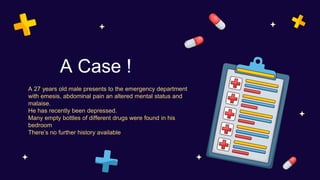
A 27 years old male presents to the emergency department
with emesis, abdominal pain an altered mental status and
malaise.
He has recently been depressed.
Many empty bottles of different drugs were found in his
bedroom
There’s no further history available
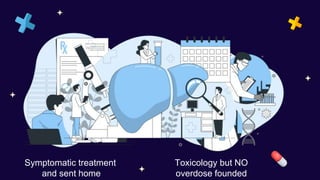
Symptomatic treatment
and sent home
Toxicology but NO
overdose founded
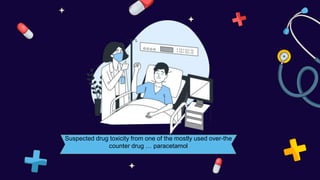
Suspected drug toxicity from one of the mostly used over-the
counter drug … paracetamol
Acetaminophen toxicity
Presented by: Dr.Alyaa Zuhair (medical intern)
Prevalence
01 Pharmacokinetics
02
Clinical picture
03 Management
04
Prevalence
In the United States, acetaminophen toxicity has
replaced viral hepatitis as the most common
cause of acute liver failure
01
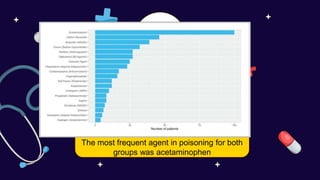
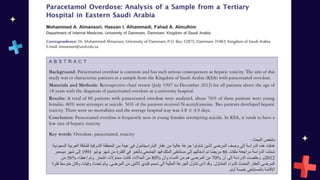
Results of a study conducted in KSA showed :
The most frequent agent in poisoning for both
groups was acetaminophen
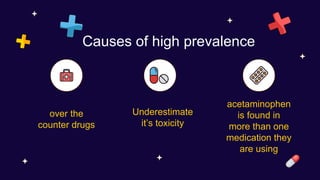
Causes of high prevalence
over the
counter drugs
Underestimate
it’s toxicity
acetaminophen
is found in
more than one
medication they
are using
Why it’s important to
recognize paracetamol
toxicity??
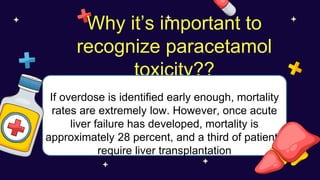
If overdose is identified early enough, mortality
rates are extremely low. However, once acute
liver failure has developed, mortality is
approximately 28 percent, and a third of patients
require liver transplantation
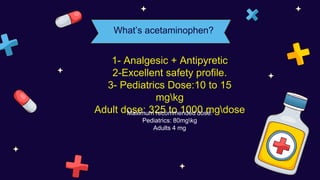
1- Analgesic + Antipyretic
2-Excellent safety profile.
3- Pediatrics Dose:10 to 15
mgkg
Adult dose: 325 to 1000 mgdose
What’s acetaminophen?
Maximum recommended dose:
Pediatrics: 80mgkg
Adults 4 mg
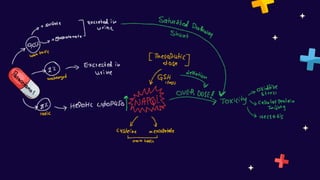
1- Excessive intake (mc)
2- delay in treatment
3- Excessive CYP450 activity .
4-Decrease capacity of glucurnidation & sulfation
5- depletion of glutathione stores
Factor’s influence toxicity
Acute Alcohol ingestion Chronic Alcohol ingestion
protective by competing w
for CYP2E1 = decreasing
the amount of NAPQI
produced.
(18 or more standard alcoholic drinks [250 mg/dL])
increases the activity of CYP2E1
activity and depletes glutathione
stores and synthesis(in overdose
therapeutic dose .
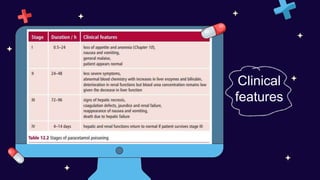
Clinical
features
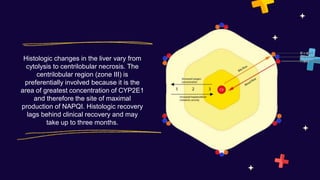
Histologic changes in the liver vary from
cytolysis to centrilobular necrosis. The
centrilobular region (zone III) is
preferentially involved because it is the
area of greatest concentration of CYP2E1
and therefore the site of maximal
production of NAPQI. Histologic recovery
lags behind clinical recovery and may
take up to three months.
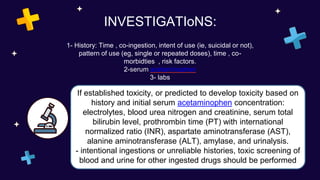
INVESTIGATIoNS:
1- History: Time , co-ingestion, intent of use (ie, suicidal or not),
pattern of use (eg, single or repeated doses), time , co-
morbidties , risk factors.
2-serum acetaminophen
3- labs
If established toxicity, or predicted to develop toxicity based on
history and initial serum acetaminophen concentration:
electrolytes, blood urea nitrogen and creatinine, serum total
bilirubin level, prothrombin time (PT) with international
normalized ratio (INR), aspartate aminotransferase (AST),
alanine aminotransferase (ALT), amylase, and urinalysis.
- intentional ingestions or unreliable histories, toxic screening of
blood and urine for other ingested drugs should be performed
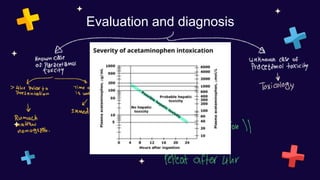
Evaluation and diagnosis
ABC
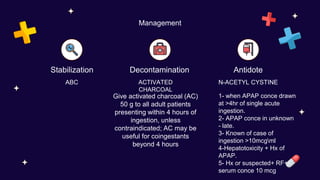
Management
Stabilization
ACTIVATED
CHARCOAL
Decontamination
N-ACETYL CYSTINE
Antidote
Give activated charcoal (AC)
50 g to all adult patients
presenting within 4 hours of
ingestion, unless
contraindicated; AC may be
useful for coingestants
beyond 4 hours
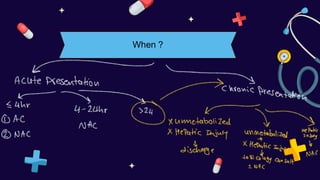
1- when APAP conce drawn
at >4hr of single acute
ingestion.
2- APAP conce in unknown
- late.
3- Known of case of
ingestion >10mcgml
4-Hepatotoxicity + Hx of
APAP.
5- Hx or suspected+ RF+
serum conce 10 mcg
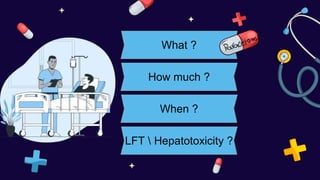
What ?
When ?
How much ?
LFT  Hepatotoxicity ?
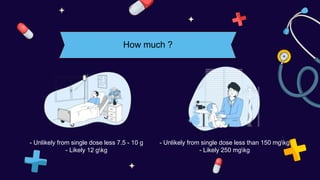
How much ?
- Unlikely from single dose less than 150 mgkg
- Likely 250 mgkg
- Unlikely from single dose less 7.5 - 10 g
- Likely 12 gkg
When ?
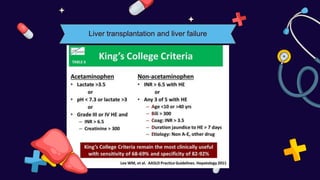
Liver transplantation and liver failure
Thanks for
your attention
Sources :
1.uptodate
2. Medscape

Paracetamol toxicity .pptx

  • 1.
    A Case ! A27 years old male presents to the emergency department with emesis, abdominal pain an altered mental status and malaise. He has recently been depressed. Many empty bottles of different drugs were found in his bedroom There’s no further history available
  • 2.
    Symptomatic treatment and senthome Toxicology but NO overdose founded
  • 3.
    Suspected drug toxicityfrom one of the mostly used over-the counter drug … paracetamol
  • 4.
    Acetaminophen toxicity Presented by:Dr.Alyaa Zuhair (medical intern)
  • 5.
  • 6.
    Prevalence In the UnitedStates, acetaminophen toxicity has replaced viral hepatitis as the most common cause of acute liver failure 01 Results of a study conducted in KSA showed : The most frequent agent in poisoning for both groups was acetaminophen
  • 8.
    Causes of highprevalence over the counter drugs Underestimate it’s toxicity acetaminophen is found in more than one medication they are using
  • 9.
    Why it’s importantto recognize paracetamol toxicity?? If overdose is identified early enough, mortality rates are extremely low. However, once acute liver failure has developed, mortality is approximately 28 percent, and a third of patients require liver transplantation
  • 10.
    1- Analgesic +Antipyretic 2-Excellent safety profile. 3- Pediatrics Dose:10 to 15 mgkg Adult dose: 325 to 1000 mgdose What’s acetaminophen? Maximum recommended dose: Pediatrics: 80mgkg Adults 4 mg
  • 12.
    1- Excessive intake(mc) 2- delay in treatment 3- Excessive CYP450 activity . 4-Decrease capacity of glucurnidation & sulfation 5- depletion of glutathione stores Factor’s influence toxicity Acute Alcohol ingestion Chronic Alcohol ingestion protective by competing w for CYP2E1 = decreasing the amount of NAPQI produced. (18 or more standard alcoholic drinks [250 mg/dL]) increases the activity of CYP2E1 activity and depletes glutathione stores and synthesis(in overdose therapeutic dose .
  • 13.
  • 14.
    Histologic changes inthe liver vary from cytolysis to centrilobular necrosis. The centrilobular region (zone III) is preferentially involved because it is the area of greatest concentration of CYP2E1 and therefore the site of maximal production of NAPQI. Histologic recovery lags behind clinical recovery and may take up to three months.
  • 15.
    INVESTIGATIoNS: 1- History: Time, co-ingestion, intent of use (ie, suicidal or not), pattern of use (eg, single or repeated doses), time , co- morbidties , risk factors. 2-serum acetaminophen 3- labs If established toxicity, or predicted to develop toxicity based on history and initial serum acetaminophen concentration: electrolytes, blood urea nitrogen and creatinine, serum total bilirubin level, prothrombin time (PT) with international normalized ratio (INR), aspartate aminotransferase (AST), alanine aminotransferase (ALT), amylase, and urinalysis. - intentional ingestions or unreliable histories, toxic screening of blood and urine for other ingested drugs should be performed
  • 16.
  • 17.
    ABC Management Stabilization ACTIVATED CHARCOAL Decontamination N-ACETYL CYSTINE Antidote Give activatedcharcoal (AC) 50 g to all adult patients presenting within 4 hours of ingestion, unless contraindicated; AC may be useful for coingestants beyond 4 hours 1- when APAP conce drawn at >4hr of single acute ingestion. 2- APAP conce in unknown - late. 3- Known of case of ingestion >10mcgml 4-Hepatotoxicity + Hx of APAP. 5- Hx or suspected+ RF+ serum conce 10 mcg
  • 18.
    What ? When ? Howmuch ? LFT Hepatotoxicity ?
  • 19.
    How much ? -Unlikely from single dose less than 150 mgkg - Likely 250 mgkg - Unlikely from single dose less 7.5 - 10 g - Likely 12 gkg
  • 20.
  • 21.
  • 22.
    Thanks for your attention Sources: 1.uptodate 2. Medscape