Collective Review
Keerati Supsaman
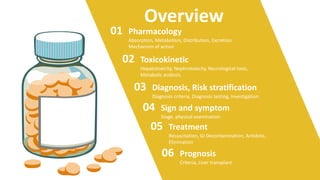
Overview
Absorption, Metabolism, Distribution, Excretion.
Mechanism of action
Pharmacology01
Hepatotoxicity, Nephrotoxicity, Neurological toxic,
Metabolic acidosis.
Toxicokinetic02
Diagnosis criteria, Diagnosis testing, Investigation.
Diagnosis, Risk stratification03
Stage, physical examination
Sign and symptom04
Resuscitation, GI Decontamination, Antidote,
Elimination
Treatment05
Criteria, Liver transplant
Prognosis06
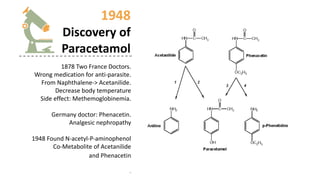
1948
Discovery of
Paracetamol
1878 Two France Doctors.
Wrong medication for anti-parasite.
From Naphthalene-> Acetanilide.
Decrease body temperature
Side effect: Methemoglobinemia.
Germany doctor: Phenacetin.
Analgesic nephropathy
1948 Found N-acetyl-P-aminophenol
Co-Metabolite of Acetanilide
and Phenacetin
.
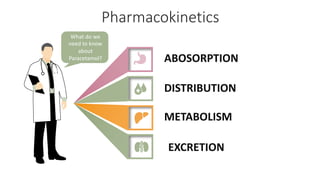
Pharmacokinetics
ABOSORPTION
What do we
need to know
about
Paracetamol?
DISTRIBUTION
METABOLISM
EXCRETION
Pharmacokinetics
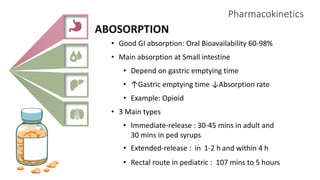
ABOSORPTION
• Good GI absorption: Oral Bioavailability 60-98%
• Main absorption at Small intestine
• Depend on gastric emptying time
• ↑Gastric emptying time ↓Absorption rate
• Example: Opioid
• 3 Main types
• Immediate-release : 30-45 mins in adult and
30 mins in ped syrups
• Extended-release : in 1-2 h and within 4 h
• Rectal route in pediatric : 107 mins to 5 hours
Pharmacokinetics
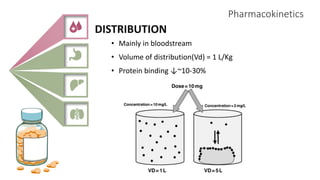
DISTRIBUTION
• Mainly in bloodstream
• Volume of distribution(Vd) = 1 L/Kg
• Protein binding ↓~10-30%
Pharmacokinetics
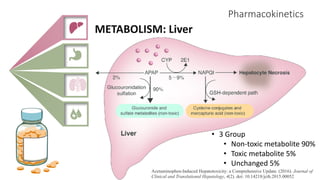
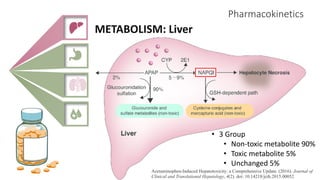
METABOLISM: Liver
• 3 Group
• Non-toxic metabolite 90%
• Toxic metabolite 5%
• Unchanged 5%
Acetaminophen-Induced Hepatotoxicity: a Comprehensive Update. (2016). Journal of
Clinical and Translational Hepatology, 4(2). doi: 10.14218/jcth.2015.00052
Pharmacokinetics
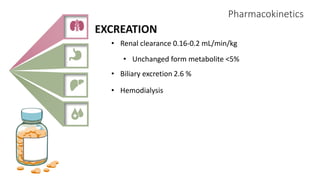
EXCREATION
• Renal clearance 0.16-0.2 mL/min/kg
• Unchanged form metabolite <5%
• Biliary excretion 2.6 %
• Hemodialysis
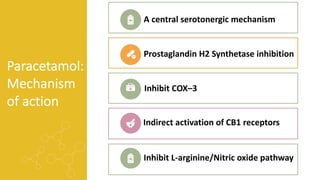
Paracetamol:
Mechanism
of action
A central serotonergic mechanism
Prostaglandin H2 Synthetase inhibition
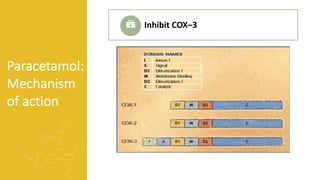
Inhibit COX–3
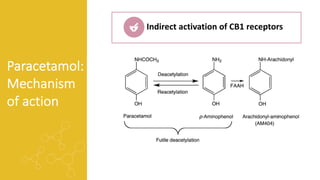
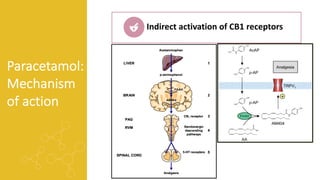
Indirect activation of CB1 receptors
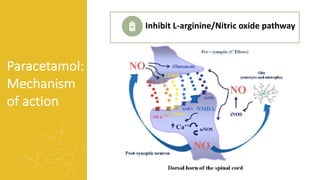
Inhibit L-arginine/Nitric oxide pathway
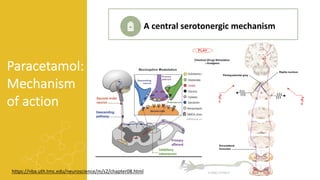
Paracetamol:
Mechanism
of action
A central serotonergic mechanism
https://nba.uth.tmc.edu/neuroscience/m/s2/chapter08.html
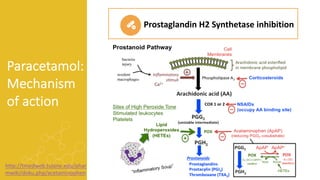
Paracetamol:
Mechanism
of action
Prostaglandin H2 Synthetase inhibition
http://tmedweb.tulane.edu/phar
mwiki/doku.php/acetaminophen
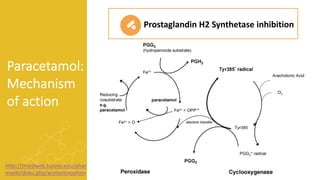
Paracetamol:
Mechanism
of action
Prostaglandin H2 Synthetase inhibition
http://tmedweb.tulane.edu/phar
mwiki/doku.php/acetaminophen
Paracetamol:
Mechanism
of action
Inhibit COX–3
Paracetamol:
Mechanism
of action
Indirect activation of CB1 receptors
Paracetamol:
Mechanism
of action
Indirect activation of CB1 receptors
Paracetamol:
Mechanism
of action
Inhibit L-arginine/Nitric oxide pathway
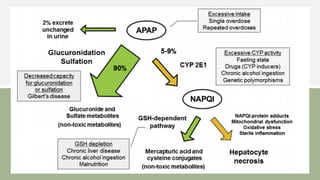
Toxicokinetic
Hepatic injury, Kidney injury, CNS injury, Metabolic acidosis NAPQI
Pharmacokinetics
METABOLISM: Liver
• 3 Group
• Non-toxic metabolite 90%
• Toxic metabolite 5%
• Unchanged 5%
Acetaminophen-Induced Hepatotoxicity: a Comprehensive Update. (2016). Journal of
Clinical and Translational Hepatology, 4(2). doi: 10.14218/jcth.2015.00052
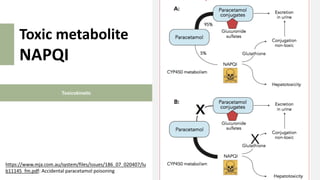
Toxicokinetic
Toxic metabolite
NAPQI
https://www.mja.com.au/system/files/issues/186_07_020407/lu
b11145_fm.pdf: Accidental paracetamol poisoning
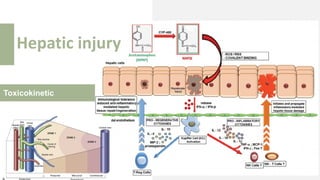
Toxicokinetic
Hepatic injury
Toxicokinetic
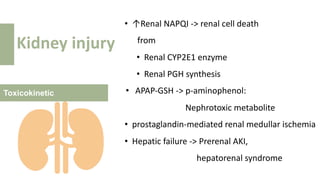
Kidney injury
• ↑Renal NAPQI -> renal cell death
from
• Renal CYP2E1 enzyme
• Renal PGH synthesis
• APAP-GSH -> p-aminophenol:
Nephrotoxic metabolite
• prostaglandin-mediated renal medullar ischemia
• Hepatic failure -> Prerenal AKI,
hepatorenal syndrome
Toxicokinetic
CNS injury
• Unknown mechanism
• Hypothesis
• Decrease CNS glutathione
• Serotonin, opioid effect
Lactic acidosis
• Unknown mechanism
• Mitochondria dysfunction
• Impair aerobic respiration
Diagnosis
Diagnosis criteria, Diagnosis testing, Investigation APAP
Tintinali’s Goldfrank’s Australia CPG
Single Dose
Adult>6 yrs >10 g, > 200 mg/kg >7.5 gm >10g, >200mg/kg
Child<6 yrs >200 mg/kg >150 mg/kg >200 mg/kg
RSTI
Adult>6 yrs >10g,>200mg/kg
in 24 h
>10g,>200mg/kg
in 24h
>10g,>200mg/kg
in 24 h
>6g,
>150mg/kg
in 24 h x 2days
>6g,
>150mg/kg
in 24 h x 2days
>12g,
>300 mg/kg
in 48 h
>60mg/kg[>4g] in48 h
+ clinical
Child<6 yrs
>200 mg/kg in 8h
>150 mg/kg
in 24 x2 days
>100 mg/kg/d in 72h Massive >= 30 g
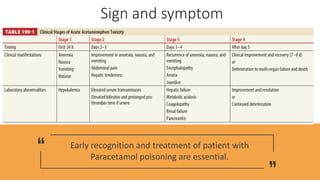
Sign and symptom
Early recognition and treatment of patient with
Paracetamol poisoning are essential.
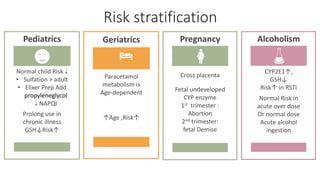
Risk stratification
Pediatrics
Normal child Risk ⇣
• Sulfation > adult
• Elixer Prep Add
propyleneglycol
⇣ NAPQI
Prolong use in
chronic illness
GSH↓Risk↑
Geriatrics
Paracetamol
metabolism is
Age-dependent
↑Age ,Risk↑
Pregnancy
Cross placenta
Fetal undeveloped
CYP enzyme
1st trimester :
Abortion
2nd trimester:
fetal Demise
Alcoholism
CYP2E1↑,
GSH↓
Risk↑ in RSTI
Normal Risk in
acute over dose
Or normal dose
Acute alcohol
ingestion
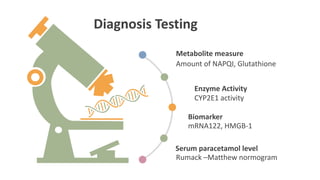
Amount of NAPQI, Glutathione
Metabolite measure
CYP2E1 activity
Enzyme Activity
mRNA122, HMGB-1
Biomarker
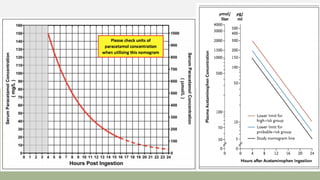
Rumack –Matthew normogram
Serum paracetamol level
Diagnosis Testing
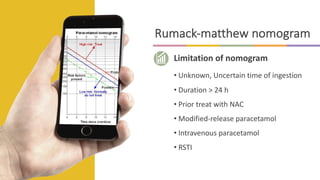
• Unknown, Uncertain time of ingestion
• Duration > 24 h
• Prior treat with NAC
• Modified-release paracetamol
• Intravenous paracetamol
• RSTI
Limitation of nomogram
Rumack-matthew nomogram
Acetaminophen-Aminotransferase
multiplication product [APxAT]
< 1500 mg.IU/L
1500-10000 mg.IU/L
No need treatment.
Low risk
- Use AST or ALT which is higher
- If no paracetamol level use 5 instead
Possible
> 10,000 mg.IU/L Probable
Paracetamol level x AST/ALT
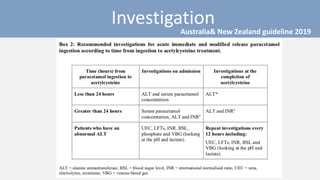
Australia& New Zealand guideline 2019
Investigation
Treatment
Resuscitation, GI decontamination, Specific antidote, H/D Acetylcysteine
Treatment
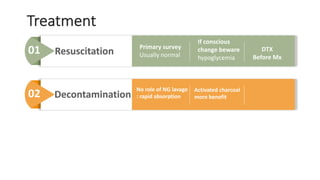
Resuscitation
Primary survey
Usually normal01
02 Decontamination
If conscious
change beware
hypoglycemia
DTX
Before Mx
No role of NG lavage
: rapid absorption
Activated charcoal
more benefit
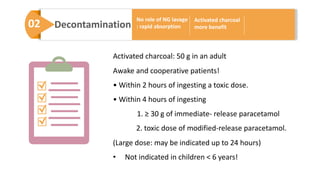
02 Decontamination
No role of NG lavage
: rapid absorption
Activated charcoal
more benefit
Activated charcoal: 50 g in an adult
Awake and cooperative patients!
• Within 2 hours of ingesting a toxic dose.
• Within 4 hours of ingesting
1. ≥ 30 g of immediate- release paracetamol
2. toxic dose of modified-release paracetamol.
(Large dose: may be indicated up to 24 hours)
• Not indicated in children < 6 years!
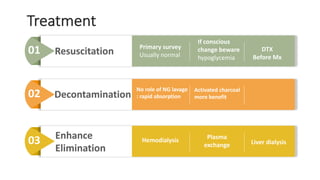
Treatment
Resuscitation
Primary survey
Usually normal01
02
03
Decontamination
Enhance
Elimination
If conscious
change beware
hypoglycemia
DTX
Before Mx
No role of NG lavage
: rapid absorption
Activated charcoal
more benefit
Hemodialysis Plasma
exchange Liver dialysis
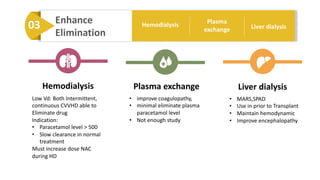
03 Enhance
Elimination
Hemodialysis Plasma
exchange Liver dialysis
Hemodialysis Plasma exchange Liver dialysis
Low Vd: Both Intermittent,
continuous CVVHD able to
Eliminate drug
Indication:
• Paracetamol level > 500
• Slow clearance in normal
treatment
Must increase dose NAC
during HD
• improve coagulopathy,
• minimal eliminate plasma
paracetamol level
• Not enough study
• MARS,SPAD
• Use in prior to Transplant
• Maintain hemodynamic
• Improve encephalopathy
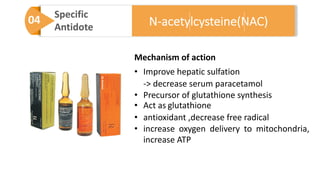
04 Specific
Antidote
Mechanism of action
• Improve hepatic sulfation
-> decrease serum paracetamol
• Precursor of glutathione synthesis
• Act as glutathione
• antioxidant ,decrease free radical
• increase oxygen delivery to mitochondria,
increase ATP
N-acetylcysteine(NAC)
04 Specific
Antidote
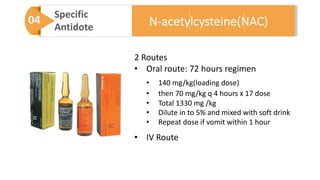
2 Routes
• Oral route: 72 hours regimen
• 140 mg/kg(loading dose)
• then 70 mg/kg q 4 hours x 17 dose
• Total 1330 mg /kg
• Dilute in to 5% and mixed with soft drink
• Repeat dose if vomit within 1 hour
• IV Route
N-acetylcysteine(NAC)
04 Specific
Antidote N-acetylcysteine(NAC)
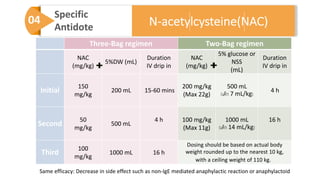
Three-Bag regimen Two-Bag regimen
NAC
(mg/kg)
5%DW (mL)
Duration
IV drip in
NAC
(mg/kg)
5% glucose or
NSS
(mL)
Duration
IV drip in
Initial
150
mg/kg
200 mL 15-60 mins
200 mg/kg
(Max 22g)
500 mL
(เด็ก 7 mL/kg)
4 h
Second
50
mg/kg
500 mL
4 h 100 mg/kg
(Max 11g)
1000 mL
(เด็ก 14 mL/kg)
16 h
Third
100
mg/kg
1000 mL 16 h
Dosing should be based on actual body
weight rounded up to the nearest 10 kg,
with a ceiling weight of 110 kg.
Same efficacy: Decrease in side effect such as non-IgE mediated anaphylactic reaction or anaphylactoid
04 Specific
Antidote N-acetylcysteine(NAC)
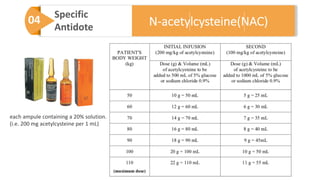
each ampule containing a 20% solution.
(i.e. 200 mg acetylcysteine per 1 mL)
Updated guidelines for the
management of paracetamol poisoning
in Australia and New Zealand
- March 2020
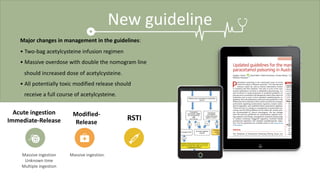
New guideline
Acute ingestion
Immediate-Release
Modified-
Release
RSTI
Massive ingestion
Unknown time
Multiple ingestion
Massive ingestion.
Major changes in management in the guidelines:
• Two-bag acetylcysteine infusion regimen
• Massive overdose with double the nomogram line
should increased dose of acetylcysteine.
• All potentially toxic modified release should
receive a full course of acetylcysteine.
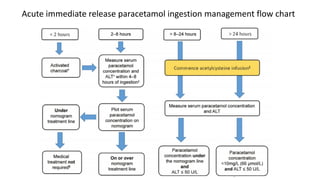
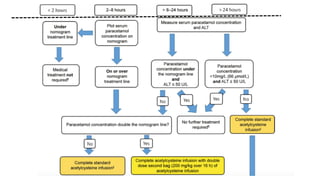
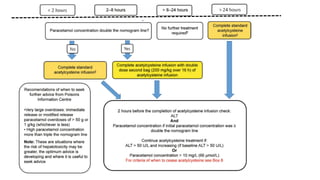
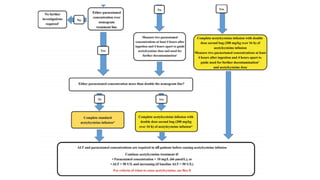
Acute immediate release paracetamol ingestion management flow chart
04 Specific
Antidote
Multiple or staggered immediate release
paracetamol ingestions
• multiple or staggered paracetamol ingestions over more
than 2 hours for the purpose of deliberate self-harm
• be treated as per acute immediate release
• If the first paracetamol concentration was measured within
2 hours of the last ingested paracetamol dose, repeated
after 2 hours to ensure there is no ongoing absorption
Specific situation
04 Specific
Antidote
Unknow time of ingestion
If the time of ingestion is unknown,
or clinician is not confident of the history of ingestion
it is safest to treat the patient as a delayed presentation.
recommendation is to follow the > 8 hours scenario in
Massive ingestion >= 30 g
If the concentration is double nomogram line
Increase second bag regimen
If triple nomogram: Consult toxicologist
Specific situation
04 Specific
Antidote
Cessation of Acetylcysteine
if all the following criteria have been met:
• ALT or AST are decreasing
• INR < 2.0
• Patient clinically well
N-acetylcysteine(NAC)
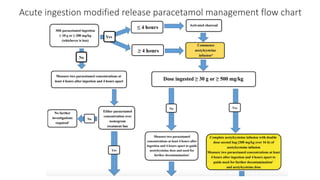
Acute ingestion modified release paracetamol management flow chart
04 Specific
Antidote
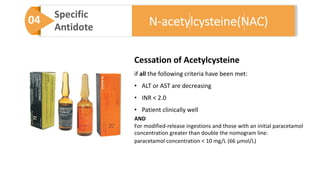
Cessation of Acetylcysteine
if all the following criteria have been met:
• ALT or AST are decreasing
• INR < 2.0
• Patient clinically well
AND
For modified-release ingestions and those with an initial paracetamol
concentration greater than double the nomogram line:
paracetamol concentration < 10 mg/L (66 μmol/L)
N-acetylcysteine(NAC)
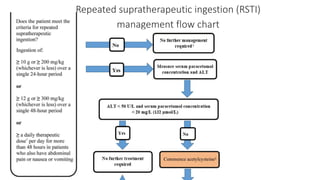
Repeated supratherapeutic ingestion (RSTI)
management flow chart
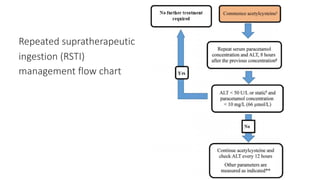
Repeated supratherapeutic
ingestion (RSTI)
management flow chart
04 Specific
Antidote
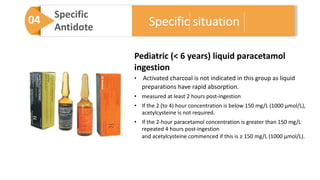
Pediatric (< 6 years) liquid paracetamol
ingestion
• Activated charcoal is not indicated in this group as liquid
preparations have rapid absorption.
• measured at least 2 hours post-ingestion
• If the 2 (to 4) hour concentration is below 150 mg/L (1000 μmol/L),
acetylcysteine is not required.
• If the 2-hour paracetamol concentration is greater than 150 mg/L
repeated 4 hours post-ingestion
and acetylcysteine commenced if this is ≥ 150 mg/L (1000 μmol/L).
Specific situation
04 Specific
Antidote
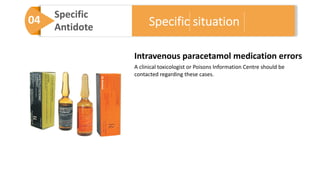
Intravenous paracetamol medication errors
A clinical toxicologist or Poisons Information Centre should be
contacted regarding these cases.
Specific situation
The King’s college criteria
For paracetamol toxicity
The patient who met this criteria has
survival rate <20%
Immediate transplant must be perform.
• Arterial pH <7.3 or Lactate> 3.0
After adequate fluid resuscitate
Or all of the following
• Creatinine >= 3.3 mg/dL
• INR>6.5 or PTT > 100 sec
• Hepatic encephalopathy grade III, IV
Liver transplant
King’s college criteria
O r g a n d o n a t i o n
STOP TREATMENT WHEN MET THE CRITERIA
Consult psychiatrist in Suicidal case
AS SHOWN IN PREVIOUS SLIDE
GOLDFRANK’S CRITERIA
• Serum paracetamol cannot detected
• AST with in normal limit.
.
D I S P O S I T I O N
AFTER TREATMENT
D I S C H R A G E H O M E
Prognosis
KCC, APACHE, MELD, Score Acetylcysteine
Prognosis tool
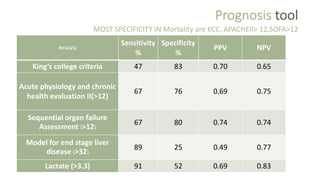
MOST SPECIFICITY IN Mortality are KCC, APACHEII> 12,SOFA>12
คะแนน
Sensitivity
%
Specificity
%
PPV NPV
King’s college criteria 47 83 0.70 0.65
Acute physiology and chronic
health evaluation II(>12)
67 76 0.69 0.75
Sequential organ failure
Assessment (>12)
67 80 0.74 0.74
Model for end stage liver
disease (>32)
89 25 0.49 0.77
Lactate (>3.3) 91 52 0.69 0.83
Thank you

Paracetamol overdose

  • 1.
  • 2.
    Overview Absorption, Metabolism, Distribution,Excretion. Mechanism of action Pharmacology01 Hepatotoxicity, Nephrotoxicity, Neurological toxic, Metabolic acidosis. Toxicokinetic02 Diagnosis criteria, Diagnosis testing, Investigation. Diagnosis, Risk stratification03 Stage, physical examination Sign and symptom04 Resuscitation, GI Decontamination, Antidote, Elimination Treatment05 Criteria, Liver transplant Prognosis06
  • 3.
    1948 Discovery of Paracetamol 1878 TwoFrance Doctors. Wrong medication for anti-parasite. From Naphthalene-> Acetanilide. Decrease body temperature Side effect: Methemoglobinemia. Germany doctor: Phenacetin. Analgesic nephropathy 1948 Found N-acetyl-P-aminophenol Co-Metabolite of Acetanilide and Phenacetin .
  • 4.
    Pharmacokinetics ABOSORPTION What do we needto know about Paracetamol? DISTRIBUTION METABOLISM EXCRETION
  • 5.
    Pharmacokinetics ABOSORPTION • Good GIabsorption: Oral Bioavailability 60-98% • Main absorption at Small intestine • Depend on gastric emptying time • ↑Gastric emptying time ↓Absorption rate • Example: Opioid • 3 Main types • Immediate-release : 30-45 mins in adult and 30 mins in ped syrups • Extended-release : in 1-2 h and within 4 h • Rectal route in pediatric : 107 mins to 5 hours
  • 6.
    Pharmacokinetics DISTRIBUTION • Mainly inbloodstream • Volume of distribution(Vd) = 1 L/Kg • Protein binding ↓~10-30%
  • 7.
    Pharmacokinetics METABOLISM: Liver • 3Group • Non-toxic metabolite 90% • Toxic metabolite 5% • Unchanged 5% Acetaminophen-Induced Hepatotoxicity: a Comprehensive Update. (2016). Journal of Clinical and Translational Hepatology, 4(2). doi: 10.14218/jcth.2015.00052
  • 8.
    Pharmacokinetics EXCREATION • Renal clearance0.16-0.2 mL/min/kg • Unchanged form metabolite <5% • Biliary excretion 2.6 % • Hemodialysis
  • 9.
    Paracetamol: Mechanism of action A centralserotonergic mechanism Prostaglandin H2 Synthetase inhibition Inhibit COX–3 Indirect activation of CB1 receptors Inhibit L-arginine/Nitric oxide pathway
  • 10.
    Paracetamol: Mechanism of action A centralserotonergic mechanism https://nba.uth.tmc.edu/neuroscience/m/s2/chapter08.html
  • 11.
    Paracetamol: Mechanism of action Prostaglandin H2Synthetase inhibition http://tmedweb.tulane.edu/phar mwiki/doku.php/acetaminophen
  • 12.
    Paracetamol: Mechanism of action Prostaglandin H2Synthetase inhibition http://tmedweb.tulane.edu/phar mwiki/doku.php/acetaminophen
  • 13.
  • 14.
  • 15.
  • 16.
  • 17.
    Toxicokinetic Hepatic injury, Kidneyinjury, CNS injury, Metabolic acidosis NAPQI
  • 18.
    Pharmacokinetics METABOLISM: Liver • 3Group • Non-toxic metabolite 90% • Toxic metabolite 5% • Unchanged 5% Acetaminophen-Induced Hepatotoxicity: a Comprehensive Update. (2016). Journal of Clinical and Translational Hepatology, 4(2). doi: 10.14218/jcth.2015.00052
  • 19.
  • 20.
  • 21.
    Toxicokinetic Kidney injury • ↑RenalNAPQI -> renal cell death from • Renal CYP2E1 enzyme • Renal PGH synthesis • APAP-GSH -> p-aminophenol: Nephrotoxic metabolite • prostaglandin-mediated renal medullar ischemia • Hepatic failure -> Prerenal AKI, hepatorenal syndrome
  • 22.
    Toxicokinetic CNS injury • Unknownmechanism • Hypothesis • Decrease CNS glutathione • Serotonin, opioid effect Lactic acidosis • Unknown mechanism • Mitochondria dysfunction • Impair aerobic respiration
  • 23.
    Diagnosis Diagnosis criteria, Diagnosistesting, Investigation APAP
  • 24.
    Tintinali’s Goldfrank’s AustraliaCPG Single Dose Adult>6 yrs >10 g, > 200 mg/kg >7.5 gm >10g, >200mg/kg Child<6 yrs >200 mg/kg >150 mg/kg >200 mg/kg RSTI Adult>6 yrs >10g,>200mg/kg in 24 h >10g,>200mg/kg in 24h >10g,>200mg/kg in 24 h >6g, >150mg/kg in 24 h x 2days >6g, >150mg/kg in 24 h x 2days >12g, >300 mg/kg in 48 h >60mg/kg[>4g] in48 h + clinical Child<6 yrs >200 mg/kg in 8h >150 mg/kg in 24 x2 days >100 mg/kg/d in 72h Massive >= 30 g
  • 25.
    Sign and symptom Earlyrecognition and treatment of patient with Paracetamol poisoning are essential.
  • 26.
    Risk stratification Pediatrics Normal childRisk ⇣ • Sulfation > adult • Elixer Prep Add propyleneglycol ⇣ NAPQI Prolong use in chronic illness GSH↓Risk↑ Geriatrics Paracetamol metabolism is Age-dependent ↑Age ,Risk↑ Pregnancy Cross placenta Fetal undeveloped CYP enzyme 1st trimester : Abortion 2nd trimester: fetal Demise Alcoholism CYP2E1↑, GSH↓ Risk↑ in RSTI Normal Risk in acute over dose Or normal dose Acute alcohol ingestion
  • 28.
    Amount of NAPQI,Glutathione Metabolite measure CYP2E1 activity Enzyme Activity mRNA122, HMGB-1 Biomarker Rumack –Matthew normogram Serum paracetamol level Diagnosis Testing
  • 29.
    • Unknown, Uncertaintime of ingestion • Duration > 24 h • Prior treat with NAC • Modified-release paracetamol • Intravenous paracetamol • RSTI Limitation of nomogram Rumack-matthew nomogram
  • 31.
    Acetaminophen-Aminotransferase multiplication product [APxAT] <1500 mg.IU/L 1500-10000 mg.IU/L No need treatment. Low risk - Use AST or ALT which is higher - If no paracetamol level use 5 instead Possible > 10,000 mg.IU/L Probable Paracetamol level x AST/ALT
  • 32.
    Australia& New Zealandguideline 2019 Investigation
  • 33.
    Treatment Resuscitation, GI decontamination,Specific antidote, H/D Acetylcysteine
  • 34.
    Treatment Resuscitation Primary survey Usually normal01 02Decontamination If conscious change beware hypoglycemia DTX Before Mx No role of NG lavage : rapid absorption Activated charcoal more benefit
  • 35.
    02 Decontamination No roleof NG lavage : rapid absorption Activated charcoal more benefit Activated charcoal: 50 g in an adult Awake and cooperative patients! • Within 2 hours of ingesting a toxic dose. • Within 4 hours of ingesting 1. ≥ 30 g of immediate- release paracetamol 2. toxic dose of modified-release paracetamol. (Large dose: may be indicated up to 24 hours) • Not indicated in children < 6 years!
  • 36.
    Treatment Resuscitation Primary survey Usually normal01 02 03 Decontamination Enhance Elimination Ifconscious change beware hypoglycemia DTX Before Mx No role of NG lavage : rapid absorption Activated charcoal more benefit Hemodialysis Plasma exchange Liver dialysis
  • 37.
    03 Enhance Elimination Hemodialysis Plasma exchangeLiver dialysis Hemodialysis Plasma exchange Liver dialysis Low Vd: Both Intermittent, continuous CVVHD able to Eliminate drug Indication: • Paracetamol level > 500 • Slow clearance in normal treatment Must increase dose NAC during HD • improve coagulopathy, • minimal eliminate plasma paracetamol level • Not enough study • MARS,SPAD • Use in prior to Transplant • Maintain hemodynamic • Improve encephalopathy
  • 38.
    04 Specific Antidote Mechanism ofaction • Improve hepatic sulfation -> decrease serum paracetamol • Precursor of glutathione synthesis • Act as glutathione • antioxidant ,decrease free radical • increase oxygen delivery to mitochondria, increase ATP N-acetylcysteine(NAC)
  • 39.
    04 Specific Antidote 2 Routes •Oral route: 72 hours regimen • 140 mg/kg(loading dose) • then 70 mg/kg q 4 hours x 17 dose • Total 1330 mg /kg • Dilute in to 5% and mixed with soft drink • Repeat dose if vomit within 1 hour • IV Route N-acetylcysteine(NAC)
  • 40.
    04 Specific Antidote N-acetylcysteine(NAC) Three-Bagregimen Two-Bag regimen NAC (mg/kg) 5%DW (mL) Duration IV drip in NAC (mg/kg) 5% glucose or NSS (mL) Duration IV drip in Initial 150 mg/kg 200 mL 15-60 mins 200 mg/kg (Max 22g) 500 mL (เด็ก 7 mL/kg) 4 h Second 50 mg/kg 500 mL 4 h 100 mg/kg (Max 11g) 1000 mL (เด็ก 14 mL/kg) 16 h Third 100 mg/kg 1000 mL 16 h Dosing should be based on actual body weight rounded up to the nearest 10 kg, with a ceiling weight of 110 kg. Same efficacy: Decrease in side effect such as non-IgE mediated anaphylactic reaction or anaphylactoid
  • 41.
    04 Specific Antidote N-acetylcysteine(NAC) eachampule containing a 20% solution. (i.e. 200 mg acetylcysteine per 1 mL)
  • 42.
    Updated guidelines forthe management of paracetamol poisoning in Australia and New Zealand - March 2020
  • 43.
    New guideline Acute ingestion Immediate-Release Modified- Release RSTI Massiveingestion Unknown time Multiple ingestion Massive ingestion. Major changes in management in the guidelines: • Two-bag acetylcysteine infusion regimen • Massive overdose with double the nomogram line should increased dose of acetylcysteine. • All potentially toxic modified release should receive a full course of acetylcysteine.
  • 44.
    Acute immediate releaseparacetamol ingestion management flow chart
  • 47.
    04 Specific Antidote Multiple orstaggered immediate release paracetamol ingestions • multiple or staggered paracetamol ingestions over more than 2 hours for the purpose of deliberate self-harm • be treated as per acute immediate release • If the first paracetamol concentration was measured within 2 hours of the last ingested paracetamol dose, repeated after 2 hours to ensure there is no ongoing absorption Specific situation
  • 48.
    04 Specific Antidote Unknow timeof ingestion If the time of ingestion is unknown, or clinician is not confident of the history of ingestion it is safest to treat the patient as a delayed presentation. recommendation is to follow the > 8 hours scenario in Massive ingestion >= 30 g If the concentration is double nomogram line Increase second bag regimen If triple nomogram: Consult toxicologist Specific situation
  • 49.
    04 Specific Antidote Cessation ofAcetylcysteine if all the following criteria have been met: • ALT or AST are decreasing • INR < 2.0 • Patient clinically well N-acetylcysteine(NAC)
  • 50.
    Acute ingestion modifiedrelease paracetamol management flow chart
  • 52.
    04 Specific Antidote Cessation ofAcetylcysteine if all the following criteria have been met: • ALT or AST are decreasing • INR < 2.0 • Patient clinically well AND For modified-release ingestions and those with an initial paracetamol concentration greater than double the nomogram line: paracetamol concentration < 10 mg/L (66 μmol/L) N-acetylcysteine(NAC)
  • 53.
    Repeated supratherapeutic ingestion(RSTI) management flow chart
  • 54.
  • 55.
    04 Specific Antidote Pediatric (<6 years) liquid paracetamol ingestion • Activated charcoal is not indicated in this group as liquid preparations have rapid absorption. • measured at least 2 hours post-ingestion • If the 2 (to 4) hour concentration is below 150 mg/L (1000 μmol/L), acetylcysteine is not required. • If the 2-hour paracetamol concentration is greater than 150 mg/L repeated 4 hours post-ingestion and acetylcysteine commenced if this is ≥ 150 mg/L (1000 μmol/L). Specific situation
  • 56.
    04 Specific Antidote Intravenous paracetamolmedication errors A clinical toxicologist or Poisons Information Centre should be contacted regarding these cases. Specific situation
  • 57.
    The King’s collegecriteria For paracetamol toxicity The patient who met this criteria has survival rate <20% Immediate transplant must be perform. • Arterial pH <7.3 or Lactate> 3.0 After adequate fluid resuscitate Or all of the following • Creatinine >= 3.3 mg/dL • INR>6.5 or PTT > 100 sec • Hepatic encephalopathy grade III, IV Liver transplant King’s college criteria O r g a n d o n a t i o n
  • 58.
    STOP TREATMENT WHENMET THE CRITERIA Consult psychiatrist in Suicidal case AS SHOWN IN PREVIOUS SLIDE GOLDFRANK’S CRITERIA • Serum paracetamol cannot detected • AST with in normal limit. . D I S P O S I T I O N AFTER TREATMENT D I S C H R A G E H O M E
  • 59.
    Prognosis KCC, APACHE, MELD,Score Acetylcysteine
  • 60.
    Prognosis tool MOST SPECIFICITYIN Mortality are KCC, APACHEII> 12,SOFA>12 คะแนน Sensitivity % Specificity % PPV NPV King’s college criteria 47 83 0.70 0.65 Acute physiology and chronic health evaluation II(>12) 67 76 0.69 0.75 Sequential organ failure Assessment (>12) 67 80 0.74 0.74 Model for end stage liver disease (>32) 89 25 0.49 0.77 Lactate (>3.3) 91 52 0.69 0.83
  • 61.