The Desktop
Computer
TOPICS
● Housing/Shielding
● Heat dissipation system
● Motherboard
● CPU/Processor
● RAM
● Hard Drive
● Power Supply Unit
Introduction
Computer is a multipurpose electronic device that can receive, process and
store data.
They are used as tools in every part of society together with the
Internet.
Computers nowadays are complex; there are a lot of different components
inside them, and they all serve different purposes. They all need to work
together for the computer to work; knowing how a computer works makes it
easier to use a computer by being able to understand how a computer will
respond.
Housing/Shielding
The housing is the part of your computer that holds
all the parts that make the computer operate.
PRINCIPLES and USAGE of Housing
- Protection and static shielding of a computer
- Principle of faraday cage which: an earthed metal
screen or housing surrounding object to exclude
electrostatic and electromagnetic influences.
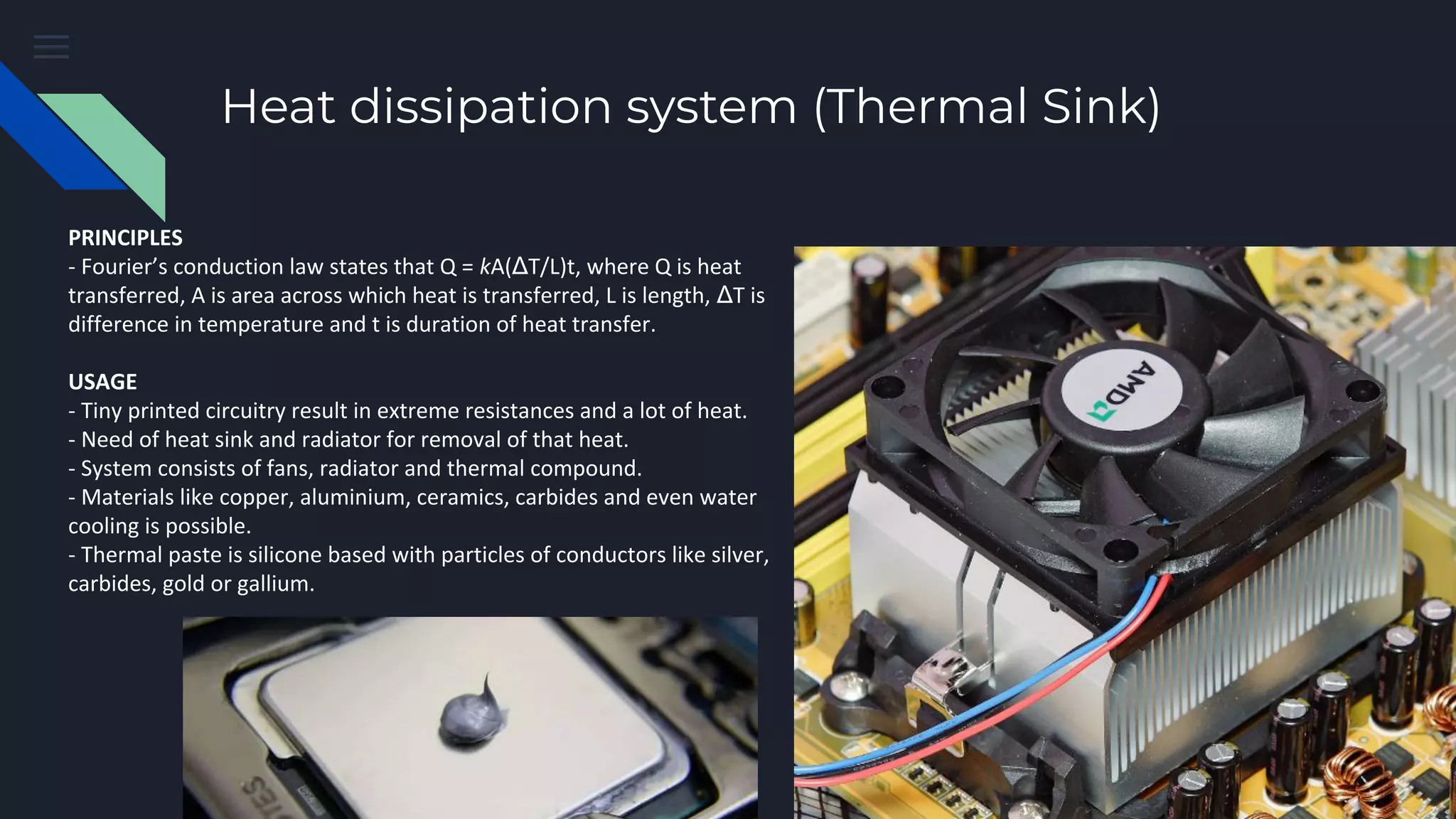
Heat dissipation system (Thermal Sink)
PRINCIPLES
- Fourier’s conduction law states that Q = kA(ΔT/L)t, where Q is heat
transferred, A is area across which heat is transferred, L is length, ΔT is
difference in temperature and t is duration of heat transfer.
USAGE
- Tiny printed circuitry result in extreme resistances and a lot of heat.
- Need of heat sink and radiator for removal of that heat.
- System consists of fans, radiator and thermal compound.
- Materials like copper, aluminium, ceramics, carbides and even water
cooling is possible.
- Thermal paste is silicone based with particles of conductors like silver,
carbides, gold or gallium.
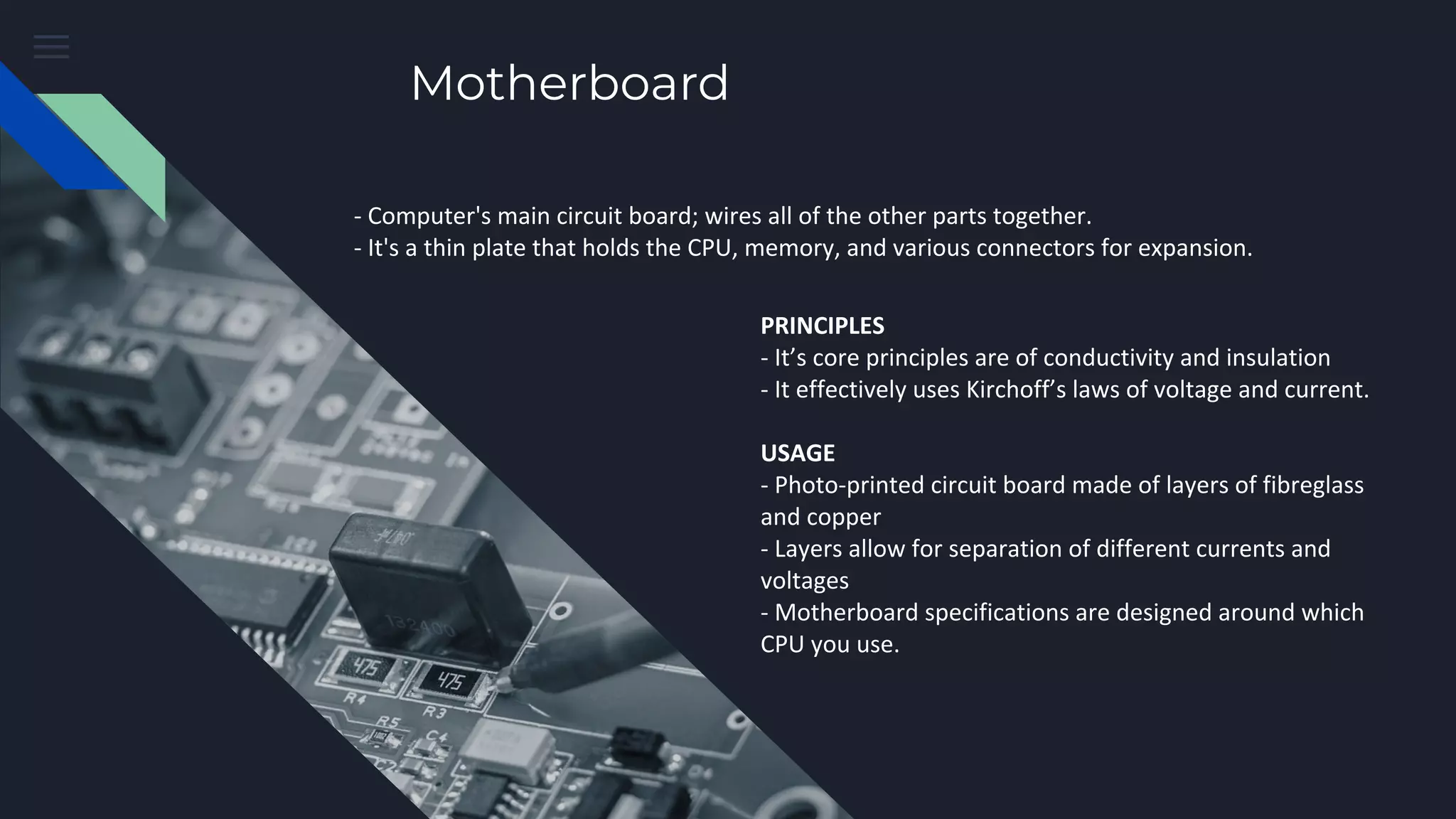
Motherboard
- Computer's main circuit board; wires all of the other parts together.
- It's a thin plate that holds the CPU, memory, and various connectors for expansion.
PRINCIPLES
- It’s core principles are of conductivity and insulation
- It effectively uses Kirchoff’s laws of voltage and current.
USAGE
- Photo-printed circuit board made of layers of fibreglass
and copper
- Layers allow for separation of different currents and
voltages
- Motherboard specifications are designed around which
CPU you use.
MOTHERBOARD LAYOUT
PROCESSOR (CPU)
- Carries out commands from the user
PRINCIPLES
- It relies on properties of semiconductors.
- Mainly silicon crystal structure and modification of it. (Doping)
- It’s most basic device is the transistor which separates or allows
flow of charges
- Doping of silicon chips allows a transistor as a temporary switch
when voltage is applied
USAGE
- Pressing a key, clicking the mouse, or starting applications sends
instructions to the CPU.
- The processor interprets every code it receives in binary.
- Usually a two-inch ceramic square with a silicon chip the size of a
thumbnail.
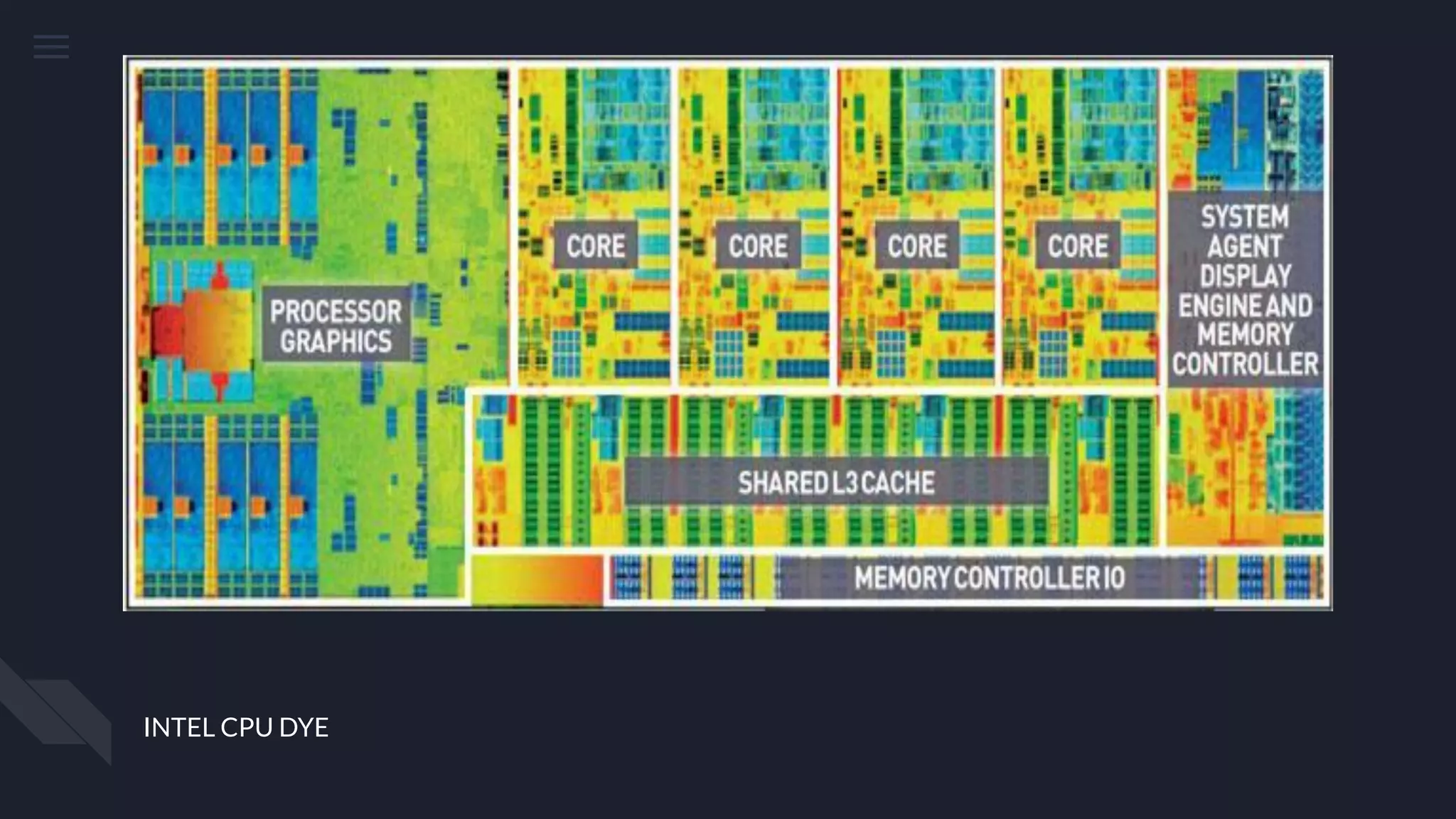
INTEL CPU DYE
RAM (Random Access Memory)
RAM is your system's short-term or instant memory. RAM is always in use as a
temporary location to execute instructions from your computer.
PRINCIPLES
- Basic principle is of using a switch with a capacitor to store charge.
- The electric charge stored between the plates of a capacitor (Q) is directly
proportional to the potential difference (V) between the plates, that is CV = Q
(C is capacitance constant)
USAGE
- A silicon transistor and micro capacitor are paired to create a memory cell
equal to 1 bit.
- Short-term memory disappears when the computer is turned off.
- If you run many programs these are stored in RAM. When you save a file, the
data is written to the permanent storage.
- The hard drive is where your software, documents, and other files are
stored.
PRINCIPLES
- It uses the basics of Fleming’s Right hand rule of electro magnetism to
determine the direction of the magnetic force on a positive moving
charge.
USAGE
- They have many magnetically coated disks or platters rotating at high
speeds, with a read or write swivelling perpendicularly over it
programming the magnetic layer.
- Laptop hard drive platters are made from glass while desktop ones are
made of aluminium on which a thin programmable coating is deposited
on both sides of the substrate.
- The hard drive is long-term storage, which means the data is still saved
even if you turn the computer off or unplug it.
HARD DRIVE
POWER SUPPLY UNIT
Converts the power from the wall outlet to DC current.
PRINCIPLE
- It relies on the most basic electrostatic rule that voltage is directly
proportional to current and resistance, and that power outputted is result of
the product of voltage applied and current drawn by any device.
Ohm’s law and Power law or formula
- It also uses magnetic induction either to increase or decrease power or
convert AC to DC current.
# V=IR (where V is voltage, P is power, I is current and R is resistance)
# P=IV
USAGE
- Each cable is of fixed wattage and arranged in stacks of 6, 8, 12 or 24 which
are standard for all components.
- Using the conversion formulas and many different arrays of coils and
resistors it can achieve optimal Direct Current for each individual device in a
PC like the hard drive, CPU, RAM and more.
Thank You
References:
Principles of Physics, Haliday Resnik Krane
Linus Tech Tips Forum
Youtube

case study on Desktop

  • 1.
  • 2.
    TOPICS ● Housing/Shielding ● Heatdissipation system ● Motherboard ● CPU/Processor ● RAM ● Hard Drive ● Power Supply Unit
  • 3.
    Introduction Computer is amultipurpose electronic device that can receive, process and store data. They are used as tools in every part of society together with the Internet. Computers nowadays are complex; there are a lot of different components inside them, and they all serve different purposes. They all need to work together for the computer to work; knowing how a computer works makes it easier to use a computer by being able to understand how a computer will respond.
  • 4.
    Housing/Shielding The housing isthe part of your computer that holds all the parts that make the computer operate. PRINCIPLES and USAGE of Housing - Protection and static shielding of a computer - Principle of faraday cage which: an earthed metal screen or housing surrounding object to exclude electrostatic and electromagnetic influences.
  • 5.
    Heat dissipation system(Thermal Sink) PRINCIPLES - Fourier’s conduction law states that Q = kA(ΔT/L)t, where Q is heat transferred, A is area across which heat is transferred, L is length, ΔT is difference in temperature and t is duration of heat transfer. USAGE - Tiny printed circuitry result in extreme resistances and a lot of heat. - Need of heat sink and radiator for removal of that heat. - System consists of fans, radiator and thermal compound. - Materials like copper, aluminium, ceramics, carbides and even water cooling is possible. - Thermal paste is silicone based with particles of conductors like silver, carbides, gold or gallium.
  • 6.
    Motherboard - Computer's maincircuit board; wires all of the other parts together. - It's a thin plate that holds the CPU, memory, and various connectors for expansion. PRINCIPLES - It’s core principles are of conductivity and insulation - It effectively uses Kirchoff’s laws of voltage and current. USAGE - Photo-printed circuit board made of layers of fibreglass and copper - Layers allow for separation of different currents and voltages - Motherboard specifications are designed around which CPU you use.
  • 7.
  • 8.
    PROCESSOR (CPU) - Carriesout commands from the user PRINCIPLES - It relies on properties of semiconductors. - Mainly silicon crystal structure and modification of it. (Doping) - It’s most basic device is the transistor which separates or allows flow of charges - Doping of silicon chips allows a transistor as a temporary switch when voltage is applied USAGE - Pressing a key, clicking the mouse, or starting applications sends instructions to the CPU. - The processor interprets every code it receives in binary. - Usually a two-inch ceramic square with a silicon chip the size of a thumbnail.
  • 9.
  • 10.
    RAM (Random AccessMemory) RAM is your system's short-term or instant memory. RAM is always in use as a temporary location to execute instructions from your computer. PRINCIPLES - Basic principle is of using a switch with a capacitor to store charge. - The electric charge stored between the plates of a capacitor (Q) is directly proportional to the potential difference (V) between the plates, that is CV = Q (C is capacitance constant) USAGE - A silicon transistor and micro capacitor are paired to create a memory cell equal to 1 bit. - Short-term memory disappears when the computer is turned off. - If you run many programs these are stored in RAM. When you save a file, the data is written to the permanent storage.
  • 11.
    - The harddrive is where your software, documents, and other files are stored. PRINCIPLES - It uses the basics of Fleming’s Right hand rule of electro magnetism to determine the direction of the magnetic force on a positive moving charge. USAGE - They have many magnetically coated disks or platters rotating at high speeds, with a read or write swivelling perpendicularly over it programming the magnetic layer. - Laptop hard drive platters are made from glass while desktop ones are made of aluminium on which a thin programmable coating is deposited on both sides of the substrate. - The hard drive is long-term storage, which means the data is still saved even if you turn the computer off or unplug it. HARD DRIVE
  • 12.
    POWER SUPPLY UNIT Convertsthe power from the wall outlet to DC current. PRINCIPLE - It relies on the most basic electrostatic rule that voltage is directly proportional to current and resistance, and that power outputted is result of the product of voltage applied and current drawn by any device. Ohm’s law and Power law or formula - It also uses magnetic induction either to increase or decrease power or convert AC to DC current. # V=IR (where V is voltage, P is power, I is current and R is resistance) # P=IV USAGE - Each cable is of fixed wattage and arranged in stacks of 6, 8, 12 or 24 which are standard for all components. - Using the conversion formulas and many different arrays of coils and resistors it can achieve optimal Direct Current for each individual device in a PC like the hard drive, CPU, RAM and more.
  • 13.
    Thank You References: Principles ofPhysics, Haliday Resnik Krane Linus Tech Tips Forum Youtube