Case Study on Change Control In Equipment
Presented by
Ch. S S N D Balakrishna, M.Pharm
Department of Regulatory Affairs
Shri Vishnu college of pharmacy (SVCP)
Introduction
Change control:
According to WHO, “Change control is a formal system by
which qualified representatives of appropriate disciplines review
proposed or actual changes that might effect a validated status. The
intent is to determine the need for the action that would ensure that
the system is maintained in a validated state”.
1
Improving product quality by reducing segregation
in a pharmaceutical application
Particle segregation is a concern in most industries. where
only very slight variations in the concentration of active drug are
permitted. Drugs that are produced in solid dosage form contain
many ingredients.
If the active ingredient is not uniformly distributed, the
finished product will not fall within content uniformity
specifications and the entire batch may be rejected.
2
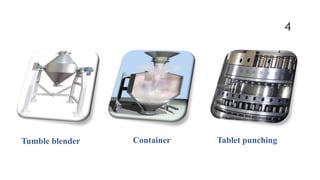
Tumble blender Container Tablet punching
4
Problem
A leading pharmaceutical firm was in the process of
validating a new tablet product. Initial tests during scaleup
showed high active ingredient percentages in the tablets produced
from the material that discharged last from the container.
5
Identification
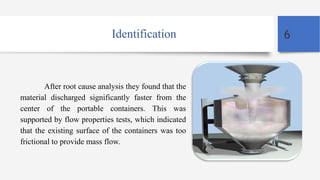
After root cause analysis they found that the
material discharged significantly faster from the
center of the portable containers. This was
supported by flow properties tests, which indicated
that the existing surface of the containers was too
frictional to provide mass flow.
6
Cont…
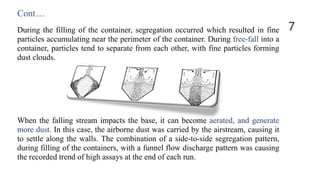
During the filling of the container, segregation occurred which resulted in fine
particles accumulating near the perimeter of the container. During free-fall into a
container, particles tend to separate from each other, with fine particles forming
dust clouds.
When the falling stream impacts the base, it can become aerated, and generate
more dust. In this case, the airborne dust was carried by the airstream, causing it
to settle along the walls. The combination of a side-to-side segregation pattern,
during filling of the containers, with a funnel flow discharge pattern was causing
the recorded trend of high assays at the end of each run.
7
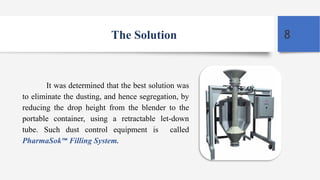
The Solution
It was determined that the best solution was
to eliminate the dusting, and hence segregation, by
reducing the drop height from the blender to the
portable container, using a retractable let-down
tube. Such dust control equipment is called
PharmaSok™ Filling System.
8
PharmaSok™ Filling System
In the production of drugs in solid dosage form dusting
and the resulting segregation can cause unacceptably high
variations in the concentration of active ingredient.
Transferring mixed powders from a blender to a bin creates a
dust cloud, which settles on top of the pile and concentrates
along the bin walls.
This finer material, commonly the active ingredient, often
discharges at the end of a batch run, producing tablets that
are not within specifications. Entire batches are failed as a
result.
9
The PharmaSok filling system is a new method of preventing these
problematic dust clouds from forming. It includes a rolling stand, FDA
compliant tubing, and a PLC-operated retraction unit. An empty portable
container is then positioned below the system.
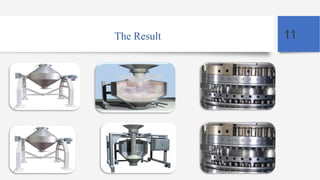
The operator discharges the powder mixture from the blender
through the PharmaSok, into the container. The PharmaSok automatically
retracts the tubing at a preset speed, filling the container gradually. The used
tubing is automatically rolled up for easy disposal as it retracts.
10
Cont…
11
The Result
Thank You

Case study on change control in equipment

  • 1.
    Case Study onChange Control In Equipment Presented by Ch. S S N D Balakrishna, M.Pharm Department of Regulatory Affairs Shri Vishnu college of pharmacy (SVCP)
  • 2.
    Introduction Change control: According toWHO, “Change control is a formal system by which qualified representatives of appropriate disciplines review proposed or actual changes that might effect a validated status. The intent is to determine the need for the action that would ensure that the system is maintained in a validated state”. 1
  • 3.
    Improving product qualityby reducing segregation in a pharmaceutical application Particle segregation is a concern in most industries. where only very slight variations in the concentration of active drug are permitted. Drugs that are produced in solid dosage form contain many ingredients. If the active ingredient is not uniformly distributed, the finished product will not fall within content uniformity specifications and the entire batch may be rejected. 2
  • 4.
    Tumble blender ContainerTablet punching 4
  • 5.
    Problem A leading pharmaceuticalfirm was in the process of validating a new tablet product. Initial tests during scaleup showed high active ingredient percentages in the tablets produced from the material that discharged last from the container. 5
  • 6.
    Identification After root causeanalysis they found that the material discharged significantly faster from the center of the portable containers. This was supported by flow properties tests, which indicated that the existing surface of the containers was too frictional to provide mass flow. 6
  • 7.
    Cont… During the fillingof the container, segregation occurred which resulted in fine particles accumulating near the perimeter of the container. During free-fall into a container, particles tend to separate from each other, with fine particles forming dust clouds. When the falling stream impacts the base, it can become aerated, and generate more dust. In this case, the airborne dust was carried by the airstream, causing it to settle along the walls. The combination of a side-to-side segregation pattern, during filling of the containers, with a funnel flow discharge pattern was causing the recorded trend of high assays at the end of each run. 7
  • 8.
    The Solution It wasdetermined that the best solution was to eliminate the dusting, and hence segregation, by reducing the drop height from the blender to the portable container, using a retractable let-down tube. Such dust control equipment is called PharmaSok™ Filling System. 8
  • 9.
    PharmaSok™ Filling System Inthe production of drugs in solid dosage form dusting and the resulting segregation can cause unacceptably high variations in the concentration of active ingredient. Transferring mixed powders from a blender to a bin creates a dust cloud, which settles on top of the pile and concentrates along the bin walls. This finer material, commonly the active ingredient, often discharges at the end of a batch run, producing tablets that are not within specifications. Entire batches are failed as a result. 9
  • 10.
    The PharmaSok fillingsystem is a new method of preventing these problematic dust clouds from forming. It includes a rolling stand, FDA compliant tubing, and a PLC-operated retraction unit. An empty portable container is then positioned below the system. The operator discharges the powder mixture from the blender through the PharmaSok, into the container. The PharmaSok automatically retracts the tubing at a preset speed, filling the container gradually. The used tubing is automatically rolled up for easy disposal as it retracts. 10 Cont…
  • 11.
  • 12.