
#aihce 
Particulate Containment 
Validation: An Effective Tool in 
Reducing Pharmaceutical 
Exposure in Emerging Economies 
Prasanth.Kondragunta 
International Safety Systems, 
Vadodara, India 
#aihce
#aihce 
Agenda 
• Introduction 
• Contract Manufacturing (CM) sites scenario in India 
• Challenges at CM sites 
• Particulate Containment Validation 
• Validation Procedure 
• Results 
• Conclusion
Introduction – Pharmaceutical Industries 
• Pharmaceutical manufacturing is growing at 14% to 17% per 
year in emerging economies, specifically China and India 
• Outsourcing of work to Contract Manufacturers (CM) 
expected to exceed $53 Billion 
• Active Pharmaceutical Ingredient (API) manufacturing 
– Bulk drug is manufactured 
– Large volume handled potential solid exposure risk is high 
• Formulation or Dosage Form 
– Solids and liquid pharmaceuticals are made 
– Potential solid API exposure risk is high 
#aihce
Contract Manufacturing Scenario in 
#aihce 
India 
• Third party/Contract Manufacturing (CM) sites are increasing 
rapidly: 
 low labour costs, 
 large existing pharmaceutical manufacturing base, 
 sizable patient population 
 large number of qualified pharmacists and chemists
#aihce 
Challenges at CM sites 
• Safety professionals or occupational physicians practicing IH 
• Limited sensitivity of site professionals to degree of hazard of 
Active Pharmaceutical Ingredients (APIs). 
• No risk assessment and evaluation through industrial (or 
occupational) hygiene assessment to determine potential 
exposure of APIs to workers. 
• Occupational Exposure Limits (OELs) are not available for 
large number of APIs and intermediates. 
• Validated analytical methods are not available for large 
number of APIs 
• No accredited laboratories are available in India for API 
analysis
#aihce 
Challenges at CM sites 
• Categorizing (or “banding”) the API based on inherent potency 
and toxicity, linking the category to safe handling practices 
and control strategies 
• Open handling of potent compounds 
• High reliability on Personal Protective Equipment (PPE) 
• No Segregated gowning and de-gowning areas provided with a 
room airlock or anteroom. 
• Limited knowledge and application of appropriate containment 
and control measures to maintain exposures below acceptable 
levels.
Particulate Containment Validation 
• Surrogate monitoring – Lactose/Naproxen Sodium 
• International Society for Pharmaceutical Engineering (ISPE) 
• Standardized Measurement of Equipment Particulate Airborne 
Concentration (SMEPAC) Committee 
• ISPE Good Practice Guide: Assessing the Particulate 
Containment Performance of Pharmaceutical Equipment 
• Standardized method of measuring 
– Performance of containment systems against specific 
challenge 
– Establish an agreed and valid method that can be used to meet 
the requirements of practitioners and supplier organizations 
#aihce
#aihce 
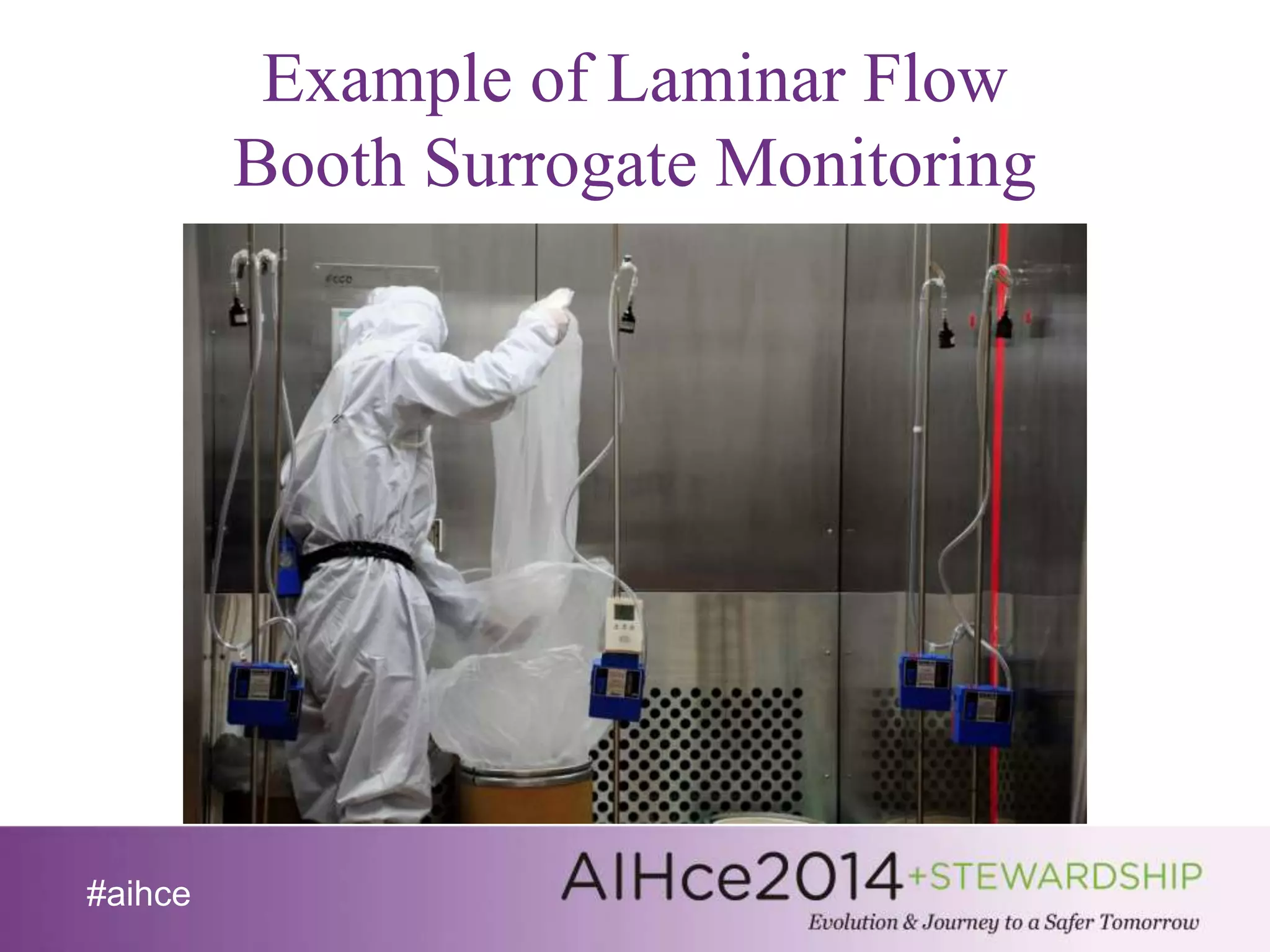
Example of Laminar Flow 
Booth Surrogate Monitoring
#aihce 
Validation Procedure 
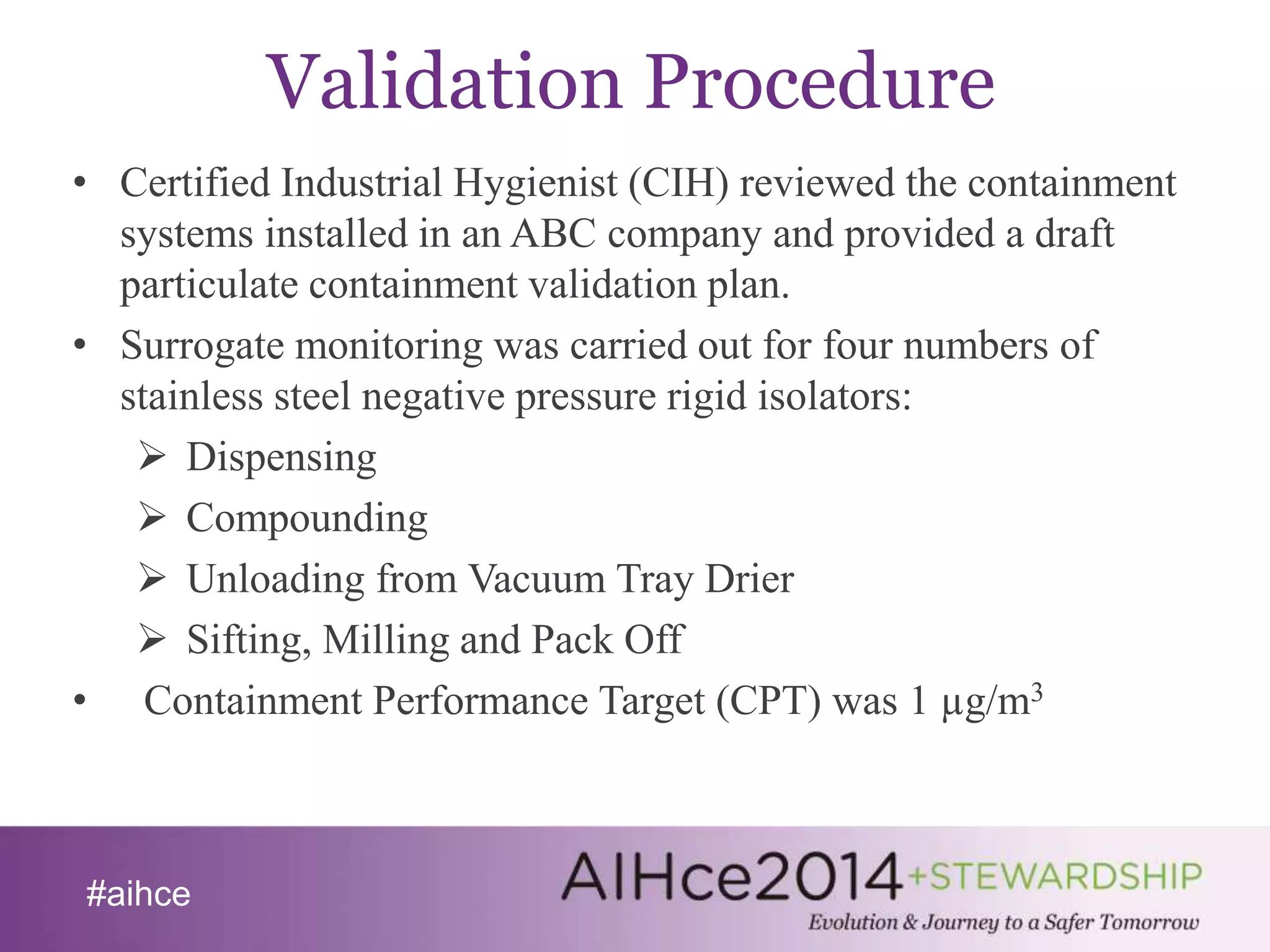
• Certified Industrial Hygienist (CIH) reviewed the containment 
systems installed in an ABC company and provided a draft 
particulate containment validation plan. 
• Surrogate monitoring was carried out for four numbers of 
stainless steel negative pressure rigid isolators: 
 Dispensing 
 Compounding 
 Unloading from Vacuum Tray Drier 
 Sifting, Milling and Pack Off 
• Containment Performance Target (CPT) was 1 μg/m3
#aihce 
Methods 
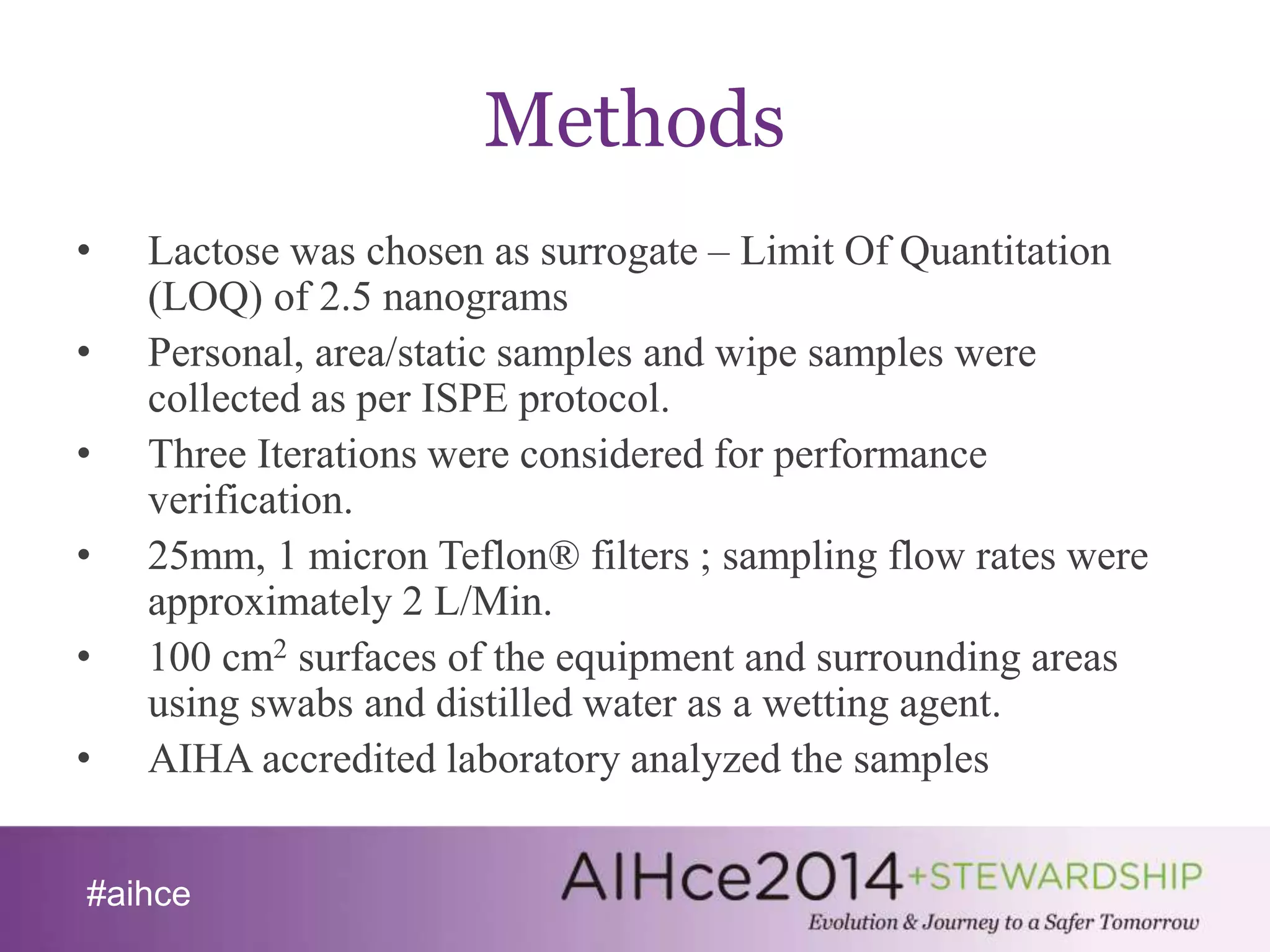
• Lactose was chosen as surrogate – Limit Of Quantitation 
(LOQ) of 2.5 nanograms 
• Personal, area/static samples and wipe samples were 
collected as per ISPE protocol. 
• Three Iterations were considered for performance 
verification. 
• 25mm, 1 micron Teflon® filters ; sampling flow rates were 
approximately 2 L/Min. 
• 100 cm2 surfaces of the equipment and surrounding areas 
using swabs and distilled water as a wetting agent. 
• AIHA accredited laboratory analyzed the samples
#aihce 
Results 
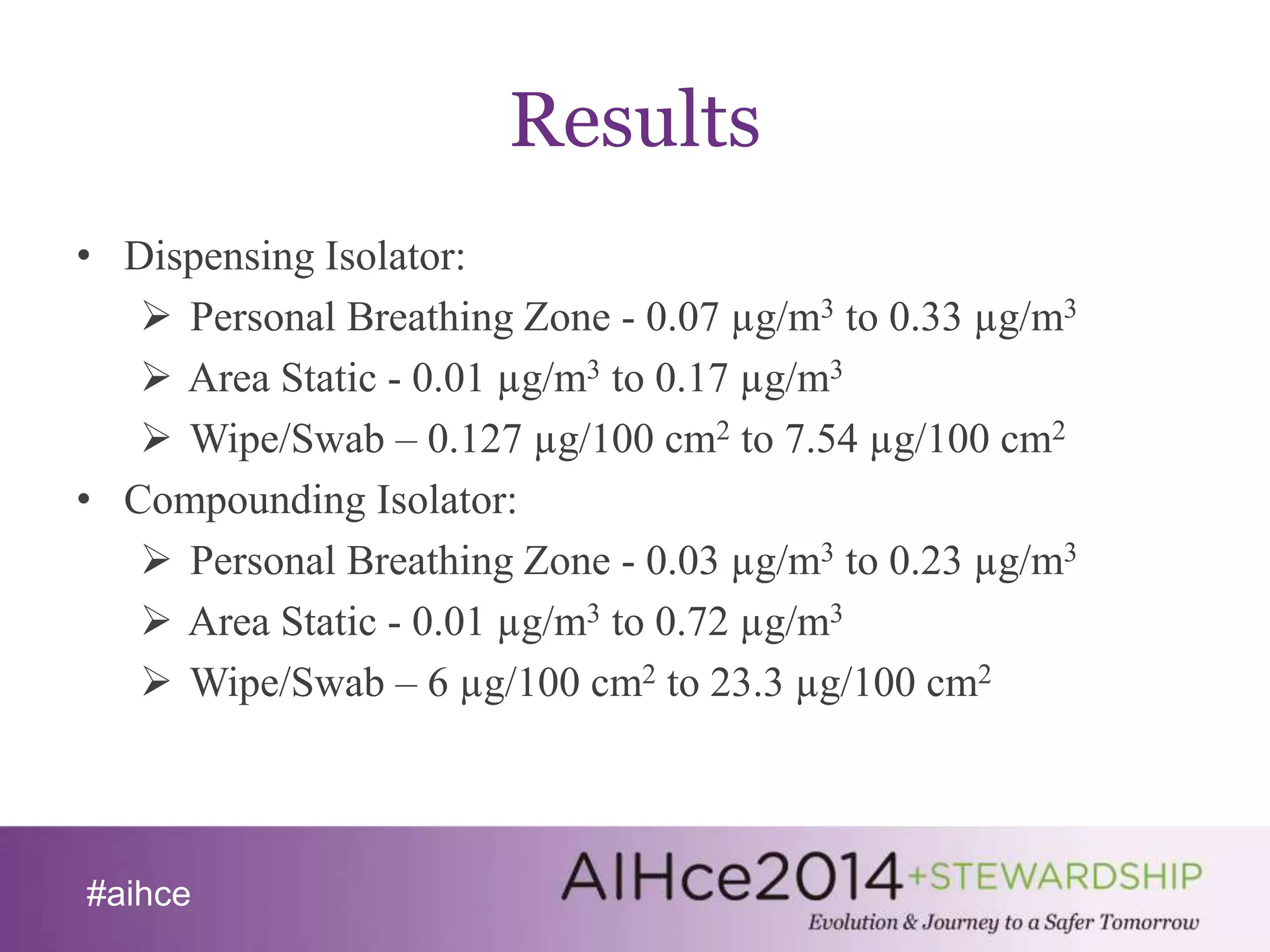
• Dispensing Isolator: 
 Personal Breathing Zone - 0.07 μg/m3 to 0.33 μg/m3 
 Area Static - 0.01 μg/m3 to 0.17 μg/m3 
 Wipe/Swab – 0.127 μg/100 cm2 to 7.54 μg/100 cm2 
• Compounding Isolator: 
 Personal Breathing Zone - 0.03 μg/m3 to 0.23 μg/m3 
 Area Static - 0.01 μg/m3 to 0.72 μg/m3 
 Wipe/Swab – 6 μg/100 cm2 to 23.3 μg/100 cm2
#aihce 
Results 
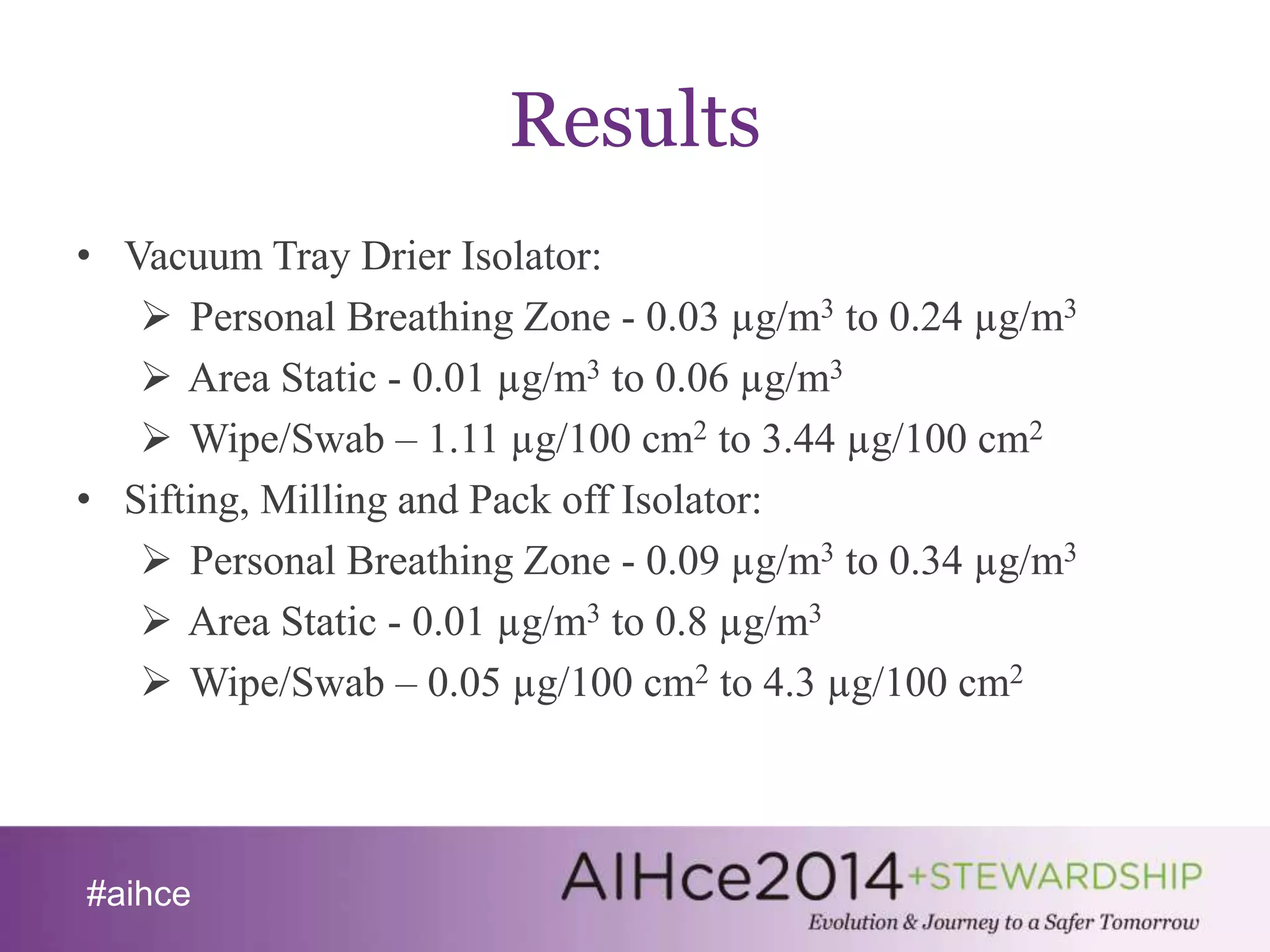
• Vacuum Tray Drier Isolator: 
 Personal Breathing Zone - 0.03 μg/m3 to 0.24 μg/m3 
 Area Static - 0.01 μg/m3 to 0.06 μg/m3 
 Wipe/Swab – 1.11 μg/100 cm2 to 3.44 μg/100 cm2 
• Sifting, Milling and Pack off Isolator: 
 Personal Breathing Zone - 0.09 μg/m3 to 0.34 μg/m3 
 Area Static - 0.01 μg/m3 to 0.8 μg/m3 
 Wipe/Swab – 0.05 μg/100 cm2 to 4.3 μg/100 cm2
#aihce 
Recommendations 
• Although air sample results were below CPT of 1 μg/m3, 
surface contamination results exceeded 10 times the CPT of 10 
μg/cm2 and hence following recommendations were provided: 
 Rectify the containment breach near glove port 
 Cleaning of spills immediately with wet wipes 
Wet wiping of the poly bag outer surface before taking out 
the bag into Rapid Transfer Port (RTP) canister 
 Ensure use of High Efficiency Particulate Air (HEPA) filter 
equipped vacuum cleaner for the cleaning and 
housekeeping activities. 
 Ensure operators take shower to decontaminate the full 
body suit after use and before removing the suit to avoid 
potential exposure to API while removing contaminated 
suit.
#aihce 
Conclusion 
• Particulate Containment Validation process was effective in 
identifying exposure and contributing factors. 
• The results of the particulate containment review of the 
isolators indicated that all the four isolators can be operated 
with API containment level below 1 μg/m3 . 
• The Contract Manufacturing site leadership team recognized 
the importance of particulate containment validation review to 
determine the overall potential occupational health risk.
#aihce 
References 
• www.gpcmevent.com 
• www.pharmaceutical-technology.com 
• www.pharmoutsourcing.com
#aihce 
Questions? 
Prasanth.K 
(prasanth.k@issehs.com) 
#aihce

Particulate Containment Validation: An Effective Tool in Reducing Pharmaceutical Exposure in Emerging Economies

  • 1.
    #aihce Particulate Containment Validation: An Effective Tool in Reducing Pharmaceutical Exposure in Emerging Economies Prasanth.Kondragunta International Safety Systems, Vadodara, India #aihce
  • 2.
    #aihce Agenda •Introduction • Contract Manufacturing (CM) sites scenario in India • Challenges at CM sites • Particulate Containment Validation • Validation Procedure • Results • Conclusion
  • 3.
    Introduction – PharmaceuticalIndustries • Pharmaceutical manufacturing is growing at 14% to 17% per year in emerging economies, specifically China and India • Outsourcing of work to Contract Manufacturers (CM) expected to exceed $53 Billion • Active Pharmaceutical Ingredient (API) manufacturing – Bulk drug is manufactured – Large volume handled potential solid exposure risk is high • Formulation or Dosage Form – Solids and liquid pharmaceuticals are made – Potential solid API exposure risk is high #aihce
  • 4.
    Contract Manufacturing Scenarioin #aihce India • Third party/Contract Manufacturing (CM) sites are increasing rapidly:  low labour costs,  large existing pharmaceutical manufacturing base,  sizable patient population  large number of qualified pharmacists and chemists
  • 5.
    #aihce Challenges atCM sites • Safety professionals or occupational physicians practicing IH • Limited sensitivity of site professionals to degree of hazard of Active Pharmaceutical Ingredients (APIs). • No risk assessment and evaluation through industrial (or occupational) hygiene assessment to determine potential exposure of APIs to workers. • Occupational Exposure Limits (OELs) are not available for large number of APIs and intermediates. • Validated analytical methods are not available for large number of APIs • No accredited laboratories are available in India for API analysis
  • 6.
    #aihce Challenges atCM sites • Categorizing (or “banding”) the API based on inherent potency and toxicity, linking the category to safe handling practices and control strategies • Open handling of potent compounds • High reliability on Personal Protective Equipment (PPE) • No Segregated gowning and de-gowning areas provided with a room airlock or anteroom. • Limited knowledge and application of appropriate containment and control measures to maintain exposures below acceptable levels.
  • 7.
    Particulate Containment Validation • Surrogate monitoring – Lactose/Naproxen Sodium • International Society for Pharmaceutical Engineering (ISPE) • Standardized Measurement of Equipment Particulate Airborne Concentration (SMEPAC) Committee • ISPE Good Practice Guide: Assessing the Particulate Containment Performance of Pharmaceutical Equipment • Standardized method of measuring – Performance of containment systems against specific challenge – Establish an agreed and valid method that can be used to meet the requirements of practitioners and supplier organizations #aihce
  • 8.
    #aihce Example ofLaminar Flow Booth Surrogate Monitoring
  • 9.
    #aihce Validation Procedure • Certified Industrial Hygienist (CIH) reviewed the containment systems installed in an ABC company and provided a draft particulate containment validation plan. • Surrogate monitoring was carried out for four numbers of stainless steel negative pressure rigid isolators:  Dispensing  Compounding  Unloading from Vacuum Tray Drier  Sifting, Milling and Pack Off • Containment Performance Target (CPT) was 1 μg/m3
  • 10.
    #aihce Methods •Lactose was chosen as surrogate – Limit Of Quantitation (LOQ) of 2.5 nanograms • Personal, area/static samples and wipe samples were collected as per ISPE protocol. • Three Iterations were considered for performance verification. • 25mm, 1 micron Teflon® filters ; sampling flow rates were approximately 2 L/Min. • 100 cm2 surfaces of the equipment and surrounding areas using swabs and distilled water as a wetting agent. • AIHA accredited laboratory analyzed the samples
  • 11.
    #aihce Results •Dispensing Isolator:  Personal Breathing Zone - 0.07 μg/m3 to 0.33 μg/m3  Area Static - 0.01 μg/m3 to 0.17 μg/m3  Wipe/Swab – 0.127 μg/100 cm2 to 7.54 μg/100 cm2 • Compounding Isolator:  Personal Breathing Zone - 0.03 μg/m3 to 0.23 μg/m3  Area Static - 0.01 μg/m3 to 0.72 μg/m3  Wipe/Swab – 6 μg/100 cm2 to 23.3 μg/100 cm2
  • 12.
    #aihce Results •Vacuum Tray Drier Isolator:  Personal Breathing Zone - 0.03 μg/m3 to 0.24 μg/m3  Area Static - 0.01 μg/m3 to 0.06 μg/m3  Wipe/Swab – 1.11 μg/100 cm2 to 3.44 μg/100 cm2 • Sifting, Milling and Pack off Isolator:  Personal Breathing Zone - 0.09 μg/m3 to 0.34 μg/m3  Area Static - 0.01 μg/m3 to 0.8 μg/m3  Wipe/Swab – 0.05 μg/100 cm2 to 4.3 μg/100 cm2
  • 13.
    #aihce Recommendations •Although air sample results were below CPT of 1 μg/m3, surface contamination results exceeded 10 times the CPT of 10 μg/cm2 and hence following recommendations were provided:  Rectify the containment breach near glove port  Cleaning of spills immediately with wet wipes Wet wiping of the poly bag outer surface before taking out the bag into Rapid Transfer Port (RTP) canister  Ensure use of High Efficiency Particulate Air (HEPA) filter equipped vacuum cleaner for the cleaning and housekeeping activities.  Ensure operators take shower to decontaminate the full body suit after use and before removing the suit to avoid potential exposure to API while removing contaminated suit.
  • 14.
    #aihce Conclusion •Particulate Containment Validation process was effective in identifying exposure and contributing factors. • The results of the particulate containment review of the isolators indicated that all the four isolators can be operated with API containment level below 1 μg/m3 . • The Contract Manufacturing site leadership team recognized the importance of particulate containment validation review to determine the overall potential occupational health risk.
  • 15.
    #aihce References •www.gpcmevent.com • www.pharmaceutical-technology.com • www.pharmoutsourcing.com
  • 16.
    #aihce Questions? Prasanth.K (prasanth.k@issehs.com) #aihce