MADE BY–
Shrikrishna kesharwani-181109005
Jhalak Agrawal - 18110900
1
7
About SDG
What do they
do?
Why it was
created?
Why sdg 7? facts
SUD goals
Affordable and
clean energy
targets
India and goal
7
challenges
Projects and
initiatives by
india
conclusion
2
CONTENTS-
About SDG
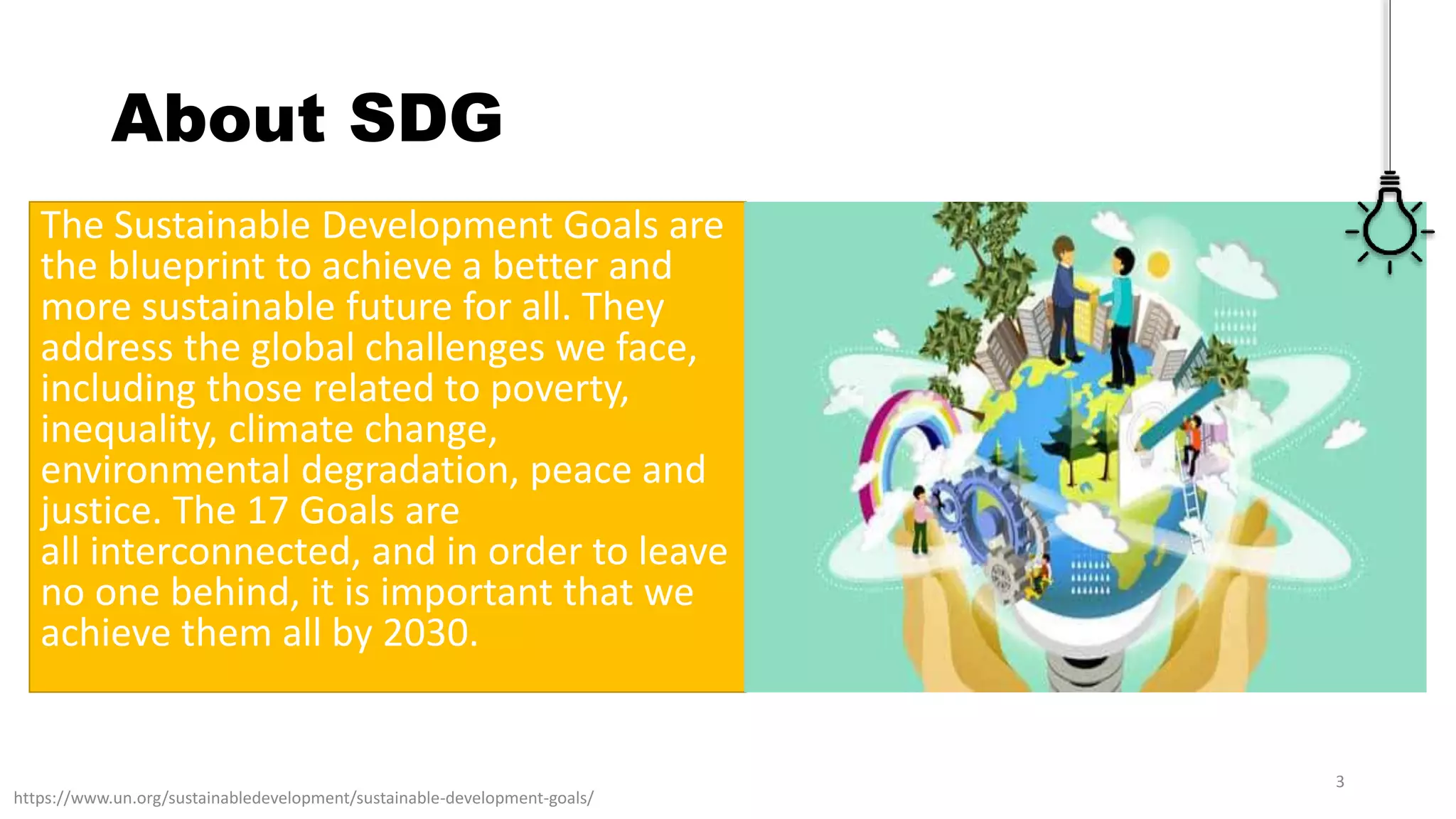
The Sustainable Development Goals are
the blueprint to achieve a better and
more sustainable future for all. They
address the global challenges we face,
including those related to poverty,
inequality, climate change,
environmental degradation, peace and
justice. The 17 Goals are
all interconnected, and in order to leave
no one behind, it is important that we
achieve them all by 2030.
3
https://www.un.org/sustainabledevelopment/sustainable-development-goals/
What do they do?
• The Sustainable Development Goals are a universal call to action to
end poverty, protect the planet and improve the lives and prospects
of everyone, everywhere. The 17 Goals were adopted by all UN
Member States in 2015, as part of the 2030 Agenda for Sustainable
Development which set out a 15-year plan to achieve the Goals.
• Today, progress is being made in many places, but, overall, action to
meet the Goals is not yet advancing at the speed or scale required.
2020 needs to usher in a decade of ambitious action to deliver the
Goals by 2030.
4
https://www.un.org/sustainabledevelopment/development-agenda/
Why was it created ?
• The day to day running of cities is a complicated business.
Bootstrapped budgets, burdensome procurement processes, and a
dearth of talent make it extremely difficult to execute efficiently. Add
to that an ever growing list of challenges- choked transportation
system too often coupled with a lack of affordable housing or
accessible public spaces; inequality and injustice and climate change,
whether or not city managers choose to address them. For those
charged with finding problem to these solutions to these issues, a
finger wagging about what your priorities should be can be pretty
annoying. But that is exactly SDG do. And they are long overdue.
5
https://www.slideshare.net/somyasinghalmaps/sdg-7-and-13?from_m_app=android
6
https://www.un.org/development/desa/disabilities/envision2030.html
7
Harsh Realities/ Facts
https://www.undp.org/content/undp/en/home/sustainable-development-goals/goal-7-affordable-and-clean-energy.html
Why SDG 7 ?
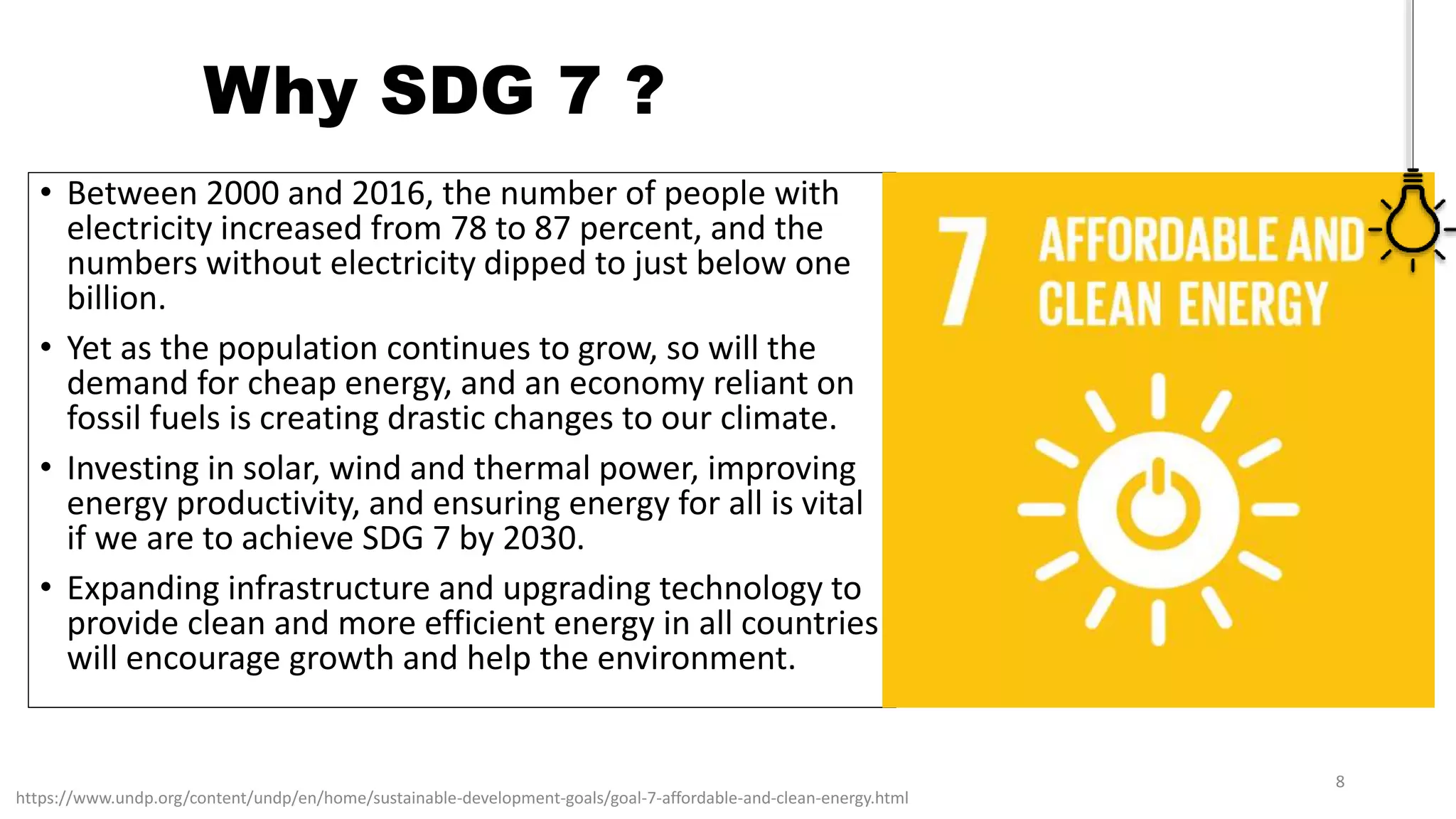
• Between 2000 and 2016, the number of people with
electricity increased from 78 to 87 percent, and the
numbers without electricity dipped to just below one
billion.
• Yet as the population continues to grow, so will the
demand for cheap energy, and an economy reliant on
fossil fuels is creating drastic changes to our climate.
• Investing in solar, wind and thermal power, improving
energy productivity, and ensuring energy for all is vital
if we are to achieve SDG 7 by 2030.
• Expanding infrastructure and upgrading technology to
provide clean and more efficient energy in all countries
will encourage growth and help the environment.
8
https://www.undp.org/content/undp/en/home/sustainable-development-goals/goal-7-affordable-and-clean-energy.html
Affordable and Clean
energy
• Renewable energy solutions are becoming
cheaper, more reliable and more efficient every
day.
• Our current reliance on fossil fuels is
unsustainable and harmful to the planet, which
is why we have to change the way we produce
and consume energy.
• Implementing these new energy solutions as
fast as possible is essential to counter climate
change, one of the biggest threats to our own
survival.
9
https://www.globalgoals.org/7-affordable-and-clean-energy
10
https://www.globalgoals.org/7-
affordable-and-clean-energy
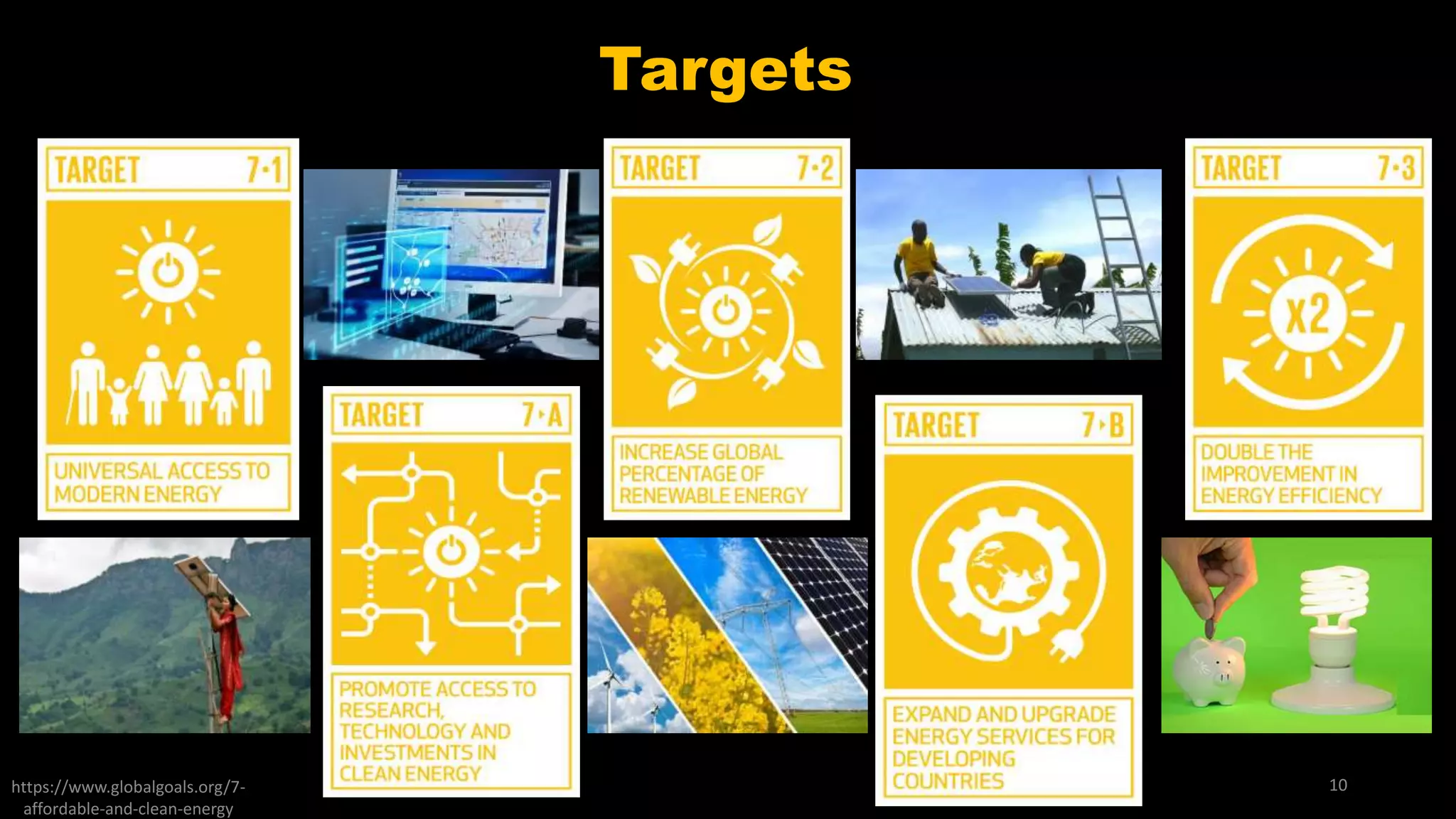
Targets
India and Goal 7
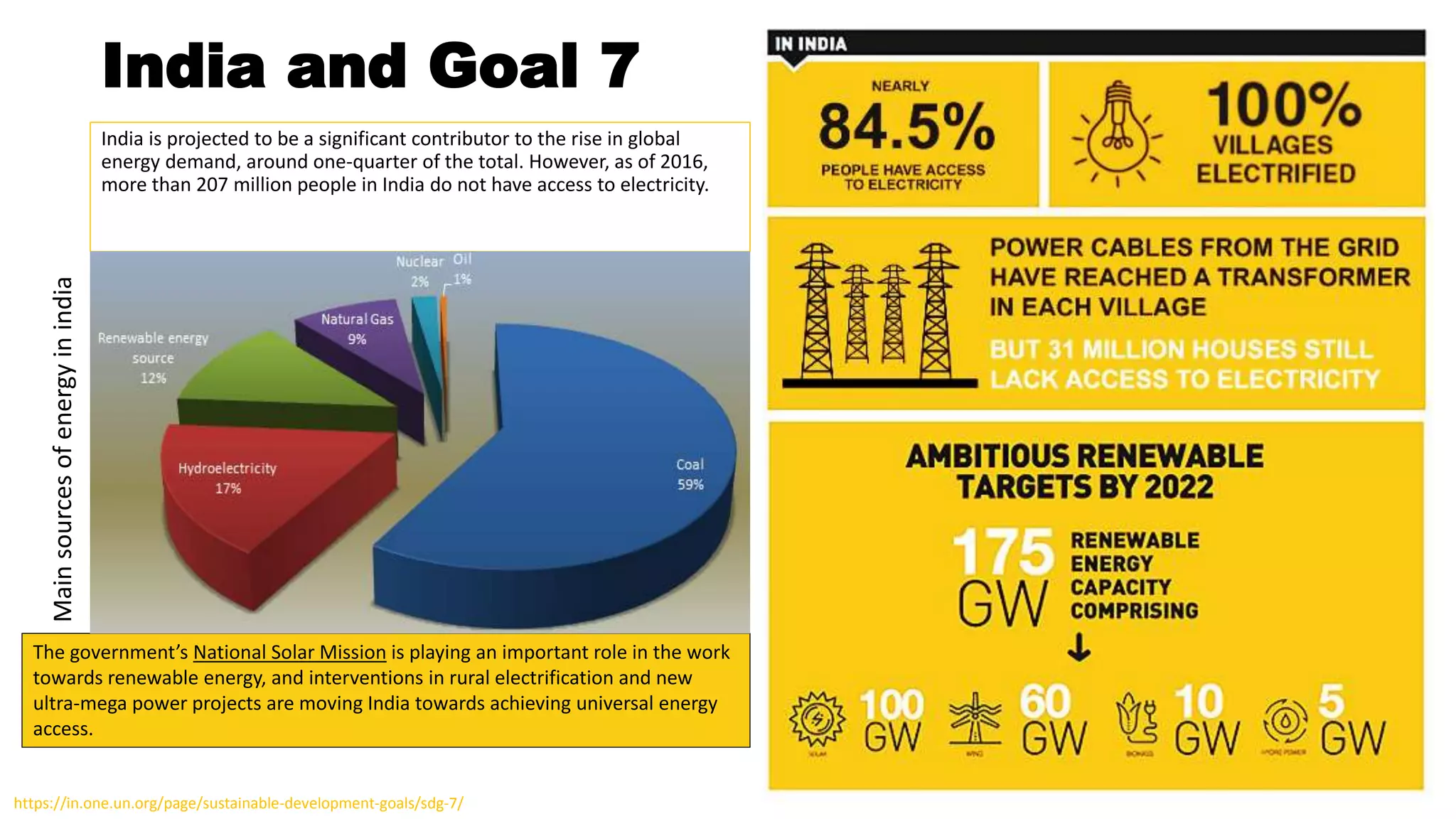
India is projected to be a significant contributor to the rise in global
energy demand, around one-quarter of the total. However, as of 2016,
more than 207 million people in India do not have access to electricity.
11
https://in.one.un.org/page/sustainable-development-goals/sdg-7/
The government’s National Solar Mission is playing an important role in the work
towards renewable energy, and interventions in rural electrification and new
ultra-mega power projects are moving India towards achieving universal energy
access.
Main
sources
of
energy
in
india
Challenges-
• The main problem is not of availability rather affordability.
• Even though the number of household electrified is 96% but
meaningful access is only 37%. The problem faced in states
like Bihar, Jharkhand and Uttar Pradesh is of connectivity
while in case of Madhya Pradesh issue is of reliability and
quality.
• In these states, some household don’t have connection due
to unavailability of grid. While majority of population have
grid in the vicinity but they have not taken connection due to
lack of affordability.
• One of the key challenges which India faces with regard to
electricity is the issue of distribution.
• The major problem is to ensure the quality of supply even
though households have been electrified as in December
2016, 41 % of household experience power cut for more
than 15 hours per day even though considered as electrified.
12
• High dependence on electricity imports
leading to insecurity in supply
• Low level of private sector investments
in power projects
• Inadequate coal block linkage and
natural gas (NG) supply
• Insufficient supply of electricity to
remote areas which witness increased
habitations and
• Lack of business models for renewable
energy projects
https://niti.gov.in/writereaddata/files/National%20Consultation%20on%20SDG%207%20Report%20of%20the%20meeting.pdf
13
• REWA project – the only
solar park to take World
Bank and VGF funding
• Power to Delhi metro from
REWA project
Projects and Initiatives by india
14
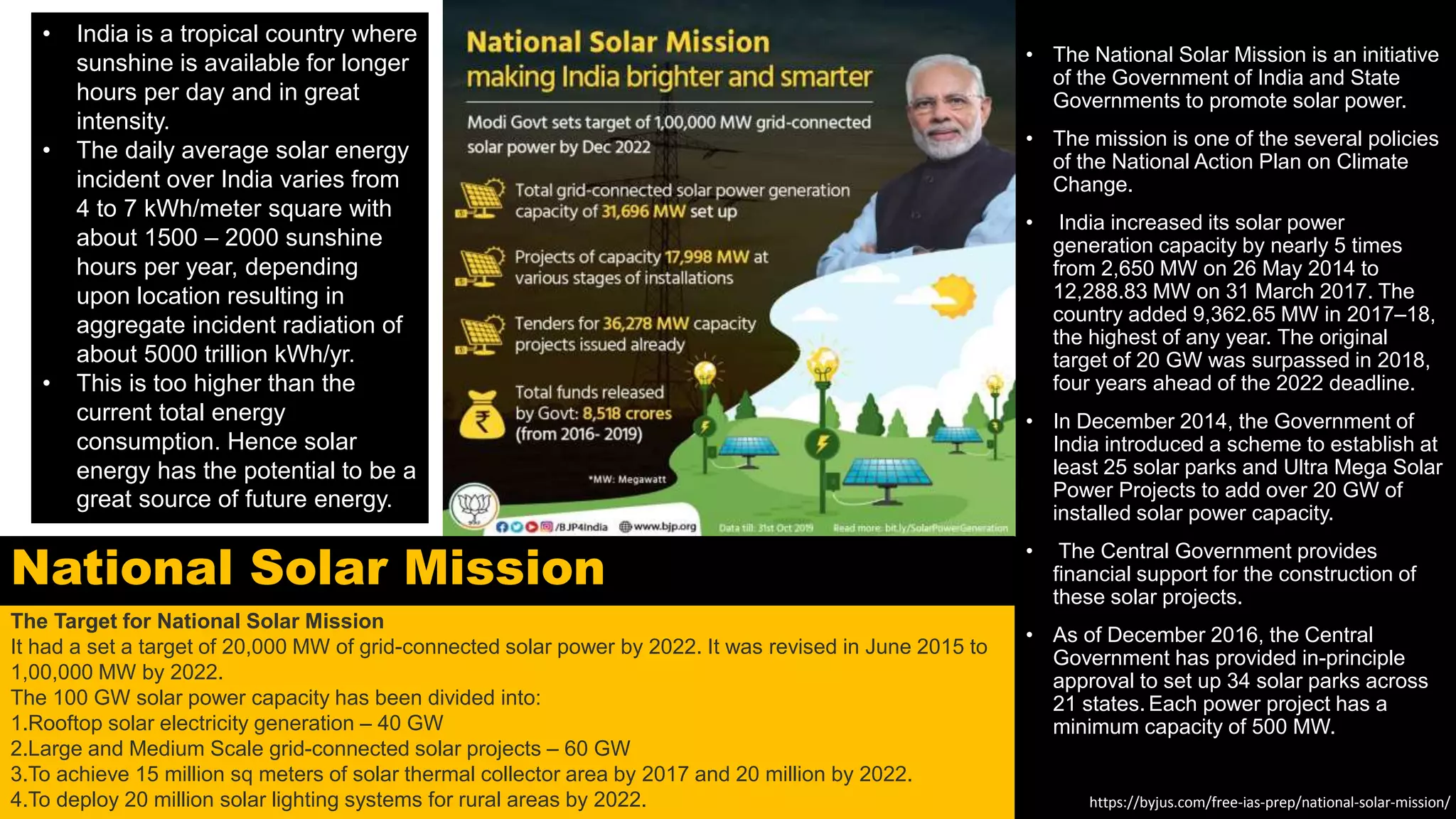
• The National Solar Mission is an initiative
of the Government of India and State
Governments to promote solar power.
• The mission is one of the several policies
of the National Action Plan on Climate
Change.
• India increased its solar power
generation capacity by nearly 5 times
from 2,650 MW on 26 May 2014 to
12,288.83 MW on 31 March 2017. The
country added 9,362.65 MW in 2017–18,
the highest of any year. The original
target of 20 GW was surpassed in 2018,
four years ahead of the 2022 deadline.
• In December 2014, the Government of
India introduced a scheme to establish at
least 25 solar parks and Ultra Mega Solar
Power Projects to add over 20 GW of
installed solar power capacity.
• The Central Government provides
financial support for the construction of
these solar projects.
• As of December 2016, the Central
Government has provided in-principle
approval to set up 34 solar parks across
21 states. Each power project has a
minimum capacity of 500 MW.
• India is a tropical country where
sunshine is available for longer
hours per day and in great
intensity.
• The daily average solar energy
incident over India varies from
4 to 7 kWh/meter square with
about 1500 – 2000 sunshine
hours per year, depending
upon location resulting in
aggregate incident radiation of
about 5000 trillion kWh/yr.
• This is too higher than the
current total energy
consumption. Hence solar
energy has the potential to be a
great source of future energy.
The Target for National Solar Mission
It had a set a target of 20,000 MW of grid-connected solar power by 2022. It was revised in June 2015 to
1,00,000 MW by 2022.
The 100 GW solar power capacity has been divided into:
1.Rooftop solar electricity generation – 40 GW
2.Large and Medium Scale grid-connected solar projects – 60 GW
3.To achieve 15 million sq meters of solar thermal collector area by 2017 and 20 million by 2022.
4.To deploy 20 million solar lighting systems for rural areas by 2022.
National Solar Mission
https://byjus.com/free-ias-prep/national-solar-mission/
15
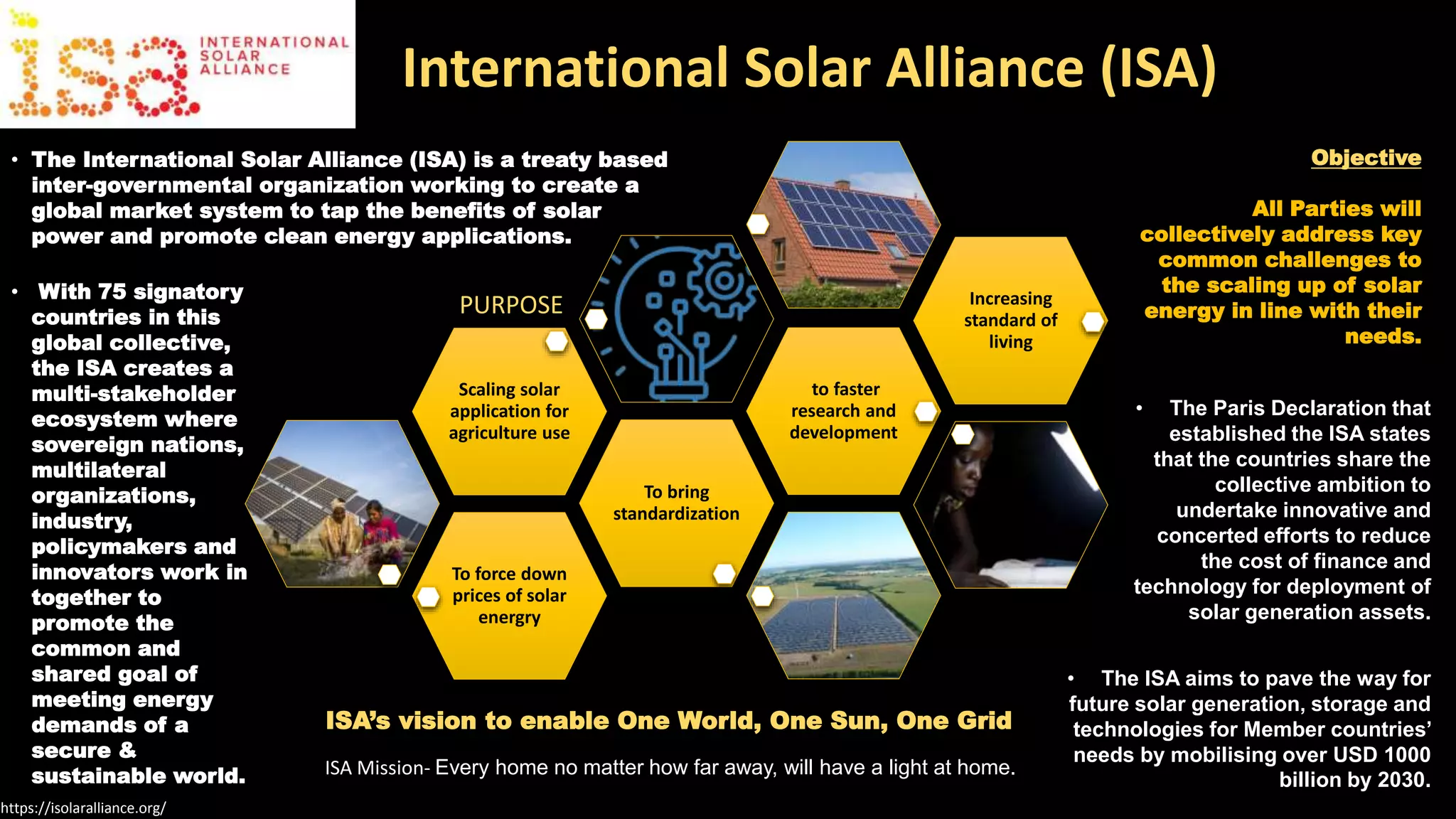
International Solar Alliance (ISA)
• The International Solar Alliance (ISA) is a treaty based
inter-governmental organization working to create a
global market system to tap the benefits of solar
power and promote clean energy applications.
To force down
prices of solar
energry
To bring
standardization
Scaling solar
application for
agriculture use
to faster
research and
development
Increasing
standard of
living
Objective
All Parties will
collectively address key
common challenges to
the scaling up of solar
energy in line with their
needs.
ISA’s vision to enable One World, One Sun, One Grid
• With 75 signatory
countries in this
global collective,
the ISA creates a
multi-stakeholder
ecosystem where
sovereign nations,
multilateral
organizations,
industry,
policymakers and
innovators work in
together to
promote the
common and
shared goal of
meeting energy
demands of a
secure &
sustainable world.
• The Paris Declaration that
established the ISA states
that the countries share the
collective ambition to
undertake innovative and
concerted efforts to reduce
the cost of finance and
technology for deployment of
solar generation assets.
• The ISA aims to pave the way for
future solar generation, storage and
technologies for Member countries’
needs by mobilising over USD 1000
billion by 2030.
ISA Mission- Every home no matter how far away, will have a light at home.
PURPOSE
https://isolaralliance.org/
One Sun One World One Grid (OSOWOG).
Under OSOWOG vision, India seeks to replicate
its global solar leadership (International Solar
Alliance) by encouraging the phased
development of a single globally connected solar
electricity grid to leverage the multiple benefits
(Low cost, Zero pollution) of solar energy.
16
Prospects For
India
• Parity with
Great Powers
• Climate
Mitigation
• Balancing China
• Bridging Current
Account Deficit
Issues with the Idea
• Development in Battery Technology
• Easy Installation of Microgrids
• Vulnerability of Grids
• Transmission Losses
• Dependency on China
• Problem with Interconnectedness
The ambitious
OSOWOG will
connect 140 countries
through a common
grid that will be used
to transfer solar
power.
https://www.drishtiias.com/daily-updates/daily-news-editorials/one-sun-one-world-one-grid-1
Everyone can help to make
sure that we meet the Global
Goals. Together we can ensure
affordable and clean energy
for all.
At individual level, using
energy judiciously in your
everyday life can really make a
difference.
17
https://www.globalgoals.org/7-affordable-and-clean-energy
18

sustainable development goals no. 7 (sdg 7) clean and affordable energy

  • 1.
  • 2.
    About SDG What dothey do? Why it was created? Why sdg 7? facts SUD goals Affordable and clean energy targets India and goal 7 challenges Projects and initiatives by india conclusion 2 CONTENTS-
  • 3.
    About SDG The SustainableDevelopment Goals are the blueprint to achieve a better and more sustainable future for all. They address the global challenges we face, including those related to poverty, inequality, climate change, environmental degradation, peace and justice. The 17 Goals are all interconnected, and in order to leave no one behind, it is important that we achieve them all by 2030. 3 https://www.un.org/sustainabledevelopment/sustainable-development-goals/
  • 4.
    What do theydo? • The Sustainable Development Goals are a universal call to action to end poverty, protect the planet and improve the lives and prospects of everyone, everywhere. The 17 Goals were adopted by all UN Member States in 2015, as part of the 2030 Agenda for Sustainable Development which set out a 15-year plan to achieve the Goals. • Today, progress is being made in many places, but, overall, action to meet the Goals is not yet advancing at the speed or scale required. 2020 needs to usher in a decade of ambitious action to deliver the Goals by 2030. 4 https://www.un.org/sustainabledevelopment/development-agenda/
  • 5.
    Why was itcreated ? • The day to day running of cities is a complicated business. Bootstrapped budgets, burdensome procurement processes, and a dearth of talent make it extremely difficult to execute efficiently. Add to that an ever growing list of challenges- choked transportation system too often coupled with a lack of affordable housing or accessible public spaces; inequality and injustice and climate change, whether or not city managers choose to address them. For those charged with finding problem to these solutions to these issues, a finger wagging about what your priorities should be can be pretty annoying. But that is exactly SDG do. And they are long overdue. 5 https://www.slideshare.net/somyasinghalmaps/sdg-7-and-13?from_m_app=android
  • 6.
  • 7.
  • 8.
    Why SDG 7? • Between 2000 and 2016, the number of people with electricity increased from 78 to 87 percent, and the numbers without electricity dipped to just below one billion. • Yet as the population continues to grow, so will the demand for cheap energy, and an economy reliant on fossil fuels is creating drastic changes to our climate. • Investing in solar, wind and thermal power, improving energy productivity, and ensuring energy for all is vital if we are to achieve SDG 7 by 2030. • Expanding infrastructure and upgrading technology to provide clean and more efficient energy in all countries will encourage growth and help the environment. 8 https://www.undp.org/content/undp/en/home/sustainable-development-goals/goal-7-affordable-and-clean-energy.html
  • 9.
    Affordable and Clean energy •Renewable energy solutions are becoming cheaper, more reliable and more efficient every day. • Our current reliance on fossil fuels is unsustainable and harmful to the planet, which is why we have to change the way we produce and consume energy. • Implementing these new energy solutions as fast as possible is essential to counter climate change, one of the biggest threats to our own survival. 9 https://www.globalgoals.org/7-affordable-and-clean-energy
  • 10.
  • 11.
    India and Goal7 India is projected to be a significant contributor to the rise in global energy demand, around one-quarter of the total. However, as of 2016, more than 207 million people in India do not have access to electricity. 11 https://in.one.un.org/page/sustainable-development-goals/sdg-7/ The government’s National Solar Mission is playing an important role in the work towards renewable energy, and interventions in rural electrification and new ultra-mega power projects are moving India towards achieving universal energy access. Main sources of energy in india
  • 12.
    Challenges- • The mainproblem is not of availability rather affordability. • Even though the number of household electrified is 96% but meaningful access is only 37%. The problem faced in states like Bihar, Jharkhand and Uttar Pradesh is of connectivity while in case of Madhya Pradesh issue is of reliability and quality. • In these states, some household don’t have connection due to unavailability of grid. While majority of population have grid in the vicinity but they have not taken connection due to lack of affordability. • One of the key challenges which India faces with regard to electricity is the issue of distribution. • The major problem is to ensure the quality of supply even though households have been electrified as in December 2016, 41 % of household experience power cut for more than 15 hours per day even though considered as electrified. 12 • High dependence on electricity imports leading to insecurity in supply • Low level of private sector investments in power projects • Inadequate coal block linkage and natural gas (NG) supply • Insufficient supply of electricity to remote areas which witness increased habitations and • Lack of business models for renewable energy projects https://niti.gov.in/writereaddata/files/National%20Consultation%20on%20SDG%207%20Report%20of%20the%20meeting.pdf
  • 13.
    13 • REWA project– the only solar park to take World Bank and VGF funding • Power to Delhi metro from REWA project Projects and Initiatives by india
  • 14.
    14 • The NationalSolar Mission is an initiative of the Government of India and State Governments to promote solar power. • The mission is one of the several policies of the National Action Plan on Climate Change. • India increased its solar power generation capacity by nearly 5 times from 2,650 MW on 26 May 2014 to 12,288.83 MW on 31 March 2017. The country added 9,362.65 MW in 2017–18, the highest of any year. The original target of 20 GW was surpassed in 2018, four years ahead of the 2022 deadline. • In December 2014, the Government of India introduced a scheme to establish at least 25 solar parks and Ultra Mega Solar Power Projects to add over 20 GW of installed solar power capacity. • The Central Government provides financial support for the construction of these solar projects. • As of December 2016, the Central Government has provided in-principle approval to set up 34 solar parks across 21 states. Each power project has a minimum capacity of 500 MW. • India is a tropical country where sunshine is available for longer hours per day and in great intensity. • The daily average solar energy incident over India varies from 4 to 7 kWh/meter square with about 1500 – 2000 sunshine hours per year, depending upon location resulting in aggregate incident radiation of about 5000 trillion kWh/yr. • This is too higher than the current total energy consumption. Hence solar energy has the potential to be a great source of future energy. The Target for National Solar Mission It had a set a target of 20,000 MW of grid-connected solar power by 2022. It was revised in June 2015 to 1,00,000 MW by 2022. The 100 GW solar power capacity has been divided into: 1.Rooftop solar electricity generation – 40 GW 2.Large and Medium Scale grid-connected solar projects – 60 GW 3.To achieve 15 million sq meters of solar thermal collector area by 2017 and 20 million by 2022. 4.To deploy 20 million solar lighting systems for rural areas by 2022. National Solar Mission https://byjus.com/free-ias-prep/national-solar-mission/
  • 15.
    15 International Solar Alliance(ISA) • The International Solar Alliance (ISA) is a treaty based inter-governmental organization working to create a global market system to tap the benefits of solar power and promote clean energy applications. To force down prices of solar energry To bring standardization Scaling solar application for agriculture use to faster research and development Increasing standard of living Objective All Parties will collectively address key common challenges to the scaling up of solar energy in line with their needs. ISA’s vision to enable One World, One Sun, One Grid • With 75 signatory countries in this global collective, the ISA creates a multi-stakeholder ecosystem where sovereign nations, multilateral organizations, industry, policymakers and innovators work in together to promote the common and shared goal of meeting energy demands of a secure & sustainable world. • The Paris Declaration that established the ISA states that the countries share the collective ambition to undertake innovative and concerted efforts to reduce the cost of finance and technology for deployment of solar generation assets. • The ISA aims to pave the way for future solar generation, storage and technologies for Member countries’ needs by mobilising over USD 1000 billion by 2030. ISA Mission- Every home no matter how far away, will have a light at home. PURPOSE https://isolaralliance.org/
  • 16.
    One Sun OneWorld One Grid (OSOWOG). Under OSOWOG vision, India seeks to replicate its global solar leadership (International Solar Alliance) by encouraging the phased development of a single globally connected solar electricity grid to leverage the multiple benefits (Low cost, Zero pollution) of solar energy. 16 Prospects For India • Parity with Great Powers • Climate Mitigation • Balancing China • Bridging Current Account Deficit Issues with the Idea • Development in Battery Technology • Easy Installation of Microgrids • Vulnerability of Grids • Transmission Losses • Dependency on China • Problem with Interconnectedness The ambitious OSOWOG will connect 140 countries through a common grid that will be used to transfer solar power. https://www.drishtiias.com/daily-updates/daily-news-editorials/one-sun-one-world-one-grid-1
  • 17.
    Everyone can helpto make sure that we meet the Global Goals. Together we can ensure affordable and clean energy for all. At individual level, using energy judiciously in your everyday life can really make a difference. 17 https://www.globalgoals.org/7-affordable-and-clean-energy
  • 18.