
Presented by Dr. Alicia Brophy
“I have come to frightening conclusion that, I am
the decisive element in the classroom. It is my
personal approach that creates the climate. It is
my daily mood that makes the weather. As a
teacher I possess tremendous power to make a
child’s life miserable or joyous. I can be a tool of
torture or an instrument of inspiration. I can
humiliate or humor, hurt or heal. In all situations
it is my response that decides whether a crisis will
be escalated or de-escalated, and a child
humanized or de-humanized.”
1.All individuals are capable of learning.
2.The teaching talent to help all
  students learn according to their
  potential exists in most schools today.
3.The knowledge gap between what is
  known about effective teaching and
  what routinely is practiced in
  classrooms is enormous.
4.All students need a safe, caring, and
  positive learning environment.
   Be able to define inclusion and related terms
    ◦ What is inclusion? (inclusion vs. full inclusion)
    ◦ What is mainstreaming?
   Gain an understanding of Federal Law with
    regard to inclusion and its history
   Identify characteristics that have been
    identified as important to and supportive of
    inclusion
   Identify strategies that can be used to support
    students within an inclusive classroom
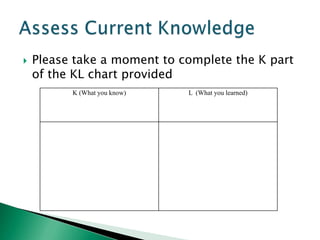
   Please take a moment to complete the K part
    of the KL chart provided
          K (What you know)   L (What you learned)
 Has anyone in this room taught in an
  inclusive classroom before?
 Students taught in this type of
  classroom environment?
   Inclusion is a term that describes the ideology
    that each child should be educated in the
    general education environment in the school
    that they would regularly attend, to the
    maximum extent possible.
   It involves providing the support services to
    the student rather than bringing the student
    to the services, and requires that the student
    will benefit from being in the class rather
    than having to keep pace with other students.
   Full inclusion is the belief that technological
    supports and instructional practices are
    currently available to provide
    accommodations to all students, regardless
    of whether or not they have a disability, in the
    classrooms and schools they would regularly
    attend.
   This term refers to the selective placement of
    students with disabilities in one or more
    general education classes.
   The idea is that students will be “set up for
    success.”
   It is assumed that in order for a student to be
    successfully mainstreamed, they must posses
    the ability to keep pace with their general
    education peers both academically and
    socially.
   The Individuals With Disabilities Education Act
    (as amended in 2004), does not require
    inclusion. Rather, the law states that children
    with disabilities should be educated in the
    "least restrictive environment.”
   IDEA stipulates that the process for
    determining the "least restrictive
    environment" should begin with placement in
    the general education classroom.
   IDEA does recognize that it is not
    appropriate to place all children in the
    general education classroom.
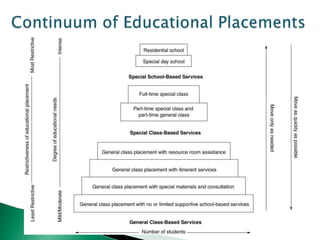
    ◦ School districts should have a “continuum of
      placements” available, extending from the
      regular education classroom to residential
      settings, in order to accommodate the
      needs of all children with disabilities.
◦ Use of the “continuum of placements”
  concept makes it more probable that each
  child will be appropriately placed in an
  environment that is specifically suited to
  meet their needs.
◦ The degree of inclusion should derive from
  what the student needs (as determined by
  the IEP team), not by the parents’ desires or
  school district’s convenience.
   Section 504 is significant in the legal mandate of
    Least Restrictive Environment (LRE) and the use
    of supplementary aids and services for students
    with disabilities because it was used to ensure
    nondiscrimination on the basis of disability.
   Because the categories of disabilities covered by
    the IDEA have expanded during the past two
    reauthorizations in 1997 and 2004, Section 504
    is used less often to provide access to public
    education for students with disabilities.
 Oberti   v. Clementon (1993)
 ◦ The Federal Court upheld the right of
   students with disabilities to be
   educated with their nondisabled peers
   in general education classrooms. This
   judicial decision required that school
   districts need to provide an
   explanation as to why students with
   disabilities are educated in separate
   settings and why this placement is the
   best option for said students.
                       (Baker, Wang, & Walberg, 1995)
   Board of Education v. Holland (1992, 1994)
    ◦ The 9th Circuit District Court defined LRE as a strong
      Congressional preference. This opinion combined
      factors from several previous decisions to determine
      what the least restrictive environment is. Those
      factors dealt with educational benefits in a regular
      classroom; non-academic benefits for the handicapped
      child in a regular classroom; the child's effect on the
      teacher and other child in the regular class; and the
      cost of supplementary aids and service to mainstream
      the handicapped child. The Court said cost is only a
      factor if it will significantly affect another child in the
      district.
   Hartmann v. Loudoun County Board of
    Education (1996)
    ◦ A Virginia federal district court ruled that a
      nonverbal student with autism should attend a
      regular education second grade class with
      appropriate supplemental aids and services.
      However, when the case was appealed, the 4th
      Circuit Court concluded that the inclusion efforts
      were sufficient with staff training and help on
      behavior issues, reduced class size, and class
      composed of independent workers.
   Cedar Rapids Community School District v.
    Garret F. (1999)
    ◦ The Supreme Court ruled that taxpayer-supported
      schools are responsible for the costs of providing
      continual care for disabled students under a federal
      law that says all children must receive
      "free, appropriate public education." Under the
      Court's reading of the IDEA's relevant
      provisions, medical treatments such as
      suctioning, ventilator checks, catheterization, and
      others which can be administered by non-physician
      personnel come within the parameters of the
      special education law's related services.
   Cooperative Learning Experiences
    ◦ Think-Pair-Share
    ◦ Peer Tutoring
    ◦ Small, cooperative learning groups
   Philosophical Orientation Defines Special
    Education as a Service, Not a Place
   Provision of Adaptations and Support
    ◦ Only as needed
    ◦ Follow accommodations and support that is
      expressed in a student’s IEP paperwork
   Inquiry-Based Learning Experiences
   Classroom is Student-Centered and has a
    Collaborative Learning Environment
    ◦ Identification of students’ strengths and areas of
      need
    ◦ Students have mutual respect within the learning
      environment
    ◦ Students help to create the classroom rules and are
      expected to follow them
    ◦ Students have a responsibility for developing their
      community
 Teachers   Teaching Teachers
 ◦ Collaboration between general education and
   special education teachers is required.
 ◦ RTI
 ◦ Strategies for increasing consultation time
 ◦ Collaborative consultation
 ◦ Assistance teams
 ◦ Coaching
 ◦ Peer collaboration
 ◦ Cooperative teaching
 ◦ Communication skills for collaboration
 Parent   Teacher Collaboration
 ◦ Establish cooperation
 ◦ Develop culturally responsive
   relationships
 ◦ Parent-teacher conferences
 ◦ Parents as teachers
 Focus  on time for learning
 Ensure high rates of student
  success
 Provide positive and supportive
  learning environments
 Plan and maintain a motivational
  environment
   Universal Design for Learning (UDL)

   High Quality Inclusion in a Diverse Society

   Positive Behavior Support

   Tiered Models in Early Intervention
 An educational framework based on
 research in the learning sciences
 that guides development of flexible
 learning environments that
 accommodates individual learning
 differences
   Since the way individuals learn can be unique, the
    UDL framework, first defined by the Center for
    Applied Special Technology (CAST) in the
    1990s, calls for initially creating curriculum that
    provides:
   Multiple means of representation to give learners
    numerous ways of acquiring information and
    knowledge
   Multiple means of expression to provide learners
    alternatives for demonstrating what they know
   Multiple means of engagement to tap into learners'
    interests, challenge them appropriately, and
    motivate them to learn
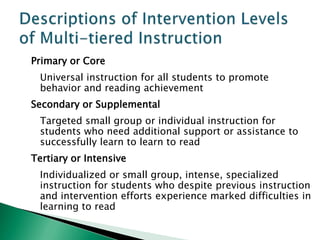
Primary or Core
 Universal instruction for all students to promote
 behavior and reading achievement
Secondary or Supplemental
 Targeted small group or individual instruction for
 students who need additional support or assistance to
 successfully learn to learn to read
Tertiary or Intensive
 Individualized or small group, intense, specialized
 instruction for students who despite previous instruction
 and intervention efforts experience marked difficulties in
 learning to read
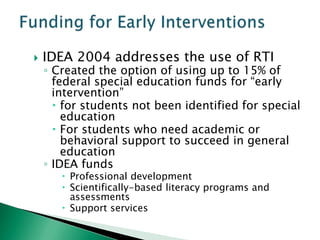
   IDEA 2004 addresses the use of RTI
    ◦ Created the option of using up to 15% of
      federal special education funds for “early
      intervention”
       for students not been identified for special
        education
       For students who need academic or
        behavioral support to succeed in general
        education
    ◦ IDEA funds
        Professional development
        Scientifically-based literacy programs and
         assessments
        Support services
   Please take a moment to complete the L part
    of the KL chart provided
           K (What you know)   L (What you learned)

Inclusion – What is It?

  • 1.
    Presented by Dr.Alicia Brophy
  • 2.
    “I have cometo frightening conclusion that, I am the decisive element in the classroom. It is my personal approach that creates the climate. It is my daily mood that makes the weather. As a teacher I possess tremendous power to make a child’s life miserable or joyous. I can be a tool of torture or an instrument of inspiration. I can humiliate or humor, hurt or heal. In all situations it is my response that decides whether a crisis will be escalated or de-escalated, and a child humanized or de-humanized.”
  • 3.
    1.All individuals arecapable of learning. 2.The teaching talent to help all students learn according to their potential exists in most schools today. 3.The knowledge gap between what is known about effective teaching and what routinely is practiced in classrooms is enormous. 4.All students need a safe, caring, and positive learning environment.
  • 4.
    Be able to define inclusion and related terms ◦ What is inclusion? (inclusion vs. full inclusion) ◦ What is mainstreaming?  Gain an understanding of Federal Law with regard to inclusion and its history  Identify characteristics that have been identified as important to and supportive of inclusion  Identify strategies that can be used to support students within an inclusive classroom
  • 5.
    Please take a moment to complete the K part of the KL chart provided K (What you know) L (What you learned)
  • 6.
     Has anyonein this room taught in an inclusive classroom before?  Students taught in this type of classroom environment?
  • 7.
    Inclusion is a term that describes the ideology that each child should be educated in the general education environment in the school that they would regularly attend, to the maximum extent possible.  It involves providing the support services to the student rather than bringing the student to the services, and requires that the student will benefit from being in the class rather than having to keep pace with other students.
  • 8.
    Full inclusion is the belief that technological supports and instructional practices are currently available to provide accommodations to all students, regardless of whether or not they have a disability, in the classrooms and schools they would regularly attend.
  • 9.
    This term refers to the selective placement of students with disabilities in one or more general education classes.  The idea is that students will be “set up for success.”  It is assumed that in order for a student to be successfully mainstreamed, they must posses the ability to keep pace with their general education peers both academically and socially.
  • 10.
    The Individuals With Disabilities Education Act (as amended in 2004), does not require inclusion. Rather, the law states that children with disabilities should be educated in the "least restrictive environment.”  IDEA stipulates that the process for determining the "least restrictive environment" should begin with placement in the general education classroom.
  • 11.
    IDEA does recognize that it is not appropriate to place all children in the general education classroom. ◦ School districts should have a “continuum of placements” available, extending from the regular education classroom to residential settings, in order to accommodate the needs of all children with disabilities.
  • 13.
    ◦ Use ofthe “continuum of placements” concept makes it more probable that each child will be appropriately placed in an environment that is specifically suited to meet their needs. ◦ The degree of inclusion should derive from what the student needs (as determined by the IEP team), not by the parents’ desires or school district’s convenience.
  • 15.
    Section 504 is significant in the legal mandate of Least Restrictive Environment (LRE) and the use of supplementary aids and services for students with disabilities because it was used to ensure nondiscrimination on the basis of disability.  Because the categories of disabilities covered by the IDEA have expanded during the past two reauthorizations in 1997 and 2004, Section 504 is used less often to provide access to public education for students with disabilities.
  • 16.
     Oberti v. Clementon (1993) ◦ The Federal Court upheld the right of students with disabilities to be educated with their nondisabled peers in general education classrooms. This judicial decision required that school districts need to provide an explanation as to why students with disabilities are educated in separate settings and why this placement is the best option for said students. (Baker, Wang, & Walberg, 1995)
  • 17.
    Board of Education v. Holland (1992, 1994) ◦ The 9th Circuit District Court defined LRE as a strong Congressional preference. This opinion combined factors from several previous decisions to determine what the least restrictive environment is. Those factors dealt with educational benefits in a regular classroom; non-academic benefits for the handicapped child in a regular classroom; the child's effect on the teacher and other child in the regular class; and the cost of supplementary aids and service to mainstream the handicapped child. The Court said cost is only a factor if it will significantly affect another child in the district.
  • 18.
    Hartmann v. Loudoun County Board of Education (1996) ◦ A Virginia federal district court ruled that a nonverbal student with autism should attend a regular education second grade class with appropriate supplemental aids and services. However, when the case was appealed, the 4th Circuit Court concluded that the inclusion efforts were sufficient with staff training and help on behavior issues, reduced class size, and class composed of independent workers.
  • 19.
    Cedar Rapids Community School District v. Garret F. (1999) ◦ The Supreme Court ruled that taxpayer-supported schools are responsible for the costs of providing continual care for disabled students under a federal law that says all children must receive "free, appropriate public education." Under the Court's reading of the IDEA's relevant provisions, medical treatments such as suctioning, ventilator checks, catheterization, and others which can be administered by non-physician personnel come within the parameters of the special education law's related services.
  • 21.
    Cooperative Learning Experiences ◦ Think-Pair-Share ◦ Peer Tutoring ◦ Small, cooperative learning groups  Philosophical Orientation Defines Special Education as a Service, Not a Place  Provision of Adaptations and Support ◦ Only as needed ◦ Follow accommodations and support that is expressed in a student’s IEP paperwork
  • 22.
    Inquiry-Based Learning Experiences  Classroom is Student-Centered and has a Collaborative Learning Environment ◦ Identification of students’ strengths and areas of need ◦ Students have mutual respect within the learning environment ◦ Students help to create the classroom rules and are expected to follow them ◦ Students have a responsibility for developing their community
  • 23.
     Teachers Teaching Teachers ◦ Collaboration between general education and special education teachers is required. ◦ RTI ◦ Strategies for increasing consultation time ◦ Collaborative consultation ◦ Assistance teams ◦ Coaching ◦ Peer collaboration ◦ Cooperative teaching ◦ Communication skills for collaboration
  • 24.
     Parent Teacher Collaboration ◦ Establish cooperation ◦ Develop culturally responsive relationships ◦ Parent-teacher conferences ◦ Parents as teachers
  • 25.
     Focus on time for learning  Ensure high rates of student success  Provide positive and supportive learning environments  Plan and maintain a motivational environment
  • 26.
    Universal Design for Learning (UDL)  High Quality Inclusion in a Diverse Society  Positive Behavior Support  Tiered Models in Early Intervention
  • 27.
     An educationalframework based on research in the learning sciences that guides development of flexible learning environments that accommodates individual learning differences
  • 28.
    Since the way individuals learn can be unique, the UDL framework, first defined by the Center for Applied Special Technology (CAST) in the 1990s, calls for initially creating curriculum that provides:  Multiple means of representation to give learners numerous ways of acquiring information and knowledge  Multiple means of expression to provide learners alternatives for demonstrating what they know  Multiple means of engagement to tap into learners' interests, challenge them appropriately, and motivate them to learn
  • 29.
    Primary or Core Universal instruction for all students to promote behavior and reading achievement Secondary or Supplemental Targeted small group or individual instruction for students who need additional support or assistance to successfully learn to learn to read Tertiary or Intensive Individualized or small group, intense, specialized instruction for students who despite previous instruction and intervention efforts experience marked difficulties in learning to read
  • 30.
    IDEA 2004 addresses the use of RTI ◦ Created the option of using up to 15% of federal special education funds for “early intervention”  for students not been identified for special education  For students who need academic or behavioral support to succeed in general education ◦ IDEA funds  Professional development  Scientifically-based literacy programs and assessments  Support services
  • 31.
    Please take a moment to complete the L part of the KL chart provided K (What you know) L (What you learned)