Prepared By /lamiaa Elsayed
     Pediatric Nursing


       Immediate care of newborn   1
The
                         1st 24 hours
                             of Life

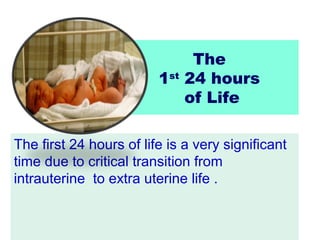
The first 24 hours of life is a very significant
time due to critical transition from
intrauterine to extra uterine life .
Immediate care of newborn   3
Purposes of immediate
      care of newborn
• Establish and maintain respiratory
  function.
• Provide warmth and prevent
  hypothermia.
• Ensure safety from injury and infection.
• Identify actual and potential problems
  that might require immediate action.
               Immediate care of newborn     4
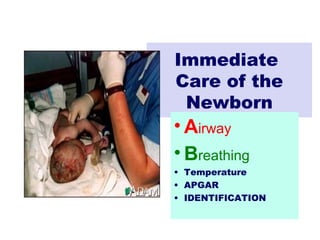
Immediate
Care of the
 Newborn
• Airway
• Breathing
• Temperature
• APGAR
• IDENTIFICATION
Implementation:
• Oro-pharengeal Suctioning:
• 1.Wipe the neonate’s mouth with a
  piece of gauze around your index finger
  once his head has been delivered.
• Wrap and dry the neonate in a warmed
  towel.
• Suction the neonate’s mouth with a
  disposable Suctioning.
              Immediate care of newborn     6
Implementation:
• Place the neonate in a radiant warmer.
• Replace the wet towel and wrap the
  neonate in another dry towel.
• Place newborn in trendlenburng position.
• Do suction of oropharyngeal canal.
• Oxygen may be given.
• Continue suction as fluid is aspirated.
              Immediate care of newborn   7
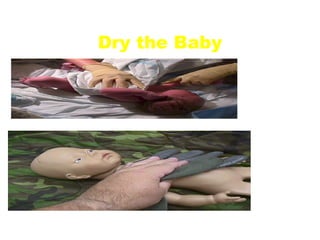
Dry the Baby
   • Hypothermia is common
   • Wet newborns rapidly lose
     heat
   • Use a warm, dry, soft towel
   • Any absorbent material:
Replace the Wet Towels
             • Then let the mother
               hold the baby
             • Her body heat will
               help keep the baby
               warm
             • Cover the head to
               prevent heat loss
POSITIONING OF THE
     NEWBORN
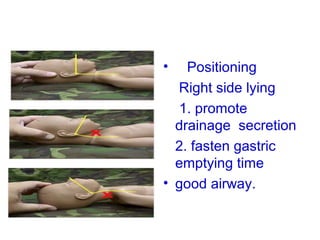
         •   Positioning
           Right side lying
           1. promote
           drainage secretion
           2. fasten gastric
           emptying time
         • good airway.
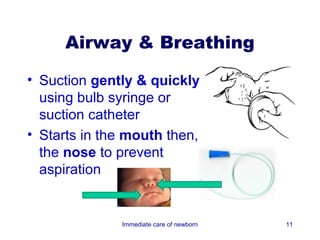
Airway & Breathing

• Suction gently & quickly
  using bulb syringe or
  suction catheter
• Starts in the mouth then,
  the nose to prevent
  aspiration


              Immediate care of newborn   11
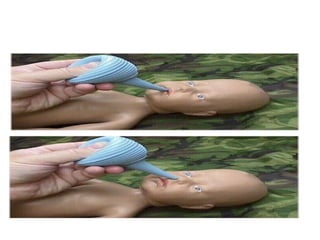
Suction first from Mouth and then from
Nose Use a by use of bulb syringe
Airway & Breathing

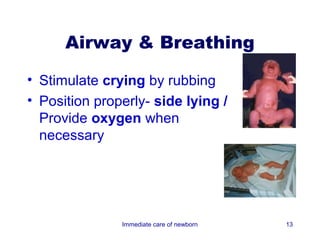
• Stimulate crying by rubbing
• Position properly- side lying /
  Provide oxygen when
  necessary


               Immediate care of newborn   13
Assess the newborn’s
 condition

A- One minute APGAR Score&- reassess at
5 minutes.
B-Neurological examination by checking
common reflexes of the newborn.
C-Vital signs pulse, respiration &
temperature.
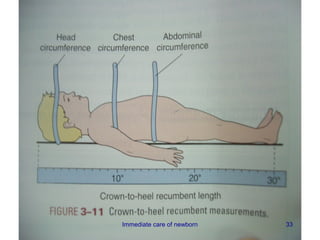
D-Growth measurement include length,
weight, head & chest circumferences.
               Immediate care of newborn   14
Assess the newborn’s
  condition
E-Assess for any gross abnormality, congenital
defects in head,
F- eyes, ears, chest, spine,. face, nose,
abdomen, anus, external genitalia &extremities.
G-Assess for any signs of eye infection.


                Immediate care of newborn   15
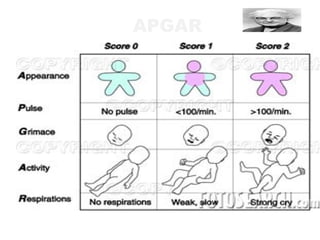
Apgar score

• The Apgar score is determined by
  evaluating the newborn baby on five
  simple criteria on a scale from zero to
  two and summing up the five
  values.The resulting Apgar score
  ranges from zero to 10.


               Immediate care of newborn    16
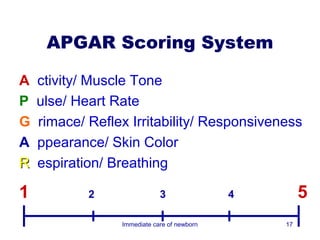
APGAR Scoring System

A   ctivity/ Muscle Tone
P   ulse/ Heart Rate
G   rimace/ Reflex Irritability/ Responsiveness
A   ppearance/ Skin Color
R   espiration/ Breathing

1           2                3               4        5
                 Immediate care of newborn       17
APGAR
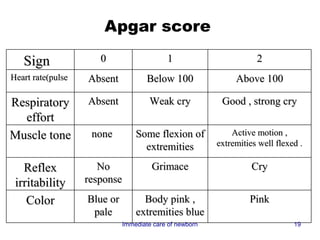
Apgar score

   Sign               0                    1                        2
Heart rate(pulse   Absent            Below 100                Above 100

Respiratory        Absent             Weak cry            Good , strong cry
  effort
Muscle tone         none         Some flexion of             Active motion ,
                                   extremities           extremities well flexed .

   Reflex             No              Grimace                      Cry
 irritability      response

    Color          Blue or         Body pink ,                    Pink
                    pale         extremities blue
                             Immediate care of newborn                         19
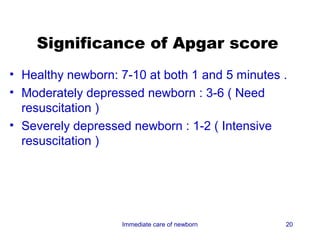
Significance of Apgar score
• Healthy newborn: 7-10 at both 1 and 5 minutes .
• Moderately depressed newborn : 3-6 ( Need
  resuscitation )
• Severely depressed newborn : 1-2 ( Intensive
  resuscitation )


                   Immediate care of newborn    20
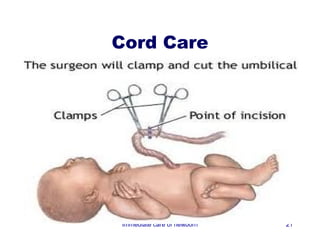
Cord Care


Immediate care of newborn   21
Cord Care

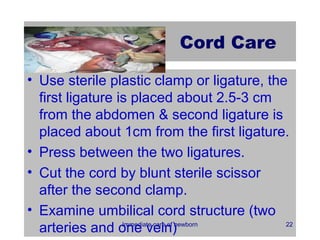
• Use sterile plastic clamp or ligature, the
  first ligature is placed about 2.5-3 cm
  from the abdomen & second ligature is
  placed about 1cm from the first ligature.
• Press between the two ligatures.
• Cut the cord by blunt sterile scissor
  after the second clamp.
• Examine umbilical cord structure (two
  arteries and one vein)
                  Immediate care of newborn 22
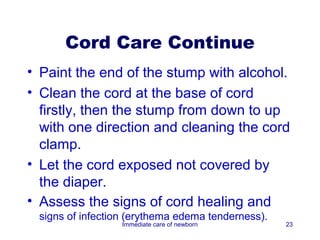
Cord Care Continue
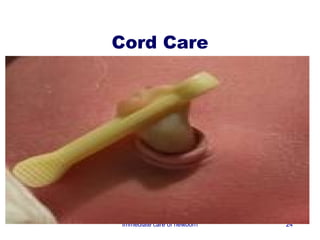
• Paint the end of the stump with alcohol.
• Clean the cord at the base of cord
  firstly, then the stump from down to up
  with one direction and cleaning the cord
  clamp.
• Let the cord exposed not covered by
  the diaper.
• Assess the signs of cord healing and
 signs of infection (erythema edema tenderness).
                  Immediate care of newborn        23
Cord Care


Immediate care of newborn   24
Eye care:
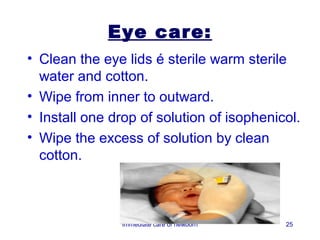
• Clean the eye lids é sterile warm sterile
  water and cotton.
• Wipe from inner to outward.
• Install one drop of solution of isophenicol.
• Wipe the excess of solution by clean
  cotton.


               Immediate care of newborn   25
Vitamin K Injection
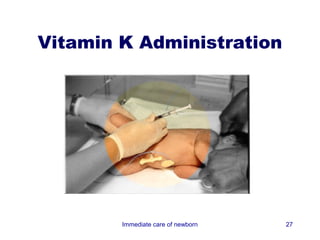
• Administer 1mg. Vitamin K by I.M
  injection.

• Route: IM into the lateral anterior thigh
  (Vastus lateralis).


                Immediate care of newborn     26
Vitamin K Administration


        Immediate care of newborn   27
Identification of the
         newborn
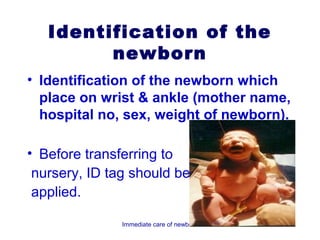
• Identification of the newborn which
  place on wrist & ankle (mother name,
  hospital no, sex, weight of newborn).

• Before transferring to
 nursery, ID tag should be
 applied.

               Immediate care of newborn   28
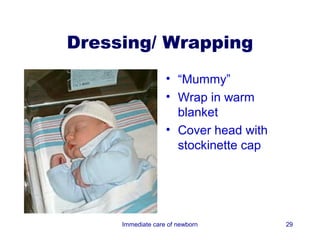
Dressing/ Wrapping
                   • “Mummy”
                   • Wrap in warm
                     blanket
                   • Cover head with
                     stockinette cap


     Immediate care of newborn         29
Assessment of vital signs
•temperature : the axillary method is the safest .
Normal axillary temperature is 36 – 36.5 °C

 •Heart Rate ( HR ) :
 HR is counted for 60 seconds at the apex of the heart (Range
from 100- 160 b/m immediately after birth ) .

•Respiratory Rate ( RR ) :
RR varies from 30- 60 b/m when the infant is not crying .

•Blood Pressure ( BP ) :
Not routinely assessed in healthy term infants .
The range of normal blood pressure in term infants is 60- 90
 mmhg for systolic pressure and 40 – 50 mmhg for diastolic
  pressure .          Immediate care of newborn          30
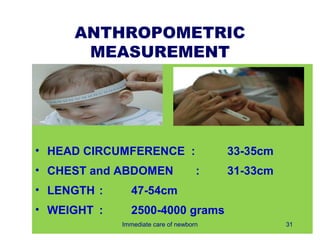
ANTHROPOMETRIC
      MEASUREMENT


• HEAD CIRCUMFERENCE :                   33-35cm
• CHEST and ABDOMEN                  :   31-33cm
• LENGTH :     47-54cm
• WEIGHT :     2500-4000 grams
             Immediate care of newborn             31
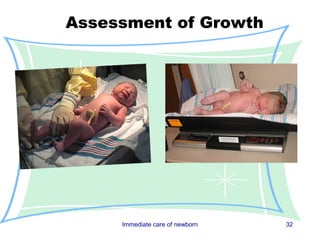
Assessment of Growth


     Immediate care of newborn   32
Immediate care of newborn   33
Neurologic System
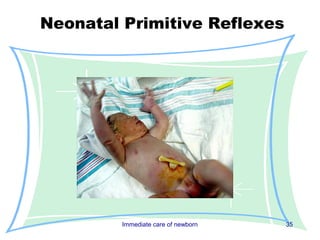
Neonatal Primitive Reflexes


         Immediate care of newborn   35
Reflexes


Include the Moro , startle , palmer and planter
  grasps, sucking and rooting and swallowing
  reflexes, tonic neck reflex ,stepping , and
  babinski sign .


                   Immediate care of newborn      36
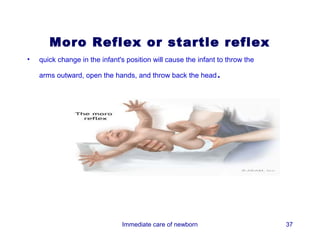
Moro Reflex or startle reflex
•   quick change in the infant's position will cause the infant to throw the

    arms outward, open the hands, and throw back the head      .


                               Immediate care of newborn                       37
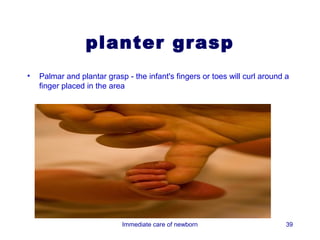
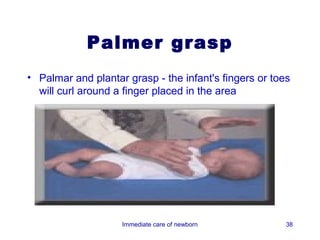
Palmer grasp
• Palmar and plantar grasp - the infant's fingers or toes
  will curl around a finger placed in the area


                    Immediate care of newborn           38
planter grasp
•   Palmar and plantar grasp - the infant's fingers or toes will curl around a
    finger placed in the area


                            Immediate care of newborn                        39
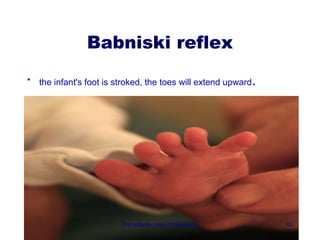
Babniski reflex
•   the infant's foot is stroked, the toes will extend upward   .


                          Immediate care of newborn                 40
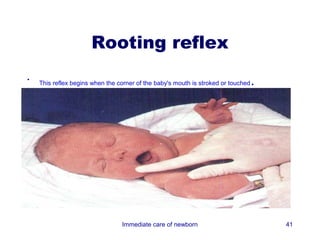
Rooting reflex
•
    This reflex begins when the corner of the baby's mouth is stroked or touched   .


                                 Immediate care of newborn                             41
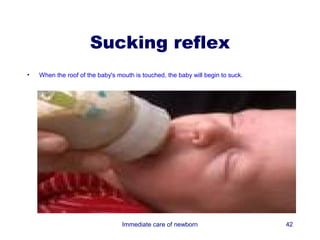
Sucking reflex
•   When the roof of the baby's mouth is touched, the baby will begin to suck.


                                  Immediate care of newborn                      42
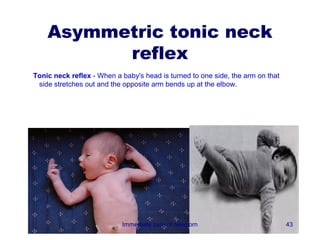
Asymmetric tonic neck
          reflex
Tonic neck reflex - When a baby's head is turned to one side, the arm on that
 side stretches out and the opposite arm bends up at the elbow.


                           Immediate care of newborn                            43
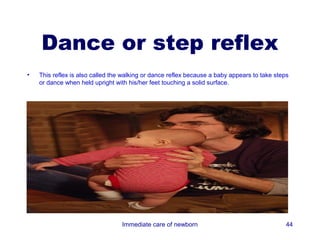
Dance or step reflex
•   This reflex is also called the walking or dance reflex because a baby appears to take steps
    or dance when held upright with his/her feet touching a solid surface.


                                  Immediate care of newborn                                   44
Immediate care of newborn   45

Immediate care lamiaa slide share

  • 1.
    Prepared By /lamiaaElsayed Pediatric Nursing Immediate care of newborn 1
  • 2.
    The 1st 24 hours of Life The first 24 hours of life is a very significant time due to critical transition from intrauterine to extra uterine life .
  • 3.
  • 4.
    Purposes of immediate care of newborn • Establish and maintain respiratory function. • Provide warmth and prevent hypothermia. • Ensure safety from injury and infection. • Identify actual and potential problems that might require immediate action. Immediate care of newborn 4
  • 5.
    Immediate Care of the Newborn • Airway • Breathing • Temperature • APGAR • IDENTIFICATION
  • 6.
    Implementation: • Oro-pharengeal Suctioning: •1.Wipe the neonate’s mouth with a piece of gauze around your index finger once his head has been delivered. • Wrap and dry the neonate in a warmed towel. • Suction the neonate’s mouth with a disposable Suctioning. Immediate care of newborn 6
  • 7.
    Implementation: • Place theneonate in a radiant warmer. • Replace the wet towel and wrap the neonate in another dry towel. • Place newborn in trendlenburng position. • Do suction of oropharyngeal canal. • Oxygen may be given. • Continue suction as fluid is aspirated. Immediate care of newborn 7
  • 8.
    Dry the Baby • Hypothermia is common • Wet newborns rapidly lose heat • Use a warm, dry, soft towel • Any absorbent material:
  • 9.
    Replace the WetTowels • Then let the mother hold the baby • Her body heat will help keep the baby warm • Cover the head to prevent heat loss
  • 10.
    POSITIONING OF THE NEWBORN • Positioning Right side lying 1. promote drainage secretion 2. fasten gastric emptying time • good airway.
  • 11.
    Airway & Breathing •Suction gently & quickly using bulb syringe or suction catheter • Starts in the mouth then, the nose to prevent aspiration Immediate care of newborn 11
  • 12.
    Suction first fromMouth and then from Nose Use a by use of bulb syringe
  • 13.
    Airway & Breathing •Stimulate crying by rubbing • Position properly- side lying / Provide oxygen when necessary Immediate care of newborn 13
  • 14.
    Assess the newborn’s condition A- One minute APGAR Score&- reassess at 5 minutes. B-Neurological examination by checking common reflexes of the newborn. C-Vital signs pulse, respiration & temperature. D-Growth measurement include length, weight, head & chest circumferences. Immediate care of newborn 14
  • 15.
    Assess the newborn’s condition E-Assess for any gross abnormality, congenital defects in head, F- eyes, ears, chest, spine,. face, nose, abdomen, anus, external genitalia &extremities. G-Assess for any signs of eye infection. Immediate care of newborn 15
  • 16.
    Apgar score • TheApgar score is determined by evaluating the newborn baby on five simple criteria on a scale from zero to two and summing up the five values.The resulting Apgar score ranges from zero to 10. Immediate care of newborn 16
  • 17.
    APGAR Scoring System A ctivity/ Muscle Tone P ulse/ Heart Rate G rimace/ Reflex Irritability/ Responsiveness A ppearance/ Skin Color R espiration/ Breathing 1 2 3 4 5 Immediate care of newborn 17
  • 18.
  • 19.
    Apgar score Sign 0 1 2 Heart rate(pulse Absent Below 100 Above 100 Respiratory Absent Weak cry Good , strong cry effort Muscle tone none Some flexion of Active motion , extremities extremities well flexed . Reflex No Grimace Cry irritability response Color Blue or Body pink , Pink pale extremities blue Immediate care of newborn 19
  • 20.
    Significance of Apgarscore • Healthy newborn: 7-10 at both 1 and 5 minutes . • Moderately depressed newborn : 3-6 ( Need resuscitation ) • Severely depressed newborn : 1-2 ( Intensive resuscitation ) Immediate care of newborn 20
  • 21.
  • 22.
    Cord Care • Usesterile plastic clamp or ligature, the first ligature is placed about 2.5-3 cm from the abdomen & second ligature is placed about 1cm from the first ligature. • Press between the two ligatures. • Cut the cord by blunt sterile scissor after the second clamp. • Examine umbilical cord structure (two arteries and one vein) Immediate care of newborn 22
  • 23.
    Cord Care Continue •Paint the end of the stump with alcohol. • Clean the cord at the base of cord firstly, then the stump from down to up with one direction and cleaning the cord clamp. • Let the cord exposed not covered by the diaper. • Assess the signs of cord healing and signs of infection (erythema edema tenderness). Immediate care of newborn 23
  • 24.
  • 25.
    Eye care: • Cleanthe eye lids é sterile warm sterile water and cotton. • Wipe from inner to outward. • Install one drop of solution of isophenicol. • Wipe the excess of solution by clean cotton. Immediate care of newborn 25
  • 26.
    Vitamin K Injection •Administer 1mg. Vitamin K by I.M injection. • Route: IM into the lateral anterior thigh (Vastus lateralis). Immediate care of newborn 26
  • 27.
    Vitamin K Administration Immediate care of newborn 27
  • 28.
    Identification of the newborn • Identification of the newborn which place on wrist & ankle (mother name, hospital no, sex, weight of newborn). • Before transferring to nursery, ID tag should be applied. Immediate care of newborn 28
  • 29.
    Dressing/ Wrapping • “Mummy” • Wrap in warm blanket • Cover head with stockinette cap Immediate care of newborn 29
  • 30.
    Assessment of vitalsigns •temperature : the axillary method is the safest . Normal axillary temperature is 36 – 36.5 °C •Heart Rate ( HR ) : HR is counted for 60 seconds at the apex of the heart (Range from 100- 160 b/m immediately after birth ) . •Respiratory Rate ( RR ) : RR varies from 30- 60 b/m when the infant is not crying . •Blood Pressure ( BP ) : Not routinely assessed in healthy term infants . The range of normal blood pressure in term infants is 60- 90 mmhg for systolic pressure and 40 – 50 mmhg for diastolic pressure . Immediate care of newborn 30
  • 31.
    ANTHROPOMETRIC MEASUREMENT • HEAD CIRCUMFERENCE : 33-35cm • CHEST and ABDOMEN : 31-33cm • LENGTH : 47-54cm • WEIGHT : 2500-4000 grams Immediate care of newborn 31
  • 32.
    Assessment of Growth Immediate care of newborn 32
  • 33.
  • 34.
  • 35.
    Neonatal Primitive Reflexes Immediate care of newborn 35
  • 36.
    Reflexes Include the Moro, startle , palmer and planter grasps, sucking and rooting and swallowing reflexes, tonic neck reflex ,stepping , and babinski sign . Immediate care of newborn 36
  • 37.
    Moro Reflex orstartle reflex • quick change in the infant's position will cause the infant to throw the arms outward, open the hands, and throw back the head . Immediate care of newborn 37
  • 38.
    Palmer grasp • Palmarand plantar grasp - the infant's fingers or toes will curl around a finger placed in the area Immediate care of newborn 38
  • 39.
    planter grasp • Palmar and plantar grasp - the infant's fingers or toes will curl around a finger placed in the area Immediate care of newborn 39
  • 40.
    Babniski reflex • the infant's foot is stroked, the toes will extend upward . Immediate care of newborn 40
  • 41.
    Rooting reflex • This reflex begins when the corner of the baby's mouth is stroked or touched . Immediate care of newborn 41
  • 42.
    Sucking reflex • When the roof of the baby's mouth is touched, the baby will begin to suck. Immediate care of newborn 42
  • 43.
    Asymmetric tonic neck reflex Tonic neck reflex - When a baby's head is turned to one side, the arm on that side stretches out and the opposite arm bends up at the elbow. Immediate care of newborn 43
  • 44.
    Dance or stepreflex • This reflex is also called the walking or dance reflex because a baby appears to take steps or dance when held upright with his/her feet touching a solid surface. Immediate care of newborn 44
  • 45.