CARE OF CHEMOPORT / PORT-A-CATH
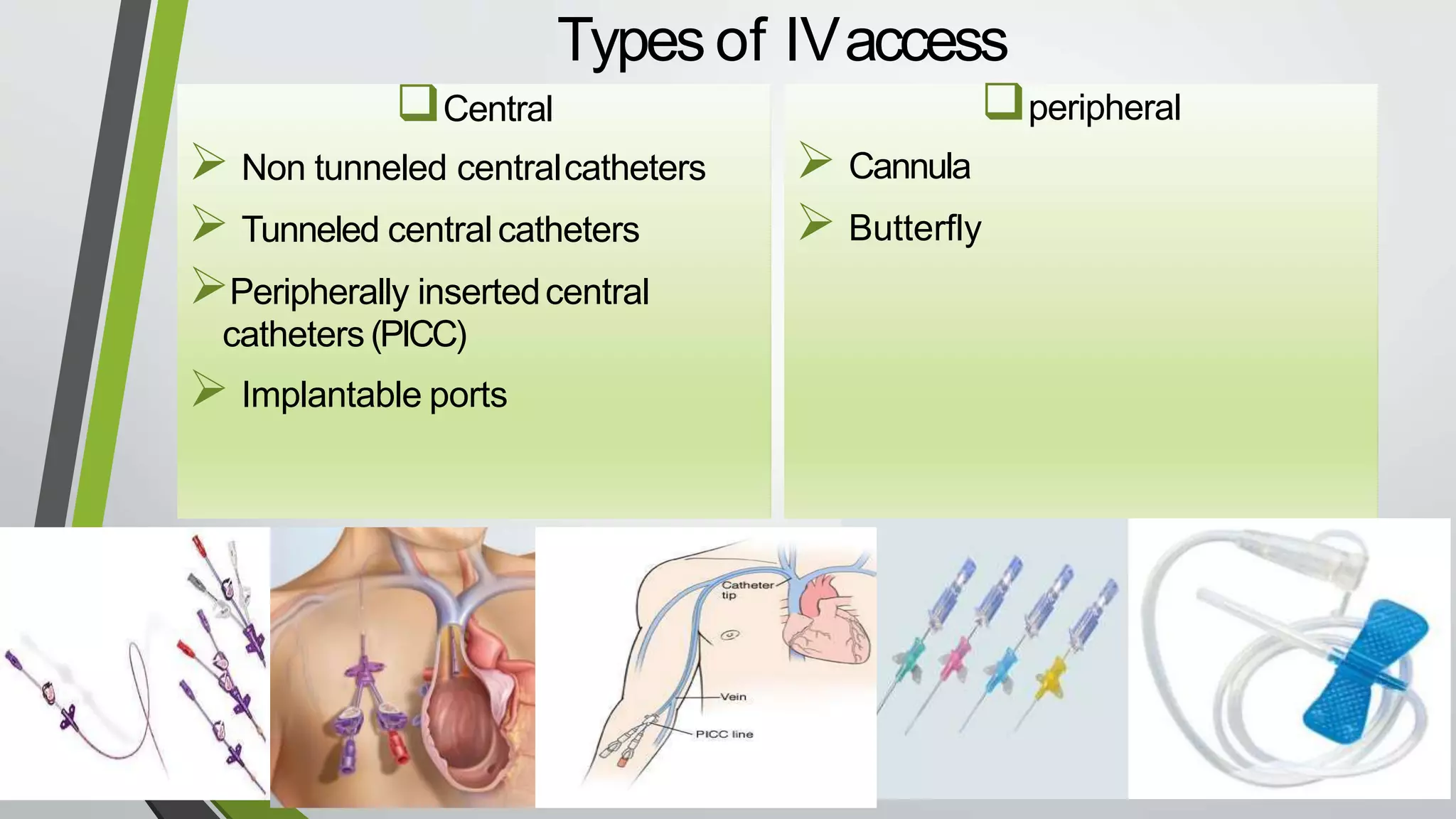
Types of IVaccess
Central
 Non tunneled centralcatheters
 Tunneled centralcatheters
Peripherally insertedcentral
catheters (PICC)
 Implantable ports
peripheral
 Cannula
 Butterfly
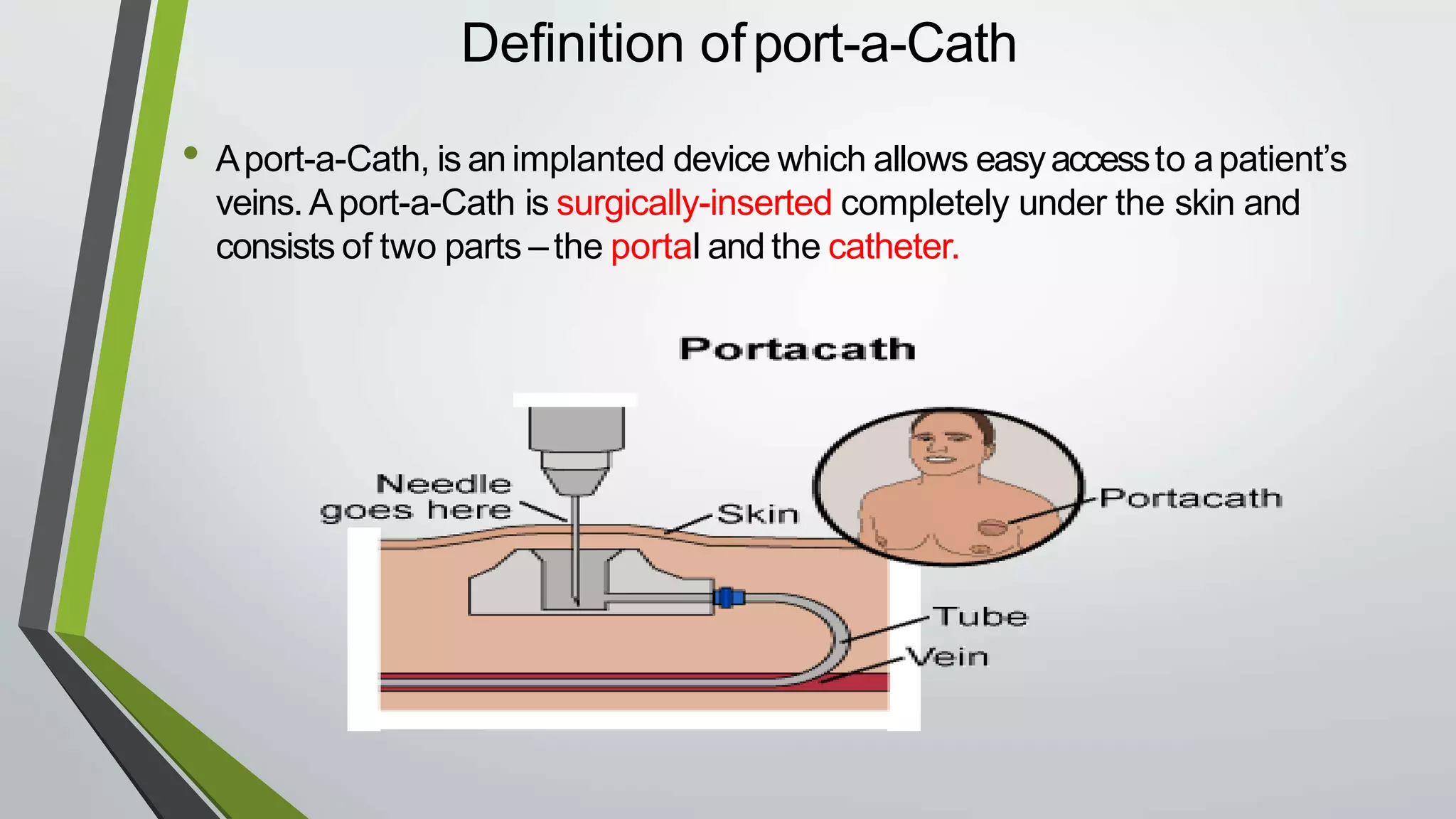
Definition ofport-a-Cath
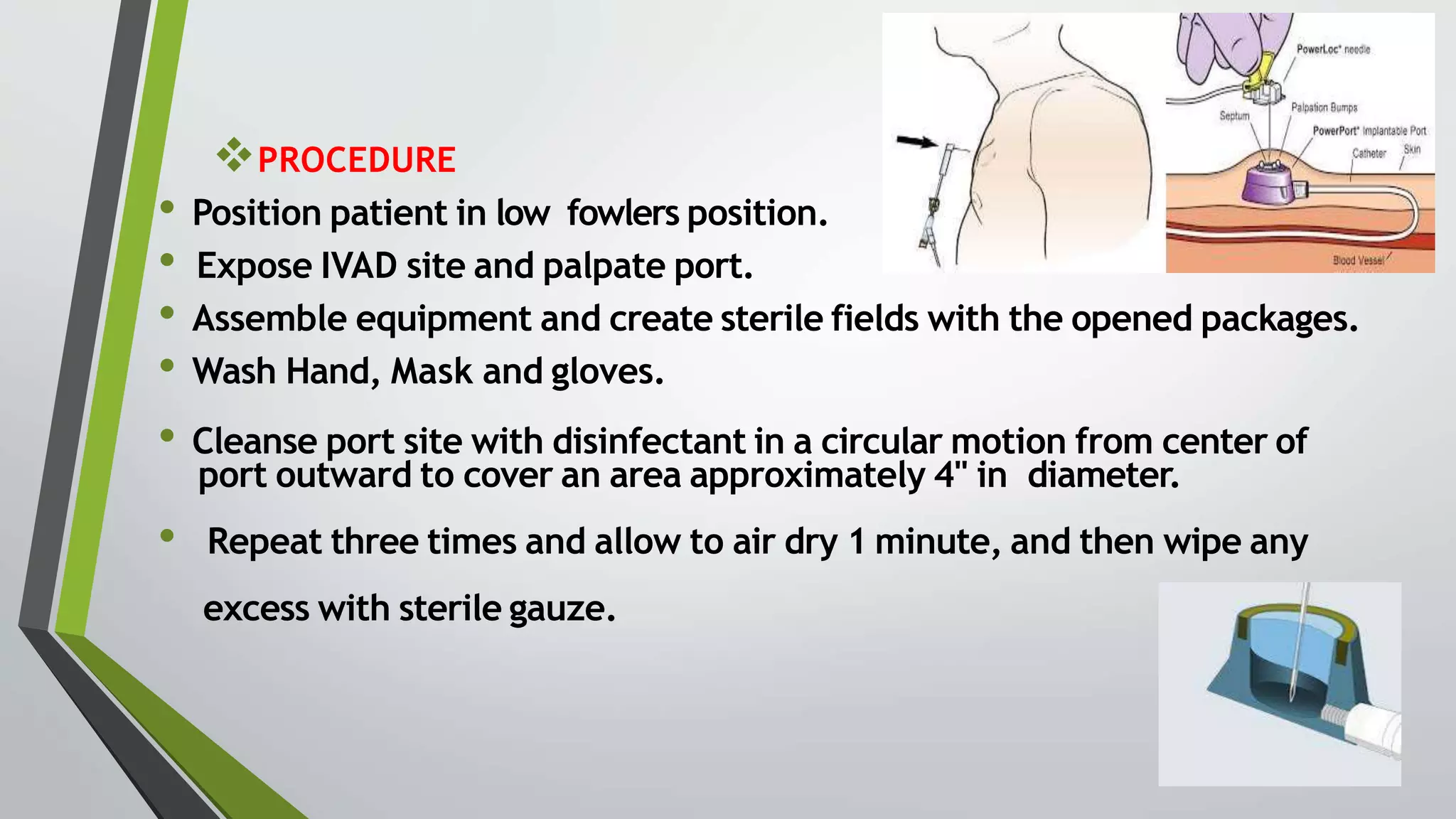
• Aport-a-Cath, is animplanted device which allows easyaccessto apatient’s
veins. A port-a-Cath is surgically-inserted completely under the skin and
consists of two parts –the portal and the catheter.
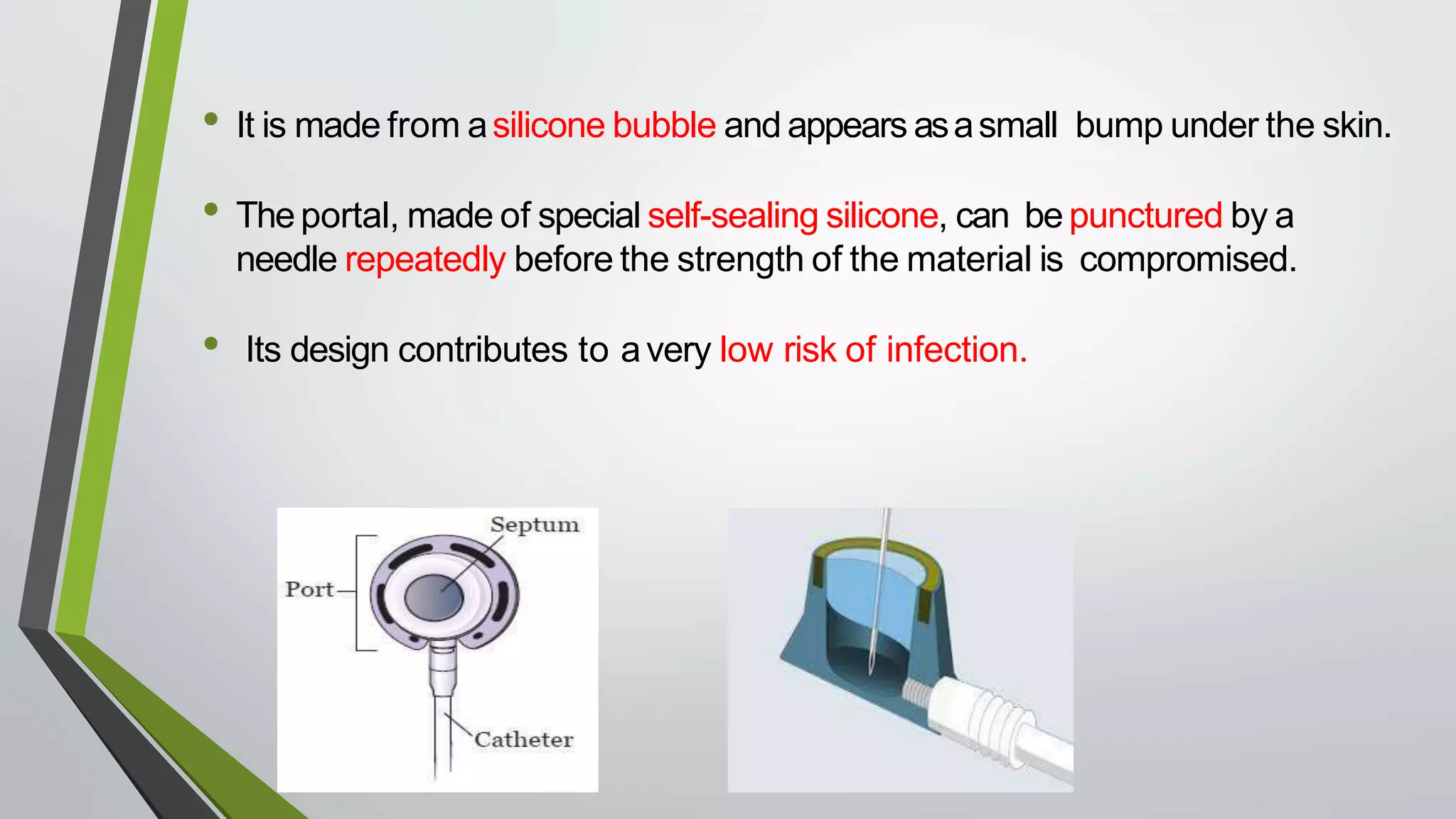
• It is made from asilicone bubble and appears asasmall bump under the skin.
• Theportal, made of special self-sealing silicone, can be punctured by a
needle repeatedly before the strength of the material is compromised.
• Its design contributes to avery low risk of infection.
Types of port- a-Cath
• Single lumen
• Doublelumen
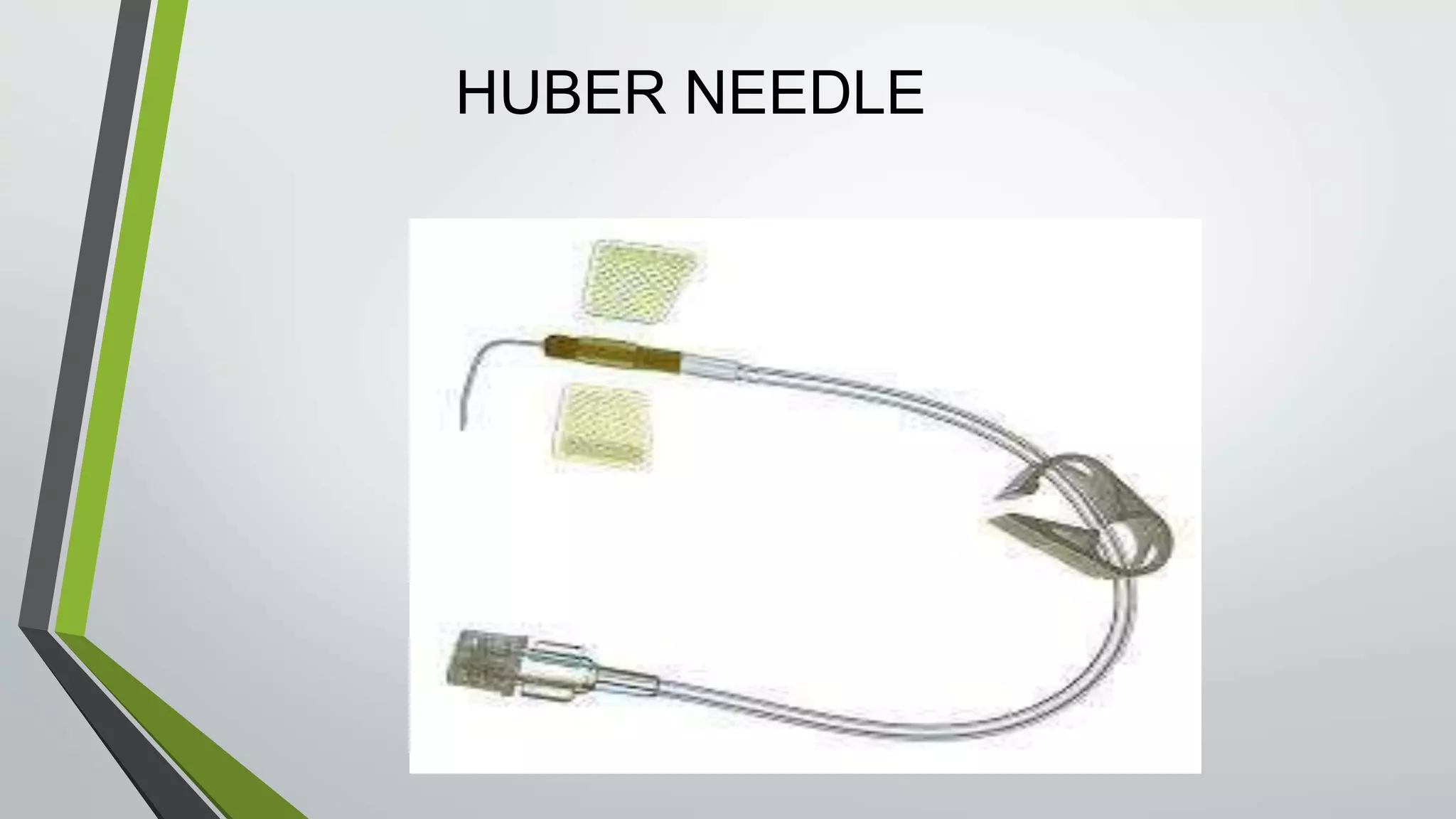
HUBER NEEDLE
Indication of port-a-Cath
 Difficult cannulation
 Long term access – can be used for many years
 Central line for blood drawing and medication administration
 May administer continuous infusion IV vesicants
 Ports placed for patients receiving chemotherapy , generally restricted
to chemotherapy infusions only
 Lowest incidence of catheter- related bloodborne infections
 Low maintenance care at home
Contraindication ofport-a-cath
• Occludedvein.
• Respiratoryproblems
• Infected site.
• Site with trauma for exampleclavicle fracture.
• PPE (personal protective equipment )
• Dressing tray/Trolley
• Huber needle with luer lock extension tubing
• Chlorhexidine 2%Gluconate with 70%IsopropylAlcohol solution
• 5ml, 10mLsyringe
• Normal saline
• Sterile dressing set (Gauze, Pad, Kidney tray)
• Transparent occlusivedressing
• Tape/ Tegaderm (8526 )
• Inj Heparin(1:10 ml ns / Inj hep lock (no dilution )
Articles / Equipment needed for procedure
PROCEDURE
• Position patient in low fowlers position.
• Expose IVAD site and palpate port.
• Assemble equipment and create sterile fields with the opened packages.
• Wash Hand, Mask and gloves.
• Cleanse port site with disinfectant in a circular motion from center of
port outward to cover an area approximately 4" in diameter.
• Repeat three times and allow to air dry 1 minute, and then wipe any
excess with sterile gauze.
• Attach saline filled syringe and prime the tubing and needle.
• Leave syringe attached to set and close the clamp.
• Be careful to maintain the sterility of the Huber needle
• Palpate the port system with the non-dominant hand and stabilize
the port edge with 2 or 3 fingers.
• With the dominant hand, using firm, consistent pressure, insert the
non-coring needle at a 90 degree angle) to the port septum until
the back of the port chamber is located.
• Rotate site with each access if last access site known.
• Open the clamp on the extension tubing and verify patency by
aspirating for blood return and instilling saline.
• Slowly flush the system with 10mL of saline, disconnect syringe and
close clamp.
• secure the needle and tubing to the Patient,
• using the 4-inch occlusive dressing.
• HEPARIN LOCKING
After saline flush, ports areflushed heparin to lock the system for intermittent access,
when discontinuing access,and every 4 weeks to maintain patency.
EQUIPMENT
• 10mLsyringecontaining5mLHeparinLock FlushSolution (100units/mL)
• 10mLsyringecontaining10mLsterile normal saline
• Chlorhexidine2%Gluconatewith 70%IsopropylAlcohol swab
 PROCEDURE
1.Cleansetop of adaptor with Chlorhexidine2%Gluconatewith 70%IsopropylAlcohol
swab.Allow to dry completely.
2.Attach syringeto adaptor.
3.Openclampon extensiontubing.
4.Verify patency and inject saline,disconnectsyringe.
5. Inject heparinsolution.
6. Disconnectsyringeand clampextensiontubing.
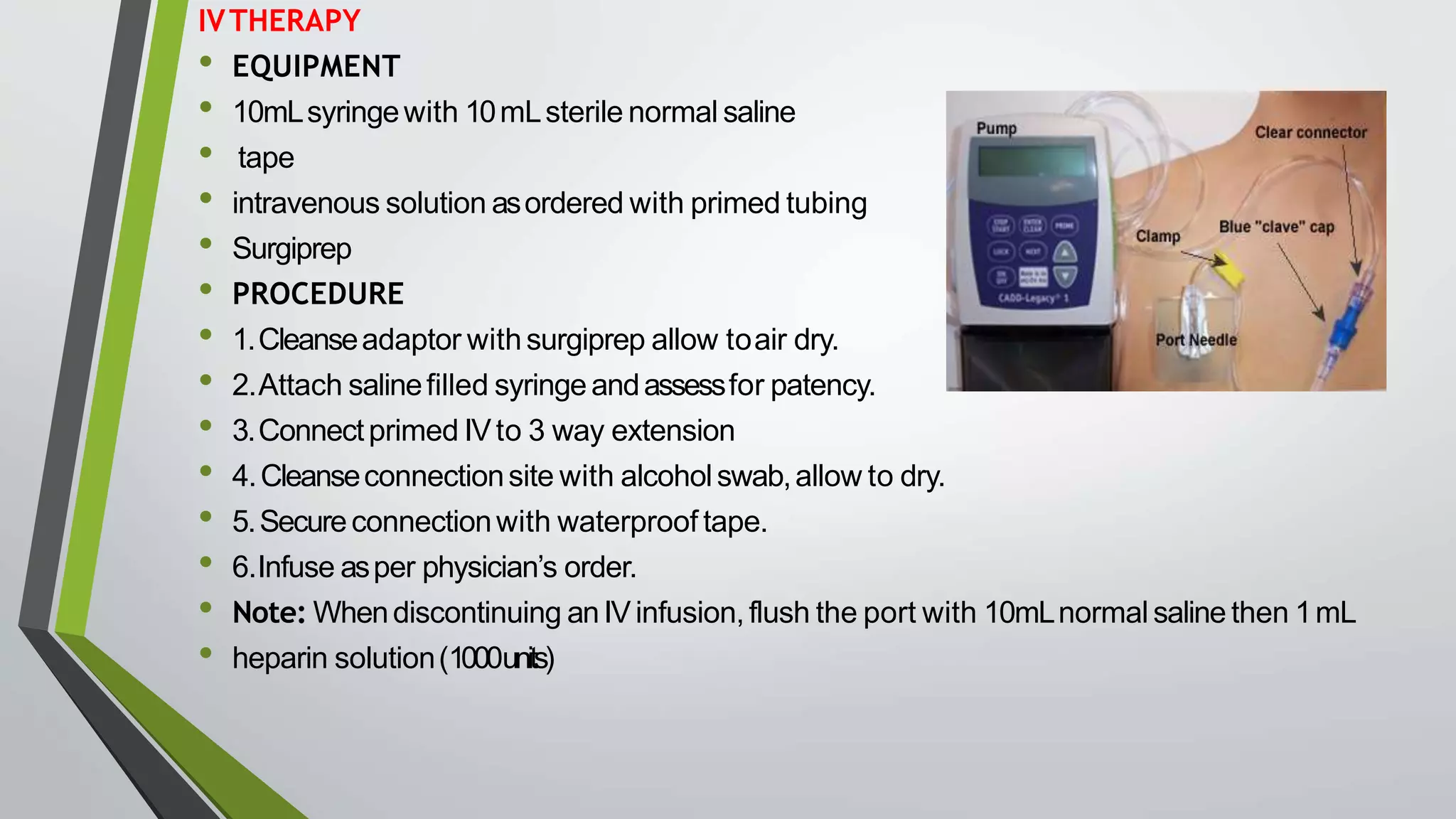
IVTHERAPY
• EQUIPMENT
• 10mLsyringewith 10mLsterile normal saline
• tape
• intravenous solution asordered with primed tubing
• Surgiprep
• PROCEDURE
• 1.Cleanseadaptor withsurgiprep allow toair dry.
• 2.Attach salinefilled syringeandassessfor patency.
• 3.Connectprimed IVto 3 way extension
• 4.Cleanseconnectionsite with alcoholswab,allow to dry.
• 5.Secureconnectionwith waterproof tape.
• 6.Infuse asper physician’s order.
• Note: Whendiscontinuing anIVinfusion,flush the port with 10mLnormal saline then 1mL
• heparin solution(1000units)
• BLOOD SAMPLING
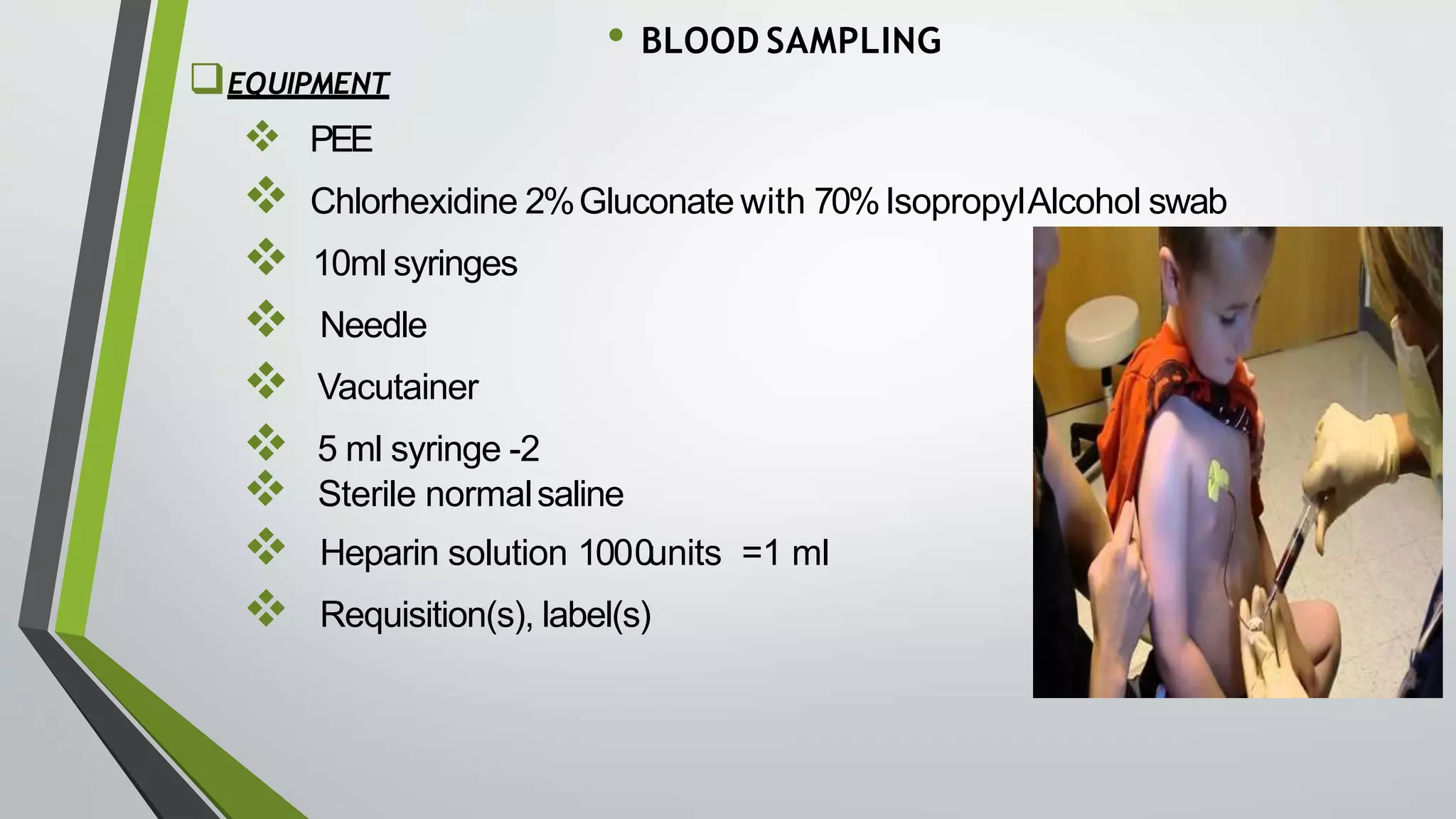
EQUIPMENT
 PEE
 Chlorhexidine 2%Gluconate with 70%IsopropylAlcohol swab
 10ml syringes
 Needle
 Vacutainer
 5 ml syringe -2
 Sterile normalsaline
 Heparin solution 1000units =1 ml
 Requisition(s), label(s)
PROCEDURE
• Apply sterilegloves.
• Prepare 10mlsnormal salinein 10-ml.syringe.
• Prepare 1mls heparin solution in 10mlsyringe. ( with dilution 10 ml NS)
• Cleanthe adaptor with asurgiprep
• Attach a10mLsyringe.
• Withdraw the required amount of blood by attaching a10ml syringe
• Flushthe IVADwith 10mLnormal saline
• NSflush/heparinflush
• resumeIVtherapy.
EQUIPMENT
 PEE
 5mLsof heparin lock flush solution in 10mLsyringe
 10mLs sterile normal saline without preservative in 10mLsyringe
 2" x 2"gauze
 Bandaid
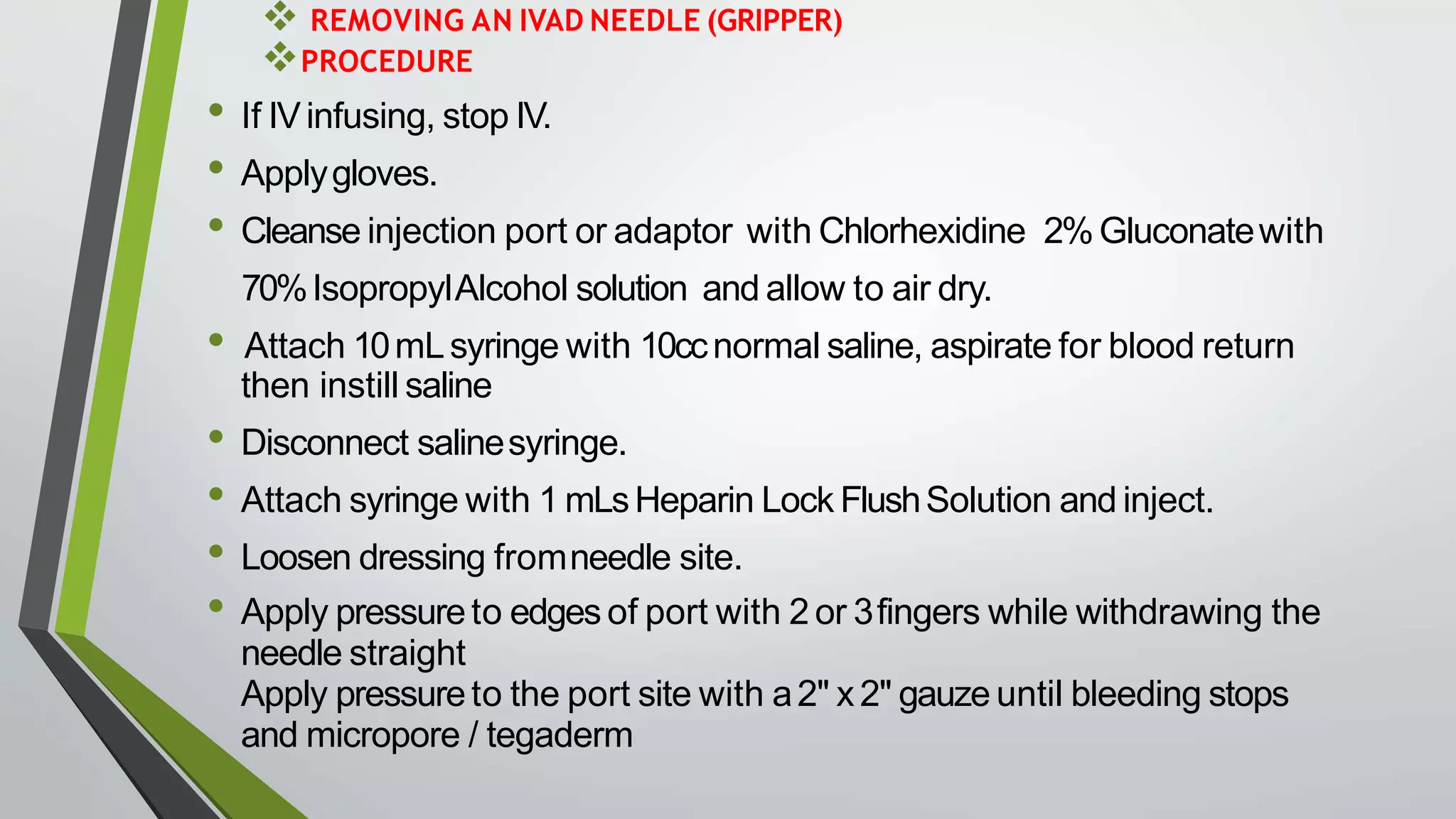
 REMOVING AN IVAD NEEDLE (GRIPPER)
PROCEDURE
• If IVinfusing, stop IV.
• Applygloves.
• Cleanse injection port or adaptor with Chlorhexidine 2%Gluconatewith
70%IsopropylAlcohol solution and allow to air dry.
• Attach 10mLsyringe with 10ccnormal saline, aspirate for blood return
then instill saline
• Disconnect salinesyringe.
• Attach syringe with 1 mLsHeparin Lock FlushSolution and inject.
• Loosen dressing fromneedle site.
• Apply pressureto edges of port with 2 or 3fingers while withdrawing the
needle straight
Apply pressureto the port site with a2" x2" gauze until bleeding stops
and micropore / tegaderm
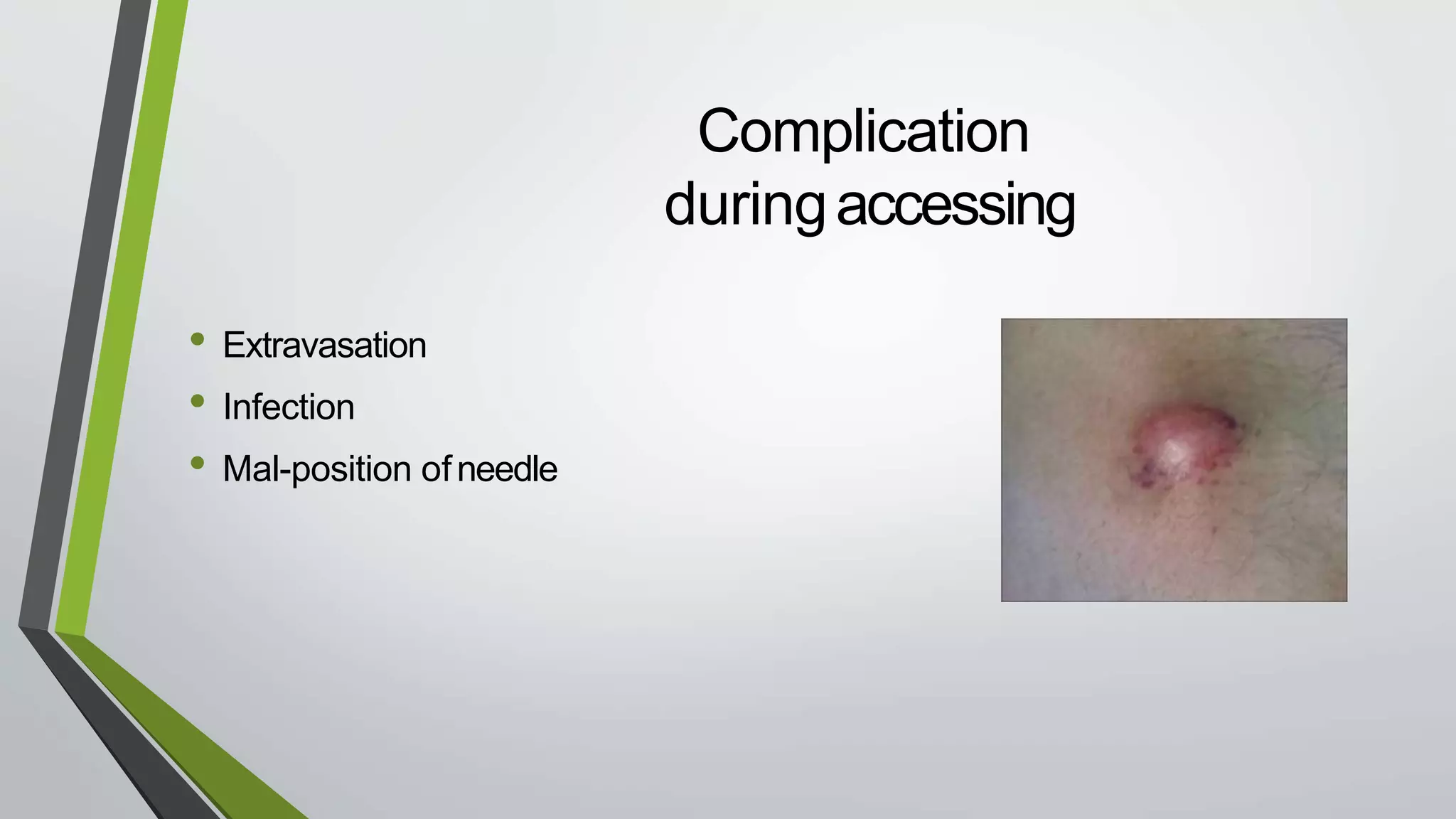
Complication
duringaccessing
• Extravasation
• Infection
• Mal-position ofneedle
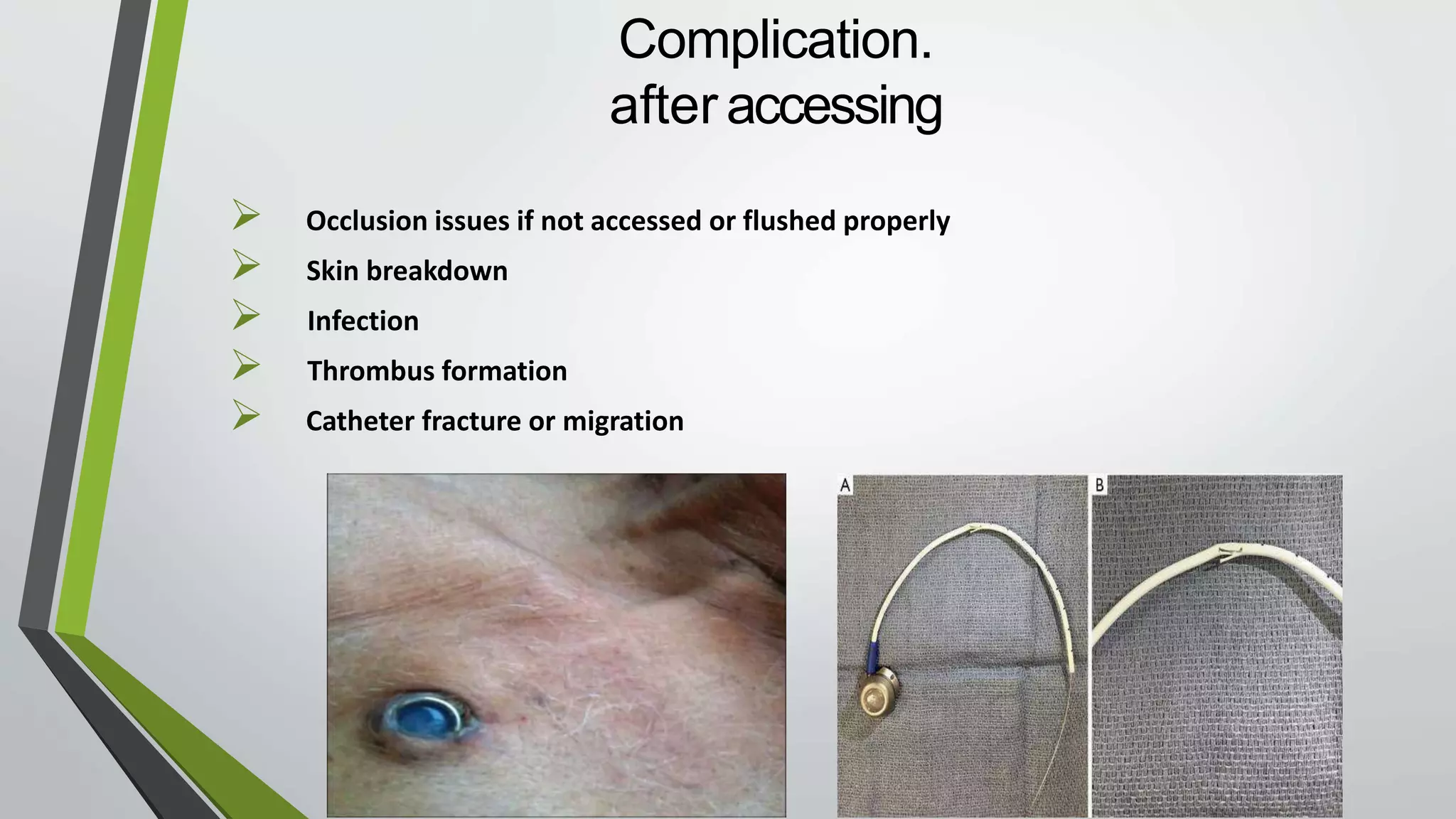
Complication.
after accessing
 Occlusion issues if not accessed or flushed properly
 Skin breakdown
 Infection
 Thrombus formation
 Catheter fracture or migration
Patienteducation 1-afterportinsertion (post operative)
• Limit activity for 24 hour
• Sterile dressing for 24 hr. if no drainage present (changedressing daily or
if needed)
• Transparent dressing till wound healing
• Notify physician if any complication (pain, fever, swelling, other)
Patienteducation 2- during in patient using port
• Do not sleep on site of port
• Observethat line is not kinked
• Low activity when connected with pump
• Mal-position ofneedle
• Extravasation
• Notify physician if any complication (pain, fever, swallowing, other)
care of chemoport.pptx

care of chemoport.pptx

  • 1.
    CARE OF CHEMOPORT/ PORT-A-CATH
  • 2.
    Types of IVaccess Central Non tunneled centralcatheters  Tunneled centralcatheters Peripherally insertedcentral catheters (PICC)  Implantable ports peripheral  Cannula  Butterfly
  • 4.
    Definition ofport-a-Cath • Aport-a-Cath,is animplanted device which allows easyaccessto apatient’s veins. A port-a-Cath is surgically-inserted completely under the skin and consists of two parts –the portal and the catheter.
  • 5.
    • It ismade from asilicone bubble and appears asasmall bump under the skin. • Theportal, made of special self-sealing silicone, can be punctured by a needle repeatedly before the strength of the material is compromised. • Its design contributes to avery low risk of infection.
  • 6.
    Types of port-a-Cath • Single lumen • Doublelumen
  • 7.
  • 8.
    Indication of port-a-Cath Difficult cannulation  Long term access – can be used for many years  Central line for blood drawing and medication administration  May administer continuous infusion IV vesicants  Ports placed for patients receiving chemotherapy , generally restricted to chemotherapy infusions only  Lowest incidence of catheter- related bloodborne infections  Low maintenance care at home
  • 9.
    Contraindication ofport-a-cath • Occludedvein. •Respiratoryproblems • Infected site. • Site with trauma for exampleclavicle fracture.
  • 10.
    • PPE (personalprotective equipment ) • Dressing tray/Trolley • Huber needle with luer lock extension tubing • Chlorhexidine 2%Gluconate with 70%IsopropylAlcohol solution • 5ml, 10mLsyringe • Normal saline • Sterile dressing set (Gauze, Pad, Kidney tray) • Transparent occlusivedressing • Tape/ Tegaderm (8526 ) • Inj Heparin(1:10 ml ns / Inj hep lock (no dilution ) Articles / Equipment needed for procedure
  • 11.
    PROCEDURE • Position patientin low fowlers position. • Expose IVAD site and palpate port. • Assemble equipment and create sterile fields with the opened packages. • Wash Hand, Mask and gloves. • Cleanse port site with disinfectant in a circular motion from center of port outward to cover an area approximately 4" in diameter. • Repeat three times and allow to air dry 1 minute, and then wipe any excess with sterile gauze.
  • 12.
    • Attach salinefilled syringe and prime the tubing and needle. • Leave syringe attached to set and close the clamp. • Be careful to maintain the sterility of the Huber needle
  • 13.
    • Palpate theport system with the non-dominant hand and stabilize the port edge with 2 or 3 fingers. • With the dominant hand, using firm, consistent pressure, insert the non-coring needle at a 90 degree angle) to the port septum until the back of the port chamber is located. • Rotate site with each access if last access site known. • Open the clamp on the extension tubing and verify patency by aspirating for blood return and instilling saline. • Slowly flush the system with 10mL of saline, disconnect syringe and close clamp.
  • 14.
    • secure theneedle and tubing to the Patient, • using the 4-inch occlusive dressing.
  • 15.
    • HEPARIN LOCKING Aftersaline flush, ports areflushed heparin to lock the system for intermittent access, when discontinuing access,and every 4 weeks to maintain patency. EQUIPMENT • 10mLsyringecontaining5mLHeparinLock FlushSolution (100units/mL) • 10mLsyringecontaining10mLsterile normal saline • Chlorhexidine2%Gluconatewith 70%IsopropylAlcohol swab  PROCEDURE 1.Cleansetop of adaptor with Chlorhexidine2%Gluconatewith 70%IsopropylAlcohol swab.Allow to dry completely. 2.Attach syringeto adaptor. 3.Openclampon extensiontubing. 4.Verify patency and inject saline,disconnectsyringe. 5. Inject heparinsolution. 6. Disconnectsyringeand clampextensiontubing.
  • 16.
    IVTHERAPY • EQUIPMENT • 10mLsyringewith10mLsterile normal saline • tape • intravenous solution asordered with primed tubing • Surgiprep • PROCEDURE • 1.Cleanseadaptor withsurgiprep allow toair dry. • 2.Attach salinefilled syringeandassessfor patency. • 3.Connectprimed IVto 3 way extension • 4.Cleanseconnectionsite with alcoholswab,allow to dry. • 5.Secureconnectionwith waterproof tape. • 6.Infuse asper physician’s order. • Note: Whendiscontinuing anIVinfusion,flush the port with 10mLnormal saline then 1mL • heparin solution(1000units)
  • 17.
    • BLOOD SAMPLING EQUIPMENT PEE  Chlorhexidine 2%Gluconate with 70%IsopropylAlcohol swab  10ml syringes  Needle  Vacutainer  5 ml syringe -2  Sterile normalsaline  Heparin solution 1000units =1 ml  Requisition(s), label(s)
  • 18.
    PROCEDURE • Apply sterilegloves. •Prepare 10mlsnormal salinein 10-ml.syringe. • Prepare 1mls heparin solution in 10mlsyringe. ( with dilution 10 ml NS) • Cleanthe adaptor with asurgiprep • Attach a10mLsyringe. • Withdraw the required amount of blood by attaching a10ml syringe • Flushthe IVADwith 10mLnormal saline • NSflush/heparinflush • resumeIVtherapy.
  • 19.
    EQUIPMENT  PEE  5mLsofheparin lock flush solution in 10mLsyringe  10mLs sterile normal saline without preservative in 10mLsyringe  2" x 2"gauze  Bandaid
  • 20.
     REMOVING ANIVAD NEEDLE (GRIPPER) PROCEDURE • If IVinfusing, stop IV. • Applygloves. • Cleanse injection port or adaptor with Chlorhexidine 2%Gluconatewith 70%IsopropylAlcohol solution and allow to air dry. • Attach 10mLsyringe with 10ccnormal saline, aspirate for blood return then instill saline • Disconnect salinesyringe. • Attach syringe with 1 mLsHeparin Lock FlushSolution and inject. • Loosen dressing fromneedle site. • Apply pressureto edges of port with 2 or 3fingers while withdrawing the needle straight Apply pressureto the port site with a2" x2" gauze until bleeding stops and micropore / tegaderm
  • 21.
  • 22.
    Complication. after accessing  Occlusionissues if not accessed or flushed properly  Skin breakdown  Infection  Thrombus formation  Catheter fracture or migration
  • 23.
    Patienteducation 1-afterportinsertion (postoperative) • Limit activity for 24 hour • Sterile dressing for 24 hr. if no drainage present (changedressing daily or if needed) • Transparent dressing till wound healing • Notify physician if any complication (pain, fever, swelling, other)
  • 24.
    Patienteducation 2- duringin patient using port • Do not sleep on site of port • Observethat line is not kinked • Low activity when connected with pump • Mal-position ofneedle • Extravasation • Notify physician if any complication (pain, fever, swallowing, other)