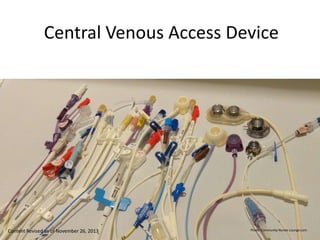
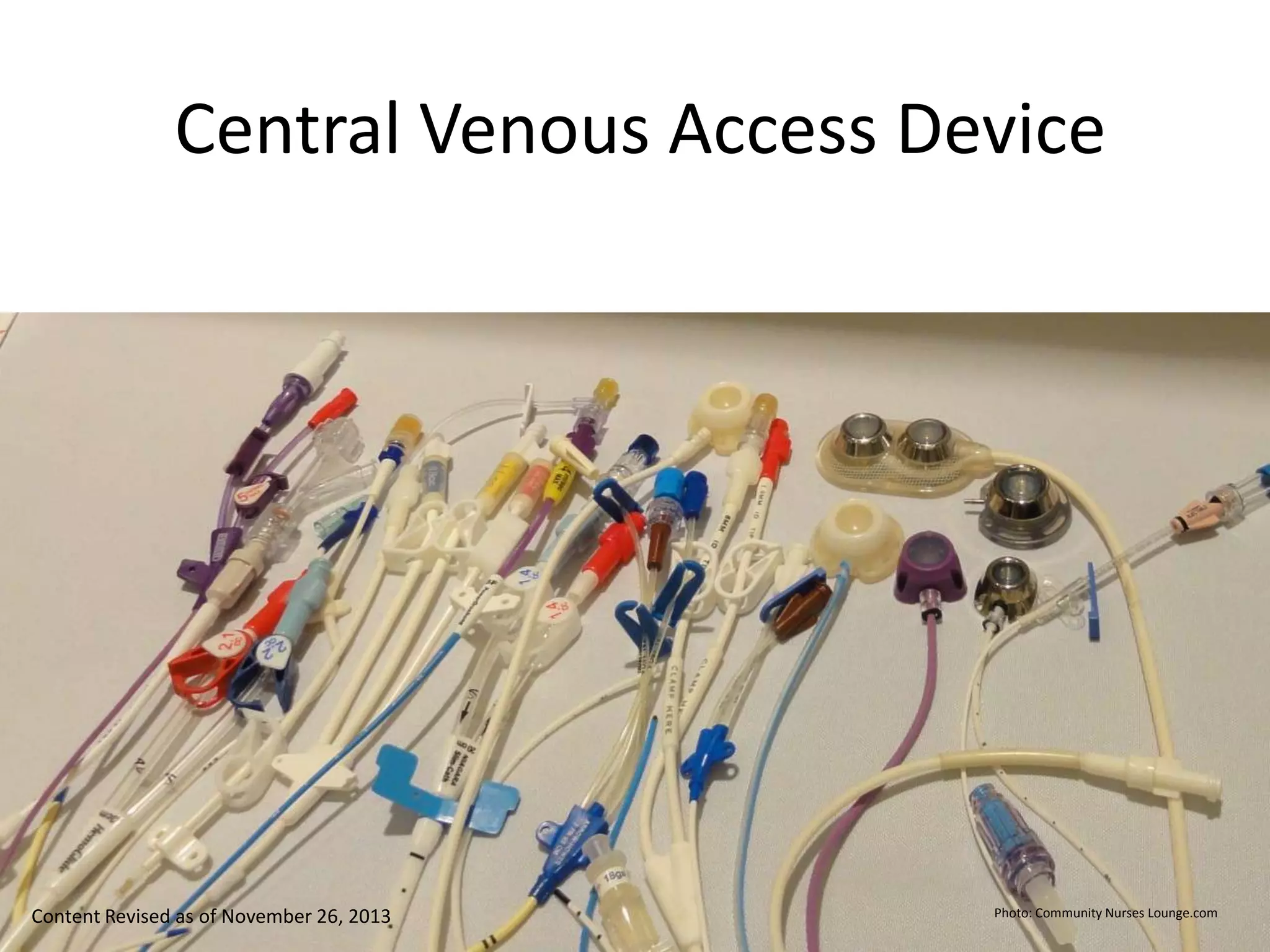
Central Venous Access Device
Photo: Community Nurses Lounge.comContent Revised as of November 26, 2013
What is CVAD?
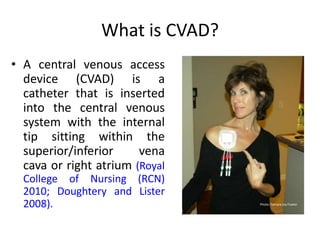
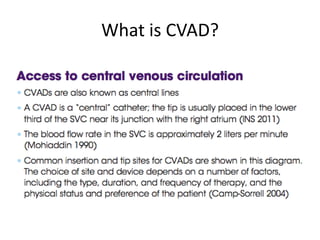
• A central venous access
device (CVAD) is a
catheter that is inserted
into the central venous
system with the internal
tip sitting within the
superior/inferior vena
cava or right atrium (Royal
College of Nursing (RCN)
2010; Doughtery and Lister
2008). Photo: Tamara Joy Fowler
What is CVAD?
Why CVAD?
Catheters can be used either short- or long-term for the infusion of:
• Parenteral Nutrition
• Chemotherapy or other vesicant or irritating solutions
• Blood and blood products
• Antibiotics
• Medication/solutions in patients with limited peripheral access
• Therapy that is ongoing or continued at home
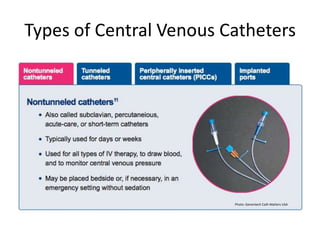
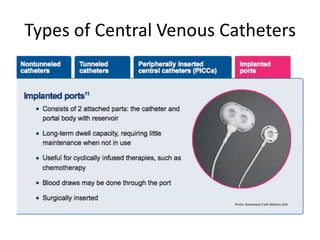
Types of Central Venous Catheters
Photo: Genentech Cath Matters USA
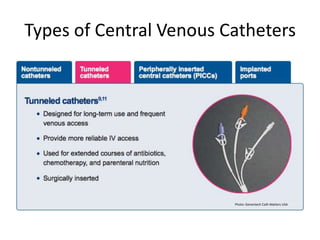
Types of Central Venous Catheters
Photo: Genentech Cath Matters USA
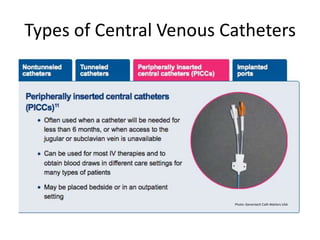
Types of Central Venous Catheters
Photo: Genentech Cath Matters USA
Types of Central Venous Catheters
Photo: Genentech Cath Matters USA
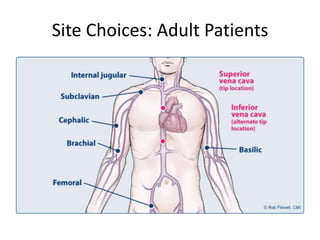
Site Choices: Adult Patients
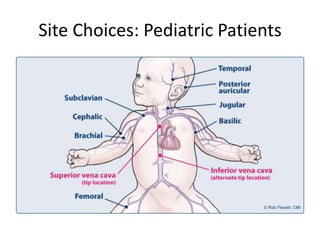
Site Choices: Pediatric Patients
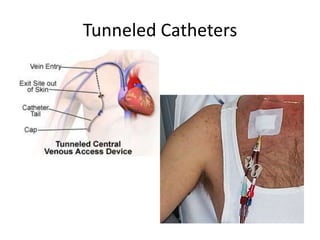
Tunneled Catheters
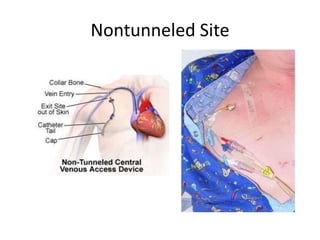
Nontunneled Site
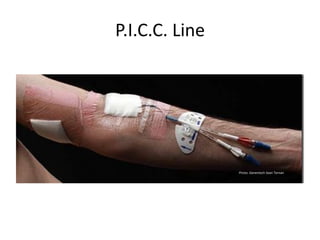
P.I.C.C. Line
Photo: Genentech Sean Ternan
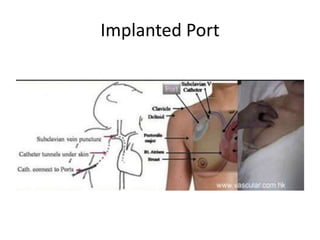
Implanted Port
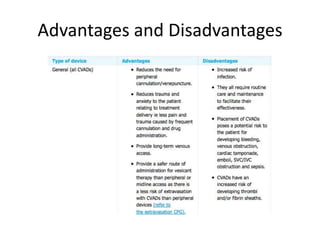
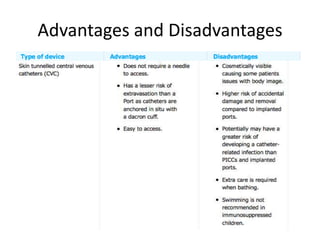
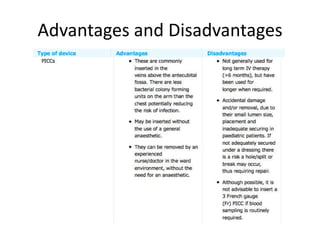
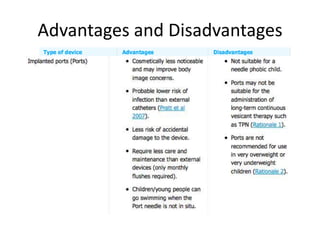
Advantages and Disadvantages
Care and Maintenance
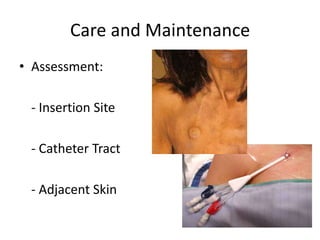
• Assessment:
- Insertion Site
- Catheter Tract
- Adjacent Skin
Care and Maintenance
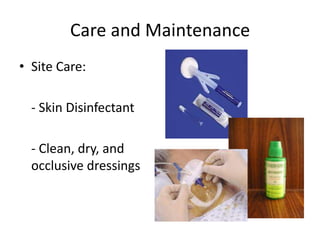
• Site Care:
- Skin Disinfectant
- Clean, dry, and
occlusive dressings
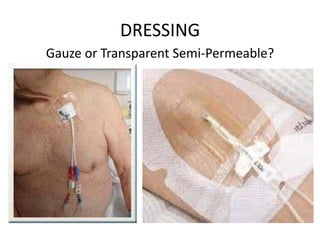
DRESSING
Gauze or Transparent Semi-Permeable?
PROCEDURE FOR SITE CARE AND DRESSING CHANGE
(Infusion Nurses Society: Norwood, Mass 2006)
• BEFORE PROCEDURE
1. Wash Hands
2. Assemble equipment
3. Don sterile gloves and other PPE
4. Use aseptic technique and observe standard
precautions throughout the procedure.
PROCEDURE FOR SITE CARE AND DRESSING CHANGE
(Infusion Nurses Society: Norwood, Mass 2006)
• DURING PROCEDURE
1. Remove dressing from VAD insertion site.
2. Inspect Site and catheter
3. Disinfect the catheter-skin junction using
antiseptic solution
4. Dress access site
PROCEDURE FOR SITE CARE AND DRESSING CHANGE
(Infusion Nurses Society: Norwood, Mass 2006)
• POST PROCEDURE
1. Discard used supplies
2. Remove gloves
3. Wash hands
4. Label new dressing
1. Document
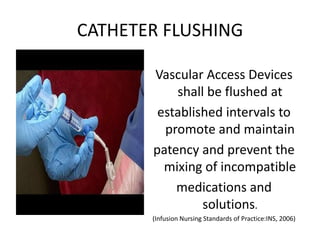
CATHETER FLUSHING
Vascular Access Devices
shall be flushed at
established intervals to
promote and maintain
patency and prevent the
mixing of incompatible
medications and
solutions.
(Infusion Nursing Standards of Practice:INS, 2006)
How often?
CATHETER FLUSHING
 The flushing volume should at least be twice the internal volume of
the CVAD and injection cap.
 Preservative-free 0.9% NaCl flushing solutions shuld be used to
ensure and maintain patency of CVADs at established intervals.
 0.9% NaCl with preservatives should not be administered to
neonates and pediatric patients; if used with adult patients, the
volume should not exceed more than 30mL per day
 Flushing with a heparin solution should occur to ensure and
maintain patency of CVADs at established intervals.
CATHETER LOCKING
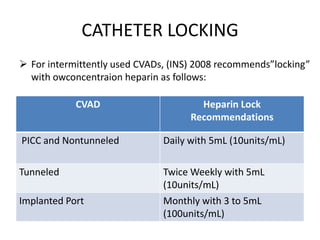
 For intermittently used CVADs, (INS) 2008 recommends”locking”
with owconcentraion heparin as follows:
CVAD Heparin Lock
Recommendations
PICC and Nontunneled Daily with 5mL (10units/mL)
Tunneled Twice Weekly with 5mL
(10units/mL)
Implanted Port Monthly with 3 to 5mL
(100units/mL)
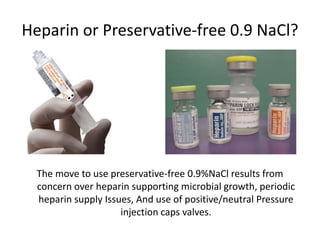
Heparin or Preservative-free 0.9 NaCl?
The move to use preservative-free 0.9%NaCl results from
concern over heparin supporting microbial growth, periodic
heparin supply Issues, And use of positive/neutral Pressure
injection caps valves.
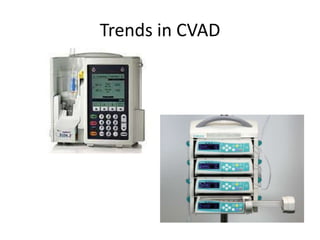
Trends in CVAD
Trends in CVAD
Trends in CVAD
CVAD

CVAD

  • 1.
    Central Venous AccessDevice Photo: Community Nurses Lounge.comContent Revised as of November 26, 2013
  • 2.
    What is CVAD? •A central venous access device (CVAD) is a catheter that is inserted into the central venous system with the internal tip sitting within the superior/inferior vena cava or right atrium (Royal College of Nursing (RCN) 2010; Doughtery and Lister 2008). Photo: Tamara Joy Fowler
  • 3.
  • 4.
    Why CVAD? Catheters canbe used either short- or long-term for the infusion of: • Parenteral Nutrition • Chemotherapy or other vesicant or irritating solutions • Blood and blood products • Antibiotics • Medication/solutions in patients with limited peripheral access • Therapy that is ongoing or continued at home
  • 8.
    Types of CentralVenous Catheters Photo: Genentech Cath Matters USA
  • 9.
    Types of CentralVenous Catheters Photo: Genentech Cath Matters USA
  • 10.
    Types of CentralVenous Catheters Photo: Genentech Cath Matters USA
  • 11.
    Types of CentralVenous Catheters Photo: Genentech Cath Matters USA
  • 12.
  • 13.
  • 14.
  • 15.
  • 16.
  • 17.
  • 18.
  • 19.
  • 20.
  • 21.
  • 22.
    Care and Maintenance •Assessment: - Insertion Site - Catheter Tract - Adjacent Skin
  • 23.
    Care and Maintenance •Site Care: - Skin Disinfectant - Clean, dry, and occlusive dressings
  • 24.
  • 25.
    PROCEDURE FOR SITECARE AND DRESSING CHANGE (Infusion Nurses Society: Norwood, Mass 2006) • BEFORE PROCEDURE 1. Wash Hands 2. Assemble equipment 3. Don sterile gloves and other PPE 4. Use aseptic technique and observe standard precautions throughout the procedure.
  • 26.
    PROCEDURE FOR SITECARE AND DRESSING CHANGE (Infusion Nurses Society: Norwood, Mass 2006) • DURING PROCEDURE 1. Remove dressing from VAD insertion site. 2. Inspect Site and catheter 3. Disinfect the catheter-skin junction using antiseptic solution 4. Dress access site
  • 27.
    PROCEDURE FOR SITECARE AND DRESSING CHANGE (Infusion Nurses Society: Norwood, Mass 2006) • POST PROCEDURE 1. Discard used supplies 2. Remove gloves 3. Wash hands 4. Label new dressing 1. Document
  • 28.
    CATHETER FLUSHING Vascular AccessDevices shall be flushed at established intervals to promote and maintain patency and prevent the mixing of incompatible medications and solutions. (Infusion Nursing Standards of Practice:INS, 2006)

  • 29.
  • 30.
    CATHETER FLUSHING  Theflushing volume should at least be twice the internal volume of the CVAD and injection cap.  Preservative-free 0.9% NaCl flushing solutions shuld be used to ensure and maintain patency of CVADs at established intervals.  0.9% NaCl with preservatives should not be administered to neonates and pediatric patients; if used with adult patients, the volume should not exceed more than 30mL per day  Flushing with a heparin solution should occur to ensure and maintain patency of CVADs at established intervals.
  • 31.
    CATHETER LOCKING  Forintermittently used CVADs, (INS) 2008 recommends”locking” with owconcentraion heparin as follows: CVAD Heparin Lock Recommendations PICC and Nontunneled Daily with 5mL (10units/mL) Tunneled Twice Weekly with 5mL (10units/mL) Implanted Port Monthly with 3 to 5mL (100units/mL)
  • 33.
    Heparin or Preservative-free0.9 NaCl? The move to use preservative-free 0.9%NaCl results from concern over heparin supporting microbial growth, periodic heparin supply Issues, And use of positive/neutral Pressure injection caps valves.
  • 34.
  • 35.
  • 36.

Editor's Notes

  • #26 Frequency of site assessment – every shift (depends on the organizational policies)Length of catheter- documented at the time of placement for future comparison
  • #30 Using friction, apply antiseptic solution.-If using alcohol, apply friction for a minimum of 30 seconds-If chlorhexedinegluconate, use friction according to manufacturer’s labeled use and directionsOnly one application is necessaryPrepared site will be approximately the size of dressing i.e. 2 to 4 inches in diameterAllow antiseptic solution to air-dryRepeat twice as necessary depending on the solution
  • #31 Documentation in the PMR should include:-site assessment-skin disinfectant-dressing material-patient response-and specific nursing actions taken to resolve
  • #34 .9NaCl preservative-presence of benzyl alcohol
  • #35 .9NaCl preservative-presence of benzyl