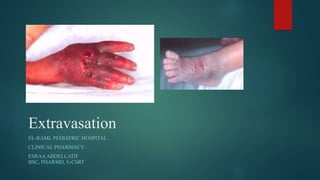
Extravasation
EL-RAML PEDIATRIC HOSPITAL
CLINICAL PHARMACY
ESRAAABDELLATIF
BSC, PHARMD, E-CSRT
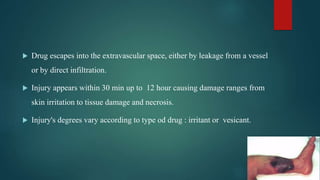
 Drug escapes into the extravascular space, either by leakage from a vessel
or by direct infiltration.
 Injury appears within 30 min up to 12 hour causing damage ranges from
skin irritation to tissue damage and necrosis.
 Injury's degrees vary according to type od drug : irritant or vesicant.
Irritants vs Vesicants
 Irritant drug: cause inflammation (warmth, erythema, tenderness) at the administration site
and along the vein, cause tissue necrosis if given in large doses.
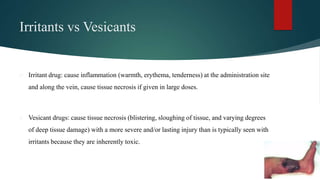
 Vesicant drugs: cause tissue necrosis (blistering, sloughing of tissue, and varying degrees
of deep tissue damage) with a more severe and/or lasting injury than is typically seen with
irritants because they are inherently toxic.
Incidence
 Up to 11% in pediatric ICU.
 Up to 45 % of peripheral venous catheters inserted into newborns; 19 % were
stage I and 11 % were stage IV. Brazil 2018
Risk factors of
extravasation
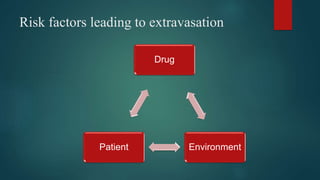
Risk factors leading to extravasation
Drug
Environment
Patient
Drug related factors:
 Nature of drug vesicant (can cause tissue necrosis) or irritant (can cause
inflammation (warmth, erythema, tenderness) but rarely cause tissue toxicity
(necrosis))
 Solution PH (≤ 5.5 or ≥ 8.5)
 Solution hypo or hyperosmolarity (< 180 or> 290 mOsm/L)
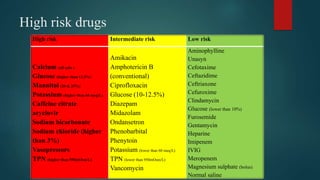
High risk drugs
High risk Intermediate risk Low risk
Calcium (all salts )
Glucose (higher than 12.5%)
Mannitol (20 & 25%)
Potassium (higher than 60 meq/L)
Caffeine citrate
acyclovir
Sodium bicarbonate
Sodium chloride (higher
than 3%)
Vasopressors
TPN (higher than 950mOsm/L)
Amikacin
Amphotericin B
(conventional)
Ciprofloxacin
Glucose (10-12.5%)
Diazepam
Midazolam
Ondansetron
Phenobarbital
Phenytoin
Potassium (lower than 60 meq/L)
TPN (lower than 950mOsm/L)
Vancomycin
Aminophylline
Unasyn
Cefotaxime
Ceftazidime
Ceftriaxone
Cefuroxime
Clindamycin
Glucose (lower than 10%)
Furosemide
Gentamycin
Heparine
Imipenem
IVIG
Meropenem
Magnesium sulphate (bolus)
Normal saline
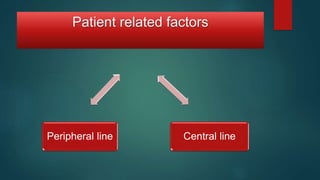
Patient related factors
Central line
Peripheral line
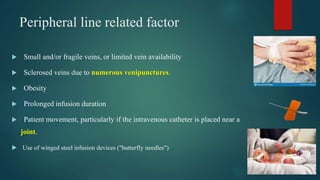
Peripheral line related factor
 Small and/or fragile veins, or limited vein availability
 Sclerosed veins due to numerous venipunctures.
 Obesity
 Prolonged infusion duration
 Patient movement, particularly if the intravenous catheter is placed near a
joint.
 Use of winged steel infusion devices ("butterfly needles")
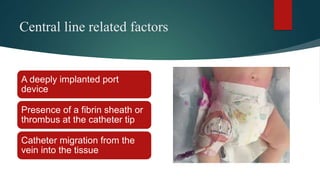
Central line related factors
A deeply implanted port
device
Presence of a fibrin sheath or
thrombus at the catheter tip
Catheter migration from the
vein into the tissue
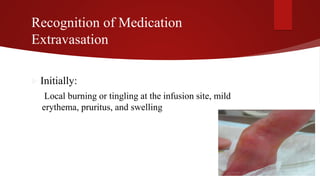
Recognition of Medication
Extravasation
 Initially:
Local burning or tingling at the infusion site, mild
erythema, pruritus, and swelling
Recognition of Medication
Extravasation
 Within two to three days:
Increased erythema, pain, brawny discoloration,
induration, dry desquamation, and/or blistering.
Recognition of Medication Extravasation
comment
 Extravasation may produce local tissue necrosis within and outside
the venous system. This may result in loss of the skin and underlying
structures.
 Symptoms may last according to severity of injury.
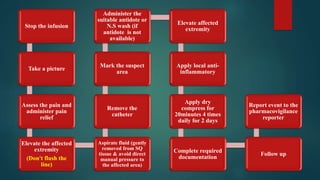
Management of
extravasation
Stop the infusion
Take a picture
Assess the pain and
administer pain
relief
Elevate the affected
extremity
(Don't flush the
line)
Aspirate fluid (gently
removed from SQ
tissue & avoid direct
manual pressure to
the affected area)
Remove the
catheter
Mark the suspect
area
Administer the
suitable antidote or
N.S wash (if
antidote is not
available)
Elevate affected
extremity
Apply local anti-
inflammatory
Apply dry
compress for
20minutes 4 times
daily for 2 days
Complete required
documentation
Follow up
Report event to the
pharmacovigilance
reporter
Prevention of
extravasation
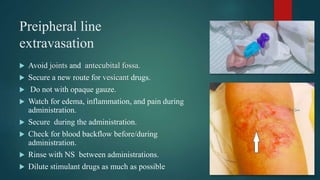
Preipheral line
extravasation
 Avoid joints and antecubital fossa.
 Secure a new route for vesicant drugs.
 Do not with opaque gauze.
 Watch for edema, inflammation, and pain during
administration.
 Secure during the administration.
 Check for blood backflow before/during
administration.
 Rinse with NS between administrations.
 Dilute stimulant drugs as much as possible
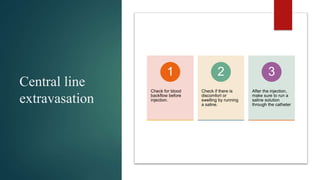
Central line
extravasation
Check for blood
backflow before
injection.
1
Check if there is
discomfort or
swelling by running
a saline.
2
After the injection,
make sure to run a
saline solution
through the catheter
3
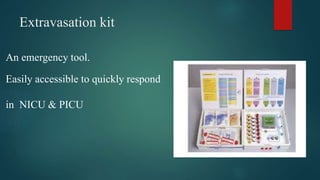
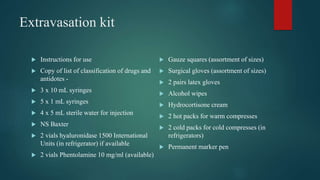
Extravasation kit
An emergency tool.
Easily accessible to quickly respond
in NICU & PICU
Extravasation kit
 Instructions for use
 Copy of list of classification of drugs and
antidotes -
 3 x 10 mL syringes
 5 x 1 mL syringes
 4 x 5 mL sterile water for injection
 NS Baxter
 2 vials hyaluronidase 1500 International
Units (in refrigerator) if available
 2 vials Phentolamine 10 mg/ml (available)
 Gauze squares (assortment of sizes)
 Surgical gloves (assortment of sizes)
 2 pairs latex gloves
 Alcohol wipes
 Hydrocortisone cream
 2 hot packs for warm compresses
 2 cold packs for cold compresses (in
refrigerators)
 Permanent marker pen
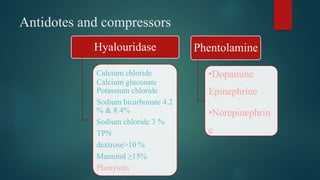
Antidotes and compressors
Hyalouridase
Calcium chloride
Calcium gluconate
Potassium chloride
Sodium bicarbonate 4.2
% & 8.4%
Sodium chloride 3 %
TPN
dextrose>10 %
Mannitol ≥15%
Phenytoin
Phentolamine
•Dopamine
Epinephrine
•Norepinephrin
e
Hyaluronidase
 Doses for neonates and smaller infiltrations are 15 units/ml.
 SQ or ID
 May be repeated.
 Administer within 1-2 hour of insult (however, it may still be
beneficial when
 given up to 12 hours after the event).
 Should not be used to treat vasoconstrictive agents.
Phentolamine
 Dilute to 0.5-1 mg/ml
 Antidote Extravasation of sympathomimetic
vasopressors within 12 hours of extravasation.
 Total dose required depends on the size of
extravasation;
 Dose may be repeated if required.
 Monitor Extravasation site resolution, blood
pressure, heart rate, skin color, local perfusion,
 Ampoule should protected from heat &light.
“ Nitroglycerin Ointment ”
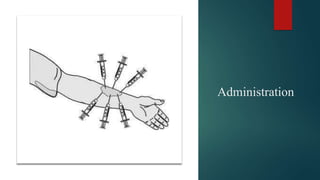
Administration
Reporting system
Reporting system
Reporting system
To be filled by nurse,
Revised and signed by physician,
Inform pharmacovigilance team.
References:
 www.uptodate.com
 •www.rch.org.au
 •https://www.jeehp.org/DOIx.php?id=10.3352/jeehp.2020.17.21 Guidelines for
the management of extravasation
Extravasation.pptx

Extravasation.pptx

  • 1.
    Extravasation EL-RAML PEDIATRIC HOSPITAL CLINICALPHARMACY ESRAAABDELLATIF BSC, PHARMD, E-CSRT
  • 2.
     Drug escapesinto the extravascular space, either by leakage from a vessel or by direct infiltration.  Injury appears within 30 min up to 12 hour causing damage ranges from skin irritation to tissue damage and necrosis.  Injury's degrees vary according to type od drug : irritant or vesicant.
  • 3.
    Irritants vs Vesicants Irritant drug: cause inflammation (warmth, erythema, tenderness) at the administration site and along the vein, cause tissue necrosis if given in large doses.  Vesicant drugs: cause tissue necrosis (blistering, sloughing of tissue, and varying degrees of deep tissue damage) with a more severe and/or lasting injury than is typically seen with irritants because they are inherently toxic.
  • 4.
    Incidence  Up to11% in pediatric ICU.  Up to 45 % of peripheral venous catheters inserted into newborns; 19 % were stage I and 11 % were stage IV. Brazil 2018
  • 5.
  • 6.
    Risk factors leadingto extravasation Drug Environment Patient
  • 7.
    Drug related factors: Nature of drug vesicant (can cause tissue necrosis) or irritant (can cause inflammation (warmth, erythema, tenderness) but rarely cause tissue toxicity (necrosis))  Solution PH (≤ 5.5 or ≥ 8.5)  Solution hypo or hyperosmolarity (< 180 or> 290 mOsm/L)
  • 8.
    High risk drugs Highrisk Intermediate risk Low risk Calcium (all salts ) Glucose (higher than 12.5%) Mannitol (20 & 25%) Potassium (higher than 60 meq/L) Caffeine citrate acyclovir Sodium bicarbonate Sodium chloride (higher than 3%) Vasopressors TPN (higher than 950mOsm/L) Amikacin Amphotericin B (conventional) Ciprofloxacin Glucose (10-12.5%) Diazepam Midazolam Ondansetron Phenobarbital Phenytoin Potassium (lower than 60 meq/L) TPN (lower than 950mOsm/L) Vancomycin Aminophylline Unasyn Cefotaxime Ceftazidime Ceftriaxone Cefuroxime Clindamycin Glucose (lower than 10%) Furosemide Gentamycin Heparine Imipenem IVIG Meropenem Magnesium sulphate (bolus) Normal saline
  • 9.
    Patient related factors Centralline Peripheral line
  • 10.
    Peripheral line relatedfactor  Small and/or fragile veins, or limited vein availability  Sclerosed veins due to numerous venipunctures.  Obesity  Prolonged infusion duration  Patient movement, particularly if the intravenous catheter is placed near a joint.  Use of winged steel infusion devices ("butterfly needles")
  • 11.
    Central line relatedfactors A deeply implanted port device Presence of a fibrin sheath or thrombus at the catheter tip Catheter migration from the vein into the tissue
  • 12.
    Recognition of Medication Extravasation Initially: Local burning or tingling at the infusion site, mild erythema, pruritus, and swelling
  • 13.
    Recognition of Medication Extravasation Within two to three days: Increased erythema, pain, brawny discoloration, induration, dry desquamation, and/or blistering.
  • 14.
    Recognition of MedicationExtravasation comment  Extravasation may produce local tissue necrosis within and outside the venous system. This may result in loss of the skin and underlying structures.  Symptoms may last according to severity of injury.
  • 15.
  • 16.
    Stop the infusion Takea picture Assess the pain and administer pain relief Elevate the affected extremity (Don't flush the line) Aspirate fluid (gently removed from SQ tissue & avoid direct manual pressure to the affected area) Remove the catheter Mark the suspect area Administer the suitable antidote or N.S wash (if antidote is not available) Elevate affected extremity Apply local anti- inflammatory Apply dry compress for 20minutes 4 times daily for 2 days Complete required documentation Follow up Report event to the pharmacovigilance reporter
  • 17.
  • 18.
    Preipheral line extravasation  Avoidjoints and antecubital fossa.  Secure a new route for vesicant drugs.  Do not with opaque gauze.  Watch for edema, inflammation, and pain during administration.  Secure during the administration.  Check for blood backflow before/during administration.  Rinse with NS between administrations.  Dilute stimulant drugs as much as possible
  • 19.
    Central line extravasation Check forblood backflow before injection. 1 Check if there is discomfort or swelling by running a saline. 2 After the injection, make sure to run a saline solution through the catheter 3
  • 20.
    Extravasation kit An emergencytool. Easily accessible to quickly respond in NICU & PICU
  • 21.
    Extravasation kit  Instructionsfor use  Copy of list of classification of drugs and antidotes -  3 x 10 mL syringes  5 x 1 mL syringes  4 x 5 mL sterile water for injection  NS Baxter  2 vials hyaluronidase 1500 International Units (in refrigerator) if available  2 vials Phentolamine 10 mg/ml (available)  Gauze squares (assortment of sizes)  Surgical gloves (assortment of sizes)  2 pairs latex gloves  Alcohol wipes  Hydrocortisone cream  2 hot packs for warm compresses  2 cold packs for cold compresses (in refrigerators)  Permanent marker pen
  • 22.
    Antidotes and compressors Hyalouridase Calciumchloride Calcium gluconate Potassium chloride Sodium bicarbonate 4.2 % & 8.4% Sodium chloride 3 % TPN dextrose>10 % Mannitol ≥15% Phenytoin Phentolamine •Dopamine Epinephrine •Norepinephrin e
  • 23.
    Hyaluronidase  Doses forneonates and smaller infiltrations are 15 units/ml.  SQ or ID  May be repeated.  Administer within 1-2 hour of insult (however, it may still be beneficial when  given up to 12 hours after the event).  Should not be used to treat vasoconstrictive agents.
  • 24.
    Phentolamine  Dilute to0.5-1 mg/ml  Antidote Extravasation of sympathomimetic vasopressors within 12 hours of extravasation.  Total dose required depends on the size of extravasation;  Dose may be repeated if required.  Monitor Extravasation site resolution, blood pressure, heart rate, skin color, local perfusion,  Ampoule should protected from heat &light. “ Nitroglycerin Ointment ”
  • 25.
  • 26.
  • 27.
  • 28.
    Reporting system To befilled by nurse, Revised and signed by physician, Inform pharmacovigilance team.
  • 29.
    References:  www.uptodate.com  •www.rch.org.au •https://www.jeehp.org/DOIx.php?id=10.3352/jeehp.2020.17.21 Guidelines for the management of extravasation