
CHIRAYU COLLEGE OF NURSING,
BHOPAL
Subject- Pharmacology
Topic- Cardiotonics
Placement Of Student- Bsc Nursing II Year
Prepared By
Mr. Migron Rubin
Lecturer
DEFINITIONS
 Drugs that increase cardiac output
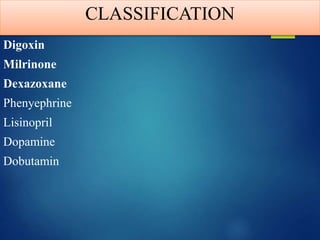
CLASSIFICATION
Digoxin
Milrinone
Dexazoxane
Phenyephrine
Lisinopril
Dopamine
Dobutamin
Mechanism Of Action
 Cardiac glycosides(digoxin) act by inhibiting
sodium and potassium ATP and then making
more calcium available to activate contracted
proteins.
 Cardiac contractility and cardiac output are
increased.
Pharmacokinetics
 Onset, peak, and duration vary widely among
products.
 Most products are metabolized in the liver and
excreted by the kidneys.
Side Effects
 The most common side effects are cardiac
disturbances, headache, hypotension, and GI
symptoms.
 Also common are blurred vision and yellow-
green halos.
USES
 Deep venous thrombosis, MI, openheart surgery,
disseminated intravascular clotting syndrome; atrial
fibrillation with embolization, transfusion, and
dialysis.
CONTRAINDICATIONS
 Hypersensitive reactions may occur, and allergies
should be identified before these products are
given.
 Also, persons with ventricular tachycardia,
ventricular fibrillation, and carotid sinus
syndrome should not use these products.
Nursing Implications
 Assess:
 Cardiac system: B/P, pulse, respirations, and
increased urine output
 Apical pulse for 1 min before giving product;
if pulse ,60 bpm, take again in 1 hr; if
still ,60 bpm, notify prescriber
 Electrolytes: K, Na, Cl, Mg; renal function
studies, including BUN and creatinine; and
blood studies
 Evaluate: Therapeutic response: decreased weight,
edema, pulse, respiration; increased urine output
FAMILY TEACHING
 Teach How to take pulse before taking product
 Patient should record or graph pulse to
identify changes
 To avoid hazardous activities until stabilized on
this product; dizziness commonly occurs
 About the need for compliance in all areas
of medical regimen, including diet, exercise,
stress reduction, product therapy
REFERENCES
 Wilson Et.al. (2007), Drug Guide Prentice Hall Health, retrieved on 21/9/18
from http://www.robholland.com/Nursing/Drug_Guide/data/
 Stanley(2001),The timeline , A brief history of pharmacology retrieved on
21/9/18 from
http://pubs.acs.org/subscribe/archive/mdd/v04/i05/html/05timeline.html#aut
h
 Katzung(2011), Katzung basic clinical pharmacology.pdf, retrieved on
21/9/18 from http://www.bio-
nica.info/biblioteca/katzungbasicclinicalpharmacology.pdf
 ScheindlAmy M Karch (2001) . Lippincott nursing drug guide :
Philadelphia ; Lippincott Williams and Wilkins
 Beatrice B. (2005). Drug information for nurses ; Philadelphia . Lexi-coms
 Brenda Barness (2002) . Saunders drug handbook for health professionals :
United states of America ; WB Saunders company
 Linda Skidmore (1997) . Mosby drug guide : St Louis, Missouri Mosby
publication
 Tara V shanbhag (2004) . Pharmacology for nurses : New delhi : Sanat
printer Kundli
Cardiotonics

Cardiotonics

  • 1.
    CHIRAYU COLLEGE OFNURSING, BHOPAL Subject- Pharmacology Topic- Cardiotonics Placement Of Student- Bsc Nursing II Year Prepared By Mr. Migron Rubin Lecturer
  • 2.
    DEFINITIONS  Drugs thatincrease cardiac output
  • 3.
  • 4.
    Mechanism Of Action Cardiac glycosides(digoxin) act by inhibiting sodium and potassium ATP and then making more calcium available to activate contracted proteins.  Cardiac contractility and cardiac output are increased.
  • 5.
    Pharmacokinetics  Onset, peak,and duration vary widely among products.  Most products are metabolized in the liver and excreted by the kidneys.
  • 6.
    Side Effects  Themost common side effects are cardiac disturbances, headache, hypotension, and GI symptoms.  Also common are blurred vision and yellow- green halos.
  • 7.
    USES  Deep venousthrombosis, MI, openheart surgery, disseminated intravascular clotting syndrome; atrial fibrillation with embolization, transfusion, and dialysis.
  • 8.
    CONTRAINDICATIONS  Hypersensitive reactionsmay occur, and allergies should be identified before these products are given.  Also, persons with ventricular tachycardia, ventricular fibrillation, and carotid sinus syndrome should not use these products.
  • 9.
    Nursing Implications  Assess: Cardiac system: B/P, pulse, respirations, and increased urine output  Apical pulse for 1 min before giving product; if pulse ,60 bpm, take again in 1 hr; if still ,60 bpm, notify prescriber  Electrolytes: K, Na, Cl, Mg; renal function studies, including BUN and creatinine; and blood studies  Evaluate: Therapeutic response: decreased weight, edema, pulse, respiration; increased urine output
  • 10.
    FAMILY TEACHING  TeachHow to take pulse before taking product  Patient should record or graph pulse to identify changes  To avoid hazardous activities until stabilized on this product; dizziness commonly occurs  About the need for compliance in all areas of medical regimen, including diet, exercise, stress reduction, product therapy
  • 11.
    REFERENCES  Wilson Et.al.(2007), Drug Guide Prentice Hall Health, retrieved on 21/9/18 from http://www.robholland.com/Nursing/Drug_Guide/data/  Stanley(2001),The timeline , A brief history of pharmacology retrieved on 21/9/18 from http://pubs.acs.org/subscribe/archive/mdd/v04/i05/html/05timeline.html#aut h  Katzung(2011), Katzung basic clinical pharmacology.pdf, retrieved on 21/9/18 from http://www.bio- nica.info/biblioteca/katzungbasicclinicalpharmacology.pdf  ScheindlAmy M Karch (2001) . Lippincott nursing drug guide : Philadelphia ; Lippincott Williams and Wilkins  Beatrice B. (2005). Drug information for nurses ; Philadelphia . Lexi-coms  Brenda Barness (2002) . Saunders drug handbook for health professionals : United states of America ; WB Saunders company  Linda Skidmore (1997) . Mosby drug guide : St Louis, Missouri Mosby publication  Tara V shanbhag (2004) . Pharmacology for nurses : New delhi : Sanat printer Kundli