MANU JACOB
PERFUSIONIST
KMCT MCH
Cardiopulmonary bypass is the diversion of the flow of
blood to the aorta, via a pump& oxygenator; avoiding
both the heart & lungs
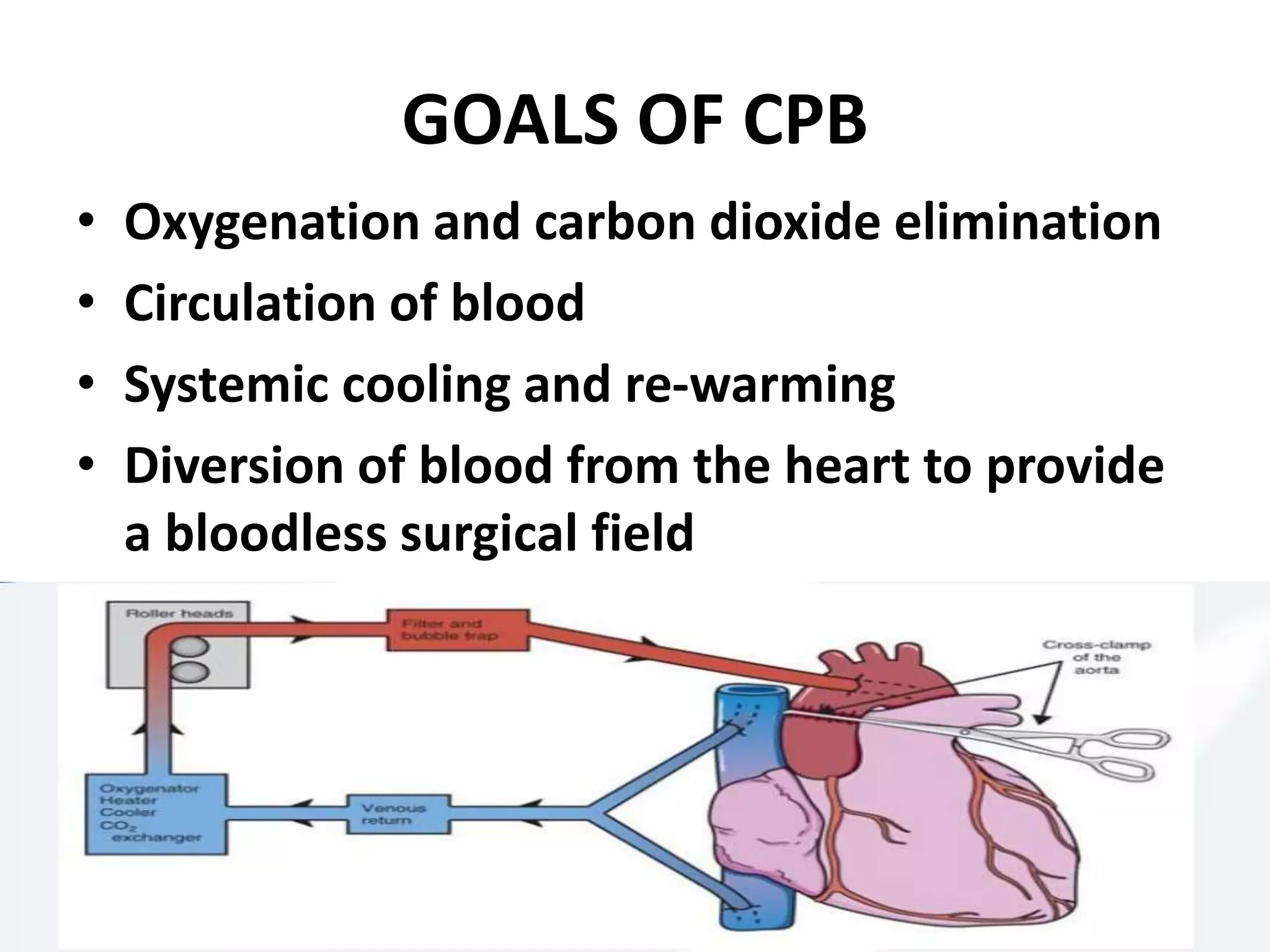
GOALS OF CPB
• Oxygenation and carbon dioxide elimination
• Circulation of blood
• Systemic cooling and re-warming
• Diversion of blood from the heart to provide
a bloodless surgical field
COMPONENTS OF CPB
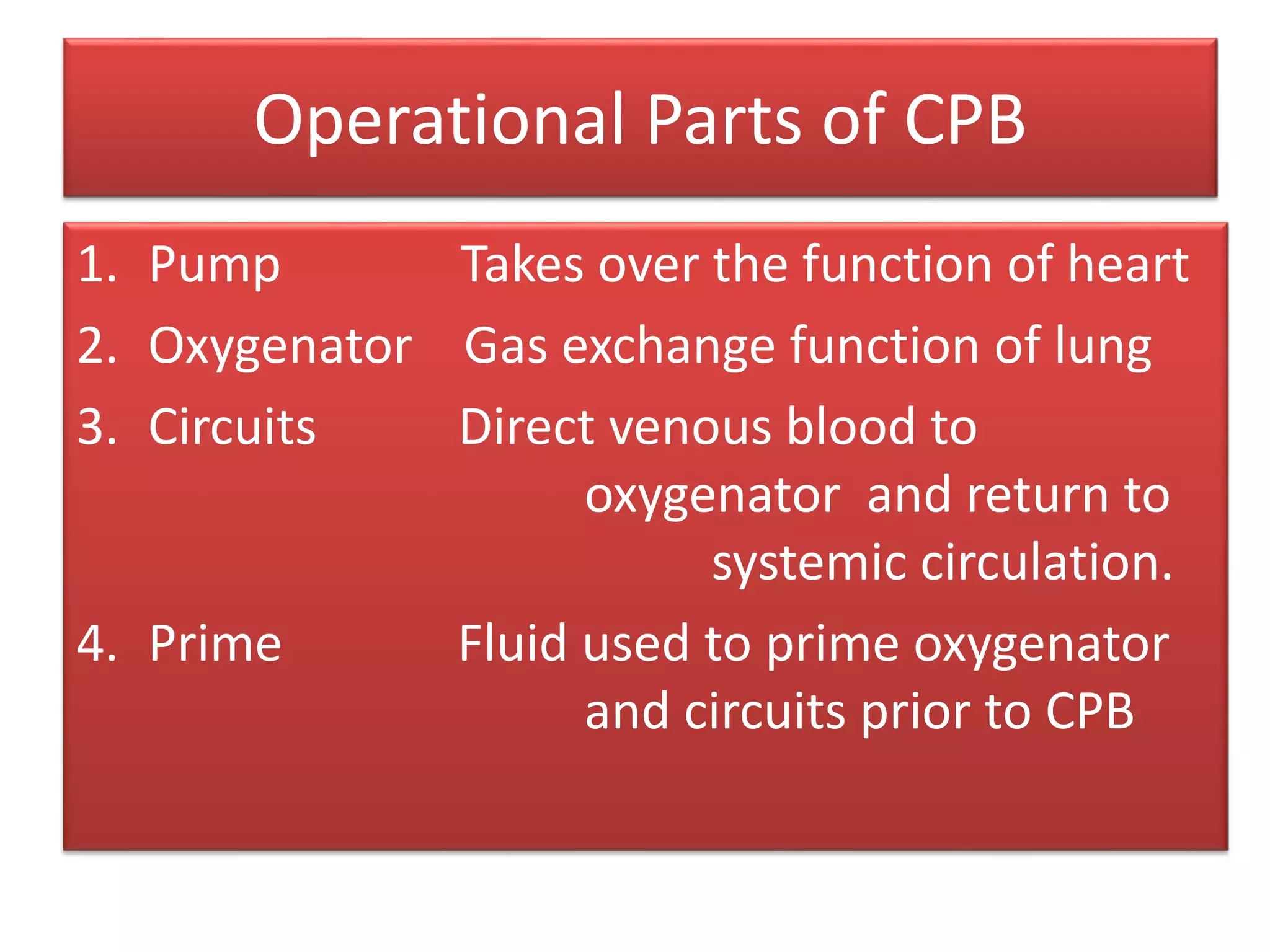
Operational Parts of CPB
1. Pump Takes over the function of heart
2. Oxygenator Gas exchange function of lung
3. Circuits Direct venous blood to
oxygenator and return to
systemic circulation.
4. Prime Fluid used to prime oxygenator
and circuits prior to CPB
Scheme of CPB Circuit
• Pump
• Oxygenator
• Heat exchanger
• Reservoir
• Filter
• Sucker & vent
• Cardioplegic solution
delivery system
Venous blood is intercepted as it returns
to the RA and diverted through the
venous line of the CPB circuit to a
venous reservoir.
Cardiopulmonary Bypass
The arterial pump functions as an artificial heart
by withdrawing blood from the reservoir and
propelling it through a heat exchanger, an
artificial lung (the oxygenator), and an
arterial line filter before returning it through
the arterial line to the patient's arterial
system.
Additional pumps and components are used to
assist in the operation to manage shed blood
(the pump sucker), decompress the heart
(vent), and deliver cardioplegia solution
Cardiopulmonary Bypass
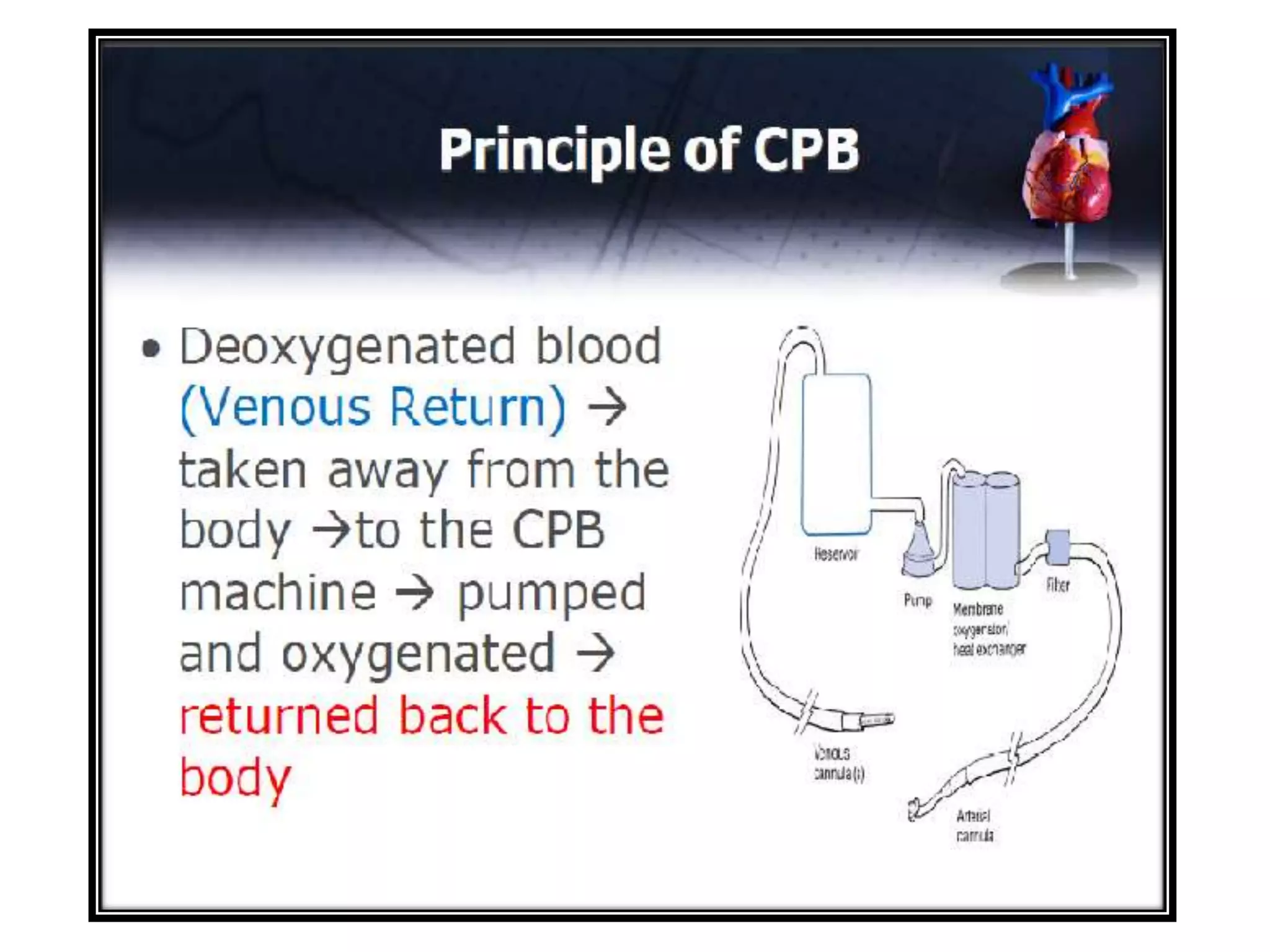
• The CPB circuit performs the function of
heart and lungs
• The blood is drained from the right side of
the heart and returned to the systemic
circulation through the aorta
Cardiopulmonary Bypass
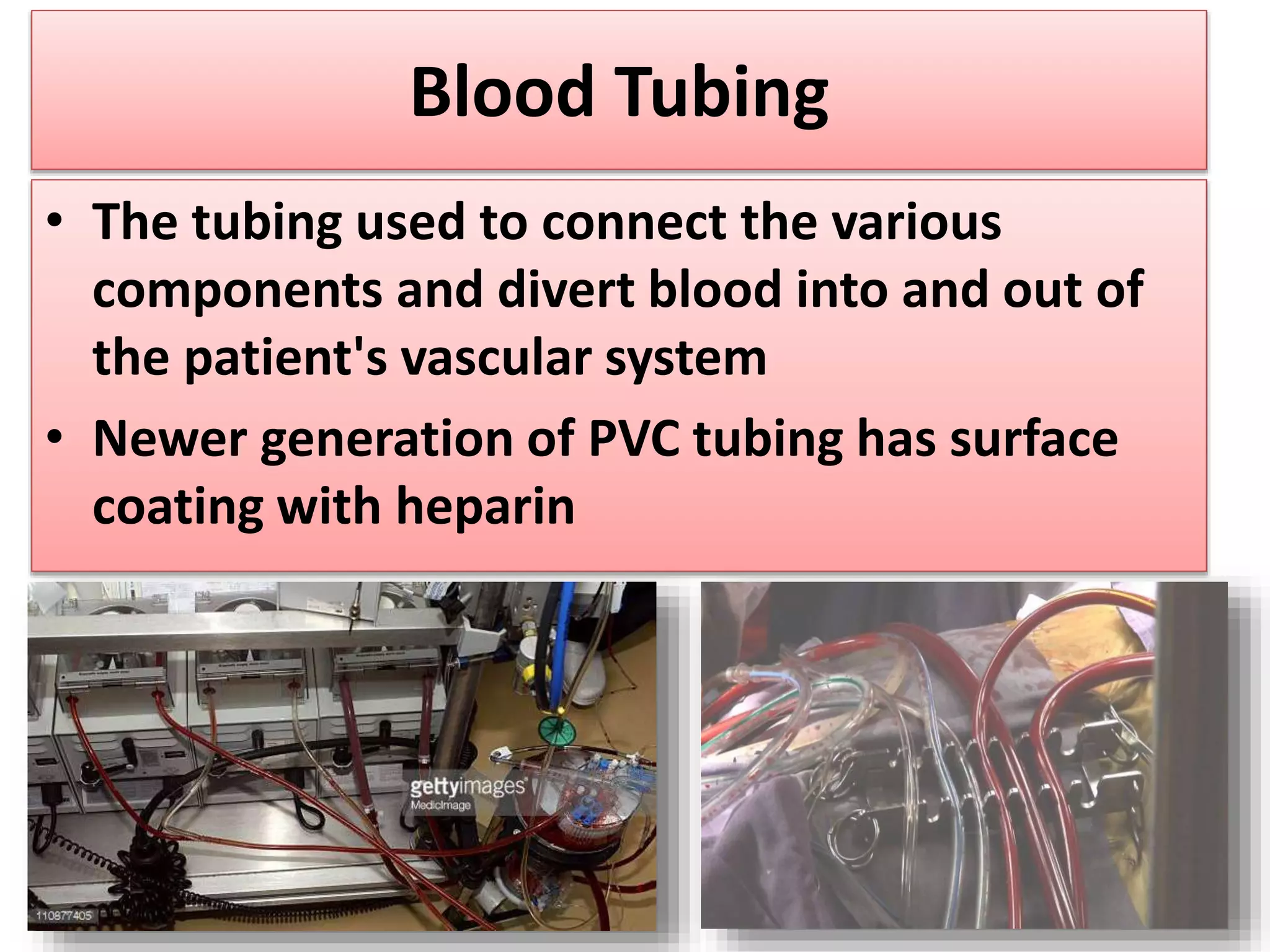
Blood Tubing
• The tubing used to connect the various
components and divert blood into and out of
the patient's vascular system
• Newer generation of PVC tubing has surface
coating with heparin
TUBINGS
• The tubings which
are used for CPB
are made of PVC’s.
• There are 4
standard tubing
sizes which are
commonly used on
CPB circuit.
• a)3/16” b) ¼” c)
3/8” d) ½”
TUBINGS
• According to the
height and weight of
the patient the size
of the tube varies.
• The length of the
tubing should be as
minimum as
possible, which
reduces the priming
volume and
haemolysis.
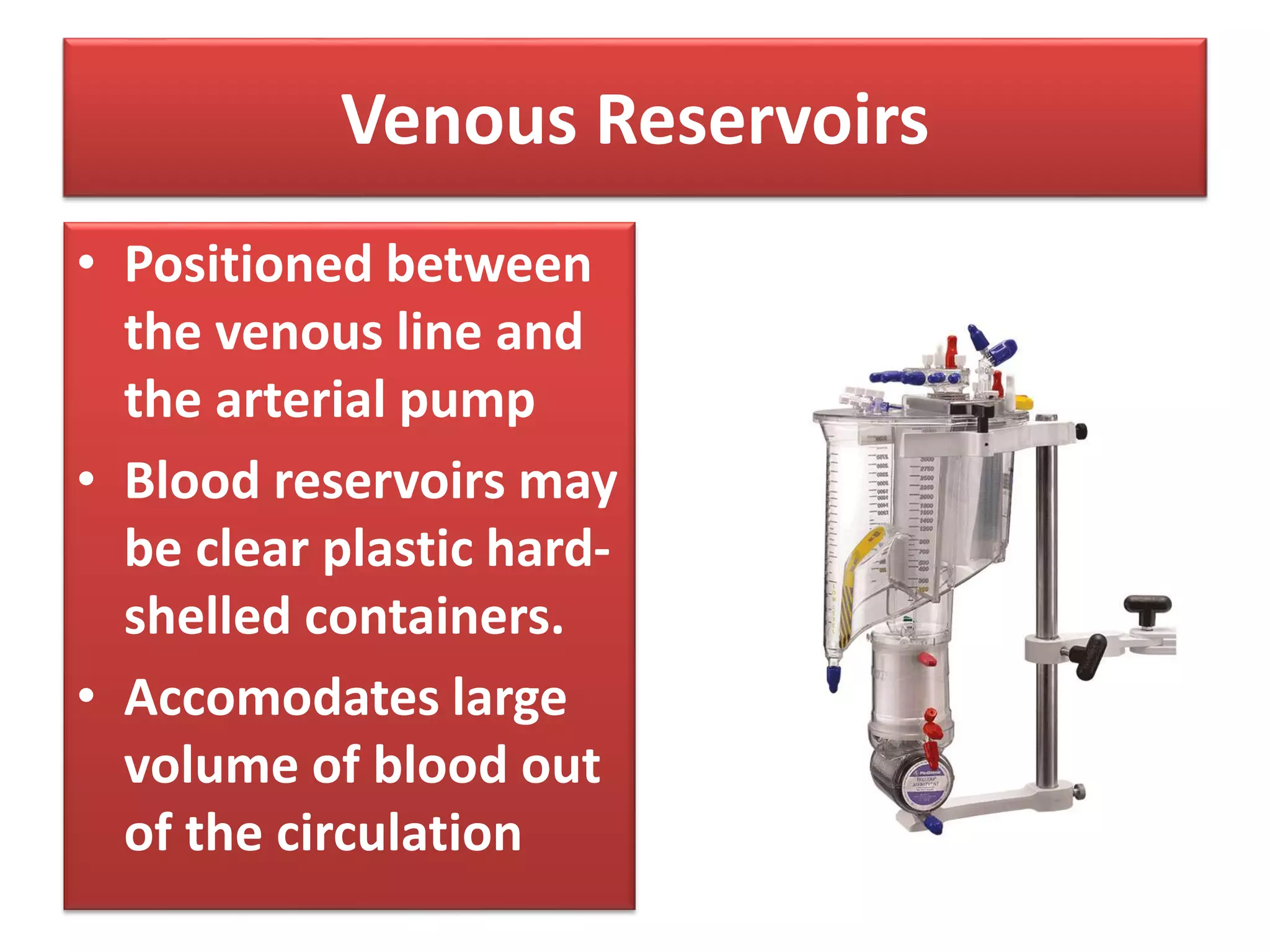
Venous Reservoirs
• Positioned between
the venous line and
the arterial pump
• Blood reservoirs may
be clear plastic hard-
shelled containers.
• Accomodates large
volume of blood out
of the circulation
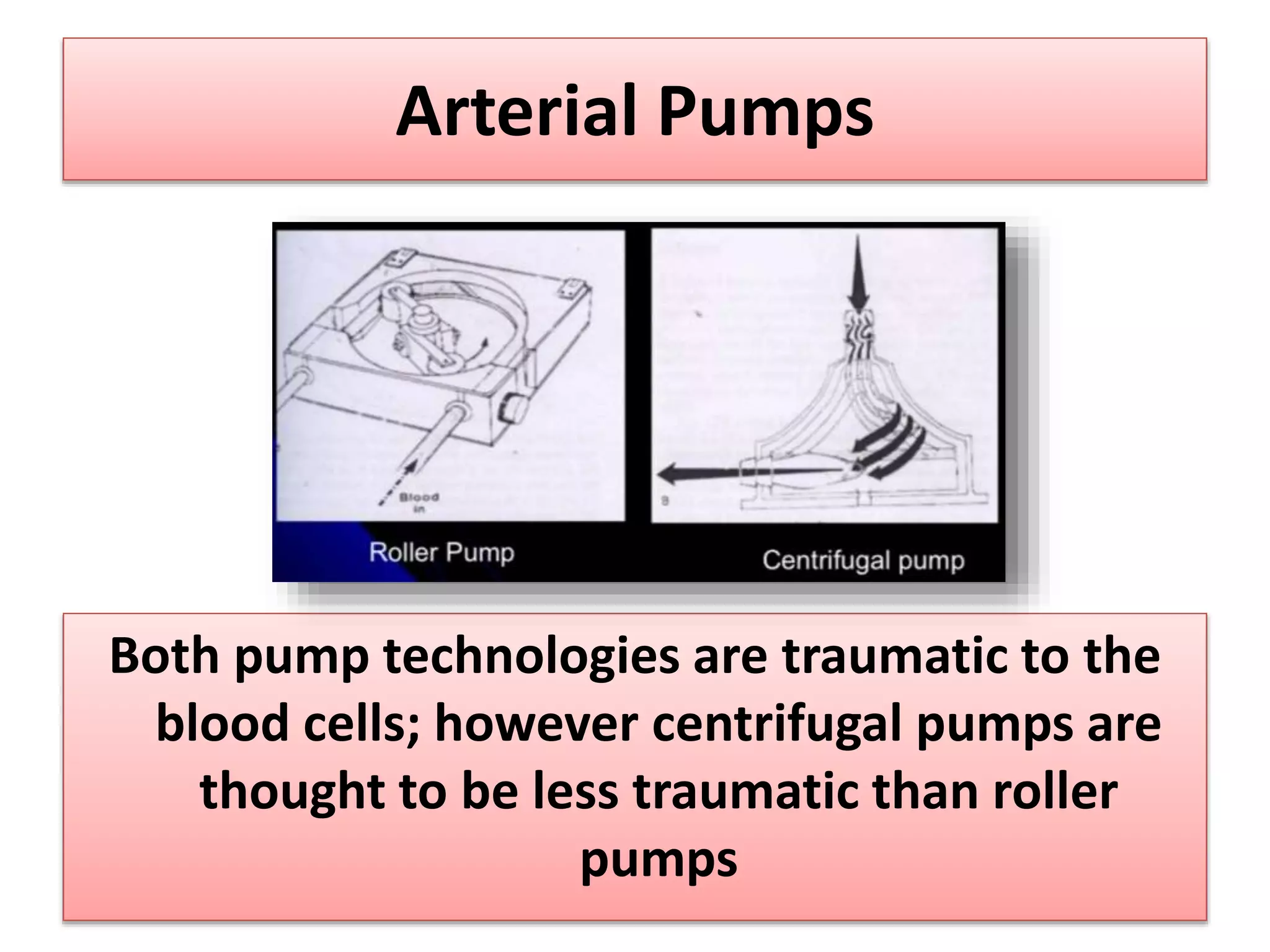
Arterial Pumps
• The pumping device used to replace the
function of the heart
• Two primary technologies: a roller pump or a
centrifugal pump
Arterial Pumps
Both pump technologies are traumatic to the
blood cells; however centrifugal pumps are
thought to be less traumatic than roller
pumps
Roller pumpsRoller pumps are positive-
displacement pumps that
function by occluding a point
in a piece of tubing and then
rolling the occlusive point of
contact along a length of the
tubing. This forces the fluid in
the tubing to move forward
in front of the occlusive point
while simultaneously drawing
in fluid behind the occlusive
point.
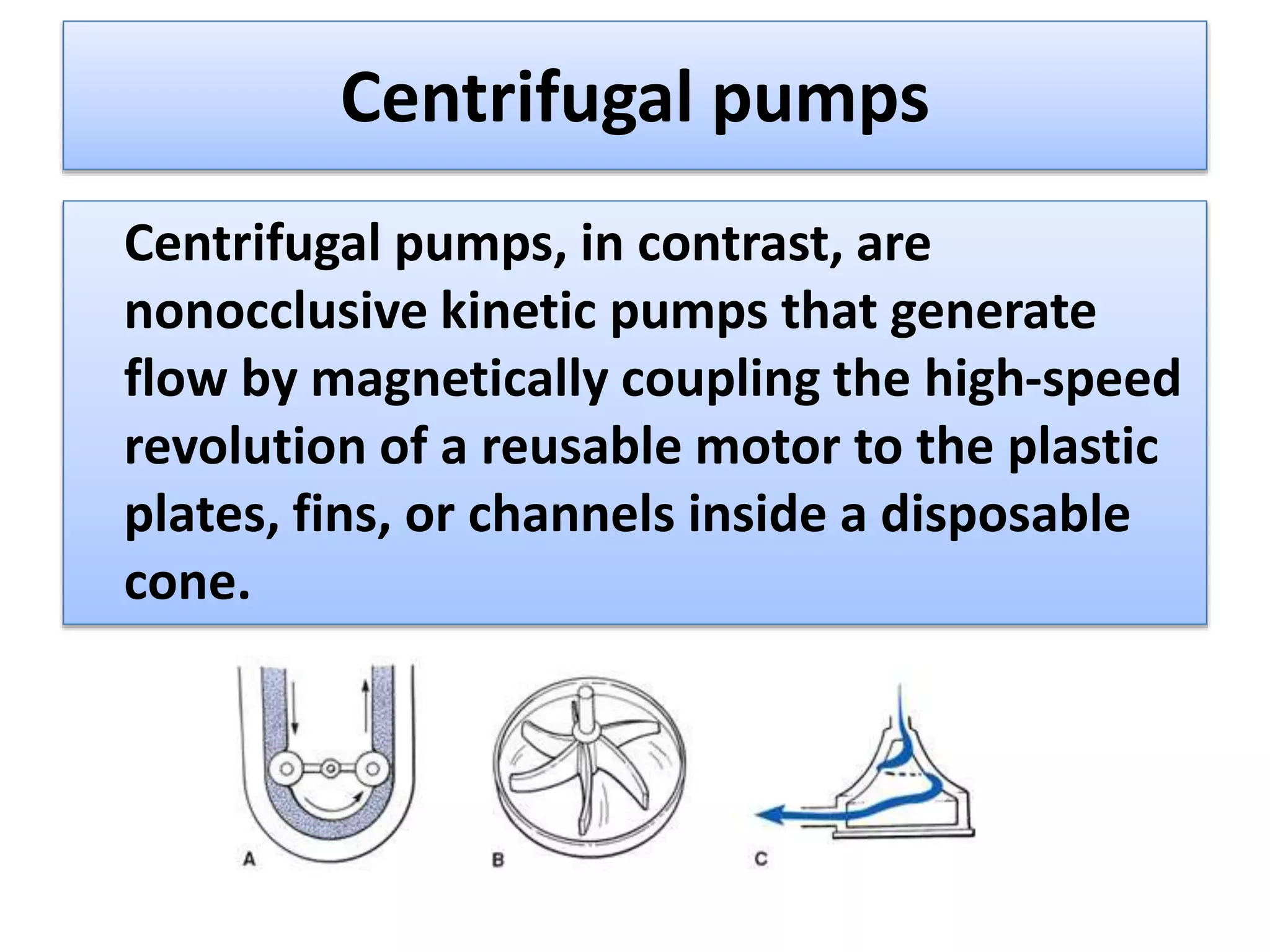
Centrifugal pumps
Centrifugal pumps, in contrast, are
nonocclusive kinetic pumps that generate
flow by magnetically coupling the high-speed
revolution of a reusable motor to the plastic
plates, fins, or channels inside a disposable
cone.
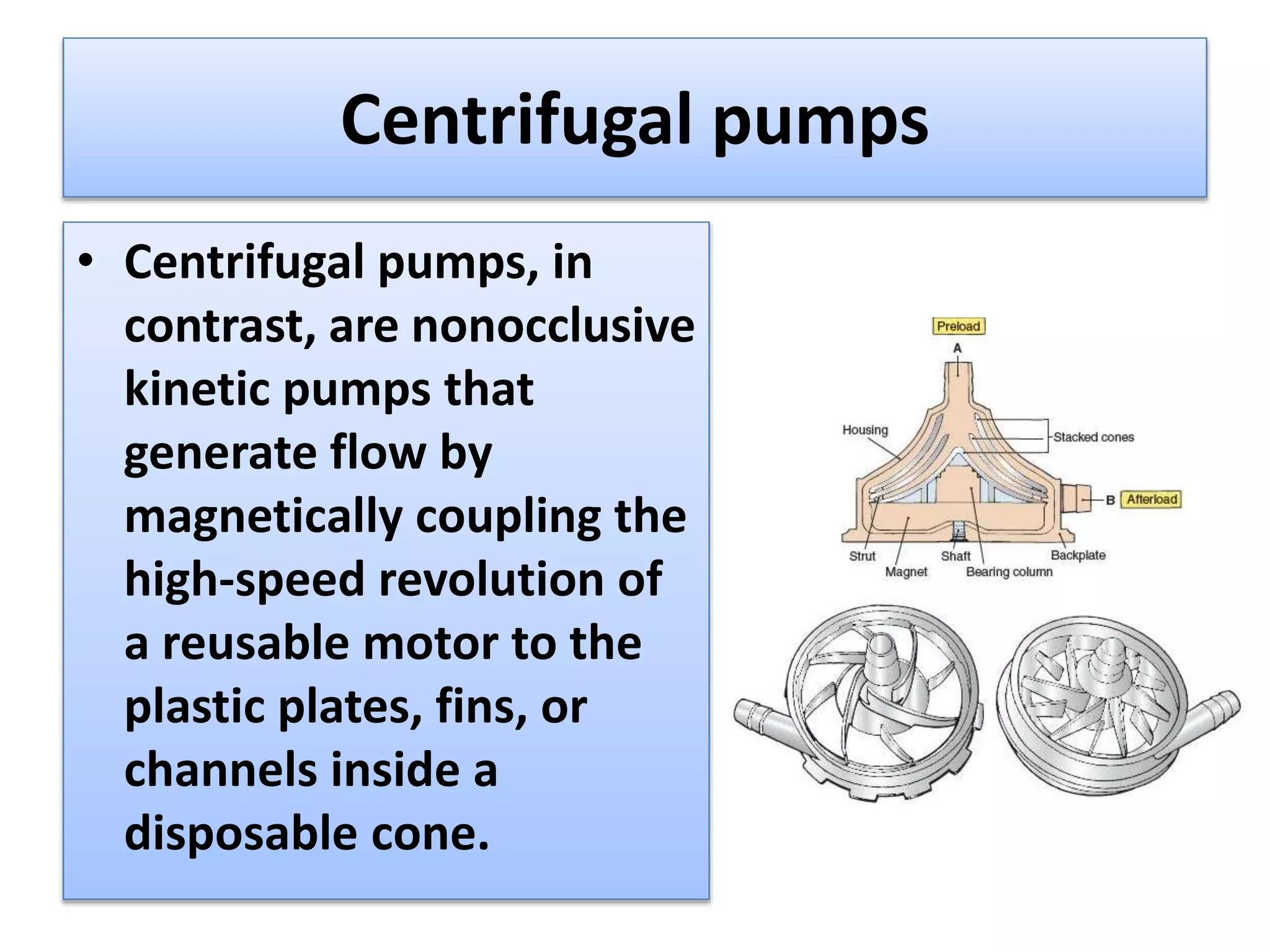
Centrifugal pumps
• Centrifugal pumps, in
contrast, are nonocclusive
kinetic pumps that
generate flow by
magnetically coupling the
high-speed revolution of
a reusable motor to the
plastic plates, fins, or
channels inside a
disposable cone.
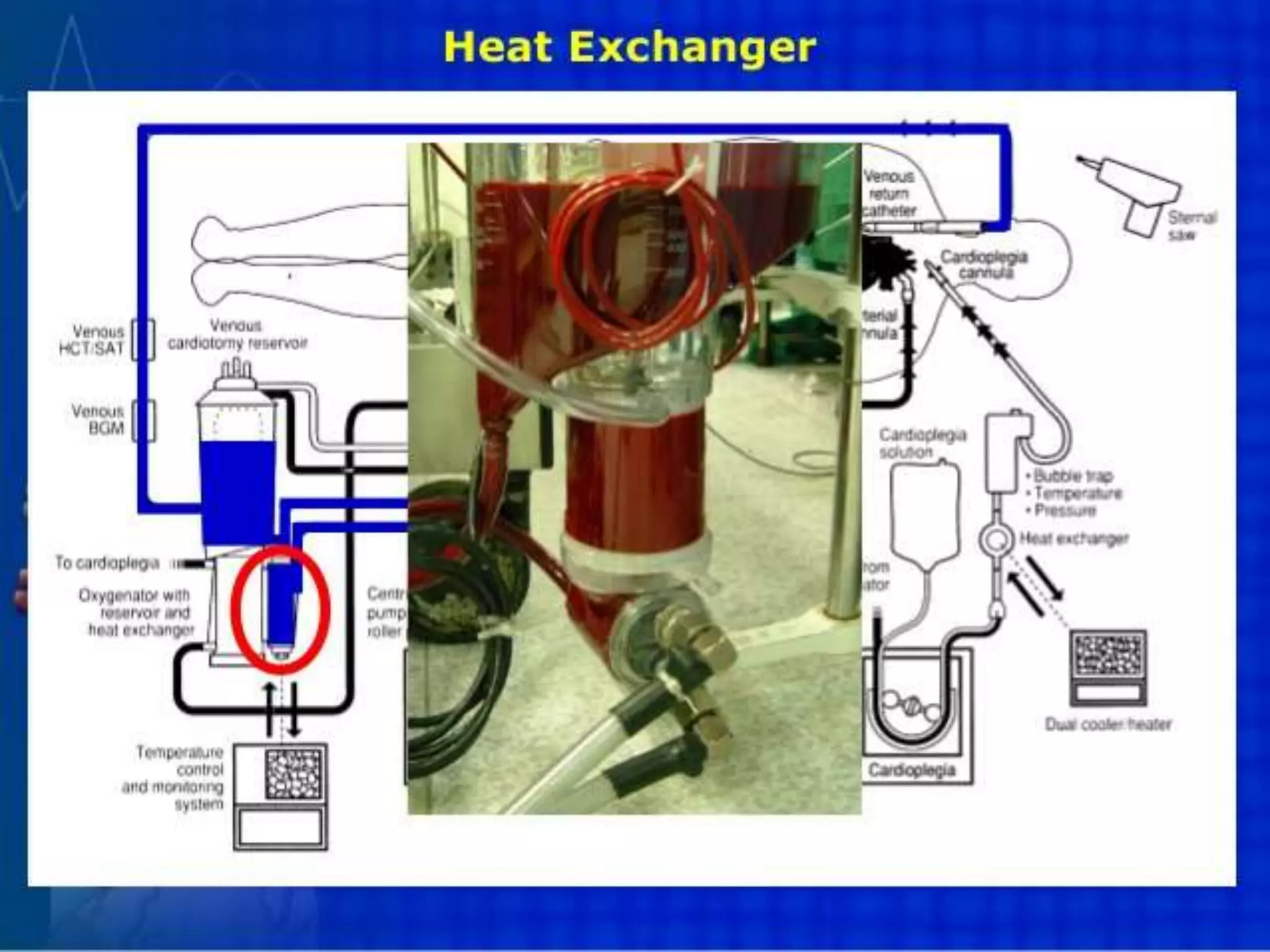
Heat Exchanger
• Facilitate management of the patient's blood
temperature
• The heat exchangers may be used to reduce
the temperature of the blood on initiation of
CPB and then to warm the blood before the
termination of CPB.
• Reduces the temperature of the cardioplegia
blood to the required level
Oxygenator
The oxygenator substitutes for the patient's
native lungs and performs the essential
function of gas exchange.
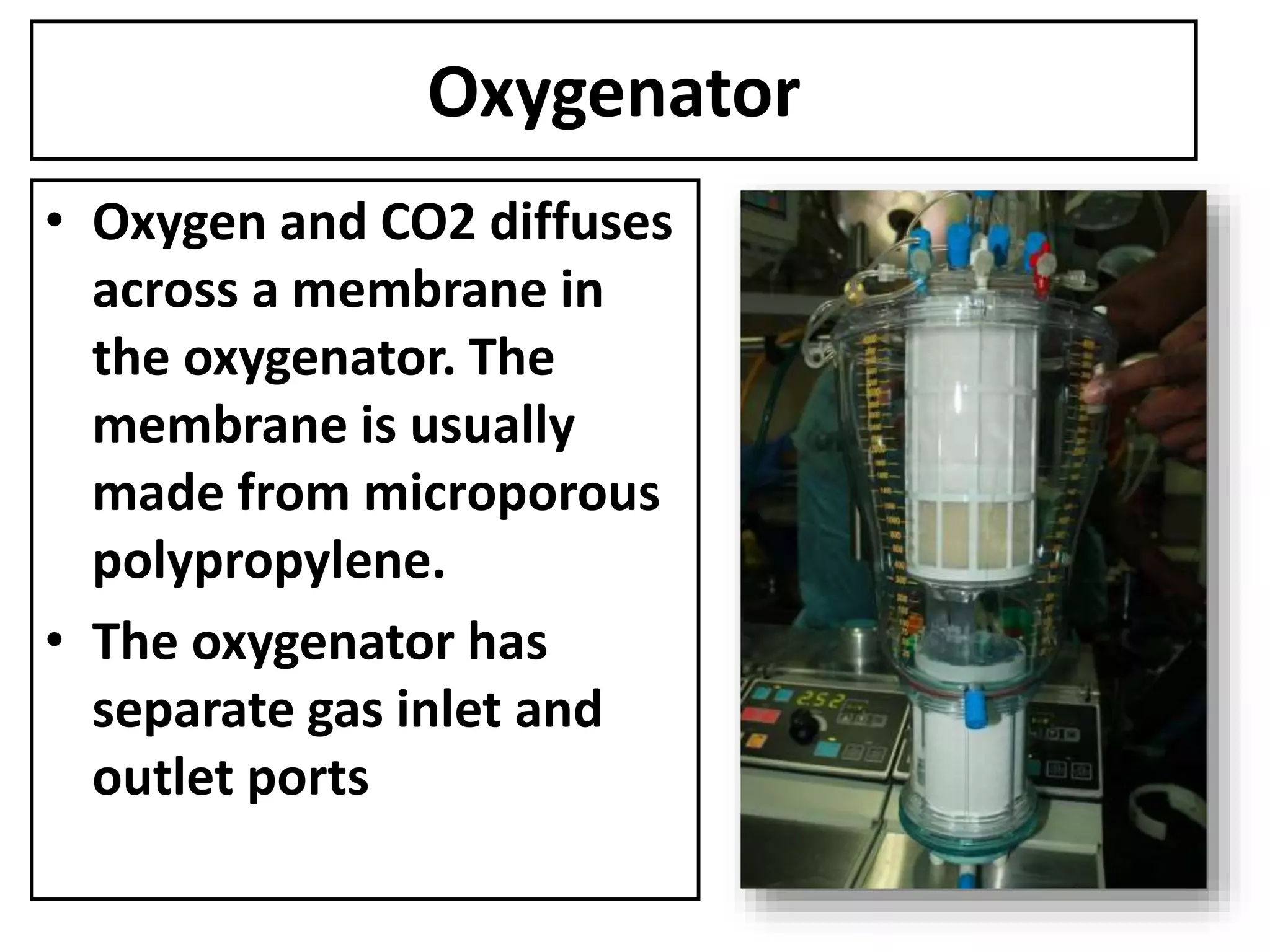
Oxygenator
• Oxygen and CO2 diffuses
across a membrane in
the oxygenator. The
membrane is usually
made from microporous
polypropylene.
• The oxygenator has
separate gas inlet and
outlet ports
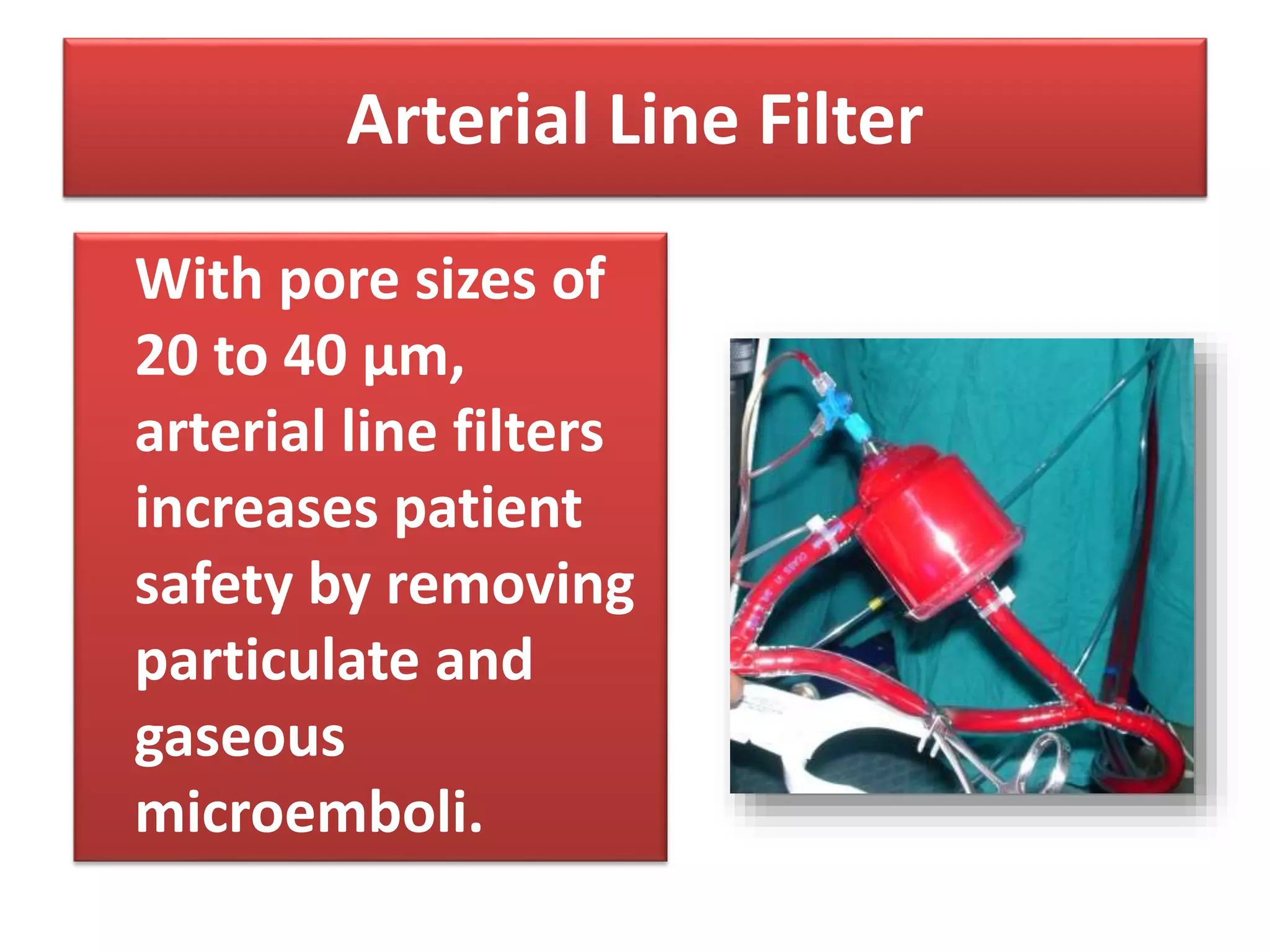
Arterial Line Filter
These filters are
placed in the arterial
line as the last
component through
which blood passes
before it returns to
the patient.
Arterial Line Filter
With pore sizes of
20 to 40 µm,
arterial line filters
increases patient
safety by removing
particulate and
gaseous
microemboli.
Management before
Cardiopulmonary Bypass
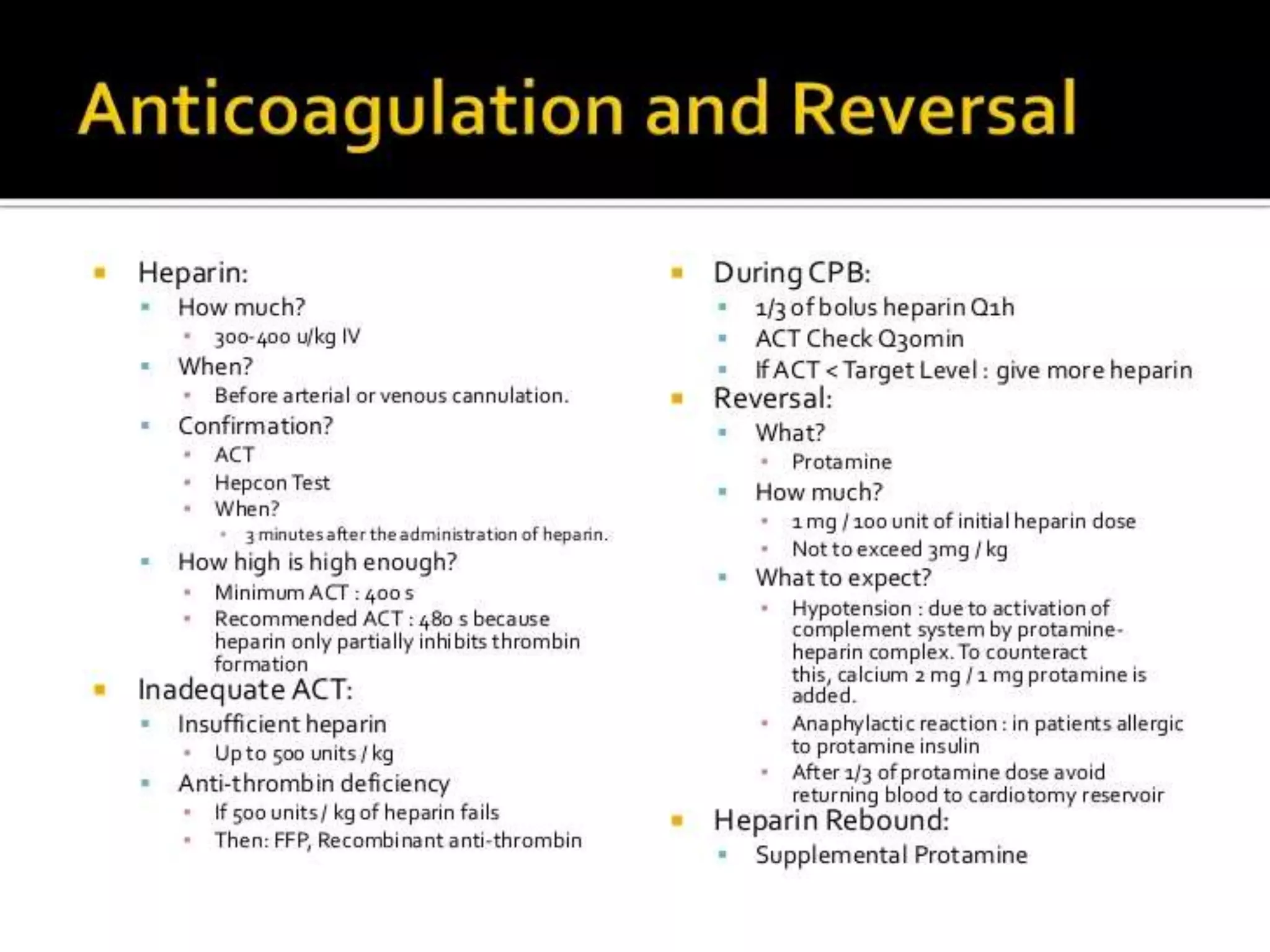
• Anticoagulation
• Cannulation of the heart
• Careful monitoring
• Protection of the heart
• Preparation for cardiopulmonary bypass
Physiologic parameters of CPB
• Perfusion pressure
• Pump flow
• Temperature management
• Central nervous system monitoring
• Pulsatility
Sequence of Events
• Circuit selection and priming
• Anticoagulation
• Cannulation
• Initiation and maintenance of CPB
• Myocardial protection
• Weaning and termination from CPB.
Fluid Management
• Crystalloid solutions lead to decreased
colloid osmotic pressure with a resultant
increase in extracellular water retention,
irrespective of the osmolarity of the pump
prime.
• Albumin, can decrease the interaction of
blood components with the bypass circuit by
coating the fluid pathway surfaces
Priming
• “prime volume” is the volume of balanced
electrolyte solution necessary to completely
de-air the circuit
• Main cause of the hemodilution associated
with CPB
• This increased volume of distribution dilutes
all of the proteins, coagulation factors and
formed elements of the blood
• Dilutes plasma levels of drugs
Anticoagulation
• Heparin is a heterogeneous, heavily sulfated
polysaccharide compound derived from pig
intestinal mucosa or bovine lung.
• It binds antithrombin III, profoundly
facilitating its native ability to inhibit plasma
coagulation, most prominently through
inhibition of factors IIa (thrombin) and Xa
Anticoagulation
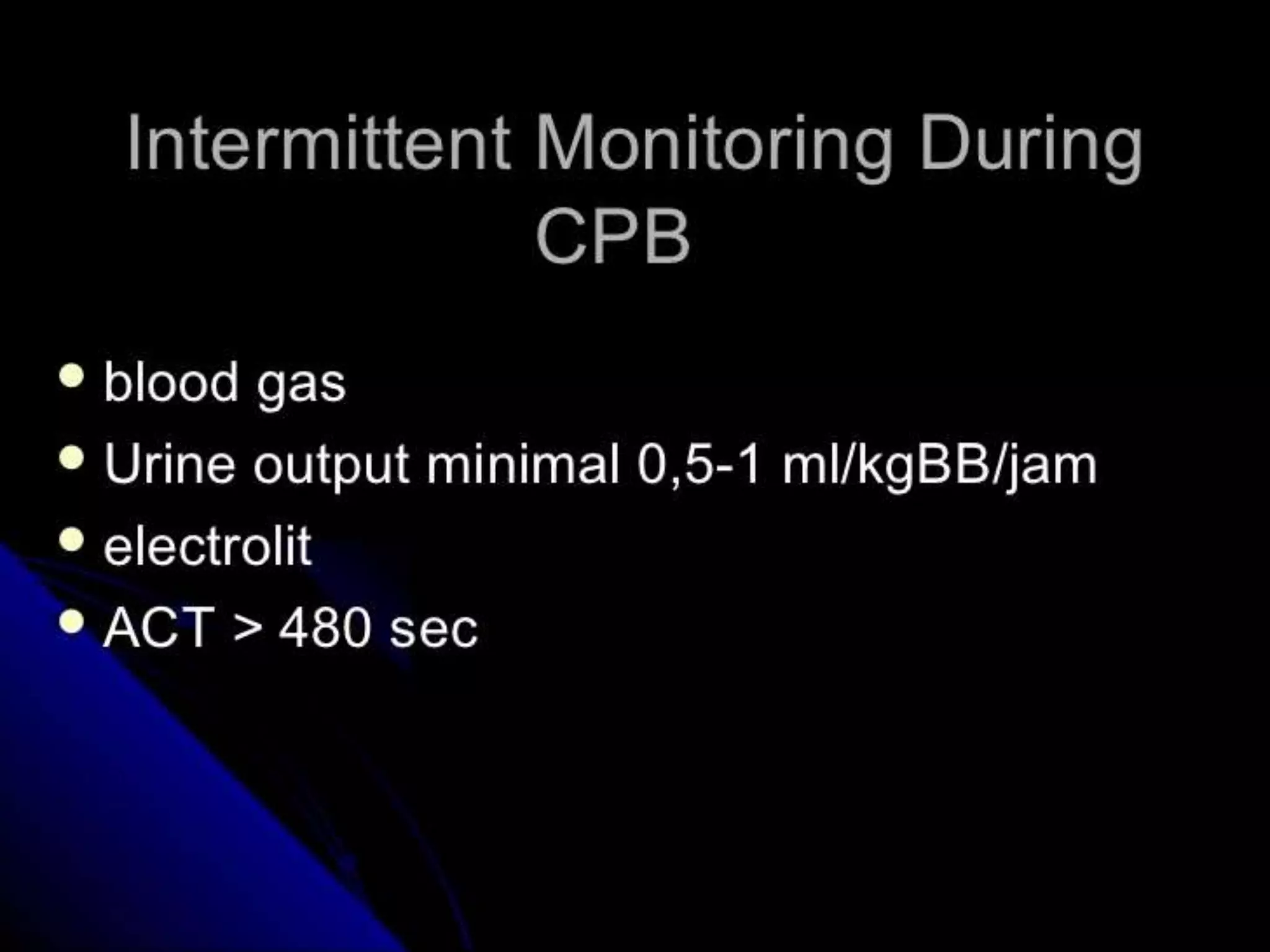
• Anticoagulation with heparin for CPB can be
monitored by measuring clotting times or
whole blood heparin concentrations
• Most commonly test used for CPB are the ACT
• Heparin resistance: AT III concentrate or FFP
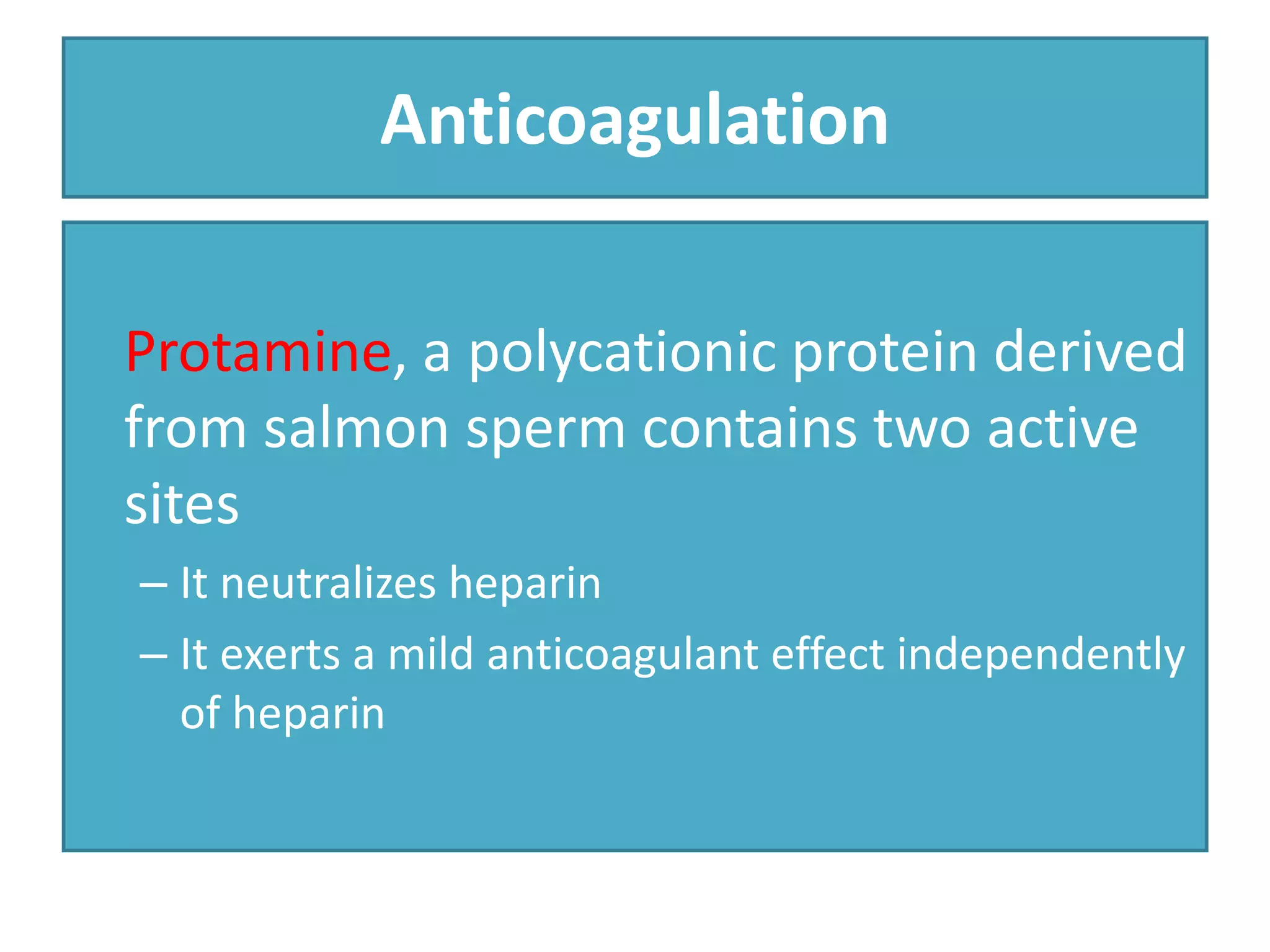
Protamine, a polycationic protein derived
from salmon sperm contains two active
sites
– It neutralizes heparin
– It exerts a mild anticoagulant effect independently
of heparin
Anticoagulation
CANNULAS
• The cannulas are the catheters which
are used to connect the patients
circulation to the extracorporeal circuit.
• There are three types of cannulations
involved in CPB.
– Arterial,
– Venous
– Cardioplegia cannulation.
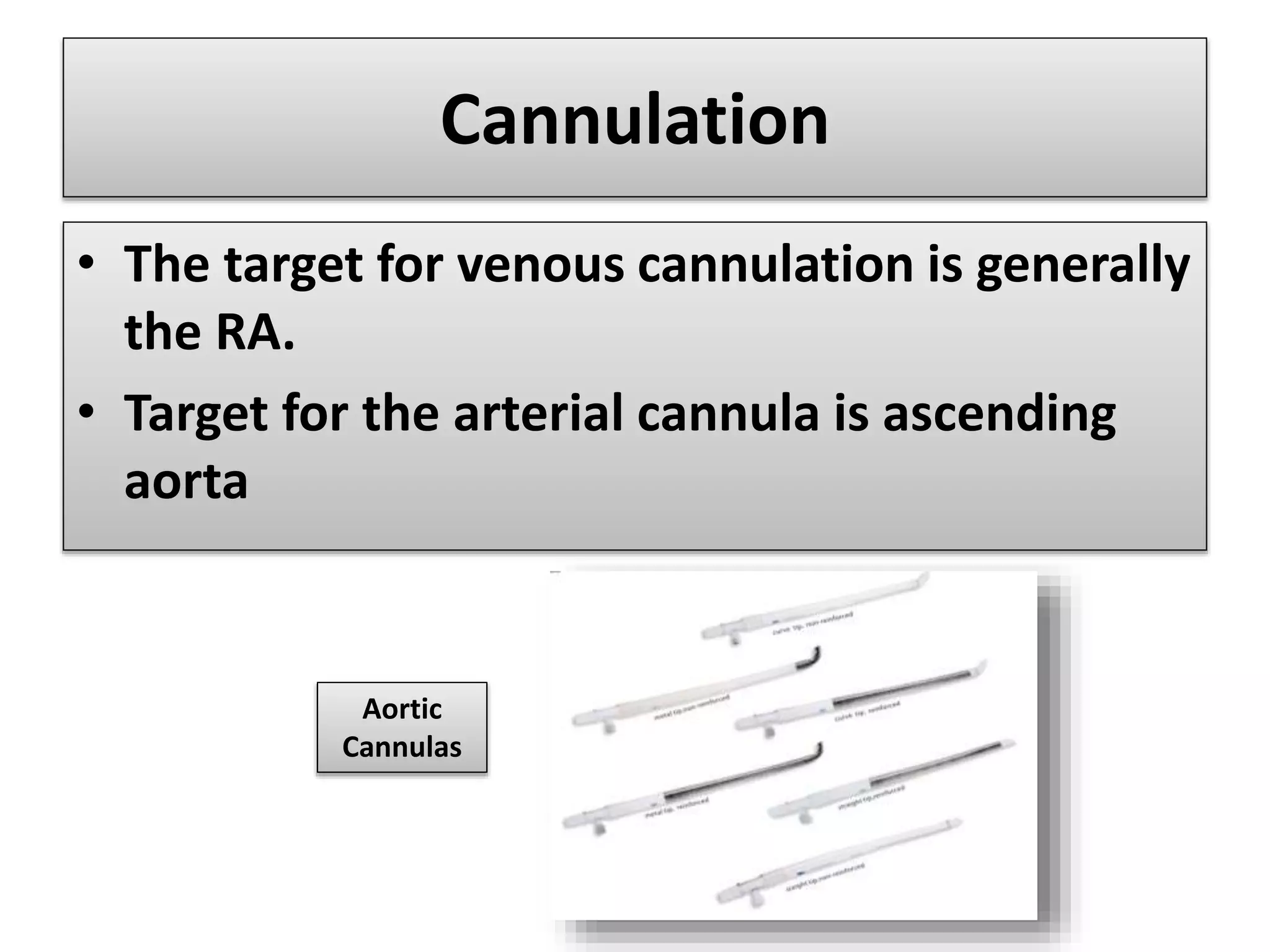
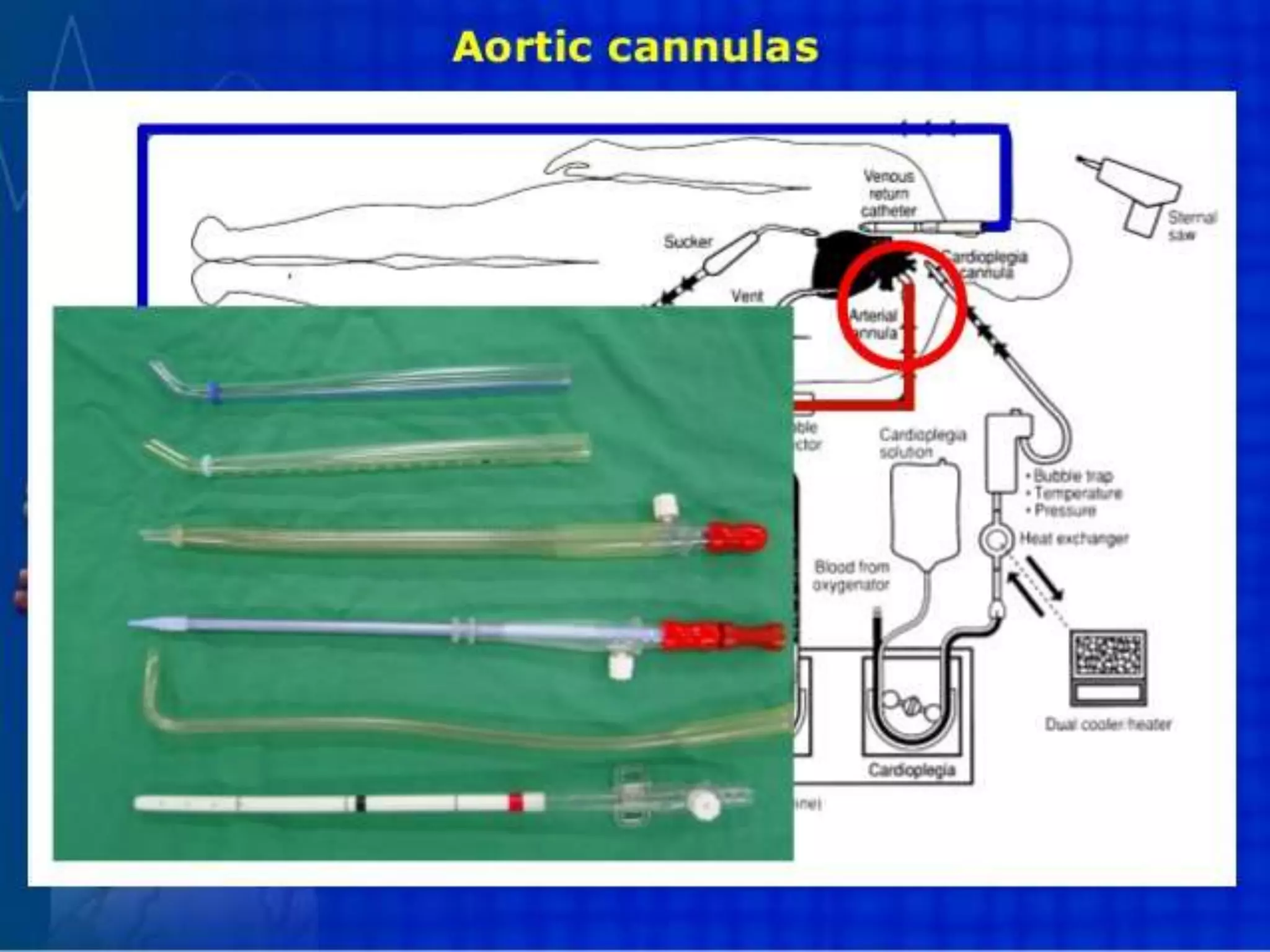
Cannulation
• The target for venous cannulation is generally
the RA.
• Target for the arterial cannula is ascending
aorta
Aortic
Cannulas
Cannulation
• The target for venous cannulation is generally
the RA.
• Target for the arterial cannula is ascending
aorta
Aortic
Cannulas
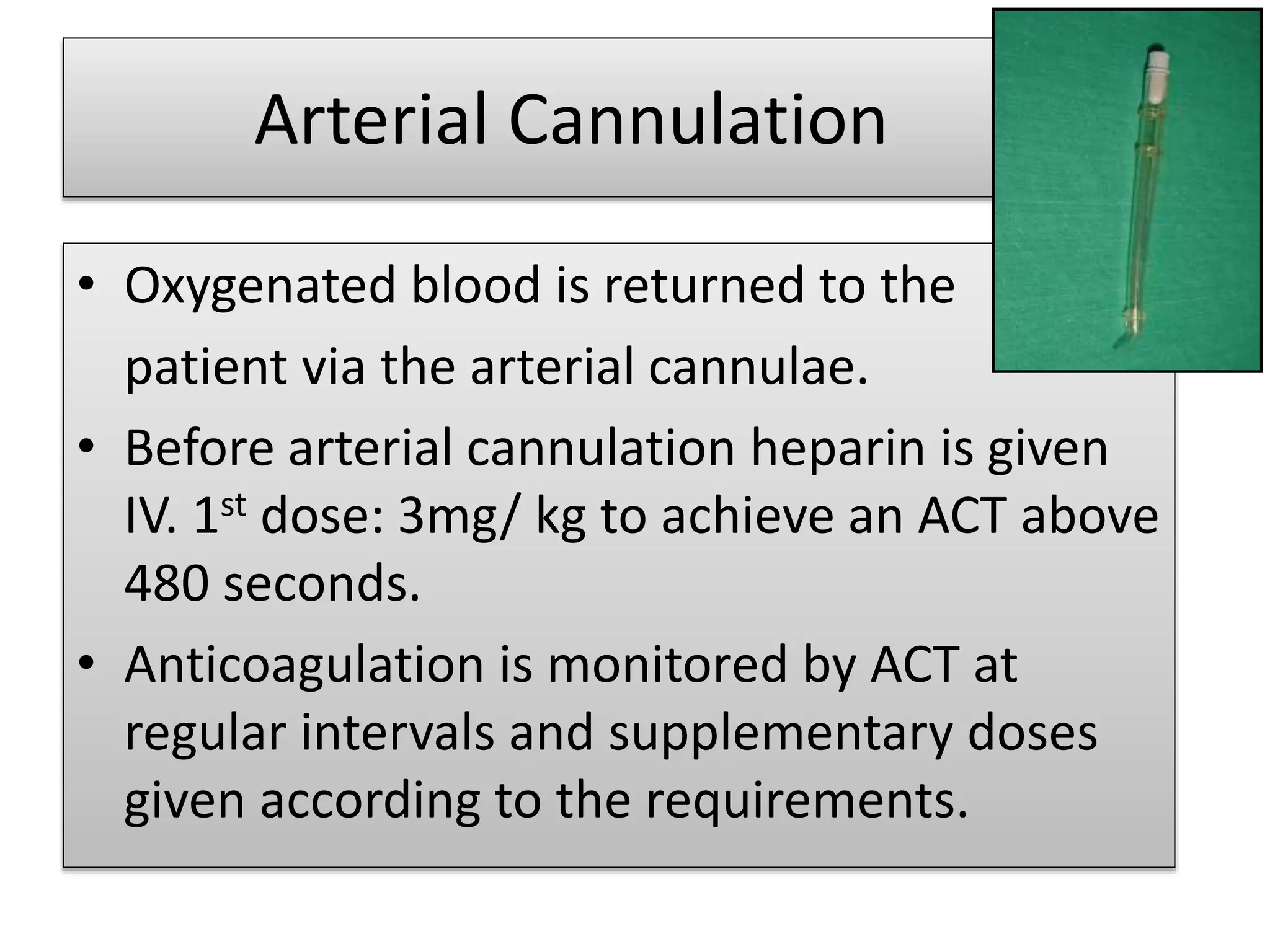
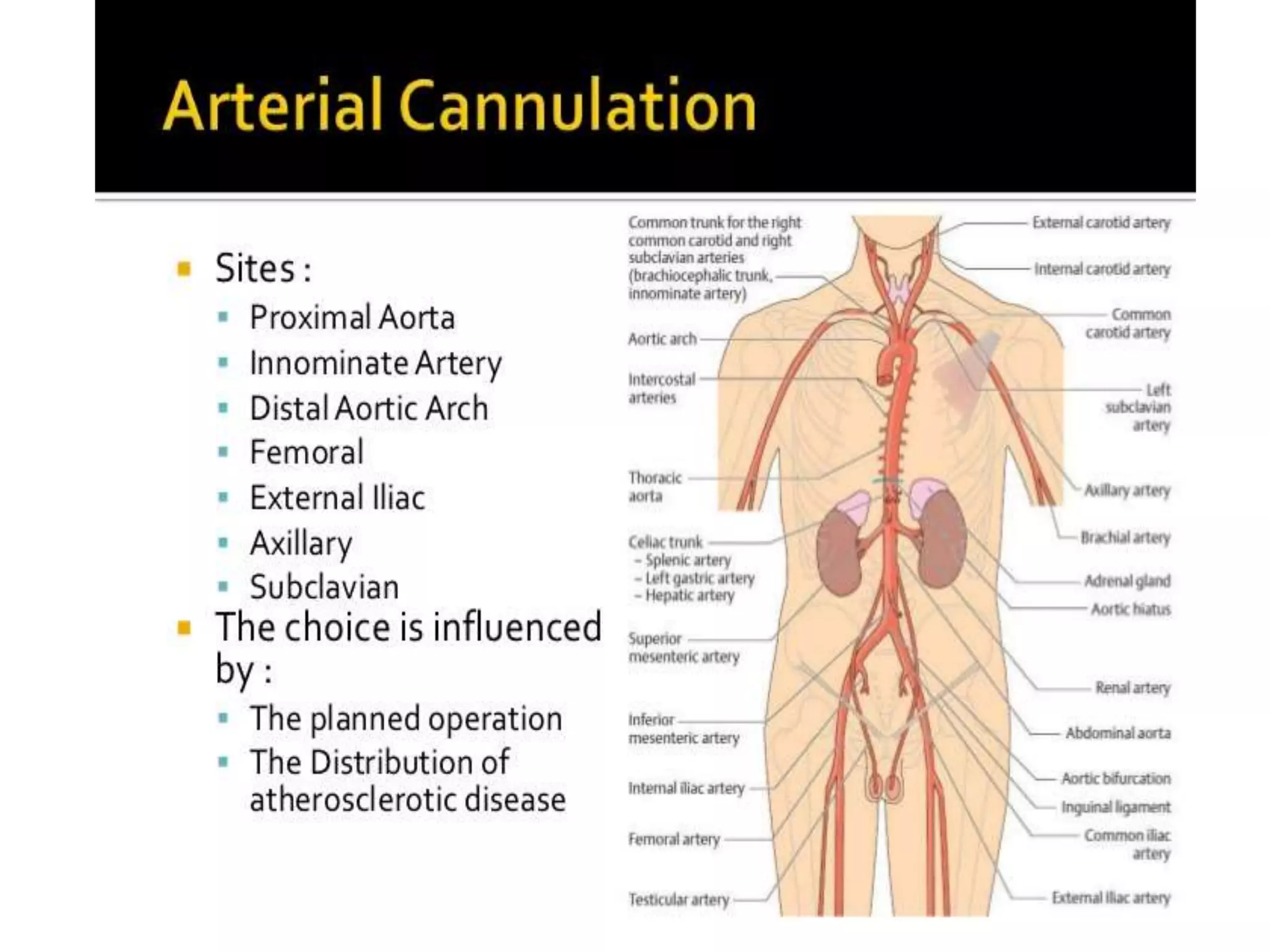
Arterial Cannulation
• Oxygenated blood is returned to the
patient via the arterial cannulae.
• Before arterial cannulation heparin is given
IV. 1st dose: 3mg/ kg to achieve an ACT above
480 seconds.
• Anticoagulation is monitored by ACT at
regular intervals and supplementary doses
given according to the requirements.
Venous Cannulation
• Systemic venous blood is diverted to the
oxygenator through two flexible plastic
cannulae which are inserted into the superior
and inferior venacavae.
• Otherwise a single cannulae inserted into RA
through RA appendage.
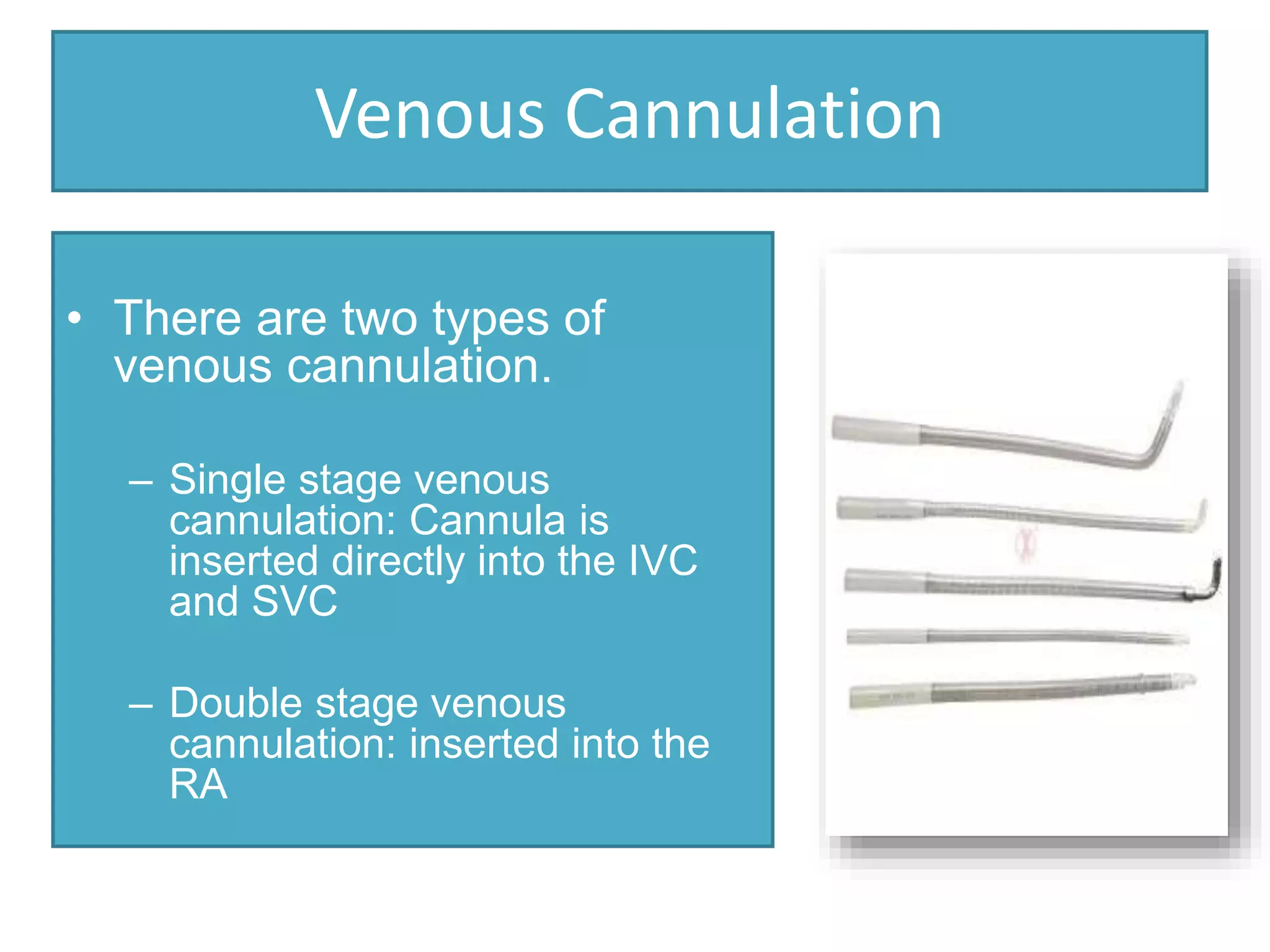
Venous Cannulation
• There are two types of
venous cannulation.
– Single stage venous
cannulation: Cannula is
inserted directly into the IVC
and SVC
– Double stage venous
cannulation: inserted into the
RA
Venous Cannulation
Blood flows freely into
the oxygenator under
the influence of
Gravity Siphon.
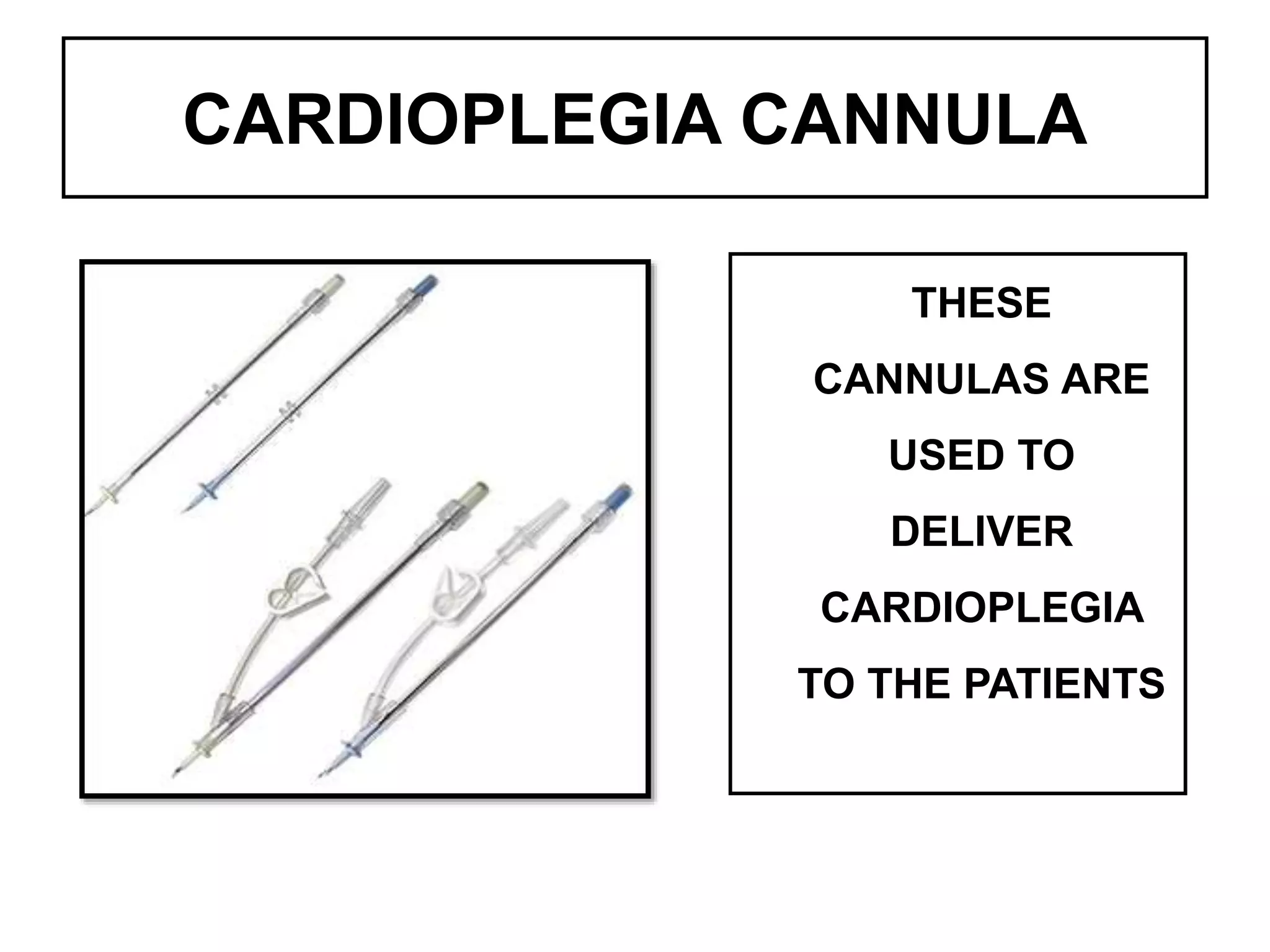
CARDIOPLEGIA CANNULA
THESE
CANNULAS ARE
USED TO
DELIVER
CARDIOPLEGIA
TO THE PATIENTS
Myocardial Protection
• To provide a motionless field for the surgeon,
the heart is arrested in diastole by the
administration of a potassium-enriched
cardioplegia solution to the heart.
• Potassium-induced arrest alone reduces the
heart's myocardial oxygen consumption by
90%.
Myocardial Protection
• The combined influence of potassium arrest
and myocardial temperatures lower than
22°C reduces myocardial oxygen
consumption by 97% and enables the tissue
to withstand complete interruption of blood
flow for periods of 20 to 40 minutes
CARDIOPLEGIA
• Antegrade cardioplegia is delivered through a
small cannula in the aortic root or via
handheld cannulas directly into the coronary
ostia when the aortic valve is exposed
• Retrogradecardioplegia is delivered through a
cuffed catheter insertedblindly into the
coronary sinus
Temperature
• Deliberate hypothermia is a reliable method
of neuroprotection and is often used during
routine CPB.
• Temp can be estimated from tympanic,
nasopharyngeal, esophageal, rectal, bladder,
skin surface, pulmonary arterial, or jugular
venous bulb temperature
HEATER COOLER UNIT
• The heater cooler unit
commonly known as
Haemotherm (or)
Temperature control unit
• Used to warm or cool
and to maintain the
temperature during CPB
SUCTIONS
Blood accumalating in the surgical
field is collected in the reservoir in
CPB Machine and returned to the
body.
Complications of Cardio- Pulmonary
Bypass
–Duration of bypass
–Age
–Cardiac function
End Organs That Can Be Adversely
Affected by CPB
• Heart
• Brain
• Kidneys
• Gastrointestinal tract
• Endocrine system
CARDIOPULMONARY BYPASS

CARDIOPULMONARY BYPASS

  • 1.
  • 4.
    Cardiopulmonary bypass isthe diversion of the flow of blood to the aorta, via a pump& oxygenator; avoiding both the heart & lungs
  • 9.
    GOALS OF CPB •Oxygenation and carbon dioxide elimination • Circulation of blood • Systemic cooling and re-warming • Diversion of blood from the heart to provide a bloodless surgical field
  • 11.
  • 12.
    Operational Parts ofCPB 1. Pump Takes over the function of heart 2. Oxygenator Gas exchange function of lung 3. Circuits Direct venous blood to oxygenator and return to systemic circulation. 4. Prime Fluid used to prime oxygenator and circuits prior to CPB
  • 13.
    Scheme of CPBCircuit • Pump • Oxygenator • Heat exchanger • Reservoir • Filter • Sucker & vent • Cardioplegic solution delivery system
  • 14.
    Venous blood isintercepted as it returns to the RA and diverted through the venous line of the CPB circuit to a venous reservoir. Cardiopulmonary Bypass
  • 15.
    Cardiopulmonary Bypass The arterialpump functions as an artificial heart by withdrawing blood from the reservoir and propelling it through a heat exchanger, an artificial lung (the oxygenator), and an arterial line filter before returning it through the arterial line to the patient's arterial system.
  • 16.
    Additional pumps andcomponents are used to assist in the operation to manage shed blood (the pump sucker), decompress the heart (vent), and deliver cardioplegia solution Cardiopulmonary Bypass
  • 17.
    • The CPBcircuit performs the function of heart and lungs • The blood is drained from the right side of the heart and returned to the systemic circulation through the aorta Cardiopulmonary Bypass
  • 18.
    Blood Tubing • Thetubing used to connect the various components and divert blood into and out of the patient's vascular system • Newer generation of PVC tubing has surface coating with heparin
  • 19.
    TUBINGS • The tubingswhich are used for CPB are made of PVC’s. • There are 4 standard tubing sizes which are commonly used on CPB circuit. • a)3/16” b) ¼” c) 3/8” d) ½”
  • 20.
    TUBINGS • According tothe height and weight of the patient the size of the tube varies. • The length of the tubing should be as minimum as possible, which reduces the priming volume and haemolysis.
  • 21.
    Venous Reservoirs • Positionedbetween the venous line and the arterial pump • Blood reservoirs may be clear plastic hard- shelled containers. • Accomodates large volume of blood out of the circulation
  • 22.
    Arterial Pumps • Thepumping device used to replace the function of the heart • Two primary technologies: a roller pump or a centrifugal pump
  • 23.
    Arterial Pumps Both pumptechnologies are traumatic to the blood cells; however centrifugal pumps are thought to be less traumatic than roller pumps
  • 25.
    Roller pumpsRoller pumpsare positive- displacement pumps that function by occluding a point in a piece of tubing and then rolling the occlusive point of contact along a length of the tubing. This forces the fluid in the tubing to move forward in front of the occlusive point while simultaneously drawing in fluid behind the occlusive point.
  • 26.
    Centrifugal pumps Centrifugal pumps,in contrast, are nonocclusive kinetic pumps that generate flow by magnetically coupling the high-speed revolution of a reusable motor to the plastic plates, fins, or channels inside a disposable cone.
  • 27.
    Centrifugal pumps • Centrifugalpumps, in contrast, are nonocclusive kinetic pumps that generate flow by magnetically coupling the high-speed revolution of a reusable motor to the plastic plates, fins, or channels inside a disposable cone.
  • 29.
    Heat Exchanger • Facilitatemanagement of the patient's blood temperature • The heat exchangers may be used to reduce the temperature of the blood on initiation of CPB and then to warm the blood before the termination of CPB. • Reduces the temperature of the cardioplegia blood to the required level
  • 31.
    Oxygenator The oxygenator substitutesfor the patient's native lungs and performs the essential function of gas exchange.
  • 34.
    Oxygenator • Oxygen andCO2 diffuses across a membrane in the oxygenator. The membrane is usually made from microporous polypropylene. • The oxygenator has separate gas inlet and outlet ports
  • 35.
    Arterial Line Filter Thesefilters are placed in the arterial line as the last component through which blood passes before it returns to the patient.
  • 36.
    Arterial Line Filter Withpore sizes of 20 to 40 µm, arterial line filters increases patient safety by removing particulate and gaseous microemboli.
  • 37.
    Management before Cardiopulmonary Bypass •Anticoagulation • Cannulation of the heart • Careful monitoring • Protection of the heart • Preparation for cardiopulmonary bypass
  • 38.
    Physiologic parameters ofCPB • Perfusion pressure • Pump flow • Temperature management • Central nervous system monitoring • Pulsatility
  • 39.
    Sequence of Events •Circuit selection and priming • Anticoagulation • Cannulation • Initiation and maintenance of CPB • Myocardial protection • Weaning and termination from CPB.
  • 40.
    Fluid Management • Crystalloidsolutions lead to decreased colloid osmotic pressure with a resultant increase in extracellular water retention, irrespective of the osmolarity of the pump prime. • Albumin, can decrease the interaction of blood components with the bypass circuit by coating the fluid pathway surfaces
  • 41.
    Priming • “prime volume”is the volume of balanced electrolyte solution necessary to completely de-air the circuit • Main cause of the hemodilution associated with CPB • This increased volume of distribution dilutes all of the proteins, coagulation factors and formed elements of the blood • Dilutes plasma levels of drugs
  • 42.
    Anticoagulation • Heparin isa heterogeneous, heavily sulfated polysaccharide compound derived from pig intestinal mucosa or bovine lung. • It binds antithrombin III, profoundly facilitating its native ability to inhibit plasma coagulation, most prominently through inhibition of factors IIa (thrombin) and Xa
  • 43.
    Anticoagulation • Anticoagulation withheparin for CPB can be monitored by measuring clotting times or whole blood heparin concentrations • Most commonly test used for CPB are the ACT • Heparin resistance: AT III concentrate or FFP
  • 44.
    Protamine, a polycationicprotein derived from salmon sperm contains two active sites – It neutralizes heparin – It exerts a mild anticoagulant effect independently of heparin Anticoagulation
  • 46.
    CANNULAS • The cannulasare the catheters which are used to connect the patients circulation to the extracorporeal circuit. • There are three types of cannulations involved in CPB. – Arterial, – Venous – Cardioplegia cannulation.
  • 47.
    Cannulation • The targetfor venous cannulation is generally the RA. • Target for the arterial cannula is ascending aorta Aortic Cannulas
  • 48.
    Cannulation • The targetfor venous cannulation is generally the RA. • Target for the arterial cannula is ascending aorta Aortic Cannulas
  • 49.
    Arterial Cannulation • Oxygenatedblood is returned to the patient via the arterial cannulae. • Before arterial cannulation heparin is given IV. 1st dose: 3mg/ kg to achieve an ACT above 480 seconds. • Anticoagulation is monitored by ACT at regular intervals and supplementary doses given according to the requirements.
  • 52.
    Venous Cannulation • Systemicvenous blood is diverted to the oxygenator through two flexible plastic cannulae which are inserted into the superior and inferior venacavae. • Otherwise a single cannulae inserted into RA through RA appendage.
  • 53.
    Venous Cannulation • Thereare two types of venous cannulation. – Single stage venous cannulation: Cannula is inserted directly into the IVC and SVC – Double stage venous cannulation: inserted into the RA
  • 54.
    Venous Cannulation Blood flowsfreely into the oxygenator under the influence of Gravity Siphon.
  • 55.
    CARDIOPLEGIA CANNULA THESE CANNULAS ARE USEDTO DELIVER CARDIOPLEGIA TO THE PATIENTS
  • 56.
    Myocardial Protection • Toprovide a motionless field for the surgeon, the heart is arrested in diastole by the administration of a potassium-enriched cardioplegia solution to the heart. • Potassium-induced arrest alone reduces the heart's myocardial oxygen consumption by 90%.
  • 57.
    Myocardial Protection • Thecombined influence of potassium arrest and myocardial temperatures lower than 22°C reduces myocardial oxygen consumption by 97% and enables the tissue to withstand complete interruption of blood flow for periods of 20 to 40 minutes
  • 59.
    CARDIOPLEGIA • Antegrade cardioplegiais delivered through a small cannula in the aortic root or via handheld cannulas directly into the coronary ostia when the aortic valve is exposed • Retrogradecardioplegia is delivered through a cuffed catheter insertedblindly into the coronary sinus
  • 60.
    Temperature • Deliberate hypothermiais a reliable method of neuroprotection and is often used during routine CPB. • Temp can be estimated from tympanic, nasopharyngeal, esophageal, rectal, bladder, skin surface, pulmonary arterial, or jugular venous bulb temperature
  • 61.
    HEATER COOLER UNIT •The heater cooler unit commonly known as Haemotherm (or) Temperature control unit • Used to warm or cool and to maintain the temperature during CPB
  • 62.
    SUCTIONS Blood accumalating inthe surgical field is collected in the reservoir in CPB Machine and returned to the body.
  • 63.
    Complications of Cardio-Pulmonary Bypass –Duration of bypass –Age –Cardiac function
  • 64.
    End Organs ThatCan Be Adversely Affected by CPB • Heart • Brain • Kidneys • Gastrointestinal tract • Endocrine system