

GOAL DIRECTED
PERFUSION
MANU JACOB
PERFUSIONIST
 Goal Directed Perfusion (GDP) is a concept inspired by Goal Directed Therapy (GDT).
 GDT was first described in 2001 by Rivers .
 The technique uses rigorous monitoring and intensive management of hemodynamics
in cpb patients as a means to improve outcomes
FACTORS AFFECT GDP
Adequate perfusion is dependent on a number of factors that include the
delivery of nutrients, their uptake and metabolism, the metabolic rate of
tissue, and the removal of waste products. This delivery is dependent on the
physical process of fluid movement through intact and functioning
cardiopulmonary and vascular tissue beds.
FACTORS AFFECT GDP
 MAP
 SVR,
 FLUID BALANCE,
 BLOOD OSMOLARITY.
 FLOW
 GLYCEMIC CONTROL
 HB
 ANESTHESIA
 TEMPERATURE
 PH
 NON PULSATILE PERFUSION
WHAT IS DELIVERY OF OXYGEN
Do2
 Amount of o2 delivered to the capillaries per minute
Do2 How is it determined
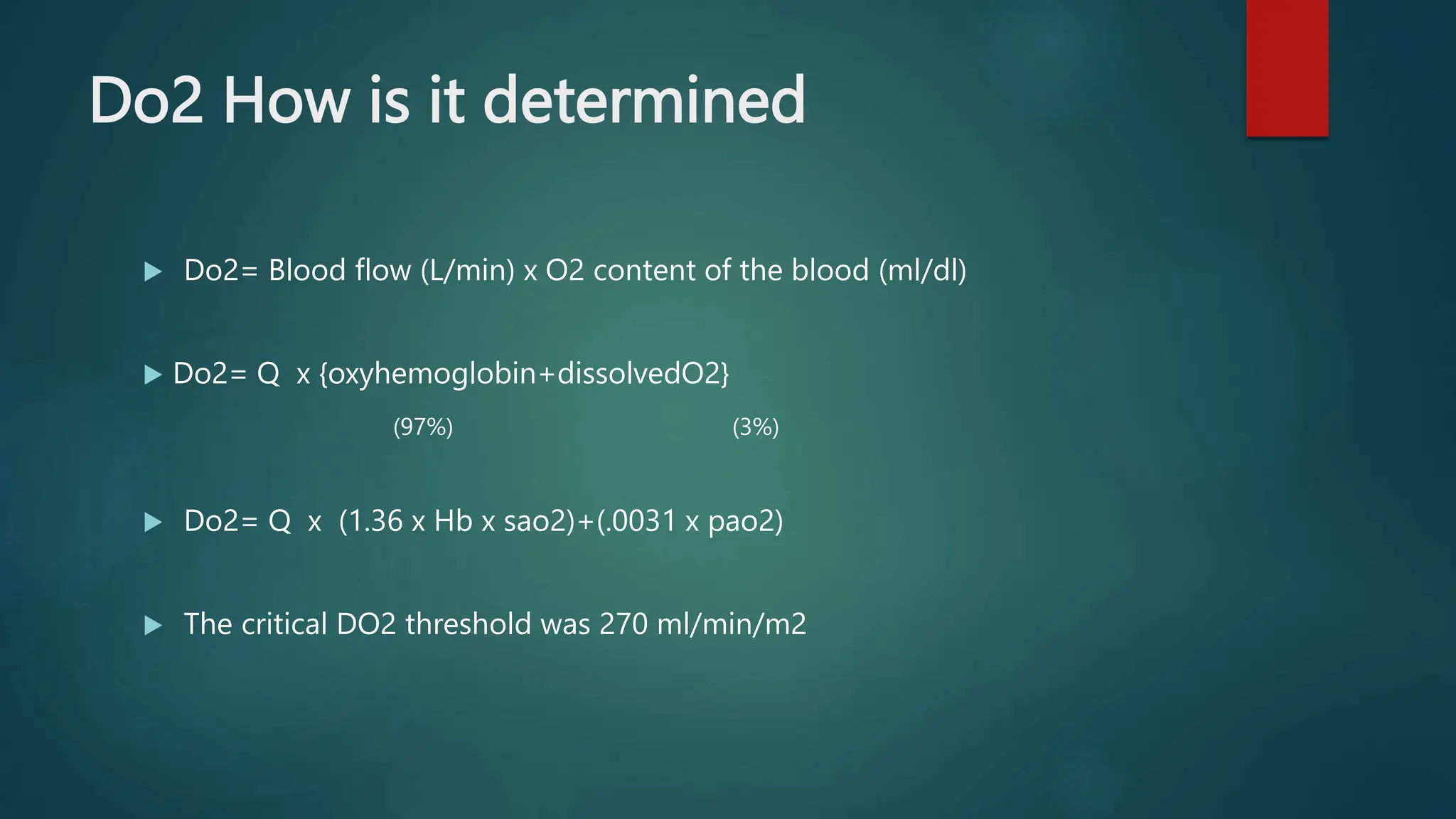
 Do2= Blood flow (L/min) x O2 content of the blood (ml/dl)
 Do2= Q x {oxyhemoglobin+dissolvedO2}
(97%) (3%)
 Do2= Q x (1.36 x Hb x sao2)+(.0031 x pao2)
 The critical DO2 threshold was 270 ml/min/m2
WHAT ARE THE FOCUS POINT
PARAMETERS
 Do2= Q x (1.36 x Hb x sao2)+(.0031 x pao2)
blood flow hemoglobin Art Sat Pao2
The Relationship between VO2 and DO2 and the
concept of VO2/DO2 Dependency
 oxygen uptake (VO2) remains independent of DO2 over a wide range of values,
because oxygen extraction (O2ER, which is the ratio of VO2 over DO2) can readily adapt to
the changes in DO2.
When cardiac output is acutely reduced by
Acute blood withdrawal, tamponade, anemia, or hypoxemia, O2ER increases (SvO2 decreases)
and VO2 remains quite stable, until DO2 falls below a critically low
threshold (DO2crit), when VO2 starts to fall. An abrupt increase in blood lactate concentrations
then occurs, indicating the development of anaerobic metabolism
 In the presence of sepsis mediators, as after the administration of endotoxin or live bacteria
[oxygen extraction capabilities are altered.
 DO2crit is higher and the critical O2ER is typically lower than in control conditions. In these
conditions, VO2 can become dependent on DO2 even when DO2 is normal or elevated.
Altogether, these observations help to characterize the four principal types of circulatory
shock
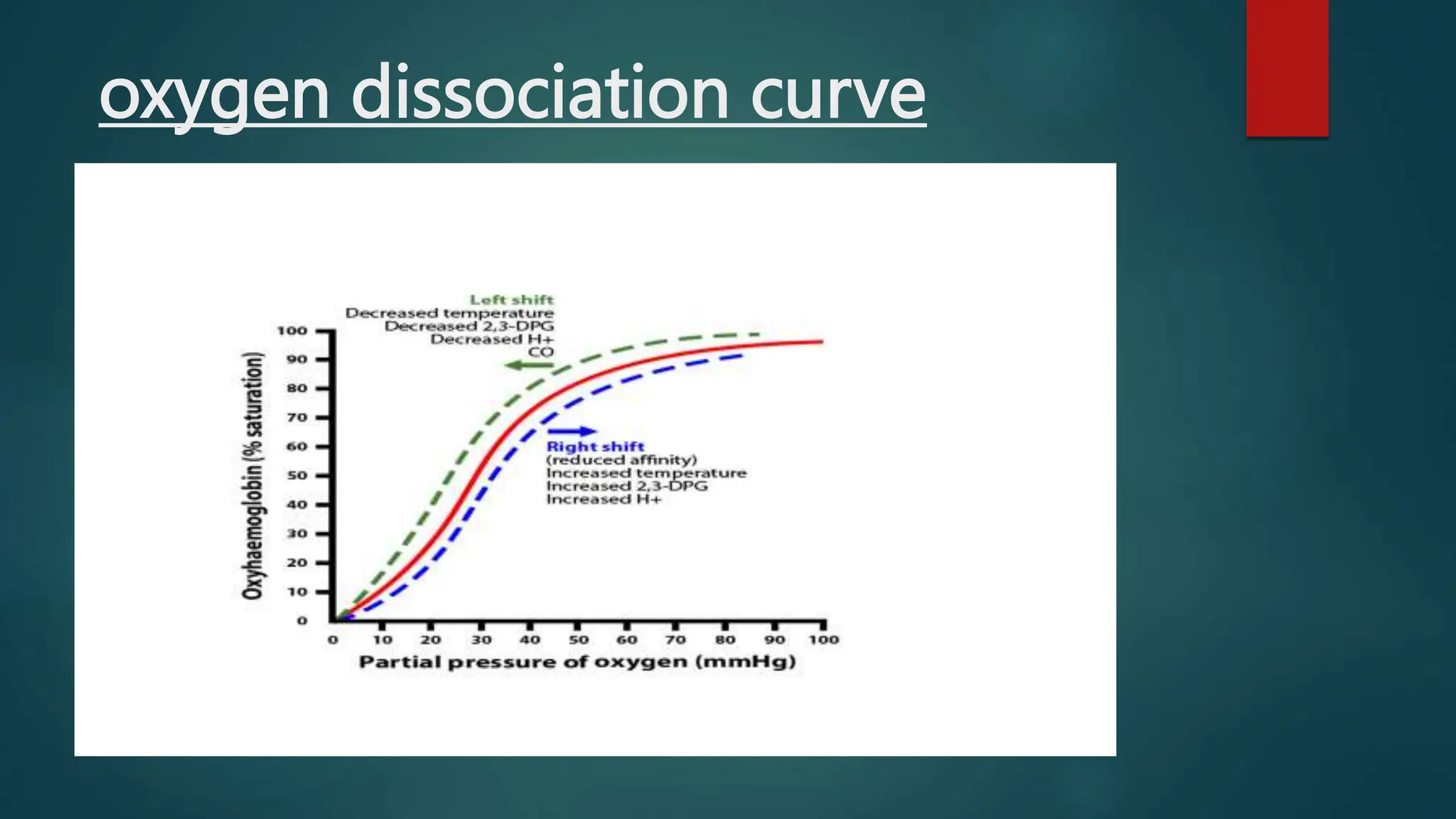
oxygen dissociation curve
Left-shifted ODC (↓P50)
 Causes ↑pH (↓H+)
 ↓PaCO2
 ↓2,3-diphosphoglycerate
 ↓Temperature
 Effect Increased haemoglobin oxygen affinity,
 enhanced oxygen binding
 Others Fetal haemoglobin
 Carbon monoxide
 poisoning
 Methaemoglobinaemia
Right-shifted ODC (↑P50)
 ↓pH (↑H+)
 ↑PaCO2
 ↑2,3-diphosphoglycerate
 ↑Temperature
 Decreased haemoglobin
 oxygen affinity, enhanced
release of oxygen in the
tissues Adult haemoglobin
oxygen dissociation curve
Oxygen Extraction Fraction
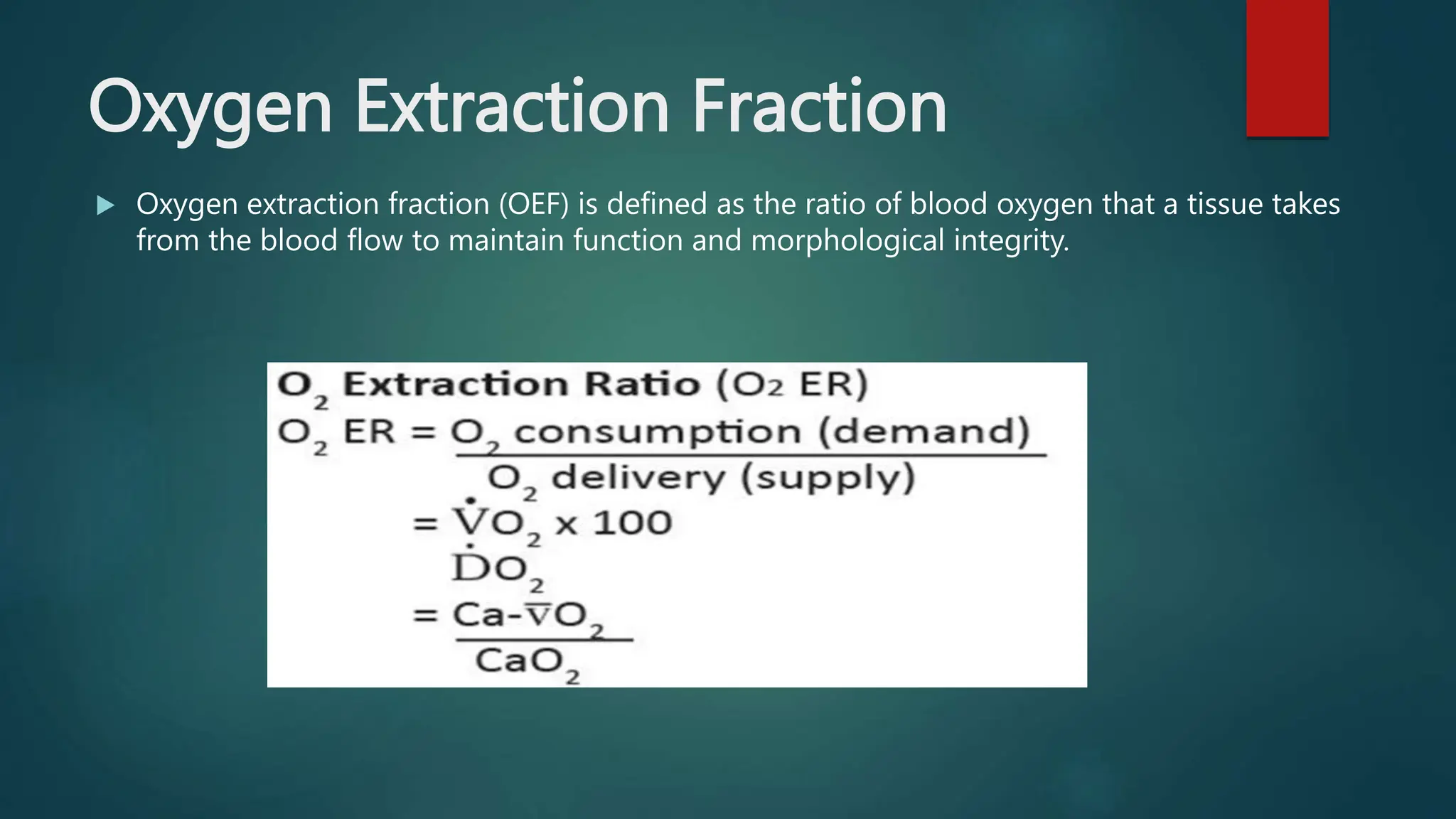
 Oxygen extraction fraction (OEF) is defined as the ratio of blood oxygen that a tissue takes
from the blood flow to maintain function and morphological integrity.
Factors affecting extraction ratio of oxygen from
capillary blood
 Rate of oxygen delivery to the capillary.
 Oxygen-haemoglobin dissociation relation.
 Size of the capillary to cellular Po2 gradient.
 Diffusion distance from the capillary to the cell.
 Rate of use of oxygen by cells.
What is the maximum oxygen extraction ratio
 60-70%
 As metabolic demand (Vo2) increases or supply (Do2) diminishes, the
oxygen extraction ratio rises to maintain aerobic metabolism. However,
once the maximum extraction ratio is reached (at 60-70% for most tissues)
further increases in demand or falls in supply lead to hypoxia.
FACTORS AFFECTING URINE OUTPUT
GFR FACTORS
 ARTERIAL BLOOD PRESSURE
 PRE-CAPILLARY SHUNTING
 PULSATILE BLOOD FLOW
 RETROGRADE PRESSURE
 GLOMERULAR STATUS
 PLASMA PROTEIN CONCENTRATION
OTHER FACTORS
 ADH LEVELS
 HYPER-OSMOLARITY
 HYPO-OSMOLARITY
 DRUGS
 DIURETIC DRUGS
UNDESIREABLE SIDE EFFECTS OF
HYPOTHERMIA
 INCREASED BLOOD VISCOSITY
 INCREASED VISCOSITY OF NONBLOOD PERFUSATE
 INCREASED SLUDGING WITH INTRAVASCULAR AGGREGATION
 INCREASED HEMOCONCENTRATION
 ARTERIO VENOUS SHUNTING
 PRECIPITATION OF FAT EMBOLI
 MYOGENIC VASOCONSTRICTION
 CELLULAR EDEMA
INDICES OF PERFUSION ADEQUACY
 1. ACID-BASE BALANCE
UNDERSTAND POTENTIAL ERRORS IN MEASUREMENT
 2. OXYGEN CONSUMPTION
UNDERSTAND POTENTIAL ERRORS IN MEASUREMENT
 3. ORGAN FUNCTION
PRIMARILY RENAL
 4. FLOW RATE
UNDERSTAND FLOW REQUIREMENTS
 5. BLOOD PRESSURE
UNDERSTAND FACTORS THAT CAUSE ALTERATION
SPECIAL IMPORTANCE IN VASCULAR DISEASE
 In conclusion, if we could predict with 95% accuracy the requirements for
the adequate perfusion, we would all be out of jobs. A computer could be
programmed to do our job better with less chance for error. At present, the
best way to insure adequacy of perfusion is to have a competent
perfusionist behind the pump, one who can receive a mass of information,
sort the data and form a composite picture of the patient's status. The
perfusionist then must recall the basic physiological demands, integrate all
of this information with the surgical problem and then make intelligent
decisions on the control of the perfusion.
GOAL DIRECTED PERFUSION-------------------------------------------------

GOAL DIRECTED PERFUSION-------------------------------------------------

  • 1.
  • 2.
     Goal DirectedPerfusion (GDP) is a concept inspired by Goal Directed Therapy (GDT).  GDT was first described in 2001 by Rivers .  The technique uses rigorous monitoring and intensive management of hemodynamics in cpb patients as a means to improve outcomes
  • 3.
    FACTORS AFFECT GDP Adequateperfusion is dependent on a number of factors that include the delivery of nutrients, their uptake and metabolism, the metabolic rate of tissue, and the removal of waste products. This delivery is dependent on the physical process of fluid movement through intact and functioning cardiopulmonary and vascular tissue beds.
  • 4.
    FACTORS AFFECT GDP MAP  SVR,  FLUID BALANCE,  BLOOD OSMOLARITY.  FLOW  GLYCEMIC CONTROL  HB  ANESTHESIA  TEMPERATURE  PH  NON PULSATILE PERFUSION
  • 5.
    WHAT IS DELIVERYOF OXYGEN Do2  Amount of o2 delivered to the capillaries per minute
  • 6.
    Do2 How isit determined  Do2= Blood flow (L/min) x O2 content of the blood (ml/dl)  Do2= Q x {oxyhemoglobin+dissolvedO2} (97%) (3%)  Do2= Q x (1.36 x Hb x sao2)+(.0031 x pao2)  The critical DO2 threshold was 270 ml/min/m2
  • 7.
    WHAT ARE THEFOCUS POINT PARAMETERS  Do2= Q x (1.36 x Hb x sao2)+(.0031 x pao2) blood flow hemoglobin Art Sat Pao2
  • 8.
    The Relationship betweenVO2 and DO2 and the concept of VO2/DO2 Dependency  oxygen uptake (VO2) remains independent of DO2 over a wide range of values, because oxygen extraction (O2ER, which is the ratio of VO2 over DO2) can readily adapt to the changes in DO2. When cardiac output is acutely reduced by Acute blood withdrawal, tamponade, anemia, or hypoxemia, O2ER increases (SvO2 decreases) and VO2 remains quite stable, until DO2 falls below a critically low threshold (DO2crit), when VO2 starts to fall. An abrupt increase in blood lactate concentrations then occurs, indicating the development of anaerobic metabolism  In the presence of sepsis mediators, as after the administration of endotoxin or live bacteria [oxygen extraction capabilities are altered.  DO2crit is higher and the critical O2ER is typically lower than in control conditions. In these conditions, VO2 can become dependent on DO2 even when DO2 is normal or elevated. Altogether, these observations help to characterize the four principal types of circulatory shock
  • 9.
    oxygen dissociation curve Left-shiftedODC (↓P50)  Causes ↑pH (↓H+)  ↓PaCO2  ↓2,3-diphosphoglycerate  ↓Temperature  Effect Increased haemoglobin oxygen affinity,  enhanced oxygen binding  Others Fetal haemoglobin  Carbon monoxide  poisoning  Methaemoglobinaemia Right-shifted ODC (↑P50)  ↓pH (↑H+)  ↑PaCO2  ↑2,3-diphosphoglycerate  ↑Temperature  Decreased haemoglobin  oxygen affinity, enhanced release of oxygen in the tissues Adult haemoglobin
  • 10.
  • 11.
    Oxygen Extraction Fraction Oxygen extraction fraction (OEF) is defined as the ratio of blood oxygen that a tissue takes from the blood flow to maintain function and morphological integrity.
  • 12.
    Factors affecting extractionratio of oxygen from capillary blood  Rate of oxygen delivery to the capillary.  Oxygen-haemoglobin dissociation relation.  Size of the capillary to cellular Po2 gradient.  Diffusion distance from the capillary to the cell.  Rate of use of oxygen by cells.
  • 13.
    What is themaximum oxygen extraction ratio  60-70%  As metabolic demand (Vo2) increases or supply (Do2) diminishes, the oxygen extraction ratio rises to maintain aerobic metabolism. However, once the maximum extraction ratio is reached (at 60-70% for most tissues) further increases in demand or falls in supply lead to hypoxia.
  • 14.
    FACTORS AFFECTING URINEOUTPUT GFR FACTORS  ARTERIAL BLOOD PRESSURE  PRE-CAPILLARY SHUNTING  PULSATILE BLOOD FLOW  RETROGRADE PRESSURE  GLOMERULAR STATUS  PLASMA PROTEIN CONCENTRATION OTHER FACTORS  ADH LEVELS  HYPER-OSMOLARITY  HYPO-OSMOLARITY  DRUGS  DIURETIC DRUGS
  • 15.
    UNDESIREABLE SIDE EFFECTSOF HYPOTHERMIA  INCREASED BLOOD VISCOSITY  INCREASED VISCOSITY OF NONBLOOD PERFUSATE  INCREASED SLUDGING WITH INTRAVASCULAR AGGREGATION  INCREASED HEMOCONCENTRATION  ARTERIO VENOUS SHUNTING  PRECIPITATION OF FAT EMBOLI  MYOGENIC VASOCONSTRICTION  CELLULAR EDEMA
  • 16.
    INDICES OF PERFUSIONADEQUACY  1. ACID-BASE BALANCE UNDERSTAND POTENTIAL ERRORS IN MEASUREMENT  2. OXYGEN CONSUMPTION UNDERSTAND POTENTIAL ERRORS IN MEASUREMENT  3. ORGAN FUNCTION PRIMARILY RENAL  4. FLOW RATE UNDERSTAND FLOW REQUIREMENTS  5. BLOOD PRESSURE UNDERSTAND FACTORS THAT CAUSE ALTERATION SPECIAL IMPORTANCE IN VASCULAR DISEASE
  • 17.
     In conclusion,if we could predict with 95% accuracy the requirements for the adequate perfusion, we would all be out of jobs. A computer could be programmed to do our job better with less chance for error. At present, the best way to insure adequacy of perfusion is to have a competent perfusionist behind the pump, one who can receive a mass of information, sort the data and form a composite picture of the patient's status. The perfusionist then must recall the basic physiological demands, integrate all of this information with the surgical problem and then make intelligent decisions on the control of the perfusion.