Post-Laboratory
Discussion on
Carboxylic Acids &
its derivatives
By Group 2 BMLS-1H
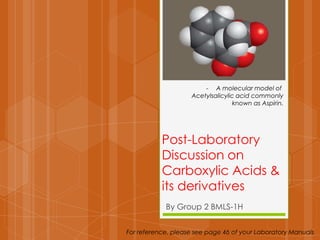
- A molecular model of
Acetylsalicylic acid commonly
known as Aspirin.
For reference, please see page 46 of your Laboratory Manuals
Carboxylic Acids
 Also referred to as the “Organic Acids”
 Able to ionize in water
 Polar because of its high electronegativity given by O
 Most frequently encountered organic compounds
 Has a R-C=O group
OH
 Weak acid; Average pH ≈ 5
 High melting point and boiling point
 Polar; soluble in H2O
Definition
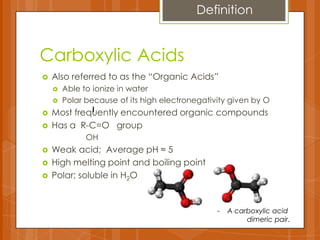
- A carboxylic acid
dimeric pair.
Esterification
 Ester - a carboxylic salt(carboxylate) most
commonly derived from the reaction of
Carboxylic acid(RCOOH) and Alcohol(ROH) –
“Fischer’s Esterification”.
 Functional group: RCOOR
 a sweet smelling compound
 Reversible reaction
 Catalyst: Strong acid(H2SO4 / HCL)
 Byproduct: H2O(aq)
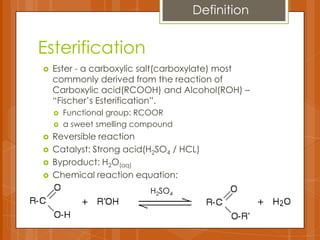
 Chemical reaction equation:
H2SO4
Definition
Esterification
 Other preparations:
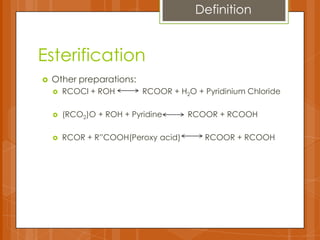
 RCOCl + ROH RCOOR + H2O + Pyridinium Chloride
 (RCO2)O + ROH + Pyridine RCOOR + RCOOH
 RCOR + R”COOH(Peroxy acid) RCOOR + RCOOH
Definition
1. Esterification
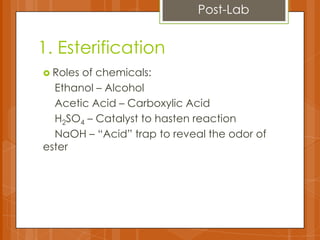
 Roles of chemicals:
Ethanol – Alcohol
Acetic Acid – Carboxylic Acid
H2SO4 – Catalyst to hasten reaction
NaOH – “Acid” trap to reveal the odor of
ester
Post-Lab
1. Esterification
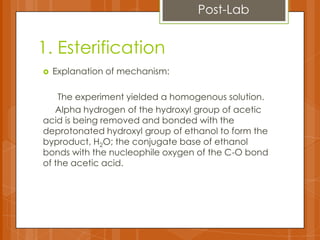
 Explanation of mechanism:
The experiment yielded a homogenous solution.
Alpha hydrogen of the hydroxyl group of acetic
acid is being removed and bonded with the
deprotonated hydroxyl group of ethanol to form the
byproduct, H2O; the conjugate base of ethanol
bonds with the nucleophile oxygen of the C-O bond
of the acetic acid.
Post-Lab
1. Esterification
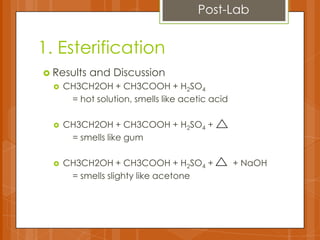
 Results and Discussion
 CH3CH2OH + CH3COOH + H2SO4
= hot solution, smells like acetic acid
 CH3CH2OH + CH3COOH + H2SO4 +
= smells like gum
 CH3CH2OH + CH3COOH + H2SO4 + + NaOH
= smells slighty like acetone
Post-Lab
2. Ferric Chloride Test
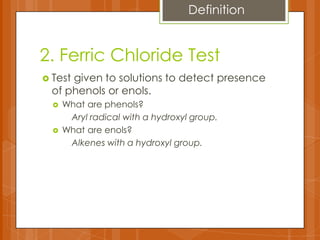
 Test given to solutions to detect presence
of phenols or enols.
 What are phenols?
Aryl radical with a hydroxyl group.
 What are enols?
Alkenes with a hydroxyl group.
Definition
2. Ferric Chloride Test
Discussion of experiment
 Dilute samples were used for conservation.
 Indicators:
 Purple/Red/Green/Blue- positive
Post-Lab
2. Ferric Chloride Test
 Results and Discussion
 CH3COOH + NaOH = orange precipitate
 Hydroxyl groups were detected but no phenols nor
enols
 CH3COOH + NaOH + HCL = yellow precipitate
 Hydroxyl groups were not that concentrated but
no phenols nor enols
Post-Lab
3. Reaction with Derivatives
 Hydrolysis of an anhydride
 Will lead to two molecules of the carboxylic acid
corresponding the anhydride.
 A reversible reaction
Definition
 Reaction of Diluted NaOH with Benzamide(Hydrolysis)
 Results to benzoate ion and ammonia
 A reversible reaction
3. Reaction with Derivatives
 Results and Discussion
 Hydrolysis of an anhydride
 Immiscibility of acetic anhydride to H2O was
observed.
 Blue litmus paper turned red: Acidic because of
Benzoic Acid
Post-Lab
 Reaction of Diluted NaOH with Benzamide(Hydrolysis)
 Flat and odorless smell = Sodium Benzoate and
Ammonia solution.
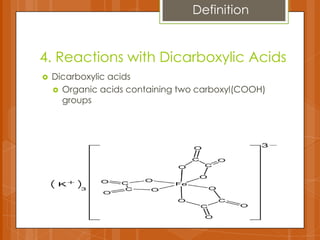
4. Reactions with Dicarboxylic Acids
 Dicarboxylic acids
 Organic acids containing two carboxyl(COOH)
groups
Definition
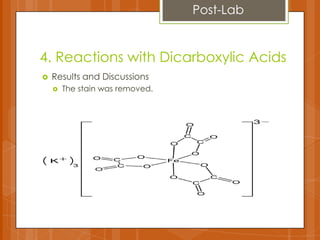
4. Reactions with Dicarboxylic Acids
 Results and Discussions
 The stain was removed.
Post-Lab
The end
To God be the Glory!

Carboxylic Acids- Post-Lab Discussion

  • 1.
    Post-Laboratory Discussion on Carboxylic Acids& its derivatives By Group 2 BMLS-1H - A molecular model of Acetylsalicylic acid commonly known as Aspirin. For reference, please see page 46 of your Laboratory Manuals
  • 2.
    Carboxylic Acids  Alsoreferred to as the “Organic Acids”  Able to ionize in water  Polar because of its high electronegativity given by O  Most frequently encountered organic compounds  Has a R-C=O group OH  Weak acid; Average pH ≈ 5  High melting point and boiling point  Polar; soluble in H2O Definition - A carboxylic acid dimeric pair.
  • 3.
    Esterification  Ester -a carboxylic salt(carboxylate) most commonly derived from the reaction of Carboxylic acid(RCOOH) and Alcohol(ROH) – “Fischer’s Esterification”.  Functional group: RCOOR  a sweet smelling compound  Reversible reaction  Catalyst: Strong acid(H2SO4 / HCL)  Byproduct: H2O(aq)  Chemical reaction equation: H2SO4 Definition
  • 4.
    Esterification  Other preparations: RCOCl + ROH RCOOR + H2O + Pyridinium Chloride  (RCO2)O + ROH + Pyridine RCOOR + RCOOH  RCOR + R”COOH(Peroxy acid) RCOOR + RCOOH Definition
  • 5.
    1. Esterification  Rolesof chemicals: Ethanol – Alcohol Acetic Acid – Carboxylic Acid H2SO4 – Catalyst to hasten reaction NaOH – “Acid” trap to reveal the odor of ester Post-Lab
  • 6.
    1. Esterification  Explanationof mechanism: The experiment yielded a homogenous solution. Alpha hydrogen of the hydroxyl group of acetic acid is being removed and bonded with the deprotonated hydroxyl group of ethanol to form the byproduct, H2O; the conjugate base of ethanol bonds with the nucleophile oxygen of the C-O bond of the acetic acid. Post-Lab
  • 7.
    1. Esterification  Resultsand Discussion  CH3CH2OH + CH3COOH + H2SO4 = hot solution, smells like acetic acid  CH3CH2OH + CH3COOH + H2SO4 + = smells like gum  CH3CH2OH + CH3COOH + H2SO4 + + NaOH = smells slighty like acetone Post-Lab
  • 8.
    2. Ferric ChlorideTest  Test given to solutions to detect presence of phenols or enols.  What are phenols? Aryl radical with a hydroxyl group.  What are enols? Alkenes with a hydroxyl group. Definition
  • 9.
    2. Ferric ChlorideTest Discussion of experiment  Dilute samples were used for conservation.  Indicators:  Purple/Red/Green/Blue- positive Post-Lab
  • 10.
    2. Ferric ChlorideTest  Results and Discussion  CH3COOH + NaOH = orange precipitate  Hydroxyl groups were detected but no phenols nor enols  CH3COOH + NaOH + HCL = yellow precipitate  Hydroxyl groups were not that concentrated but no phenols nor enols Post-Lab
  • 11.
    3. Reaction withDerivatives  Hydrolysis of an anhydride  Will lead to two molecules of the carboxylic acid corresponding the anhydride.  A reversible reaction Definition  Reaction of Diluted NaOH with Benzamide(Hydrolysis)  Results to benzoate ion and ammonia  A reversible reaction
  • 12.
    3. Reaction withDerivatives  Results and Discussion  Hydrolysis of an anhydride  Immiscibility of acetic anhydride to H2O was observed.  Blue litmus paper turned red: Acidic because of Benzoic Acid Post-Lab  Reaction of Diluted NaOH with Benzamide(Hydrolysis)  Flat and odorless smell = Sodium Benzoate and Ammonia solution.
  • 13.
    4. Reactions withDicarboxylic Acids  Dicarboxylic acids  Organic acids containing two carboxyl(COOH) groups Definition
  • 14.
    4. Reactions withDicarboxylic Acids  Results and Discussions  The stain was removed. Post-Lab
  • 15.
    The end To Godbe the Glory!