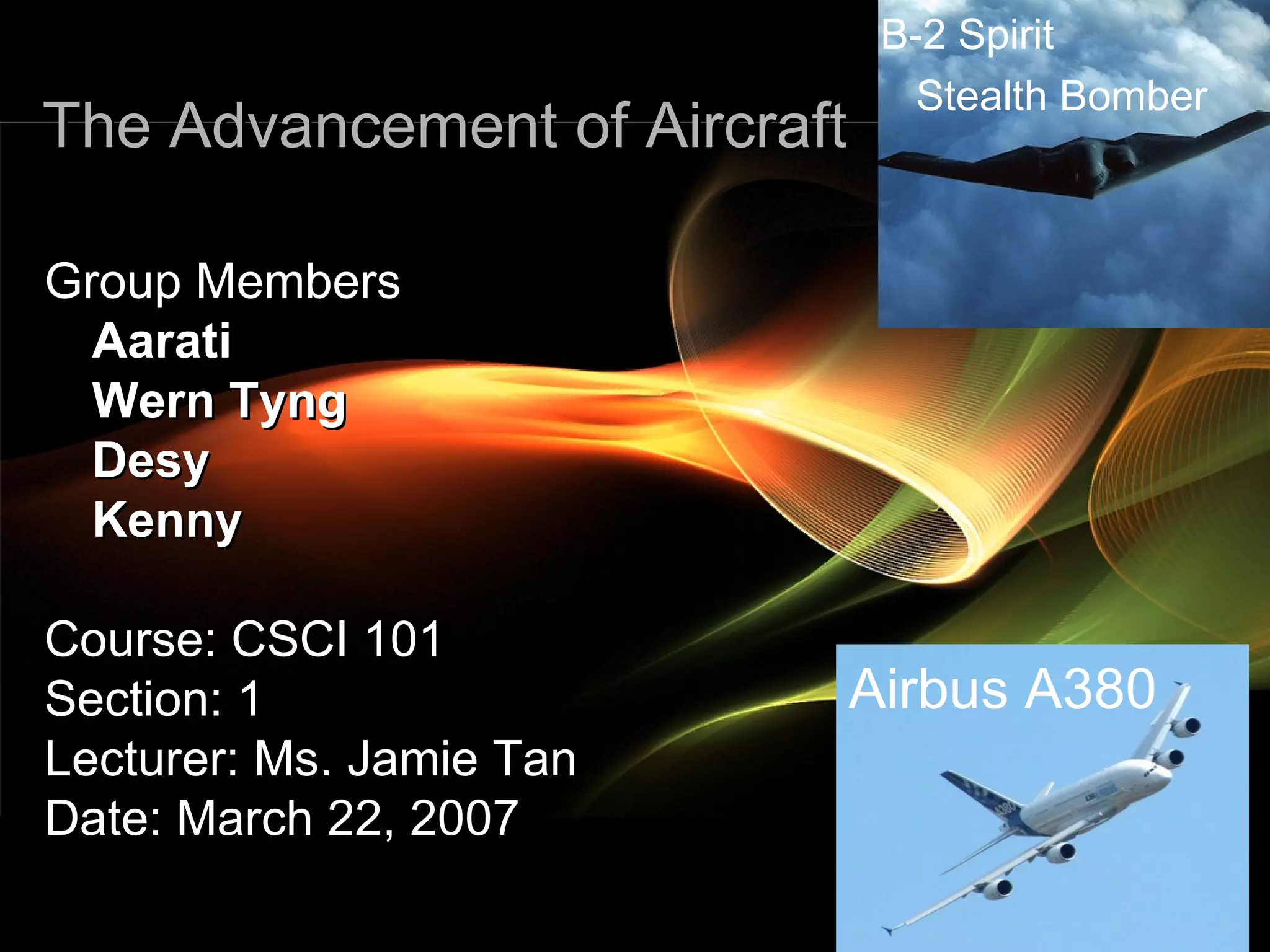
The Advancement of Aircraft Group Members Aarati Wern Tyng Desy Kenny Course: CSCI 101 Section: 1 Lecturer: Ms. Jamie Tan Date: March 22, 2007 B-2 Spirit  Stealth Bomber Airbus A380


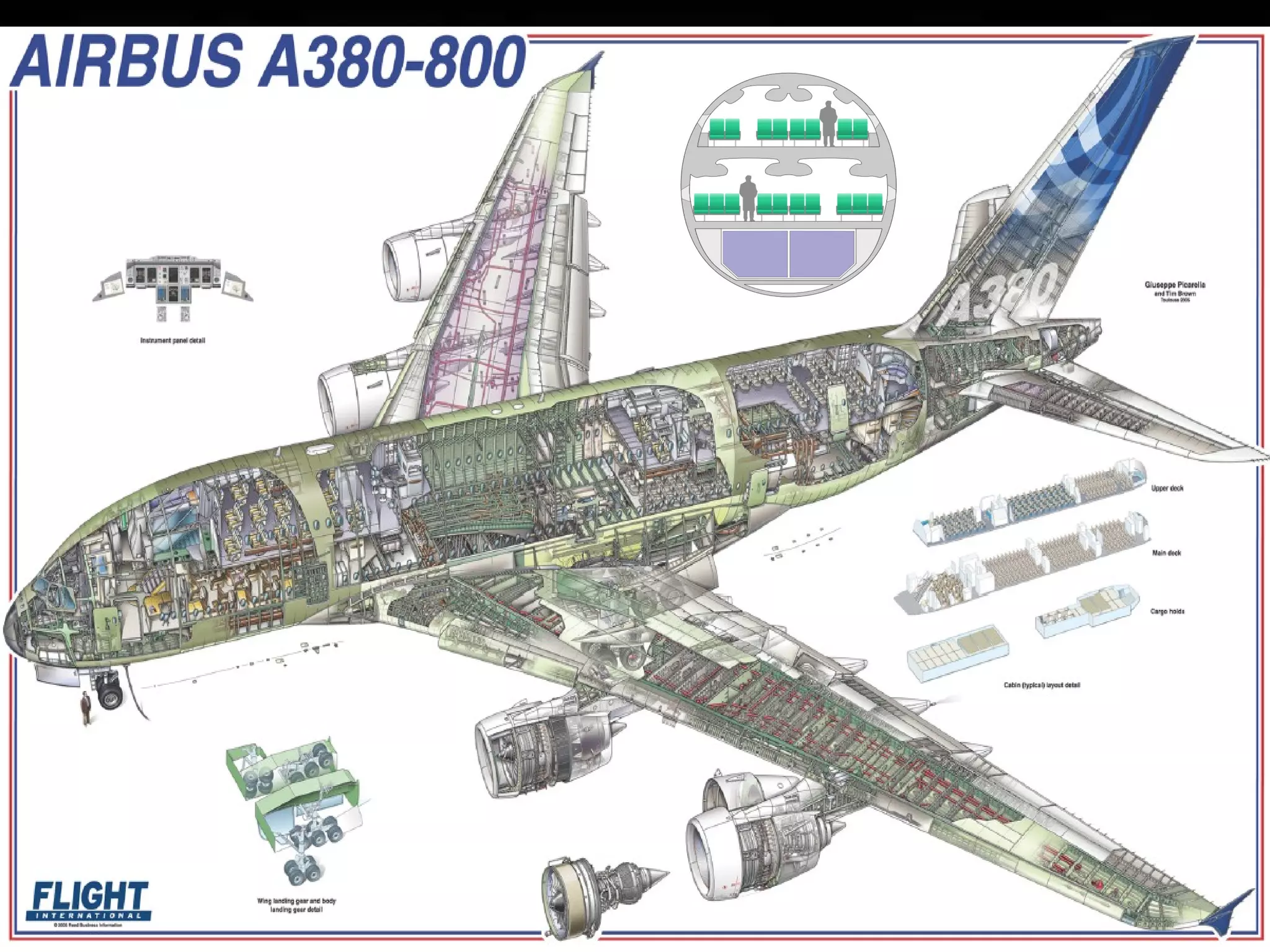
Airbus A380 Design & Specification The Airbus A380 is sold in two models.  The A380-800 can carry 555 passengers in a three-class configuration or up to 853 passengers in a single-class economy configuration. The range for the -800 model is 15,000 kilometers. The second model, the A380-800F freighter, will carry 150,000kg of cargo 10,400 km. 3,010m Take-Off Field Length 15,000km or 10,410km Performance Range 1040km/h Cruise Speed 590,000kg Maximum Take-Off Weight 30.38m Tail Plane Span 24.08m Overall Height 72.75m Length 252,200kg Empty Weight 79.65m Wingspan
 
 
AirBus A380 Advances The new design has to offer them a way to make more money.  The A380 offer opportunities for increased profit through the  economics of scale.  The operating cost of an A380 is not significantly greater than that of the Boeing 747 (the closest passenger jet in size and capacity).  The increased range helps add to an increased number of "seat-miles" per flight. The end result is a  drop in per-passenger operating costs  of 15 to 20 percent.
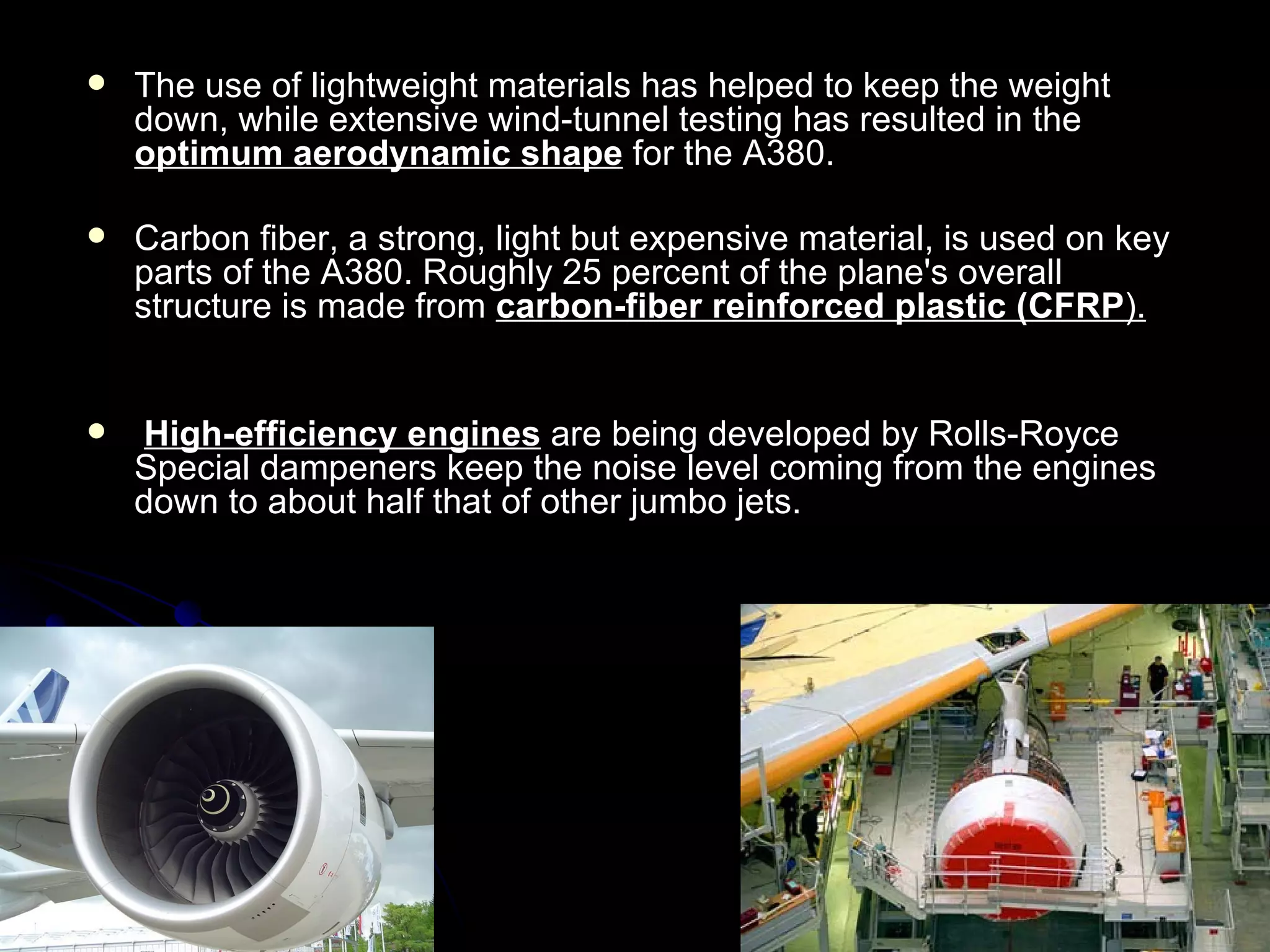
The use of lightweight materials has helped to keep the weight down, while extensive wind-tunnel testing has resulted in the  optimum aerodynamic shape  for the A380.  Carbon fiber, a strong, light but expensive material, is used on key parts of the A380. Roughly 25 percent of the plane's overall structure is made from  carbon-fiber reinforced plastic (CFRP ).   High-efficiency engines  are being developed by Rolls-Royce Special dampeners keep the noise level coming from the engines down to about half that of other jumbo jets.
AirBus A380 Interior Airbus offering  50 percent more floor space  than old generation aircraft.  With the A380's comfort and space, installations such as relaxation areas, bars, gyms, duty-free shops, and beauty salons is possible.  With 555 passengers, the A380 represents a 35% increase over the 747-400 in standard three-class configuration, along with a nearly  50% larger cabin volume  - meaning much more space per passenger.  It can hold up to 853 passengers in an all-economy-class configuration, its maximum certified carrying capacity.
1st class stretched seat (flat bed seat style). Offering about a third more seating and far more available floor space than its closest competitor, the A380 will have wider seats and aisles, open spaces for passengers to stretch their legs.
Passenger Bar area in business class. Onboard gyms and showers will all become a reality .  A380 will be the most spacious passenger plane. There will be room on the lower deck for shops, bars, restaurants, gyms and casinos.
For long-distance passengers used to cramped economy class cabins, the A380 will offer new levels of comfort with wider seats and aisles, individual armrests and extra legroom. Economy class seats will be about 1 inch wider.
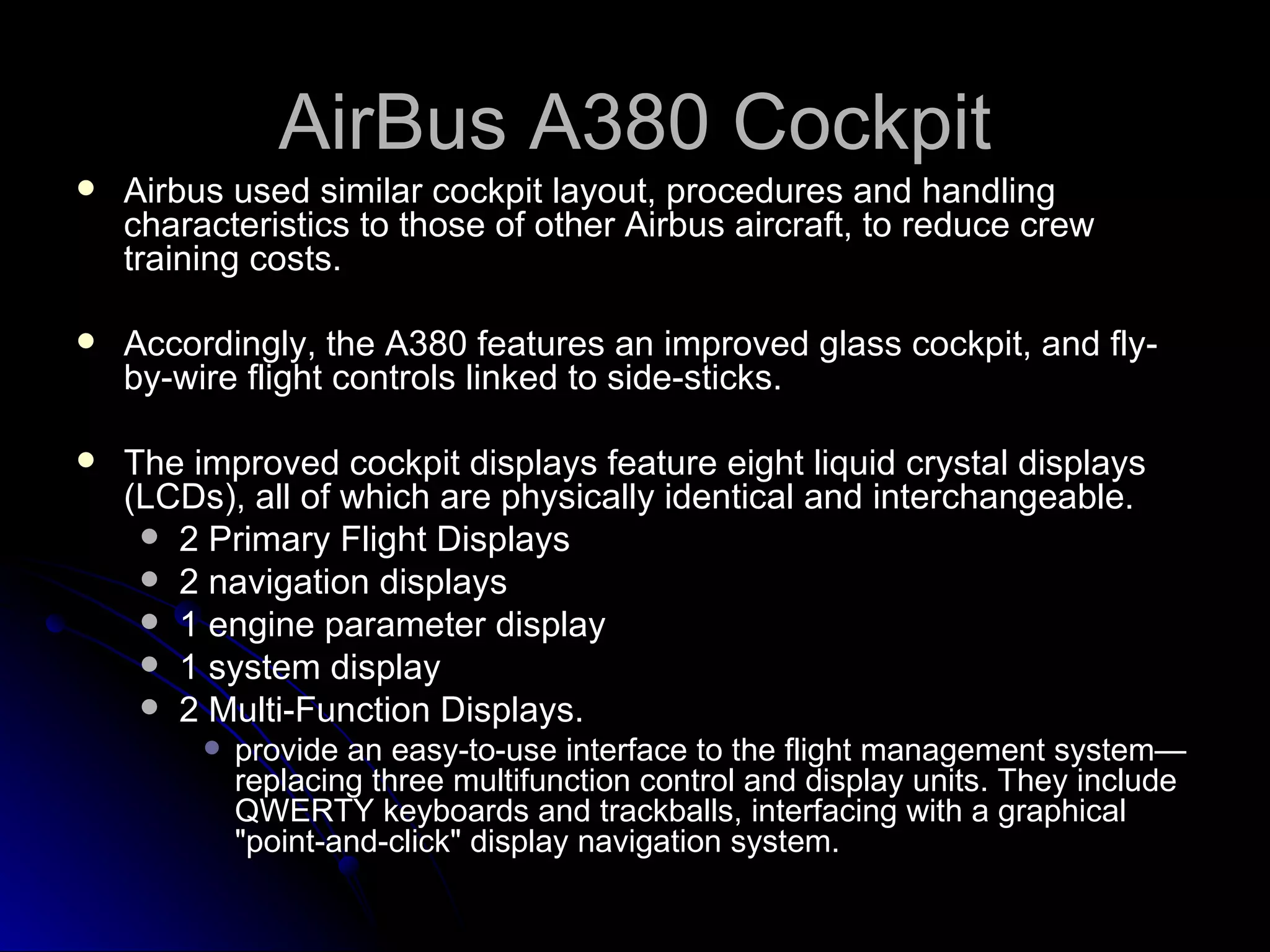
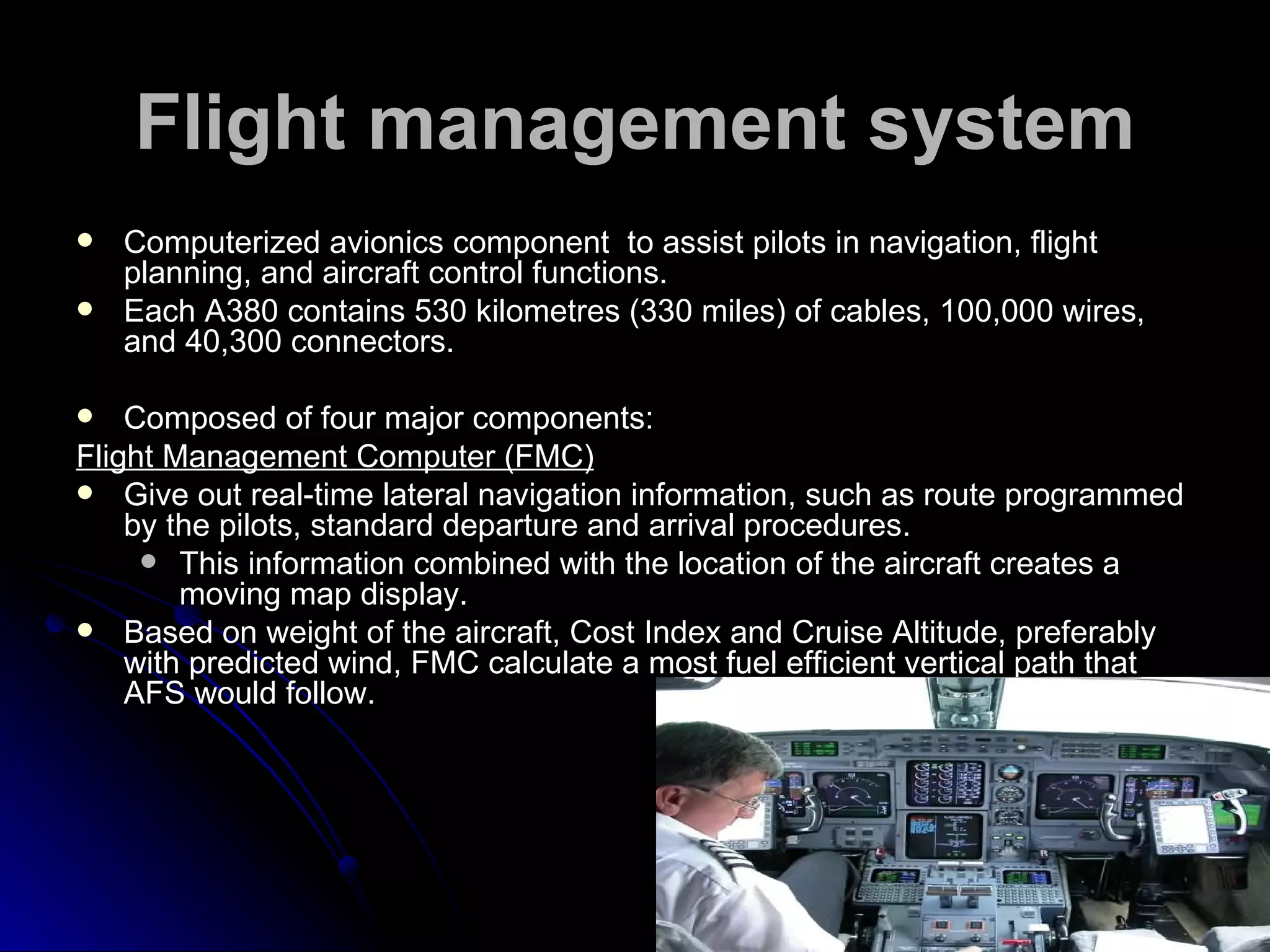
AirBus A380 Cockpit Airbus used similar cockpit layout, procedures and handling characteristics to those of other Airbus aircraft, to reduce crew training costs.  Accordingly, the A380 features an improved glass cockpit, and fly-by-wire flight controls linked to side-sticks.  The improved cockpit displays feature eight liquid crystal displays (LCDs), all of which are physically identical and interchangeable.  2 Primary Flight Displays 2 navigation displays 1 engine parameter display 1 system display  2 Multi-Function Displays.  provide an easy-to-use interface to the flight management system—replacing three multifunction control and display units. They include QWERTY keyboards and trackballs, interfacing with a graphical "point-and-click" display navigation system.
Flight Management System
Flight management system Computerized avionics component  to assist pilots in navigation, flight planning, and aircraft control functions. Each A380 contains 530 kilometres (330 miles) of cables, 100,000 wires, and 40,300 connectors. Composed of four major components:  Flight Management Computer (FMC) Give out real-time lateral navigation information, such as route programmed by the pilots, standard departure and arrival procedures. This information combined with the location of the aircraft creates a moving map display.  Based on weight of the aircraft, Cost Index and Cruise Altitude, preferably with predicted wind, FMC calculate a most fuel efficient vertical path that AFS would follow.
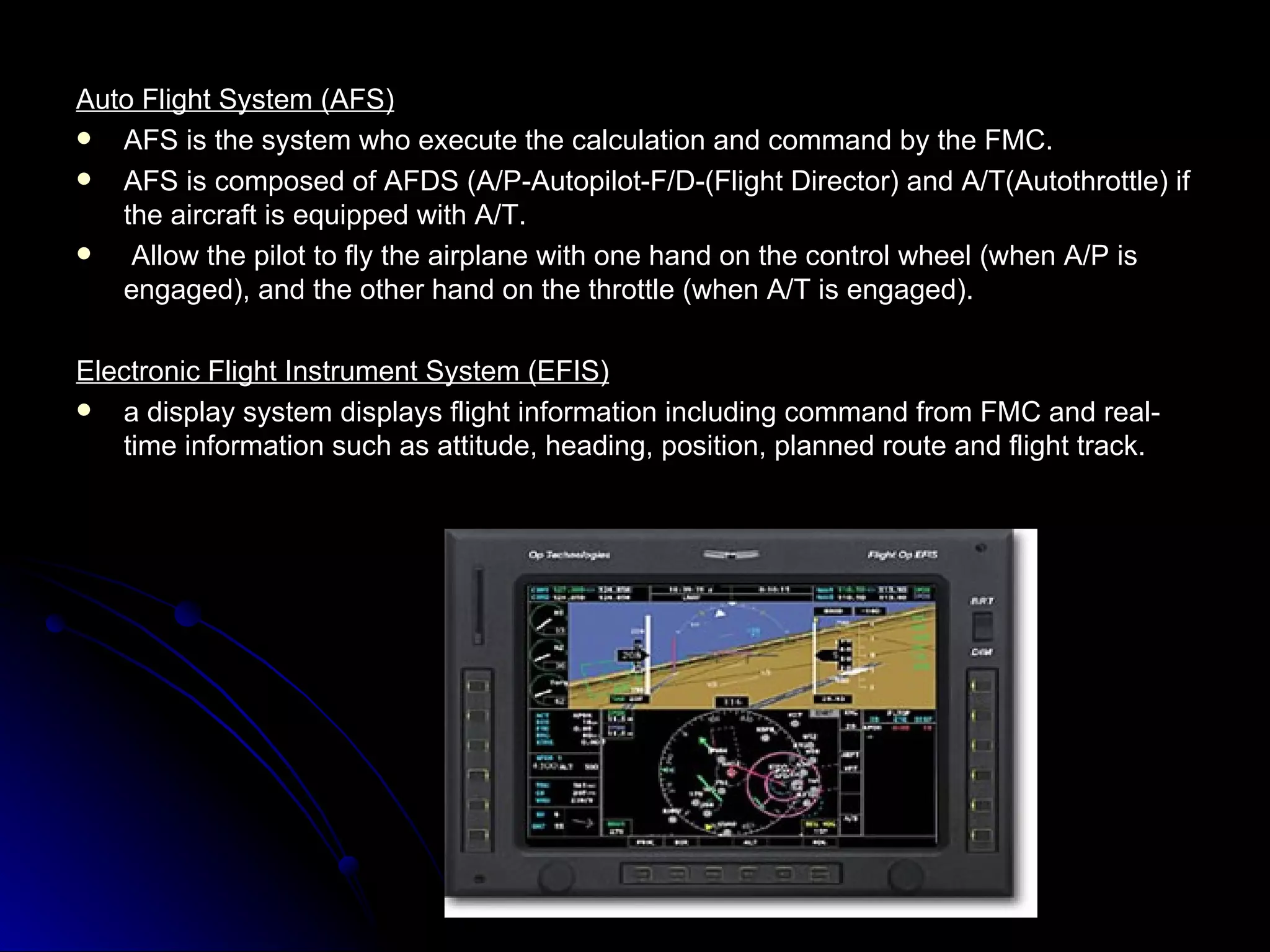
Auto Flight System (AFS) AFS is the system who execute the calculation and command by the FMC.  AFS is composed of AFDS (A/P-Autopilot-F/D-(Flight Director) and A/T(Autothrottle) if the aircraft is equipped with A/T. Allow the pilot to fly the airplane with one hand on the control wheel (when A/P is engaged), and the other hand on the throttle (when A/T is engaged).  Electronic Flight Instrument System (EFIS) a display system displays flight information including command from FMC and real-time information such as attitude, heading, position, planned route and flight track.
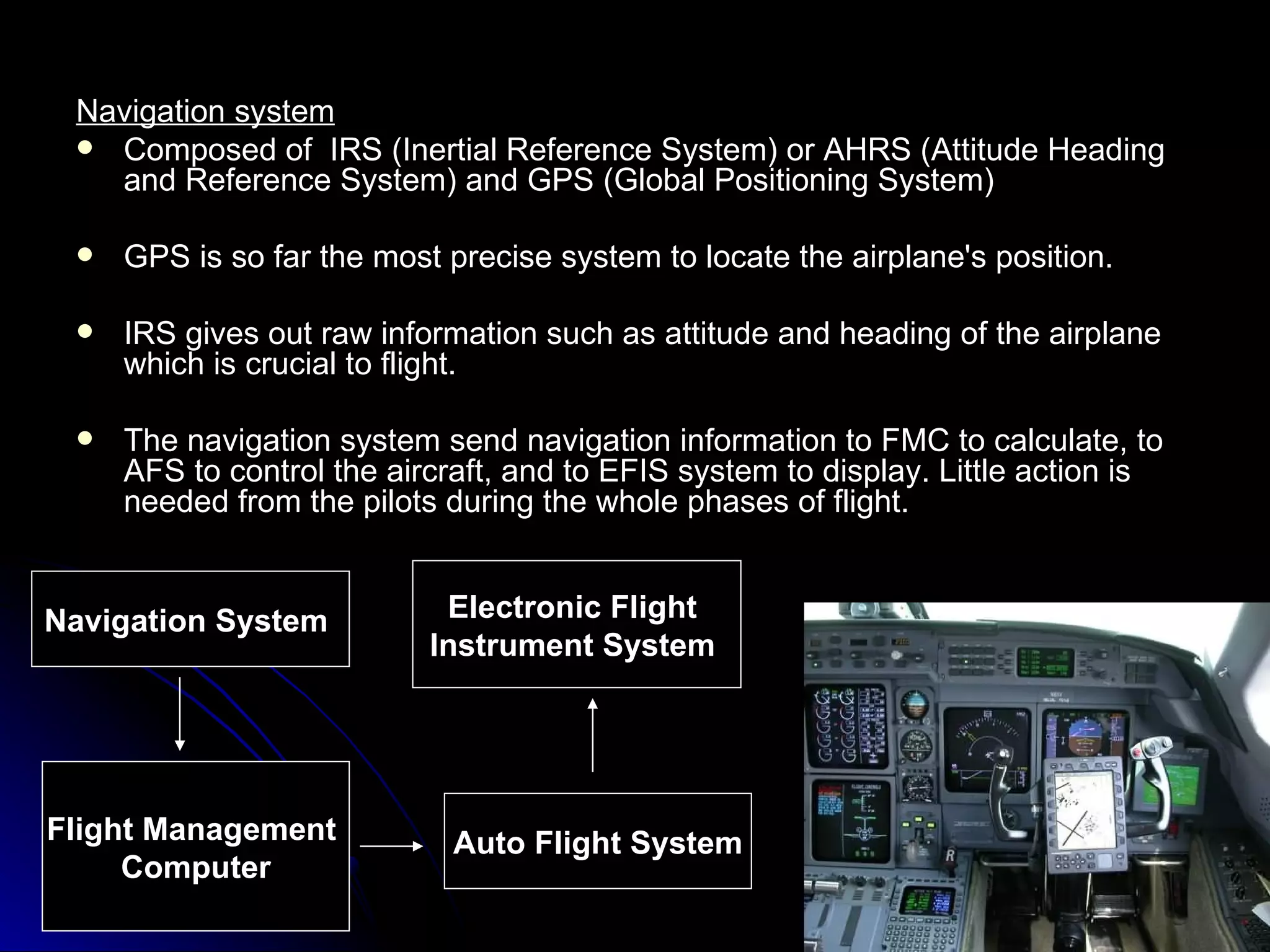
Navigation system Composed of  IRS (Inertial Reference System) or AHRS (Attitude Heading and Reference System) and GPS (Global Positioning System) GPS is so far the most precise system to locate the airplane's position. IRS gives out raw information such as attitude and heading of the airplane which is crucial to flight.  The navigation system send navigation information to FMC to calculate, to AFS to control the aircraft, and to EFIS system to display. Little action is needed from the pilots during the whole phases of flight. Navigation System  Flight Management  Computer Electronic Flight  Instrument System  Auto Flight System
Northrop Grumman  B-2 Spirit Stealth Bomber
 
 
B-2 Spirit Specifications Crew: 2  Length: 20.9 m Wingspan: 52.12 m Height: 5.1 m Empty weight: 71,700 kg  Loaded weight: 152,600 kg Max takeoff weight: 171,000 kg Performance Maximum speed: 764 km/h  Range: 10,400 km Service ceiling: 15,000 m  Introduced  April 1997 Number built  21 Unit cost  US$1.157-$2.2 billion in 1998 Maximum bomb weight: 20,000kg Maximum carriage quantity : 150
B-2 Spirit Stealth Bomber The B-2 has a crew of two; a pilot in the left seat and mission commander in the right. Capable of all-altitude attack missions up to 15,000m , with a range of more than 10,400 km unrefuelled and over 20,000km with one refuelling, giving it the ability to fly to any point in the world within hours. The B-2's stealth comes from a combination of reduced acoustic, infrared, visual and radar signatures, making it difficult for defences to detect, track and engage.  the B-2's low observable materials, special radar-absorbent coating and flying wing design contribute to its stealth abilities.
COCKPIT The cockpit accommodates two crew. It is equipped Electronic Flight Instrumentation System (EFIS), which displays flight, engine and sensor data and avionics systems and weapons status. The pilot can choose to activate the appropriate selection of flight and mission equipment for take-off mode, go-to-war mode and landing mode by using a simple three-way switch. NAVIGATION  The B-2's navigation suite includes a Rockwell Collins TCN-250 Tactical Air Navigation system (TACAN) and a VIR-130A instrument landing system.  RADAR The Raytheon AN/APQ-181 covert strike radar, operating at J-band (Ku-band), is a multi-purpose radar with terrain following and terrain avoidance modes at altitudes down to 200ft.
ENGINE The aircraft is powered by four General Electric F118-GE-100 turbofan engines internally mounted in the body of the wings.  The engines have an exhaust temperature control system to minimise thermal signature. The engines, rated at 77kN, provide a high subsonic speed. In-flight refuelling gear is installed in the top centre line of the aircraft behind the cockpit. COUNTERMEASURES The B-2 carries a Lockheed Martin radar warning receiver, a Northrop Grumman defensive aids system and the Lockheed Martin AN/APR-50 Defensive Management System (DMS).
 

Airbus A380 & B-2 Spirit Stealth Bomber

  • 1.
    The Advancement ofAircraft Group Members Aarati Wern Tyng Desy Kenny Course: CSCI 101 Section: 1 Lecturer: Ms. Jamie Tan Date: March 22, 2007 B-2 Spirit Stealth Bomber Airbus A380
  • 2.
  • 3.
  • 4.
  • 5.
  • 6.
    Airbus A380 Design& Specification The Airbus A380 is sold in two models. The A380-800 can carry 555 passengers in a three-class configuration or up to 853 passengers in a single-class economy configuration. The range for the -800 model is 15,000 kilometers. The second model, the A380-800F freighter, will carry 150,000kg of cargo 10,400 km. 3,010m Take-Off Field Length 15,000km or 10,410km Performance Range 1040km/h Cruise Speed 590,000kg Maximum Take-Off Weight 30.38m Tail Plane Span 24.08m Overall Height 72.75m Length 252,200kg Empty Weight 79.65m Wingspan
  • 7.
  • 8.
  • 9.
    AirBus A380 AdvancesThe new design has to offer them a way to make more money. The A380 offer opportunities for increased profit through the economics of scale. The operating cost of an A380 is not significantly greater than that of the Boeing 747 (the closest passenger jet in size and capacity). The increased range helps add to an increased number of "seat-miles" per flight. The end result is a drop in per-passenger operating costs of 15 to 20 percent.
  • 10.
    The use oflightweight materials has helped to keep the weight down, while extensive wind-tunnel testing has resulted in the optimum aerodynamic shape for the A380. Carbon fiber, a strong, light but expensive material, is used on key parts of the A380. Roughly 25 percent of the plane's overall structure is made from carbon-fiber reinforced plastic (CFRP ). High-efficiency engines are being developed by Rolls-Royce Special dampeners keep the noise level coming from the engines down to about half that of other jumbo jets.
  • 11.
    AirBus A380 InteriorAirbus offering 50 percent more floor space than old generation aircraft. With the A380's comfort and space, installations such as relaxation areas, bars, gyms, duty-free shops, and beauty salons is possible. With 555 passengers, the A380 represents a 35% increase over the 747-400 in standard three-class configuration, along with a nearly 50% larger cabin volume - meaning much more space per passenger. It can hold up to 853 passengers in an all-economy-class configuration, its maximum certified carrying capacity.
  • 12.
    1st class stretchedseat (flat bed seat style). Offering about a third more seating and far more available floor space than its closest competitor, the A380 will have wider seats and aisles, open spaces for passengers to stretch their legs.
  • 13.
    Passenger Bar areain business class. Onboard gyms and showers will all become a reality . A380 will be the most spacious passenger plane. There will be room on the lower deck for shops, bars, restaurants, gyms and casinos.
  • 14.
    For long-distance passengersused to cramped economy class cabins, the A380 will offer new levels of comfort with wider seats and aisles, individual armrests and extra legroom. Economy class seats will be about 1 inch wider.
  • 15.
    AirBus A380 CockpitAirbus used similar cockpit layout, procedures and handling characteristics to those of other Airbus aircraft, to reduce crew training costs. Accordingly, the A380 features an improved glass cockpit, and fly-by-wire flight controls linked to side-sticks. The improved cockpit displays feature eight liquid crystal displays (LCDs), all of which are physically identical and interchangeable. 2 Primary Flight Displays 2 navigation displays 1 engine parameter display 1 system display 2 Multi-Function Displays. provide an easy-to-use interface to the flight management system—replacing three multifunction control and display units. They include QWERTY keyboards and trackballs, interfacing with a graphical "point-and-click" display navigation system.
  • 16.
  • 17.
    Flight management systemComputerized avionics component to assist pilots in navigation, flight planning, and aircraft control functions. Each A380 contains 530 kilometres (330 miles) of cables, 100,000 wires, and 40,300 connectors. Composed of four major components: Flight Management Computer (FMC) Give out real-time lateral navigation information, such as route programmed by the pilots, standard departure and arrival procedures. This information combined with the location of the aircraft creates a moving map display. Based on weight of the aircraft, Cost Index and Cruise Altitude, preferably with predicted wind, FMC calculate a most fuel efficient vertical path that AFS would follow.
  • 18.
    Auto Flight System(AFS) AFS is the system who execute the calculation and command by the FMC. AFS is composed of AFDS (A/P-Autopilot-F/D-(Flight Director) and A/T(Autothrottle) if the aircraft is equipped with A/T. Allow the pilot to fly the airplane with one hand on the control wheel (when A/P is engaged), and the other hand on the throttle (when A/T is engaged). Electronic Flight Instrument System (EFIS) a display system displays flight information including command from FMC and real-time information such as attitude, heading, position, planned route and flight track.
  • 19.
    Navigation system Composedof IRS (Inertial Reference System) or AHRS (Attitude Heading and Reference System) and GPS (Global Positioning System) GPS is so far the most precise system to locate the airplane's position. IRS gives out raw information such as attitude and heading of the airplane which is crucial to flight. The navigation system send navigation information to FMC to calculate, to AFS to control the aircraft, and to EFIS system to display. Little action is needed from the pilots during the whole phases of flight. Navigation System Flight Management Computer Electronic Flight Instrument System Auto Flight System
  • 20.
    Northrop Grumman B-2 Spirit Stealth Bomber
  • 21.
  • 22.
  • 23.
    B-2 Spirit SpecificationsCrew: 2 Length: 20.9 m Wingspan: 52.12 m Height: 5.1 m Empty weight: 71,700 kg Loaded weight: 152,600 kg Max takeoff weight: 171,000 kg Performance Maximum speed: 764 km/h Range: 10,400 km Service ceiling: 15,000 m Introduced April 1997 Number built 21 Unit cost US$1.157-$2.2 billion in 1998 Maximum bomb weight: 20,000kg Maximum carriage quantity : 150
  • 24.
    B-2 Spirit StealthBomber The B-2 has a crew of two; a pilot in the left seat and mission commander in the right. Capable of all-altitude attack missions up to 15,000m , with a range of more than 10,400 km unrefuelled and over 20,000km with one refuelling, giving it the ability to fly to any point in the world within hours. The B-2's stealth comes from a combination of reduced acoustic, infrared, visual and radar signatures, making it difficult for defences to detect, track and engage. the B-2's low observable materials, special radar-absorbent coating and flying wing design contribute to its stealth abilities.
  • 25.
    COCKPIT The cockpitaccommodates two crew. It is equipped Electronic Flight Instrumentation System (EFIS), which displays flight, engine and sensor data and avionics systems and weapons status. The pilot can choose to activate the appropriate selection of flight and mission equipment for take-off mode, go-to-war mode and landing mode by using a simple three-way switch. NAVIGATION The B-2's navigation suite includes a Rockwell Collins TCN-250 Tactical Air Navigation system (TACAN) and a VIR-130A instrument landing system. RADAR The Raytheon AN/APQ-181 covert strike radar, operating at J-band (Ku-band), is a multi-purpose radar with terrain following and terrain avoidance modes at altitudes down to 200ft.
  • 26.
    ENGINE The aircraftis powered by four General Electric F118-GE-100 turbofan engines internally mounted in the body of the wings. The engines have an exhaust temperature control system to minimise thermal signature. The engines, rated at 77kN, provide a high subsonic speed. In-flight refuelling gear is installed in the top centre line of the aircraft behind the cockpit. COUNTERMEASURES The B-2 carries a Lockheed Martin radar warning receiver, a Northrop Grumman defensive aids system and the Lockheed Martin AN/APR-50 Defensive Management System (DMS).
  • 27.