Carbohydrates
Topic to be discuss
2
Haworth Projection formula5
Classification2
Open structure of Glucose3
Cyclic structure of Glucose4
Epimerization, Mutarotation6
Definition1
Uses7
What are Carbohydrates?
• Carbohydrates, commonly referred to as sugars and
starches,
are optically active polyhydroxy aldehydes or
polyhydroxy ketones
or
the compounds that on hydrolysis give polyhydroxy
aldehydes or polyhydroxy ketones.
General Formula: Cx(H2O)y
Hydrates of Carbon
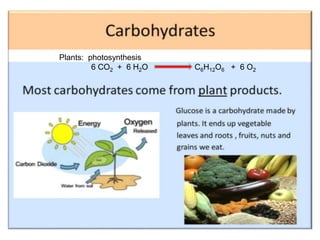
Plants: photosynthesis
6 CO2 + 6 H2O C6H12O6 + 6 O2
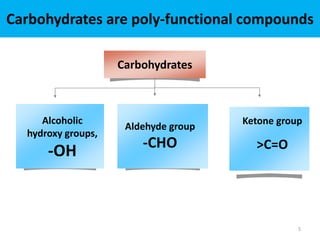
Carbohydrates are poly-functional compounds
Carbohydrates
Alcoholic
hydroxy groups,
-OH
Aldehyde group
-CHO
Ketone group
>C=O
5
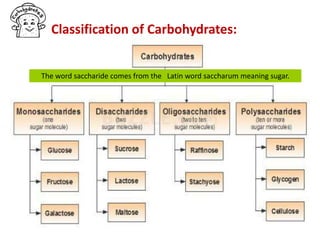
Classification of Carbohydrates:
The word saccharide comes from the Latin word saccharum meaning sugar.
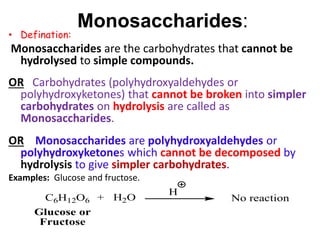
Monosaccharides:
• Defination:
Monosaccharides are the carbohydrates that cannot be
hydrolysed to simple compounds.
OR Carbohydrates (polyhydroxyaldehydes or
polyhydroxyketones) that cannot be broken into simpler
carbohydrates on hydrolysis are called as
Monosaccharides.
OR Monosaccharides are polyhydroxyaldehydes or
polyhydroxyketones which cannot be decomposed by
hydrolysis to give simpler carbohydrates.
Examples: Glucose and fructose.
C6H12O6 + H2O
H
No reaction
Glucose or
Fructose
C
C OHH
C HHO
C OHH
C OHH
CH2OH
D-glucose
OH
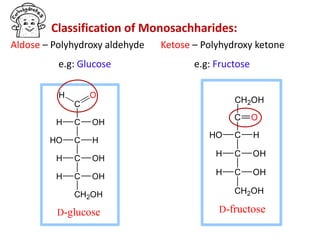
Aldose – Polyhydroxy aldehyde
e.g: Glucose
C HHO
C OHH
C OHH
CH2OH
CH2OH
C O
D-fructose
Ketose – Polyhydroxy ketone
e.g: Fructose
Classification of Monosachharides:
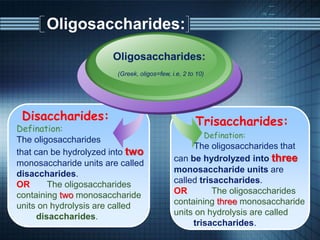
Oligosaccharides:
Disaccharides:
Defination:
The oligosaccharides
that can be hydrolyzed into two
monosaccharide units are called
disaccharides.
OR The oligosaccharides
containing two monosaccharide
units on hydrolysis are called
disaccharides.
Oligosaccharides:
(Greek, oligos=few, i.e, 2 to 10)
Trisaccharides:
Defination:
The oligosaccharides that
can be hydrolyzed into three
monosaccharide units are
called trisaccharides.
OR The oligosaccharides
containing three monosaccharide
units on hydrolysis are called
trisaccharides.
LOGO
Polysaccharides:
 Defination:
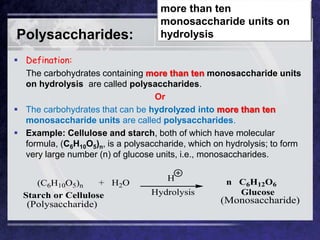
The carbohydrates containing more than ten monosaccharide units
on hydrolysis are called polysaccharides.
Or
 The carbohydrates that can be hydrolyzed into more than ten
monosaccharide units are called polysaccharides.
 Example: Cellulose and starch, both of which have molecular
formula, (C6H10O5)n, is a polysaccharide, which on hydrolysis; to form
very large number (n) of glucose units, i.e., monosaccharides.
more than ten
monosaccharide units on
hydrolysis
+ H2O
(Monosaccharide)
Hydrolysis Glucose
n C6H12O6
H
(Polysaccharide)
(C6H10O5)n
Starch or Cellulose
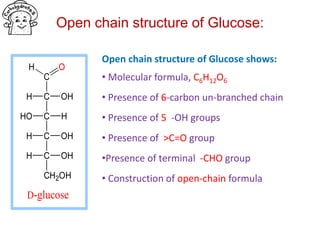
Open chain structure of Glucose:
C
C OHH
C HHO
C OHH
C OHH
CH2OH
D-glucose
OH
Open chain structure of Glucose shows:
• Molecular formula, C6H12O6
• Presence of 6-carbon un-branched chain
• Presence of 5 -OH groups
• Presence of >C=O group
•Presence of terminal -CHO group
• Construction of open-chain formula
CHO
OHH
OHH
OHH
OHH
CH2OH
CHO
HHO
OHH
OHH
OHH
CH2OH
CHO
OHH
HHO
OHH
OHH
CH2OH
CHO
HHO
HHO
OHH
OHH
CH2OH
CHO
OHH
OHH
HHO
OHH
CH2OH
CHO
HHO
OHH
HHO
OHH
CH2OH
CHO
OHH
HHO
HHO
OHH
CH2OH
CHO
HHO
HHO
HHO
OHH
CH2OH
CHO
HO H
HO H
HO H
HO H
CH2OH
CHO
H OH
HO H
HO H
HO H
CH2OH
CHO
HO H
H OH
HO H
HO H
CH2OH
CHO
H OH
H OH
HO H
HO H
CH2OH
CHO
HO H
HO H
H OH
HO H
CH2OH
CHO
H OH
HO H
H OH
HO H
CH2OH
CHO
HO H
H OH
H OH
HO H
CH2OH
CHO
H OH
H OH
H OH
HO H
CH2OH
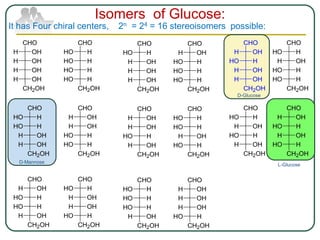
It has Four chiral centers, 2n = 24 = 16 stereoisomers possible:
Isomers of Glucose:
D-Glucose
L-Glucose
D-Mannose
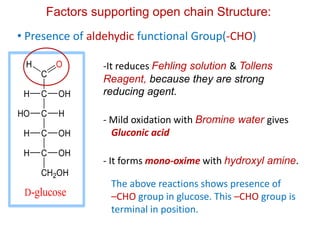
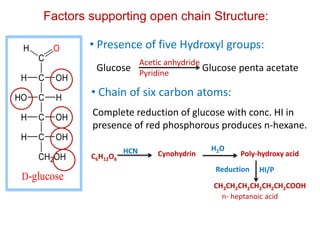
Factors supporting open chain Structure:
-It reduces Fehling solution & Tollens
Reagent, because they are strong
reducing agent.
- Mild oxidation with Bromine water gives
Gluconic acid
- It forms mono-oxime with hydroxyl amine.
The above reactions shows presence of
–CHO group in glucose. This –CHO group is
terminal in position.
• Presence of aldehydic functional Group(-CHO)
C
C OHH
C HHO
C OHH
C OHH
CH2OH
D-glucose
OH
Glucose Glucose penta acetate
C6H12O6
HCN Cynohydrin Poly-hydroxy acid
H2O
HI/P
CH3CH2CH2CH2CH2CH2COOH
n- heptanoic acid
• Presence of five Hydroxyl groups:
Factors supporting open chain Structure:
C
C OHH
C HHO
C OHH
C OHH
CH2OH
D-glucose
OH
Acetic anhydride
Pyridine
• Chain of six carbon atoms:
Complete reduction of glucose with conc. HI in
presence of red phosphorous produces n-hexane.
Reduction
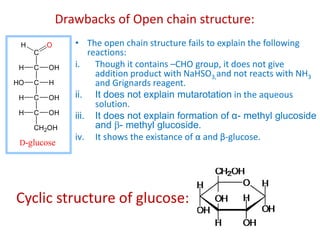
Drawbacks of Open chain structure:
• The open chain structure fails to explain the following
reactions:
i. Though it contains –CHO group, it does not give
addition product with NaHSO3,and not reacts with NH3
and Grignards reagent.
ii. It does not explain mutarotation in the aqueous
solution.
iii. It does not explain formation of α- methyl glucoside
and - methyl glucoside.
iv. It shows the existance of α and β-glucose.
C
C OHH
C HHO
C OHH
C OHH
CH2OH
D-glucose
OH
Cyclic structure of glucose:
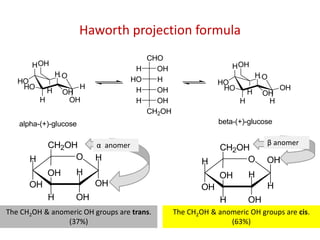
Haworth projection formula
CHO
OHH
HHO
OHH
OHH
CH2OH
O
H
HO
H
HO
H
OH
OHH
H
OH
O
H
HO
H
HO
H
H
OHH
OH
OH
alpha-(+)-glucose beta-(+)-glucose
OH
OH
OH
H
H
OHH
OH
CH2OH
OH
OH
H
OH
H
OHH
OH
CH2OH
The CH2OH & anomeric OH groups are trans.
(37%)
The CH2OH & anomeric OH groups are cis.
(63%)
α anomer β anomer
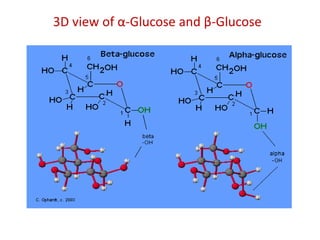
3D view of α-Glucose and β-Glucose
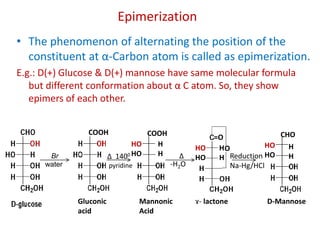
Epimerization
• The phenomenon of alternating the position of the
constituent at α-Carbon atom is called as epimerization.
E.g.: D(+) Glucose & D(+) mannose have same molecular formula
but different conformation about α C atom. So, they show
epimers of each other.
Br
water
COOH
Δ 1400
pyridine
COOH
HO
HO
H
H Δ
-H2O
=O
OH
H
HO
HO Reduction
Na-Hg/HCl
HO
HO
H
H
CHO
Gluconic
acid
Mannonic
Acid
ɤ- lactone D-Mannose
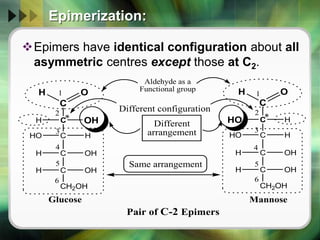
Epimerization:
Epimers have identical configuration about all
asymmetric centres except those at C2.
C
C
C
C
C
CH2OH
H O
OH
H
OH
OH
H
HO
H
H
Pair of C-2 Epimers
2
C
C
C
C
C
CH2OH
H O
H
H
OH
OH
HO
HO
H
H
2
Glucose Mannose
3
4
5
6
3
4
5
6
1 1
Different configuration
* *
Different
arrangement
Same arrangement
Aldehyde as a
Functional group
Mutarotation:
• The change in specific rotation of optically active
compound in solution to an equilibrium value is
called as Mutarotation.
• The inter conversion of one optically active form into
another is called as Mutarotation.
C HHO
C OHH
CH O H
CH2OH
C OHH
C
OH
1
2
3
4
5
6
*
*
*
*
D-(+)-Glucose
..
....
..
C
C
C
C
C
CH2OH
OH
H
OH
H
HO
H
H
D - Glucose
HO H C
C
C
C
C
CH2OH
OH
H
OH
H
HO
H
H
D - Glucose
O
H OH
Anomeric Carbons

Anomeric Carbons (new asymmertic carbon)
O
+ 52.5o
+ 19o + 110o
Open-chain structure
(Intermediate form)
* *
First carbon becomes asymmetric carbon
1 1
Mutarotation is a term related to interconversion of anomers (new asymmertric carbon).
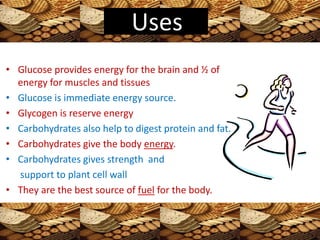
• Glucose provides energy for the brain and ½ of
energy for muscles and tissues
• Glucose is immediate energy source.
• Glycogen is reserve energy
• Carbohydrates also help to digest protein and fat.
• Carbohydrates give the body energy.
• Carbohydrates gives strength and
support to plant cell wall
• They are the best source of fuel for the body.
Uses
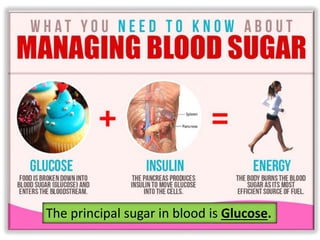
The principal sugar in blood is Glucose.
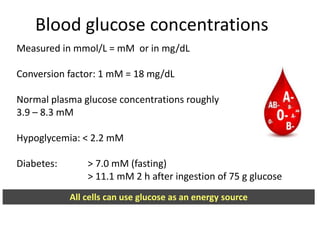
Blood glucose concentrations
Measured in mmol/L = mM or in mg/dL
Conversion factor: 1 mM = 18 mg/dL
Normal plasma glucose concentrations roughly
3.9 – 8.3 mM
Hypoglycemia: < 2.2 mM
Diabetes: > 7.0 mM (fasting)
> 11.1 mM 2 h after ingestion of 75 g glucose
All cells can use glucose as an energy source
REFFERENCES:
Cotton and wood are almost pure cellulose.
CARBOHYDRATES

CARBOHYDRATES

  • 1.
  • 2.
    Topic to bediscuss 2 Haworth Projection formula5 Classification2 Open structure of Glucose3 Cyclic structure of Glucose4 Epimerization, Mutarotation6 Definition1 Uses7
  • 3.
    What are Carbohydrates? •Carbohydrates, commonly referred to as sugars and starches, are optically active polyhydroxy aldehydes or polyhydroxy ketones or the compounds that on hydrolysis give polyhydroxy aldehydes or polyhydroxy ketones. General Formula: Cx(H2O)y Hydrates of Carbon
  • 4.
    Plants: photosynthesis 6 CO2+ 6 H2O C6H12O6 + 6 O2
  • 5.
    Carbohydrates are poly-functionalcompounds Carbohydrates Alcoholic hydroxy groups, -OH Aldehyde group -CHO Ketone group >C=O 5
  • 6.
    Classification of Carbohydrates: Theword saccharide comes from the Latin word saccharum meaning sugar.
  • 7.
    Monosaccharides: • Defination: Monosaccharides arethe carbohydrates that cannot be hydrolysed to simple compounds. OR Carbohydrates (polyhydroxyaldehydes or polyhydroxyketones) that cannot be broken into simpler carbohydrates on hydrolysis are called as Monosaccharides. OR Monosaccharides are polyhydroxyaldehydes or polyhydroxyketones which cannot be decomposed by hydrolysis to give simpler carbohydrates. Examples: Glucose and fructose. C6H12O6 + H2O H No reaction Glucose or Fructose
  • 8.
    C C OHH C HHO COHH C OHH CH2OH D-glucose OH Aldose – Polyhydroxy aldehyde e.g: Glucose C HHO C OHH C OHH CH2OH CH2OH C O D-fructose Ketose – Polyhydroxy ketone e.g: Fructose Classification of Monosachharides:
  • 9.
    Oligosaccharides: Disaccharides: Defination: The oligosaccharides that canbe hydrolyzed into two monosaccharide units are called disaccharides. OR The oligosaccharides containing two monosaccharide units on hydrolysis are called disaccharides. Oligosaccharides: (Greek, oligos=few, i.e, 2 to 10) Trisaccharides: Defination: The oligosaccharides that can be hydrolyzed into three monosaccharide units are called trisaccharides. OR The oligosaccharides containing three monosaccharide units on hydrolysis are called trisaccharides.
  • 10.
    LOGO Polysaccharides:  Defination: The carbohydratescontaining more than ten monosaccharide units on hydrolysis are called polysaccharides. Or  The carbohydrates that can be hydrolyzed into more than ten monosaccharide units are called polysaccharides.  Example: Cellulose and starch, both of which have molecular formula, (C6H10O5)n, is a polysaccharide, which on hydrolysis; to form very large number (n) of glucose units, i.e., monosaccharides. more than ten monosaccharide units on hydrolysis + H2O (Monosaccharide) Hydrolysis Glucose n C6H12O6 H (Polysaccharide) (C6H10O5)n Starch or Cellulose
  • 11.
    Open chain structureof Glucose: C C OHH C HHO C OHH C OHH CH2OH D-glucose OH Open chain structure of Glucose shows: • Molecular formula, C6H12O6 • Presence of 6-carbon un-branched chain • Presence of 5 -OH groups • Presence of >C=O group •Presence of terminal -CHO group • Construction of open-chain formula
  • 14.
    CHO OHH OHH OHH OHH CH2OH CHO HHO OHH OHH OHH CH2OH CHO OHH HHO OHH OHH CH2OH CHO HHO HHO OHH OHH CH2OH CHO OHH OHH HHO OHH CH2OH CHO HHO OHH HHO OHH CH2OH CHO OHH HHO HHO OHH CH2OH CHO HHO HHO HHO OHH CH2OH CHO HO H HO H HOH HO H CH2OH CHO H OH HO H HO H HO H CH2OH CHO HO H H OH HO H HO H CH2OH CHO H OH H OH HO H HO H CH2OH CHO HO H HO H H OH HO H CH2OH CHO H OH HO H H OH HO H CH2OH CHO HO H H OH H OH HO H CH2OH CHO H OH H OH H OH HO H CH2OH It has Four chiral centers, 2n = 24 = 16 stereoisomers possible: Isomers of Glucose: D-Glucose L-Glucose D-Mannose
  • 15.
    Factors supporting openchain Structure: -It reduces Fehling solution & Tollens Reagent, because they are strong reducing agent. - Mild oxidation with Bromine water gives Gluconic acid - It forms mono-oxime with hydroxyl amine. The above reactions shows presence of –CHO group in glucose. This –CHO group is terminal in position. • Presence of aldehydic functional Group(-CHO) C C OHH C HHO C OHH C OHH CH2OH D-glucose OH
  • 16.
    Glucose Glucose pentaacetate C6H12O6 HCN Cynohydrin Poly-hydroxy acid H2O HI/P CH3CH2CH2CH2CH2CH2COOH n- heptanoic acid • Presence of five Hydroxyl groups: Factors supporting open chain Structure: C C OHH C HHO C OHH C OHH CH2OH D-glucose OH Acetic anhydride Pyridine • Chain of six carbon atoms: Complete reduction of glucose with conc. HI in presence of red phosphorous produces n-hexane. Reduction
  • 17.
    Drawbacks of Openchain structure: • The open chain structure fails to explain the following reactions: i. Though it contains –CHO group, it does not give addition product with NaHSO3,and not reacts with NH3 and Grignards reagent. ii. It does not explain mutarotation in the aqueous solution. iii. It does not explain formation of α- methyl glucoside and - methyl glucoside. iv. It shows the existance of α and β-glucose. C C OHH C HHO C OHH C OHH CH2OH D-glucose OH Cyclic structure of glucose:
  • 18.
    Haworth projection formula CHO OHH HHO OHH OHH CH2OH O H HO H HO H OH OHH H OH O H HO H HO H H OHH OH OH alpha-(+)-glucosebeta-(+)-glucose OH OH OH H H OHH OH CH2OH OH OH H OH H OHH OH CH2OH The CH2OH & anomeric OH groups are trans. (37%) The CH2OH & anomeric OH groups are cis. (63%) α anomer β anomer
  • 19.
    3D view ofα-Glucose and β-Glucose
  • 20.
    Epimerization • The phenomenonof alternating the position of the constituent at α-Carbon atom is called as epimerization. E.g.: D(+) Glucose & D(+) mannose have same molecular formula but different conformation about α C atom. So, they show epimers of each other. Br water COOH Δ 1400 pyridine COOH HO HO H H Δ -H2O =O OH H HO HO Reduction Na-Hg/HCl HO HO H H CHO Gluconic acid Mannonic Acid ɤ- lactone D-Mannose
  • 21.
    Epimerization: Epimers have identicalconfiguration about all asymmetric centres except those at C2. C C C C C CH2OH H O OH H OH OH H HO H H Pair of C-2 Epimers 2 C C C C C CH2OH H O H H OH OH HO HO H H 2 Glucose Mannose 3 4 5 6 3 4 5 6 1 1 Different configuration * * Different arrangement Same arrangement Aldehyde as a Functional group
  • 22.
    Mutarotation: • The changein specific rotation of optically active compound in solution to an equilibrium value is called as Mutarotation. • The inter conversion of one optically active form into another is called as Mutarotation. C HHO C OHH CH O H CH2OH C OHH C OH 1 2 3 4 5 6 * * * * D-(+)-Glucose .. .... .. C C C C C CH2OH OH H OH H HO H H D - Glucose HO H C C C C C CH2OH OH H OH H HO H H D - Glucose O H OH Anomeric Carbons  Anomeric Carbons (new asymmertic carbon) O + 52.5o + 19o + 110o Open-chain structure (Intermediate form) * * First carbon becomes asymmetric carbon 1 1 Mutarotation is a term related to interconversion of anomers (new asymmertric carbon).
  • 23.
    • Glucose providesenergy for the brain and ½ of energy for muscles and tissues • Glucose is immediate energy source. • Glycogen is reserve energy • Carbohydrates also help to digest protein and fat. • Carbohydrates give the body energy. • Carbohydrates gives strength and support to plant cell wall • They are the best source of fuel for the body. Uses
  • 24.
    The principal sugarin blood is Glucose.
  • 25.
    Blood glucose concentrations Measuredin mmol/L = mM or in mg/dL Conversion factor: 1 mM = 18 mg/dL Normal plasma glucose concentrations roughly 3.9 – 8.3 mM Hypoglycemia: < 2.2 mM Diabetes: > 7.0 mM (fasting) > 11.1 mM 2 h after ingestion of 75 g glucose All cells can use glucose as an energy source
  • 26.
    REFFERENCES: Cotton and woodare almost pure cellulose.