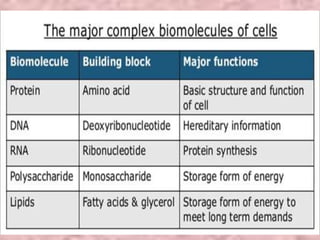
BIOMOLECULES
Module 1/3
CLASS 12
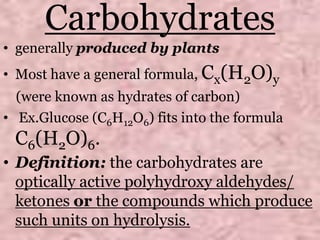
Carbohydrates
• generally produced by plants
• Most have a general formula, Cx(H2O)y
(were known as hydrates of carbon)
• Ex.Glucose (C6H12O6) fits into the formula
C6(H2O)6.
• Definition: the carbohydrates are
optically active polyhydroxy aldehydes/
ketones or the compounds which produce
such units on hydrolysis.
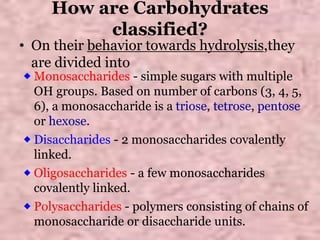
How are Carbohydrates
classified?
• On their behavior towards hydrolysis,they
are divided into
⬥Monosaccharides - simple sugars with multiple
OH groups. Based on number of carbons (3, 4, 5,
6), a monosaccharide is a triose, tetrose, pentose
or hexose.
⬥Disaccharides - 2 monosaccharides covalently
linked.
⬥Oligosaccharides - a few monosaccharides
covalently linked.
⬥Polysaccharides - polymers consisting of chains of
monosaccharide or disaccharide units.
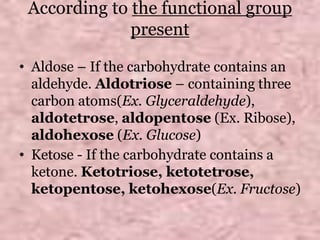
According to the functional group
present
• Aldose – If the carbohydrate contains an
aldehyde. Aldotriose – containing three
carbon atoms(Ex. Glyceraldehyde),
aldotetrose, aldopentose (Ex. Ribose),
aldohexose (Ex. Glucose)
• Ketose - If the carbohydrate contains a
ketone. Ketotriose, ketotetrose,
ketopentose, ketohexose(Ex. Fructose)
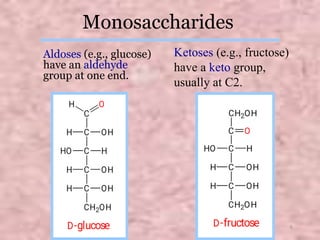
Monosaccharides
Aldoses (e.g., glucose)
have an aldehyde
group at one end.
Ketoses (e.g., fructose)
have a keto group,
usually at C2.
6
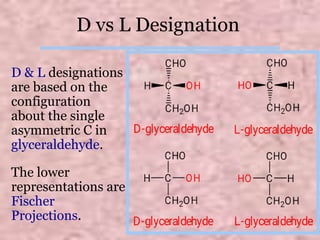
D vs L Designation
D & L designations
are based on the
configuration
about the single
asymmetric C in
glyceraldehyde.
The lower
representations are
Fischer
Projections.
7
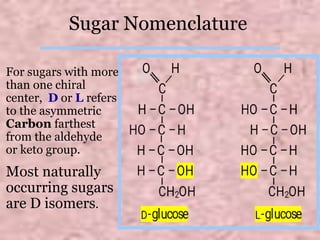
Sugar Nomenclature
For sugars with more
than one chiral
center, D or L refers
to the asymmetric
Carbon farthest
from the aldehyde
or keto group.
Most naturally
occurring sugars
are D isomers.
As reducing or non reducing sugars
-
• All those carbohydrates which reduce
Fehling’s solution and Tollens’ reagent
are referred to as reducing sugars.
• In disaccharides, if the reducing groups
of monosaccharides i.e., aldehydic or ketonic
groups are bonded, these are non-reducing
sugars e.g. sucrose. On the other hand,
sugars in which these functional groups
are free, are called reducing sugars, for
example, maltose and lactose.
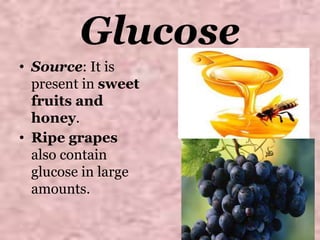
Glucose
• Source: It is
present in sweet
fruits and
honey.
• Ripe grapes
also contain
glucose in large
amounts.
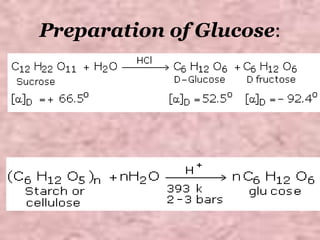
Preparation of Glucose:
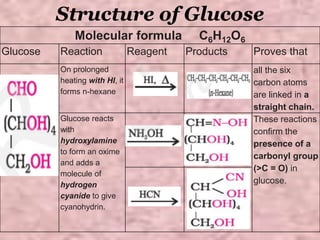
Structure of Glucose
Molecular formula C6H12O6
Glucose Reaction Reagent Products Proves that
On prolonged
heating with HI, it
forms n-hexane
all the six
carbon atoms
are linked in a
straight chain.
Glucose reacts
with
hydroxylamine
to form an oxime
and adds a
molecule of
hydrogen
cyanide to give
cyanohydrin.
These reactions
confirm the
presence of a
carbonyl group
(>C = O) in
glucose.
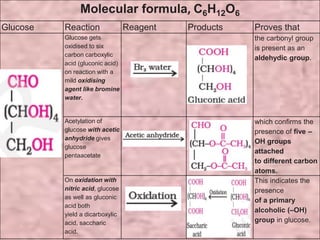
Molecular formula, C6H12O6
Glucose Reaction Reagent Products Proves that
Glucose gets
oxidised to six
carbon carboxylic
acid (gluconic acid)
on reaction with a
mild oxidising
agent like bromine
water.
the carbonyl group
is present as an
aldehydic group.
Acetylation of
glucose with acetic
anhydride gives
glucose
pentaacetate
which confirms the
presence of five –
OH groups
attached
to different carbon
atoms.
On oxidation with
nitric acid, glucose
as well as gluconic
acid both
yield a dicarboxylic
acid, saccharic
acid.
This indicates the
presence
of a primary
alcoholic (–OH)
group in glucose.
Pentoses and
hexoses can
cyclize as the
ketone or
aldehyde reacts
with a distal OH.
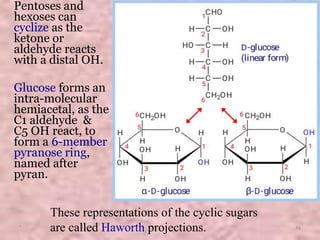
Glucose forms an
intra-molecular
hemiacetal, as the
C1 aldehyde &
C5 OH react, to
form a 6-member
pyranose ring,
named after
pyran.
These representations of the cyclic sugars
are called Haworth projections.
* 14
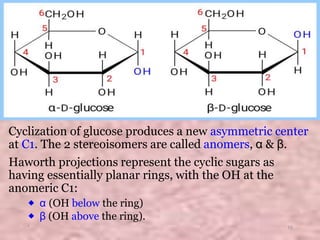
Cyclization of glucose produces a new asymmetric center
at C1. The 2 stereoisomers are called anomers, α & β.
Haworth projections represent the cyclic sugars as
having essentially planar rings, with the OH at the
anomeric C1:
⬥ α (OH below the ring)
⬥ β (OH above the ring).
* 15
Reactions and facts about glucose which
cannot be explained by its open chain
structure
• Despite having the aldehyde group, glucose does not give Schiff’s
test and it does not form the hydrogensulphite addition
product with NaHSO3.
• The pentaacetate of glucose does not react with hydroxylamine
indicating the absence of free —CHO group.
• Glucose is found to exist in 2 different crystalline forms which
- α and β. The α-form of glucose (m.p. 419 K) is obtained by
crystallisation from concentrated solution of glucose at 303 K while
the β-form (m.p. 423 K) is obtained by crystallisation from hot and
saturated aqueous solution at 371 K.
This behaviour could not be explained
by the open chain structure.
Fructose
Fructose forms a 5-member furanose ring, by reaction
of the C2 keto group with the OH on C5.
Fructose is an important ketohexose.
It is obtained along with glucose by the hydrolysis of
sucrose.
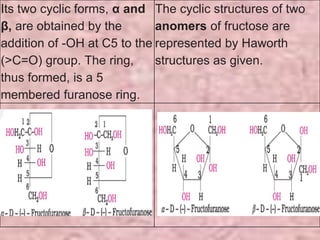
Its two cyclic forms, α and
β, are obtained by the
addition of -OH at C5 to the
(>C=O) group. The ring,
thus formed, is a 5
membered furanose ring.
The cyclic structures of two
anomers of fructose are
represented by Haworth
structures as given.
References:
1. NCERT Class XII Chemistry Vol 2
2. Google images

Biomolecules.pptx

  • 1.
  • 3.
    Carbohydrates • generally producedby plants • Most have a general formula, Cx(H2O)y (were known as hydrates of carbon) • Ex.Glucose (C6H12O6) fits into the formula C6(H2O)6. • Definition: the carbohydrates are optically active polyhydroxy aldehydes/ ketones or the compounds which produce such units on hydrolysis.
  • 4.
    How are Carbohydrates classified? •On their behavior towards hydrolysis,they are divided into ⬥Monosaccharides - simple sugars with multiple OH groups. Based on number of carbons (3, 4, 5, 6), a monosaccharide is a triose, tetrose, pentose or hexose. ⬥Disaccharides - 2 monosaccharides covalently linked. ⬥Oligosaccharides - a few monosaccharides covalently linked. ⬥Polysaccharides - polymers consisting of chains of monosaccharide or disaccharide units.
  • 5.
    According to thefunctional group present • Aldose – If the carbohydrate contains an aldehyde. Aldotriose – containing three carbon atoms(Ex. Glyceraldehyde), aldotetrose, aldopentose (Ex. Ribose), aldohexose (Ex. Glucose) • Ketose - If the carbohydrate contains a ketone. Ketotriose, ketotetrose, ketopentose, ketohexose(Ex. Fructose)
  • 6.
    Monosaccharides Aldoses (e.g., glucose) havean aldehyde group at one end. Ketoses (e.g., fructose) have a keto group, usually at C2. 6
  • 7.
    D vs LDesignation D & L designations are based on the configuration about the single asymmetric C in glyceraldehyde. The lower representations are Fischer Projections. 7
  • 8.
    Sugar Nomenclature For sugarswith more than one chiral center, D or L refers to the asymmetric Carbon farthest from the aldehyde or keto group. Most naturally occurring sugars are D isomers.
  • 9.
    As reducing ornon reducing sugars - • All those carbohydrates which reduce Fehling’s solution and Tollens’ reagent are referred to as reducing sugars. • In disaccharides, if the reducing groups of monosaccharides i.e., aldehydic or ketonic groups are bonded, these are non-reducing sugars e.g. sucrose. On the other hand, sugars in which these functional groups are free, are called reducing sugars, for example, maltose and lactose.
  • 10.
    Glucose • Source: Itis present in sweet fruits and honey. • Ripe grapes also contain glucose in large amounts.
  • 11.
  • 12.
    Structure of Glucose Molecularformula C6H12O6 Glucose Reaction Reagent Products Proves that On prolonged heating with HI, it forms n-hexane all the six carbon atoms are linked in a straight chain. Glucose reacts with hydroxylamine to form an oxime and adds a molecule of hydrogen cyanide to give cyanohydrin. These reactions confirm the presence of a carbonyl group (>C = O) in glucose.
  • 13.
    Molecular formula, C6H12O6 GlucoseReaction Reagent Products Proves that Glucose gets oxidised to six carbon carboxylic acid (gluconic acid) on reaction with a mild oxidising agent like bromine water. the carbonyl group is present as an aldehydic group. Acetylation of glucose with acetic anhydride gives glucose pentaacetate which confirms the presence of five – OH groups attached to different carbon atoms. On oxidation with nitric acid, glucose as well as gluconic acid both yield a dicarboxylic acid, saccharic acid. This indicates the presence of a primary alcoholic (–OH) group in glucose.
  • 14.
    Pentoses and hexoses can cyclizeas the ketone or aldehyde reacts with a distal OH. Glucose forms an intra-molecular hemiacetal, as the C1 aldehyde & C5 OH react, to form a 6-member pyranose ring, named after pyran. These representations of the cyclic sugars are called Haworth projections. * 14
  • 15.
    Cyclization of glucoseproduces a new asymmetric center at C1. The 2 stereoisomers are called anomers, α & β. Haworth projections represent the cyclic sugars as having essentially planar rings, with the OH at the anomeric C1: ⬥ α (OH below the ring) ⬥ β (OH above the ring). * 15
  • 16.
    Reactions and factsabout glucose which cannot be explained by its open chain structure • Despite having the aldehyde group, glucose does not give Schiff’s test and it does not form the hydrogensulphite addition product with NaHSO3. • The pentaacetate of glucose does not react with hydroxylamine indicating the absence of free —CHO group. • Glucose is found to exist in 2 different crystalline forms which - α and β. The α-form of glucose (m.p. 419 K) is obtained by crystallisation from concentrated solution of glucose at 303 K while the β-form (m.p. 423 K) is obtained by crystallisation from hot and saturated aqueous solution at 371 K. This behaviour could not be explained by the open chain structure.
  • 17.
    Fructose Fructose forms a5-member furanose ring, by reaction of the C2 keto group with the OH on C5. Fructose is an important ketohexose. It is obtained along with glucose by the hydrolysis of sucrose.
  • 18.
    Its two cyclicforms, α and β, are obtained by the addition of -OH at C5 to the (>C=O) group. The ring, thus formed, is a 5 membered furanose ring. The cyclic structures of two anomers of fructose are represented by Haworth structures as given.
  • 19.
    References: 1. NCERT ClassXII Chemistry Vol 2 2. Google images