SHRI SHIVAJI EDUCATION SOCIETY AMRAVATI
SHRI SHIVAJI COLLEGE OF ARTS COMMERCE AND
SCIENCE AKOLA(MS)
NAAC REACCREDITED WITH A GRADE(CGPA OF( 3.24)COLLEGE WITH POTENTIAL FOR EXCELLENCE(STATUS BY UGC)LEAD COLLEGE
(STATUS BY SGBAU, AMRAVATI)
DST-FIST SUPPORT
DEPARTMENT OF BOTANY
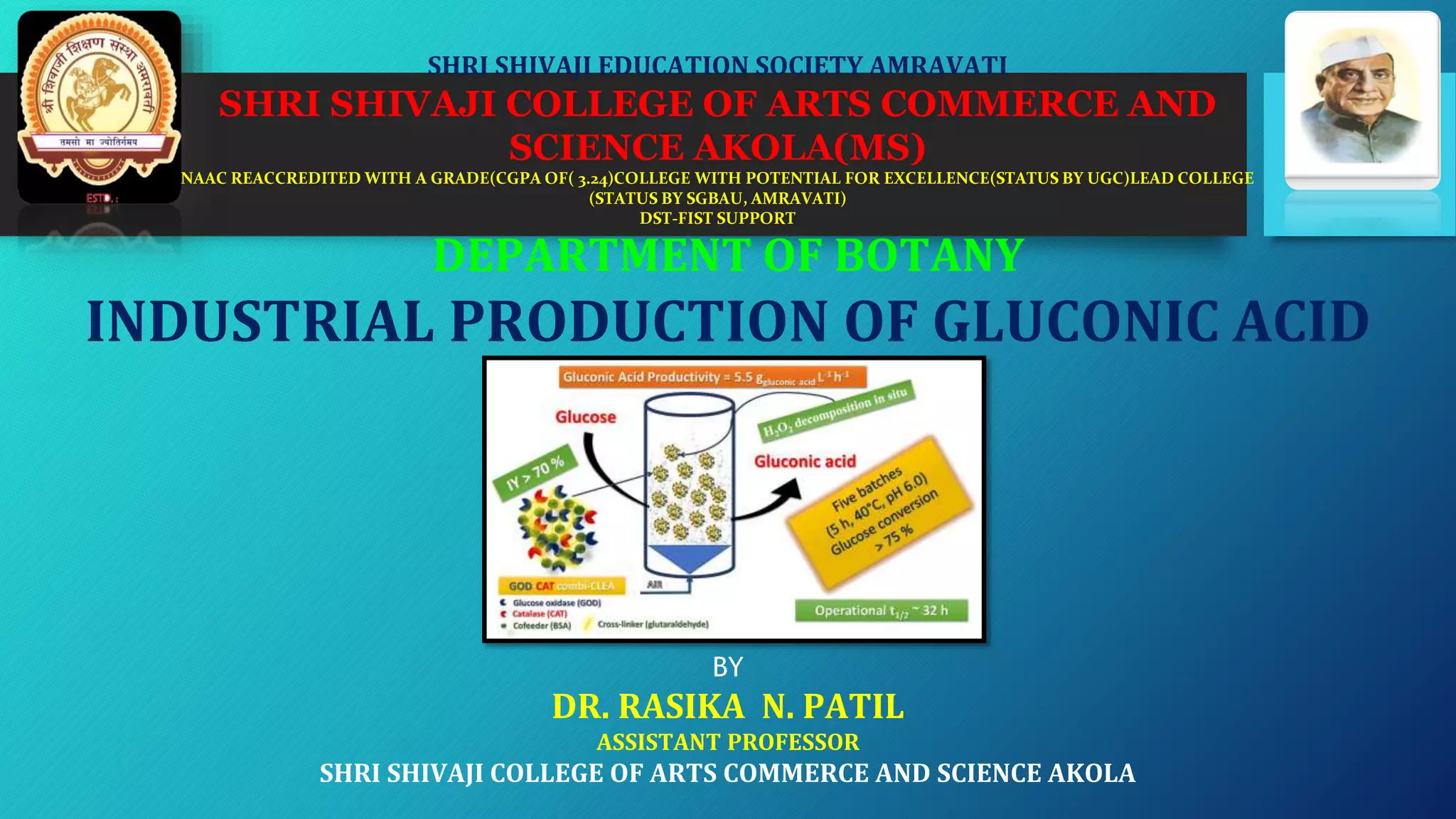
INDUSTRIAL PRODUCTION OF GLUCONIC ACID
BY
DR. RASIKA N. PATIL
ASSISTANT PROFESSOR
SHRI SHIVAJI COLLEGE OF ARTS COMMERCE AND SCIENCE AKOLA
INTRODUCTION
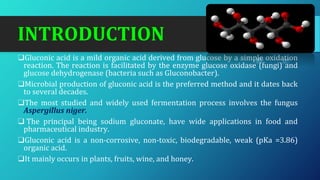
❑Gluconic acid is a mild organic acid derived from glucose by a simple oxidation
reaction. The reaction is facilitated by the enzyme glucose oxidase (fungi) and
glucose dehydrogenase (bacteria such as Gluconobacter).
❑Microbial production of gluconic acid is the preferred method and it dates back
to several decades.
❑The most studied and widely used fermentation process involves the fungus
Aspergillus niger.
❑ The principal being sodium gluconate, have wide applications in food and
pharmaceutical industry.
❑Gluconic acid is a non-corrosive, non-toxic, biodegradable, weak (pKa =3.86)
organic acid.
❑It mainly occurs in plants, fruits, wine, and honey.
HISTORY
• Gluconic acid production dates back to 1870 when Hlasiwetz and
Habermann discovered gluconic acid.
• In 1880 Boutroux found for the first time that acetic acid bacteria are capable
of producing sugar acid.
• In 1922 Molliard detected gluconic acid in the Sterig- matocystis nigra, now
known as Aspergillus niger.
OCCURRENCE
⮚Occurrence Gluconic acid is abundantly available in plants, fruits and other
foodstuffs such as rice, meat, dairy products, wine (up to 0.25 %), honey (up to
1 %), and vinegar. It is produced by different microorganisms as well, which
include bacteria such as Pseudomonas ovalis , Acetobacter methanolicus,
Zymomonas mobilis, Acetobacter diazotrophicus, Gluconobacter oxydans,
Gluconobacter suboxydans, Azospirillum brasiliense, fungi such as
Aspergillus niger, Penicillium funiculosum , P. variabile, P. amagasakiense ,
and various other species such as Gliocladium, Scopulariopsis, Gonatobotrys,
Endomycopsis and yeasts such as Aureobasidium pullulans (formerly known
as Dematium or Pullularia pullulans) .
⮚Ectomycorrhizal fungus Tricholoma robustum, which is associated with the
roots of Pinus densiflora, was found to synthesized gluconic acid.
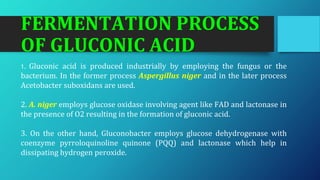
ENZYMATIC REACTIONS LEADING
TO GLUCONIC ACID FORMATION :
FERMENTATION PROCESS
OF GLUCONIC ACID
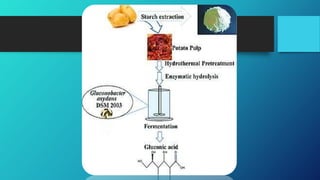
1. Gluconic acid is produced industrially by employing the fungus or the
bacterium. In the former process Aspergillus niger and in the later process
Acetobacter suboxidans are used.
2. A. niger employs glucose oxidase involving agent like FAD and lactonase in
the presence of O2 resulting in the formation of gluconic acid.
3. On the other hand, Gluconobacter employs glucose dehydrogenase with
coenzyme pyrroloquinoline quinone (PQQ) and lactonase which help in
dissipating hydrogen peroxide.
PRODUCTION OF PURE GLUCONIC
ACID
It is also possible to obtain gluconic acid in pure form by the
following procedure, where calcium gluconate is employed:
⮚Calcium is precipitated by the addition of sulfuric acid. Calcium sulfate thus formed is
separated by filtration.
⮚The filtrate is decolorized with activated charcoal.
⮚The acid solution is concentrated to 50 percent acid strength.
⮚The product thus formed is a mixture of gluconic acid and lactones.
⮚The concentrate is then treated with a temperature ranging from 0°C-30°C. The crystals that
separate at this temperature consist of pure gluconic acid.
⮚When the concentrate is treated with a temperature ranging from 30°-70°C crystals of
lactones separate.
RECOVERY
• The recovery process depends on the method followed for broth neutralization and the nature of carbon
sources used. Generally, the downstream process is similar for the fermentation processes using fungal and
bacterial species.
• Gluconic acid, glucono-d-lactone, calcium gluconate, and sodium gluconate are some of the important products
and their extraction process is briefly mentioned below. For the recovery of free gluconic acid from calcium
gluconate the broth is clarified, decolorized, concentrated and exposed to –10 °C in the presence or absence of
alcohol. Thus the calcium salt of gluconic acid crystallizes, then it is recovered and further purified.
• Gluconic acid can also be obtained by precipitating the calcium gluconate from hyper saturated solutions in the
cold and released subsequently by adding sulphuric acid stoichiometrically, removing the calcium as calcium
sulphate.
• Another method of passing the solution through a column containing a strong cation exchanger is also practiced
where the calcium ions are absorbed. For obtaining calcium gluconate as a product, calcium hydroxide or
calcium carbonate is used as the neutralising agent. They are added to the nutritive broth accompanied by
heating and vigorous stirring. The broth is concentrated to a hot supersaturated solution of calcium gluconate,
followed by cooling at 20 °C, and adding water miscible solvents, which crystallizes the compound. A treatment
with activated carbon facilitates the crystallization process. Finally they are centrifuged, washed several times
and dried at 80 °C.
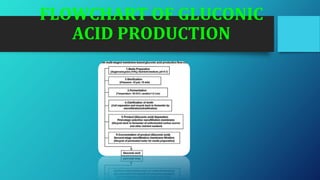
FLOWCHART OF GLUCONIC
ACID PRODUCTION
USES OF GLUCONIC ACID
• Gluconic acid is used in the manufacture of metal, leather and food.
• Sodium gluconate is used as a sequestering agent in many detergents.
• Calcium gluconate is used in medicine.
• Gluconolactone is used as baking powder and as an additive.
• Its inner ester, glucono-d-lactone imparts an initially sweet taste which later
becomes
• It is a natural constituent in fruit juices and honey and is used in the pickling of
foods.
• Slightly acidic. It is used in meat and dairy products particularly in baked goods as
a component of leavening agent for preleavened products.
• It is used as a flavorings agent (for example, in sherbets) and it also finds
application in reducing fat absorption in doughnuts and cones.
• Foodstuffs containing D-glucono-d-lactone include bean curd, yoghurt, cottage
cheese, bread, confectionery and meat.
APPLICATIONS
Gluconic acid: Prevention of milk stone in dairy industry Cleaning of aluminium cans.
Glucono-d- -lactone:
• Latent acid in baking powders for use in dry cakes and instantly leavened bread mixes
• Slow acting acidulant in meat processing such as sausages
• Coagulation of soybean protein in the manufacture of tofu, In dairy industry for cheese curd
formation and for improvement of heat stability of milk
Sodium salt of gluconic acid: Detergent in bottle washing
Metallurgy (alkaline derusting): Additive in cement Derusting agent, Textile (iron deposits
prevention) Paper industry,
Iron salt of gluconic acid: Treatment of anaemia ,Foliar feed formulations in horticulture
Used in stainless steel manufacturing leather(can remove rust and calcareous deposits)
Food additive for beverages, Used in Ca and Fe therapy gluconate used in sequestering agent in
detergents, Desizing polyester or polyamide fabric, Manufacture of frost and cracking resistant
concrete.
THANK YOU

Gluconic acid

  • 1.
    SHRI SHIVAJI EDUCATIONSOCIETY AMRAVATI SHRI SHIVAJI COLLEGE OF ARTS COMMERCE AND SCIENCE AKOLA(MS) NAAC REACCREDITED WITH A GRADE(CGPA OF( 3.24)COLLEGE WITH POTENTIAL FOR EXCELLENCE(STATUS BY UGC)LEAD COLLEGE (STATUS BY SGBAU, AMRAVATI) DST-FIST SUPPORT DEPARTMENT OF BOTANY INDUSTRIAL PRODUCTION OF GLUCONIC ACID BY DR. RASIKA N. PATIL ASSISTANT PROFESSOR SHRI SHIVAJI COLLEGE OF ARTS COMMERCE AND SCIENCE AKOLA
  • 2.
    INTRODUCTION ❑Gluconic acid isa mild organic acid derived from glucose by a simple oxidation reaction. The reaction is facilitated by the enzyme glucose oxidase (fungi) and glucose dehydrogenase (bacteria such as Gluconobacter). ❑Microbial production of gluconic acid is the preferred method and it dates back to several decades. ❑The most studied and widely used fermentation process involves the fungus Aspergillus niger. ❑ The principal being sodium gluconate, have wide applications in food and pharmaceutical industry. ❑Gluconic acid is a non-corrosive, non-toxic, biodegradable, weak (pKa =3.86) organic acid. ❑It mainly occurs in plants, fruits, wine, and honey.
  • 3.
    HISTORY • Gluconic acidproduction dates back to 1870 when Hlasiwetz and Habermann discovered gluconic acid. • In 1880 Boutroux found for the first time that acetic acid bacteria are capable of producing sugar acid. • In 1922 Molliard detected gluconic acid in the Sterig- matocystis nigra, now known as Aspergillus niger.
  • 4.
    OCCURRENCE ⮚Occurrence Gluconic acidis abundantly available in plants, fruits and other foodstuffs such as rice, meat, dairy products, wine (up to 0.25 %), honey (up to 1 %), and vinegar. It is produced by different microorganisms as well, which include bacteria such as Pseudomonas ovalis , Acetobacter methanolicus, Zymomonas mobilis, Acetobacter diazotrophicus, Gluconobacter oxydans, Gluconobacter suboxydans, Azospirillum brasiliense, fungi such as Aspergillus niger, Penicillium funiculosum , P. variabile, P. amagasakiense , and various other species such as Gliocladium, Scopulariopsis, Gonatobotrys, Endomycopsis and yeasts such as Aureobasidium pullulans (formerly known as Dematium or Pullularia pullulans) . ⮚Ectomycorrhizal fungus Tricholoma robustum, which is associated with the roots of Pinus densiflora, was found to synthesized gluconic acid.
  • 5.
    ENZYMATIC REACTIONS LEADING TOGLUCONIC ACID FORMATION :
  • 6.
    FERMENTATION PROCESS OF GLUCONICACID 1. Gluconic acid is produced industrially by employing the fungus or the bacterium. In the former process Aspergillus niger and in the later process Acetobacter suboxidans are used. 2. A. niger employs glucose oxidase involving agent like FAD and lactonase in the presence of O2 resulting in the formation of gluconic acid. 3. On the other hand, Gluconobacter employs glucose dehydrogenase with coenzyme pyrroloquinoline quinone (PQQ) and lactonase which help in dissipating hydrogen peroxide.
  • 7.
    PRODUCTION OF PUREGLUCONIC ACID It is also possible to obtain gluconic acid in pure form by the following procedure, where calcium gluconate is employed: ⮚Calcium is precipitated by the addition of sulfuric acid. Calcium sulfate thus formed is separated by filtration. ⮚The filtrate is decolorized with activated charcoal. ⮚The acid solution is concentrated to 50 percent acid strength. ⮚The product thus formed is a mixture of gluconic acid and lactones. ⮚The concentrate is then treated with a temperature ranging from 0°C-30°C. The crystals that separate at this temperature consist of pure gluconic acid. ⮚When the concentrate is treated with a temperature ranging from 30°-70°C crystals of lactones separate.
  • 8.
    RECOVERY • The recoveryprocess depends on the method followed for broth neutralization and the nature of carbon sources used. Generally, the downstream process is similar for the fermentation processes using fungal and bacterial species. • Gluconic acid, glucono-d-lactone, calcium gluconate, and sodium gluconate are some of the important products and their extraction process is briefly mentioned below. For the recovery of free gluconic acid from calcium gluconate the broth is clarified, decolorized, concentrated and exposed to –10 °C in the presence or absence of alcohol. Thus the calcium salt of gluconic acid crystallizes, then it is recovered and further purified. • Gluconic acid can also be obtained by precipitating the calcium gluconate from hyper saturated solutions in the cold and released subsequently by adding sulphuric acid stoichiometrically, removing the calcium as calcium sulphate. • Another method of passing the solution through a column containing a strong cation exchanger is also practiced where the calcium ions are absorbed. For obtaining calcium gluconate as a product, calcium hydroxide or calcium carbonate is used as the neutralising agent. They are added to the nutritive broth accompanied by heating and vigorous stirring. The broth is concentrated to a hot supersaturated solution of calcium gluconate, followed by cooling at 20 °C, and adding water miscible solvents, which crystallizes the compound. A treatment with activated carbon facilitates the crystallization process. Finally they are centrifuged, washed several times and dried at 80 °C.
  • 10.
  • 11.
    USES OF GLUCONICACID • Gluconic acid is used in the manufacture of metal, leather and food. • Sodium gluconate is used as a sequestering agent in many detergents. • Calcium gluconate is used in medicine. • Gluconolactone is used as baking powder and as an additive. • Its inner ester, glucono-d-lactone imparts an initially sweet taste which later becomes • It is a natural constituent in fruit juices and honey and is used in the pickling of foods. • Slightly acidic. It is used in meat and dairy products particularly in baked goods as a component of leavening agent for preleavened products. • It is used as a flavorings agent (for example, in sherbets) and it also finds application in reducing fat absorption in doughnuts and cones. • Foodstuffs containing D-glucono-d-lactone include bean curd, yoghurt, cottage cheese, bread, confectionery and meat.
  • 12.
    APPLICATIONS Gluconic acid: Preventionof milk stone in dairy industry Cleaning of aluminium cans. Glucono-d- -lactone: • Latent acid in baking powders for use in dry cakes and instantly leavened bread mixes • Slow acting acidulant in meat processing such as sausages • Coagulation of soybean protein in the manufacture of tofu, In dairy industry for cheese curd formation and for improvement of heat stability of milk Sodium salt of gluconic acid: Detergent in bottle washing Metallurgy (alkaline derusting): Additive in cement Derusting agent, Textile (iron deposits prevention) Paper industry, Iron salt of gluconic acid: Treatment of anaemia ,Foliar feed formulations in horticulture Used in stainless steel manufacturing leather(can remove rust and calcareous deposits) Food additive for beverages, Used in Ca and Fe therapy gluconate used in sequestering agent in detergents, Desizing polyester or polyamide fabric, Manufacture of frost and cracking resistant concrete.
  • 14.