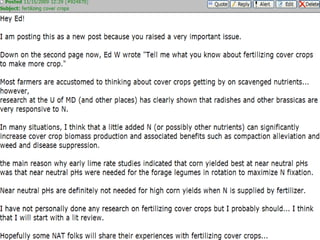
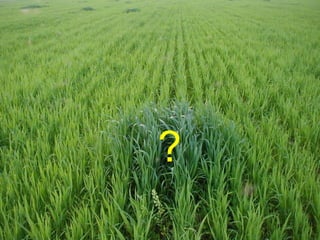
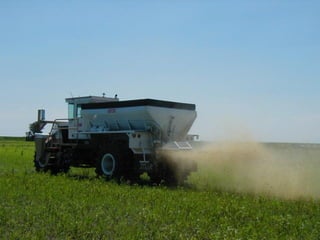
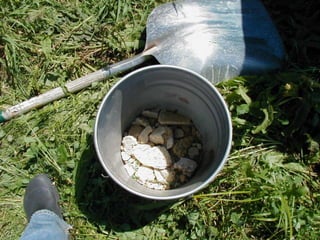
Capturing the full
potential of cover crops
        Dr. Joel Gruver
      WIU – Agriculture
      j-gruver@wiu.edu
Haphazard
cover cropping
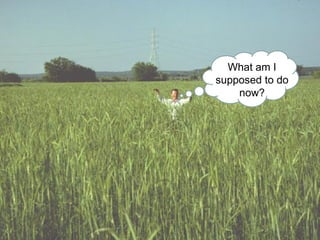
What am I
supposed to do
    now?
Very common question received
by CC seed vendors in early fall


“What cover
crop should I
 plant ???”
Well… what do you
  want your cover
crops to do for you?
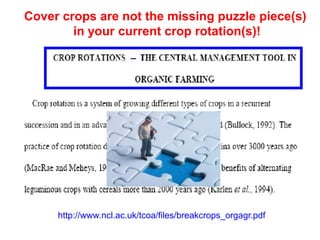
Cover crops are not the missing puzzle piece(s)
        in your current crop rotation(s)!


     http://www.ncl.ac.uk/tcoa/files/breakcrops_orgagr.pdf
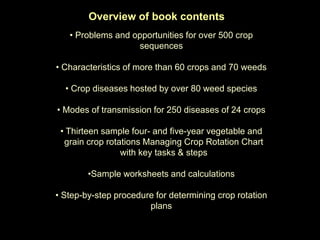
Overview of book contents
   • Problems and opportunities for over 500 crop
                   sequences

• Characteristics of more than 60 crops and 70 weeds

  • Crop diseases hosted by over 80 weed species

• Modes of transmission for 250 diseases of 24 crops

 • Thirteen sample four- and five-year vegetable and
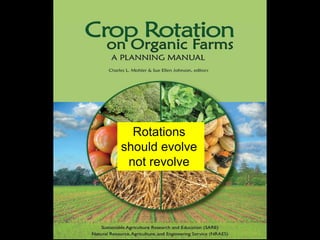
                    Rotations
  grain crop rotations Managing Crop Rotation Chart
                 should evolve
                 with key tasks & steps
                  not revolve
        •Sample worksheets and calculations

• Step-by-step procedure for determining crop rotation
                       plans
Overview of book contents
   • Problems and opportunities for over 500 crop
                   sequences

• Characteristics of more than 60 crops and 70 weeds

  • Crop diseases hosted by over 80 weed species

• Modes of transmission for 250 diseases of 24 crops

 • Thirteen sample four- and five-year vegetable and
  grain crop rotations Managing Crop Rotation Chart
                 with key tasks & steps

        •Sample worksheets and calculations

• Step-by-step procedure for determining crop rotation
                       plans
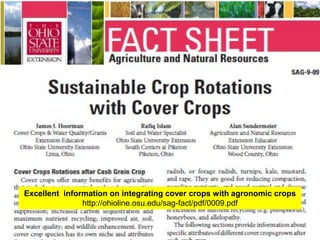
Excellent information on integrating cover crops with agronomic crops
               http://ohioline.osu.edu/sag-fact/pdf/0009.pdf
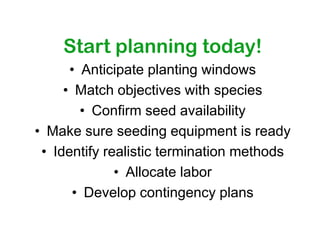
Start planning today!
      • Anticipate planting windows
     • Match objectives with species
        • Confirm seed availability
• Make sure seeding equipment is ready
 • Identify realistic termination methods
              • Allocate labor
       • Develop contingency plans
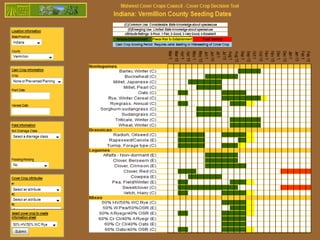
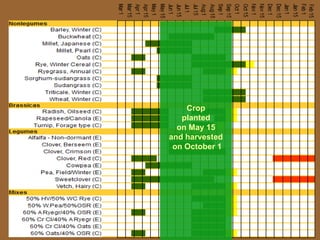
Crop
   planted
  on May 15
and harvested
 on October 1
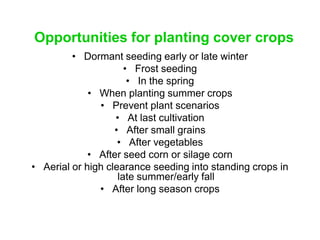
Opportunities for planting cover crops
         • Dormant seeding early or late winter
                      • Frost seeding
                       • In the spring
             • When planting summer crops
               • Prevent plant scenarios
                   • At last cultivation
                   • After small grains
                    • After vegetables
             • After seed corn or silage corn
• Aerial or high clearance seeding into standing crops in
                    late summer/early fall
               • After long season crops
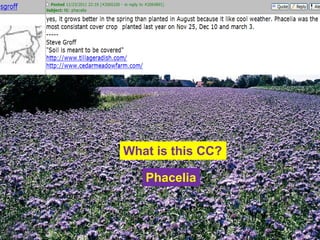
What is this CC?

   Phacelia
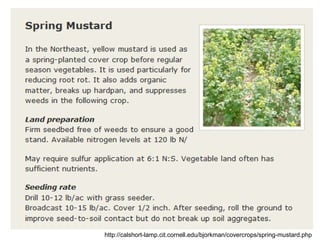
http://calshort-lamp.cit.cornell.edu/bjorkman/covercrops/spring-mustard.php
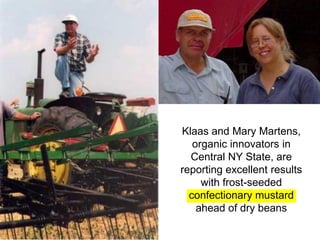
Klaas and Mary Martens,
   organic innovators in
  Central NY State, are
reporting excellent results
     with frost-seeded
  confectionary mustard
    ahead of dry beans
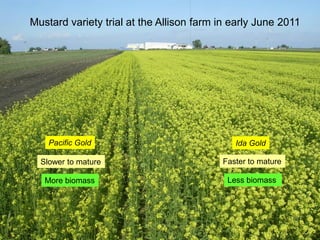
Mustard variety trial at the Allison farm in early June 2011


    Pacific Gold                             Ida Gold

  Slower to mature                        Faster to mature

   More biomass                            Less biomass
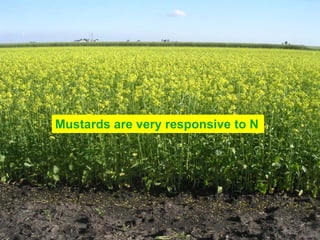
Mustards are very responsive to N
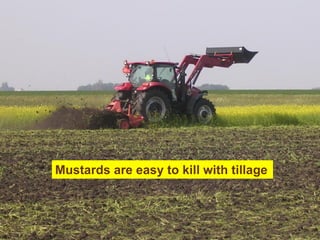
Mustards are easy to kill with tillage
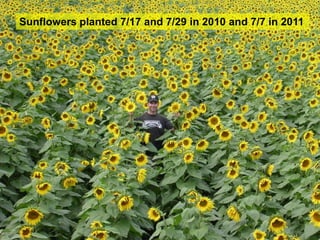
Sunflowers planted 7/17 and 7/29 in 2010 and 7/7 in 2011
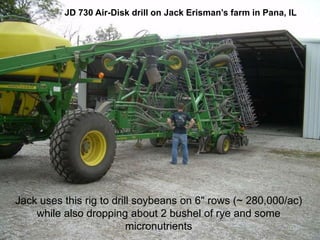
JD 730 Air-Disk drill on Jack Erisman’s farm in Pana, IL


Jack uses this rig to drill soybeans on 6" rows (~ 280,000/ac)
    while also dropping about 2 bushel of rye and some
                          micronutrients
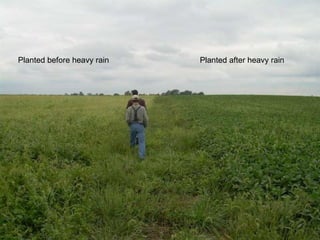
Planted before heavy rain   Planted after heavy rain
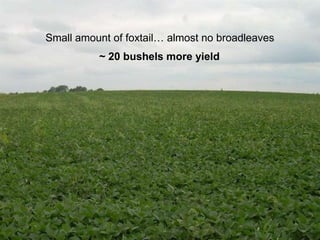
Small amount of foxtail… almost no broadleaves
          ~ 20 bushels more yield
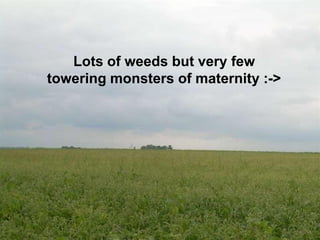
Lots of weeds but very few
towering monsters of maternity :->
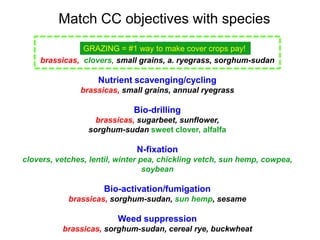
Match CC objectives with species
                            Grazing
               GRAZING = #1 way to make cover crops pay!
    brassicas, clovers, small grains, a. ryegrass, sorghum-sudan

                    Nutrient scavenging/cycling
               brassicas, small grains, annual ryegrass

                             Bio-drilling
                   brassicas, sugarbeet, sunflower,
                 sorghum-sudan sweet clover, alfalfa

                              N-fixation
clovers, vetches, lentil, winter pea, chickling vetch, sun hemp, cowpea,
                                  soybean

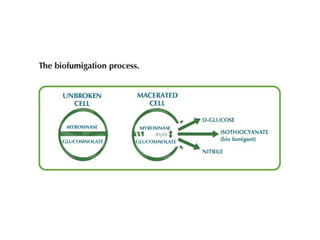
                     Bio-activation/fumigation
            brassicas, sorghum-sudan, sun hemp, sesame

                         Weed suppression
          brassicas, sorghum-sudan, cereal rye, buckwheat
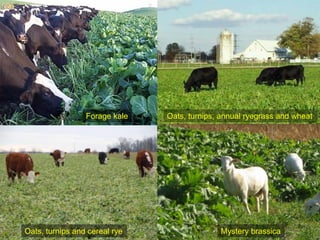
Forage kale   Oats, turnips, annual ryegrass and wheat


Oats, turnips and cereal rye                 Mystery brassica
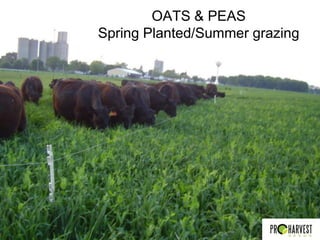
OATS & PEAS
Spring Planted/Summer grazing
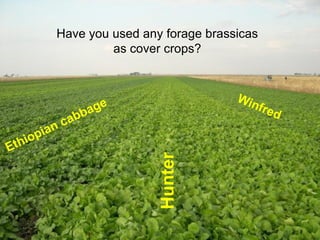
Have you used any forage brassicas
         as cover crops?


                 Hunter
Franzluebbers AJ and JA Stuedemann. 2008.
     Soil physical responses to cattle grazing cover
     crops under conventional and no tillage in the
                Southern Piedmont USA.
         Soil and Tillage Research 100, 141-153.

• Cover crops (winter or summer) can provide high-
  quality forage and increase economic return and
     farm diversity, but some farmers have been
  reluctant to take this advantage due to perceived
      “compaction” caused by animal trampling.

• Grazing of cover crops can compact soil, but
 not to the detrimental levels often perceived.
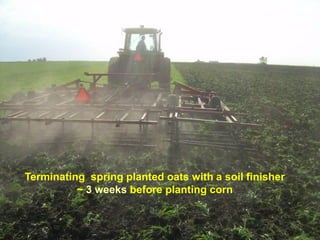
Terminating spring planted oats with a soil finisher
          ~ 3 weeks before planting corn
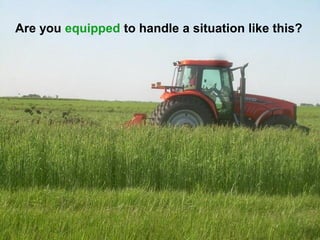
Are you equipped to handle a situation like this?
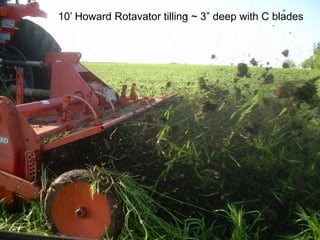
10’ Howard Rotavator tilling ~ 3” deep with C blades
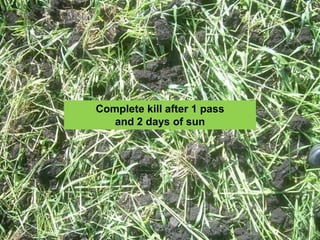
Complete kill after 1 pass
   and 2 days of sun
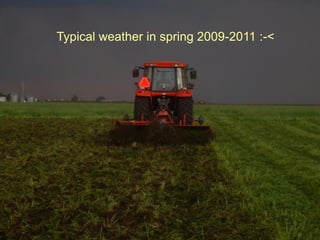
Typical weather in spring 2009-2011 :-<
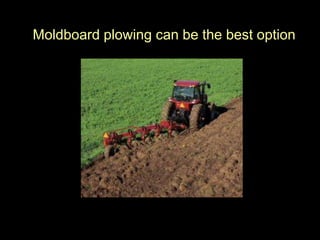
Moldboard plowing can be the best option
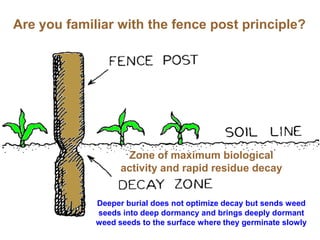
Are you familiar with the fence post principle?


                    Zone of maximum biological
                   activity and rapid residue decay


             Deeper burial does not optimize decay but sends weed
             seeds into deep dormancy and brings deeply dormant
             weed seeds to the surface where they germinate slowly
Performance over Price
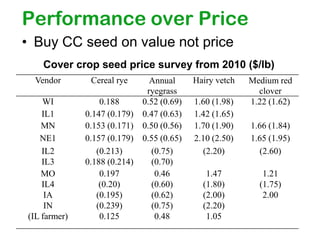
• Buy CC seed on value not price
    Cover crop seed price survey from 2010 ($/lb)
 Vendor        Cereal rye       Annual      Hairy vetch   Medium red
                               ryegrass                     clover
    WI            0.188       0.52 (0.69)   1.60 (1.98)   1.22 (1.62)
    IL1       0.147 (0.179)   0.47 (0.63)   1.42 (1.65)
    MN        0.153 (0.171)   0.50 (0.56)   1.70 (1.90)   1.66 (1.84)
   NE1        0.157 (0.179)   0.55 (0.65)   2.10 (2.50)   1.65 (1.95)
    IL2          (0.213)        (0.75)        (2.20)        (2.60)
    IL3       0.188 (0.214)     (0.70)
    MO            0.197          0.46          1.47          1.21
    IL4           (0.20)        (0.60)        (1.80)        (1.75)
     IA          (0.195)        (0.62)        (2.00)         2.00
     IN          (0.239)        (0.75)        (2.20)
(IL farmer)       0.125          0.48          1.05
The cheapest seed available is
frequently VNS – variety not stated

   Do you know the difference
   between “variety name” and
        “brand name”?

  How important is uniform seed
     size and vigor to you?
How much
 is good
technical
 support
 worth to
   you?
Reduce Risk
• Enroll in programs that pay you to plant CCs
        • Use time tested CC methods
 • Use more than one method of planting CCs
           • Plant mixtures/cocktails
     • Grow some crops e.g. small grains,
     vegetables, corn silage, shorter season
    hybrids/varieties that are harvested early
                    • Irrigate
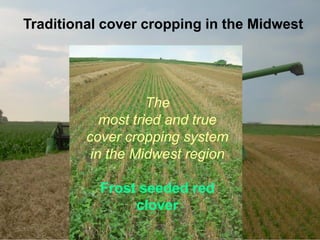
Traditional cover cropping in the Midwest


                    The
            most tried and true
         cover cropping system
          in the Midwest region

           Frost seeded red
                clover
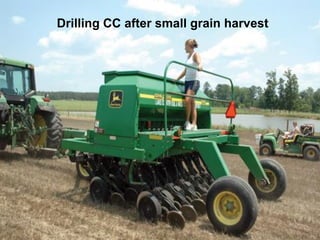
Drilling CC after small grain harvest
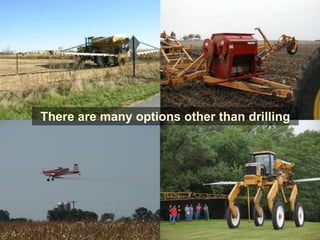
There are many options other than drilling
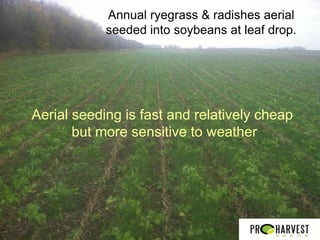
Annual ryegrass & radishes aerial
            seeded into soybeans at leaf drop.


Aerial seeding is fast and relatively cheap
       but more sensitive to weather
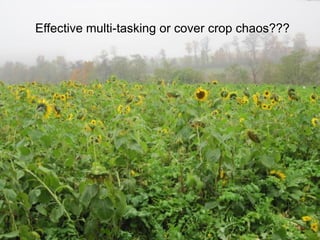
Effective multi-tasking or cover crop chaos???
Beware of hype!
• Cover crops are not a silver bullet solution
               to any problem
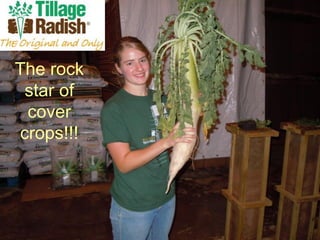
The rock
 star of
 cover
crops!!!
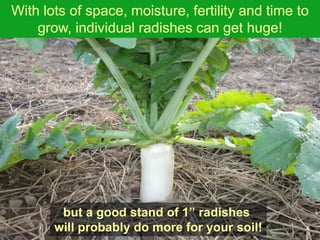
With lots of space, moisture, fertility and time to
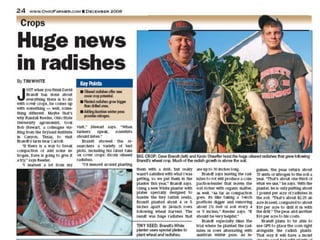
    grow, individual radishes can get huge!


        but a good stand of 1” radishes
       will probably do more for your soil!
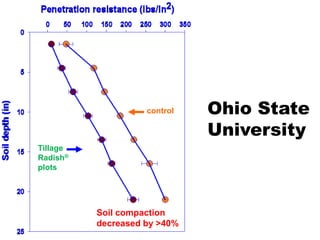
control   Ohio State
                              University
Tillage
Radish®
plots


          Soil compaction
          decreased by >40%
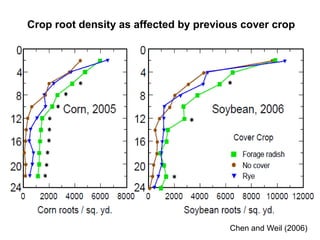
Crop root density as affected by previous cover crop


                                       Chen and Weil (2006)
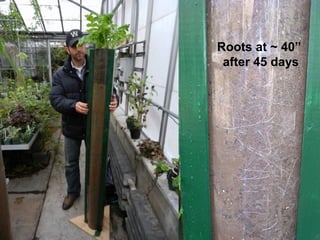
Roots at ~ 40”
 after 45 days
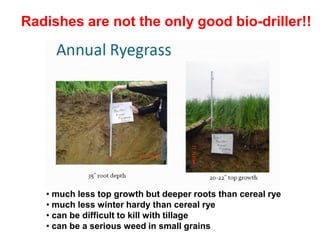
Radishes are not the only good bio-driller!!


   • much less top growth but deeper roots than cereal rye
   • much less winter hardy than cereal rye
   • can be difficult to kill with tillage
   • can be a serious weed in small grains
Learn from cover crop innovators
    • Attend field days/host a field day
          • Attend conferences
      • Participate in internet forums
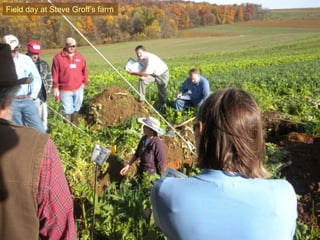
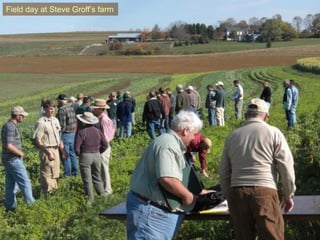
Field day at Steve Groff’s farm
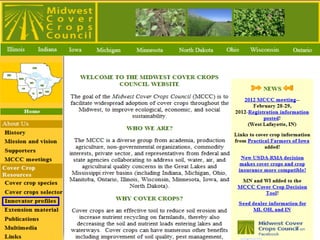
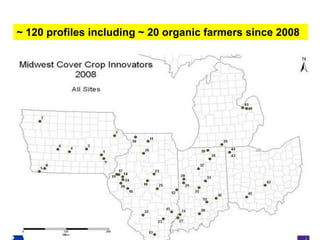
~ 120 profiles including ~ 20 organic farmers since 2008
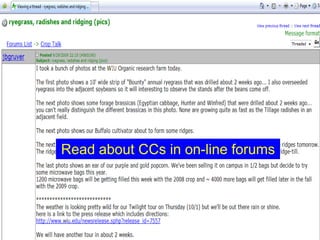
Read about CCs in on-line forums
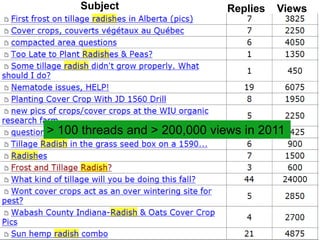
Subject                   Replies   Views


> 100 threads and > 200,000 views in 2011
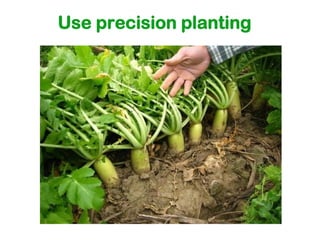
Use precision planting
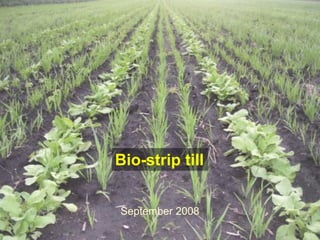
Bio-strip till


September 2008
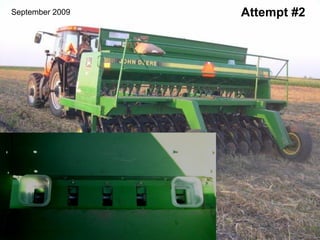
September 2009   Attempt #2
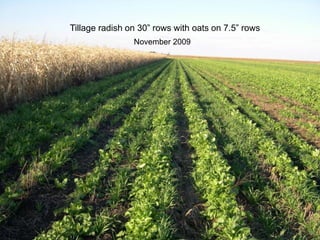
Tillage radish on 30” rows with oats on 7.5” rows
                November 2009
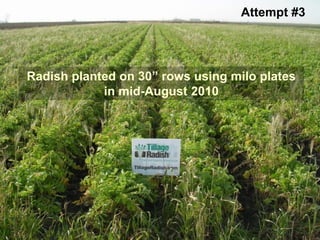
Attempt #3


Radish planted on 30” rows using milo plates
            in mid-August 2010
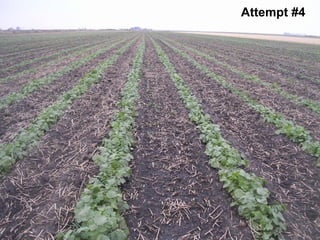
Attempt #4
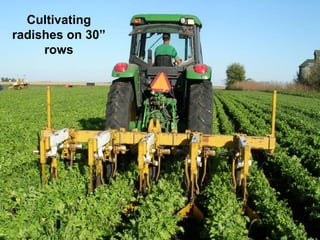
Cultivating
radishes on 30”
     rows
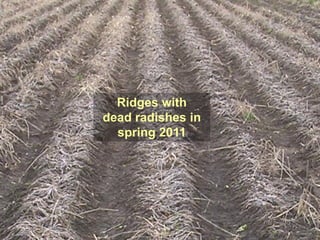
Ridges with
dead radishes in
  spring 2011
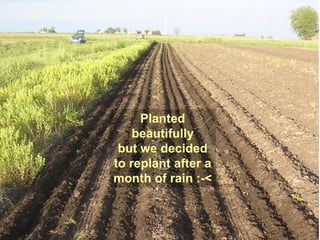
Planted
    beautifully
 but we decided
to replant after a
month of rain :-<
Keep good records
       – Date of planting
 – Seeding rates, drill settings…
     – Take lots of photos!
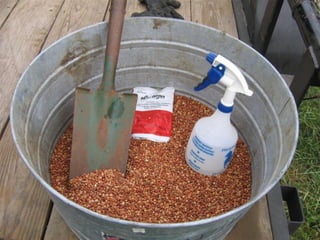
Optimize fertility
     • Inoculate legumes
 • Inoculate non-legumes?
• Fertilize cover crops when
    residual fertility is low
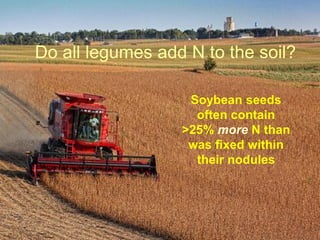
Do all legumes add N to the soil?

                   Soybean seeds
                    often contain
                  >25% more N than
                   was fixed within
                    their nodules
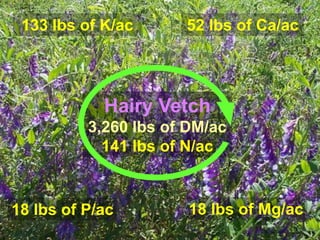
133 lbs of K/ac      52 lbs of Ca/ac


            Hairy Vetch
          3,260 lbs of DM/ac
            141 lbs of N/ac


18 lbs of P/ac         18 lbs of Mg/ac
?
Learn from research
           On-farm research
• Leave check strips - replicate if possible
     • Work with universities/NRCS
        Research station trials
          • Make suggestions
        • Pay attention to results
Practical Farmers of Iowa
  Field Crops Project on-farm research questions

 1. Can cover crop seed planted using a modified
     highboy have better establishment then an
                       airplane?
2. How can we improve use of spring cover crops?
 3. What other species of cover crops work in IA?
What are the yields of improved organic and non-GMO
                     corn hybrids?
   5. What are the yields and aphid counts of aphid-
                 resistant soybeans?
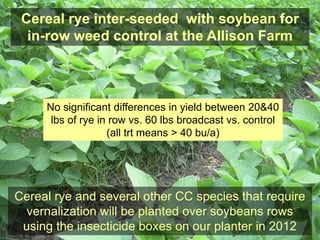
Cereal rye inter-seeded with soybean for
  in-row weed control at the Allison Farm


     No significant differences in yield between 20&40
      lbs of rye in row vs. 60 lbs broadcast vs. control
                   (all trt means > 40 bu/a)


Cereal rye and several other CC species that require
  vernalization will be planted over soybeans rows
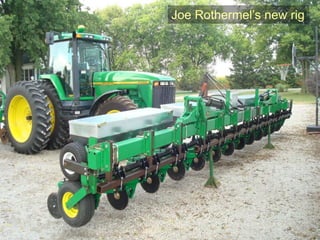
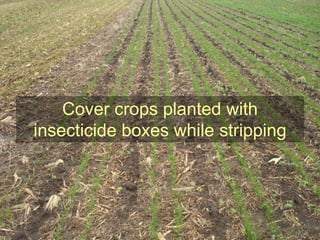
 using the insecticide boxes on our planter in 2012
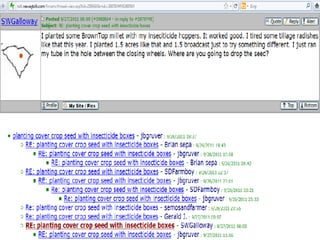
Joe Rothermel’s new rig
Cover crops planted with
insecticide boxes while stripping
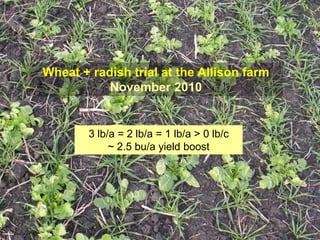
Wheat + radish trial at the Allison farm
           November 2010


        3 lb/a = 2 lb/a = 1 lb/a > 0 lb/c
             ~ 2.5 bu/a yield boost
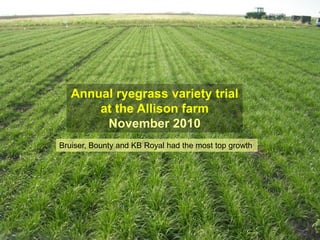
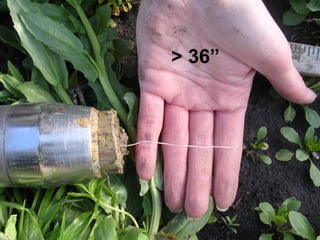
Annual ryegrass variety trial
       at the Allison farm
        November 2010
Bruiser, Bounty and KB Royal had the most top growth
> 36”
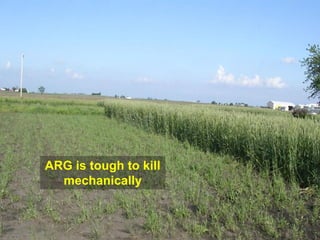
ARG is tough to kill
  mechanically
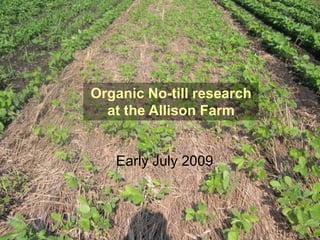
Organic No-till research
  at the Allison Farm


   Early July 2009
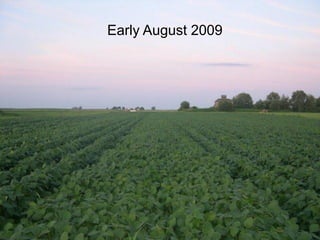
Early August 2009
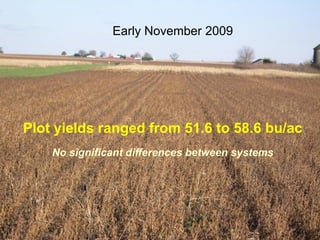
Early November 2009


Plot yields ranged from 51.6 to 58.6 bu/ac
    No significant differences between systems
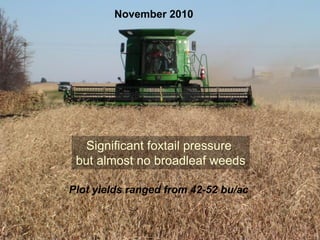
November 2010


   Significant foxtail pressure
 but almost no broadleaf weeds

Plot yields ranged from 42-52 bu/ac
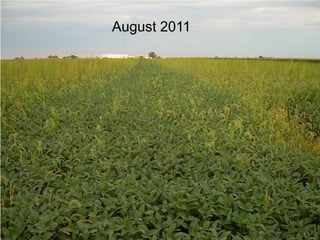
August 2011
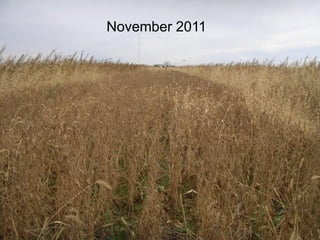
November 2011
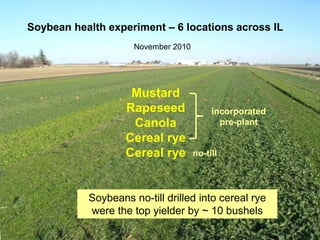
Soybean health experiment – 6 locations across IL
                     November 2010


                    Mustard
                   Rapeseed               incorporated
                    Canola                  pre-plant
                   Cereal rye
                   Cereal rye        no-till


           Soybeans no-till drilled into cereal rye
           were the top yielder by ~ 10 bushels
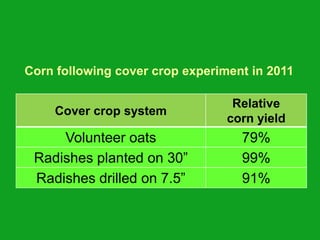
Corn following cover crop experiment in 2011

                                  Relative
    Cover crop system
                                 corn yield
     Volunteer oats                79%
 Radishes planted on 30”           99%
 Radishes drilled on 7.5”          91%
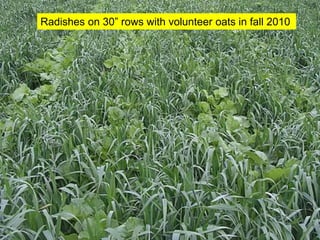
Radishes on 30” rows with volunteer oats in fall 2010
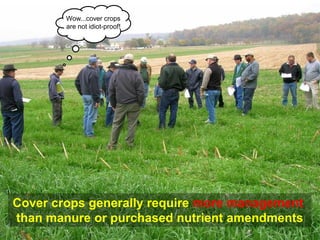
Wow...cover crops
        are not idiot-proof!


Cover crops generally require more management
than manure or purchased nutrient amendments
Good advice from Steve Groff…

    TREAT
    YOUR
    COVER
     CROPS
  LIKE YOUR
     CASH
    CROPS!

Capturing the full potential of cover crops

  • 1.
    Capturing the full potentialof cover crops Dr. Joel Gruver WIU – Agriculture j-gruver@wiu.edu
  • 2.
  • 3.
  • 4.
    Very common questionreceived by CC seed vendors in early fall “What cover crop should I plant ???”
  • 5.
    Well… what doyou want your cover crops to do for you?
  • 6.
    Cover crops arenot the missing puzzle piece(s) in your current crop rotation(s)! http://www.ncl.ac.uk/tcoa/files/breakcrops_orgagr.pdf
  • 7.
    Overview of bookcontents • Problems and opportunities for over 500 crop sequences • Characteristics of more than 60 crops and 70 weeds • Crop diseases hosted by over 80 weed species • Modes of transmission for 250 diseases of 24 crops • Thirteen sample four- and five-year vegetable and Rotations grain crop rotations Managing Crop Rotation Chart should evolve with key tasks & steps not revolve •Sample worksheets and calculations • Step-by-step procedure for determining crop rotation plans
  • 8.
    Overview of bookcontents • Problems and opportunities for over 500 crop sequences • Characteristics of more than 60 crops and 70 weeds • Crop diseases hosted by over 80 weed species • Modes of transmission for 250 diseases of 24 crops • Thirteen sample four- and five-year vegetable and grain crop rotations Managing Crop Rotation Chart with key tasks & steps •Sample worksheets and calculations • Step-by-step procedure for determining crop rotation plans
  • 9.
    Excellent information onintegrating cover crops with agronomic crops http://ohioline.osu.edu/sag-fact/pdf/0009.pdf
  • 10.
    Start planning today! • Anticipate planting windows • Match objectives with species • Confirm seed availability • Make sure seeding equipment is ready • Identify realistic termination methods • Allocate labor • Develop contingency plans
  • 12.
    Crop planted on May 15 and harvested on October 1
  • 13.
    Opportunities for plantingcover crops • Dormant seeding early or late winter • Frost seeding • In the spring • When planting summer crops • Prevent plant scenarios • At last cultivation • After small grains • After vegetables • After seed corn or silage corn • Aerial or high clearance seeding into standing crops in late summer/early fall • After long season crops
  • 15.
    What is thisCC? Phacelia
  • 16.
  • 17.
    Klaas and MaryMartens, organic innovators in Central NY State, are reporting excellent results with frost-seeded confectionary mustard ahead of dry beans
  • 18.
    Mustard variety trialat the Allison farm in early June 2011 Pacific Gold Ida Gold Slower to mature Faster to mature More biomass Less biomass
  • 19.
    Mustards are veryresponsive to N
  • 20.
    Mustards are easyto kill with tillage
  • 22.
    Sunflowers planted 7/17and 7/29 in 2010 and 7/7 in 2011
  • 23.
    JD 730 Air-Diskdrill on Jack Erisman’s farm in Pana, IL Jack uses this rig to drill soybeans on 6" rows (~ 280,000/ac) while also dropping about 2 bushel of rye and some micronutrients
  • 24.
    Planted before heavyrain Planted after heavy rain
  • 25.
    Small amount offoxtail… almost no broadleaves ~ 20 bushels more yield
  • 26.
    Lots of weedsbut very few towering monsters of maternity :->
  • 27.
    Match CC objectiveswith species Grazing GRAZING = #1 way to make cover crops pay! brassicas, clovers, small grains, a. ryegrass, sorghum-sudan Nutrient scavenging/cycling brassicas, small grains, annual ryegrass Bio-drilling brassicas, sugarbeet, sunflower, sorghum-sudan sweet clover, alfalfa N-fixation clovers, vetches, lentil, winter pea, chickling vetch, sun hemp, cowpea, soybean Bio-activation/fumigation brassicas, sorghum-sudan, sun hemp, sesame Weed suppression brassicas, sorghum-sudan, cereal rye, buckwheat
  • 28.
    Forage kale Oats, turnips, annual ryegrass and wheat Oats, turnips and cereal rye Mystery brassica
  • 29.
    OATS & PEAS SpringPlanted/Summer grazing
  • 30.
    Have you usedany forage brassicas as cover crops? Hunter
  • 31.
    Franzluebbers AJ andJA Stuedemann. 2008. Soil physical responses to cattle grazing cover crops under conventional and no tillage in the Southern Piedmont USA. Soil and Tillage Research 100, 141-153. • Cover crops (winter or summer) can provide high- quality forage and increase economic return and farm diversity, but some farmers have been reluctant to take this advantage due to perceived “compaction” caused by animal trampling. • Grazing of cover crops can compact soil, but not to the detrimental levels often perceived.
  • 32.
    Terminating spring plantedoats with a soil finisher ~ 3 weeks before planting corn
  • 33.
    Are you equippedto handle a situation like this?
  • 34.
    10’ Howard Rotavatortilling ~ 3” deep with C blades
  • 35.
    Complete kill after1 pass and 2 days of sun
  • 36.
    Typical weather inspring 2009-2011 :-<
  • 37.
    Moldboard plowing canbe the best option
  • 38.
    Are you familiarwith the fence post principle? Zone of maximum biological activity and rapid residue decay Deeper burial does not optimize decay but sends weed seeds into deep dormancy and brings deeply dormant weed seeds to the surface where they germinate slowly
  • 39.
    Performance over Price •Buy CC seed on value not price Cover crop seed price survey from 2010 ($/lb) Vendor Cereal rye Annual Hairy vetch Medium red ryegrass clover WI 0.188 0.52 (0.69) 1.60 (1.98) 1.22 (1.62) IL1 0.147 (0.179) 0.47 (0.63) 1.42 (1.65) MN 0.153 (0.171) 0.50 (0.56) 1.70 (1.90) 1.66 (1.84) NE1 0.157 (0.179) 0.55 (0.65) 2.10 (2.50) 1.65 (1.95) IL2 (0.213) (0.75) (2.20) (2.60) IL3 0.188 (0.214) (0.70) MO 0.197 0.46 1.47 1.21 IL4 (0.20) (0.60) (1.80) (1.75) IA (0.195) (0.62) (2.00) 2.00 IN (0.239) (0.75) (2.20) (IL farmer) 0.125 0.48 1.05
  • 40.
    The cheapest seedavailable is frequently VNS – variety not stated Do you know the difference between “variety name” and “brand name”? How important is uniform seed size and vigor to you?
  • 41.
    How much isgood technical support worth to you?
  • 42.
    Reduce Risk • Enrollin programs that pay you to plant CCs • Use time tested CC methods • Use more than one method of planting CCs • Plant mixtures/cocktails • Grow some crops e.g. small grains, vegetables, corn silage, shorter season hybrids/varieties that are harvested early • Irrigate
  • 44.
    Traditional cover croppingin the Midwest The most tried and true cover cropping system in the Midwest region Frost seeded red clover
  • 45.
    Drilling CC aftersmall grain harvest
  • 46.
    There are manyoptions other than drilling
  • 47.
    Annual ryegrass &radishes aerial seeded into soybeans at leaf drop. Aerial seeding is fast and relatively cheap but more sensitive to weather
  • 48.
    Effective multi-tasking orcover crop chaos???
  • 53.
    Beware of hype! •Cover crops are not a silver bullet solution to any problem
  • 54.
    The rock starof cover crops!!!
  • 55.
    With lots ofspace, moisture, fertility and time to grow, individual radishes can get huge! but a good stand of 1” radishes will probably do more for your soil!
  • 57.
    control Ohio State University Tillage Radish® plots Soil compaction decreased by >40%
  • 58.
    Crop root densityas affected by previous cover crop Chen and Weil (2006)
  • 59.
    Roots at ~40” after 45 days
  • 60.
    Radishes are notthe only good bio-driller!! • much less top growth but deeper roots than cereal rye • much less winter hardy than cereal rye • can be difficult to kill with tillage • can be a serious weed in small grains
  • 61.
    Learn from covercrop innovators • Attend field days/host a field day • Attend conferences • Participate in internet forums
  • 62.
    Field day atSteve Groff’s farm
  • 63.
    Field day atSteve Groff’s farm
  • 65.
    ~ 120 profilesincluding ~ 20 organic farmers since 2008
  • 66.
    Read about CCsin on-line forums
  • 67.
    Subject Replies Views > 100 threads and > 200,000 views in 2011
  • 68.
  • 70.
  • 71.
    September 2009 Attempt #2
  • 72.
    Tillage radish on30” rows with oats on 7.5” rows November 2009
  • 73.
    Attempt #3 Radish plantedon 30” rows using milo plates in mid-August 2010
  • 74.
  • 75.
  • 76.
  • 78.
    Planted beautifully but we decided to replant after a month of rain :-<
  • 80.
    Keep good records – Date of planting – Seeding rates, drill settings… – Take lots of photos!
  • 81.
    Optimize fertility • Inoculate legumes • Inoculate non-legumes? • Fertilize cover crops when residual fertility is low
  • 83.
    Do all legumesadd N to the soil? Soybean seeds often contain >25% more N than was fixed within their nodules
  • 84.
    133 lbs ofK/ac 52 lbs of Ca/ac Hairy Vetch 3,260 lbs of DM/ac 141 lbs of N/ac 18 lbs of P/ac 18 lbs of Mg/ac
  • 86.
  • 89.
    Learn from research On-farm research • Leave check strips - replicate if possible • Work with universities/NRCS Research station trials • Make suggestions • Pay attention to results
  • 90.
    Practical Farmers ofIowa Field Crops Project on-farm research questions 1. Can cover crop seed planted using a modified highboy have better establishment then an airplane? 2. How can we improve use of spring cover crops? 3. What other species of cover crops work in IA? What are the yields of improved organic and non-GMO corn hybrids? 5. What are the yields and aphid counts of aphid- resistant soybeans?
  • 91.
    Cereal rye inter-seededwith soybean for in-row weed control at the Allison Farm No significant differences in yield between 20&40 lbs of rye in row vs. 60 lbs broadcast vs. control (all trt means > 40 bu/a) Cereal rye and several other CC species that require vernalization will be planted over soybeans rows using the insecticide boxes on our planter in 2012
  • 93.
  • 94.
    Cover crops plantedwith insecticide boxes while stripping
  • 95.
    Wheat + radishtrial at the Allison farm November 2010 3 lb/a = 2 lb/a = 1 lb/a > 0 lb/c ~ 2.5 bu/a yield boost
  • 96.
    Annual ryegrass varietytrial at the Allison farm November 2010 Bruiser, Bounty and KB Royal had the most top growth
  • 97.
  • 98.
    ARG is toughto kill mechanically
  • 99.
    Organic No-till research at the Allison Farm Early July 2009
  • 100.
  • 101.
    Early November 2009 Plotyields ranged from 51.6 to 58.6 bu/ac No significant differences between systems
  • 102.
    November 2010 Significant foxtail pressure but almost no broadleaf weeds Plot yields ranged from 42-52 bu/ac
  • 103.
  • 104.
  • 105.
    Soybean health experiment– 6 locations across IL November 2010 Mustard Rapeseed incorporated Canola pre-plant Cereal rye Cereal rye no-till Soybeans no-till drilled into cereal rye were the top yielder by ~ 10 bushels
  • 106.
    Corn following covercrop experiment in 2011 Relative Cover crop system corn yield Volunteer oats 79% Radishes planted on 30” 99% Radishes drilled on 7.5” 91%
  • 107.
    Radishes on 30”rows with volunteer oats in fall 2010
  • 108.
    Wow...cover crops are not idiot-proof! Cover crops generally require more management than manure or purchased nutrient amendments
  • 109.
    Good advice fromSteve Groff… TREAT YOUR COVER CROPS LIKE YOUR CASH CROPS!