

FINANCIAL MARKET
BY – ABHISHEK TIWARI
PREVIEW
 What is investment ?
 An Introduction to Financial Market
 Types of Financial Market
 Stock Exchanges in India
 Securities and Exchange Board of India
WHAT IS INVESTMENT ?
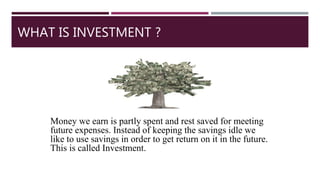
Money we earn is partly spent and rest saved for meeting
future expenses. Instead of keeping the savings idle we
like to use savings in order to get return on it in the future.
This is called Investment.
WHY INVEST ?
 Earn Return on idle resources
 Generate sum of money for specified goal in life
 Make provision for uncertain future
 To meet the cost of inflation
AN INTRODUCTION TO FINANCIAL MARKET
In economics, a financial market is a mechanism
that allows people to easily buy & sell (trade)
financial securities ( such as stocks & bonds ),
commodities ( such as precious metals or
agricultural goods ).
TYPES OF FINANCIAL MARKET
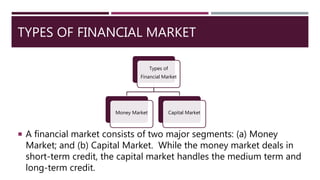
 A financial market consists of two major segments: (a) Money
Market; and (b) Capital Market. While the money market deals in
short-term credit, the capital market handles the medium term and
long-term credit.
Types of
Financial Market
Money Market Capital Market
MONEY MARKET
 The money market is a market for short-term funds, which deals in
financial assets whose period of maturity is up to one year.
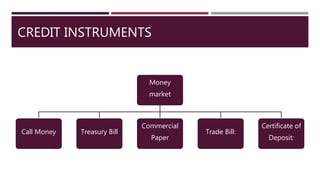
 It simply provides a market for credit instruments such as bills of
exchange, promissory notes, commercial paper, treasury bills, etc.
 Money market does not imply to any specific market place.
 Most of the money market transactions are taken place on
telephone, fax or Internet.
CREDIT INSTRUMENTS
Money
market
Call Money Treasury Bill
Commercial
Paper
Trade Bill:
Certificate of
Deposit:
CAPITAL MARKET
 Capital Market may be defined as a market dealing in medium and
long-term funds.
 It is an institutional arrangement for borrowing medium and long-
term funds and which provides facilities for marketing and trading
of securities.
 It constitutes all long-term borrowings from banks and financial
institutions, borrowings from foreign markets and raising of capital
by issue various securities such as shares debentures, bonds, etc.
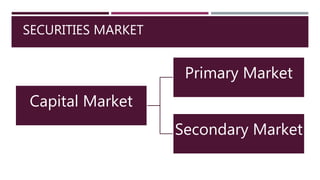
 The market where securities are traded known as Securities market.
SECURITIES MARKET
Capital Market
Primary Market
Secondary Market
PRIMARY MARKET
 The Primary Market consists of arrangements, which facilitate the
procurement of long-term funds by companies by making fresh
issue of shares and debentures.
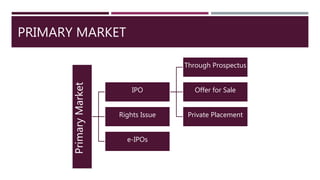
PRIMARY MARKET
PrimaryMarket
IPO
Through Prospectus
Offer for Sale
Private PlacementRights Issue
e-IPOs
SECONDARY MARKET
 Secondary market provides the place for trading securities on a
regular basis.
 The secondary market known as stock market or stock exchange
plays an equally important role in mobilizing long-term funds by
providing the necessary liquidity to holdings in shares and
debentures.
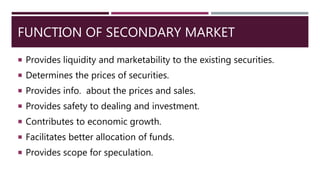
FUNCTION OF SECONDARY MARKET
 Provides liquidity and marketability to the existing securities.
 Determines the prices of securities.
 Provides info. about the prices and sales.
 Provides safety to dealing and investment.
 Contributes to economic growth.
 Facilitates better allocation of funds.
 Provides scope for speculation.
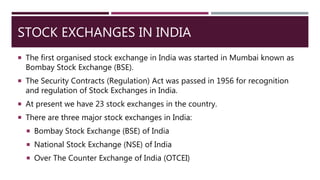
STOCK EXCHANGES IN INDIA
 The first organised stock exchange in India was started in Mumbai known as
Bombay Stock Exchange (BSE).
 The Security Contracts (Regulation) Act was passed in 1956 for recognition
and regulation of Stock Exchanges in India.
 At present we have 23 stock exchanges in the country.
 There are three major stock exchanges in India:
 Bombay Stock Exchange (BSE) of India
 National Stock Exchange (NSE) of India
 Over The Counter Exchange of India (OTCEI)
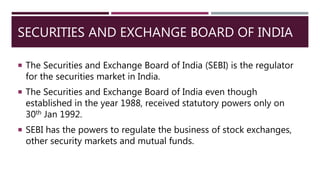
SECURITIES AND EXCHANGE BOARD OF INDIA
 The Securities and Exchange Board of India (SEBI) is the regulator
for the securities market in India.
 The Securities and Exchange Board of India even though
established in the year 1988, received statutory powers only on
30th Jan 1992.
 SEBI has the powers to regulate the business of stock exchanges,
other security markets and mutual funds.
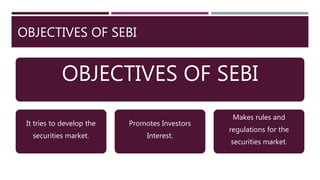
OBJECTIVES OF SEBI
OBJECTIVES OF SEBI
It tries to develop the
securities market.
Promotes Investors
Interest.
Makes rules and
regulations for the
securities market.
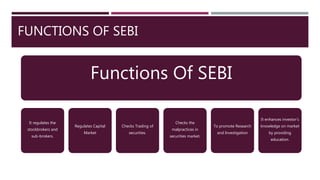
FUNCTIONS OF SEBI
Functions Of SEBI
It regulates the
stockbrokers and
sub-brokers.
Regulates Capital
Market
Checks Trading of
securities.
Checks the
malpractices in
securities market.
To promote Research
and Investigation
It enhances investor's
knowledge on market
by providing
education.
SUMMARY
THANK YOU!

Financial market

  • 1.
    FINANCIAL MARKET BY –ABHISHEK TIWARI
  • 2.
    PREVIEW  What isinvestment ?  An Introduction to Financial Market  Types of Financial Market  Stock Exchanges in India  Securities and Exchange Board of India
  • 3.
    WHAT IS INVESTMENT? Money we earn is partly spent and rest saved for meeting future expenses. Instead of keeping the savings idle we like to use savings in order to get return on it in the future. This is called Investment.
  • 4.
    WHY INVEST ? Earn Return on idle resources  Generate sum of money for specified goal in life  Make provision for uncertain future  To meet the cost of inflation
  • 5.
    AN INTRODUCTION TOFINANCIAL MARKET In economics, a financial market is a mechanism that allows people to easily buy & sell (trade) financial securities ( such as stocks & bonds ), commodities ( such as precious metals or agricultural goods ).
  • 6.
    TYPES OF FINANCIALMARKET  A financial market consists of two major segments: (a) Money Market; and (b) Capital Market. While the money market deals in short-term credit, the capital market handles the medium term and long-term credit. Types of Financial Market Money Market Capital Market
  • 7.
    MONEY MARKET  Themoney market is a market for short-term funds, which deals in financial assets whose period of maturity is up to one year.  It simply provides a market for credit instruments such as bills of exchange, promissory notes, commercial paper, treasury bills, etc.  Money market does not imply to any specific market place.  Most of the money market transactions are taken place on telephone, fax or Internet.
  • 8.
    CREDIT INSTRUMENTS Money market Call MoneyTreasury Bill Commercial Paper Trade Bill: Certificate of Deposit:
  • 9.
    CAPITAL MARKET  CapitalMarket may be defined as a market dealing in medium and long-term funds.  It is an institutional arrangement for borrowing medium and long- term funds and which provides facilities for marketing and trading of securities.  It constitutes all long-term borrowings from banks and financial institutions, borrowings from foreign markets and raising of capital by issue various securities such as shares debentures, bonds, etc.  The market where securities are traded known as Securities market.
  • 10.
  • 11.
    PRIMARY MARKET  ThePrimary Market consists of arrangements, which facilitate the procurement of long-term funds by companies by making fresh issue of shares and debentures.
  • 12.
    PRIMARY MARKET PrimaryMarket IPO Through Prospectus Offerfor Sale Private PlacementRights Issue e-IPOs
  • 13.
    SECONDARY MARKET  Secondarymarket provides the place for trading securities on a regular basis.  The secondary market known as stock market or stock exchange plays an equally important role in mobilizing long-term funds by providing the necessary liquidity to holdings in shares and debentures.
  • 14.
    FUNCTION OF SECONDARYMARKET  Provides liquidity and marketability to the existing securities.  Determines the prices of securities.  Provides info. about the prices and sales.  Provides safety to dealing and investment.  Contributes to economic growth.  Facilitates better allocation of funds.  Provides scope for speculation.
  • 15.
    STOCK EXCHANGES ININDIA  The first organised stock exchange in India was started in Mumbai known as Bombay Stock Exchange (BSE).  The Security Contracts (Regulation) Act was passed in 1956 for recognition and regulation of Stock Exchanges in India.  At present we have 23 stock exchanges in the country.  There are three major stock exchanges in India:  Bombay Stock Exchange (BSE) of India  National Stock Exchange (NSE) of India  Over The Counter Exchange of India (OTCEI)
  • 16.
    SECURITIES AND EXCHANGEBOARD OF INDIA  The Securities and Exchange Board of India (SEBI) is the regulator for the securities market in India.  The Securities and Exchange Board of India even though established in the year 1988, received statutory powers only on 30th Jan 1992.  SEBI has the powers to regulate the business of stock exchanges, other security markets and mutual funds.
  • 17.
    OBJECTIVES OF SEBI OBJECTIVESOF SEBI It tries to develop the securities market. Promotes Investors Interest. Makes rules and regulations for the securities market.
  • 18.
    FUNCTIONS OF SEBI FunctionsOf SEBI It regulates the stockbrokers and sub-brokers. Regulates Capital Market Checks Trading of securities. Checks the malpractices in securities market. To promote Research and Investigation It enhances investor's knowledge on market by providing education.
  • 19.