


CYBER LAWS AND INFORMATION
TECHNOLOGY ACT 2000
THE ACT OF PARLIAMENT RECEIVED THE ASSENT OF
THE PRESIDENT ON THE 9TH JUNE, 2000
PRESENTED BYPRESENTED BY
SNEHA CHOUHAN
(Roll No. 21)
DR. D Y PATIL UNIVERSITY,
SCHOOL OF BUSINESS
MANAGEMENT,
NAVI MUMBAI.
CONTENTS
1. INFORMATION TECHNOLOGY ACT 2000
2. OBJECTIVES OF THE IT ACT 2000
3. SECTIONS OF IT ACT 2000
4. SECTION 5 LEGAL RECOGNITION OF DIGITAL SIGNATURES
5. SECTION 15 SECURE DIGITAL SIGNATURE.
6. SECTION 65 TAMPERING WITH COMPUTER SOURCE DOCUMENTS
7. SECTION 66 HACKING WITH COMPUTER SYSTEM
8. SECTION 67 PUBLISHING OF OBSCENE INFORMATION
9. SECTION 73 - PENALTY FOR PUBLISHING FALSE DIGITAL SIGNATURE
CERTIFICATE
10. SECTION 74 PUBLICATION FOR FRAUDULENT PURPOSE
11. THE CYBER REGULATIONS APPELLATE TRIBUNAL
12. SECTION 48 ESTABLISHMENT OF CYBER APPELLATE TRIBUNAL
13. SECTION 49 COMPOSITION OF CYBER APPELLATE TRIBUNAL
14. CASE STUDIES AND OTHER AMENDMENTS
INFORMATION TECHNOLOGY
ACT 2000
• The act of parliament received the assent of the president
on the 9th
June, 2000.
• Information Technology Act 2000, is to provide legal
recognition for transactions carried out by means of
electronic data interchange and other means of electronic
communication, commonly referred to as “electronic
commerce”, which involve the use of alternatives to paper-
based methods of communication and storage of
information, to facilitate electronic filing of documents with
the Government agencies and further to amend the Indian
Penal Code, the Indian Evidence Act, 1872, the Bankers
Books Evidence Act, 1891 and the Reserve Bank of India
Act, 1934 and for matters connected therewith or
incidental thereto.
• Information Technology Act 2000, is based on UNCITRAL
(United Nations Commission on International Trade Law)
Model Law.
• Information Technology Act 2000, has 13 chapters, 94
sections and 4 schedules.
– First 14 sections deals with some legal aspects
concerning digital signature.
– Further other sections deal with certifying authorities who
are licensed to issue digital signature certificate.
– Sections 43 to 47 provide for penalties and
compensation.
– Sections 48 to 64 deals with Tribunals a appeal to high
court.
– Section 65 to 79 of the act deals with offences.
– Section 80 to 94 deals with miscellaneous of the Act.
OBJECTIVES OF THE IT ACT
2000
To provide legal recognition for transactions:-
Carried out by means of electronic data interchange, and
other means of electronic communication, commonly
referred to as "electronic commerce“
To facilitate electronic filing of documents with
Government agencies and E-Payments
To amend the Indian Penal Code, Indian Evidence
Act,1872, the Banker’s Books Evidence Act 1891,Reserve
Bank of India Act ,1934
Aims to provide for the legal framework so that legal
sanctity is accorded to all electronic records and other
activities carried out by electronic means.
OBJECTIVES OF THE IT ACT
2000
Legal Recognition for E-Commerce
• Digital Signatures and Regulatory Regime
• Electronic Documents at par with paper documents
E-Governance
• Electronic Filing of Documents
Amend certain Acts
Define Civil wrongs, Offences, punishments
• Investigation, Adjudication
• Appellate Regime
COMPUTER (CYBER) CRIME
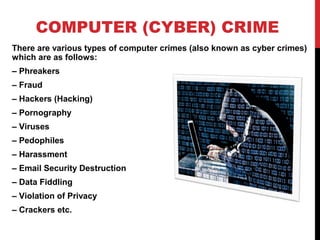
There are various types of computer crimes (also known as cyber crimes)
which are as follows:
– Phreakers
– Fraud
– Hackers (Hacking)
– Pornography
– Viruses
– Pedophiles
– Harassment
– Email Security Destruction
– Data Fiddling
– Violation of Privacy
– Crackers etc.
SECTIONS OF IT ACT 2000
• Sections 2(d) of the act defines “affixing digital signature” as
affixing digital signature, with its grammatical variations and
cognate expressions means adoption of any methodology or
procedure by a person for the purpose of authenticating an
electronic record by means of digital signature.
• Section 2(i) “computer” is defined as any electronic, magnetic,
optical or high speed data proceeding device or systems which
performs logical, arithmetic and memory functions by
manipulations of electronic, magnetic or optical impulses and
includes all input, output, proceedings, storage, computer
software or communication facilities which are concerned or
related to the computer in a computer system or computer
network.
• Section 2(zc) defines private key as the key of a key pair used to
create a digital signature.
• Section 2(zd) defines public key as the key of a key pair used to
verify a digital signature and listed in Digital Signature Certificate.
SECTION 5 LEGAL RECOGNITION
OF DIGITAL SIGNATURES
• Section 5 of the Act gives legal recognition to digital
signatures.
• Where any law provides that information or any other
matter shall be authenticated by affixing the signature or
any document shall be signed or bear the signature of any
person then, notwithstanding anything contained in such
law, such requirement shall be deemed to have been
satisfied, if such information or matter is authenticated by
means of digital signature affixed in such manner as may
be prescribed by the Central Government.
SECTION 15 SECURE DIGITAL
SIGNATURE.
If, by application of a security procedure agreed to by the
parties concerned, it can be verified that a digital signature,
at the time it was affixed, was—
– unique to the subscriber affixing it;
– capable of identifying such subscriber;
– created in a manner or using a means under the exclusive
control of the subscriber and is linked to the electronic
record to which it relates in such a manner that if the
electronic record was altered the digital signature would be
invalidated,
then such digital signature shall be deemed to be a secure
digital signature.
SECTION 65 TAMPERING WITH
COMPUTER SOURCE DOCUMENTS
• Whoever knowingly or intentionally conceals,
destroys or alters or intentionally or knowingly
causes another to conceal, destroy or alter any
computer source code used for a computer,
computer programme, computer system or
computer network, when the computer source
code is required to be kept or maintained by law
for the time being in force, shall be punishable
with imprisonment up to three years, or with fine
which may extend up to two lakh rupees, or with
both.
SECTION 66 HACKING WITH
COMPUTER SYSTEM
• Whoever with the intent to cause or knowing that he is
likely to cause wrongful loss or damage to the public or any
person destroys or deletes or alters any information residing
in a computer resource or diminishes its value or utility or
affects it injuriously by any means, commits hack:
• Whoever commits hacking shall be punished with
imprisonment up to three years, or with fine which may
extend upto two lakh rupees, or with both
SECTION 67 PUBLISHING OF
OBSCENE INFORMATION
• Whoever publishes or transmits or causes to be
published in the electronic form, any material which is
lascivious or appeals to the prurient interest or if its
effect is such as to tend to deprave and corrupt persons
who are likely, having regard to all relevant
circumstances, to read, see or hear the matter contained
or embodied in it, shall be punished on first conviction
with imprisonment of either description for a term which
may extend to five years and with fine which may extend
to one lakh rupees and in the event of a second or
subsequent conviction with imprisonment of either
description for a term which may extend to ten years and
also with fine which may extend to two lakh rupees.
SECTION 73 - PENALTY FOR
PUBLISHING FALSE DIGITAL
SIGNATURE CERTIFICATE
• No person shall publish a Digital Signature Certificate or otherwise
make it available to any other person with the knowledge that—
– the Certifying Authority listed in the certificate has not issued it; or
– the subscriber listed in the certificate has not accepted it; or
– the certificate has been revoked or suspended,
• unless such publication is for the purpose of verifying a digital
signature created prior to such suspension or revocation.
• Any person who contravenes the provisions of sub-section
(1) shall be punished with imprisonment for a term which may extend
to two years, or with fine which may extend to one lakh rupees, or
with both.
SECTION 74 PUBLICATION
FOR FRAUDULENT PURPOSE
Whoever knowingly creates, publishes or otherwise makes
available a Digital Signature Certificate for any fraudulent or
unlawful purpose shall be punished with imprisonment for a
term which may extend to two years, or with fine which may
extend to one lakh rupees, or with both.
THE CYBER REGULATIONS
APPELLATE TRIBUNAL
Cyber Appellate Tribunal are created to regulate and
supervise the Certifying Authorities who issue Digital
Signature certificates.
• Cyber Appellate Tribunal provide for appeal by person
aggrieved against an order made by the Adjudicating Officer
under the Information Technology Act.
•Section 48 to 64 of Information Technology Act 2000
contains provisions relating to Cyber Appellate Tribunal.
SECTION 48 ESTABLISHMENT
OF CYBER APPELLATE
TRIBUNAL
• The Central Government shall, by notification, establish one
or more appellate tribunals to be known as the Cyber
Regulations Appellate Tribunal.
• The Central Government shall also specify, in the
notification referred to in subsection
(1), the matters and places in relation to which the Cyber
Appellate Tribunal may exercise jurisdiction.
SECTION 49 COMPOSITION OF
CYBER APPELLATE TRIBUNAL
A Cyber Appellate Tribunal shall
consist of one person only
(hereinafter referred to as the
Residing Officer of the Cyber
Appellate Tribunal) to be appointed,
by notification, by the Central
Government
ELECTRONIC
GOVERNANCE
• Legal recognition of electronic records.
• Legal recognition of digital signatures.
• Use of electronic records and digital signatures in
Government and its agencies.
• Retention of electronic records.
• Publication of rule, regulation, etc., in Electronic Gazette.
• Sections 6,7 and 8 not to confer right to insist document
should be accepted in electronic form.
• Power to make rules by Central Government in respect of
digital signature.
ADVANTAGES OF IT ACT
2000
Helpful to promote Ecommerce
Enhance the corporate business
Filing online forms
High penalty for cyber crime
CASE STUDIES
AND SOME
RECENT
AMENDMENTS
CASE STUDY – 1
STATE OF TAMIL NADU V/S SUHAS KATTI
CONVICTION WITHIN 7 MONTHS
• The case related to posting of obscene, defamatory and annoying message
about a divorcee woman in the yahoo message group. E-Mails were also
forwarded to the victim for information by the accused through a false e-mail
account opened by him in the name of the victim. The posting of the
message resulted in annoying phone calls to the lady in the belief that she
was soliciting.
• The accused was a known family friend of the victim and was reportedly
interested in marrying her. She however married another person. This
marriage later ended in divorce and the accused started contacting her once
again. On her reluctance to marry him, the accused took up the harassment
through the Internet.
• The accused is found guilty and convicted for offences under section 469,
509 IPC and 67 of IT Act 2000 . This is considered as the first case convicted
under section 67 of Information Technology Act 2000 in India.
• The accused paid fine amount and he was lodged at Central Prison, Chennai.
This is considered as the first case convicted under section 67 of Information
Technology Act 2000 in India.
CASE STUDY – 2
EXTORTION OF MONEY THROUGH
INTERNET
• The complainant has received a threatening email and demanded
protection from unknown person claiming to be the member of
Halala Gang, Dubai. Police registered a case u/s. 384/506/511 IPC.
• The sender of the email used the email ID xyz@yahoo.com &
abc@yahoo.com and signed as Chengez Babar.
Both the email accounts were tracked, details collected from ISP’s
(Internet Service Provider) & locations were identified.
• The Cyber cafes from which the emails has been made were
monitored and the accused person was nabbed red handed.
CASE STUDY – 3
FIR NO. 76/02FIR NO. 76/02
PS PARLIAMENT STREETPS PARLIAMENT STREET
• Mrs. Sonia Gandhi received threatening E - mail from
missionrevenge84@hotmail.com
• The case was referred to Cyber Cell
• Accused was traces and found that he had lost his parents
during 1984 riots and thus sent threatening emails to Sonia.
CASE STUDY – 4
CYBER STALKING
• Ritu Kohli (first lady to register the cyber stalking case) is
a victim of cyber-stalking.
• A friend of her husband gave her phone number and
name on a chat site for immoral purposes.
• A computer expert, Kohli was able to trace the culprit.
• Now, the latter is being tried for "outraging the modesty
of a woman", under Section 509 of IPC.
RECENT AMENDMENT
RELATED TO INFORMATION
TECHNOLOGY ACT
• Section 66 A
THANKYOU

Cyber Law and Information Technology Act 2000 with case studies

  • 1.
    CYBER LAWS ANDINFORMATION TECHNOLOGY ACT 2000 THE ACT OF PARLIAMENT RECEIVED THE ASSENT OF THE PRESIDENT ON THE 9TH JUNE, 2000
  • 2.
    PRESENTED BYPRESENTED BY SNEHACHOUHAN (Roll No. 21) DR. D Y PATIL UNIVERSITY, SCHOOL OF BUSINESS MANAGEMENT, NAVI MUMBAI.
  • 3.
    CONTENTS 1. INFORMATION TECHNOLOGYACT 2000 2. OBJECTIVES OF THE IT ACT 2000 3. SECTIONS OF IT ACT 2000 4. SECTION 5 LEGAL RECOGNITION OF DIGITAL SIGNATURES 5. SECTION 15 SECURE DIGITAL SIGNATURE. 6. SECTION 65 TAMPERING WITH COMPUTER SOURCE DOCUMENTS 7. SECTION 66 HACKING WITH COMPUTER SYSTEM 8. SECTION 67 PUBLISHING OF OBSCENE INFORMATION 9. SECTION 73 - PENALTY FOR PUBLISHING FALSE DIGITAL SIGNATURE CERTIFICATE 10. SECTION 74 PUBLICATION FOR FRAUDULENT PURPOSE 11. THE CYBER REGULATIONS APPELLATE TRIBUNAL 12. SECTION 48 ESTABLISHMENT OF CYBER APPELLATE TRIBUNAL 13. SECTION 49 COMPOSITION OF CYBER APPELLATE TRIBUNAL 14. CASE STUDIES AND OTHER AMENDMENTS
  • 4.
    INFORMATION TECHNOLOGY ACT 2000 •The act of parliament received the assent of the president on the 9th June, 2000. • Information Technology Act 2000, is to provide legal recognition for transactions carried out by means of electronic data interchange and other means of electronic communication, commonly referred to as “electronic commerce”, which involve the use of alternatives to paper- based methods of communication and storage of information, to facilitate electronic filing of documents with the Government agencies and further to amend the Indian Penal Code, the Indian Evidence Act, 1872, the Bankers Books Evidence Act, 1891 and the Reserve Bank of India Act, 1934 and for matters connected therewith or incidental thereto.
  • 5.
    • Information TechnologyAct 2000, is based on UNCITRAL (United Nations Commission on International Trade Law) Model Law. • Information Technology Act 2000, has 13 chapters, 94 sections and 4 schedules. – First 14 sections deals with some legal aspects concerning digital signature. – Further other sections deal with certifying authorities who are licensed to issue digital signature certificate. – Sections 43 to 47 provide for penalties and compensation. – Sections 48 to 64 deals with Tribunals a appeal to high court. – Section 65 to 79 of the act deals with offences. – Section 80 to 94 deals with miscellaneous of the Act.
  • 6.
    OBJECTIVES OF THEIT ACT 2000 To provide legal recognition for transactions:- Carried out by means of electronic data interchange, and other means of electronic communication, commonly referred to as "electronic commerce“ To facilitate electronic filing of documents with Government agencies and E-Payments To amend the Indian Penal Code, Indian Evidence Act,1872, the Banker’s Books Evidence Act 1891,Reserve Bank of India Act ,1934 Aims to provide for the legal framework so that legal sanctity is accorded to all electronic records and other activities carried out by electronic means.
  • 7.
    OBJECTIVES OF THEIT ACT 2000 Legal Recognition for E-Commerce • Digital Signatures and Regulatory Regime • Electronic Documents at par with paper documents E-Governance • Electronic Filing of Documents Amend certain Acts Define Civil wrongs, Offences, punishments • Investigation, Adjudication • Appellate Regime
  • 8.
    COMPUTER (CYBER) CRIME Thereare various types of computer crimes (also known as cyber crimes) which are as follows: – Phreakers – Fraud – Hackers (Hacking) – Pornography – Viruses – Pedophiles – Harassment – Email Security Destruction – Data Fiddling – Violation of Privacy – Crackers etc.
  • 9.
    SECTIONS OF ITACT 2000 • Sections 2(d) of the act defines “affixing digital signature” as affixing digital signature, with its grammatical variations and cognate expressions means adoption of any methodology or procedure by a person for the purpose of authenticating an electronic record by means of digital signature. • Section 2(i) “computer” is defined as any electronic, magnetic, optical or high speed data proceeding device or systems which performs logical, arithmetic and memory functions by manipulations of electronic, magnetic or optical impulses and includes all input, output, proceedings, storage, computer software or communication facilities which are concerned or related to the computer in a computer system or computer network. • Section 2(zc) defines private key as the key of a key pair used to create a digital signature. • Section 2(zd) defines public key as the key of a key pair used to verify a digital signature and listed in Digital Signature Certificate.
  • 10.
    SECTION 5 LEGALRECOGNITION OF DIGITAL SIGNATURES • Section 5 of the Act gives legal recognition to digital signatures. • Where any law provides that information or any other matter shall be authenticated by affixing the signature or any document shall be signed or bear the signature of any person then, notwithstanding anything contained in such law, such requirement shall be deemed to have been satisfied, if such information or matter is authenticated by means of digital signature affixed in such manner as may be prescribed by the Central Government.
  • 11.
    SECTION 15 SECUREDIGITAL SIGNATURE. If, by application of a security procedure agreed to by the parties concerned, it can be verified that a digital signature, at the time it was affixed, was— – unique to the subscriber affixing it; – capable of identifying such subscriber; – created in a manner or using a means under the exclusive control of the subscriber and is linked to the electronic record to which it relates in such a manner that if the electronic record was altered the digital signature would be invalidated, then such digital signature shall be deemed to be a secure digital signature.
  • 12.
    SECTION 65 TAMPERINGWITH COMPUTER SOURCE DOCUMENTS • Whoever knowingly or intentionally conceals, destroys or alters or intentionally or knowingly causes another to conceal, destroy or alter any computer source code used for a computer, computer programme, computer system or computer network, when the computer source code is required to be kept or maintained by law for the time being in force, shall be punishable with imprisonment up to three years, or with fine which may extend up to two lakh rupees, or with both.
  • 13.
    SECTION 66 HACKINGWITH COMPUTER SYSTEM • Whoever with the intent to cause or knowing that he is likely to cause wrongful loss or damage to the public or any person destroys or deletes or alters any information residing in a computer resource or diminishes its value or utility or affects it injuriously by any means, commits hack: • Whoever commits hacking shall be punished with imprisonment up to three years, or with fine which may extend upto two lakh rupees, or with both
  • 14.
    SECTION 67 PUBLISHINGOF OBSCENE INFORMATION • Whoever publishes or transmits or causes to be published in the electronic form, any material which is lascivious or appeals to the prurient interest or if its effect is such as to tend to deprave and corrupt persons who are likely, having regard to all relevant circumstances, to read, see or hear the matter contained or embodied in it, shall be punished on first conviction with imprisonment of either description for a term which may extend to five years and with fine which may extend to one lakh rupees and in the event of a second or subsequent conviction with imprisonment of either description for a term which may extend to ten years and also with fine which may extend to two lakh rupees.
  • 15.
    SECTION 73 -PENALTY FOR PUBLISHING FALSE DIGITAL SIGNATURE CERTIFICATE • No person shall publish a Digital Signature Certificate or otherwise make it available to any other person with the knowledge that— – the Certifying Authority listed in the certificate has not issued it; or – the subscriber listed in the certificate has not accepted it; or – the certificate has been revoked or suspended, • unless such publication is for the purpose of verifying a digital signature created prior to such suspension or revocation. • Any person who contravenes the provisions of sub-section (1) shall be punished with imprisonment for a term which may extend to two years, or with fine which may extend to one lakh rupees, or with both.
  • 16.
    SECTION 74 PUBLICATION FORFRAUDULENT PURPOSE Whoever knowingly creates, publishes or otherwise makes available a Digital Signature Certificate for any fraudulent or unlawful purpose shall be punished with imprisonment for a term which may extend to two years, or with fine which may extend to one lakh rupees, or with both.
  • 17.
    THE CYBER REGULATIONS APPELLATETRIBUNAL Cyber Appellate Tribunal are created to regulate and supervise the Certifying Authorities who issue Digital Signature certificates. • Cyber Appellate Tribunal provide for appeal by person aggrieved against an order made by the Adjudicating Officer under the Information Technology Act. •Section 48 to 64 of Information Technology Act 2000 contains provisions relating to Cyber Appellate Tribunal.
  • 18.
    SECTION 48 ESTABLISHMENT OFCYBER APPELLATE TRIBUNAL • The Central Government shall, by notification, establish one or more appellate tribunals to be known as the Cyber Regulations Appellate Tribunal. • The Central Government shall also specify, in the notification referred to in subsection (1), the matters and places in relation to which the Cyber Appellate Tribunal may exercise jurisdiction.
  • 19.
    SECTION 49 COMPOSITIONOF CYBER APPELLATE TRIBUNAL A Cyber Appellate Tribunal shall consist of one person only (hereinafter referred to as the Residing Officer of the Cyber Appellate Tribunal) to be appointed, by notification, by the Central Government
  • 20.
    ELECTRONIC GOVERNANCE • Legal recognitionof electronic records. • Legal recognition of digital signatures. • Use of electronic records and digital signatures in Government and its agencies. • Retention of electronic records. • Publication of rule, regulation, etc., in Electronic Gazette. • Sections 6,7 and 8 not to confer right to insist document should be accepted in electronic form. • Power to make rules by Central Government in respect of digital signature.
  • 21.
    ADVANTAGES OF ITACT 2000 Helpful to promote Ecommerce Enhance the corporate business Filing online forms High penalty for cyber crime
  • 22.
  • 23.
    CASE STUDY –1 STATE OF TAMIL NADU V/S SUHAS KATTI CONVICTION WITHIN 7 MONTHS • The case related to posting of obscene, defamatory and annoying message about a divorcee woman in the yahoo message group. E-Mails were also forwarded to the victim for information by the accused through a false e-mail account opened by him in the name of the victim. The posting of the message resulted in annoying phone calls to the lady in the belief that she was soliciting. • The accused was a known family friend of the victim and was reportedly interested in marrying her. She however married another person. This marriage later ended in divorce and the accused started contacting her once again. On her reluctance to marry him, the accused took up the harassment through the Internet. • The accused is found guilty and convicted for offences under section 469, 509 IPC and 67 of IT Act 2000 . This is considered as the first case convicted under section 67 of Information Technology Act 2000 in India. • The accused paid fine amount and he was lodged at Central Prison, Chennai. This is considered as the first case convicted under section 67 of Information Technology Act 2000 in India.
  • 24.
    CASE STUDY –2 EXTORTION OF MONEY THROUGH INTERNET • The complainant has received a threatening email and demanded protection from unknown person claiming to be the member of Halala Gang, Dubai. Police registered a case u/s. 384/506/511 IPC. • The sender of the email used the email ID xyz@yahoo.com & abc@yahoo.com and signed as Chengez Babar. Both the email accounts were tracked, details collected from ISP’s (Internet Service Provider) & locations were identified. • The Cyber cafes from which the emails has been made were monitored and the accused person was nabbed red handed.
  • 25.
    CASE STUDY –3 FIR NO. 76/02FIR NO. 76/02 PS PARLIAMENT STREETPS PARLIAMENT STREET • Mrs. Sonia Gandhi received threatening E - mail from missionrevenge84@hotmail.com • The case was referred to Cyber Cell • Accused was traces and found that he had lost his parents during 1984 riots and thus sent threatening emails to Sonia.
  • 26.
    CASE STUDY –4 CYBER STALKING • Ritu Kohli (first lady to register the cyber stalking case) is a victim of cyber-stalking. • A friend of her husband gave her phone number and name on a chat site for immoral purposes. • A computer expert, Kohli was able to trace the culprit. • Now, the latter is being tried for "outraging the modesty of a woman", under Section 509 of IPC.
  • 27.
    RECENT AMENDMENT RELATED TOINFORMATION TECHNOLOGY ACT • Section 66 A
  • 28.