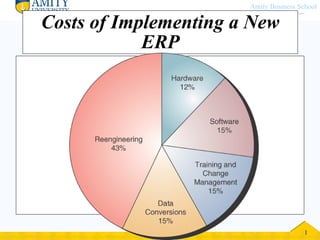
Costs of Implementing a New ERP
ERP Implementation and ROI ROI analysis  is becoming an important factor in influencing the organizations’ decision to acquire ERP packages. A  demonstrable return on investment (ROI) , is becoming a must for customers to invest scarce capital and human resources in ERP packages. ROI models fall short in their ability to accurately measure the total value of an enterprise software investment are they are focused only on  quantifiable (tangible) measures of return . The  overall payback  that enterprise software can offer to a company gives a more complete analysis of return. This analysis takes into account both the tangible and intangible benefits of the ERP systems. Intangible benefits  include new business opportunities, improved customer and customer goodwill, better relationships with partners, suppliers and other business associates, improved time to market, etc.  These  intangible benefits  contribute significantly to the success of a company's enterprise software implementation and use. Enterprise Resource Planning (Second Edition). Copyright 2008, Alexis Leon. All rights reserved.
Payback Parameters The  overall payback  that enterprise software can offer to a company gives a more complete analysis of return. The major key  payback parameters  are: Faster time to market Improved business processes Improved customer support Rapid capitalization of new business opportunities Lower implementation costs The sum of the parameters described by enterprise payback— tangible  as well as  intangible —offers a much more complete picture of the value of the software and services provided by a given vendor. Enterprise Resource Planning (Second Edition). Copyright 2008, Alexis Leon. All rights reserved.
Quantifiable Benefits from an ERP Reduced  inventory  costs  (by at least 20%) Reduced  inventory carrying costs  (by 25–30%) Reduced  manpower costs  (by 10% or more) Reduced  material costs  (by 5% or more) Improved  sales  (by 10% or more)  Improved  customer service  resulting in savings of 5% or more Efficient  financial management  resulting in savings of 18% or more Enterprise Resource Planning (Second Edition). Copyright 2008, Alexis Leon. All rights reserved.
The Intangible Effects of ERP ERP provides a framework for working effectively together and devising a consistent plan for action. The ERP system improves the efficiency of many departments and functions including: Accounting Product and Process Design Production and Materials Management Sales MIS Function Enterprise Resource Planning (Second Edition). Copyright 2008, Alexis Leon. All rights reserved.
Other Factors Many other factors that should be considered while justifying ERP investments.  Some of them are quantifiable while others are intangible. The major factors are: Lower  implementation costs Lower  production costs Lower  business transaction costs Lower  cost of reporting Lower  personnel costs Lower  business process change   Lower  enhancement costs Supporting and enhancing the  customer experience Supporting and enhancing the  partner experience Enabling new  business opportunities Enterprise Resource Planning (Second Edition). Copyright 2008, Alexis Leon. All rights reserved.
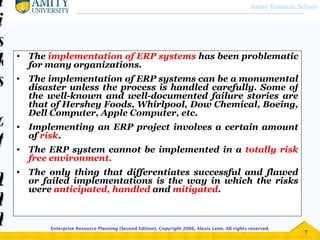
Risks of ERP The  implementation of ERP systems  has been problematic for many organizations.  The implementation of ERP systems can be a monumental disaster unless the process is handled carefully. Some of the well-known and well-documented failure stories are that of Hershey Foods, Whirlpool, Dow Chemical, Boeing, Dell Computer, Apple Computer, etc. Implementing an ERP project involves a certain amount of  risk .  The ERP system cannot be implemented in a  totally risk free environment.  The only thing that differentiates successful and flawed or failed implementations is the way in which the risks were  anticipated, handled  and  mitigated .  Enterprise Resource Planning (Second Edition). Copyright 2008, Alexis Leon. All rights reserved.
Minimizing the Risks… Prepare well —Meticulously plan each every step of the implementation. Have a contingency plan —There will always be unexpected problems; you should have a plan for those situations. Use a proven methodology —A methodology will help ward off risk, but a contingency plan is still absolutely necessary.  Enterprise Resource Planning (Second Edition). Copyright 2008, Alexis Leon. All rights reserved.
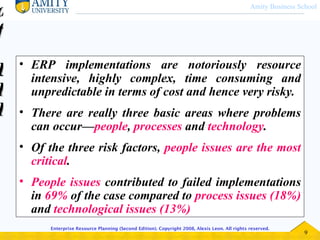
Risks of ERP ERP implementations are notoriously resource intensive, highly complex, time consuming and unpredictable in terms of cost and hence very risky. There are really three basic areas where problems can occur— people ,  processes  and  technology .  Of the three risk factors,  people issues are the most critical . People issues  contributed to failed implementations in  69%  of the case compared to  process issues (18%)  and  technological issues (13%) Enterprise Resource Planning (Second Edition). Copyright 2008, Alexis Leon. All rights reserved.
People Issues People—employees, management, implementation team, consultants and vendors—are the most crucial factor that decides the success or failure of an ERP system. The main people issues are: Change management Internal staff adequacy Project team Training Employee re-location and re-training Staffing (includes turnover) Top management support Consultants Discipline Resistance to change Enterprise Resource Planning (Second Edition). Copyright 2008, Alexis Leon. All rights reserved.
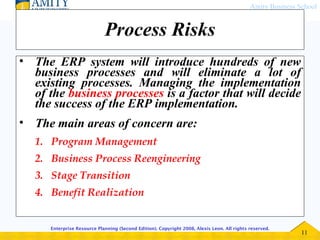
Process Risks The ERP system will introduce hundreds of new business processes and will eliminate a lot of existing processes. Managing the implementation of the  business processes  is a factor that will decide the success of the ERP implementation.  The main areas of concern are: Program Management Business Process Reengineering Stage Transition Benefit Realization Enterprise Resource Planning (Second Edition). Copyright 2008, Alexis Leon. All rights reserved.
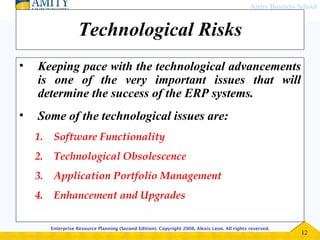
Technological Risks Keeping pace with the technological advancements is one of the very important issues that will determine the success of the ERP systems.  Some of the technological issues are: Software Functionality Technological Obsolescence Application Portfolio Management Enhancement and Upgrades Enterprise Resource Planning (Second Edition). Copyright 2008, Alexis Leon. All rights reserved.
Implementation Issues Many ERP implementations fail because they do not consider the various implementation issues associated with a complex and risky project.  Some of these issues are: Project Size Lengthy Implementation Time High Initial Investment Unreasonable Deadlines Insufficient Funding Interface Organizational Politics Scope Creep Unexpected Gaps Configuration Difficulties Enterprise Resource Planning (Second Edition). Copyright 2008, Alexis Leon. All rights reserved.
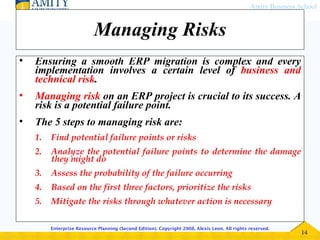
Managing Risks Ensuring a smooth ERP migration is complex and every implementation involves a certain level of  business and technical risk . Managing risk  on an ERP project is crucial to its success. A risk is a potential failure point.  The 5 steps to managing risk are: Find potential failure points or risks Analyze the potential failure points to determine the damage they might do Assess the probability of the failure occurring Based on the first three factors, prioritize the risks Mitigate the risks through whatever action is necessary Enterprise Resource Planning (Second Edition). Copyright 2008, Alexis Leon. All rights reserved.
Benefits of ERP Installing an ERP system has many advantages—both  direct  and  indirect .  The  direct advantages  include improved efficiency, information integration for better decision- making, faster response time to customer queries, etc.  The  indirect benefits  include better corporate image, improved customer goodwill, customer satisfaction and so on.  Some of the benefits are  quantitative (tangible)  while many others are  qualitative (intangible). Enterprise Resource Planning (Second Edition). Copyright 2008, Alexis Leon. All rights reserved.
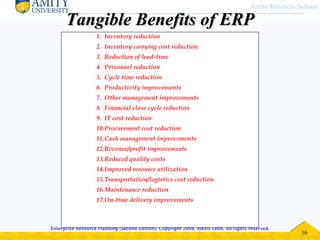
Tangible Benefits of ERP Inventory reduction Inventory carrying cost reduction Reduction of lead-time Personnel reduction Cycle time reduction Productivity improvements Other management improvements Financial close cycle reduction IT cost reduction Procurement cost reduction Cash management improvements Revenue/profit improvements Reduced quality costs Improved resource utilization Transportation/logistics cost reduction Maintenance reduction On-time delivery improvements Enterprise Resource Planning (Second Edition). Copyright 2008, Alexis Leon. All rights reserved.
Intangible Benefits of ERP Information visibility New and improved business processes Customer responsiveness Improved supplier performance Better customer satisfaction Cost reduction Integration of business functions  Information integration  Better analysis and planning capabilities Improved information accuracy Improved decision-making capability Standardization of business processes  Flexibility and business agility  Globalization of the organization Better business performance Supply chain integration Use of latest technology Enterprise Resource Planning (Second Edition). Copyright 2008, Alexis Leon. All rights reserved.

6d5a24 risks and benefits

  • 1.
  • 2.
    ERP Implementation andROI ROI analysis is becoming an important factor in influencing the organizations’ decision to acquire ERP packages. A demonstrable return on investment (ROI) , is becoming a must for customers to invest scarce capital and human resources in ERP packages. ROI models fall short in their ability to accurately measure the total value of an enterprise software investment are they are focused only on quantifiable (tangible) measures of return . The overall payback that enterprise software can offer to a company gives a more complete analysis of return. This analysis takes into account both the tangible and intangible benefits of the ERP systems. Intangible benefits include new business opportunities, improved customer and customer goodwill, better relationships with partners, suppliers and other business associates, improved time to market, etc. These intangible benefits contribute significantly to the success of a company's enterprise software implementation and use. Enterprise Resource Planning (Second Edition). Copyright 2008, Alexis Leon. All rights reserved.
  • 3.
    Payback Parameters The overall payback that enterprise software can offer to a company gives a more complete analysis of return. The major key payback parameters are: Faster time to market Improved business processes Improved customer support Rapid capitalization of new business opportunities Lower implementation costs The sum of the parameters described by enterprise payback— tangible as well as intangible —offers a much more complete picture of the value of the software and services provided by a given vendor. Enterprise Resource Planning (Second Edition). Copyright 2008, Alexis Leon. All rights reserved.
  • 4.
    Quantifiable Benefits froman ERP Reduced inventory costs (by at least 20%) Reduced inventory carrying costs (by 25–30%) Reduced manpower costs (by 10% or more) Reduced material costs (by 5% or more) Improved sales (by 10% or more) Improved customer service resulting in savings of 5% or more Efficient financial management resulting in savings of 18% or more Enterprise Resource Planning (Second Edition). Copyright 2008, Alexis Leon. All rights reserved.
  • 5.
    The Intangible Effectsof ERP ERP provides a framework for working effectively together and devising a consistent plan for action. The ERP system improves the efficiency of many departments and functions including: Accounting Product and Process Design Production and Materials Management Sales MIS Function Enterprise Resource Planning (Second Edition). Copyright 2008, Alexis Leon. All rights reserved.
  • 6.
    Other Factors Manyother factors that should be considered while justifying ERP investments. Some of them are quantifiable while others are intangible. The major factors are: Lower implementation costs Lower production costs Lower business transaction costs Lower cost of reporting Lower personnel costs Lower business process change Lower enhancement costs Supporting and enhancing the customer experience Supporting and enhancing the partner experience Enabling new business opportunities Enterprise Resource Planning (Second Edition). Copyright 2008, Alexis Leon. All rights reserved.
  • 7.
    Risks of ERPThe implementation of ERP systems has been problematic for many organizations. The implementation of ERP systems can be a monumental disaster unless the process is handled carefully. Some of the well-known and well-documented failure stories are that of Hershey Foods, Whirlpool, Dow Chemical, Boeing, Dell Computer, Apple Computer, etc. Implementing an ERP project involves a certain amount of risk . The ERP system cannot be implemented in a totally risk free environment. The only thing that differentiates successful and flawed or failed implementations is the way in which the risks were anticipated, handled and mitigated . Enterprise Resource Planning (Second Edition). Copyright 2008, Alexis Leon. All rights reserved.
  • 8.
    Minimizing the Risks…Prepare well —Meticulously plan each every step of the implementation. Have a contingency plan —There will always be unexpected problems; you should have a plan for those situations. Use a proven methodology —A methodology will help ward off risk, but a contingency plan is still absolutely necessary. Enterprise Resource Planning (Second Edition). Copyright 2008, Alexis Leon. All rights reserved.
  • 9.
    Risks of ERPERP implementations are notoriously resource intensive, highly complex, time consuming and unpredictable in terms of cost and hence very risky. There are really three basic areas where problems can occur— people , processes and technology . Of the three risk factors, people issues are the most critical . People issues contributed to failed implementations in 69% of the case compared to process issues (18%) and technological issues (13%) Enterprise Resource Planning (Second Edition). Copyright 2008, Alexis Leon. All rights reserved.
  • 10.
    People Issues People—employees,management, implementation team, consultants and vendors—are the most crucial factor that decides the success or failure of an ERP system. The main people issues are: Change management Internal staff adequacy Project team Training Employee re-location and re-training Staffing (includes turnover) Top management support Consultants Discipline Resistance to change Enterprise Resource Planning (Second Edition). Copyright 2008, Alexis Leon. All rights reserved.
  • 11.
    Process Risks TheERP system will introduce hundreds of new business processes and will eliminate a lot of existing processes. Managing the implementation of the business processes is a factor that will decide the success of the ERP implementation. The main areas of concern are: Program Management Business Process Reengineering Stage Transition Benefit Realization Enterprise Resource Planning (Second Edition). Copyright 2008, Alexis Leon. All rights reserved.
  • 12.
    Technological Risks Keepingpace with the technological advancements is one of the very important issues that will determine the success of the ERP systems. Some of the technological issues are: Software Functionality Technological Obsolescence Application Portfolio Management Enhancement and Upgrades Enterprise Resource Planning (Second Edition). Copyright 2008, Alexis Leon. All rights reserved.
  • 13.
    Implementation Issues ManyERP implementations fail because they do not consider the various implementation issues associated with a complex and risky project. Some of these issues are: Project Size Lengthy Implementation Time High Initial Investment Unreasonable Deadlines Insufficient Funding Interface Organizational Politics Scope Creep Unexpected Gaps Configuration Difficulties Enterprise Resource Planning (Second Edition). Copyright 2008, Alexis Leon. All rights reserved.
  • 14.
    Managing Risks Ensuringa smooth ERP migration is complex and every implementation involves a certain level of business and technical risk . Managing risk on an ERP project is crucial to its success. A risk is a potential failure point. The 5 steps to managing risk are: Find potential failure points or risks Analyze the potential failure points to determine the damage they might do Assess the probability of the failure occurring Based on the first three factors, prioritize the risks Mitigate the risks through whatever action is necessary Enterprise Resource Planning (Second Edition). Copyright 2008, Alexis Leon. All rights reserved.
  • 15.
    Benefits of ERPInstalling an ERP system has many advantages—both direct and indirect . The direct advantages include improved efficiency, information integration for better decision- making, faster response time to customer queries, etc. The indirect benefits include better corporate image, improved customer goodwill, customer satisfaction and so on. Some of the benefits are quantitative (tangible) while many others are qualitative (intangible). Enterprise Resource Planning (Second Edition). Copyright 2008, Alexis Leon. All rights reserved.
  • 16.
    Tangible Benefits ofERP Inventory reduction Inventory carrying cost reduction Reduction of lead-time Personnel reduction Cycle time reduction Productivity improvements Other management improvements Financial close cycle reduction IT cost reduction Procurement cost reduction Cash management improvements Revenue/profit improvements Reduced quality costs Improved resource utilization Transportation/logistics cost reduction Maintenance reduction On-time delivery improvements Enterprise Resource Planning (Second Edition). Copyright 2008, Alexis Leon. All rights reserved.
  • 17.
    Intangible Benefits ofERP Information visibility New and improved business processes Customer responsiveness Improved supplier performance Better customer satisfaction Cost reduction Integration of business functions Information integration Better analysis and planning capabilities Improved information accuracy Improved decision-making capability Standardization of business processes Flexibility and business agility Globalization of the organization Better business performance Supply chain integration Use of latest technology Enterprise Resource Planning (Second Edition). Copyright 2008, Alexis Leon. All rights reserved.