N° 04 MAY 2013
Accelerating Digital Transformation
• Allianz: Creating a Digital DNA - Joe Gross • Etisalat: Accelerating Transformation through a Digital
Services Unit - Khalifa Al Shamsi • Zurich: “The Department of YES” or the Evolving Role of a CIO
- Markus Nordlin • Yammer: Driving Employee Engagement through Social Networks
- Adam Pisoni • Being Digital: Engaging the Organization to Accelerate Digital Transformation
- MIT and Capgemini Consulting • Badgeville: Helping Companies to Better Engage with Employees
- Kris Duggan • UK Digital Champion: Driving a Nation Forward with Digital - Martha Lane Fox
Digital Transformation Review N° 04 3
N° 04 MAY 2013
Xavier Hochet 	 CEO
Ken Toombs 		 Deputy CEO and USA Regional Head
Didier Bonnet 		 Global Head of Practices
Jerome Buvat 		 Head of Research
Andrew McAfee 	 MIT Research Scientist
Michael Welch 	 Visiting Scientist at MIT
	 	 The Digital Transformation
	 	 Research Institute
Accelerating Digital Transformation
CapgeminiConsulting’sEditorialBoard
Digital Transformation Review N° 04
ACCELERATIONTHROUGH
STRONGIT/BUSINESS
RELATIONSHIPS
Zurich: “The Department of
YES” or the Evolving role of a
CIO - Markus Nordlin
page 24
EDITORIAL
Accelerating Digital
Transformation
- Capgemini Consulting’s
Editorial Board
page 6
STRATEGY
Allianz: Creating a Digital DNA
- Joe Gross
page 8
ACCELERATIONTHROUGH
GOVERNANCE
Etisalat: Accelerating
Transformation through a
Digital Services Unit
- Khalifa Al Shamsi
page 16
CONTENTS
By Sergi Herrero, CEO, L’Atelier
BNP Paribas USA
pages 15, 29, 57
COMPANIESTOWATCH:
VIEWFROMSILICONVALLEY
Digital Transformation Review N° 04
Badgeville: Helping Companies
Engage with Employees
Better - Kris Duggan
page 49
ACCELERATIONTHROUGH
ENGAGEMENT
Yammer: Driving Employee
Engagement through Social
Networks - Adam Pisoni
page 30
SPECIALGUEST
UK Digital Champion: Driving
a Nation Forward with Digital -
Martha Lane Fox
page 58
Being Digital: Engaging the
Organization to Accelerate
Digital Transformation
- MIT and Capgemini Consulting
page 37
101011010010
101011010010
101011010010
A major research initiative at the MIT Sloan School of Management
Digital Transformation Review N° 046
O
rganizations across
sectors are realizing the
transformative power of
digital. However, while there
is increased appreciation of
digital’s role, many organizations
are struggling to take their
transformation initiatives to
the next level. They are caught
struggling for pace, and risk
falling in the chasm between
initiation and termination of
transformation initiatives. In this
fourth Digital Transformation
Review, we aim to help business
leaders understand how to
accelerate their efforts at
transforming digitally.
We open the Review with
insurance giant Allianz, which is
investing aggressively in digital
initiatives in a sector not known
for being digitally-savvy. We
interview Joe Gross, Head of
Group Market Management at
Allianz, who shares his views on
why organizations should make
digital part of their DNA.
To make digital part of the
lifeblood of the organization
not only requires strong vision
and investment, it also requires
accelerated deployment across
the business. In this Review
we look at three primary
mechanisms for accelerating
this needed adoption and
deployment.
The first approach is acceleration
through better governance.
Organizations can create
governance structures that
inherently allow for replication
of best practices and elimination
of capability redundancies.
Leading UAE-based telecom
player Etisalat recently launched
such a dedicated Digital Services
Unit. We interview Khalifa Al
Shamsi, Chief Digital Services
Officer at Etisalat, who expands
on how a Digital Services Unit
is helping Etisalat accelerate its
digital transformation.
Technology plays a crucial role
in an organization’s digital
transformation. It is imperative
that IT executives play a big role
in the transformation for it to be
successful. This brings us to our
second approach – acceleration
through tighter linkage
between IT and business. And
this linkage has to start right
at the top with the CIO. We
interview Markus Nordlin, the
CIO of Zurich Insurance, to
understand the evolving role of
a CIO in the context of a digital
transformation.
Digital transformation is
an executive-led initiative.
Nevertheless, any such large-
scale initiative can only succeed
if it has clear buy-in from rank
and file employees across the
company. The third approach
we examine looks at the
importance of engagement as a
tool for acceleration of digital
transformation. Social media has
made people more comfortable
with sharing, connecting and
engaging with one another.
Organizations are now willing to
adopt such social networks inside
the enterprise in order to drive
engagement. We interview Adam
Pisoni, Co-Founder and CTO
of Yammer, to understand his
view of social networks within
a corporate environment and
how they can drive employee
engagement.
Employee engagement is
indeed a significant challenge
for organizations. Our earlier
research proved that people
challenges are amongst the
Accelerating Digital Transformation
By Capgemini Consulting’s Editorial Board
EditorialDigitalTransformationReview
Digital Transformation Review N° 04 7
biggest obstacles to a successful
digital transformation. We
present our latest research
with the MIT Center for
Digital Business on the role
of engagement. We expand on
how organizations can kick-start
digital engagement and use it
as a tool for accelerating digital
transformation.
Engagement can also be
achieved by understanding
employee activity off-duty and
trying to recreate similar cues
in the workplace. As a result,
organizations are keen to see
how they can learn from popular
consumer digital services and
applications and apply them
inside enterprises. In this context,
gamification – or the application
of game mechanics to help
businesses measure and influence
user behavior – is growing in
popularity. We interview Kris
Duggan, Co-Founder and Chief
Strategy Officer of Badgeville, a
leading provider of gamification
platforms. He shares his
perspectives on how companies
can use gamification techniques
to better engage with employees.
Finally, digital transformation is
not just for companies. Societal
transformation towards a better
future that is digital-driven
is the next logical step. This
transformation also requires
acceleration to ensure we
empower the digital-citizen.
Some countries have already
recognized the role that digital
can play in creating a better
and more informed country. We
speak to Martha Lane Fox, the
UK’s Digital Champion, on how
digital can help governments
drive change.
Digital transformation,
ultimately, is a matter of
executive vision and leadership.
It is also an exercise that
requires collective buy-in and
engagement from all, leaders
and line employees alike.
In this edition of the Digital
Transformation Review, we have
shared perspectives and thinking
from around the world on how
organizations can accelerate the
take-up of digital transformation,
building a true collective will
behind the leader’s digital vision.
DigitalTransformationReviewEditorial
Digital Transformation Review N° 048
llianz is one of the world’s top insurance companies with over 78
million customers and 144,000 employees in over 70 countries. The 	
group had a turnover of over €106 billion in 2012. It has invested
aggressively in digital in recent years. Capgemini Consulting spoke to Joe
Gross, Head of Group Market Management at Allianz.
	 Allianz: Creating a Digital DNA
Interview with Joe Gross,
Head of Group Market Management at Allianz
DigitalizationatAllianz
Last year you declared that digitalization would become part of
Allianz’s DNA. What has been the driving force behind Allianz’s move
to digitalization?
We look at digitalization as a huge opportunity for Allianz. In terms of
what has gotten us on our digital journey, I think it is the new customer
trends that have set things in motion. In our digital world, consumers
expect us to be available whenever they need our services – that’s 24/7
anywhere in the world. They want convenience and the same high-
quality technical standard as from other digital suppliers. Allianz needs
to provide all of this. Digital is actually a tremendous opportunity to
transform the customer experience.
JoeGross
HeadofGroupMarketManagementatAllianz
We look at
digitalization as a huge
opportunity for Allianz.
Allianz:CreatingaDigitalDNADigitalTransformationReview
Digital Transformation Review N° 04 9
consistency and standardization
throughout our processes across
the globe.
A crucial step we took was to
loop in our marketing and sales
teams, right from the beginning.
So, it wasn’t about only focusing
on operations and IT agendas;
we encouraged an inclusive
atmosphere that also took into
consideration the perspectives of
marketing and sales. We didn’t
want an imbalance, where one
function dominated another.
So, what does Allianz’s digital
strategy look like and what have
you done so far?
We’ve invested massively in the
digitalization of our business
over the past couple of years.
We first defined a global digital
target picture, along with our
lines of business, and it has
been the guiding element in the
transformation process. This was
supported by an assessment of
our operational entities which
helped them to define their
ambition level for the next three-
five years.
Based on these results, the
operating entities and Group
have set up initiatives to drive
relevant topics, such as social
media and mobile, globally
and we are building Group
assets such as our global Web
platform “Allianz oneWeb”. Our
operating entities are driving the
transformation and for instance
are providing more engaging and
responsive broker interfaces and
mobile quoting apps to help our
agents with their everyday roles.
Also, Germany, Brazil and India
have been actively using social
media to engage with clients and
to generate sales leads.
What are the key changes that
you implemented?
We didn’t want to reinvent the
wheel. For example, in marketing
and distribution functions,
instead of replacing the way
things were being done, we tried
to complement these processes.
So, using social media to
generate sales leads or equipping
our Allianz Germany agents
with homepages to engage with
their clients were some of the
ways we tried achieving this.
We also automated our back-
office processes. We needed to
drive centralization, automation,
To really get things
moving, we needed to
drive a sense of urgency
from the top.
We first defined a
global digital target
picture, along with
our lines of business,
and it has been the
guiding element in
the transformation
process.
DigitalTransformationReviewAllianz:CreatingaDigitalDNA
Digital Transformation Review N° 0410
that level it’s primarily the CEO of
the operating entity who drives
digital efforts. That happened in
Allianz Italy, for example, where
the CEO created a committee
comprising the top management
executives who have been driving
change across the unit. At the
same time, our central team also
has to support the transformation
efforts of our local entities. The
idea is to consolidate all our
efforts and bring in transparency
and consistency across all our
processes.
DigitalOrganizationand
Governance
So how did it all start – how
did you get the ball rolling in
Allianz’s digital transformation?
We realized that the insurance
industry, as a whole, was late in
joining the digital revolution.
We didn’t have any benchmark
or company references to fall
back on but we had to start
somewhere. So, we started
analyzing customer behavior
– what was the impact on
insurance when customers started
using digital channels. We also
tried studying other industries
and their digital initiatives. This
collective learning formed the
basis of a rough groundwork of
sorts.
To really get things moving,
we needed to drive a sense of
urgency from the top. So, our
COO, Christof Mascher, took
on an active role in driving
the digital efforts, with the
participation from our Allianz SE
board. Not only did we engage
our board members, but most
importantly our main operating
entities. Our objective was to get
a local perspective and leadership
in the digital arena. So, it was
a two-way process of driving
digital – not just top-down but
also bottom-up because in the
insurance sector local presence
plays a crucial role.
It’s interesting that you mention
having a blend of local and
organization-wide digital
change. How did Allianz strike
that balance?
Winning the battle at the local
level was extremely important to
us. In insurance, almost all our
activities are driven locally with
agents tied to specific regional
regulatory environments, within
a local product setup, local IT
legacy systems, and so on. So, at
Not only did we engage
our board members, but
also our main operating
entities to drive our
digital initiatives. It
was a two-way process. It is critical to establish
a common ground – a
uniform understanding
of what digital
transformation means.
Allianz:CreatingaDigitalDNADigitalTransformationReview
Digital Transformation Review N° 04 11
of them. That was when we really
had a holistic picture across all
functions of what digital meant
at a granular level. We then asked
our local operating entities to
assess themselves based on the
criteria we had outlined. That
established a baseline operating
entity. For every criterion, we
also had the operating entity
come up with an ambition level
Y. So, if you were at level X, you
eventually needed to reach Y.
Once we had this in place,
we went about looking at the
bigger picture – at the Group
level. We needed to cherry-
pick our priorities based on
which dimension needed more
investment and focus. So,
while we have been ensuring a
localized, granular approach to
digital, we haven’t lost sight of
the big picture.
While we have been
ensuring a localized,
granular approach to
digital, we haven’t lost
sight of the big picture.
With so many local entities
driving digital initiatives in their
respective regions, how does
Allianz manage governance in its
digitalization efforts?
Digital transformation can be
very subjective, in the sense
that it means different things
to different departments. If you
ask the IT folks, they would
talk about SAP standardization
or data warehousing. To the
marketing guys, their idea of
digital transformation would
be restricted to an app, or
digital marketing. For the
claims processing people, it
would mean digital straight-
through processing to reduce
costs and claims ratio. With
digital meaning different things
to different departments, it
became critical to establish a
common ground – a uniform
understanding of what digital
transformation meant.
To do this, we started by
identifying touch points that
digital impacted, and of course
these touch points spanned the
entire spectrum of the value
chain – right from the customer
awareness stage to distribution
to actual sales, product offers to
pricing etc. Once we identified
these touch points, we devised
assessment criteria against each
OperationalExcellence
Large-scale transformation
projects need different abilities.
Do you see a marked difference
in terms of skill sets required for
digital transformation initiatives?
I think from the IT, automation
and operational perspectives
we are already doing very well.
But in areas such as analytics
and predictive modeling, just
like everyone else, we too look
for top-notch talent. We already
have teams of highly talented
actuaries who have the necessary
statistical and analytical
DigitalTransformationReviewAllianz:CreatingaDigitalDNA
Digital Transformation Review N° 0412
The digital journey
might be slower at
Allianz but it is
sustainable because
it involves granular
transformation across
the value chain.
One of our key
challenges has been to
percolate the digital
enthusiasm and
willingness from the
senior leadership to
middle management
and operational levels.
Allianz:CreatingaDigitalDNADigitalTransformationReview
background for data analysis.
We’re trying to find effective
ways to tap into this in-house
talent.
Recruiting people with analytics
skills is one aspect of driving
change. But what are some of
the other challenges you’ve
faced when implementing digital
initiatives?
We started our digital journey
about three years back and
we’ve been at it ever since. As of
now, we have complete buy-
in from our senior leadership
but this represents only one
level of engagement. One of
our key challenges has been to
percolate this “digital enthusiasm
and willingness” to middle
management and operational
levels. It’s all well and good
to say that digital has enabled
us to have one-click access to
customer touch points. But if
you’re an operational entity that
has, up until now, only worked
with local agents via a call center,
how does this change affect your
operations at the most granular
level?
I think encouraging a culture of
change becomes easier when we
develop necessary skills around
the transformation. The question
is how do you go about building
those skills – from within or
externally? It is most critical
to build internal talent and not
just attempt to “buy” skills. In
selected cases including external
talent, of course, can augment
your talent pool and cross-
pollinate the organization.
Would you like to share the key
lessons that you have learned
over the last two to three years of
this transformation journey?
I think for a company of
Allianz’s size and complexity
we are well underway in this
transformation journey. We may
not be fast enough. But I find
value in being evolutionary and
not revolutionary in Allianz. I
trust in our backbone of digital
transformation. While the
journey itself might be slow it is
sustainable because it involves
granular transformation of this
company throughout the value
chain. It’s similar to a structure
that has a solid support ground-
up - it’s less likely to fall. If you
do not get a digital business
model right, all the fancier stuff
you do on apps, digital banners
and social media will have a
risk of being experiments that
Digital Transformation Review N° 04 13
If you do not get a
digital business model
right, all the fancier
stuff you do on apps,
digital banners and
social media will
have a risk of being
experiments that will
fizzle away or will
never result in a pure
transformation of the
company.
will fizzle away or will never
result in a pure transformation
of the company. The reason
we involved marketing, sales
and local entities, and not just
IT or operations in our digital
transformation is because
we needed everyone’s active
participation to drive change of
this scale.
DigitalFuture
Looking ahead into Allianz’s
digital journey over the next
three years, what do you think
will be the biggest challenges?
I think the top challenge for
Allianz will be to maintain and
accelerate the momentum that we
have already generated. It’s still an
evolving process - we cannot hope
to see immediate results. It’s also
easy for organizations to slip back
into old, familiar patterns. The
DigitalTransformationReviewAllianz:CreatingaDigitalDNA
Digital Transformation Review N° 0414
Allianz:CreatingaDigitalDNADigitalTransformationReview
challenge for us is not to go back
to our comfort zones, and instead
always keep looking for new
digital opportunities.
So, how do we sustain this
transformation drive without it
being permanently pushed from
The top challenge for
Allianz will be to
maintain and accelerate
the momentum that we
have already generated.
the top? We need to create bottom-
up change momentum that passes
across people, culture, capabilities
and tools. So, it is the entire change
management portfolio that we
have to use to drive change across
every entity, department and
function.
Poshmark:
Shop from
the closets of
women all over
the world
Companies to Watch:
View from Silicon Valley
By Sergi Herrero, CEO, L’Atelier BNP Paribas USA
According to Vocus, by 2015, 50% of
web sales will occur via
social media. Social commerce may
bring $30 billion every year by 2015. Already,
about 20% of online shoppers say they prefer to
buy products through the Facebook page of a
brand than its website.
Poshmark is a mobile application that works
like a social network and allows you to buy
and sell fashion. Thanks to a Pinterest-like
interface, women all over the world are able
to put their closets online and thus buy and
sell their clothes. Poshmark allows users to get
inspired, choose a style mate whom they can
follow and connect to new inspiring style icons
when they want. Poshmark is different from
other e-commerce platforms. The Poshmark
Community uploads about $1 million worth
of inventory every day, providing users with a
unique experience.
Modern
Meadow:
Now you can 3D
print your meat
Each year, 300 million tons
of meatis consumed worldwide.
By 2050, this amount will probably reach
500 million tons. Meat is among the most
environmentally-draining resources and
industrial farming has been criticized for
its consequences on food security, the
environment and the well-being of the
animals.
Modern Meadow has invented a tissue
engineering technique based on bioprinting.
They are now applying this 3D printing
technology to culture leather and meat,
suppressing the need for animals. Their
approach includes cell culture, biofabrication
and bioreactors. Modern Meadow now works
in collaboration with artists, designers and
chefs to be able to make the highest quality
meat and leather.
Digital Transformation Review N° 04 15
DigitalTransformationReviewCompaniestoWatch:ViewfromSiliconValley
Digital Transformation Review N° 0416
E
tisalat is a leading UAE-based telecom player with operations in
15 countries across the Middle East, Africa and Asia. Etisalat had
revenues of over $8.9 billion in 2012. The company recently launched a
standalone unit to focus exclusively on Digital Services. Capgemini Consulting
spoke to Khalifa Al Shamsi, the Chief Digital Services Officer at Etisalat.
Etisalat: Accelerating Transformation
through a Digital Services Unit
KhalifaAlShamsi
ChiefDigitalServicesOfficeratEtisalat
Interview with Khalifa Al Shamsi,
Chief Digital Services Officer at Etisalat
DigitalServices
Last year Etisalat created a Digital Services Unit. What factors have
driven the company to move towards digital?
Our customers are becoming more technologically connected each day
and prefer using online channels. This may be perceived as a potential
threat by certain traditional telecom players, but we view it as a great
opportunity for Etisalat. We believe that the positive aspect of change
in consumer behavior is that they are now a lot more open to new
services in contrast to the recent past. For instance, when telecom
companies launched the MMS (Multimedia Messaging Service) offering,
it took a lot of time and marketing expenditure to convince consumers
to use this service. Now, consumers are more eager and willing to try
new services.
We established a Digital
Services Unit last
year to accelerate our
transformation.
Etisalat:AcceleratingTransformationthroughaDigitalServicesUnitDigitalTransformationReview
Digital Transformation Review N° 04 17
Our Digital Services
Unit focuses on
developing digital
services and the
capabilities required
to deliver them to
customers.
Although telecom companies
need to protect their core voice
and access services, we realize
that digital services offer a
distinct growth opportunity.
Moreover, being a telecom player,
we already had the infrastructure
and expertise in place to enter
the digital services space. So,
we decided to focus on digital
services and established a
Digital Services Unit last year to
revitalize our position within the
digital ecosystem and accelerate
our transformation.
What is the focus of this Digital
Services Unit?
Our Digital Services Unit
focuses on developing digital
services and the capabilities
required to deliver them to
customers. Within the B2B
space, we are targeting areas
such as machine-to-machine
(M2M) and cloud services. In
the consumer segment, we
focus on content-related and
digital entertainment services
such as video services, music,
gaming and applications. Digital
payment, digital advertising
and advanced communications
are also important segments for
us. 	
DigitalOrganization
Considering your diverse
geographic presence, how do
you accelerate your digital
transformation across the
organization?
One of the key challenges is the
limited availability of the right
digital skills and capabilities. As
a result, it is not possible to have
full teams present locally to look
after all digital services. To tackle
this problem, we consolidate
the activities centrally around
our digital services portfolio –
economies of scale make a big
difference in the digital space.
You have mentioned the scarcity
of digital capabilities. How did
you go about building these
capabilities? Was it mainly
internal training or hiring?
We have employed a combination
of both techniques. We had a
good starting pool of resources
from the many digital services
initiatives that were already
in progress before we formed
the Digital Services Unit. The
challenge was to unite all our
digital initiatives under one
umbrella and then build on
this consolidated portfolio. For
further requirements, we hired
resources with expertise across a
range of services.
We consolidate the
activities centrally
around our digital
services portfolio –
economies of scale make
a big difference in the
digital space.
DigitalTransformationReviewEtisalat:AcceleratingTransformationthroughaDigitalServicesUnit
Digital Transformation Review N° 0418
Basically, we wanted a good mix
of people from different regions
and backgrounds – telecom as
well as non-telecom – to enrich
the team and, thus, drive a
culture of innovation within the
company.
To accelerate the rollout of digital
services, we have focused on
building a good blend of both
commercial and technical skill
sets in our unit. For instance,
we need technology capabilities
to implement and support
digital services and commercial
capabilities to drive product
innovation, design and strategic
alliances.
As a telecom player, Etisalat
has the dual task of enabling
The challenge was to
unite all our digital
initiatives under one
umbrella.
Our CIO is responsible
for Etisalat’s internal
digital transformation.
To accelerate the rollout
of digital services,
we have focused on
building a good blend
of both commercial and
technical skill sets in our
unit.
digital transformation for
other organizations, while
transforming internally at the
same time. How do you approach
internal digital transformation
and does the digital unit have
any role in it?
We have an important mandate
at the Group level to transform
Etisalat into a digital enterprise.
We have clearly defined roles
and responsibilities for achieving
this. Our CIO is responsible
for Etisalat’s internal digital
transformation while the Digital
Services Unit focuses on digital
services for our customers.
The CIO’s role is shifting from
an IT-centric profile towards
innovation and empowerment. In
a digital enterprise such as ours,
the CIO empowers the business
units to drive lean and efficient
business operations rather than
solely focusing on delivering
discrete IT projects.
OperationalExcellence
We found from our research with
the MIT that telecom companies
are investing in digital initiatives.
However, they appear to be
struggling around transformation
management in aligning common
vision and governance across
silos and engaging different
teams to work together. What are
your views on such challenges?
The internal acceptance for
investments in technologies is not
an issue within Etisalat. We have
an ambitious digital vision and
Etisalat:AcceleratingTransformationthroughaDigitalServicesUnitDigitalTransformationReview
Digital Transformation Review N° 04 19
we will pursue it. For instance,
we placed a lot of importance
on rolling out a nation-wide
optical fiber network while other
countries were still debating on
whether they should roll it out or
not.
We are still at an early stage in
our digital services journey. We
have had good initial success,
but there is a long way to go. So,
at present we cannot claim any
success story but we have taken
the right steps at the right pace.
Going forward, we understand
that we need to address multiple
challenges along this journey,
most significant of which will be
aligning and managing the right
resources and teams to focus on
digital services.
Then, searching for the right
alliance partner is another
challenge. A right strategic
partner needs to have the same
ambition and commitment levels
as we have while also being
willing to take equal risk and
gain similar rewards. So, we
need to continuously explore,
evaluate and select the right
partners (whether these include
other telecom companies or our
suppliers) that support our digital
services initiatives across our
footprint.
Customizing digital
services to local
market realities is
very important.
Thus, analyzing and
developing the ecosystem
is vital for success.
Apart from the challenge of
aligning the right resources and
teams around digital services,
what other internal or external
factors would you say can prove
to be pain points?
Different digital services have
varying maturity levels in
each country. Customizing
digital services to local market
realities is very important. Thus,
analyzing and developing the
ecosystem is vital for success. For
instance, while releasing digital
services involving financial
transactions (m-commerce),
one has to check the readiness
and capabilities of a financial
institution (bank), regulatory
authorities and a central
bank. Similarly, for digital
advertisement services, one
has to ensure that brands,
aggregators and broadcasters are
correctly aligned for the initiative
to successfully work.
DigitalTransformationReviewEtisalat:AcceleratingTransformationthroughaDigitalServicesUnit
Digital Transformation Review N° 0420
latest digital technologies?
We tap into the collective
knowledge of our resources
to keep abreast of the latest
technologies and trends
in digital. This collective
intelligence comprises not just
our internal knowledge database
but also our highly-skilled
newly recruited employees
who share industry trends and
best practices. We also conduct
regular meetings and knowledge-
sharing events that sharpen our
understanding around industry
developments. These meetings
involve interactions with our
peers who are not just from the
telecom industry but from other
industries as well. All these key
So, for these types of services,
apart from our readiness,
ecosystem development is
absolutely critical.
How do you measure your
progress towards the deployment
of digital services across
countries? What are the key
metrics applied?
We have established different
types of Key Performance
Indicators (KPIs) to measure our
progress. For instance, there
are operational KPIs, which
evaluate the milestones, e.g.
whether beta testing of a service
has been conducted, evaluating
the number of subscribers
for a particular service, their
satisfaction levels and gauging
customer reaction towards
service failures. In addition, we
have financial KPIs that assess
the contributions of a particular
service in retaining users or
generating additional revenues.
Etisalat has launched services
based on new technologies such
as M2M and Augmented Reality.
With the rapid evolution of
technologies, what processes do
you use to stay updated and keep
your team up to speed with the
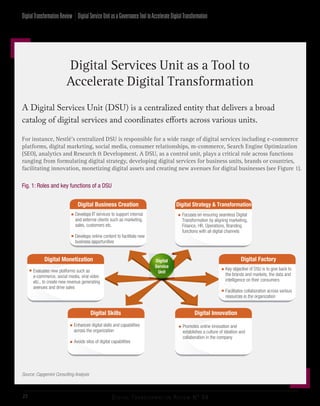
The key priority for a
digital entity such as
ours will be to deliver
the promise of keeping
Etisalat relevant in the
digital space.
learnings are then funneled
down into a few high-priority
areas that we start focusing on
from the perspective of staying
relevant in the market.
Etisalat:AcceleratingTransformationthroughaDigitalServicesUnitDigitalTransformationReview
Digital Transformation Review N° 04 21
One of the key
challenges will be to
refine digital services
based on evolving needs
– that might entail
discontinuing existing
services and including
new relevant ones.
DigitalFuture
Looking ahead, what are your
future priorities for the Digital
Services Unit?
The key priority for a digital
entity such as ours will be to
deliver the promise of keeping
Etisalat relevant in the digital
space. We can achieve this by
demonstrating the value-add
DigitalTransformationReviewEtisalat:AcceleratingTransformationthroughaDigitalServicesUnit
that our unit delivers, innovating
and leveraging our telecom
capabilities, and providing
a consistent revenue stream.
Another priority for us will be
to track and maintain the right
portfolio of digital services. One
of the key challenges will be
to refine digital services based
on evolving needs – that might
entail discontinuing existing
services and including new
relevant ones.
Digital Transformation Review N° 0422
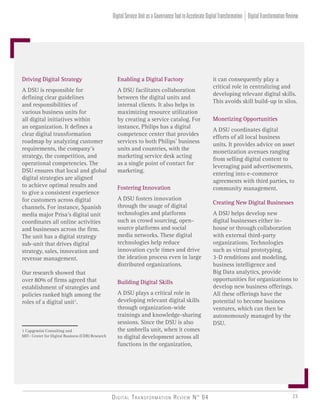
A Digital Services Unit (DSU) is a centralized entity that delivers a broad
catalog of digital services and coordinates efforts across various units.
Digital Services Unit as a Tool to
Accelerate Digital Transformation
For instance, Nestlé’s centralized DSU is responsible for a wide range of digital services including e-commerce
platforms, digital marketing, social media, consumer relationships, m-commerce, Search Engine Optimization
(SEO), analytics and Research & Development. A DSU, as a control unit, plays a critical role across functions
ranging from formulating digital strategy, developing digital services for business units, brands or countries,
facilitating innovation, monetizing digital assets and creating new avenues for digital businesses (see Figure 1).
Fig. 1: Roles and key functions of a DSU
Source: Capgemini Consulting Analysis
Evaluates new platforms such as
e-commerce, social media, viral video
etc., to create new revenue generating
avenues and drive sales

Digital Monetization Digital Factory
Key objective of DSU is to give back to
the brands and markets, the data and
intelligence on their consumers
Facilitates collaboration across various
resources in the organization


Digital
Service
Unit
Digital
Service
Unit
Digital Strategy & Transformation
Focuses on ensuring seamless Digital
Transformation by aligning marketing,
Finance, HR, Operations, Branding
functions with all digital channels

Digital Innovation
Promotes online innovation and
establishes a culture of ideation and
collaboration in the company

Digital Skills
Enhances digital skills and capabilities
across the organization
Avoids silos of digital capabilities


Digital Business Creation
Develops IT services to support internal
and external clients such as marketing,
sales, customers etc.
Develops online content to facilitate new
business opportunities


DigitalServiceUnitasaGovernanceTooltoAccelerateDigitalTransformationDigitalTransformationReview
Digital Transformation Review N° 04 23
Enabling a Digital Factory
A DSU facilitates collaboration
between the digital units and
internal clients. It also helps in
maximizing resource utilization
by creating a service catalog. For
instance, Philips has a digital
competence center that provides
services to both Philips’ business
units and countries, with the
marketing service desk acting
as a single point of contact for
marketing.
Fostering Innovation
A DSU fosters innovation
through the usage of digital
technologies and platforms
such as crowd sourcing, open-
source platforms and social
media networks. These digital
technologies help reduce
innovation cycle times and drive
the ideation process even in large
distributed organizations.
Building Digital Skills
A DSU plays a critical role in
developing relevant digital skills
through organization-wide
trainings and knowledge-sharing
sessions. Since the DSU is also
the umbrella unit, when it comes
to digital development across all
functions in the organization,
Driving Digital Strategy
A DSU is responsible for
defining clear guidelines
and responsibilities of
various business units for
all digital initiatives within
an organization. It defines a
clear digital transformation
roadmap by analyzing customer
requirements, the company’s
strategy, the competition, and
operational competencies. The
DSU ensures that local and global
digital strategies are aligned
to achieve optimal results and
to give a consistent experience
for customers across digital
channels. For instance, Spanish
media major Prisa’s digital unit
coordinates all online activities
and businesses across the firm.
The unit has a digital strategy
sub-unit that drives digital
strategy, sales, innovation and
revenue management.
Our research showed that
over 80% of firms agreed that
establishment of strategies and
policies ranked high among the
roles of a digital unit1
.
it can consequently play a
critical role in centralizing and
developing relevant digital skills.
This avoids skill build-up in silos.
Monetizing Opportunities
A DSU coordinates digital
efforts of all local business
units. It provides advice on asset
monetization avenues ranging
from selling digital content to
leveraging paid advertisements,
entering into e-commerce
agreements with third parties, to
community management.
Creating New Digital Businesses
A DSU helps develop new
digital businesses either in-
house or through collaboration
with external third-party
organizations. Technologies
such as virtual prototyping,
3-D renditions and modeling,
business intelligence and
Big Data analytics, provide
opportunities for organizations to
develop new business offerings.
All these offerings have the
potential to become business
ventures, which can then be
autonomously managed by the
DSU.
1 Capgemini Consulting and
MIT- Center for Digital Business (CDB) Research
DigitalTransformationReviewDigitalServiceUnitasaGovernanceTooltoAccelerateDigitalTransformation
Digital Transformation Review N° 0424
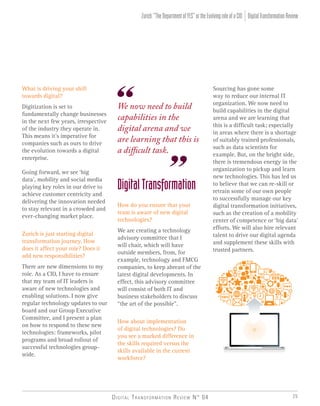
Z
urich is a global insurance company with over 60,000 employees and
operations in over 170 countries. The company is starting on a digital
transformation of its customer experience. Capgemini Consulting spoke
to Markus Nordlin, the CIO of Zurich, to understand the evolving role of a CIO.
Zurich: “The Department of YES”
or the Evolving Role of a CIO
Interview with Markus Nordlin,
CIO of Zurich Insurance
TheEvolvingRoleoftheCIO
What have been your key focus areas over the past few years?
At Zurich, our strategy has focused on leveraging our global presence
to drive efficiency and expense reduction. In my role as a CIO, I help to
simplify and improve our processes and systems thereby supporting our
strategy. In support of these goals, Zurich’s IT organization has focused
extensively on IT infrastructure sourcing over the past few years. This
has helped to free up resources, which can be reinvested to achieve
another key pillar of our business strategy – improved customer focus
through digital transformation.
MarkusNordlin
CIOofZurichInsurance
Outsourcing helped to
free up resources, which
can be reinvested to
achieve another key
pillar of our business
strategy – improved
customer focus through
digital transformation.
Zurich:“TheDepartmentofYES”ortheEvolvingroleofaCIODigitalTransformationReview
Digital Transformation Review N° 04 25
DigitalTransformation
How do you ensure that your
team is aware of new digital
technologies?
We are creating a technology
advisory committee that I
will chair, which will have
outside members, from, for
example, technology and FMCG
companies, to keep abreast of the
latest digital developments. In
effect, this advisory committee
will consist of both IT and
business stakeholders to discuss
“the art of the possible”.
How about implementation
of digital technologies? Do
you see a marked difference in
the skills required versus the
skills available in the current
workforce?
What is driving your shift
towards digital?
Digitization is set to
fundamentally change businesses
in the next few years, irrespective
of the industry they operate in.
This means it’s imperative for
companies such as ours to drive
the evolution towards a digital
enterprise.
Going forward, we see ‘big
data’, mobility and social media
playing key roles in our drive to
achieve customer centricity and
delivering the innovation needed
to stay relevant in a crowded and
ever-changing market place.
Zurich is just starting digital
transformation journey. How
does it affect your role? Does it
add new responsibilities?
There are new dimensions to my
role. As a CIO, I have to ensure
that my team of IT leaders is
aware of new technologies and
enabling solutions. I now give
regular technology updates to our
board and our Group Executive
Committee, and I present a plan
on how to respond to these new
technologies: frameworks, pilot
programs and broad rollout of
successful technologies group-
wide.
Sourcing has gone some
way to reduce our internal IT
organization. We now need to
build capabilities in the digital
arena and we are learning that
this is a difficult task; especially
in areas where there is a shortage
of suitably trained professionals,
such as data scientists for
example. But, on the bright side,
there is tremendous energy in the
organization to pickup and learn
new technologies. This has led us
to believe that we can re-skill or
retrain some of our own people
to successfully manage our key
digital transformation initiatives,
such as the creation of a mobility
center of competence or ‘big data’
efforts. We will also hire relevant
talent to drive our digital agenda
and supplement these skills with
trusted partners.
DigitalTransformationReviewZurich:“TheDepartmentofYES”ortheEvolvingroleofaCIO
We now need to build
capabilities in the
digital arena and we
are learning that this is
a difficult task.
Digital Transformation Review N° 0426
the IT department and work
directly with external vendors?
In such a large global
organization, this kind of a
risk always exists. But it is our
expectation that business units
include us early on in such
discussions; and we will be happy
to help them go forward. For
instance, if a business unit wishes
to use a particular technology,
we need to figure out the security
and support issues related to this
technology. But to make sure we
have good relationships with our
business units, I have to be the
department of `yes`and not the
department of `no’.
I have to be the
department of yes, not
the department of no.
The successful leaders
of tomorrow are going
to be true hybrid
professionals who have
spent some time in
IT but have shifted to
operations and vice-
versa.
Zurich:“TheDepartmentofYES”ortheEvolvingroleofaCIODigitalTransformationReview
This would be our three-pronged
approach to obtaining and
developing the skills that we need
as we go forward.
IT/Business
Relationship
You spoke about re-skilling. Do
you also see a need for cross-
pollination between IT and
business?
I believe that the successful
leaders of tomorrow, in any
business or industry, are going
to be true hybrid professionals
who have spent some time in IT
but have shifted to operations
and vice-versa. This will be very
beneficial for businesses, as
business and IT leaders will have
common knowledge, common
understanding and some
common and shared experiences
as they go forward.
You spoke about the need for
technologically-savvy business
professionals. Do you foresee a
risk that business units staffed by
these professionals may bypass
Looking ahead, do you foresee
the creation of new roles
due to your focus on digital
transformation?
Social media is one area of
opportunity. These platforms
might give us the opportunity
to append social data to our
existing database, in order to
meet and exceed our customers’
expectations - even ones that
they don’t have yet!
We are also looking at bringing
marketing and communications
people together to understand
and harness the power of ‘big
data,’ which comes from social
media and the Internet. We need
to look at people who understand
both marketing and data and
these will be pretty unique skills.
Digital Transformation Review N° 04 27
investments. But we will need
to set aside some resources for
experimenting in these topics of
mobility, cloud, ‘big data’, and
supporting analytics. We need to
learn what can actually drive real
business value because this is not
clear today in the industry.
One of the key
initiatives that we are
driving is our Digital
Workplace.
Going forward, what challenges
do you foresee? What are the
hurdles that you will have to
overtake?
In terms of future challenges,
one of my predictions is that
cloud might become the next
legacy. Those who are moving
into the cloud space are quickly
realizing that governing a cloud
deployment, knowing where
this data is, what data is leaving
an enterprise is actually very
difficult to manage. I believe
caution is required and we
will move carefully into cloud
computing only when and if it is
appropriate.
DigitalTransformationReviewZurich:“TheDepartmentofYES”ortheEvolvingroleofaCIO
FutureChallenges
Going forward, what are the
major changes that you want to
drive in the next two years?
One of the key initiatives that
Zurich IT is driving is our Digital
Workplace initiative. Ultimately,
our ambition is to ensure that our
employees, wherever in the world
they are, have full access to all of
our technology resources; click to
call, click to chat, click to video
conference; on any device. This
year, we’re rolling out the ability
for all of our employees to bring
their own iOS device—iPad or
iPhone.
What are the other changes you
would like to implement?
Another key focus for us in this
next year will be ‘big data’. We
will create our target framework
and do some pilot projects.
Do you see any difficulty in
convincing stakeholders about
the business case for ‘big data’ or
social media?
We are still firmly looking at
business cases for all of our IT
Digital Transformation Review N° 0428
Do you see the CIO giving way to,
say, Chief Digital Officer or Chief
Data Officer in the next two-three
years?
For the large financial services
firms, I see the role of the CIO
remaining as before. The legacy,
the volumes, the budgets are
so large that it’s hard for me to
foresee that role would disappear.
But yes, we will start having
enhancements in roles whether
they fit in IT or next to IT as
The CIO will have
additional roles and
challenges but they will
not eliminate the core
responsibilities of a
corporate CIO.
partners in the business. Chief
Digital Officer or Chief Data
Officer are emerging roles that
will definitely be key. But I think
that the organizational constructs
for these roles are still being
experimented with. My feeling is
that the CIO will have additional
roles and challenges but they
will not eliminate the core
responsibilities of a corporate
CIO.
Zurich:“TheDepartmentofYES”ortheEvolvingroleofaCIODigitalTransformationReview
Companies to Watch:
View from Silicon Valley
By Sergi Herrero, CEO, L’Atelier BNP Paribas USA
Amplify:
A tablet to
monitor K-12
classrooms
Lyft:
Drive and share
your car with
people around
you
As many as 81% of
American teachers believe
tablets enhance learning. However, access to
such tools is fairly unequal and disparities exist
between students coming from higher and
lower income families. Approximately 41% of
teachers consider those disparities to result in
learning gaps between students. Among other
things, the price of tablets is a serious concern.
Amplify - a product from News Corporation’s
education unit - is a 10-inch Android tablet
designed to bring connectivity to the classroom
and to enable blended learning. It is preloaded
with educational material for students, such as
lessons, exercises and Khan Academy videos.
With the tablet, the teacher can monitor
students’ devices, unlock and lock specific
apps and run short tests to check if students
understood the lesson. Amplify, which can be
used for blended learning, costs $299 and can
be used by an entire school or district for a more
homogeneous learning experience.
In 2012, 17 million cars were
sold in the U.S.This number is
expected to reach the 20 million mark by 2019.
A growing number of people are buying cars
each year and Americans have been estimated
to drive nearly 3 trillion miles annually.
However, not all of these cars are filled to their
capacity and this impacts transportation.
Lyft is an app launched in 2012 that allows its
users to do carpooling within cities for short
distances, similar to taxi rides. Lyft cars wear
pink moustaches and can be localized through
a map available with the application. So if you
don’t want to pay as much as a taxi or cannot
find one, just ask for a Lyft ride!
DigitalTransformationReviewCompaniestoWatch:ViewfromSiliconValley
Digital Transformation Review N° 04 29
Digital Transformation Review N° 0430
ammer is a pioneer in the Enterprise Social Networking space. It
is used by over 200,000 organizations globally, including 85% of
Fortune 500 companies. By end of 2012, it had more than 7 million
registered users. The company was founded in 2008 and was acquired by
Microsoft in 2012. Capgemini Consulting spoke to Adam Pisoni, Co-Founder
and CTO of Yammer to understand social networks in the enterprise and their
role in employee engagement.
Yammer: Driving Employee
Engagement through Social Networks
AdamPisoni
Co-founderandCTOofYammer
Interview with Adam Pisoni,
Co-founder and CTO of Yammer
SocialNetworksforEnterprises
Social networks have registered a rapid adoption in the consumer
segment. What do you think is the key difference between consumer
and enterprise social networks?
In a consumer social network you’re primarily interested in the people
you already know. But in an enterprise social network, you need the
information to do your job regardless of whether you know the person
who has it. This creates all sorts of fundamental changes in the way you
think about creating these networks. Over time, I think we are going to
continue to see a divergence in how enterprise social networks evolve
compared to consumer social networks.
Y
Leadership is no
more about cascading
directives from top
to bottom, but about
hearing from bottom to
top and across.
Yammer:DrivingEmployeeEngagementthroughSocialNetworksDigitalTransformationReview
Digital Transformation Review N° 04 31
What do you think are the key
drivers for adoption of enterprise
social networks?
I believe the fundamental driver
is the current pace of change.
I think that the way in which
we organize and communicate
within companies today is
changing. The job of a company
is no longer to do the same thing
as consistently as possible, but
to figure out how to innovate
and provide value as soon as
possible. Social networks create
tight feedback loops between
disseminating information and
getting feedback from across
the organization. By doing so,
they help companies better align
people to this goal.
ImpactonDigital
Organization
How do you think the
implementation of enterprise
social networks changes the role
of leaders in an organization?
I think that the role of leaders is
going to change the most in this
digital revolution. Today, leaders
have to understand the influx of
changes that are occurring and
act on feedback from people who
interact with end-customers. So,
they are involved in building and
adjusting the offerings according
to this feedback and ensuring
that the field force conveys
information back to customers.
This is a different model than the
conventional approach where
it was just all about cascading
directives from top to bottom.
Now, it is about hearing from
bottom to top and across the
organization and being able to
push information down quickly.
So what do you see as the key
benefits of social networks in an
enterprise?
I believe enterprise social
networks have three fundamental
benefits. First, they help you
get the information you need
to make better decisions. You
can get that information from
your co-workers, customers or
managers. Second, they help
you share information that other
people need to be successful. This
information could be from the
manager to their employees to
make sure that they are aligned
or know recent directional
changes. Finally, social networks
help in communicating
information amongst employees.
This information exchange could
be from the bottom to the top
management. But ultimately, it’s
all about getting your work done
more efficiently.
We have seen companies
that adopt social
networks with a focused
approach benefit from it
within months.
In a consumer social
network, who you
know matters; in
an enterprise social
network what you
know makes you
relevant.
DigitalTransformationReviewYammer:DrivingEmployeeEngagementthroughSocialNetworks
Digital Transformation Review N° 0432
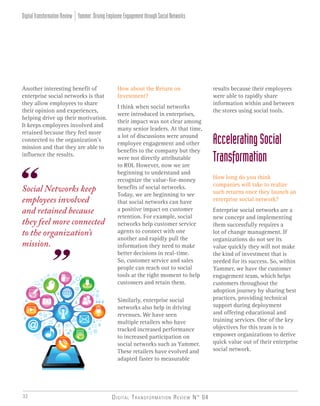
Social Networks keep
employees involved
and retained because
they feel more connected
to the organization’s
mission.
How about the Return on
Investment?
I think when social networks
were introduced in enterprises,
their impact was not clear among
many senior leaders. At that time,
a lot of discussions were around
employee engagement and other
benefits to the company but they
were not directly attributable
to ROI. However, now we are
beginning to understand and
recognize the value-for-money
benefits of social networks.
Today, we are beginning to see
that social networks can have
a positive impact on customer
retention. For example, social
networks help customer service
agents to connect with one
another and rapidly pull the
information they need to make
better decisions in real-time.
So, customer service and sales
people can reach out to social
tools at the right moment to help
customers and retain them.
Similarly, enterprise social
networks also help in driving
revenues. We have seen
multiple retailers who have
tracked increased performance
to increased participation on
social networks such as Yammer.
These retailers have evolved and
adapted faster to measurable
Another interesting benefit of
enterprise social networks is that
they allow employees to share
their opinion and experiences,
helping drive up their motivation.
It keeps employees involved and
retained because they feel more
connected to the organization’s
mission and that they are able to
influence the results.
results because their employees
were able to rapidly share
information within and between
the stores using social tools.
AcceleratingSocial
Transformation
How long do you think
companies will take to realize
such returns once they launch an
enterprise social network?
Enterprise social networks are a
new concept and implementing
them successfully requires a
lot of change management. If
organizations do not see its
value quickly they will not make
the kind of investment that is
needed for its success. So, within
Yammer, we have the customer
engagement team, which helps
customers throughout the
adoption journey by sharing best
practices, providing technical
support during deployment
and offering educational and
training services. One of the key
objectives for this team is to
empower organizations to derive
quick value out of their enterprise
social network.
Yammer:DrivingEmployeeEngagementthroughSocialNetworksDigitalTransformationReview
Digital Transformation Review N° 04 33
We are beginning to see
that social networks can
have a positive impact
on customer retention.
Are there any big stumbling
blocks that companies should be
aware of?
I think one of the initial mistakes
that organizations make is to
think that adoption of social
networks will happen by itself.
It’s also often assumed that
once launched, an enterprise
collaboration platform will be
able to fix every problem within
the company without any support
from top management. However,
there are several change
management and cultural issues
which occur while adopting
social networks. Focused
initiatives from top management
and technology solutions play
a key role in rising above these
issues.
What are some of the cultural
issues that you have mentioned
as a major challenge?
It’s true that a lot of social
deployments have failed. There’s
one big reason why the majority
of enterprise social rollouts
fail, and it goes back to what I
was saying before about how it
doesn’t happen on its own. If a
company is going to have a social
network, it has to be comfortable
with transparency and people
have to feel comfortable doing
their work in public. That’s a
huge cultural change for a lot
of companies where they sort
of err on the side of privacy or
people may be afraid to point
out problems or talk about the
DigitalTransformationReviewYammer:DrivingEmployeeEngagementthroughSocialNetworks
One of the initial
mistakes that
organizations make
is to think that social
network adoption will
happen by itself.
voluntary adoption. It is hard
to mandate people to use social
networks and employees will
not use them if there is no value
attached.
Beyond measuring adoption,
we help companies find and
improve KPIs that are meaningful
to their goals. For instance, a
major hamburger chain needed
to change its menu frequently.
One of the things they tracked
was to check how quickly a menu
change was understood by the
serving staff, and they have a KPI
for that. We were able to track the
improvement in that KPI by using
Yammer as a social tool. They
also used Yammer to circulate the
information of improvement in
KPIs among employees.
Digital Transformation Review N ° 0434
Considering the cultural
challenges you mentioned,
can you share any interesting
instance of successful enterprise
social network deployment?
Let me tell you about NAB, an
Australian bank that leveraged
their social network to drive
improvements in their processes.
They deployed principles of
continuous improvement
(Kaizen) on their social network.
So, whenever employees identify
areas that need to be improved,
they share it on the network and
solutions can then be crowd-
sourced. By doing so, they were
able to drive real results in a
matter of hours as opposed to
the months that it took them
earlier. NAB is driving a cultural
shift by spreading the message
that improving a company is
everyone’s job.
If a company is going to
have a social network,
it has to be okay just to
talk more openly within
the company about
things.
Technology is really
a minor part of the
problem.
Yammer:DrivingEmployeeEngagementthroughSocialNetworksDigitalTransformationReview
things that aren’t working.
People may be rewarded for
hoarding information as opposed
to sharing. It’s not something
where you can just have a
social network and hope that it
gives you the benefits you need
because the technology is really a
minor part of the problem.
So do you think employee
engagement or adoption can be
considered as success metrics for
an enterprise social network?
I think that different companies
have different objectives that
they try to improve internally.
However, I do believe that
employee engagement and
adoption can be used as
substitutes to measure value
because social networks require
At NAB, social
networks are driving
a cultural shift by
spreading the message
that improving a
company is everyone’s
job.
Digital Transformation Review N° 04 35
So, there are different KPIs
for different companies. The
fundamental question is how
does a company measure
innovation and engagement at
the front-end and that is different
for each company.
DigitalFuture
What do you see as the future of
enterprise social networking?
I think that employees in
companies of all sizes, sectors
and geographies are going to
communicate internally using
a lot more social tools in the
coming years. There will be a
social transformation and all our
key digital tools will be around
social networks. It is going to be
the default and fundamental way
we all will work internally.
DigitalTransformationReviewYammer:DrivingEmployeeEngagementthroughSocialNetworks
Digital Transformation Review N° 04 37
DigitalTransformationReviewBeingDigital:EngagingtheOrganizationtoAccelerateDigitalTransformation
EngagingEmployees
throughDigital-A
Double-EdgedSword
Ask any executive who has
led an organization through a
large, transformative change,
and he or she will tell you that
a company’s strategic vision is
only as good as the people behind
it. Digital Transformation is no
different. Making new digital
ways of working stick is a matter
of winning the hearts and minds
of people at all levels in the
organization. Instead of offering
resistance, employees who are
engaged and invested in a shared
vision of the company’s digital
future help make that vision a
reality.
Many of the concepts in the
executive’s change management
playbook still apply to Digital
Transformation. But, how
executives are engaging their
organizations is dramatically
different. Digital tools help
leaders connect with employees
at unprecedented scale and
in new ways. Blogs provide a
forum to share regular, candid
perspectives and collect feedback.
Digital videos help create
richer, more personal executive
communications. Enterprise
social platforms offer employees
the opportunity to share their
ideas, collaborate with colleagues
and be recognized for their
contributions.
Yet these new digital channels
are a double-edged sword;
technology often poses one
of the biggest hurdles when
engaging employees in Digital
Transformation. Where different
generations of workers have
different levels of familiarity
with digital, executives struggle
to reach everyone in the
organization. Adoption of digital
collaboration platforms also
remains low in many companies
(see infographic on page 41),
despite significant investment
(and considerable hype).
Being Digital: Engaging the Organization to
Accelerate Digital Transformation
By Andrew McAfee, MIT and Michael Welch, Capgemini Consulting
IT and Capgemini Consulting, as part of their 3-year research
collaboration, have identified engagement as one of the key success
factors of any Digital Transformation.M
101011010010
101011010010
101011010010
A major research initiative at the MIT Sloan School of Management
Simply put – the best
way to become digital, is
to be digital.
Digital Transformation Review N° 0438
The stakes for digital engagement
are high. Capgemini Consulting’s
joint research with the MIT
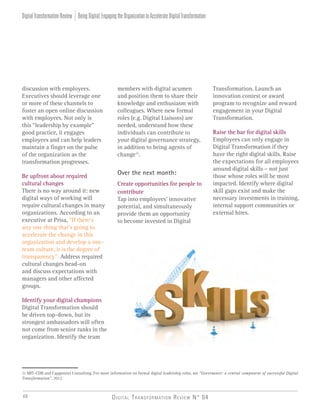
Center for Digital Business shows
that digital engagement is a
major driver of success in Digital
Transformation1
. Rather than
jumping headfirst into digital
engagement, executives need
to lay the groundwork to make
sure those efforts are effective.
This means taking a proactive
approach to many of the common
challenges that organizations
face, and leveraging strategies
that many leading companies
are already taking in their own
Digital Transformations.
DigitalEngagement
PresentsCommon
Challenges
Over the course of our research,
we interviewed over 150
executives across a broad
range of industry sectors and
geographies. Many executives
noted challenges that they faced
in engaging their employees
in Digital Transformation.
Among these issues, a number of
common themes emerged:
A Generational Divide
Younger workers today have far
greater familiarity with digital
tools and ways of working than
their more tenured counterparts.
Many executives highlighted
a growing gap between older
and younger workers in their
expectations and work habits
around technology. Where
older employees face a learning
curve, Generation Y workers
are often underwhelmed by the
digital tools available to them.
One executive comments, “these
people coming into the company,
mid 20’s, late 20’s, even early
30’s, they do everything
electronically. They say ‘Come
on, I know the company is
over 100 years old, but our
information and IT capabilities
don’t have to match the age of
the company!”
Executives also noted that
younger workers are often
frustrated by a slow pace of
change. “The woman that is
in charge of our social media
policies is pushing, right up to the
CEO, saying, ‘We are way behind.
You better move now. We are
way behind. Move now.’ It’s very
persistent as well. Really trying to
bring the company forward”.
Finding the right
communications strategy,
incentives and pace of change
amidst this generational divide
has proven a challenge for many
companies.
1 Digital Transformation: a roadmap for billion-dollar organizations, MIT-CDB and Capgemini Consulting 2011
The Digital Advantage: how digital leaders outperform their peers in every industry, MIT-CDB and Capgemini Consulting 2012
Come on, I know the
company is over 100
years old, but our
information and IT
capabilities don’t have
to match the age of the
company!
BeingDigital:EngagingtheOrganizationtoAccelerateDigitalTransformationDigitalTransformationReview
Digital Transformation Review N° 04 39
of] opportunities aren’t looking
at [our company] for them”.
Without the digital talent to
realize them, ambitious visions
for Digital Transformation may
lack credibility or – worse –
overreach the capabilities of the
organization.
Digital Platforms: High Potential,
Low Adoption
Some of the executives we
interviewed reported success
in using platforms such as
enterprise social networks or
collaboration tools; others
highlighted challenges. Given
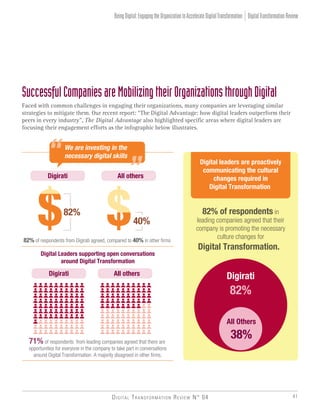
I need a charismatic
quant – somebody who’s
an influencer and can
carry their weight in a
senior meeting, but at
the same time, someone
who could roll up their
sleeves and look at data
tables and build models
and enjoy it.
And this issue shows no signs
of abating. Within just the next
few years, college graduates
entering the workforce will have
no memory of life before the
Internet. Just as a house divided
cannot stand, a widening digital
(and cultural) divide between
employees may frustrate efforts
to engage the entire organization
in transformation.
The Scarcity of Digital Talent
Digital Transformation is about
turning technological potential
into real business outcomes, and
it demands a different mix of
skills. Finding people with equal
parts digital savvy and business
acumen has proven a challenge
for many of the executives that
we interviewed. According
to one executive, “I need a
charismatic quant – somebody
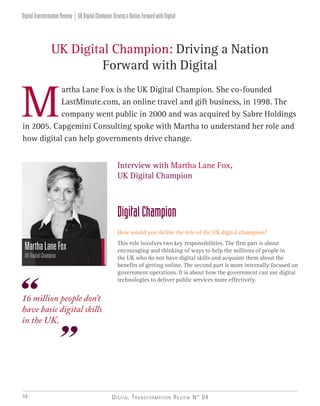
who’s an influencer and can
carry their weight in a senior
meeting, but at the same time,
someone who could roll up their
sleeves and look at data tables
and build models and enjoy it”.
When these skills do not already
exist within an organization,
executives also noted difficulty
finding them externally, “Our
recruiters don’t know where to
go find these people, and people
who are looking for [these kinds
the investment made in these
systems, lack of adoption is a
serious concern. One CFO states,
“We’ve spent an awful lot of
money on technology, but I still
see people working in the old
way”.
On the user side, executives
reported a lack of understanding
and unclear business value as
major issues. A leader in the
food service industry explains,
“I think people are apprehensive
about new technologies. They
don’t understand them, there is
a fear of unknown. They don’t
really fully understand how
they’re going to drive business
outcomes”.
Executives also pointed out
challenges in managing the
implementation of these
platforms. When success criteria
are focused on IT deployment,
actual user adoption can take a
back seat to tactical milestones.
Implementation goals defined
in terms of active licenses or
live deployment locations miss
the true ROI of enterprise social
platforms: actively engaged
users. The result is a widely
deployed system that no one
actually uses.
DigitalTransformationReviewBeingDigital:EngagingtheOrganizationtoAccelerateDigitalTransformation
Digital Transformation Review N° 0440
One hospitality industry
executive also voiced challenges
in shifting technology strategies:
“We were looking at one tool.
We got a decent user base in it.
And then we found out that we
didn’t like their pricing model…
And so, we said, ‘OK, we’re going
in another direction now, we’re
trying a different tool,’ and [we
had to] to regain the momentum
that we had with the previous
one”. When employees haven’t
adopted new digital tools, they
often cannot contribute to an
improved business process,
much less a successful Digital
Transformation.
Management Roles in a Digital
Organization
New digital tools, automation
of business processes and
an increasing role of data in
decision-making can increase
transparency in an organization.
But, as conversations move
online and information is
more freely available, some
executives noted resistance
from management employees.
Managers may view these trends
as a threat to their autonomy
or influence. Explaining sales
managers’ reactions to the
introduction of a real-time
reporting platform, one executive
comments,
Implementation goals
defined in terms of
active licenses or live
deployment locations
miss the true ROI
of enterprise social
platforms: actively
engaged users.
“That kind of transparency,
they’re not used to, so there’s an
initial pushback”.
Middle managers are often the
front lines of introducing change
to an organization, as they have
the important task of translating
a strategic vision into everyday
operations. Where engaged
managers can be a cornerstone
of cultural change, resistant
managers can stop Digital
Transformation in its tracks.
Where engaged
managers can be a
cornerstone of cultural
change, resistant
managers can stop
Digital Transformation
in its tracks.
BeingDigital:EngagingtheOrganizationtoAccelerateDigitalTransformationDigitalTransformationReview
Digital Transformation Review N° 04 41
DigitalTransformationReviewBeingDigital:EngagingtheOrganizationtoAccelerateDigitalTransformation
SuccessfulCompaniesareMobilizingtheirOrganizationsthroughDigital
Faced with common challenges in engaging their organizations, many companies are leveraging similar
strategies to mitigate them. Our recent report: “The Digital Advantage: how digital leaders outperform their
peers in every industry”, The Digital Advantage also highlighted specific areas where digital leaders are
focusing their engagement efforts as the infographic below illustrates.
82% of respondents in
leading companies agreed that their
company is promoting the necessary
culture changes for
Digital Transformation.
Digital Leaders supporting open conversations
around Digital Transformation
We are investing in the
necessary digital skills
Digirati
All Others
Digirati All others
Digirati All others
82%
38%
Digital leaders are proactively
communicating the cultural
changes required in
Digital Transformation
82% of respondents from Digirati agreed, compared to 40% in other firms
71% of respondents from leading companies agreed that there are
opportunities for everyone in the company to take part in conversations
around Digital Transformation. A majority disagreed in other firms.
82%
40%
Digital Transformation Review N° 0442
Taking leadership online
Gone are the days of executives
having assistants print out emails
for them to read. Today, many
digital-savvy CEOs are active
bloggers, podcasters and Twitter
users. Many of the executives
we interviewed are using similar
digital platforms to communicate
with their organizations around
Digital Transformation. In doing
so, they are leading by example
and setting expectations for
the rest of the organization. A
medical technology company
we interviewed used digital
video broadcasts to report
the progress of a multi-day
executive strategy workshop (see
Broadcasting Accountability).
Kraft Foods’ employees can
access podcasts (dubbed “Kraft
casts”) from the CEO and other
executives to stay on top of the
latest corporate strategies and
branding initiatives. According
to one executive, this allows the
company to “communicate with
our employees in a way that is
more visual than having them sit
and read text”2
.
Inviting contributions
According to our research,
the strategic vision for Digital
Transformation must be led from
the top. However, the collective
ingenuity of the “crowd,” can
be an insightful source of
feedback as well as a powerful
tool to engage employees.
2 http://www.apple.com/iphone/business/profiles/kraft-foods/
3 MIT-CDB and Capgemini Consulting research
Broadcasting
Accountability
A medical technology company
we interviewed hosted close
to 300 executives and senior
managers in a multi-day
strategy workshop. Each
afternoon, the company
recorded digital video debriefs
from executives sharing
what was discussed and what
decisions were made. These
videos were then broadcast
to the rest of the organization
so employees could follow
the progress of the workshop.
Moreover, the broadcasts helped
hold the attendees accountable
for the decisions and actions
that were taken in the session.
According to one attendee,
“You’re broadcasting, ‘Here’s
what we’re working on, day one’
back to their organizations. So
when [executives] walk out of
the meeting, people know that
they were there and what they
were working on. And all of a
sudden the organization has an
expectation of follow-up. It’s
really interesting”3
.
BeingDigital:EngagingtheOrganizationtoAccelerateDigitalTransformationDigitalTransformationReview
Gone are the days of
executives having
assistants print out
emails for them to read.
Today, many digital-
savvy CEOs are active
bloggers, podcasters and
Twitter users.
Digital Transformation Review N° 04 43
DigitalTransformationReviewBeingDigital:EngagingtheOrganizationtoAccelerateDigitalTransformation
4 Capgemini Consulting and MIT-CDB, The Digital Advantage: how digital leaders outperform their peers in every industry, 2012
5 Management Exchange, InnovationLive: Engaging 3M’s Global Employees in Creating an Exciting, Growth-Focused Future, 2011
6 Digital for all, L’Oreal website
to trade digital know-how for
career coaching (see Bridging the
Generational Divide). L’Oreal,
a global cosmetics firm, also
launched its own “Digital Reverse
Mentoring” program. As part of
its “Digitall” campaign to raise
“digital IQ” across all employees
Online innovation contests or
award programs give employees
the opportunity to contribute
feedback or new ideas; they also
give leaders the opportunity to
publicly recognize and reward
engagement. For example,
Codelco engaged its employees
early through innovation
contests to foster a culture of
change4
. Similarly, 3M leveraged
Enterprise 2.0 technologies
to “crowdsource” ideas for
new market strategies from
thousands of its employees (see
Crowdsourcing Engagement).
Driving change with new roles
and relationships
One of the most effective vehicles
of change in an organization
can be employees themselves.
Companies are leveraging their
digital “champions” through
both informal and formal roles
to facilitate skills transfer
and engage the rest of the
organization. A medical device
company paired Generation
Y team members with more
tenured managers and executives
and brands, the company
paired 120 younger workers
with management committee
members. The pairs worked
together to identify trends
and understand new customer
behaviors6
.
Crowdsourcing Engagement
To innovate the way it conducted strategic planning and engage
workers, 3M turned to Enterprise 2.0 tools and crowdsourcing.
The company hosted an online innovation jam, dubbed
“InnovationLive,” and invited over 20,000 employees from its Sales,
Marketing and R&D units. Over the course of the two-week event,
3M collected 736 ideas, 6,799 votes and 1,084 comments from
more than 1,200 participants in over 40 countries. By the end of the
event, the company had identified nine new strategic opportunities
and made a significant impact on employee engagement. In fact,
the InnovationLive format itself was the most discussed “idea” of
the event. Reflecting on the event, one participant stated, “....This
has been an absolutely amazing exercise. For one thing, it certainly
made me feel part of the global 3M and showed me that one’s ideas,
comments, vote is important to the potential solutions that could
affect in a POSITIVE WAY our economics, people, lifestyles, planet
and urbanization…Thank you ever so much for the opportunity to
express my view, comments and ideas”5
.
Digital Transformation Review N° 0444
Formal, dedicated roles can
also help drive engagement
in Digital Transformation.
Prisa – a major Spanish media
company – unified different
regional operations under a
common strategy and platform
by formally naming a Chief
Digital Officer in each region.
These individuals liaise with the
company’s central digital unit to
align top-down digital strategies
with regional requirements. In
doing so, they also ensure that
regional operations remain
engaged and that their needs and
contributions are represented at
the corporate level.
Management Roles in a Digital
Organization
To meet the growing need for
technical and managerial skills
in new digital disciplines, many
companies are making significant
investments in digital skills.
Procter & Gamble established
a baseline for all its employees
through a “digital skills
inventory,” and set proficiency
expectations for specific
roles and career progression7
.
Similarly, Pepsi launched its
“digital fitness” program to keep
its marketers’ digital skills up to
par. According to one executive,
“There’s a gap, and we have to
work relentlessly to close that
gap. We’ve looked for a way to
describe it, and that’s fitness. You
can’t just work out once”8
.
7 Forbes, The Matrix of Soap, 2011
8 AdAge, Digital Fitness Is Latest Craze in Building up Your Marketing Ranks, 2011
BeingDigital:EngagingtheOrganizationtoAccelerateDigitalTransformationDigitalTransformationReview
Prisa – a major Spanish
media company –
unified different
regional operations
under a common
strategy and platform
by formally naming a
Chief Digital Officer in
each region.
There’s a gap, and we
have to work relentlessly
to close that gap. We’ve
looked for a way to
describe it, and that’s
fitness. You can’t just
work out once.
Digital Transformation Review N° 04 45
Kick-startingDigital
Engagement
Digital Transformation is often
a multi-year journey, and
building employee engagement
behind it takes time. Winning
the employees’ hearts and minds
will not happen overnight.
Once executives have defined
a vision for leading Digital
Transformation, they should
be proactive about engaging
employees. The following
checklist includes actions that
executives can take tomorrow
morning, as well as others to
think about within the next six
months:
Tomorrow morning:
Start (and sustain) a two-way
conversation
Blogs, internal social networks,
and streaming video represent
more than just a bigger
megaphone. The real value of
these platforms is in their ability
to capture feedback and facilitate
9 MIT-CDB and Capgemini Consulting research
10 AdAge, Digital Fitness Is Latest Craze in Building up Your Marketing Ranks, 2011
Bridging the Generational Divide
To bridge the generational divide between employees, the same
medical technology company introduced an informal “XYZ
network”. Within this network, employees pair with colleagues
from different generations to share their respective experiences
with one another; senior employees provide career coaching, while
younger employees contribute digital skills and perspectives on
how to leverage technology better. Describing the junior members
of the group, one executive says, “We’re really attempting to
be responsive to that group. They have a whole different set of
expectations about what information they need to do their job, how
they want that information, and just as importantly, how they want
to communicate with others in the company”9
.
Keeping (Digitally) Fit
Acknowledging a widening gap between society’s use of digital
technology and the digital skills inside the organization, Pepsi
has instituted a “Digital Fitness” program for its marketing teams.
The program leverages online learning courses and hands-on
“experimental” sessions to keep Pepsi’s marketers up-to-date on
the latest digital tools. According to one executive, “As we look at
where our customers are going in the future, [we realize] everything
from supply chain to sales needs to understand how to operate in
this digital world. And it’s going to happen really quickly. It’s not 20
years out, it’s four years out”10
.
DigitalTransformationReviewBeingDigital:EngagingtheOrganizationtoAccelerateDigitalTransformation
Digital Transformation Review N° 0446
discussion with employees.
Executives should leverage one
or more of these channels to
foster an open online discussion
with employees. Not only is
this “leadership by example”
good practice, it engages
employees and can help leaders
maintain a finger on the pulse
of the organization as the
transformation progresses.
Be upfront about required
cultural changes
There is no way around it: new
digital ways of working will
require cultural changes in many
organizations. According to an
executive at Prisa, “If there’s
any one thing that’s going to
accelerate the change in this
organization and develop a one-
team culture, it is the degree of
transparency”. Address required
cultural changes head-on
and discuss expectations with
managers and other affected
groups.
Identify your digital champions
Digital Transformation should
be driven top-down, but its
strongest ambassadors will often
not come from senior ranks in the
organization. Identify the team
members with digital acumen
and position them to share their
knowledge and enthusiasm with
colleagues. Where new formal
roles (e.g. Digital Liaisons) are
needed, understand how these
individuals can contribute to
your digital governance strategy,
in addition to being agents of
change11
.
Over the next month:
Create opportunities for people to
contribute
Tap into employees’ innovative
potential, and simultaneously
provide them an opportunity
to become invested in Digital
Transformation. Launch an
innovation contest or award
program to recognize and reward
engagement in your Digital
Transformation.
Raise the bar for digital skills
Employees can only engage in
Digital Transformation if they
have the right digital skills. Raise
the expectations for all employees
around digital skills – not just
those whose roles will be most
impacted. Identify where digital
skill gaps exist and make the
necessary investments in training,
internal support communities or
external hires.
11 MIT-CDB and Capgemini Consulting, For more information on formal digital leadership roles, see “Governance: a central component of successful Digital
Transformation”, 2012
BeingDigital:EngagingtheOrganizationtoAccelerateDigitalTransformationDigitalTransformationReview
Digital Transformation Review N° 04 47
Within the next six months:
Provide the Right Incentives
Organizational culture and
individual behaviors are difficult
to change without the right
incentives in place. Identify which
levers are the most effective, adapt
reward systems, and communicate
changes openly. At senior levels,
tying personal performance
KPIs to Digital Transformation
milestones can help focus
executive attention.
Focus on Behavior Change, Not
Tools
Introducing digital collaboration
platforms needs to focus on
using the tools, not having them.
Measure success and frame KPIs in
terms of actual user adoption and
activity on the platform, not in
terms of how widely available or
feature-rich the tool is. Executives
can also leverage creative new
solutions to sustain adoption. For
example, “gamifying” new digital
tools by embedding rewards,
achievements and recognition
can create a more engaging user
experience14
.
12 Case Study: EMC Drives Employee and Customer Engagement with Badgeville, Presentation by Tyler Altrup
13 Case Study: EMC Drives Employee and Customer Engagement with Badgeville, Presentation by Tyler Altrup
14 Capgemini Consulting, For more information on the potential of game mechanics to accelerate user adoption, see “Let the Games Begin: Using Game
Mechanics to Drive Digital Transformation”, 2013
Winning the Adoption Game
High-tech company EMC had implemented an enterprise social
platform, called the EMC Community Network (ECN), to connect its
ecosystem of employees, partners and customers. But, getting users
to adopt and use the platform proved a challenge. EMC embedded
game mechanics through a program it called “RAMP” (Reward
Awards and Motivation Program) to increase overall activity on the
platform and reward desired user behaviors.
The company piloted this “gamification” strategy during its annual
EMC World conference, with the goal of making the event “a more
interesting, more engaging, online-connected-to-offline experience
than it’s ever been before”12
. To do this, the RAMP team prioritized
the real-world attendee behaviors they wanted to promote, and
designed corresponding game mechanics and rewards into the ECN.
For example, the team designed check-in “missions” to encourage
attendees to visit multiple event booths. By the end of the event,
more than 350 attendees had earned ECN profile achievements for
checking-in at fifteen or more booths.
Since the integration of RAMP into the EMC Community Network,
the company has seen a nearly 20% increase in community
interactions and profile page views have more than quintupled13
.
It has also extended RAMP integration to EMC|One, its internal
employee community, as well as external social media channels.
DigitalTransformationReviewBeingDigital:EngagingtheOrganizationtoAccelerateDigitalTransformation
Digital Transformation Review N° 0448
A US insurance giant was struggling with inefficient claims processing leading to long
turnaround times for its customers. It wanted to streamline its complex processes and
used a gamified social innovation tool to draw ideas from its employees. The initiative
saw self-driven participation without any attached reward component. The chance
to collaborate on simplifying their workflow was the primary driving factor for the
participants. The activity resulted in a new, simplified process, which saved the company
$18 million a year and increased worker satisfaction1
.
Over-hyped or duly justified, enterprise gamification — the application of game design
techniques to a business setting in order to make tasks more fun and engaging — is
garnering attention from business leaders, world over. Enterprise gamification is expected
to exponentially increase over the next couple of years. Research indicates that by 2015,
more than 40% of global 2000 organizations will have at least one application where
gamification will be used2
.
Gamification is an Enabler for Digital Transformation
While organizations have ramped up their investments in digital tools and technologies,
two-thirds of digital transformation projects fail mainly due to workforce behavioral
issues3
. Our research with the MIT Center for Digital Business indicates that 55% of
companies surveyed cited company culture, particularly employee resistance to job
changes, to be a major hurdle to digital transformation4
.We believe that enterprise
gamification, when designed and implemented effectively, can help accelerate digital
transformation by driving employee engagement and supporting change management.
1 Gamification Facts & Figures: www.enterprise-gamification.com
2 Gartner, “Gartner Predicts Over 70 Percent of Global 2000 Organisations Will Have at Least One Gamified Application by 2014”, November 2012
3 Capgemini Consulting, “Transform to the Power of Digital - Digital Transformation as a Driver of Corporate Performance”, 2011
4 Capgemini Consulting and MIT Center for Digital Business, “Digital Transformation: A Roadmap for Billion-Dollar Organization”, 2011
Why Gamification Matters Now?
WhyGamificationmattersNow?DigitalTransformationReview
Digital Transformation Review N° 04 49
Badgeville: Helping Companies to Better
Engage with Employees
B
adgeville is one of the leading vendors of gamification platforms that
help businesses measure and influence user behavior through the
usage of game mechanics. The company, based in Redwood, California,
was founded in 2010 and has over over 250 customer organizations that
employ its solutions. Capgemini Consulting spoke to Kris Duggan, Co-Founder
and Chief Strategy Officer of Badgeville.
KrisDuggan
Co-FounderofBadgeville
Gamification helps
address a key challenge
with employees and
customers - improving
engagement levels.
Interview with Kris Duggan,
Co-Founder of Badgeville
GamificationTechniquesforEnterprises
Gamification is the flavor of the season. Why do you think
organizations are looking towards it?
There are two fundamental changes that are leading to the rapid
adoption of gaming techniques. The first change is the impact that
digital footprints and evolving technologies are having on the behavior
that we are trying to drive. Behaviors that were difficult to measure
earlier can now be tracked and measured. For instance, in the past
companies determined customer loyalty by only focusing on a behavior
of repeat purchase. But today, with the use of digital tools, we are able
to determine what customers purchase, review, refer and whether they
purchase across multiple product categories. So, there are multiple sets
of behaviors that we can now actually examine and use to determine
customer loyalty.
DigitalTransformationReviewBadgeville:HelpingCompaniestoBetterEngagewithEmployees
Digital Transformation Review N° 0450
The other fundamental change
is how digital technologies
have expanded traditional
ways of incentivizing users for
adopting desired behaviors. In
the traditional arrangement,
the reward program was only
about discounts, coupons and
savings. But now companies are
recognizing that there can be a
lot of other rewards and some of
them can entirely be intangible.
These are things like status,
reputation, expertise, recognition,
and privileges. So there is an
expanded set of rewards and
incentives that marketers can
use to improve customer loyalty
or managers can apply to drive
employee productivity.
What are some key benefits
that organizations can aim to
achieve through usage of gaming
techniques?
Gamification addresses one of the
key problems that organizations
are facing with both their
customers and employees today;
the challenge of improving
engagement levels. The key
benefit of gamification on the
customer side is that it helps in
improving customer relationship
and loyalty. On the employee
front, it is more about enhancing
employee productivity and
building more productive teams.
Are these business benefits easily
quantifiable?
It depends on how you want
to measure the gamification
program. It is about
understanding the behaviors
that you are trying to drive.
So if you want to increase the
frequency of some desired
behavior then I think it is easily
measurable. Using analytics
we can compare the increase in
frequency of a particular activity.
Typically, implementation of
gaming mechanics on top of
existing systems results in about
30% - 50% increase in the
frequency of activities. Take the
case of Autodesk (see Exhibit 1
overleaf). It registered increased
engagement levels in terms of
10% more trial downloads and
40% increase in trial usage
through usage of gamification
techniques. Similarly, Samsung
recorded a 500% increase
in reviews and 200% more
comments across the site by
gamifying their corporate website
(see Exhibit 2 page 53).
On the internal process efficiency
front, gaming techniques can
help in optimizing specific
workflows. It can be about how
to ensure that people submit their
expense reports on time or to
make them use a new software.
ImpactonDigital
Organization
How does the implementation of
gamification techniques impact
the role of managers?
The two fundamental changes
that we discussed make it an
interesting time for managing
customers and employees. Now,
managers have to prioritize
what kind of behaviors they
want to motivate – qualitative
or quantitative and how they
should be measured. They also
need to select the right reward
system – be it about expertise,
reputation or recognition and
how to effectively implement it.
These are the key challenges for
managers.
Badgeville:HelpingCompaniestoBetterEngagewithEmployeesDigitalTransformationReview
Digital Transformation Review N° 04 51
DigitalTransformationReviewBadgeville:HelpingCompaniestoBetterEngagewithEmployees
Background
Autodesk, a leading 3D design and engineering software company, wanted to provide an engaging
experience for software trial users. Due to the complexity of Autodesk’s software, a user license can
be a significant investment, making software trials a critical component of a customer’s purchasing
decision. With millions of online visitors every week looking for software trials, the company intended
to reward and encourage these users to explore the robust features and functionality of its software.
Initiatives
Autodesk included game mechanics to create a new software experience for trial users. Utilizing
gamification techniques, the trial was contextualized within a ‘race-against-time’ narrative.
Participants competed against their peers to earn the most ‘Points’. The top performers received
Autodesk’s Entertainment Creation Suite.
Autodesk identified and configured the key behaviors it wanted to drive with gamification elements.
For instance, the company designed a series of learning tracks or ‘Missions’ to guide users through
the various features of software. Users were rewarded with points and ‘Achievements’ for completing
missions or specific behaviors. They could also share their achievements on social networks such as
Facebook and Twitter to earn additional points. A ‘Leaderboard’ showed trial users how they ranked
against their peers and who won the game.
Benefits
Autodesk created their 30-day trial into a more engaging and fun experience by using game mechanics.
The company registered increased engagement levels in terms of 10% more trial downloads and 40%
increase in trial usage.
Exhibit 1: Autodesk Registered 40% Increase in Software
Trial Usage with Gaming Mechanics
Digital Transformation Review N° 0452
engagement and thus yield better
business results.
So what kind of advice would
you give to companies that
are starting their gamification
initiatives?
The key advice would be to get
started and do something now.
They need to understand the two
fundamental concepts – what
are the behaviors that they are
trying to derive and what are the
combinations of rewards they can
provide. The first year could be
about experimentation, learning
what works. The second year is
about applying the learning. The
third year can then be a potential
rollout, but it is going to take
multiple years to master gaming
concepts. Also, the required
expertise and technologies in
this space are still limited and
developing.
AcceleratingDigital
Transformation
Deployment of digital tools is
typically a drawn-out process.
What role does gamification have
in a digital transformation?
Gamification concepts should
be bundled early-on while
implementing any digital
initiative in an organization. I
believe that gamification is like
an insurance policy because if
people do not use your digital
tools and there is no adoption,
then there is no business result.
In order to get business results,
you need adoption. Gamification
helps in changing people’s
behavior by offering them a
platform to do what motivates
them and thus drives overall
adoption of digital tools.
Who does gamification appeal to
most? HR, business managers or
is it the CIO?
It boils down to any leader with
a defined goal. For example, a
sales leader wants to ensure that
the CRM has been used and an
HR leader tries to drive adoption
of training programs. In essence,
most department leaders care
about adoption. They might not
call it adoption but would need
their employees to be productive.
In most organizations, CIOs are
typically responsible for overall
adoption of business systems.
They would be most interested
in gamification as there are
large numbers of unused and
underutilized enterprise software.
For instance, researchers have
estimated that billions of dollars
are wasted annually on unused
software licenses. So if we can
identify these systems and add
a gamification layer on top,
they can drive adoption and
Companies need
to understand
behaviors that they
are trying to derive
and combinations
of rewards they can
provide.
Mastery of gamification
concepts will take
multiple years.
Badgeville:HelpingCompaniestoBetterEngagewithEmployeesDigitalTransformationReview
Digital Transformation Review N° 04 53
Background
Samsung.com acts as a central portal for customers to check thousands of products and read and
write reviews. Social sharing functionality is embedded throughout the website and the ‘Bazaarvoice’
conversations platform provides user generated content alongside each product. The website registered
millions of users per month but its design was catalog driven. Most users visit the website to research for
purchase validation before going to the store and then didn’t return. In other cases, they accessed the site
to voice a complaint or ask a support question. So, Samsung customers needed a compelling reason to
come back to the site. Moreover, the company wanted to leverage customer advocates and get them to
promote Samsung products to their network.
Initiatives
Samsung rolled out a social loyalty program, Samsung Nation, based on gamification. Using gaming
techniques the company identified key customer behaviors it wanted to measure, recognize and reward
across the Samsung.com portal. The company also integrated the ‘Bazaarvoice’ conversations platform to
reward customers for submitting reviews or commenting on product Q&A. Also, to maximize customer
engagement across the site, Samsung identified the key motivators of its customer base that visited the
site. They then build engagement mechanics in the platform that mapped these needs.
They rewarded customers with ‘Points’ for performing key behaviors and scaling them appropriately based
on the effort required to do them. A ‘Leaderboard’ displayed the users with leading points. There, customer
advocates could check their name, rank and status and be eligible for product coupons at the end of each
month. Customers could also earn ‘Achievements’ for demonstrating loyalty and aptitude in multiple
product areas.
Benefits
The gamification program helped Samsung to turn passive Web visitors into brand advocates that
supported Samsung in user-generated content and through sharing on popular social networks. Since
deploying Samsung Nation, Samsung.com has quadrupled its number of customer advocates to more than
50,000 at present. Further, the company recorded a 500% increase in reviews and 200% more comments
across the site. This resulted in improved engagement and critical conversations around the company’s
products on the ‘Bazaarvoice’ platform, that drive product purchases.
Exhibit 2: Samsung Benefited with Four Times
More Brand Advocates Using Gamification
DigitalTransformationReviewBadgeville:HelpingCompaniestoBetterEngagewithEmployees
Digital Transformation Review N° 0454
Increasingly,
organizations will
start investing in
engagement managers
or similar positions.
Gamification
requires an ongoing
commitment.
Is game fatigue a real challenge
for organizations and how can
they overcome it?
I believe that if you do not
have gamification then many
important tasks would be boring
and non-engaging. Organizations
can deliver better results in
terms of engagement by adding
gaming mechanics and we have
clear business cases to support it.
However, gamification requires
an ongoing commitment as it
is a program and not another
project. Organizations need to
define responsibilities to manage
its demand, rules, content and
experience. They also need to
update it continuously because
if everybody levels up or reaches
the maximum stage then they
have won and it is game over. But
if you keep adding more content
and layers then you keep them
engaged. This is one of the major
reasons we do not see game
fatigue as a challenge.
DigitalFuture
How do you see gamification
working its way inside the
enterprise?
Going forward, I believe that
an individual’s performance
inside gamification programs
will be tied to tangible things
such as the career path inside
an organization, promotions
and ultimately compensation. In
addition, today we are talking
about gamification of one
department, whether sales, HR
or collaboration tools. But over
the next few years I believe most
departments will get gamified.
Then we are going to see different
kinds of point and reward
systems inside one company.
For instance, I picture a world
where there is a profile page of
the employees and it shows all of
the systems that they are using.
It will also display all of their
achievements, levels and scoring.
What is your vision for the future
of gamification?
I think over the next 5-10 years,
it won’t be called gamification.
I do not know what it would
be called, maybe behavior
management or something about
engagement. But I think that
gaming concepts are going to
be very critical for companies. I
believe that organizations will
start investing in engagement
managers or similar positions.
Today, it seems 1 in 100
companies are interested in
buying a global reputation
system for the entire company. I
think in the next few years 30 to
50 companies out of 100 would
buy global enterprise reputation
systems to enhance gaming
capabilities.
Badgeville:HelpingCompaniestoBetterEngagewithEmployeesDigitalTransformationReview
Digital Transformation Review N° 04 55
What are the Key Success Factors
for Enterprise Gamification?
Enterprise gamification plays a crucial role in helping address the firm’s
cultural and skill-based gaps for a successful digital transformation. Based on
our experience, there are six distinct key success factors that determine the
adoption/failure of gamified processes.
Identify a clear goal
Gamification finds its application
across multiple business areas-
engagement, compliance, and
learning. However, organizations
should ideally pick only one goal at a
time in order to achieve best results.
Picking multiple focus areas for
application of gamification dilutes
the goal of a gamified environment.
Define the user group upfront
Understanding the behavior of the
people performing the task, their skill
levels and abilities, their intrinsic
and extrinsic motivators and their
triggers will aid in choosing the
right game mechanics and keeping
the players engaged. For instance,
motivation and rewards for a group
of senior research scientists would
typically be different from those of
call-center employees.
Key Success Factors for Enterprise Gamification
Key
Success
Factors
Adopt an
Iterative Approach
Identify
a Clear Goal
Continuously
Measure
and Adjust
Set up Internal
Capabilities
Define
the User
Group
Proactively
Manage
Game
Completion
DigitalTransformationReviewWhataretheKeySuccessFactorsforEnterpriseGamification?
Digital Transformation Review N° 0456
Set up internal capabilities
for gamification
Gamification is more than just
implementing a digital tool.
It is a capability that requires
significant investment in people
(game designers, developers, and
change managers), processes
(methodology, performance) and
technology (gaming platforms,
analytics)1
. Firms need to
plan along these aspects and
evaluate which capabilities need
to be built in-house, which to
partner for and identify people
to champion the gamification
initiative internally in order
to effectively implement
gamification.
Continuously measure and
adjust
Firms need to put in place
the systems and processes
to capture and accurately
interpret gamification data.
Measuring output from gamified
applications is an ongoing
effort and is needed to ensure
continued relevance and to
monitor and adjust gamification
applications. Continuous
measurement of results,
such as adoption rates, game
abandonment stage, number
of visits in a day, etc. provides
insights into the efficacy of
the gaming mechanics. This
allows for real-time tweaking
of gamification parameters
(levels of complexity needed,
collaboration, point systems, etc.)
leading to higher success rates.
This continuous measurement
is also essential for periodic
benchmarking against predefined
performance parameters and for
understanding ROI impact.
Proactively manage game
completion
Each gamification initiative has
its own shelf life but eventually
engagement of the user group
declines over time as “game
fatigue” sets in. Good game
mechanics design and continuous
feedback help determine the
optimal time for running the
initiative. Subsequently, the
completion should be managed
proactively and quickly to
prevent active disengagement or
“loyalty backlash”.
Adopt an iterative approach
to gamification
Initial failures in gamification
are OK and should be embraced
as learning experiences.
Gamification is a complex area
which needs customized game
mechanics based on the goal and
the user group. It is usually not
possible to achieve the desired
results in a one-shot manner,
but requires an approach of
constant feedback, adjustment
and learning. Development of a
culture of testing and iterative
learning is key to the creation of
a digitally-enabled enterprise.
Enterprise gamification
requires thorough planning,
considerable investment and
management commitment. By
altering organization culture,
gamification has the potential
to change the overall employee
experience. The scope of
gamification, in an enterprise
context, can indeed be vast –
from recruitment right up to
managing alumni networks.
There are pitfalls to getting it
right; however, the benefits
clearly outweigh implementation
challenges. We believe that
gamification and Digital
Transformation are a winning
combination that firms cannot
afford to ignore.
1 Bala Iyer, “Understanding Gamification: From Commercial to Social”, February 2012
WhataretheKeySuccessFactorsforEnterpriseGamification?DigitalTransformationReview
Companies to Watch:
View from Silicon Valley
By Sergi Herrero, CEO, L’Atelier BNP Paribas USA
Asthmapolis:
Track asthma
symptoms thanks
to inhalators
Peek:
Get local help to
“book amazing
things to do”
According to the Center for Disease Control
around 26 million people
suffer from asthma in the USA. Every year,
the USA spends $50 billion on medical costs.
Another $6 billion can be added to this amount
due to indirect costs resulting from missed
days of work and school. A large part of these
expenses are due to insufficient use or misuse
of asthma inhalers.
Asthmapolis has developed a technology that
can help asthma patients successfully follow
their treatment with doctors being able to
effectively monitor their patients. Thanks to
a little sensor placed on the top of the inhaler
and linked to a mobile application, patients
can better control how they use their inhalers
and doctors can advise them on proper usage.
Moreover, the app is able to collect precise data
on environmental conditions under which the
patients used their inhalers and thus improve
research in this field.
In 2012, people all over
world took 6.8 billion trips.
According to the ITB World Travel Trends
Report, Domestic Travel was to grow by 2%
reaching 5.77 billion trips, while international
travel was expected to increase by 4% to
1.03 billion trips. Of all these trips, 54% were
booked over the Internet while travel agencies
accounted for 24% of these reservations.
Peek has transformed this industry to give it a
more local and social flavor. When people book
a trip their first concern is about how to get to
their destination and where to stay. However,
they might find it challenging to identify
places of interest and holiday activities. Peek
has taken the challenge to put local people
in contact with tourists in order to help them
discover places of interest while providing
them with useful travel advice so that they
have a glimpse of what the true country looks
like.
DigitalTransformationReviewCompaniestoWatch:ViewfromSiliconValley
Digital Transformation Review N° 04 57
Digital Transformation Review N° 0458
artha Lane Fox is the UK Digital Champion. She co-founded
LastMinute.com, an online travel and gift business, in 1998. The 	
company went public in 2000 and was acquired by Sabre Holdings
in 2005. Capgemini Consulting spoke with Martha to understand her role and
how digital can help governments drive change.
UK Digital Champion: Driving a Nation
Forward with Digital
MarthaLaneFox
UKDigitalChampion
Interview with Martha Lane Fox,
UK Digital Champion
DigitalChampion
How would you define the role of the UK digital champion?
This role involves two key responsibilities. The first part is about
encouraging and thinking of ways to help the millions of people in
the UK who do not have digital skills and acquaint them about the
benefits of getting online. The second part is more internally focused on
government operations. It is about how the government can use digital
technologies to deliver public services more effectively.
M
16 million people don’t
have basic digital skills
in the UK.
UKDigitalChampion:DrivingaNationForwardwithDigitalDigitalTransformationReview
Digital Transformation Review N° 04 59
DigitalTransformationReviewUKDigitalChampion:DrivingaNationForwardwithDigital
online applications. Addressing
the challenges of the 16 million
people who don’t have basic
digital skills is the emphasis of
this initiative.
So, we think just being online or
offline is too simplistic a measure
and you want to get the benefit
of being online. The objective
of ‘Go ON UK’ is to have every
individual and small business to
have the skills and confidence to
benefit from new digital services.
How do you influence the
government to implement digital
initiatives?
We can influence at multiple
levels. Over the last four years I
have talked to many ministers
and civil servants about what
we are doing. I tried to show
the cost effectiveness of digital
initiatives as the spending part
can have the biggest influence
on the government. Finally, I use
the media to put pressure back on
government. I feel it’s important
to build a coalition of support to
influence government authorities
and accelerate digital initiatives.
How has the focus on digital
inclusion evolved over the last
few years?
We have got a broad coalition
now with many business partners
in our initiative, which is now
called ‘Go ON UK’. This has
helped in shifting the focus from
just being about whether people
have gone online or not to also
improving their basic digital
skills. There are many people
who have never been online but
whose lives can be made simpler
by using these digital skills. Some
of these skills include the ability
to use a search engine, send and
receive emails, and complete
What was the rationale behind the
creation of this role?
In 2009, I was appointed
by the government to help
disadvantaged groups go online.
At the time there were 11 million
people who had never been online
and we wanted to bridge this
‘digital divide’. The authorities
decided that they needed someone
to focus on digital inclusion. This
became the genesis of my role
during that time. A year later,
in 2010, the new government
expanded my role to advise on
how delivering public services on
the Internet can help to streamline
these services while getting more
people online.
How do you interact with the
government on digital matters?
Initially, the government was
involved in kick-starting the
campaign. However, as with
most quasi-autonomous non-
governmental organizations, once
the public money started to dry
up, the commercial sector stepped
in. Gradually, my role has become
more autonomous. Of course I
still report to the Prime Minister
frequently and we have joint-
conferences and events with other
ministers to discuss their digital
agendas.
The role of the UK
digital champion
involves two
responsibilities: helping
the millions of people
in the UK who do
not have digital skills
and advising the
government on the
delivery of digital public
services.
Digital Transformation Review N° 0460
DigitalTransformation
forCountries
The UK is well positioned in the
digital space as compared to
other countries. For example,
The World Wide Web foundation
placed the UK at number 3 out
of 61 countries in its Web Index
research. What do you think are
the major reasons behind this
lead?
I believe there are a number of
reasons for this achievement.
First, being an English speaking
country plays an important
role in our success. We have
had the advantage of many
US-based digital companies
expanding here first and driving
the digital market. For instance,
Amazon’s expansion in the UK
helped grow a number of small
businesses in the digital domain.
Second, we have relatively good
infrastructure and we had started
transforming the telecom sector
early on. The initial deregulation
policies encouraged competition
and improved infrastructure,
which proved beneficial to digital
growth. Finally, it may sound
surprising but, I would say that
A reliable network
infrastructure, digital
skills and business
capabilities are the three
levers countries should
use to drive their digital
transformation.
the BBC’s reach has helped create
and drive digital services growth.
Due to the BBC’s extensive
presence there has always been
good local digital content that
has driven people online.
Based on the UK’s experience,
what are the key levers that a
country can utilize to drive its
digital transformation?
I think there are mainly three
levers that are important. First,
it is about having a reliable
network infrastructure, whether
wireless or wired broadband. The
ability to stay connected to a
network at some minimum speed
is vital.
Secondly, I would consider digital
skills as another very important
factor. You need to place an
emphasis on the disadvantaged
communities and help them
acquire these skills to benefit
from being online. This requires
setting-up training networks
across the country. For instance,
we have established a network of
online centers in the UK. These
centers are effective in reaching
the disadvantaged communities
and it can be an interesting lever
for other countries too.
Finally, it is about building
business capabilities. It is
important that the government
encourages more private
businesses to drive digitization
across sectors, including smaller
businesses. For instance, a senior
policy advisor in the UK put a lot
of emphasis on digital start-ups.
UKDigitalChampion:DrivingaNationForwardwithDigitalDigitalTransformationReview
Digital Transformation Review N° 04 61
But I think that the government
can also play an important role
in the adoption of digital skills
through a renewed emphasis both
in schools and supporting online
centers.
Governments should also take
advantage of digital technologies
to deliver simpler and more
effective services to users. For
instance, the UK government
has set up a team, which is
focusing on delivering digital
public services as part of the
government digital initiative.
It involved creating a ‘gov.uk’
site, which is a central portal
for all government services and
information. The UK is becoming
one of the leading countries
in how it has approached its
delivery of multiple digital
services.
DigitalVisionandits
Measurement
You have discussed multiple
digital initiatives that the UK
government has launched. Could
you highlight the key digital
priorities of the government?
In the same context, the role of
the government in improving
network infrastructure is evident.
How can governments help drive
improvement across these areas?
I might be biased but I do think
that having a role such as
‘Digital Champion’ is helpful for
countries. So, I would encourage
governments to find a digital
champion. Each country may
have its own viewpoints on
what this champion should do.
Some may include changing
the infrastructure for social
development while others may
choose to develop digital skills,
which I opted for. It is helpful to
have someone with technology
experience who is outside the
government.
Having a digital
champion with
technology expertise
and who is outside the
government will help
countries accelerate their
digital transformation.
Although we rate well
on the creation of start-
ups, we are struggling
to create scale of digital
businesses when they
start hitting the £100
million mark.
I may not be the best person
to talk about that as my role is
outside the government. So, I can
share my opinion about a few
key priorities. The government is
placing an emphasis on creating
more digital start-ups. A “digital
by default” agenda is also a key
priority to create better public
services using the government
digital services. However, I would
argue that the government is
not placing the same emphasis
on the adoption of digital skills.
So, through ‘Go ON UK’ we
are attempting to capture the
corporate sector interaction and
combine it with the public sector
initiatives to drive digital skills
adoption in the UK.
DigitalTransformationReviewUKDigitalChampion:DrivingaNationForwardwithDigital
Digital Transformation Review N° 0462
DigitalFuture
The scarcity of talent around
digital technologies is one of
the major issues that companies
and governments will continue
to face over the next few years.
What do you recommend for
countries such as the UK to
attract the best digital talent?
We have to do both – attract and
groom talent within the country
and that is an ongoing process.
We also need to place more
emphasis on both digital skills
and creativity. It is important to
train students on this early on
- in schools - to be a successful
digital country in the future. For
instance, countries such as South
Korea and Estonia have followed
this more effectively than we are
able to do. Education of that type
is considered fundamental in
those countries.
In the same context, I also think
that we need to encourage
entrepreneurs to start up
businesses in the UK, particularly
e-business ventures. But we
don’t only need entrepreneurs,
we also need people who have
the experience of scaling-up
We should be looking
at countries such as
South Korea and
build a world-class
infrastructure.
Teaching digital
skills in schools is
fundamental. Countries
such as South Korea or
Estonia are doing it
effectively.
So what are the major challenges
that authorities in the UK are
facing while working towards
these priorities?
I think that despite major
challenges we have done well
in the UK. However, 16 million
people lack the basic digital skills
to fully benefit from Internet
usage. Another challenge is that
we don’t create scale of digital
businesses when they start hitting
the £100 million mark, although
we are rated well on start-ups.
So, for me the emphasis now is to
build a world-class infrastructure
and we should be looking at
countries such as South Korea for
inspiration. To me, there is still a
long way to go before becoming
a digitally world-class nation.
the businesses. Such initiatives
will help us in developing and
retaining digital talent.
Going forward, how do you see
your role as a digital champion
evolving in the coming years?
At present, I am not sure how
this role will evolve. But I think
that there is still a significant
opportunity for an independent
role, such as Digital Champion,
to highlight and act on the key
digital trends. The key task for
the next stage of development
would be to roll out major
transactional services across
platforms. Online transactional
services present the biggest
opportunity to save people’s time
and the government’s money.
UKDigitalChampion:DrivingaNationForwardwithDigitalDigitalTransformationReview
About Capgemini Consulting
About Capgemini
Capgemini Consulting is the global strategy and transformation
consulting organization of the Capgemini Group, specializing in
advising and supporting enterprises in significant transformation, from
innovative strategy to execution and with an unstinting focus on
results. With the new digital economy creating significant disruptions
and opportunities, our global team of over 3,600 talented individuals
work with leading companies and governments to master Digital
Transformation, drawing on our understanding of the digital economy
and our leadership in business transformation and organizational
change.
Find out more at: www.capgemini-consulting.com
With more than 125,000 people in 44 countries, Capgemini is one of
the world’s foremost providers of consulting, technology and outsourc-
ing services.The Group reported 2012 global revenues of EUR 10.3
billion.Together with its clients, Capgemini creates and delivers
business and technology solutions that fit their needs and drive the
results they want. A deeply multicultural organization, Capgemini has
developed its own way of working, the Collaborative Business
ExperienceTM, and draws on Rightshore®, its worldwide delivery
model.
Learn more about us at: www.capgemini.com

Digital Transformation Review

  • 1.
    N° 04 MAY2013 Accelerating Digital Transformation • Allianz: Creating a Digital DNA - Joe Gross • Etisalat: Accelerating Transformation through a Digital Services Unit - Khalifa Al Shamsi • Zurich: “The Department of YES” or the Evolving Role of a CIO - Markus Nordlin • Yammer: Driving Employee Engagement through Social Networks - Adam Pisoni • Being Digital: Engaging the Organization to Accelerate Digital Transformation - MIT and Capgemini Consulting • Badgeville: Helping Companies to Better Engage with Employees - Kris Duggan • UK Digital Champion: Driving a Nation Forward with Digital - Martha Lane Fox
  • 3.
    Digital Transformation ReviewN° 04 3 N° 04 MAY 2013 Xavier Hochet CEO Ken Toombs Deputy CEO and USA Regional Head Didier Bonnet Global Head of Practices Jerome Buvat Head of Research Andrew McAfee MIT Research Scientist Michael Welch Visiting Scientist at MIT The Digital Transformation Research Institute Accelerating Digital Transformation CapgeminiConsulting’sEditorialBoard
  • 4.
    Digital Transformation ReviewN° 04 ACCELERATIONTHROUGH STRONGIT/BUSINESS RELATIONSHIPS Zurich: “The Department of YES” or the Evolving role of a CIO - Markus Nordlin page 24 EDITORIAL Accelerating Digital Transformation - Capgemini Consulting’s Editorial Board page 6 STRATEGY Allianz: Creating a Digital DNA - Joe Gross page 8 ACCELERATIONTHROUGH GOVERNANCE Etisalat: Accelerating Transformation through a Digital Services Unit - Khalifa Al Shamsi page 16 CONTENTS By Sergi Herrero, CEO, L’Atelier BNP Paribas USA pages 15, 29, 57 COMPANIESTOWATCH: VIEWFROMSILICONVALLEY
  • 5.
    Digital Transformation ReviewN° 04 Badgeville: Helping Companies Engage with Employees Better - Kris Duggan page 49 ACCELERATIONTHROUGH ENGAGEMENT Yammer: Driving Employee Engagement through Social Networks - Adam Pisoni page 30 SPECIALGUEST UK Digital Champion: Driving a Nation Forward with Digital - Martha Lane Fox page 58 Being Digital: Engaging the Organization to Accelerate Digital Transformation - MIT and Capgemini Consulting page 37 101011010010 101011010010 101011010010 A major research initiative at the MIT Sloan School of Management
  • 6.
    Digital Transformation ReviewN° 046 O rganizations across sectors are realizing the transformative power of digital. However, while there is increased appreciation of digital’s role, many organizations are struggling to take their transformation initiatives to the next level. They are caught struggling for pace, and risk falling in the chasm between initiation and termination of transformation initiatives. In this fourth Digital Transformation Review, we aim to help business leaders understand how to accelerate their efforts at transforming digitally. We open the Review with insurance giant Allianz, which is investing aggressively in digital initiatives in a sector not known for being digitally-savvy. We interview Joe Gross, Head of Group Market Management at Allianz, who shares his views on why organizations should make digital part of their DNA. To make digital part of the lifeblood of the organization not only requires strong vision and investment, it also requires accelerated deployment across the business. In this Review we look at three primary mechanisms for accelerating this needed adoption and deployment. The first approach is acceleration through better governance. Organizations can create governance structures that inherently allow for replication of best practices and elimination of capability redundancies. Leading UAE-based telecom player Etisalat recently launched such a dedicated Digital Services Unit. We interview Khalifa Al Shamsi, Chief Digital Services Officer at Etisalat, who expands on how a Digital Services Unit is helping Etisalat accelerate its digital transformation. Technology plays a crucial role in an organization’s digital transformation. It is imperative that IT executives play a big role in the transformation for it to be successful. This brings us to our second approach – acceleration through tighter linkage between IT and business. And this linkage has to start right at the top with the CIO. We interview Markus Nordlin, the CIO of Zurich Insurance, to understand the evolving role of a CIO in the context of a digital transformation. Digital transformation is an executive-led initiative. Nevertheless, any such large- scale initiative can only succeed if it has clear buy-in from rank and file employees across the company. The third approach we examine looks at the importance of engagement as a tool for acceleration of digital transformation. Social media has made people more comfortable with sharing, connecting and engaging with one another. Organizations are now willing to adopt such social networks inside the enterprise in order to drive engagement. We interview Adam Pisoni, Co-Founder and CTO of Yammer, to understand his view of social networks within a corporate environment and how they can drive employee engagement. Employee engagement is indeed a significant challenge for organizations. Our earlier research proved that people challenges are amongst the Accelerating Digital Transformation By Capgemini Consulting’s Editorial Board EditorialDigitalTransformationReview
  • 7.
    Digital Transformation ReviewN° 04 7 biggest obstacles to a successful digital transformation. We present our latest research with the MIT Center for Digital Business on the role of engagement. We expand on how organizations can kick-start digital engagement and use it as a tool for accelerating digital transformation. Engagement can also be achieved by understanding employee activity off-duty and trying to recreate similar cues in the workplace. As a result, organizations are keen to see how they can learn from popular consumer digital services and applications and apply them inside enterprises. In this context, gamification – or the application of game mechanics to help businesses measure and influence user behavior – is growing in popularity. We interview Kris Duggan, Co-Founder and Chief Strategy Officer of Badgeville, a leading provider of gamification platforms. He shares his perspectives on how companies can use gamification techniques to better engage with employees. Finally, digital transformation is not just for companies. Societal transformation towards a better future that is digital-driven is the next logical step. This transformation also requires acceleration to ensure we empower the digital-citizen. Some countries have already recognized the role that digital can play in creating a better and more informed country. We speak to Martha Lane Fox, the UK’s Digital Champion, on how digital can help governments drive change. Digital transformation, ultimately, is a matter of executive vision and leadership. It is also an exercise that requires collective buy-in and engagement from all, leaders and line employees alike. In this edition of the Digital Transformation Review, we have shared perspectives and thinking from around the world on how organizations can accelerate the take-up of digital transformation, building a true collective will behind the leader’s digital vision. DigitalTransformationReviewEditorial
  • 8.
    Digital Transformation ReviewN° 048 llianz is one of the world’s top insurance companies with over 78 million customers and 144,000 employees in over 70 countries. The group had a turnover of over €106 billion in 2012. It has invested aggressively in digital in recent years. Capgemini Consulting spoke to Joe Gross, Head of Group Market Management at Allianz. Allianz: Creating a Digital DNA Interview with Joe Gross, Head of Group Market Management at Allianz DigitalizationatAllianz Last year you declared that digitalization would become part of Allianz’s DNA. What has been the driving force behind Allianz’s move to digitalization? We look at digitalization as a huge opportunity for Allianz. In terms of what has gotten us on our digital journey, I think it is the new customer trends that have set things in motion. In our digital world, consumers expect us to be available whenever they need our services – that’s 24/7 anywhere in the world. They want convenience and the same high- quality technical standard as from other digital suppliers. Allianz needs to provide all of this. Digital is actually a tremendous opportunity to transform the customer experience. JoeGross HeadofGroupMarketManagementatAllianz We look at digitalization as a huge opportunity for Allianz. Allianz:CreatingaDigitalDNADigitalTransformationReview
  • 9.
    Digital Transformation ReviewN° 04 9 consistency and standardization throughout our processes across the globe. A crucial step we took was to loop in our marketing and sales teams, right from the beginning. So, it wasn’t about only focusing on operations and IT agendas; we encouraged an inclusive atmosphere that also took into consideration the perspectives of marketing and sales. We didn’t want an imbalance, where one function dominated another. So, what does Allianz’s digital strategy look like and what have you done so far? We’ve invested massively in the digitalization of our business over the past couple of years. We first defined a global digital target picture, along with our lines of business, and it has been the guiding element in the transformation process. This was supported by an assessment of our operational entities which helped them to define their ambition level for the next three- five years. Based on these results, the operating entities and Group have set up initiatives to drive relevant topics, such as social media and mobile, globally and we are building Group assets such as our global Web platform “Allianz oneWeb”. Our operating entities are driving the transformation and for instance are providing more engaging and responsive broker interfaces and mobile quoting apps to help our agents with their everyday roles. Also, Germany, Brazil and India have been actively using social media to engage with clients and to generate sales leads. What are the key changes that you implemented? We didn’t want to reinvent the wheel. For example, in marketing and distribution functions, instead of replacing the way things were being done, we tried to complement these processes. So, using social media to generate sales leads or equipping our Allianz Germany agents with homepages to engage with their clients were some of the ways we tried achieving this. We also automated our back- office processes. We needed to drive centralization, automation, To really get things moving, we needed to drive a sense of urgency from the top. We first defined a global digital target picture, along with our lines of business, and it has been the guiding element in the transformation process. DigitalTransformationReviewAllianz:CreatingaDigitalDNA
  • 10.
    Digital Transformation ReviewN° 0410 that level it’s primarily the CEO of the operating entity who drives digital efforts. That happened in Allianz Italy, for example, where the CEO created a committee comprising the top management executives who have been driving change across the unit. At the same time, our central team also has to support the transformation efforts of our local entities. The idea is to consolidate all our efforts and bring in transparency and consistency across all our processes. DigitalOrganizationand Governance So how did it all start – how did you get the ball rolling in Allianz’s digital transformation? We realized that the insurance industry, as a whole, was late in joining the digital revolution. We didn’t have any benchmark or company references to fall back on but we had to start somewhere. So, we started analyzing customer behavior – what was the impact on insurance when customers started using digital channels. We also tried studying other industries and their digital initiatives. This collective learning formed the basis of a rough groundwork of sorts. To really get things moving, we needed to drive a sense of urgency from the top. So, our COO, Christof Mascher, took on an active role in driving the digital efforts, with the participation from our Allianz SE board. Not only did we engage our board members, but most importantly our main operating entities. Our objective was to get a local perspective and leadership in the digital arena. So, it was a two-way process of driving digital – not just top-down but also bottom-up because in the insurance sector local presence plays a crucial role. It’s interesting that you mention having a blend of local and organization-wide digital change. How did Allianz strike that balance? Winning the battle at the local level was extremely important to us. In insurance, almost all our activities are driven locally with agents tied to specific regional regulatory environments, within a local product setup, local IT legacy systems, and so on. So, at Not only did we engage our board members, but also our main operating entities to drive our digital initiatives. It was a two-way process. It is critical to establish a common ground – a uniform understanding of what digital transformation means. Allianz:CreatingaDigitalDNADigitalTransformationReview
  • 11.
    Digital Transformation ReviewN° 04 11 of them. That was when we really had a holistic picture across all functions of what digital meant at a granular level. We then asked our local operating entities to assess themselves based on the criteria we had outlined. That established a baseline operating entity. For every criterion, we also had the operating entity come up with an ambition level Y. So, if you were at level X, you eventually needed to reach Y. Once we had this in place, we went about looking at the bigger picture – at the Group level. We needed to cherry- pick our priorities based on which dimension needed more investment and focus. So, while we have been ensuring a localized, granular approach to digital, we haven’t lost sight of the big picture. While we have been ensuring a localized, granular approach to digital, we haven’t lost sight of the big picture. With so many local entities driving digital initiatives in their respective regions, how does Allianz manage governance in its digitalization efforts? Digital transformation can be very subjective, in the sense that it means different things to different departments. If you ask the IT folks, they would talk about SAP standardization or data warehousing. To the marketing guys, their idea of digital transformation would be restricted to an app, or digital marketing. For the claims processing people, it would mean digital straight- through processing to reduce costs and claims ratio. With digital meaning different things to different departments, it became critical to establish a common ground – a uniform understanding of what digital transformation meant. To do this, we started by identifying touch points that digital impacted, and of course these touch points spanned the entire spectrum of the value chain – right from the customer awareness stage to distribution to actual sales, product offers to pricing etc. Once we identified these touch points, we devised assessment criteria against each OperationalExcellence Large-scale transformation projects need different abilities. Do you see a marked difference in terms of skill sets required for digital transformation initiatives? I think from the IT, automation and operational perspectives we are already doing very well. But in areas such as analytics and predictive modeling, just like everyone else, we too look for top-notch talent. We already have teams of highly talented actuaries who have the necessary statistical and analytical DigitalTransformationReviewAllianz:CreatingaDigitalDNA
  • 12.
    Digital Transformation ReviewN° 0412 The digital journey might be slower at Allianz but it is sustainable because it involves granular transformation across the value chain. One of our key challenges has been to percolate the digital enthusiasm and willingness from the senior leadership to middle management and operational levels. Allianz:CreatingaDigitalDNADigitalTransformationReview background for data analysis. We’re trying to find effective ways to tap into this in-house talent. Recruiting people with analytics skills is one aspect of driving change. But what are some of the other challenges you’ve faced when implementing digital initiatives? We started our digital journey about three years back and we’ve been at it ever since. As of now, we have complete buy- in from our senior leadership but this represents only one level of engagement. One of our key challenges has been to percolate this “digital enthusiasm and willingness” to middle management and operational levels. It’s all well and good to say that digital has enabled us to have one-click access to customer touch points. But if you’re an operational entity that has, up until now, only worked with local agents via a call center, how does this change affect your operations at the most granular level? I think encouraging a culture of change becomes easier when we develop necessary skills around the transformation. The question is how do you go about building those skills – from within or externally? It is most critical to build internal talent and not just attempt to “buy” skills. In selected cases including external talent, of course, can augment your talent pool and cross- pollinate the organization. Would you like to share the key lessons that you have learned over the last two to three years of this transformation journey? I think for a company of Allianz’s size and complexity we are well underway in this transformation journey. We may not be fast enough. But I find value in being evolutionary and not revolutionary in Allianz. I trust in our backbone of digital transformation. While the journey itself might be slow it is sustainable because it involves granular transformation of this company throughout the value chain. It’s similar to a structure that has a solid support ground- up - it’s less likely to fall. If you do not get a digital business model right, all the fancier stuff you do on apps, digital banners and social media will have a risk of being experiments that

  • 13.
    Digital Transformation ReviewN° 04 13 If you do not get a digital business model right, all the fancier stuff you do on apps, digital banners and social media will have a risk of being experiments that will fizzle away or will never result in a pure transformation of the company. will fizzle away or will never result in a pure transformation of the company. The reason we involved marketing, sales and local entities, and not just IT or operations in our digital transformation is because we needed everyone’s active participation to drive change of this scale. DigitalFuture Looking ahead into Allianz’s digital journey over the next three years, what do you think will be the biggest challenges? I think the top challenge for Allianz will be to maintain and accelerate the momentum that we have already generated. It’s still an evolving process - we cannot hope to see immediate results. It’s also easy for organizations to slip back into old, familiar patterns. The DigitalTransformationReviewAllianz:CreatingaDigitalDNA
  • 14.
    Digital Transformation ReviewN° 0414 Allianz:CreatingaDigitalDNADigitalTransformationReview challenge for us is not to go back to our comfort zones, and instead always keep looking for new digital opportunities. So, how do we sustain this transformation drive without it being permanently pushed from The top challenge for Allianz will be to maintain and accelerate the momentum that we have already generated. the top? We need to create bottom- up change momentum that passes across people, culture, capabilities and tools. So, it is the entire change management portfolio that we have to use to drive change across every entity, department and function.
  • 15.
    Poshmark: Shop from the closetsof women all over the world Companies to Watch: View from Silicon Valley By Sergi Herrero, CEO, L’Atelier BNP Paribas USA According to Vocus, by 2015, 50% of web sales will occur via social media. Social commerce may bring $30 billion every year by 2015. Already, about 20% of online shoppers say they prefer to buy products through the Facebook page of a brand than its website. Poshmark is a mobile application that works like a social network and allows you to buy and sell fashion. Thanks to a Pinterest-like interface, women all over the world are able to put their closets online and thus buy and sell their clothes. Poshmark allows users to get inspired, choose a style mate whom they can follow and connect to new inspiring style icons when they want. Poshmark is different from other e-commerce platforms. The Poshmark Community uploads about $1 million worth of inventory every day, providing users with a unique experience. Modern Meadow: Now you can 3D print your meat Each year, 300 million tons of meatis consumed worldwide. By 2050, this amount will probably reach 500 million tons. Meat is among the most environmentally-draining resources and industrial farming has been criticized for its consequences on food security, the environment and the well-being of the animals. Modern Meadow has invented a tissue engineering technique based on bioprinting. They are now applying this 3D printing technology to culture leather and meat, suppressing the need for animals. Their approach includes cell culture, biofabrication and bioreactors. Modern Meadow now works in collaboration with artists, designers and chefs to be able to make the highest quality meat and leather. Digital Transformation Review N° 04 15 DigitalTransformationReviewCompaniestoWatch:ViewfromSiliconValley
  • 16.
    Digital Transformation ReviewN° 0416 E tisalat is a leading UAE-based telecom player with operations in 15 countries across the Middle East, Africa and Asia. Etisalat had revenues of over $8.9 billion in 2012. The company recently launched a standalone unit to focus exclusively on Digital Services. Capgemini Consulting spoke to Khalifa Al Shamsi, the Chief Digital Services Officer at Etisalat. Etisalat: Accelerating Transformation through a Digital Services Unit KhalifaAlShamsi ChiefDigitalServicesOfficeratEtisalat Interview with Khalifa Al Shamsi, Chief Digital Services Officer at Etisalat DigitalServices Last year Etisalat created a Digital Services Unit. What factors have driven the company to move towards digital? Our customers are becoming more technologically connected each day and prefer using online channels. This may be perceived as a potential threat by certain traditional telecom players, but we view it as a great opportunity for Etisalat. We believe that the positive aspect of change in consumer behavior is that they are now a lot more open to new services in contrast to the recent past. For instance, when telecom companies launched the MMS (Multimedia Messaging Service) offering, it took a lot of time and marketing expenditure to convince consumers to use this service. Now, consumers are more eager and willing to try new services. We established a Digital Services Unit last year to accelerate our transformation. Etisalat:AcceleratingTransformationthroughaDigitalServicesUnitDigitalTransformationReview
  • 17.
    Digital Transformation ReviewN° 04 17 Our Digital Services Unit focuses on developing digital services and the capabilities required to deliver them to customers. Although telecom companies need to protect their core voice and access services, we realize that digital services offer a distinct growth opportunity. Moreover, being a telecom player, we already had the infrastructure and expertise in place to enter the digital services space. So, we decided to focus on digital services and established a Digital Services Unit last year to revitalize our position within the digital ecosystem and accelerate our transformation. What is the focus of this Digital Services Unit? Our Digital Services Unit focuses on developing digital services and the capabilities required to deliver them to customers. Within the B2B space, we are targeting areas such as machine-to-machine (M2M) and cloud services. In the consumer segment, we focus on content-related and digital entertainment services such as video services, music, gaming and applications. Digital payment, digital advertising and advanced communications are also important segments for us. DigitalOrganization Considering your diverse geographic presence, how do you accelerate your digital transformation across the organization? One of the key challenges is the limited availability of the right digital skills and capabilities. As a result, it is not possible to have full teams present locally to look after all digital services. To tackle this problem, we consolidate the activities centrally around our digital services portfolio – economies of scale make a big difference in the digital space. You have mentioned the scarcity of digital capabilities. How did you go about building these capabilities? Was it mainly internal training or hiring? We have employed a combination of both techniques. We had a good starting pool of resources from the many digital services initiatives that were already in progress before we formed the Digital Services Unit. The challenge was to unite all our digital initiatives under one umbrella and then build on this consolidated portfolio. For further requirements, we hired resources with expertise across a range of services. We consolidate the activities centrally around our digital services portfolio – economies of scale make a big difference in the digital space. DigitalTransformationReviewEtisalat:AcceleratingTransformationthroughaDigitalServicesUnit
  • 18.
    Digital Transformation ReviewN° 0418 Basically, we wanted a good mix of people from different regions and backgrounds – telecom as well as non-telecom – to enrich the team and, thus, drive a culture of innovation within the company. To accelerate the rollout of digital services, we have focused on building a good blend of both commercial and technical skill sets in our unit. For instance, we need technology capabilities to implement and support digital services and commercial capabilities to drive product innovation, design and strategic alliances. As a telecom player, Etisalat has the dual task of enabling The challenge was to unite all our digital initiatives under one umbrella. Our CIO is responsible for Etisalat’s internal digital transformation. To accelerate the rollout of digital services, we have focused on building a good blend of both commercial and technical skill sets in our unit. digital transformation for other organizations, while transforming internally at the same time. How do you approach internal digital transformation and does the digital unit have any role in it? We have an important mandate at the Group level to transform Etisalat into a digital enterprise. We have clearly defined roles and responsibilities for achieving this. Our CIO is responsible for Etisalat’s internal digital transformation while the Digital Services Unit focuses on digital services for our customers. The CIO’s role is shifting from an IT-centric profile towards innovation and empowerment. In a digital enterprise such as ours, the CIO empowers the business units to drive lean and efficient business operations rather than solely focusing on delivering discrete IT projects. OperationalExcellence We found from our research with the MIT that telecom companies are investing in digital initiatives. However, they appear to be struggling around transformation management in aligning common vision and governance across silos and engaging different teams to work together. What are your views on such challenges? The internal acceptance for investments in technologies is not an issue within Etisalat. We have an ambitious digital vision and Etisalat:AcceleratingTransformationthroughaDigitalServicesUnitDigitalTransformationReview
  • 19.
    Digital Transformation ReviewN° 04 19 we will pursue it. For instance, we placed a lot of importance on rolling out a nation-wide optical fiber network while other countries were still debating on whether they should roll it out or not. We are still at an early stage in our digital services journey. We have had good initial success, but there is a long way to go. So, at present we cannot claim any success story but we have taken the right steps at the right pace. Going forward, we understand that we need to address multiple challenges along this journey, most significant of which will be aligning and managing the right resources and teams to focus on digital services. Then, searching for the right alliance partner is another challenge. A right strategic partner needs to have the same ambition and commitment levels as we have while also being willing to take equal risk and gain similar rewards. So, we need to continuously explore, evaluate and select the right partners (whether these include other telecom companies or our suppliers) that support our digital services initiatives across our footprint. Customizing digital services to local market realities is very important. Thus, analyzing and developing the ecosystem is vital for success. Apart from the challenge of aligning the right resources and teams around digital services, what other internal or external factors would you say can prove to be pain points? Different digital services have varying maturity levels in each country. Customizing digital services to local market realities is very important. Thus, analyzing and developing the ecosystem is vital for success. For instance, while releasing digital services involving financial transactions (m-commerce), one has to check the readiness and capabilities of a financial institution (bank), regulatory authorities and a central bank. Similarly, for digital advertisement services, one has to ensure that brands, aggregators and broadcasters are correctly aligned for the initiative to successfully work. DigitalTransformationReviewEtisalat:AcceleratingTransformationthroughaDigitalServicesUnit
  • 20.
    Digital Transformation ReviewN° 0420 latest digital technologies? We tap into the collective knowledge of our resources to keep abreast of the latest technologies and trends in digital. This collective intelligence comprises not just our internal knowledge database but also our highly-skilled newly recruited employees who share industry trends and best practices. We also conduct regular meetings and knowledge- sharing events that sharpen our understanding around industry developments. These meetings involve interactions with our peers who are not just from the telecom industry but from other industries as well. All these key So, for these types of services, apart from our readiness, ecosystem development is absolutely critical. How do you measure your progress towards the deployment of digital services across countries? What are the key metrics applied? We have established different types of Key Performance Indicators (KPIs) to measure our progress. For instance, there are operational KPIs, which evaluate the milestones, e.g. whether beta testing of a service has been conducted, evaluating the number of subscribers for a particular service, their satisfaction levels and gauging customer reaction towards service failures. In addition, we have financial KPIs that assess the contributions of a particular service in retaining users or generating additional revenues. Etisalat has launched services based on new technologies such as M2M and Augmented Reality. With the rapid evolution of technologies, what processes do you use to stay updated and keep your team up to speed with the The key priority for a digital entity such as ours will be to deliver the promise of keeping Etisalat relevant in the digital space. learnings are then funneled down into a few high-priority areas that we start focusing on from the perspective of staying relevant in the market. Etisalat:AcceleratingTransformationthroughaDigitalServicesUnitDigitalTransformationReview
  • 21.
    Digital Transformation ReviewN° 04 21 One of the key challenges will be to refine digital services based on evolving needs – that might entail discontinuing existing services and including new relevant ones. DigitalFuture Looking ahead, what are your future priorities for the Digital Services Unit? The key priority for a digital entity such as ours will be to deliver the promise of keeping Etisalat relevant in the digital space. We can achieve this by demonstrating the value-add DigitalTransformationReviewEtisalat:AcceleratingTransformationthroughaDigitalServicesUnit that our unit delivers, innovating and leveraging our telecom capabilities, and providing a consistent revenue stream. Another priority for us will be to track and maintain the right portfolio of digital services. One of the key challenges will be to refine digital services based on evolving needs – that might entail discontinuing existing services and including new relevant ones.
  • 22.
    Digital Transformation ReviewN° 0422 A Digital Services Unit (DSU) is a centralized entity that delivers a broad catalog of digital services and coordinates efforts across various units. Digital Services Unit as a Tool to Accelerate Digital Transformation For instance, Nestlé’s centralized DSU is responsible for a wide range of digital services including e-commerce platforms, digital marketing, social media, consumer relationships, m-commerce, Search Engine Optimization (SEO), analytics and Research & Development. A DSU, as a control unit, plays a critical role across functions ranging from formulating digital strategy, developing digital services for business units, brands or countries, facilitating innovation, monetizing digital assets and creating new avenues for digital businesses (see Figure 1). Fig. 1: Roles and key functions of a DSU Source: Capgemini Consulting Analysis Evaluates new platforms such as e-commerce, social media, viral video etc., to create new revenue generating avenues and drive sales  Digital Monetization Digital Factory Key objective of DSU is to give back to the brands and markets, the data and intelligence on their consumers Facilitates collaboration across various resources in the organization   Digital Service Unit Digital Service Unit Digital Strategy & Transformation Focuses on ensuring seamless Digital Transformation by aligning marketing, Finance, HR, Operations, Branding functions with all digital channels  Digital Innovation Promotes online innovation and establishes a culture of ideation and collaboration in the company  Digital Skills Enhances digital skills and capabilities across the organization Avoids silos of digital capabilities   Digital Business Creation Develops IT services to support internal and external clients such as marketing, sales, customers etc. Develops online content to facilitate new business opportunities   DigitalServiceUnitasaGovernanceTooltoAccelerateDigitalTransformationDigitalTransformationReview
  • 23.
    Digital Transformation ReviewN° 04 23 Enabling a Digital Factory A DSU facilitates collaboration between the digital units and internal clients. It also helps in maximizing resource utilization by creating a service catalog. For instance, Philips has a digital competence center that provides services to both Philips’ business units and countries, with the marketing service desk acting as a single point of contact for marketing. Fostering Innovation A DSU fosters innovation through the usage of digital technologies and platforms such as crowd sourcing, open- source platforms and social media networks. These digital technologies help reduce innovation cycle times and drive the ideation process even in large distributed organizations. Building Digital Skills A DSU plays a critical role in developing relevant digital skills through organization-wide trainings and knowledge-sharing sessions. Since the DSU is also the umbrella unit, when it comes to digital development across all functions in the organization, Driving Digital Strategy A DSU is responsible for defining clear guidelines and responsibilities of various business units for all digital initiatives within an organization. It defines a clear digital transformation roadmap by analyzing customer requirements, the company’s strategy, the competition, and operational competencies. The DSU ensures that local and global digital strategies are aligned to achieve optimal results and to give a consistent experience for customers across digital channels. For instance, Spanish media major Prisa’s digital unit coordinates all online activities and businesses across the firm. The unit has a digital strategy sub-unit that drives digital strategy, sales, innovation and revenue management. Our research showed that over 80% of firms agreed that establishment of strategies and policies ranked high among the roles of a digital unit1 . it can consequently play a critical role in centralizing and developing relevant digital skills. This avoids skill build-up in silos. Monetizing Opportunities A DSU coordinates digital efforts of all local business units. It provides advice on asset monetization avenues ranging from selling digital content to leveraging paid advertisements, entering into e-commerce agreements with third parties, to community management. Creating New Digital Businesses A DSU helps develop new digital businesses either in- house or through collaboration with external third-party organizations. Technologies such as virtual prototyping, 3-D renditions and modeling, business intelligence and Big Data analytics, provide opportunities for organizations to develop new business offerings. All these offerings have the potential to become business ventures, which can then be autonomously managed by the DSU. 1 Capgemini Consulting and MIT- Center for Digital Business (CDB) Research DigitalTransformationReviewDigitalServiceUnitasaGovernanceTooltoAccelerateDigitalTransformation
  • 24.
    Digital Transformation ReviewN° 0424 Z urich is a global insurance company with over 60,000 employees and operations in over 170 countries. The company is starting on a digital transformation of its customer experience. Capgemini Consulting spoke to Markus Nordlin, the CIO of Zurich, to understand the evolving role of a CIO. Zurich: “The Department of YES” or the Evolving Role of a CIO Interview with Markus Nordlin, CIO of Zurich Insurance TheEvolvingRoleoftheCIO What have been your key focus areas over the past few years? At Zurich, our strategy has focused on leveraging our global presence to drive efficiency and expense reduction. In my role as a CIO, I help to simplify and improve our processes and systems thereby supporting our strategy. In support of these goals, Zurich’s IT organization has focused extensively on IT infrastructure sourcing over the past few years. This has helped to free up resources, which can be reinvested to achieve another key pillar of our business strategy – improved customer focus through digital transformation. MarkusNordlin CIOofZurichInsurance Outsourcing helped to free up resources, which can be reinvested to achieve another key pillar of our business strategy – improved customer focus through digital transformation. Zurich:“TheDepartmentofYES”ortheEvolvingroleofaCIODigitalTransformationReview
  • 25.
    Digital Transformation ReviewN° 04 25 DigitalTransformation How do you ensure that your team is aware of new digital technologies? We are creating a technology advisory committee that I will chair, which will have outside members, from, for example, technology and FMCG companies, to keep abreast of the latest digital developments. In effect, this advisory committee will consist of both IT and business stakeholders to discuss “the art of the possible”. How about implementation of digital technologies? Do you see a marked difference in the skills required versus the skills available in the current workforce? What is driving your shift towards digital? Digitization is set to fundamentally change businesses in the next few years, irrespective of the industry they operate in. This means it’s imperative for companies such as ours to drive the evolution towards a digital enterprise. Going forward, we see ‘big data’, mobility and social media playing key roles in our drive to achieve customer centricity and delivering the innovation needed to stay relevant in a crowded and ever-changing market place. Zurich is just starting digital transformation journey. How does it affect your role? Does it add new responsibilities? There are new dimensions to my role. As a CIO, I have to ensure that my team of IT leaders is aware of new technologies and enabling solutions. I now give regular technology updates to our board and our Group Executive Committee, and I present a plan on how to respond to these new technologies: frameworks, pilot programs and broad rollout of successful technologies group- wide. Sourcing has gone some way to reduce our internal IT organization. We now need to build capabilities in the digital arena and we are learning that this is a difficult task; especially in areas where there is a shortage of suitably trained professionals, such as data scientists for example. But, on the bright side, there is tremendous energy in the organization to pickup and learn new technologies. This has led us to believe that we can re-skill or retrain some of our own people to successfully manage our key digital transformation initiatives, such as the creation of a mobility center of competence or ‘big data’ efforts. We will also hire relevant talent to drive our digital agenda and supplement these skills with trusted partners. DigitalTransformationReviewZurich:“TheDepartmentofYES”ortheEvolvingroleofaCIO We now need to build capabilities in the digital arena and we are learning that this is a difficult task.
  • 26.
    Digital Transformation ReviewN° 0426 the IT department and work directly with external vendors? In such a large global organization, this kind of a risk always exists. But it is our expectation that business units include us early on in such discussions; and we will be happy to help them go forward. For instance, if a business unit wishes to use a particular technology, we need to figure out the security and support issues related to this technology. But to make sure we have good relationships with our business units, I have to be the department of `yes`and not the department of `no’. I have to be the department of yes, not the department of no. The successful leaders of tomorrow are going to be true hybrid professionals who have spent some time in IT but have shifted to operations and vice- versa. Zurich:“TheDepartmentofYES”ortheEvolvingroleofaCIODigitalTransformationReview This would be our three-pronged approach to obtaining and developing the skills that we need as we go forward. IT/Business Relationship You spoke about re-skilling. Do you also see a need for cross- pollination between IT and business? I believe that the successful leaders of tomorrow, in any business or industry, are going to be true hybrid professionals who have spent some time in IT but have shifted to operations and vice-versa. This will be very beneficial for businesses, as business and IT leaders will have common knowledge, common understanding and some common and shared experiences as they go forward. You spoke about the need for technologically-savvy business professionals. Do you foresee a risk that business units staffed by these professionals may bypass Looking ahead, do you foresee the creation of new roles due to your focus on digital transformation? Social media is one area of opportunity. These platforms might give us the opportunity to append social data to our existing database, in order to meet and exceed our customers’ expectations - even ones that they don’t have yet! We are also looking at bringing marketing and communications people together to understand and harness the power of ‘big data,’ which comes from social media and the Internet. We need to look at people who understand both marketing and data and these will be pretty unique skills.
  • 27.
    Digital Transformation ReviewN° 04 27 investments. But we will need to set aside some resources for experimenting in these topics of mobility, cloud, ‘big data’, and supporting analytics. We need to learn what can actually drive real business value because this is not clear today in the industry. One of the key initiatives that we are driving is our Digital Workplace. Going forward, what challenges do you foresee? What are the hurdles that you will have to overtake? In terms of future challenges, one of my predictions is that cloud might become the next legacy. Those who are moving into the cloud space are quickly realizing that governing a cloud deployment, knowing where this data is, what data is leaving an enterprise is actually very difficult to manage. I believe caution is required and we will move carefully into cloud computing only when and if it is appropriate. DigitalTransformationReviewZurich:“TheDepartmentofYES”ortheEvolvingroleofaCIO FutureChallenges Going forward, what are the major changes that you want to drive in the next two years? One of the key initiatives that Zurich IT is driving is our Digital Workplace initiative. Ultimately, our ambition is to ensure that our employees, wherever in the world they are, have full access to all of our technology resources; click to call, click to chat, click to video conference; on any device. This year, we’re rolling out the ability for all of our employees to bring their own iOS device—iPad or iPhone. What are the other changes you would like to implement? Another key focus for us in this next year will be ‘big data’. We will create our target framework and do some pilot projects. Do you see any difficulty in convincing stakeholders about the business case for ‘big data’ or social media? We are still firmly looking at business cases for all of our IT
  • 28.
    Digital Transformation ReviewN° 0428 Do you see the CIO giving way to, say, Chief Digital Officer or Chief Data Officer in the next two-three years? For the large financial services firms, I see the role of the CIO remaining as before. The legacy, the volumes, the budgets are so large that it’s hard for me to foresee that role would disappear. But yes, we will start having enhancements in roles whether they fit in IT or next to IT as The CIO will have additional roles and challenges but they will not eliminate the core responsibilities of a corporate CIO. partners in the business. Chief Digital Officer or Chief Data Officer are emerging roles that will definitely be key. But I think that the organizational constructs for these roles are still being experimented with. My feeling is that the CIO will have additional roles and challenges but they will not eliminate the core responsibilities of a corporate CIO. Zurich:“TheDepartmentofYES”ortheEvolvingroleofaCIODigitalTransformationReview
  • 29.
    Companies to Watch: Viewfrom Silicon Valley By Sergi Herrero, CEO, L’Atelier BNP Paribas USA Amplify: A tablet to monitor K-12 classrooms Lyft: Drive and share your car with people around you As many as 81% of American teachers believe tablets enhance learning. However, access to such tools is fairly unequal and disparities exist between students coming from higher and lower income families. Approximately 41% of teachers consider those disparities to result in learning gaps between students. Among other things, the price of tablets is a serious concern. Amplify - a product from News Corporation’s education unit - is a 10-inch Android tablet designed to bring connectivity to the classroom and to enable blended learning. It is preloaded with educational material for students, such as lessons, exercises and Khan Academy videos. With the tablet, the teacher can monitor students’ devices, unlock and lock specific apps and run short tests to check if students understood the lesson. Amplify, which can be used for blended learning, costs $299 and can be used by an entire school or district for a more homogeneous learning experience. In 2012, 17 million cars were sold in the U.S.This number is expected to reach the 20 million mark by 2019. A growing number of people are buying cars each year and Americans have been estimated to drive nearly 3 trillion miles annually. However, not all of these cars are filled to their capacity and this impacts transportation. Lyft is an app launched in 2012 that allows its users to do carpooling within cities for short distances, similar to taxi rides. Lyft cars wear pink moustaches and can be localized through a map available with the application. So if you don’t want to pay as much as a taxi or cannot find one, just ask for a Lyft ride! DigitalTransformationReviewCompaniestoWatch:ViewfromSiliconValley Digital Transformation Review N° 04 29
  • 30.
    Digital Transformation ReviewN° 0430 ammer is a pioneer in the Enterprise Social Networking space. It is used by over 200,000 organizations globally, including 85% of Fortune 500 companies. By end of 2012, it had more than 7 million registered users. The company was founded in 2008 and was acquired by Microsoft in 2012. Capgemini Consulting spoke to Adam Pisoni, Co-Founder and CTO of Yammer to understand social networks in the enterprise and their role in employee engagement. Yammer: Driving Employee Engagement through Social Networks AdamPisoni Co-founderandCTOofYammer Interview with Adam Pisoni, Co-founder and CTO of Yammer SocialNetworksforEnterprises Social networks have registered a rapid adoption in the consumer segment. What do you think is the key difference between consumer and enterprise social networks? In a consumer social network you’re primarily interested in the people you already know. But in an enterprise social network, you need the information to do your job regardless of whether you know the person who has it. This creates all sorts of fundamental changes in the way you think about creating these networks. Over time, I think we are going to continue to see a divergence in how enterprise social networks evolve compared to consumer social networks. Y Leadership is no more about cascading directives from top to bottom, but about hearing from bottom to top and across. Yammer:DrivingEmployeeEngagementthroughSocialNetworksDigitalTransformationReview
  • 31.
    Digital Transformation ReviewN° 04 31 What do you think are the key drivers for adoption of enterprise social networks? I believe the fundamental driver is the current pace of change. I think that the way in which we organize and communicate within companies today is changing. The job of a company is no longer to do the same thing as consistently as possible, but to figure out how to innovate and provide value as soon as possible. Social networks create tight feedback loops between disseminating information and getting feedback from across the organization. By doing so, they help companies better align people to this goal. ImpactonDigital Organization How do you think the implementation of enterprise social networks changes the role of leaders in an organization? I think that the role of leaders is going to change the most in this digital revolution. Today, leaders have to understand the influx of changes that are occurring and act on feedback from people who interact with end-customers. So, they are involved in building and adjusting the offerings according to this feedback and ensuring that the field force conveys information back to customers. This is a different model than the conventional approach where it was just all about cascading directives from top to bottom. Now, it is about hearing from bottom to top and across the organization and being able to push information down quickly. So what do you see as the key benefits of social networks in an enterprise? I believe enterprise social networks have three fundamental benefits. First, they help you get the information you need to make better decisions. You can get that information from your co-workers, customers or managers. Second, they help you share information that other people need to be successful. This information could be from the manager to their employees to make sure that they are aligned or know recent directional changes. Finally, social networks help in communicating information amongst employees. This information exchange could be from the bottom to the top management. But ultimately, it’s all about getting your work done more efficiently. We have seen companies that adopt social networks with a focused approach benefit from it within months. In a consumer social network, who you know matters; in an enterprise social network what you know makes you relevant. DigitalTransformationReviewYammer:DrivingEmployeeEngagementthroughSocialNetworks
  • 32.
    Digital Transformation ReviewN° 0432 Social Networks keep employees involved and retained because they feel more connected to the organization’s mission. How about the Return on Investment? I think when social networks were introduced in enterprises, their impact was not clear among many senior leaders. At that time, a lot of discussions were around employee engagement and other benefits to the company but they were not directly attributable to ROI. However, now we are beginning to understand and recognize the value-for-money benefits of social networks. Today, we are beginning to see that social networks can have a positive impact on customer retention. For example, social networks help customer service agents to connect with one another and rapidly pull the information they need to make better decisions in real-time. So, customer service and sales people can reach out to social tools at the right moment to help customers and retain them. Similarly, enterprise social networks also help in driving revenues. We have seen multiple retailers who have tracked increased performance to increased participation on social networks such as Yammer. These retailers have evolved and adapted faster to measurable Another interesting benefit of enterprise social networks is that they allow employees to share their opinion and experiences, helping drive up their motivation. It keeps employees involved and retained because they feel more connected to the organization’s mission and that they are able to influence the results. results because their employees were able to rapidly share information within and between the stores using social tools. AcceleratingSocial Transformation How long do you think companies will take to realize such returns once they launch an enterprise social network? Enterprise social networks are a new concept and implementing them successfully requires a lot of change management. If organizations do not see its value quickly they will not make the kind of investment that is needed for its success. So, within Yammer, we have the customer engagement team, which helps customers throughout the adoption journey by sharing best practices, providing technical support during deployment and offering educational and training services. One of the key objectives for this team is to empower organizations to derive quick value out of their enterprise social network. Yammer:DrivingEmployeeEngagementthroughSocialNetworksDigitalTransformationReview
  • 33.
    Digital Transformation ReviewN° 04 33 We are beginning to see that social networks can have a positive impact on customer retention. Are there any big stumbling blocks that companies should be aware of? I think one of the initial mistakes that organizations make is to think that adoption of social networks will happen by itself. It’s also often assumed that once launched, an enterprise collaboration platform will be able to fix every problem within the company without any support from top management. However, there are several change management and cultural issues which occur while adopting social networks. Focused initiatives from top management and technology solutions play a key role in rising above these issues. What are some of the cultural issues that you have mentioned as a major challenge? It’s true that a lot of social deployments have failed. There’s one big reason why the majority of enterprise social rollouts fail, and it goes back to what I was saying before about how it doesn’t happen on its own. If a company is going to have a social network, it has to be comfortable with transparency and people have to feel comfortable doing their work in public. That’s a huge cultural change for a lot of companies where they sort of err on the side of privacy or people may be afraid to point out problems or talk about the DigitalTransformationReviewYammer:DrivingEmployeeEngagementthroughSocialNetworks One of the initial mistakes that organizations make is to think that social network adoption will happen by itself.
  • 34.
    voluntary adoption. Itis hard to mandate people to use social networks and employees will not use them if there is no value attached. Beyond measuring adoption, we help companies find and improve KPIs that are meaningful to their goals. For instance, a major hamburger chain needed to change its menu frequently. One of the things they tracked was to check how quickly a menu change was understood by the serving staff, and they have a KPI for that. We were able to track the improvement in that KPI by using Yammer as a social tool. They also used Yammer to circulate the information of improvement in KPIs among employees. Digital Transformation Review N ° 0434 Considering the cultural challenges you mentioned, can you share any interesting instance of successful enterprise social network deployment? Let me tell you about NAB, an Australian bank that leveraged their social network to drive improvements in their processes. They deployed principles of continuous improvement (Kaizen) on their social network. So, whenever employees identify areas that need to be improved, they share it on the network and solutions can then be crowd- sourced. By doing so, they were able to drive real results in a matter of hours as opposed to the months that it took them earlier. NAB is driving a cultural shift by spreading the message that improving a company is everyone’s job. If a company is going to have a social network, it has to be okay just to talk more openly within the company about things. Technology is really a minor part of the problem. Yammer:DrivingEmployeeEngagementthroughSocialNetworksDigitalTransformationReview things that aren’t working. People may be rewarded for hoarding information as opposed to sharing. It’s not something where you can just have a social network and hope that it gives you the benefits you need because the technology is really a minor part of the problem. So do you think employee engagement or adoption can be considered as success metrics for an enterprise social network? I think that different companies have different objectives that they try to improve internally. However, I do believe that employee engagement and adoption can be used as substitutes to measure value because social networks require At NAB, social networks are driving a cultural shift by spreading the message that improving a company is everyone’s job.
  • 35.
    Digital Transformation ReviewN° 04 35 So, there are different KPIs for different companies. The fundamental question is how does a company measure innovation and engagement at the front-end and that is different for each company. DigitalFuture What do you see as the future of enterprise social networking? I think that employees in companies of all sizes, sectors and geographies are going to communicate internally using a lot more social tools in the coming years. There will be a social transformation and all our key digital tools will be around social networks. It is going to be the default and fundamental way we all will work internally. DigitalTransformationReviewYammer:DrivingEmployeeEngagementthroughSocialNetworks
  • 37.
    Digital Transformation ReviewN° 04 37 DigitalTransformationReviewBeingDigital:EngagingtheOrganizationtoAccelerateDigitalTransformation EngagingEmployees throughDigital-A Double-EdgedSword Ask any executive who has led an organization through a large, transformative change, and he or she will tell you that a company’s strategic vision is only as good as the people behind it. Digital Transformation is no different. Making new digital ways of working stick is a matter of winning the hearts and minds of people at all levels in the organization. Instead of offering resistance, employees who are engaged and invested in a shared vision of the company’s digital future help make that vision a reality. Many of the concepts in the executive’s change management playbook still apply to Digital Transformation. But, how executives are engaging their organizations is dramatically different. Digital tools help leaders connect with employees at unprecedented scale and in new ways. Blogs provide a forum to share regular, candid perspectives and collect feedback. Digital videos help create richer, more personal executive communications. Enterprise social platforms offer employees the opportunity to share their ideas, collaborate with colleagues and be recognized for their contributions. Yet these new digital channels are a double-edged sword; technology often poses one of the biggest hurdles when engaging employees in Digital Transformation. Where different generations of workers have different levels of familiarity with digital, executives struggle to reach everyone in the organization. Adoption of digital collaboration platforms also remains low in many companies (see infographic on page 41), despite significant investment (and considerable hype). Being Digital: Engaging the Organization to Accelerate Digital Transformation By Andrew McAfee, MIT and Michael Welch, Capgemini Consulting IT and Capgemini Consulting, as part of their 3-year research collaboration, have identified engagement as one of the key success factors of any Digital Transformation.M 101011010010 101011010010 101011010010 A major research initiative at the MIT Sloan School of Management Simply put – the best way to become digital, is to be digital.
  • 38.
    Digital Transformation ReviewN° 0438 The stakes for digital engagement are high. Capgemini Consulting’s joint research with the MIT Center for Digital Business shows that digital engagement is a major driver of success in Digital Transformation1 . Rather than jumping headfirst into digital engagement, executives need to lay the groundwork to make sure those efforts are effective. This means taking a proactive approach to many of the common challenges that organizations face, and leveraging strategies that many leading companies are already taking in their own Digital Transformations. DigitalEngagement PresentsCommon Challenges Over the course of our research, we interviewed over 150 executives across a broad range of industry sectors and geographies. Many executives noted challenges that they faced in engaging their employees in Digital Transformation. Among these issues, a number of common themes emerged: A Generational Divide Younger workers today have far greater familiarity with digital tools and ways of working than their more tenured counterparts. Many executives highlighted a growing gap between older and younger workers in their expectations and work habits around technology. Where older employees face a learning curve, Generation Y workers are often underwhelmed by the digital tools available to them. One executive comments, “these people coming into the company, mid 20’s, late 20’s, even early 30’s, they do everything electronically. They say ‘Come on, I know the company is over 100 years old, but our information and IT capabilities don’t have to match the age of the company!” Executives also noted that younger workers are often frustrated by a slow pace of change. “The woman that is in charge of our social media policies is pushing, right up to the CEO, saying, ‘We are way behind. You better move now. We are way behind. Move now.’ It’s very persistent as well. Really trying to bring the company forward”. Finding the right communications strategy, incentives and pace of change amidst this generational divide has proven a challenge for many companies. 1 Digital Transformation: a roadmap for billion-dollar organizations, MIT-CDB and Capgemini Consulting 2011 The Digital Advantage: how digital leaders outperform their peers in every industry, MIT-CDB and Capgemini Consulting 2012 Come on, I know the company is over 100 years old, but our information and IT capabilities don’t have to match the age of the company! BeingDigital:EngagingtheOrganizationtoAccelerateDigitalTransformationDigitalTransformationReview
  • 39.
    Digital Transformation ReviewN° 04 39 of] opportunities aren’t looking at [our company] for them”. Without the digital talent to realize them, ambitious visions for Digital Transformation may lack credibility or – worse – overreach the capabilities of the organization. Digital Platforms: High Potential, Low Adoption Some of the executives we interviewed reported success in using platforms such as enterprise social networks or collaboration tools; others highlighted challenges. Given I need a charismatic quant – somebody who’s an influencer and can carry their weight in a senior meeting, but at the same time, someone who could roll up their sleeves and look at data tables and build models and enjoy it. And this issue shows no signs of abating. Within just the next few years, college graduates entering the workforce will have no memory of life before the Internet. Just as a house divided cannot stand, a widening digital (and cultural) divide between employees may frustrate efforts to engage the entire organization in transformation. The Scarcity of Digital Talent Digital Transformation is about turning technological potential into real business outcomes, and it demands a different mix of skills. Finding people with equal parts digital savvy and business acumen has proven a challenge for many of the executives that we interviewed. According to one executive, “I need a charismatic quant – somebody who’s an influencer and can carry their weight in a senior meeting, but at the same time, someone who could roll up their sleeves and look at data tables and build models and enjoy it”. When these skills do not already exist within an organization, executives also noted difficulty finding them externally, “Our recruiters don’t know where to go find these people, and people who are looking for [these kinds the investment made in these systems, lack of adoption is a serious concern. One CFO states, “We’ve spent an awful lot of money on technology, but I still see people working in the old way”. On the user side, executives reported a lack of understanding and unclear business value as major issues. A leader in the food service industry explains, “I think people are apprehensive about new technologies. They don’t understand them, there is a fear of unknown. They don’t really fully understand how they’re going to drive business outcomes”. Executives also pointed out challenges in managing the implementation of these platforms. When success criteria are focused on IT deployment, actual user adoption can take a back seat to tactical milestones. Implementation goals defined in terms of active licenses or live deployment locations miss the true ROI of enterprise social platforms: actively engaged users. The result is a widely deployed system that no one actually uses. DigitalTransformationReviewBeingDigital:EngagingtheOrganizationtoAccelerateDigitalTransformation
  • 40.
    Digital Transformation ReviewN° 0440 One hospitality industry executive also voiced challenges in shifting technology strategies: “We were looking at one tool. We got a decent user base in it. And then we found out that we didn’t like their pricing model… And so, we said, ‘OK, we’re going in another direction now, we’re trying a different tool,’ and [we had to] to regain the momentum that we had with the previous one”. When employees haven’t adopted new digital tools, they often cannot contribute to an improved business process, much less a successful Digital Transformation. Management Roles in a Digital Organization New digital tools, automation of business processes and an increasing role of data in decision-making can increase transparency in an organization. But, as conversations move online and information is more freely available, some executives noted resistance from management employees. Managers may view these trends as a threat to their autonomy or influence. Explaining sales managers’ reactions to the introduction of a real-time reporting platform, one executive comments, Implementation goals defined in terms of active licenses or live deployment locations miss the true ROI of enterprise social platforms: actively engaged users. “That kind of transparency, they’re not used to, so there’s an initial pushback”. Middle managers are often the front lines of introducing change to an organization, as they have the important task of translating a strategic vision into everyday operations. Where engaged managers can be a cornerstone of cultural change, resistant managers can stop Digital Transformation in its tracks. Where engaged managers can be a cornerstone of cultural change, resistant managers can stop Digital Transformation in its tracks. BeingDigital:EngagingtheOrganizationtoAccelerateDigitalTransformationDigitalTransformationReview
  • 41.
    Digital Transformation ReviewN° 04 41 DigitalTransformationReviewBeingDigital:EngagingtheOrganizationtoAccelerateDigitalTransformation SuccessfulCompaniesareMobilizingtheirOrganizationsthroughDigital Faced with common challenges in engaging their organizations, many companies are leveraging similar strategies to mitigate them. Our recent report: “The Digital Advantage: how digital leaders outperform their peers in every industry”, The Digital Advantage also highlighted specific areas where digital leaders are focusing their engagement efforts as the infographic below illustrates. 82% of respondents in leading companies agreed that their company is promoting the necessary culture changes for Digital Transformation. Digital Leaders supporting open conversations around Digital Transformation We are investing in the necessary digital skills Digirati All Others Digirati All others Digirati All others 82% 38% Digital leaders are proactively communicating the cultural changes required in Digital Transformation 82% of respondents from Digirati agreed, compared to 40% in other firms 71% of respondents from leading companies agreed that there are opportunities for everyone in the company to take part in conversations around Digital Transformation. A majority disagreed in other firms. 82% 40%
  • 42.
    Digital Transformation ReviewN° 0442 Taking leadership online Gone are the days of executives having assistants print out emails for them to read. Today, many digital-savvy CEOs are active bloggers, podcasters and Twitter users. Many of the executives we interviewed are using similar digital platforms to communicate with their organizations around Digital Transformation. In doing so, they are leading by example and setting expectations for the rest of the organization. A medical technology company we interviewed used digital video broadcasts to report the progress of a multi-day executive strategy workshop (see Broadcasting Accountability). Kraft Foods’ employees can access podcasts (dubbed “Kraft casts”) from the CEO and other executives to stay on top of the latest corporate strategies and branding initiatives. According to one executive, this allows the company to “communicate with our employees in a way that is more visual than having them sit and read text”2 . Inviting contributions According to our research, the strategic vision for Digital Transformation must be led from the top. However, the collective ingenuity of the “crowd,” can be an insightful source of feedback as well as a powerful tool to engage employees. 2 http://www.apple.com/iphone/business/profiles/kraft-foods/ 3 MIT-CDB and Capgemini Consulting research Broadcasting Accountability A medical technology company we interviewed hosted close to 300 executives and senior managers in a multi-day strategy workshop. Each afternoon, the company recorded digital video debriefs from executives sharing what was discussed and what decisions were made. These videos were then broadcast to the rest of the organization so employees could follow the progress of the workshop. Moreover, the broadcasts helped hold the attendees accountable for the decisions and actions that were taken in the session. According to one attendee, “You’re broadcasting, ‘Here’s what we’re working on, day one’ back to their organizations. So when [executives] walk out of the meeting, people know that they were there and what they were working on. And all of a sudden the organization has an expectation of follow-up. It’s really interesting”3 . BeingDigital:EngagingtheOrganizationtoAccelerateDigitalTransformationDigitalTransformationReview Gone are the days of executives having assistants print out emails for them to read. Today, many digital- savvy CEOs are active bloggers, podcasters and Twitter users.
  • 43.
    Digital Transformation ReviewN° 04 43 DigitalTransformationReviewBeingDigital:EngagingtheOrganizationtoAccelerateDigitalTransformation 4 Capgemini Consulting and MIT-CDB, The Digital Advantage: how digital leaders outperform their peers in every industry, 2012 5 Management Exchange, InnovationLive: Engaging 3M’s Global Employees in Creating an Exciting, Growth-Focused Future, 2011 6 Digital for all, L’Oreal website to trade digital know-how for career coaching (see Bridging the Generational Divide). L’Oreal, a global cosmetics firm, also launched its own “Digital Reverse Mentoring” program. As part of its “Digitall” campaign to raise “digital IQ” across all employees Online innovation contests or award programs give employees the opportunity to contribute feedback or new ideas; they also give leaders the opportunity to publicly recognize and reward engagement. For example, Codelco engaged its employees early through innovation contests to foster a culture of change4 . Similarly, 3M leveraged Enterprise 2.0 technologies to “crowdsource” ideas for new market strategies from thousands of its employees (see Crowdsourcing Engagement). Driving change with new roles and relationships One of the most effective vehicles of change in an organization can be employees themselves. Companies are leveraging their digital “champions” through both informal and formal roles to facilitate skills transfer and engage the rest of the organization. A medical device company paired Generation Y team members with more tenured managers and executives and brands, the company paired 120 younger workers with management committee members. The pairs worked together to identify trends and understand new customer behaviors6 . Crowdsourcing Engagement To innovate the way it conducted strategic planning and engage workers, 3M turned to Enterprise 2.0 tools and crowdsourcing. The company hosted an online innovation jam, dubbed “InnovationLive,” and invited over 20,000 employees from its Sales, Marketing and R&D units. Over the course of the two-week event, 3M collected 736 ideas, 6,799 votes and 1,084 comments from more than 1,200 participants in over 40 countries. By the end of the event, the company had identified nine new strategic opportunities and made a significant impact on employee engagement. In fact, the InnovationLive format itself was the most discussed “idea” of the event. Reflecting on the event, one participant stated, “....This has been an absolutely amazing exercise. For one thing, it certainly made me feel part of the global 3M and showed me that one’s ideas, comments, vote is important to the potential solutions that could affect in a POSITIVE WAY our economics, people, lifestyles, planet and urbanization…Thank you ever so much for the opportunity to express my view, comments and ideas”5 .
  • 44.
    Digital Transformation ReviewN° 0444 Formal, dedicated roles can also help drive engagement in Digital Transformation. Prisa – a major Spanish media company – unified different regional operations under a common strategy and platform by formally naming a Chief Digital Officer in each region. These individuals liaise with the company’s central digital unit to align top-down digital strategies with regional requirements. In doing so, they also ensure that regional operations remain engaged and that their needs and contributions are represented at the corporate level. Management Roles in a Digital Organization To meet the growing need for technical and managerial skills in new digital disciplines, many companies are making significant investments in digital skills. Procter & Gamble established a baseline for all its employees through a “digital skills inventory,” and set proficiency expectations for specific roles and career progression7 . Similarly, Pepsi launched its “digital fitness” program to keep its marketers’ digital skills up to par. According to one executive, “There’s a gap, and we have to work relentlessly to close that gap. We’ve looked for a way to describe it, and that’s fitness. You can’t just work out once”8 . 7 Forbes, The Matrix of Soap, 2011 8 AdAge, Digital Fitness Is Latest Craze in Building up Your Marketing Ranks, 2011 BeingDigital:EngagingtheOrganizationtoAccelerateDigitalTransformationDigitalTransformationReview Prisa – a major Spanish media company – unified different regional operations under a common strategy and platform by formally naming a Chief Digital Officer in each region. There’s a gap, and we have to work relentlessly to close that gap. We’ve looked for a way to describe it, and that’s fitness. You can’t just work out once.
  • 45.
    Digital Transformation ReviewN° 04 45 Kick-startingDigital Engagement Digital Transformation is often a multi-year journey, and building employee engagement behind it takes time. Winning the employees’ hearts and minds will not happen overnight. Once executives have defined a vision for leading Digital Transformation, they should be proactive about engaging employees. The following checklist includes actions that executives can take tomorrow morning, as well as others to think about within the next six months: Tomorrow morning: Start (and sustain) a two-way conversation Blogs, internal social networks, and streaming video represent more than just a bigger megaphone. The real value of these platforms is in their ability to capture feedback and facilitate 9 MIT-CDB and Capgemini Consulting research 10 AdAge, Digital Fitness Is Latest Craze in Building up Your Marketing Ranks, 2011 Bridging the Generational Divide To bridge the generational divide between employees, the same medical technology company introduced an informal “XYZ network”. Within this network, employees pair with colleagues from different generations to share their respective experiences with one another; senior employees provide career coaching, while younger employees contribute digital skills and perspectives on how to leverage technology better. Describing the junior members of the group, one executive says, “We’re really attempting to be responsive to that group. They have a whole different set of expectations about what information they need to do their job, how they want that information, and just as importantly, how they want to communicate with others in the company”9 . Keeping (Digitally) Fit Acknowledging a widening gap between society’s use of digital technology and the digital skills inside the organization, Pepsi has instituted a “Digital Fitness” program for its marketing teams. The program leverages online learning courses and hands-on “experimental” sessions to keep Pepsi’s marketers up-to-date on the latest digital tools. According to one executive, “As we look at where our customers are going in the future, [we realize] everything from supply chain to sales needs to understand how to operate in this digital world. And it’s going to happen really quickly. It’s not 20 years out, it’s four years out”10 . DigitalTransformationReviewBeingDigital:EngagingtheOrganizationtoAccelerateDigitalTransformation
  • 46.
    Digital Transformation ReviewN° 0446 discussion with employees. Executives should leverage one or more of these channels to foster an open online discussion with employees. Not only is this “leadership by example” good practice, it engages employees and can help leaders maintain a finger on the pulse of the organization as the transformation progresses. Be upfront about required cultural changes There is no way around it: new digital ways of working will require cultural changes in many organizations. According to an executive at Prisa, “If there’s any one thing that’s going to accelerate the change in this organization and develop a one- team culture, it is the degree of transparency”. Address required cultural changes head-on and discuss expectations with managers and other affected groups. Identify your digital champions Digital Transformation should be driven top-down, but its strongest ambassadors will often not come from senior ranks in the organization. Identify the team members with digital acumen and position them to share their knowledge and enthusiasm with colleagues. Where new formal roles (e.g. Digital Liaisons) are needed, understand how these individuals can contribute to your digital governance strategy, in addition to being agents of change11 . Over the next month: Create opportunities for people to contribute Tap into employees’ innovative potential, and simultaneously provide them an opportunity to become invested in Digital Transformation. Launch an innovation contest or award program to recognize and reward engagement in your Digital Transformation. Raise the bar for digital skills Employees can only engage in Digital Transformation if they have the right digital skills. Raise the expectations for all employees around digital skills – not just those whose roles will be most impacted. Identify where digital skill gaps exist and make the necessary investments in training, internal support communities or external hires. 11 MIT-CDB and Capgemini Consulting, For more information on formal digital leadership roles, see “Governance: a central component of successful Digital Transformation”, 2012 BeingDigital:EngagingtheOrganizationtoAccelerateDigitalTransformationDigitalTransformationReview
  • 47.
    Digital Transformation ReviewN° 04 47 Within the next six months: Provide the Right Incentives Organizational culture and individual behaviors are difficult to change without the right incentives in place. Identify which levers are the most effective, adapt reward systems, and communicate changes openly. At senior levels, tying personal performance KPIs to Digital Transformation milestones can help focus executive attention. Focus on Behavior Change, Not Tools Introducing digital collaboration platforms needs to focus on using the tools, not having them. Measure success and frame KPIs in terms of actual user adoption and activity on the platform, not in terms of how widely available or feature-rich the tool is. Executives can also leverage creative new solutions to sustain adoption. For example, “gamifying” new digital tools by embedding rewards, achievements and recognition can create a more engaging user experience14 . 12 Case Study: EMC Drives Employee and Customer Engagement with Badgeville, Presentation by Tyler Altrup 13 Case Study: EMC Drives Employee and Customer Engagement with Badgeville, Presentation by Tyler Altrup 14 Capgemini Consulting, For more information on the potential of game mechanics to accelerate user adoption, see “Let the Games Begin: Using Game Mechanics to Drive Digital Transformation”, 2013 Winning the Adoption Game High-tech company EMC had implemented an enterprise social platform, called the EMC Community Network (ECN), to connect its ecosystem of employees, partners and customers. But, getting users to adopt and use the platform proved a challenge. EMC embedded game mechanics through a program it called “RAMP” (Reward Awards and Motivation Program) to increase overall activity on the platform and reward desired user behaviors. The company piloted this “gamification” strategy during its annual EMC World conference, with the goal of making the event “a more interesting, more engaging, online-connected-to-offline experience than it’s ever been before”12 . To do this, the RAMP team prioritized the real-world attendee behaviors they wanted to promote, and designed corresponding game mechanics and rewards into the ECN. For example, the team designed check-in “missions” to encourage attendees to visit multiple event booths. By the end of the event, more than 350 attendees had earned ECN profile achievements for checking-in at fifteen or more booths. Since the integration of RAMP into the EMC Community Network, the company has seen a nearly 20% increase in community interactions and profile page views have more than quintupled13 . It has also extended RAMP integration to EMC|One, its internal employee community, as well as external social media channels. DigitalTransformationReviewBeingDigital:EngagingtheOrganizationtoAccelerateDigitalTransformation
  • 48.
    Digital Transformation ReviewN° 0448 A US insurance giant was struggling with inefficient claims processing leading to long turnaround times for its customers. It wanted to streamline its complex processes and used a gamified social innovation tool to draw ideas from its employees. The initiative saw self-driven participation without any attached reward component. The chance to collaborate on simplifying their workflow was the primary driving factor for the participants. The activity resulted in a new, simplified process, which saved the company $18 million a year and increased worker satisfaction1 . Over-hyped or duly justified, enterprise gamification — the application of game design techniques to a business setting in order to make tasks more fun and engaging — is garnering attention from business leaders, world over. Enterprise gamification is expected to exponentially increase over the next couple of years. Research indicates that by 2015, more than 40% of global 2000 organizations will have at least one application where gamification will be used2 . Gamification is an Enabler for Digital Transformation While organizations have ramped up their investments in digital tools and technologies, two-thirds of digital transformation projects fail mainly due to workforce behavioral issues3 . Our research with the MIT Center for Digital Business indicates that 55% of companies surveyed cited company culture, particularly employee resistance to job changes, to be a major hurdle to digital transformation4 .We believe that enterprise gamification, when designed and implemented effectively, can help accelerate digital transformation by driving employee engagement and supporting change management. 1 Gamification Facts & Figures: www.enterprise-gamification.com 2 Gartner, “Gartner Predicts Over 70 Percent of Global 2000 Organisations Will Have at Least One Gamified Application by 2014”, November 2012 3 Capgemini Consulting, “Transform to the Power of Digital - Digital Transformation as a Driver of Corporate Performance”, 2011 4 Capgemini Consulting and MIT Center for Digital Business, “Digital Transformation: A Roadmap for Billion-Dollar Organization”, 2011 Why Gamification Matters Now? WhyGamificationmattersNow?DigitalTransformationReview
  • 49.
    Digital Transformation ReviewN° 04 49 Badgeville: Helping Companies to Better Engage with Employees B adgeville is one of the leading vendors of gamification platforms that help businesses measure and influence user behavior through the usage of game mechanics. The company, based in Redwood, California, was founded in 2010 and has over over 250 customer organizations that employ its solutions. Capgemini Consulting spoke to Kris Duggan, Co-Founder and Chief Strategy Officer of Badgeville. KrisDuggan Co-FounderofBadgeville Gamification helps address a key challenge with employees and customers - improving engagement levels. Interview with Kris Duggan, Co-Founder of Badgeville GamificationTechniquesforEnterprises Gamification is the flavor of the season. Why do you think organizations are looking towards it? There are two fundamental changes that are leading to the rapid adoption of gaming techniques. The first change is the impact that digital footprints and evolving technologies are having on the behavior that we are trying to drive. Behaviors that were difficult to measure earlier can now be tracked and measured. For instance, in the past companies determined customer loyalty by only focusing on a behavior of repeat purchase. But today, with the use of digital tools, we are able to determine what customers purchase, review, refer and whether they purchase across multiple product categories. So, there are multiple sets of behaviors that we can now actually examine and use to determine customer loyalty. DigitalTransformationReviewBadgeville:HelpingCompaniestoBetterEngagewithEmployees
  • 50.
    Digital Transformation ReviewN° 0450 The other fundamental change is how digital technologies have expanded traditional ways of incentivizing users for adopting desired behaviors. In the traditional arrangement, the reward program was only about discounts, coupons and savings. But now companies are recognizing that there can be a lot of other rewards and some of them can entirely be intangible. These are things like status, reputation, expertise, recognition, and privileges. So there is an expanded set of rewards and incentives that marketers can use to improve customer loyalty or managers can apply to drive employee productivity. What are some key benefits that organizations can aim to achieve through usage of gaming techniques? Gamification addresses one of the key problems that organizations are facing with both their customers and employees today; the challenge of improving engagement levels. The key benefit of gamification on the customer side is that it helps in improving customer relationship and loyalty. On the employee front, it is more about enhancing employee productivity and building more productive teams. Are these business benefits easily quantifiable? It depends on how you want to measure the gamification program. It is about understanding the behaviors that you are trying to drive. So if you want to increase the frequency of some desired behavior then I think it is easily measurable. Using analytics we can compare the increase in frequency of a particular activity. Typically, implementation of gaming mechanics on top of existing systems results in about 30% - 50% increase in the frequency of activities. Take the case of Autodesk (see Exhibit 1 overleaf). It registered increased engagement levels in terms of 10% more trial downloads and 40% increase in trial usage through usage of gamification techniques. Similarly, Samsung recorded a 500% increase in reviews and 200% more comments across the site by gamifying their corporate website (see Exhibit 2 page 53). On the internal process efficiency front, gaming techniques can help in optimizing specific workflows. It can be about how to ensure that people submit their expense reports on time or to make them use a new software. ImpactonDigital Organization How does the implementation of gamification techniques impact the role of managers? The two fundamental changes that we discussed make it an interesting time for managing customers and employees. Now, managers have to prioritize what kind of behaviors they want to motivate – qualitative or quantitative and how they should be measured. They also need to select the right reward system – be it about expertise, reputation or recognition and how to effectively implement it. These are the key challenges for managers. Badgeville:HelpingCompaniestoBetterEngagewithEmployeesDigitalTransformationReview
  • 51.
    Digital Transformation ReviewN° 04 51 DigitalTransformationReviewBadgeville:HelpingCompaniestoBetterEngagewithEmployees Background Autodesk, a leading 3D design and engineering software company, wanted to provide an engaging experience for software trial users. Due to the complexity of Autodesk’s software, a user license can be a significant investment, making software trials a critical component of a customer’s purchasing decision. With millions of online visitors every week looking for software trials, the company intended to reward and encourage these users to explore the robust features and functionality of its software. Initiatives Autodesk included game mechanics to create a new software experience for trial users. Utilizing gamification techniques, the trial was contextualized within a ‘race-against-time’ narrative. Participants competed against their peers to earn the most ‘Points’. The top performers received Autodesk’s Entertainment Creation Suite. Autodesk identified and configured the key behaviors it wanted to drive with gamification elements. For instance, the company designed a series of learning tracks or ‘Missions’ to guide users through the various features of software. Users were rewarded with points and ‘Achievements’ for completing missions or specific behaviors. They could also share their achievements on social networks such as Facebook and Twitter to earn additional points. A ‘Leaderboard’ showed trial users how they ranked against their peers and who won the game. Benefits Autodesk created their 30-day trial into a more engaging and fun experience by using game mechanics. The company registered increased engagement levels in terms of 10% more trial downloads and 40% increase in trial usage. Exhibit 1: Autodesk Registered 40% Increase in Software Trial Usage with Gaming Mechanics
  • 52.
    Digital Transformation ReviewN° 0452 engagement and thus yield better business results. So what kind of advice would you give to companies that are starting their gamification initiatives? The key advice would be to get started and do something now. They need to understand the two fundamental concepts – what are the behaviors that they are trying to derive and what are the combinations of rewards they can provide. The first year could be about experimentation, learning what works. The second year is about applying the learning. The third year can then be a potential rollout, but it is going to take multiple years to master gaming concepts. Also, the required expertise and technologies in this space are still limited and developing. AcceleratingDigital Transformation Deployment of digital tools is typically a drawn-out process. What role does gamification have in a digital transformation? Gamification concepts should be bundled early-on while implementing any digital initiative in an organization. I believe that gamification is like an insurance policy because if people do not use your digital tools and there is no adoption, then there is no business result. In order to get business results, you need adoption. Gamification helps in changing people’s behavior by offering them a platform to do what motivates them and thus drives overall adoption of digital tools. Who does gamification appeal to most? HR, business managers or is it the CIO? It boils down to any leader with a defined goal. For example, a sales leader wants to ensure that the CRM has been used and an HR leader tries to drive adoption of training programs. In essence, most department leaders care about adoption. They might not call it adoption but would need their employees to be productive. In most organizations, CIOs are typically responsible for overall adoption of business systems. They would be most interested in gamification as there are large numbers of unused and underutilized enterprise software. For instance, researchers have estimated that billions of dollars are wasted annually on unused software licenses. So if we can identify these systems and add a gamification layer on top, they can drive adoption and Companies need to understand behaviors that they are trying to derive and combinations of rewards they can provide. Mastery of gamification concepts will take multiple years. Badgeville:HelpingCompaniestoBetterEngagewithEmployeesDigitalTransformationReview
  • 53.
    Digital Transformation ReviewN° 04 53 Background Samsung.com acts as a central portal for customers to check thousands of products and read and write reviews. Social sharing functionality is embedded throughout the website and the ‘Bazaarvoice’ conversations platform provides user generated content alongside each product. The website registered millions of users per month but its design was catalog driven. Most users visit the website to research for purchase validation before going to the store and then didn’t return. In other cases, they accessed the site to voice a complaint or ask a support question. So, Samsung customers needed a compelling reason to come back to the site. Moreover, the company wanted to leverage customer advocates and get them to promote Samsung products to their network. Initiatives Samsung rolled out a social loyalty program, Samsung Nation, based on gamification. Using gaming techniques the company identified key customer behaviors it wanted to measure, recognize and reward across the Samsung.com portal. The company also integrated the ‘Bazaarvoice’ conversations platform to reward customers for submitting reviews or commenting on product Q&A. Also, to maximize customer engagement across the site, Samsung identified the key motivators of its customer base that visited the site. They then build engagement mechanics in the platform that mapped these needs. They rewarded customers with ‘Points’ for performing key behaviors and scaling them appropriately based on the effort required to do them. A ‘Leaderboard’ displayed the users with leading points. There, customer advocates could check their name, rank and status and be eligible for product coupons at the end of each month. Customers could also earn ‘Achievements’ for demonstrating loyalty and aptitude in multiple product areas. Benefits The gamification program helped Samsung to turn passive Web visitors into brand advocates that supported Samsung in user-generated content and through sharing on popular social networks. Since deploying Samsung Nation, Samsung.com has quadrupled its number of customer advocates to more than 50,000 at present. Further, the company recorded a 500% increase in reviews and 200% more comments across the site. This resulted in improved engagement and critical conversations around the company’s products on the ‘Bazaarvoice’ platform, that drive product purchases. Exhibit 2: Samsung Benefited with Four Times More Brand Advocates Using Gamification DigitalTransformationReviewBadgeville:HelpingCompaniestoBetterEngagewithEmployees
  • 54.
    Digital Transformation ReviewN° 0454 Increasingly, organizations will start investing in engagement managers or similar positions. Gamification requires an ongoing commitment. Is game fatigue a real challenge for organizations and how can they overcome it? I believe that if you do not have gamification then many important tasks would be boring and non-engaging. Organizations can deliver better results in terms of engagement by adding gaming mechanics and we have clear business cases to support it. However, gamification requires an ongoing commitment as it is a program and not another project. Organizations need to define responsibilities to manage its demand, rules, content and experience. They also need to update it continuously because if everybody levels up or reaches the maximum stage then they have won and it is game over. But if you keep adding more content and layers then you keep them engaged. This is one of the major reasons we do not see game fatigue as a challenge. DigitalFuture How do you see gamification working its way inside the enterprise? Going forward, I believe that an individual’s performance inside gamification programs will be tied to tangible things such as the career path inside an organization, promotions and ultimately compensation. In addition, today we are talking about gamification of one department, whether sales, HR or collaboration tools. But over the next few years I believe most departments will get gamified. Then we are going to see different kinds of point and reward systems inside one company. For instance, I picture a world where there is a profile page of the employees and it shows all of the systems that they are using. It will also display all of their achievements, levels and scoring. What is your vision for the future of gamification? I think over the next 5-10 years, it won’t be called gamification. I do not know what it would be called, maybe behavior management or something about engagement. But I think that gaming concepts are going to be very critical for companies. I believe that organizations will start investing in engagement managers or similar positions. Today, it seems 1 in 100 companies are interested in buying a global reputation system for the entire company. I think in the next few years 30 to 50 companies out of 100 would buy global enterprise reputation systems to enhance gaming capabilities. Badgeville:HelpingCompaniestoBetterEngagewithEmployeesDigitalTransformationReview
  • 55.
    Digital Transformation ReviewN° 04 55 What are the Key Success Factors for Enterprise Gamification? Enterprise gamification plays a crucial role in helping address the firm’s cultural and skill-based gaps for a successful digital transformation. Based on our experience, there are six distinct key success factors that determine the adoption/failure of gamified processes. Identify a clear goal Gamification finds its application across multiple business areas- engagement, compliance, and learning. However, organizations should ideally pick only one goal at a time in order to achieve best results. Picking multiple focus areas for application of gamification dilutes the goal of a gamified environment. Define the user group upfront Understanding the behavior of the people performing the task, their skill levels and abilities, their intrinsic and extrinsic motivators and their triggers will aid in choosing the right game mechanics and keeping the players engaged. For instance, motivation and rewards for a group of senior research scientists would typically be different from those of call-center employees. Key Success Factors for Enterprise Gamification Key Success Factors Adopt an Iterative Approach Identify a Clear Goal Continuously Measure and Adjust Set up Internal Capabilities Define the User Group Proactively Manage Game Completion DigitalTransformationReviewWhataretheKeySuccessFactorsforEnterpriseGamification?
  • 56.
    Digital Transformation ReviewN° 0456 Set up internal capabilities for gamification Gamification is more than just implementing a digital tool. It is a capability that requires significant investment in people (game designers, developers, and change managers), processes (methodology, performance) and technology (gaming platforms, analytics)1 . Firms need to plan along these aspects and evaluate which capabilities need to be built in-house, which to partner for and identify people to champion the gamification initiative internally in order to effectively implement gamification. Continuously measure and adjust Firms need to put in place the systems and processes to capture and accurately interpret gamification data. Measuring output from gamified applications is an ongoing effort and is needed to ensure continued relevance and to monitor and adjust gamification applications. Continuous measurement of results, such as adoption rates, game abandonment stage, number of visits in a day, etc. provides insights into the efficacy of the gaming mechanics. This allows for real-time tweaking of gamification parameters (levels of complexity needed, collaboration, point systems, etc.) leading to higher success rates. This continuous measurement is also essential for periodic benchmarking against predefined performance parameters and for understanding ROI impact. Proactively manage game completion Each gamification initiative has its own shelf life but eventually engagement of the user group declines over time as “game fatigue” sets in. Good game mechanics design and continuous feedback help determine the optimal time for running the initiative. Subsequently, the completion should be managed proactively and quickly to prevent active disengagement or “loyalty backlash”. Adopt an iterative approach to gamification Initial failures in gamification are OK and should be embraced as learning experiences. Gamification is a complex area which needs customized game mechanics based on the goal and the user group. It is usually not possible to achieve the desired results in a one-shot manner, but requires an approach of constant feedback, adjustment and learning. Development of a culture of testing and iterative learning is key to the creation of a digitally-enabled enterprise. Enterprise gamification requires thorough planning, considerable investment and management commitment. By altering organization culture, gamification has the potential to change the overall employee experience. The scope of gamification, in an enterprise context, can indeed be vast – from recruitment right up to managing alumni networks. There are pitfalls to getting it right; however, the benefits clearly outweigh implementation challenges. We believe that gamification and Digital Transformation are a winning combination that firms cannot afford to ignore. 1 Bala Iyer, “Understanding Gamification: From Commercial to Social”, February 2012 WhataretheKeySuccessFactorsforEnterpriseGamification?DigitalTransformationReview
  • 57.
    Companies to Watch: Viewfrom Silicon Valley By Sergi Herrero, CEO, L’Atelier BNP Paribas USA Asthmapolis: Track asthma symptoms thanks to inhalators Peek: Get local help to “book amazing things to do” According to the Center for Disease Control around 26 million people suffer from asthma in the USA. Every year, the USA spends $50 billion on medical costs. Another $6 billion can be added to this amount due to indirect costs resulting from missed days of work and school. A large part of these expenses are due to insufficient use or misuse of asthma inhalers. Asthmapolis has developed a technology that can help asthma patients successfully follow their treatment with doctors being able to effectively monitor their patients. Thanks to a little sensor placed on the top of the inhaler and linked to a mobile application, patients can better control how they use their inhalers and doctors can advise them on proper usage. Moreover, the app is able to collect precise data on environmental conditions under which the patients used their inhalers and thus improve research in this field. In 2012, people all over world took 6.8 billion trips. According to the ITB World Travel Trends Report, Domestic Travel was to grow by 2% reaching 5.77 billion trips, while international travel was expected to increase by 4% to 1.03 billion trips. Of all these trips, 54% were booked over the Internet while travel agencies accounted for 24% of these reservations. Peek has transformed this industry to give it a more local and social flavor. When people book a trip their first concern is about how to get to their destination and where to stay. However, they might find it challenging to identify places of interest and holiday activities. Peek has taken the challenge to put local people in contact with tourists in order to help them discover places of interest while providing them with useful travel advice so that they have a glimpse of what the true country looks like. DigitalTransformationReviewCompaniestoWatch:ViewfromSiliconValley Digital Transformation Review N° 04 57
  • 58.
    Digital Transformation ReviewN° 0458 artha Lane Fox is the UK Digital Champion. She co-founded LastMinute.com, an online travel and gift business, in 1998. The company went public in 2000 and was acquired by Sabre Holdings in 2005. Capgemini Consulting spoke with Martha to understand her role and how digital can help governments drive change. UK Digital Champion: Driving a Nation Forward with Digital MarthaLaneFox UKDigitalChampion Interview with Martha Lane Fox, UK Digital Champion DigitalChampion How would you define the role of the UK digital champion? This role involves two key responsibilities. The first part is about encouraging and thinking of ways to help the millions of people in the UK who do not have digital skills and acquaint them about the benefits of getting online. The second part is more internally focused on government operations. It is about how the government can use digital technologies to deliver public services more effectively. M 16 million people don’t have basic digital skills in the UK. UKDigitalChampion:DrivingaNationForwardwithDigitalDigitalTransformationReview
  • 59.
    Digital Transformation ReviewN° 04 59 DigitalTransformationReviewUKDigitalChampion:DrivingaNationForwardwithDigital online applications. Addressing the challenges of the 16 million people who don’t have basic digital skills is the emphasis of this initiative. So, we think just being online or offline is too simplistic a measure and you want to get the benefit of being online. The objective of ‘Go ON UK’ is to have every individual and small business to have the skills and confidence to benefit from new digital services. How do you influence the government to implement digital initiatives? We can influence at multiple levels. Over the last four years I have talked to many ministers and civil servants about what we are doing. I tried to show the cost effectiveness of digital initiatives as the spending part can have the biggest influence on the government. Finally, I use the media to put pressure back on government. I feel it’s important to build a coalition of support to influence government authorities and accelerate digital initiatives. How has the focus on digital inclusion evolved over the last few years? We have got a broad coalition now with many business partners in our initiative, which is now called ‘Go ON UK’. This has helped in shifting the focus from just being about whether people have gone online or not to also improving their basic digital skills. There are many people who have never been online but whose lives can be made simpler by using these digital skills. Some of these skills include the ability to use a search engine, send and receive emails, and complete What was the rationale behind the creation of this role? In 2009, I was appointed by the government to help disadvantaged groups go online. At the time there were 11 million people who had never been online and we wanted to bridge this ‘digital divide’. The authorities decided that they needed someone to focus on digital inclusion. This became the genesis of my role during that time. A year later, in 2010, the new government expanded my role to advise on how delivering public services on the Internet can help to streamline these services while getting more people online. How do you interact with the government on digital matters? Initially, the government was involved in kick-starting the campaign. However, as with most quasi-autonomous non- governmental organizations, once the public money started to dry up, the commercial sector stepped in. Gradually, my role has become more autonomous. Of course I still report to the Prime Minister frequently and we have joint- conferences and events with other ministers to discuss their digital agendas. The role of the UK digital champion involves two responsibilities: helping the millions of people in the UK who do not have digital skills and advising the government on the delivery of digital public services.
  • 60.
    Digital Transformation ReviewN° 0460 DigitalTransformation forCountries The UK is well positioned in the digital space as compared to other countries. For example, The World Wide Web foundation placed the UK at number 3 out of 61 countries in its Web Index research. What do you think are the major reasons behind this lead? I believe there are a number of reasons for this achievement. First, being an English speaking country plays an important role in our success. We have had the advantage of many US-based digital companies expanding here first and driving the digital market. For instance, Amazon’s expansion in the UK helped grow a number of small businesses in the digital domain. Second, we have relatively good infrastructure and we had started transforming the telecom sector early on. The initial deregulation policies encouraged competition and improved infrastructure, which proved beneficial to digital growth. Finally, it may sound surprising but, I would say that A reliable network infrastructure, digital skills and business capabilities are the three levers countries should use to drive their digital transformation. the BBC’s reach has helped create and drive digital services growth. Due to the BBC’s extensive presence there has always been good local digital content that has driven people online. Based on the UK’s experience, what are the key levers that a country can utilize to drive its digital transformation? I think there are mainly three levers that are important. First, it is about having a reliable network infrastructure, whether wireless or wired broadband. The ability to stay connected to a network at some minimum speed is vital. Secondly, I would consider digital skills as another very important factor. You need to place an emphasis on the disadvantaged communities and help them acquire these skills to benefit from being online. This requires setting-up training networks across the country. For instance, we have established a network of online centers in the UK. These centers are effective in reaching the disadvantaged communities and it can be an interesting lever for other countries too. Finally, it is about building business capabilities. It is important that the government encourages more private businesses to drive digitization across sectors, including smaller businesses. For instance, a senior policy advisor in the UK put a lot of emphasis on digital start-ups. UKDigitalChampion:DrivingaNationForwardwithDigitalDigitalTransformationReview
  • 61.
    Digital Transformation ReviewN° 04 61 But I think that the government can also play an important role in the adoption of digital skills through a renewed emphasis both in schools and supporting online centers. Governments should also take advantage of digital technologies to deliver simpler and more effective services to users. For instance, the UK government has set up a team, which is focusing on delivering digital public services as part of the government digital initiative. It involved creating a ‘gov.uk’ site, which is a central portal for all government services and information. The UK is becoming one of the leading countries in how it has approached its delivery of multiple digital services. DigitalVisionandits Measurement You have discussed multiple digital initiatives that the UK government has launched. Could you highlight the key digital priorities of the government? In the same context, the role of the government in improving network infrastructure is evident. How can governments help drive improvement across these areas? I might be biased but I do think that having a role such as ‘Digital Champion’ is helpful for countries. So, I would encourage governments to find a digital champion. Each country may have its own viewpoints on what this champion should do. Some may include changing the infrastructure for social development while others may choose to develop digital skills, which I opted for. It is helpful to have someone with technology experience who is outside the government. Having a digital champion with technology expertise and who is outside the government will help countries accelerate their digital transformation. Although we rate well on the creation of start- ups, we are struggling to create scale of digital businesses when they start hitting the £100 million mark. I may not be the best person to talk about that as my role is outside the government. So, I can share my opinion about a few key priorities. The government is placing an emphasis on creating more digital start-ups. A “digital by default” agenda is also a key priority to create better public services using the government digital services. However, I would argue that the government is not placing the same emphasis on the adoption of digital skills. So, through ‘Go ON UK’ we are attempting to capture the corporate sector interaction and combine it with the public sector initiatives to drive digital skills adoption in the UK. DigitalTransformationReviewUKDigitalChampion:DrivingaNationForwardwithDigital
  • 62.
    Digital Transformation ReviewN° 0462 DigitalFuture The scarcity of talent around digital technologies is one of the major issues that companies and governments will continue to face over the next few years. What do you recommend for countries such as the UK to attract the best digital talent? We have to do both – attract and groom talent within the country and that is an ongoing process. We also need to place more emphasis on both digital skills and creativity. It is important to train students on this early on - in schools - to be a successful digital country in the future. For instance, countries such as South Korea and Estonia have followed this more effectively than we are able to do. Education of that type is considered fundamental in those countries. In the same context, I also think that we need to encourage entrepreneurs to start up businesses in the UK, particularly e-business ventures. But we don’t only need entrepreneurs, we also need people who have the experience of scaling-up We should be looking at countries such as South Korea and build a world-class infrastructure. Teaching digital skills in schools is fundamental. Countries such as South Korea or Estonia are doing it effectively. So what are the major challenges that authorities in the UK are facing while working towards these priorities? I think that despite major challenges we have done well in the UK. However, 16 million people lack the basic digital skills to fully benefit from Internet usage. Another challenge is that we don’t create scale of digital businesses when they start hitting the £100 million mark, although we are rated well on start-ups. So, for me the emphasis now is to build a world-class infrastructure and we should be looking at countries such as South Korea for inspiration. To me, there is still a long way to go before becoming a digitally world-class nation. the businesses. Such initiatives will help us in developing and retaining digital talent. Going forward, how do you see your role as a digital champion evolving in the coming years? At present, I am not sure how this role will evolve. But I think that there is still a significant opportunity for an independent role, such as Digital Champion, to highlight and act on the key digital trends. The key task for the next stage of development would be to roll out major transactional services across platforms. Online transactional services present the biggest opportunity to save people’s time and the government’s money. UKDigitalChampion:DrivingaNationForwardwithDigitalDigitalTransformationReview
  • 64.
    About Capgemini Consulting AboutCapgemini Capgemini Consulting is the global strategy and transformation consulting organization of the Capgemini Group, specializing in advising and supporting enterprises in significant transformation, from innovative strategy to execution and with an unstinting focus on results. With the new digital economy creating significant disruptions and opportunities, our global team of over 3,600 talented individuals work with leading companies and governments to master Digital Transformation, drawing on our understanding of the digital economy and our leadership in business transformation and organizational change. Find out more at: www.capgemini-consulting.com With more than 125,000 people in 44 countries, Capgemini is one of the world’s foremost providers of consulting, technology and outsourc- ing services.The Group reported 2012 global revenues of EUR 10.3 billion.Together with its clients, Capgemini creates and delivers business and technology solutions that fit their needs and drive the results they want. A deeply multicultural organization, Capgemini has developed its own way of working, the Collaborative Business ExperienceTM, and draws on Rightshore®, its worldwide delivery model. Learn more about us at: www.capgemini.com