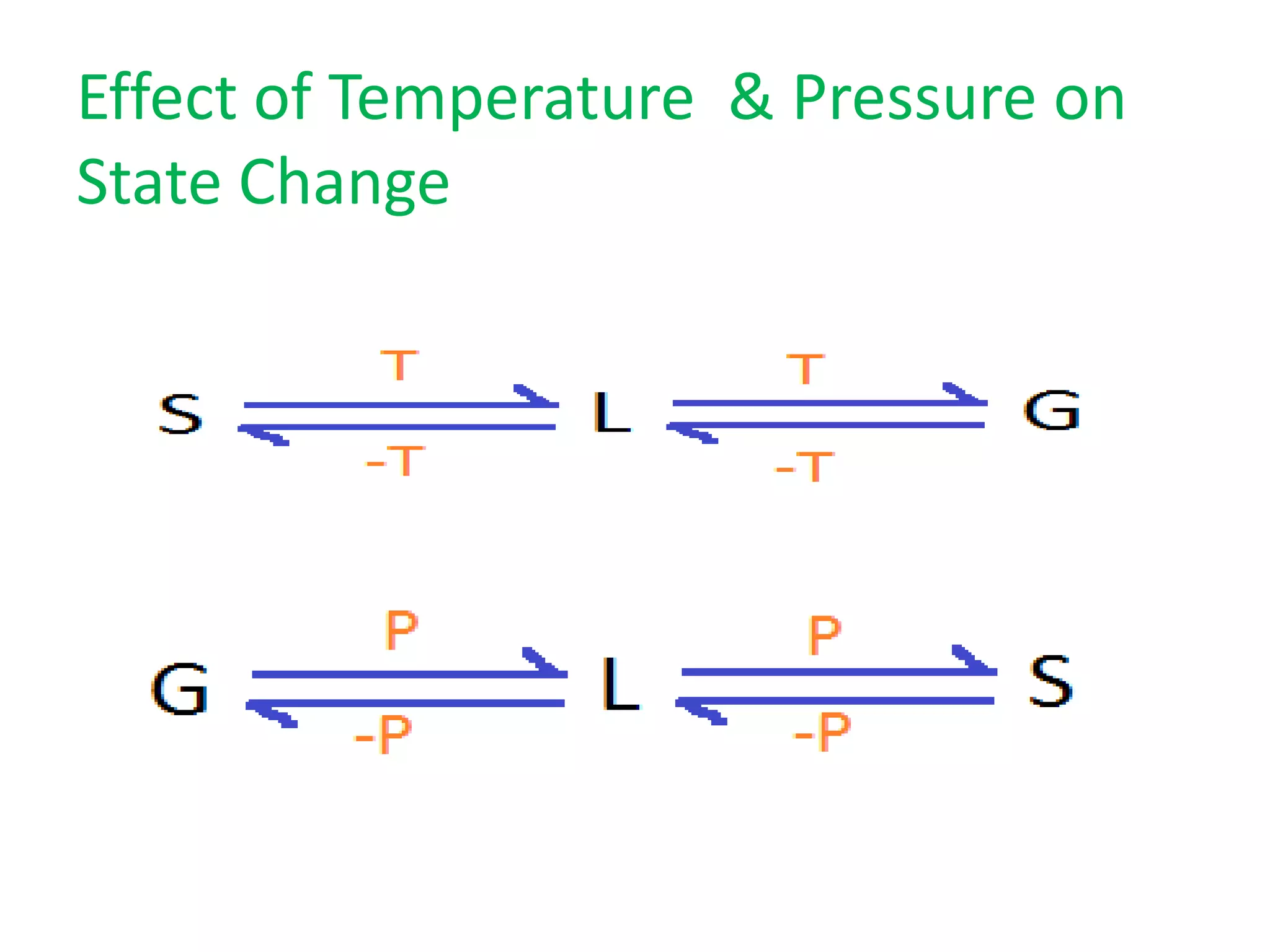
Effect of Temperature & Pressure on
State Change
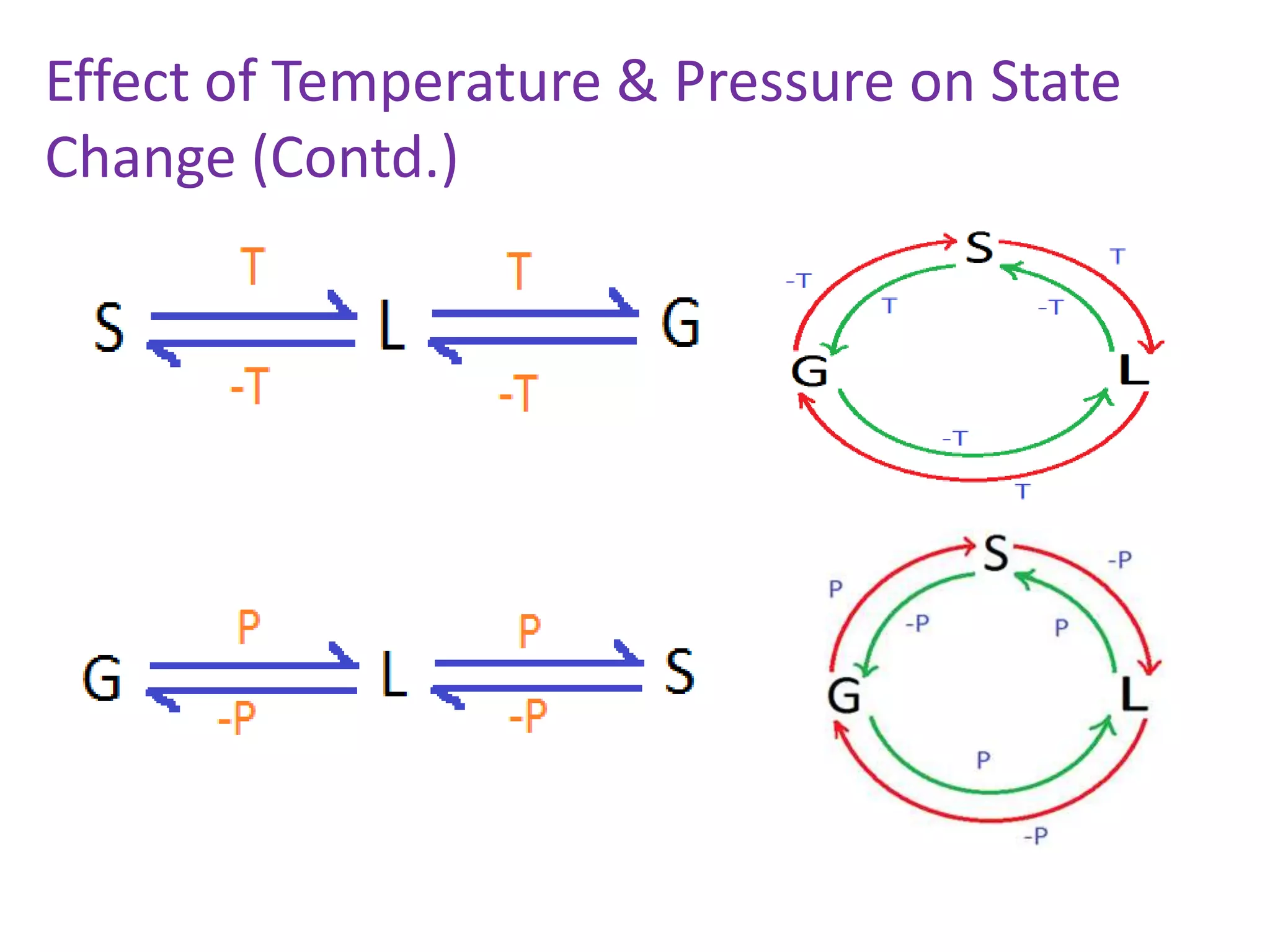
Effect of Temperature & Pressure on State
Change (Contd.)
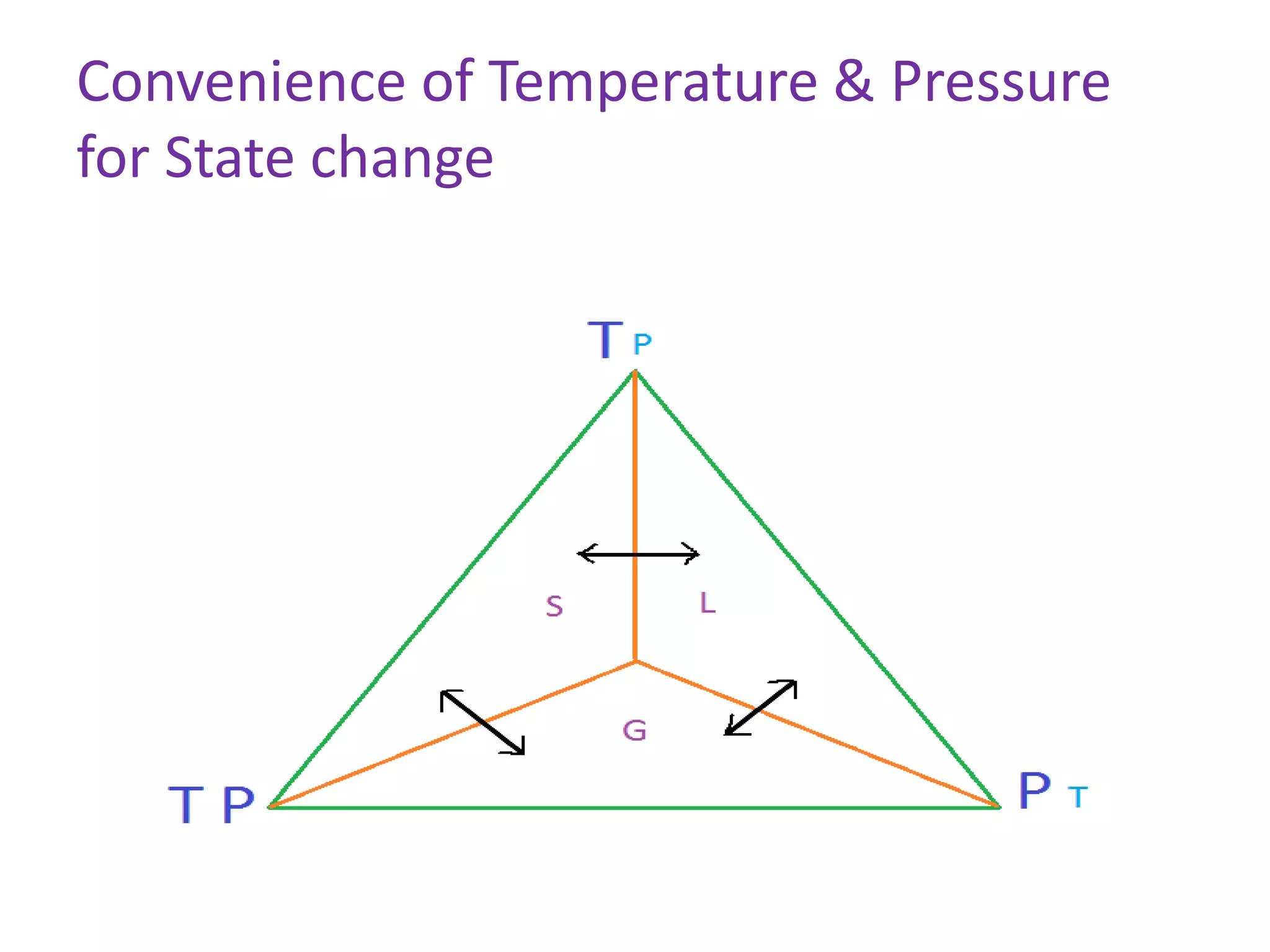
Convenience of Temperature & Pressure
for State change
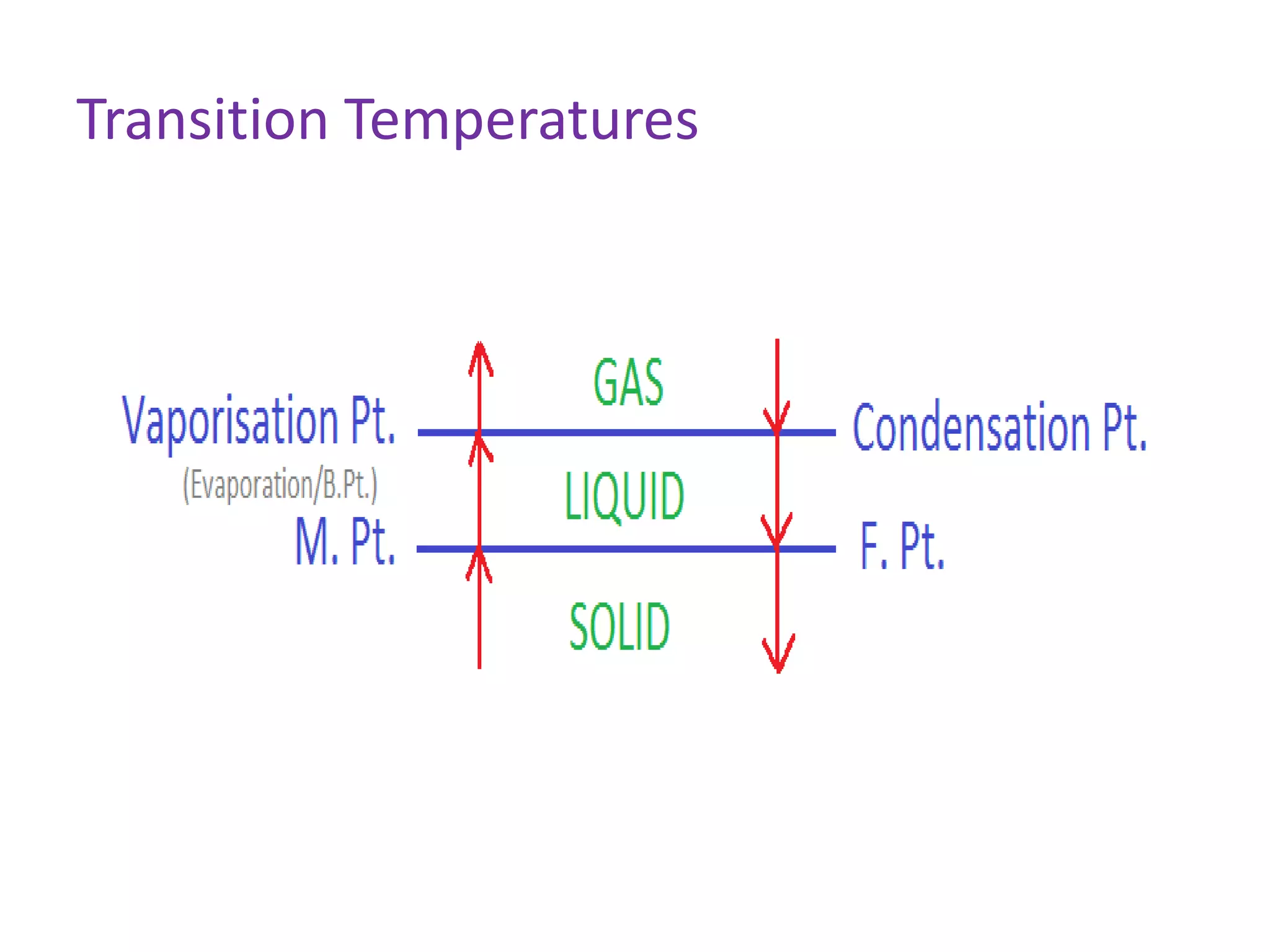
Transition Temperatures
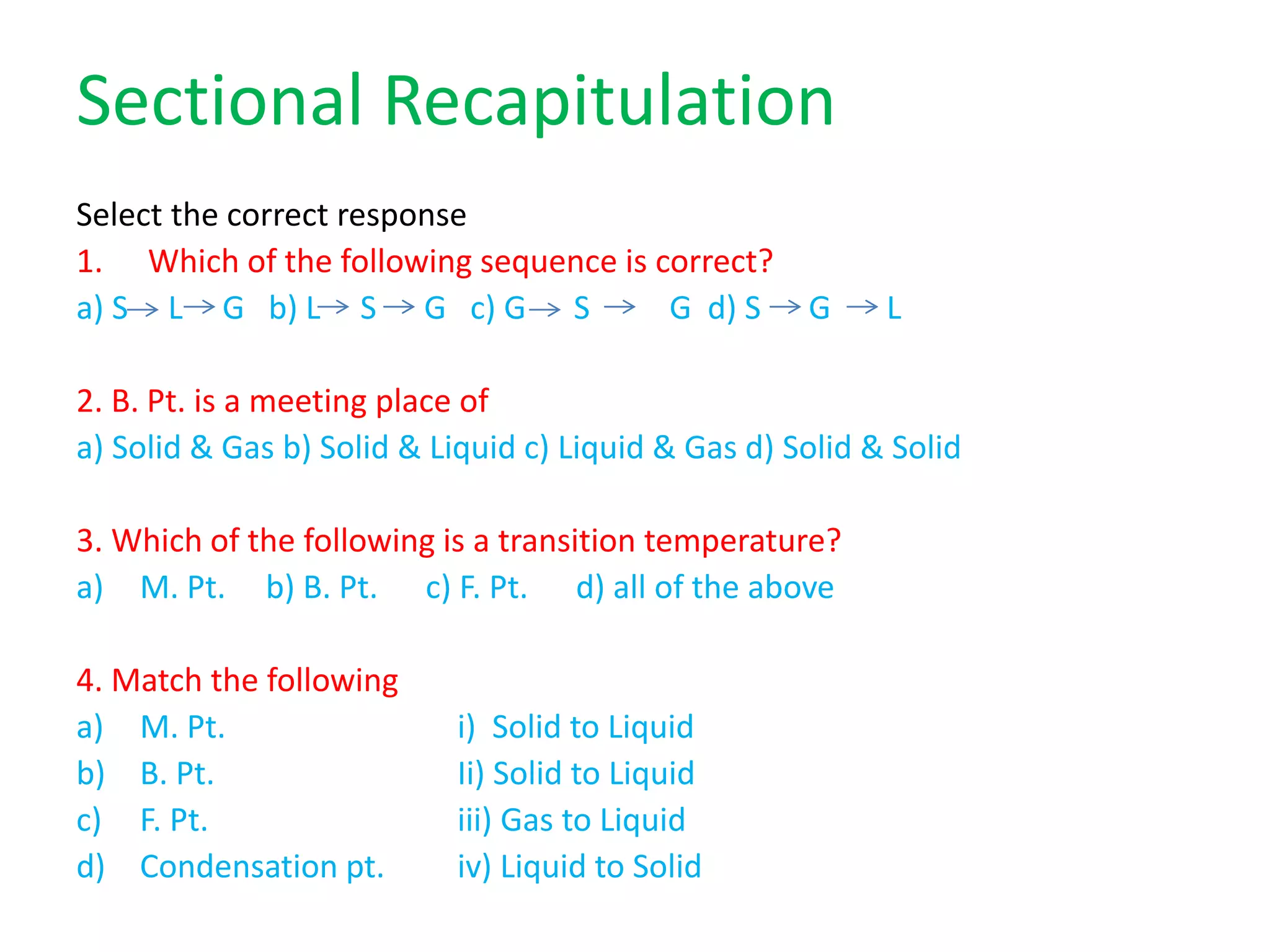
Sectional Recapitulation
Select the correct response
1. Which of the following sequence is correct?
a) S L G b) L S G c) G S G d) S G L
2. B. Pt. is a meeting place of
a) Solid & Gas b) Solid & Liquid c) Liquid & Gas d) Solid & Solid
3. Which of the following is a transition temperature?
a) M. Pt. b) B. Pt. c) F. Pt. d) all of the above
4. Match the following
a) M. Pt. i) Solid to Liquid
b) B. Pt. Ii) Solid to Liquid
c) F. Pt. iii) Gas to Liquid
d) Condensation pt. iv) Liquid to Solid
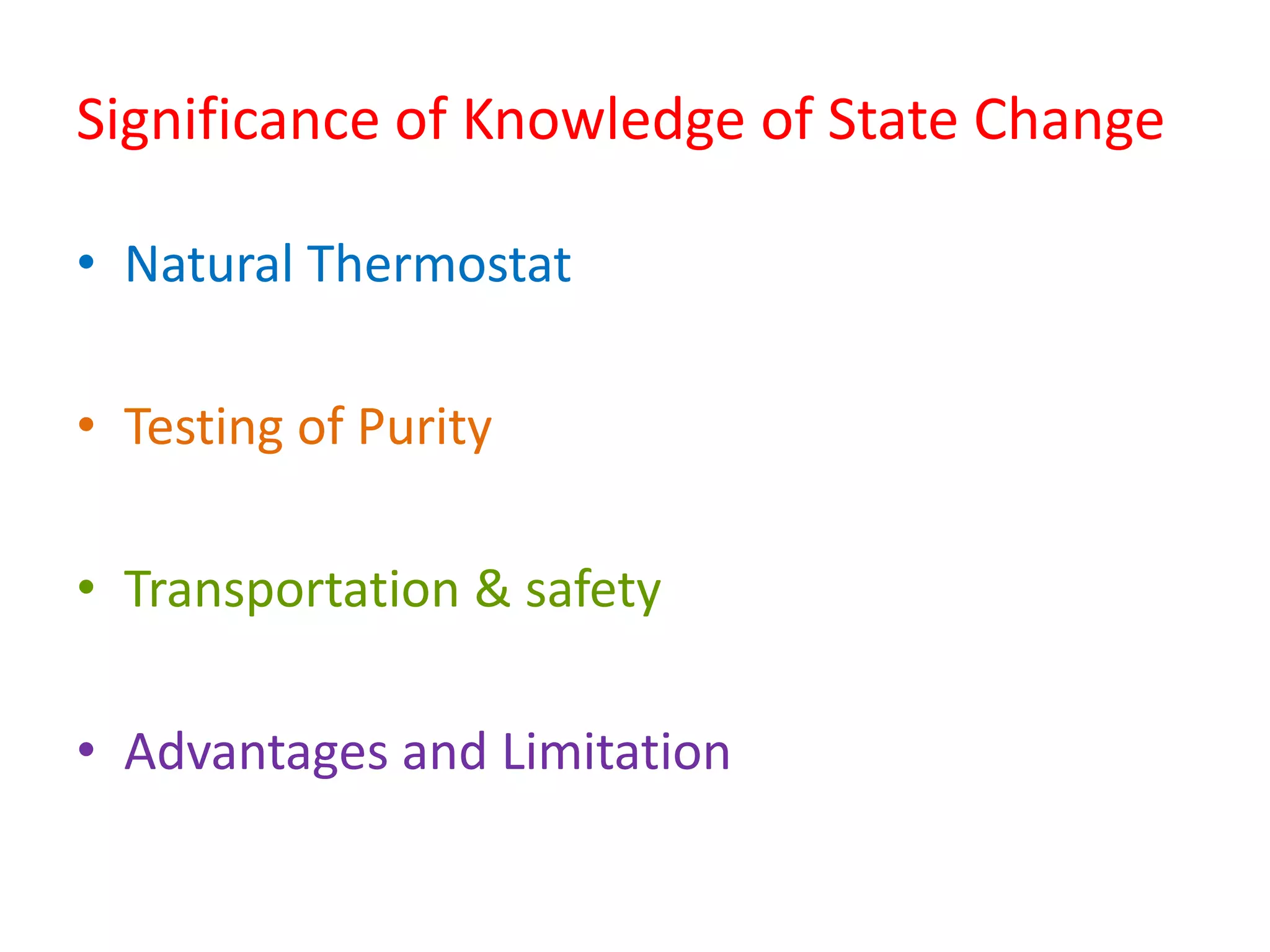
Significance of Knowledge of State Change
• Natural Thermostat
• Testing of Purity
• Transportation & safety
• Advantages and Limitation
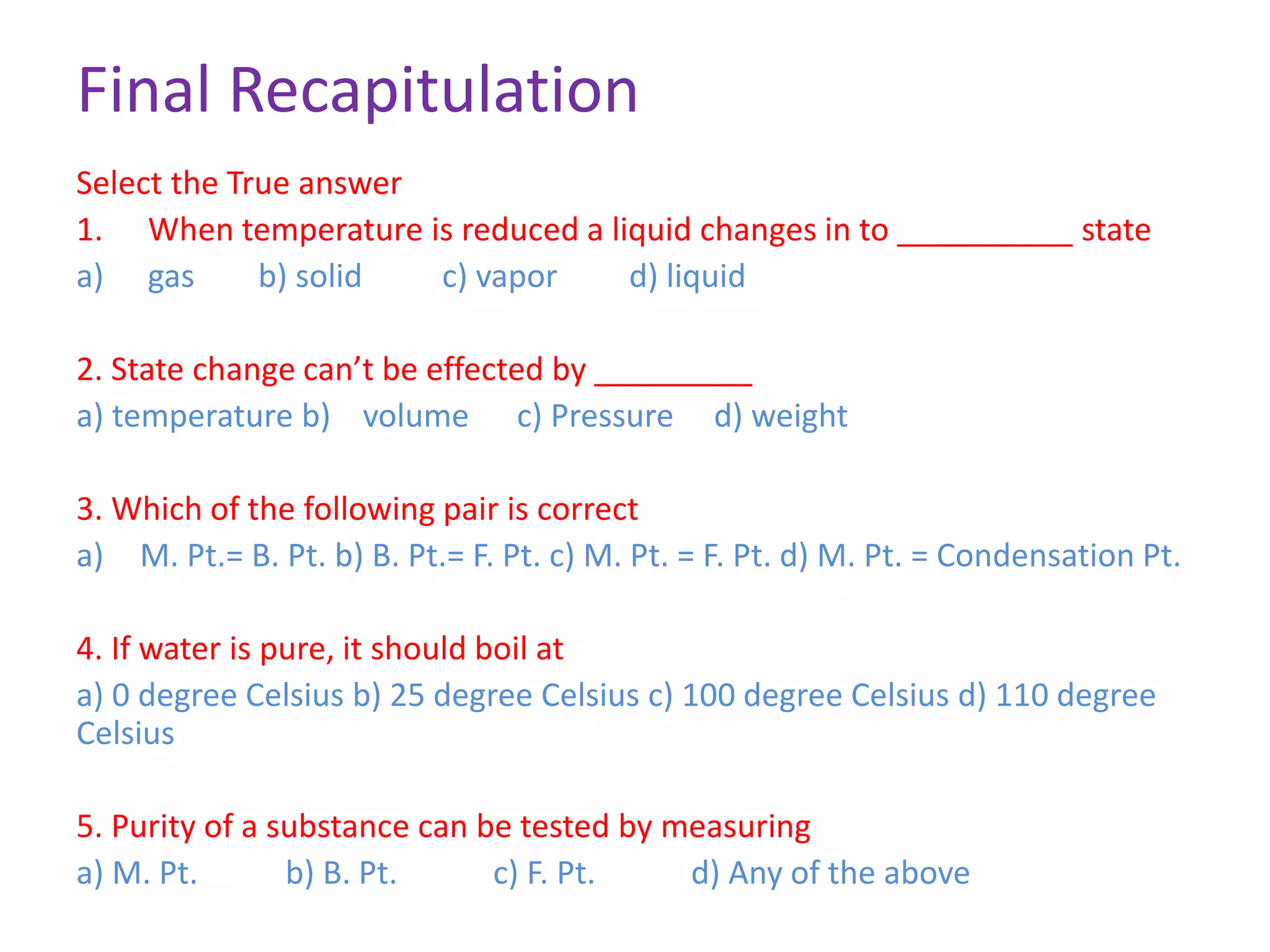
Final Recapitulation
Select the True answer
1. When temperature is reduced a liquid changes in to __________ state
a) gas b) solid c) vapor d) liquid
2. State change can’t be effected by _________
a) temperature b) volume c) Pressure d) weight
3. Which of the following pair is correct
a) M. Pt.= B. Pt. b) B. Pt.= F. Pt. c) M. Pt. = F. Pt. d) M. Pt. = Condensation Pt.
4. If water is pure, it should boil at
a) 0 degree Celsius b) 25 degree Celsius c) 100 degree Celsius d) 110 degree
Celsius
5. Purity of a substance can be tested by measuring
a) M. Pt. b) B. Pt. c) F. Pt. d) Any of the above
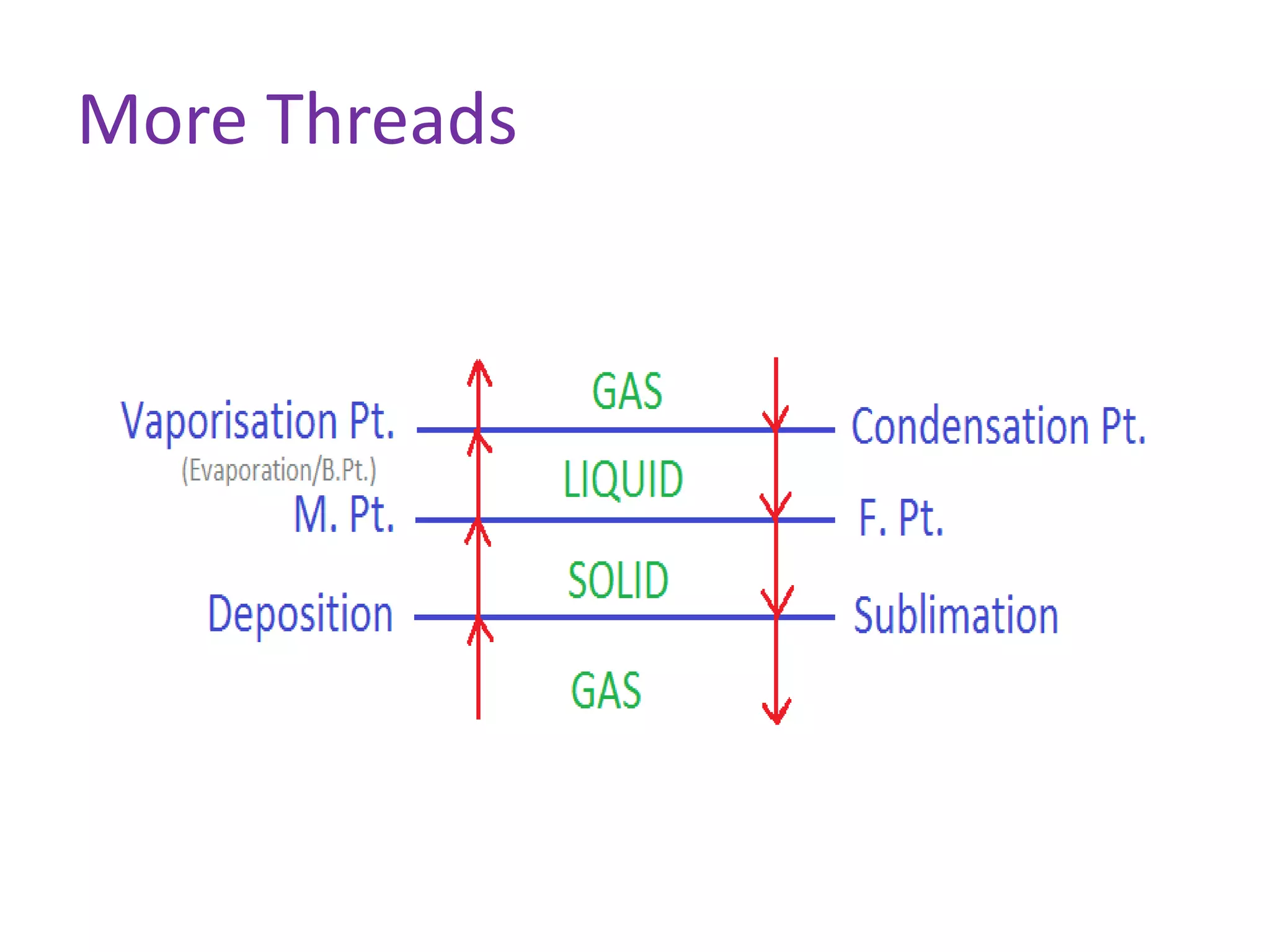
More Threads
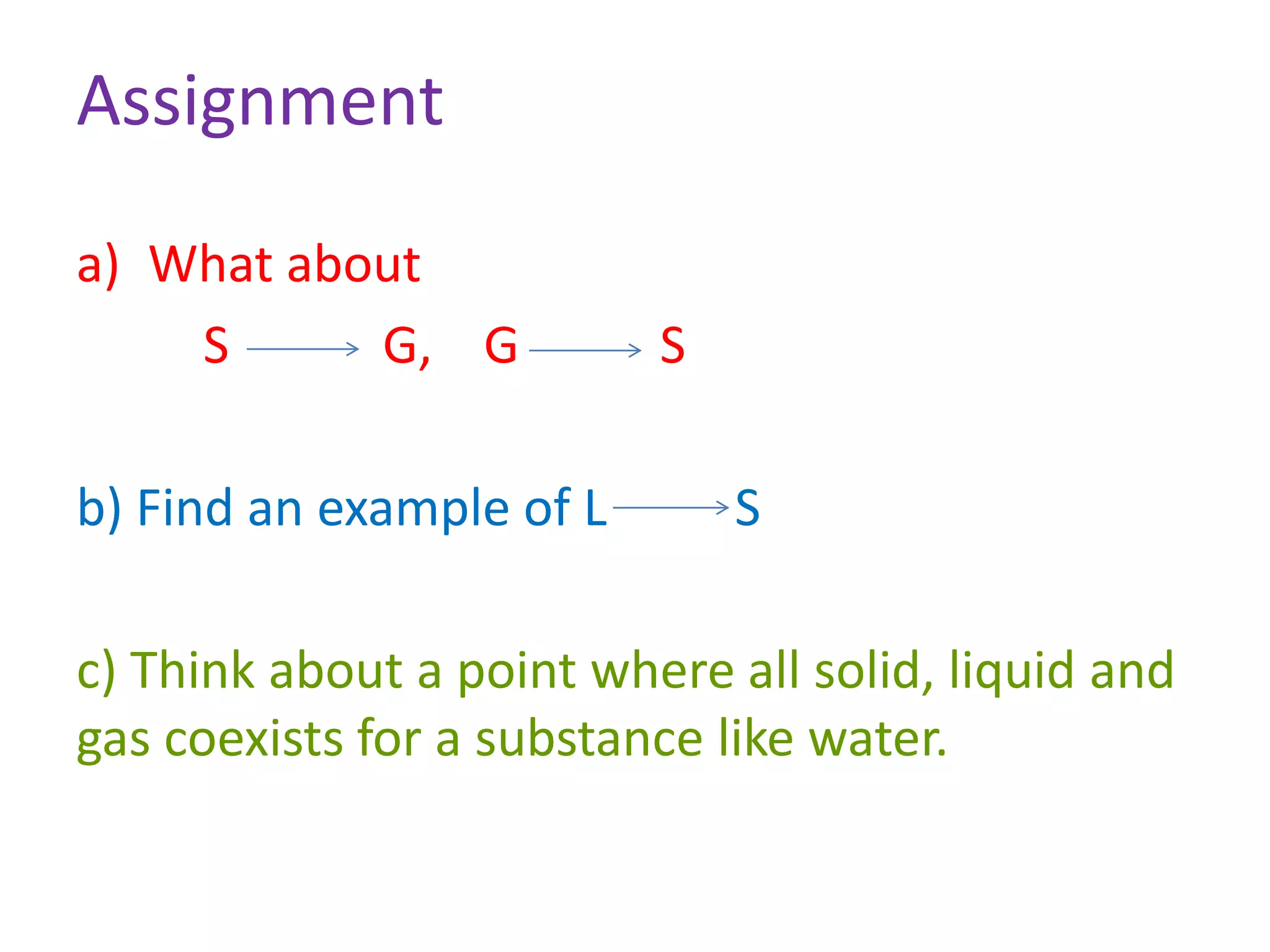
Assignment
a) What about
S G, G S
b) Find an example of L S
c) Think about a point where all solid, liquid and
gas coexists for a substance like water.
Thanks for Your Cooperation
Dr. Vijay Grover
DAV College of Education, Abohar

Model lesson change of state by vijay grover

  • 1.
    Effect of Temperature& Pressure on State Change
  • 2.
    Effect of Temperature& Pressure on State Change (Contd.)
  • 3.
    Convenience of Temperature& Pressure for State change
  • 4.
  • 5.
    Sectional Recapitulation Select thecorrect response 1. Which of the following sequence is correct? a) S L G b) L S G c) G S G d) S G L 2. B. Pt. is a meeting place of a) Solid & Gas b) Solid & Liquid c) Liquid & Gas d) Solid & Solid 3. Which of the following is a transition temperature? a) M. Pt. b) B. Pt. c) F. Pt. d) all of the above 4. Match the following a) M. Pt. i) Solid to Liquid b) B. Pt. Ii) Solid to Liquid c) F. Pt. iii) Gas to Liquid d) Condensation pt. iv) Liquid to Solid
  • 6.
    Significance of Knowledgeof State Change • Natural Thermostat • Testing of Purity • Transportation & safety • Advantages and Limitation
  • 7.
    Final Recapitulation Select theTrue answer 1. When temperature is reduced a liquid changes in to __________ state a) gas b) solid c) vapor d) liquid 2. State change can’t be effected by _________ a) temperature b) volume c) Pressure d) weight 3. Which of the following pair is correct a) M. Pt.= B. Pt. b) B. Pt.= F. Pt. c) M. Pt. = F. Pt. d) M. Pt. = Condensation Pt. 4. If water is pure, it should boil at a) 0 degree Celsius b) 25 degree Celsius c) 100 degree Celsius d) 110 degree Celsius 5. Purity of a substance can be tested by measuring a) M. Pt. b) B. Pt. c) F. Pt. d) Any of the above
  • 8.
  • 9.
    Assignment a) What about SG, G S b) Find an example of L S c) Think about a point where all solid, liquid and gas coexists for a substance like water.
  • 10.
    Thanks for YourCooperation Dr. Vijay Grover DAV College of Education, Abohar