introduction 
The term "demodicosis" originated from the Latin 
name of mites belonging to the genus Demodex. 
In addition to human parasitic mites Demodex on 
human skin and various animals, including pets 
(dogs, cats, horses, cattle, sheep, goats, pigs). 
Genus Demodex counts, at least 65 species, 10 of 
which are considered pathogenic parasites of humans 
and domestic animals. However, they are strictly 
specific to each type, mites, pet parasites incapable of 
parasitism in humans.
definition 
skin disease, 
causative agent - opportunistic mite 
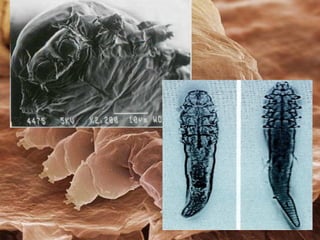
- demodex folliculorum («long» mite 0.3 - 0.5 
mm) and (or) 
- demodex brevis («short tick" 0.13 - 0.18 mm).
Biology and ecology of mites 
(ticks) 
Two mite species, usually separated. 
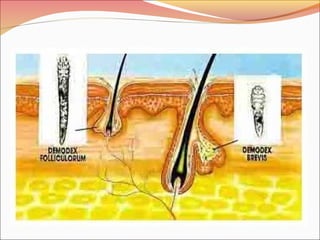
D. follicullorum prefer the hair follicles of eyelashes and 
eyebrows, at least - the hair on the head and chest. 
D. brevis mainly live in the sebaceous glands of the skin (the 
nasolabial folds, the wings of the nose), but can also be found in 
other areas of the skin: chest, back, neck - where sebaceous 
glands are located. 
D. follicullorum number can reach 18 copies in the follicle, and 
D. brevis - 3 copies in the sebaceous glands. Often one and the 
same patient meets a joint invasion of D. follicullorum and D. 
brevis. 
Mites feed on the contents epithelial cells of the walls of the 
hair follicles and sebaceous glands.
Biology and ecology of mites 
(ticks) 
Demodex follikulorum the most common, found only in 
human hair follicles, sebaceous glands, the outside of the 
host (human) reproduction of the mite stops. 
Mite is viable outside the host if saved with constant 
humidity and average temperature in the dark for up to 9 
days. 
The optimum temperature for development of the mite - 
30-40 ° C at 14 ° C mites are in a state of torpor and at 52 ° 
C is rapidly die. In the water stored insects to 25 days in 
dry air are killed 1.5 days. The most favorable breeding 
ground for demodex - vegetable oil, grease, petroleum 
jelly.
The life cycle of the mite 
Development cycle of these mites includes five stages of 
development: 
-egg, - larva, -nymph of the first age (protonymph), -the nymph of 
the second age (deutonymph), -mature individuals (male or 
female). 
The mating of a male and female is carried out in the hair 
follicle. Fertilized female moves deep into the follicle and it lays 
eggs. The interval between mating and egg-laying is about 12 
hours. From the egg larva, which feeds and molts, passing in 
protonymphs (nymph 1). This nymph, in turn, feeds, and at the 
same time moves at the mouth of the follicle with a current of 
sebum, which fades, turning into a nymph of the second age 
(deyteronimfa). Deutonymph, reaching the surface of the skin is 
able to move from follicle to follicle within 12-36 hours. Then 
she gets into the hair follicle and converted there into a female. 
Duration of each stage of ticks varies from 36 to 120 hours. 
The entire life cycle of the female D. folliculorum is about 15 days.
Epidemiology 
- Common among people of all races. Person's gender 
does not affect the frequency of tick infestation, just 
men rarely go to the doctor about ther appearance. 
With age, the detection rate increases D. brevis and 
D. folliculorum - remains virtually unchanged. In 
humans demodicosis often accompanies other skin or 
ophthalmic diseases such as rosacea, perioral 
dermatitis, blepharitis. However, it should again be 
emphasized that demodicosis is associated primarily 
with the defeat of the skin of the face.
Modes of transmission 
Іnfection of humans by mite 
occurs mainly by direct contact 
between humens. It is believed 
that during the daytime mites 
are mainly in the follicles, and 
the skin surface only come at 
night. It follows that the most 
probable time of transition from 
one host ticks on the other - the 
night. 
Infection through household 
items, as it was shown that the 
mites can long enough to 
remain viable outside the host.
The role of mites Demodex in the 
development of skin diseases 
Parasite on human these mites can often be 
asymptomatic. 
Carriers of mites are on average up to 55% of people. 
With age, the mite infestation increases and, according to 
some authors, the elderly up to 100%. 
Because of this, their role in the development of skin 
diseases remains a controversial issue, but it has been 
proven that an important factor is the number of D. 
folliculorum mite more than 5 copies per sq cm/ 
Number of mites significantly increased in patients with 
certain forms of rosacea: apparently genus Demodex mites 
are involved in the pathogenesis of these diseases/
Clinical features 
Favourite localization of mites: 
 - eyelinds; 
- facial skin; 
 - browridges; - 
forehead; - 
 Nasolabial folds; 
 - Chin; - 
 The outer ear canal.
Clinical features 
There are skin and eye manifestations of the disease. 
Demodicosis is very similar manifestations with acne, and 
its main manifestation is a reddening of the skin, peeling 
it, accompanied by itching, which can be both permanent 
and appear after applying tonics or wash with cold water, 
the occurrence of this background of inflammatory 
elements, like acne, that contributes to the appearance of 
pustular lesions caused by staphylococcus or 
streptococcus. 
The eye is manifested clinically itching, swelling and 
redness of the eyelid margins, the appearance of scales in 
the roots of eyelashes for a long time. Typically, patients 
complain of eyestrain. looks like the affected eyelid: a raid 
on the edge of the eyelids, matted cilia, surrounded by 
crusts.
signs of Demodecosis 
 pimples, acne, rashes, rosacea, abscesses, sores, etc. on the face are likely to be 
a manifestation of demodectic mange. In the long process spots found on the 
skin of the back, chest and even the hips; red spots on the face; of oily skin, 
enlarged pores. 
 The affected areas are represented wet, greasy, have a characteristic luster. 
Usually suffers from the skin on the nose and cheeks, pale or ashy-gray shade 
of the face; 
 In the thick rough skin formed "scar" tissue and a variety of small hard lumps 
of calcium, which leads to an unhealthy complexion and uneven skin, 
difficulty mimic facial movements; increase in the size of the nose. Sometimes 
it is very significant, while the nose begins to resemble a huge blue and red 
plum (rhinophyma); itching, slight tickling sensation of crawling. 
 Sometimes people do not notice tickling and scratching automatically. Itching 
worse in the evening and continued overnight. This time - the period of the 
most active life ticks usually happens then their mating 
 itchy scalp hair loss. Premature hair loss can also be associated with the 
active work demodex; itching eyelashes. Loss of eyelashes as well, most often, 
is a consequence of the activities of DEMODEX mite that lives in the roots of 
eyelashes: base of the eyelashes begin to itch, lashes become thinner and 
begin to fall; 
 itching ears.
clinical forms 
Erythematous form is sometimes called rosacea similar - 
similar due to external displays, and is often confused with 
this rosacea - a separate disease, a unique form of vascular 
neurosis arising under the influence of bacterial and 
fungal microflora. Ticks are not the cause of rosacea but 
can significantly aggravate its course. 
Pustular form is rare. On clinical grounds it may 
resemble simple acne, folliculitis, and other forms, but 
with the prevalence of pustular rash. Papular form the 
most common form. Size papules varies from 0.5 to 2 mm 
or more in diameter, color - from pink to intense red. 
Mixed form is characterized by the fact that the skin of 
the patient are observed all characteristic of this disease 
variety of rashes.
For some diseases can be 
complicated by demodex 
It is necessary to distinguish between demodicosis 
and diseases, during which exacerbates the presence 
of mites. Acne is often combined with other skin 
diseases, in particular, with a simple acne (up 30%) 
and especially rosacea (95%), also rozatseopodobnym, 
seborrheic dermatitis, and oral. People with chronic 
eye diseases demodicosis occurs in 60-70% of cases. 
The greatest number of ticks observed in 
conjunctivitis, episcleritis, keratitis, iridocyclitis, 
periorbikulyarnyh dermatitis.
treatment 
 Peeling and antiparasitic treatments - 
with liquid nitrogen cryotherapy, 
application of an ointment containing a 
high concentration of sulfur (5-10%), 
hydrochloric acid (6%), sodium 
thiosulfate, ointments based on sulfur 
tar alcohol powder. Antihistamines - to 
exclude the possibility of allergy. 
Therapy treatable "Risk Factors" in 
violation of alkaline-acid balance, - 
strengthening the walls of blood vessels, 
Vitamin therapy, absorbents, in some 
cases - a course of antibiotics. Light diet 
without fat, fried, spicy, salty. Overall 
desinsection! Boil the linen clean things! 
You can not go to the bath, sunbathing - 
and also in the solarium, use decorative 
cosmetics. And no cosmetic procedures 
- not to disrupt the treatment regimen.
Thank you

Demodex

  • 2.
    introduction The term"demodicosis" originated from the Latin name of mites belonging to the genus Demodex. In addition to human parasitic mites Demodex on human skin and various animals, including pets (dogs, cats, horses, cattle, sheep, goats, pigs). Genus Demodex counts, at least 65 species, 10 of which are considered pathogenic parasites of humans and domestic animals. However, they are strictly specific to each type, mites, pet parasites incapable of parasitism in humans.
  • 3.
    definition skin disease, causative agent - opportunistic mite - demodex folliculorum («long» mite 0.3 - 0.5 mm) and (or) - demodex brevis («short tick" 0.13 - 0.18 mm).
  • 5.
    Biology and ecologyof mites (ticks) Two mite species, usually separated. D. follicullorum prefer the hair follicles of eyelashes and eyebrows, at least - the hair on the head and chest. D. brevis mainly live in the sebaceous glands of the skin (the nasolabial folds, the wings of the nose), but can also be found in other areas of the skin: chest, back, neck - where sebaceous glands are located. D. follicullorum number can reach 18 copies in the follicle, and D. brevis - 3 copies in the sebaceous glands. Often one and the same patient meets a joint invasion of D. follicullorum and D. brevis. Mites feed on the contents epithelial cells of the walls of the hair follicles and sebaceous glands.
  • 7.
    Biology and ecologyof mites (ticks) Demodex follikulorum the most common, found only in human hair follicles, sebaceous glands, the outside of the host (human) reproduction of the mite stops. Mite is viable outside the host if saved with constant humidity and average temperature in the dark for up to 9 days. The optimum temperature for development of the mite - 30-40 ° C at 14 ° C mites are in a state of torpor and at 52 ° C is rapidly die. In the water stored insects to 25 days in dry air are killed 1.5 days. The most favorable breeding ground for demodex - vegetable oil, grease, petroleum jelly.
  • 8.
    The life cycleof the mite Development cycle of these mites includes five stages of development: -egg, - larva, -nymph of the first age (protonymph), -the nymph of the second age (deutonymph), -mature individuals (male or female). The mating of a male and female is carried out in the hair follicle. Fertilized female moves deep into the follicle and it lays eggs. The interval between mating and egg-laying is about 12 hours. From the egg larva, which feeds and molts, passing in protonymphs (nymph 1). This nymph, in turn, feeds, and at the same time moves at the mouth of the follicle with a current of sebum, which fades, turning into a nymph of the second age (deyteronimfa). Deutonymph, reaching the surface of the skin is able to move from follicle to follicle within 12-36 hours. Then she gets into the hair follicle and converted there into a female. Duration of each stage of ticks varies from 36 to 120 hours. The entire life cycle of the female D. folliculorum is about 15 days.
  • 10.
    Epidemiology - Commonamong people of all races. Person's gender does not affect the frequency of tick infestation, just men rarely go to the doctor about ther appearance. With age, the detection rate increases D. brevis and D. folliculorum - remains virtually unchanged. In humans demodicosis often accompanies other skin or ophthalmic diseases such as rosacea, perioral dermatitis, blepharitis. However, it should again be emphasized that demodicosis is associated primarily with the defeat of the skin of the face.
  • 11.
    Modes of transmission Іnfection of humans by mite occurs mainly by direct contact between humens. It is believed that during the daytime mites are mainly in the follicles, and the skin surface only come at night. It follows that the most probable time of transition from one host ticks on the other - the night. Infection through household items, as it was shown that the mites can long enough to remain viable outside the host.
  • 12.
    The role ofmites Demodex in the development of skin diseases Parasite on human these mites can often be asymptomatic. Carriers of mites are on average up to 55% of people. With age, the mite infestation increases and, according to some authors, the elderly up to 100%. Because of this, their role in the development of skin diseases remains a controversial issue, but it has been proven that an important factor is the number of D. folliculorum mite more than 5 copies per sq cm/ Number of mites significantly increased in patients with certain forms of rosacea: apparently genus Demodex mites are involved in the pathogenesis of these diseases/
  • 13.
    Clinical features Favouritelocalization of mites:  - eyelinds; - facial skin;  - browridges; - forehead; -  Nasolabial folds;  - Chin; -  The outer ear canal.
  • 15.
    Clinical features Thereare skin and eye manifestations of the disease. Demodicosis is very similar manifestations with acne, and its main manifestation is a reddening of the skin, peeling it, accompanied by itching, which can be both permanent and appear after applying tonics or wash with cold water, the occurrence of this background of inflammatory elements, like acne, that contributes to the appearance of pustular lesions caused by staphylococcus or streptococcus. The eye is manifested clinically itching, swelling and redness of the eyelid margins, the appearance of scales in the roots of eyelashes for a long time. Typically, patients complain of eyestrain. looks like the affected eyelid: a raid on the edge of the eyelids, matted cilia, surrounded by crusts.
  • 16.
    signs of Demodecosis  pimples, acne, rashes, rosacea, abscesses, sores, etc. on the face are likely to be a manifestation of demodectic mange. In the long process spots found on the skin of the back, chest and even the hips; red spots on the face; of oily skin, enlarged pores.  The affected areas are represented wet, greasy, have a characteristic luster. Usually suffers from the skin on the nose and cheeks, pale or ashy-gray shade of the face;  In the thick rough skin formed "scar" tissue and a variety of small hard lumps of calcium, which leads to an unhealthy complexion and uneven skin, difficulty mimic facial movements; increase in the size of the nose. Sometimes it is very significant, while the nose begins to resemble a huge blue and red plum (rhinophyma); itching, slight tickling sensation of crawling.  Sometimes people do not notice tickling and scratching automatically. Itching worse in the evening and continued overnight. This time - the period of the most active life ticks usually happens then their mating  itchy scalp hair loss. Premature hair loss can also be associated with the active work demodex; itching eyelashes. Loss of eyelashes as well, most often, is a consequence of the activities of DEMODEX mite that lives in the roots of eyelashes: base of the eyelashes begin to itch, lashes become thinner and begin to fall;  itching ears.
  • 19.
    clinical forms Erythematousform is sometimes called rosacea similar - similar due to external displays, and is often confused with this rosacea - a separate disease, a unique form of vascular neurosis arising under the influence of bacterial and fungal microflora. Ticks are not the cause of rosacea but can significantly aggravate its course. Pustular form is rare. On clinical grounds it may resemble simple acne, folliculitis, and other forms, but with the prevalence of pustular rash. Papular form the most common form. Size papules varies from 0.5 to 2 mm or more in diameter, color - from pink to intense red. Mixed form is characterized by the fact that the skin of the patient are observed all characteristic of this disease variety of rashes.
  • 20.
    For some diseasescan be complicated by demodex It is necessary to distinguish between demodicosis and diseases, during which exacerbates the presence of mites. Acne is often combined with other skin diseases, in particular, with a simple acne (up 30%) and especially rosacea (95%), also rozatseopodobnym, seborrheic dermatitis, and oral. People with chronic eye diseases demodicosis occurs in 60-70% of cases. The greatest number of ticks observed in conjunctivitis, episcleritis, keratitis, iridocyclitis, periorbikulyarnyh dermatitis.
  • 21.
    treatment  Peelingand antiparasitic treatments - with liquid nitrogen cryotherapy, application of an ointment containing a high concentration of sulfur (5-10%), hydrochloric acid (6%), sodium thiosulfate, ointments based on sulfur tar alcohol powder. Antihistamines - to exclude the possibility of allergy. Therapy treatable "Risk Factors" in violation of alkaline-acid balance, - strengthening the walls of blood vessels, Vitamin therapy, absorbents, in some cases - a course of antibiotics. Light diet without fat, fried, spicy, salty. Overall desinsection! Boil the linen clean things! You can not go to the bath, sunbathing - and also in the solarium, use decorative cosmetics. And no cosmetic procedures - not to disrupt the treatment regimen.
  • 22.