Neoplasia-5
Carcinogenesis-
A Multistep process-
Hallmark of Cancer
Dr. Roopam Jain
Professor & Head, Pathology
Neoplasia Outline
 Tumor nomenclature
 Tumor characteristics
 Epidemiology
 Cancer pathogenesis
•Overview
•Genes
•Steps
•Chromosomes
Molecular Basis of Neoplasia:
Proto-oncogene
Oncogene
Gatekeepers and Caretakers
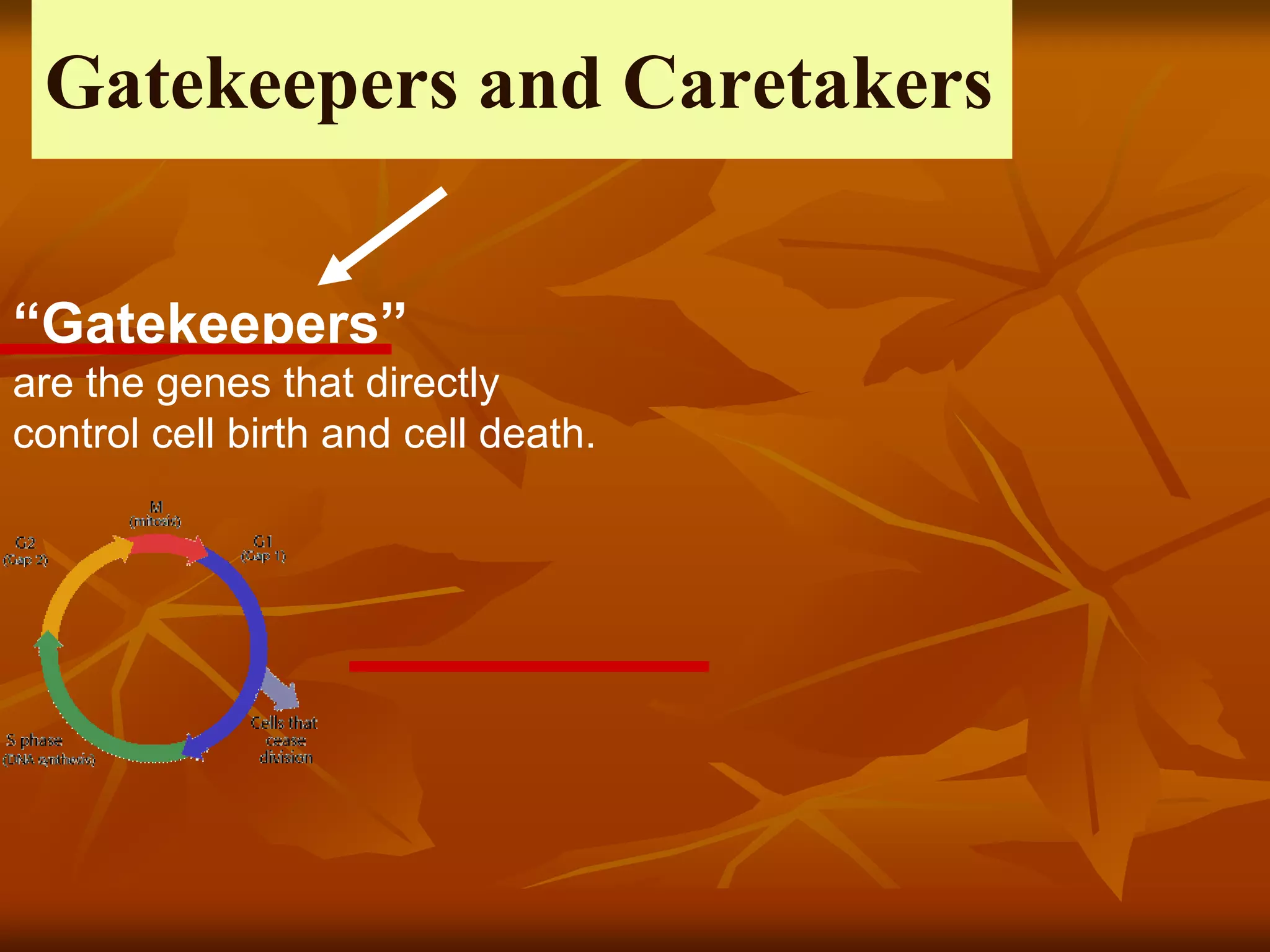
“Gatekeepers”
are the genes that directly
control cell birth and cell death.
Tumor growth kinetics is different
for gatekeepers and caretakers
Gatekeeper genes
is altered through mutation,
Oncogenes & tumor suppressor genes directly control
tumor growth. Regulate entry of cell into tumorigenic path
Caretaker genes
that do not directly control tumor growth but affect genomic
instability - DNA repair genes
Increased mutations of all genes
and the process of tumorigenesis is accelerated.
Molecular Basis of Carcinogenesis
 Four classes of regulatory genes.
1. Growth Promoters – Proto-oncogenes
2. Inhibitors – Cancer-suppressor genes
3. Genes regulating Apoptosis.
4. DNA repair genes.
Non-lethal Genetic damage lies at
the center of carcinogenesis.
 Loss/damage to suppressor genes,
 Duplication of promoter genes
 Loss/damage to Apoptosis genes
 Loss/damage of DNA repair genes.
Genes
Autonomous growth
Insensitivity to growth-inhibitory signals
Evasion of apoptosis
Limitless replication
Sustained angiogenesis
Invasion and metastasis
“Cancer genes” cause bad things in cells:
MOLECULAR BASIS OF
CANCER
Theories of Cancer
 1. Monoclonality of tumours
 2. Field theory of cancer
 3. Multi-step process of cancer growth and
progression
 4. Genetic theory of cancer
 5. Genetic regulators of normal and abnormal mitosis
 Four classes of regulatory genes.
1. Growth Promoters – Proto-oncogenes
2. Anti-Oncogenes – Cancer-suppressor genes
3. Genes regulating Apoptosis.
4. DNA repair genes.
Non-lethal, Genetic damage lies at the
center of carcinogenesis.
 i) Inactivation of cancer-suppressor genes (i.e.
inactivation of anti-oncogenes)
Loss/damage to suppressor genes,
 ii) Activation of growth-promoting oncogenes
(Duplication of promoter genes)
 iii) Abnormal apoptosis regulatory genes
(Loss/damage to Apoptosis genes)
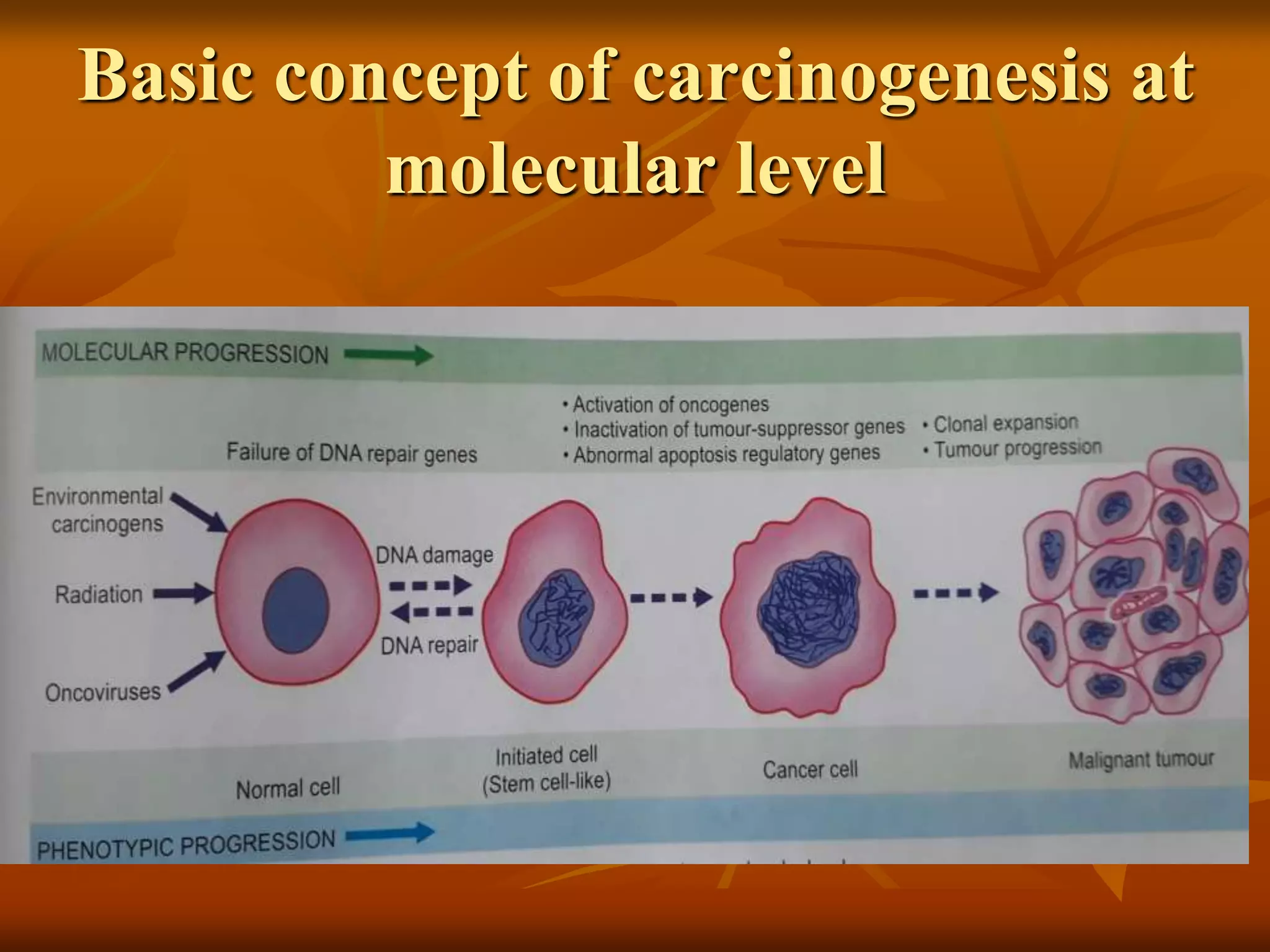
 iv) Failure of DNA repair genes
(Loss/damage of DNA repair genes)
Basic concept of carcinogenesis at
molecular level
Basic concept of carcinogenesis at
molecular level
Major properties
of cancer in
terms of
molecular
carcinogenesis.
Genetic basis of cancer includes
major genetic properties
 1. Excessive and autonomous growth:
Activation of Growth-promoting oncogenes.
 2. Refractoriness to growth inhibition:
Inactivation of anti-oncogenes.
 3. Escaping cell death by apoptosis:
Abnormal apoptosis regulatory genes.
 4. Avoiding cellular ageing: Telomeres and
telomerase in cancer.
 5. Continued perfusion of cancer: Cancer
angiogenesis
 6. Invasion and distant metastasis: Cancer
dissemination.
 7. DNA damage and repair system: failure of
DNA repair genes, Mutator genes and cancer.
 8. Cancer progression and tumour
heterogeneity: Clonal aggressiveness.
 9. Cancer a sequential multistep molecular
phenomenon: Multistep theory.
Neoplasia Outline
 Tumor nomenclature
 Tumor characteristics
 Epidemiology
Cancer pathogenesis
•Overview
•Genes
•Steps
•Chromosomes
CANCER-RELATED GENES
AND CELL GROWTH
(HALLMARKS OF CANCER)
Genes
Autonomous growth
Insensitivity to growth-inhibitory signals
Evasion of apoptosis
Limitless replication
Sustained angiogenesis
Invasion and metastasis
“Cancer genes” cause bad things in cells:
Genes
Autonomous growth
Insensitivity to growth-inhibitory signals
Evasion of apoptosis
Limitless replication
Sustained angiogenesis
“Cancer genes” cause bad things in cells:
1. Excessive and Autonomous Growth:
Growth Promoting Oncogenes
 Transformation of proto-oncogene (i.e. normal cell
proliferation gene) to oncogenes (i.e. cancer cell
proliferation gene) may occur by three mechanisms:
 i) Point mutations (RAS oncogene
 ii) Chromosomal translocations (Philadelphia
chromosome, translocation of c-MYC proto-oncogene)
 iii) Gene amplification (Neuroblastoma having n-MYC
HSR region. & ERB-B1 in breast and ovarian cancer.)
Mechanisms of activation of protooncogenes
to form growth promoting oncogenes.
Genes
Autonomous growth
Insensitivity to growth-
inhibitory signals
Evasion of apoptosis
Limitless replication
Sustained angiogenesis
“Cancer genes” cause bad things in cells:
2. Refractoriness to Growth Inhibition:
Growth Suppressing Anti-Oncogenes
 Mutated anti-oncogenes behave like
growth-promoting oncogenes
Important tumour-suppressor anti-oncogenes
and associated human tumors
Genes
Autonomous growth
Insensitivity to growth-inhibitory signals
Evasion of apoptosis
Limitless replication
Sustained angiogenesis
“Cancer genes” cause bad things in cells:
3. Escaping Cell Death by Apoptosis:
Genes Regulating Apoptosis and Cancer
 In cancer cells, the function of apoptosis is interfered due
to mutations in the genes (pro-apoptotic factors (BAD,
BAX, BID and p53) and apoptosis-inhibitors (BCL2,
BCL-X) , which regulate apoptosis in the normal cell.
 The examples of tumours by this mechanism are as under
a) BCL2 gene
b) CD95
Normal p53 pathway for control of cell apoptosis in breast
cancer
Damaged DNA
P 53
Rb
active
Rb
inactive
TWO MAJOR EFFECTS:
 i. Cell cycle arrest
 ii. Apoptosis
 Cell cycle arrest in late G1 phase-caused
by p53 dependent transcription of CDK
inhibitor p21- inhibits cyclin/CDK complexes.
 Thus prevents phosphorylation of RB
necessary for cells to enter S phase. So allows
cells the time to repair DNA damage.
Cell Cycle is controlled by genes.
4. Avoiding Cellular Ageing: Telomeres
and Telomerase in Cancer
 Cancer cells in most malignancies have markedly
up-regulated telomerase enzyme, and hence
telomere length is maintained.
 Thus, cancer cells avoid ageing,
mitosis does not slow down or cease,
 thereby immortalising the cancer cells.
Genes
Autonomous growth
Insensitivity to growth-inhibitory signals
Evasion of apoptosis
Limitless replication
“Cancer genes” cause bad things in cells:
Limitless Replication
 Normal human cells: only 60-70 doublings
 Telomeres keep getting shorter…
 …leading to cell cycle arrest (via p53 check points,
causing proliferative arrest or apoptosis
 Stem cells and cancer cells use HIGH telomerase
activity to maintain telomere length and keep
replicating!
Genes
Autonomous growth
Insensitivity to growth-inhibitory signals
Evasion of apoptosis
Limitless replication
Sustained angiogenesis
“Cancer genes” cause bad things in cells:
5. Continued Perfusion of
Cancer: Tumour Angiogenesis
 Cancers can only survive and thrive if the cancer cells
are adequately nourished and perfused, as otherwise
they cannot grow further.
 Neovascularisation in the cancers supplies oxygen and
nutrients to tumors.
 The stimulus for angiogenesis is provided by the release
of various factors:
 i) Promoters of tumour angiogenesis - (VEGF, bFGF)
 ii) Anti-angiogenesis factors – (thrombospondin-1,
angiostatin, endostatin and vasculostatin)
6. Invasion and Distant
Metastasis: Cancer Dissemination
 One of the most important characteristic of
cancers is invasiveness and metastasis
7. DNA Damage and Repair System:
Mutator Genes and Cancer
 small mutational damage to the dividing cell by
exogenous factors (radiation, chemical carcinogens etc) is
also repaired.
 p53 gene is held responsible for detection and repair of
DNA damage.
 However, if this system of DNA repair is defective
(mutator genes) --- cancer results.
 e.g. - Hereditary non-polyposis colon cancer, Ataxia
telangiectasia, Xeroderma pigmentosum , Bloom
syndrome
Neoplasia Outline
 Tumor nomenclature
 Tumor characteristics
 Epidemiology
 Cancer pathogenesis
•Overview
•Genes
•Steps
•Chromosomes
How do all these genetic mutations arise?
 We swim in a Sea of Carcinogens.
 mutagenic agents (sunlight, radiation, chemicals)!!
 We don’t get very many cancers because normal cells are
able to REPAIR DNA damage!!
 In addition to environmental damage, DNA of normal
dividing cells is susceptible to alterations resulting from
"Spontaneous Errors" occurring during DNA replication
 Many systems for DNA repair exist.
 If you inherit a defect in any of these systems, you’ll be more
likely to get cancer.
Failure of DNA repair
Carcinogenesis
Chromosomal Changes
 Genetic damage can be:
• small, invisible on a karyotype (point mutation)
• large, visible in a karyotype
 Some karyotypic abnormalities occur predictably in
certain tumors
• leukemias, lymphomas
• solid tumors
1. Point mutation
2. Deletion
3. Chromosomal translocation
4. Gene amplification
5. Over expression of signaling proteins
Chromosome banding
Chromosomal Changes
 Balanced translocations
• Common!
• Either put proto-oncogene next to a
promotor…
• …or create a fusion gene that makes a bad,
growth-promoting product
• Most common in hematopoietic tumors
• Example: Ph chromosome
Chromosomal Changes
 Balanced translocations
 Deletions
• Deletion of part or all of a chromosome
• Usually: deletion of a tumor-suppressor gene
• Most common in solid tumors
• Example: del 13q14 in retinoblastoma
8. Cancer Progression and
Heterogeneity:
Clonal Aggressiveness
 with passage of time cancers become more aggressive;
this property is termed tumour progression
 Clinical parameters of cancer progression are:
 increasing size of the tumour,
 higher histologic grade (as seen by poorer
differentiation and greater anaplasia),
 areas of tumour necrosis (i.e. tumour outgrows its
blood supply),
 invasiveness and distant metastasis
Gatekeepers and Caretakers
“Gatekeepers”
are the genes that directly
control cell birth and cell death.
Tumor growth kinetics is different
for gatekeepers and caretakers
Gatekeeper genes
is altered through mutation,
Oncogenes & tumor suppressor genes directly control
tumor growth. Regulate entry of cell into tumorigenic path
Caretaker genes
that do not directly control tumor growth but affect genomic
instability - DNA repair genes
Increased mutations of all genes
and the process of tumorigenesis is accelerated.
Inherited Conditions That Increase
Risk For Certain Cancers
Multi-step Theory
 Stage of initiation
 Latent stage
 Stage of promotion
 Stage of malignant transformation
Multi-step Process
 Tumor initiation and progression results from
stepwise accumulation of DNA mutations.
 Several characters of malignant neoplasm are
the result of multiple genetic defects.
 Initial steps reversible(e.g. dysplasia), but
final Malignant transformation is irreversible.
“Hit & Run”
Steps to Cancer
 Every tumor results from the accumulation of a
bunch of mutations
 Average: 90!
 Normally, body fixes or gets rid of mutated cells
(RB, p53)!
 For a tumor cell to grow, one of its mutations
must be within these checkpoint/guardian genes.
TUMOR PROGRESSION
Programmed cell death in carcinogenesis
TRANSFORMATION
Initial event
Immortalization
Inhibition of apoptosis
PROMOTION
Altered DNA
repair
Successive
accumulation of
mutations
Cell cycle
promotion
Inhibition of
apoptosis
PROGRESSION
Genomic instability
Other mutations
Irregular expression
of apoptosis
Drug resistance
Summary
 DNA damage - loss of control over cell
division.
 Radiation, Chemicals & Viral infections are
some known causes of cancers.
 Cancer evolves in multiple steps by
sequentially acquiring different DNA damages.
 Initiation, Latent stage, Promotion and
Malignant transformation are recognizable
stages in carcinogenesis.
 Each character of malignancy depends on
unique DNA alteration.
NEOPLASIA: CARCINOGENESIS

NEOPLASIA: CARCINOGENESIS

  • 1.
    Neoplasia-5 Carcinogenesis- A Multistep process- Hallmarkof Cancer Dr. Roopam Jain Professor & Head, Pathology
  • 2.
    Neoplasia Outline  Tumornomenclature  Tumor characteristics  Epidemiology  Cancer pathogenesis •Overview •Genes •Steps •Chromosomes
  • 3.
    Molecular Basis ofNeoplasia: Proto-oncogene Oncogene
  • 4.
    Gatekeepers and Caretakers “Gatekeepers” arethe genes that directly control cell birth and cell death.
  • 5.
    Tumor growth kineticsis different for gatekeepers and caretakers Gatekeeper genes is altered through mutation, Oncogenes & tumor suppressor genes directly control tumor growth. Regulate entry of cell into tumorigenic path Caretaker genes that do not directly control tumor growth but affect genomic instability - DNA repair genes Increased mutations of all genes and the process of tumorigenesis is accelerated.
  • 6.
    Molecular Basis ofCarcinogenesis  Four classes of regulatory genes. 1. Growth Promoters – Proto-oncogenes 2. Inhibitors – Cancer-suppressor genes 3. Genes regulating Apoptosis. 4. DNA repair genes.
  • 7.
    Non-lethal Genetic damagelies at the center of carcinogenesis.  Loss/damage to suppressor genes,  Duplication of promoter genes  Loss/damage to Apoptosis genes  Loss/damage of DNA repair genes.
  • 8.
    Genes Autonomous growth Insensitivity togrowth-inhibitory signals Evasion of apoptosis Limitless replication Sustained angiogenesis Invasion and metastasis “Cancer genes” cause bad things in cells:
  • 9.
  • 10.
     1. Monoclonalityof tumours  2. Field theory of cancer  3. Multi-step process of cancer growth and progression  4. Genetic theory of cancer  5. Genetic regulators of normal and abnormal mitosis  Four classes of regulatory genes. 1. Growth Promoters – Proto-oncogenes 2. Anti-Oncogenes – Cancer-suppressor genes 3. Genes regulating Apoptosis. 4. DNA repair genes.
  • 11.
    Non-lethal, Genetic damagelies at the center of carcinogenesis.  i) Inactivation of cancer-suppressor genes (i.e. inactivation of anti-oncogenes) Loss/damage to suppressor genes,  ii) Activation of growth-promoting oncogenes (Duplication of promoter genes)  iii) Abnormal apoptosis regulatory genes (Loss/damage to Apoptosis genes)  iv) Failure of DNA repair genes (Loss/damage of DNA repair genes)
  • 12.
    Basic concept ofcarcinogenesis at molecular level
  • 13.
    Basic concept ofcarcinogenesis at molecular level
  • 14.
    Major properties of cancerin terms of molecular carcinogenesis.
  • 15.
    Genetic basis ofcancer includes major genetic properties  1. Excessive and autonomous growth: Activation of Growth-promoting oncogenes.  2. Refractoriness to growth inhibition: Inactivation of anti-oncogenes.  3. Escaping cell death by apoptosis: Abnormal apoptosis regulatory genes.  4. Avoiding cellular ageing: Telomeres and telomerase in cancer.  5. Continued perfusion of cancer: Cancer angiogenesis
  • 16.
     6. Invasionand distant metastasis: Cancer dissemination.  7. DNA damage and repair system: failure of DNA repair genes, Mutator genes and cancer.  8. Cancer progression and tumour heterogeneity: Clonal aggressiveness.  9. Cancer a sequential multistep molecular phenomenon: Multistep theory.
  • 17.
    Neoplasia Outline  Tumornomenclature  Tumor characteristics  Epidemiology Cancer pathogenesis •Overview •Genes •Steps •Chromosomes
  • 19.
    CANCER-RELATED GENES AND CELLGROWTH (HALLMARKS OF CANCER)
  • 20.
    Genes Autonomous growth Insensitivity togrowth-inhibitory signals Evasion of apoptosis Limitless replication Sustained angiogenesis Invasion and metastasis “Cancer genes” cause bad things in cells:
  • 21.
    Genes Autonomous growth Insensitivity togrowth-inhibitory signals Evasion of apoptosis Limitless replication Sustained angiogenesis “Cancer genes” cause bad things in cells:
  • 22.
    1. Excessive andAutonomous Growth: Growth Promoting Oncogenes  Transformation of proto-oncogene (i.e. normal cell proliferation gene) to oncogenes (i.e. cancer cell proliferation gene) may occur by three mechanisms:  i) Point mutations (RAS oncogene  ii) Chromosomal translocations (Philadelphia chromosome, translocation of c-MYC proto-oncogene)  iii) Gene amplification (Neuroblastoma having n-MYC HSR region. & ERB-B1 in breast and ovarian cancer.)
  • 24.
    Mechanisms of activationof protooncogenes to form growth promoting oncogenes.
  • 26.
    Genes Autonomous growth Insensitivity togrowth- inhibitory signals Evasion of apoptosis Limitless replication Sustained angiogenesis “Cancer genes” cause bad things in cells:
  • 27.
    2. Refractoriness toGrowth Inhibition: Growth Suppressing Anti-Oncogenes  Mutated anti-oncogenes behave like growth-promoting oncogenes
  • 28.
  • 30.
    Genes Autonomous growth Insensitivity togrowth-inhibitory signals Evasion of apoptosis Limitless replication Sustained angiogenesis “Cancer genes” cause bad things in cells:
  • 31.
    3. Escaping CellDeath by Apoptosis: Genes Regulating Apoptosis and Cancer  In cancer cells, the function of apoptosis is interfered due to mutations in the genes (pro-apoptotic factors (BAD, BAX, BID and p53) and apoptosis-inhibitors (BCL2, BCL-X) , which regulate apoptosis in the normal cell.  The examples of tumours by this mechanism are as under a) BCL2 gene b) CD95
  • 32.
    Normal p53 pathwayfor control of cell apoptosis in breast cancer
  • 34.
  • 35.
    TWO MAJOR EFFECTS: i. Cell cycle arrest  ii. Apoptosis  Cell cycle arrest in late G1 phase-caused by p53 dependent transcription of CDK inhibitor p21- inhibits cyclin/CDK complexes.  Thus prevents phosphorylation of RB necessary for cells to enter S phase. So allows cells the time to repair DNA damage.
  • 36.
    Cell Cycle iscontrolled by genes.
  • 37.
    4. Avoiding CellularAgeing: Telomeres and Telomerase in Cancer  Cancer cells in most malignancies have markedly up-regulated telomerase enzyme, and hence telomere length is maintained.  Thus, cancer cells avoid ageing, mitosis does not slow down or cease,  thereby immortalising the cancer cells.
  • 38.
    Genes Autonomous growth Insensitivity togrowth-inhibitory signals Evasion of apoptosis Limitless replication “Cancer genes” cause bad things in cells:
  • 39.
    Limitless Replication  Normalhuman cells: only 60-70 doublings  Telomeres keep getting shorter…  …leading to cell cycle arrest (via p53 check points, causing proliferative arrest or apoptosis  Stem cells and cancer cells use HIGH telomerase activity to maintain telomere length and keep replicating!
  • 40.
    Genes Autonomous growth Insensitivity togrowth-inhibitory signals Evasion of apoptosis Limitless replication Sustained angiogenesis “Cancer genes” cause bad things in cells:
  • 41.
    5. Continued Perfusionof Cancer: Tumour Angiogenesis  Cancers can only survive and thrive if the cancer cells are adequately nourished and perfused, as otherwise they cannot grow further.  Neovascularisation in the cancers supplies oxygen and nutrients to tumors.  The stimulus for angiogenesis is provided by the release of various factors:  i) Promoters of tumour angiogenesis - (VEGF, bFGF)  ii) Anti-angiogenesis factors – (thrombospondin-1, angiostatin, endostatin and vasculostatin)
  • 45.
    6. Invasion andDistant Metastasis: Cancer Dissemination  One of the most important characteristic of cancers is invasiveness and metastasis
  • 46.
    7. DNA Damageand Repair System: Mutator Genes and Cancer  small mutational damage to the dividing cell by exogenous factors (radiation, chemical carcinogens etc) is also repaired.  p53 gene is held responsible for detection and repair of DNA damage.  However, if this system of DNA repair is defective (mutator genes) --- cancer results.  e.g. - Hereditary non-polyposis colon cancer, Ataxia telangiectasia, Xeroderma pigmentosum , Bloom syndrome
  • 48.
    Neoplasia Outline  Tumornomenclature  Tumor characteristics  Epidemiology  Cancer pathogenesis •Overview •Genes •Steps •Chromosomes
  • 49.
    How do allthese genetic mutations arise?  We swim in a Sea of Carcinogens.  mutagenic agents (sunlight, radiation, chemicals)!!  We don’t get very many cancers because normal cells are able to REPAIR DNA damage!!  In addition to environmental damage, DNA of normal dividing cells is susceptible to alterations resulting from "Spontaneous Errors" occurring during DNA replication  Many systems for DNA repair exist.  If you inherit a defect in any of these systems, you’ll be more likely to get cancer. Failure of DNA repair
  • 50.
  • 51.
    Chromosomal Changes  Geneticdamage can be: • small, invisible on a karyotype (point mutation) • large, visible in a karyotype  Some karyotypic abnormalities occur predictably in certain tumors • leukemias, lymphomas • solid tumors
  • 52.
    1. Point mutation 2.Deletion 3. Chromosomal translocation 4. Gene amplification 5. Over expression of signaling proteins
  • 54.
  • 55.
    Chromosomal Changes  Balancedtranslocations • Common! • Either put proto-oncogene next to a promotor… • …or create a fusion gene that makes a bad, growth-promoting product • Most common in hematopoietic tumors • Example: Ph chromosome
  • 57.
    Chromosomal Changes  Balancedtranslocations  Deletions • Deletion of part or all of a chromosome • Usually: deletion of a tumor-suppressor gene • Most common in solid tumors • Example: del 13q14 in retinoblastoma
  • 59.
    8. Cancer Progressionand Heterogeneity: Clonal Aggressiveness  with passage of time cancers become more aggressive; this property is termed tumour progression  Clinical parameters of cancer progression are:  increasing size of the tumour,  higher histologic grade (as seen by poorer differentiation and greater anaplasia),  areas of tumour necrosis (i.e. tumour outgrows its blood supply),  invasiveness and distant metastasis
  • 60.
    Gatekeepers and Caretakers “Gatekeepers” arethe genes that directly control cell birth and cell death.
  • 61.
    Tumor growth kineticsis different for gatekeepers and caretakers Gatekeeper genes is altered through mutation, Oncogenes & tumor suppressor genes directly control tumor growth. Regulate entry of cell into tumorigenic path Caretaker genes that do not directly control tumor growth but affect genomic instability - DNA repair genes Increased mutations of all genes and the process of tumorigenesis is accelerated.
  • 62.
    Inherited Conditions ThatIncrease Risk For Certain Cancers
  • 63.
    Multi-step Theory  Stageof initiation  Latent stage  Stage of promotion  Stage of malignant transformation
  • 64.
    Multi-step Process  Tumorinitiation and progression results from stepwise accumulation of DNA mutations.  Several characters of malignant neoplasm are the result of multiple genetic defects.  Initial steps reversible(e.g. dysplasia), but final Malignant transformation is irreversible. “Hit & Run”
  • 65.
    Steps to Cancer Every tumor results from the accumulation of a bunch of mutations  Average: 90!  Normally, body fixes or gets rid of mutated cells (RB, p53)!  For a tumor cell to grow, one of its mutations must be within these checkpoint/guardian genes.
  • 68.
  • 69.
    Programmed cell deathin carcinogenesis TRANSFORMATION Initial event Immortalization Inhibition of apoptosis PROMOTION Altered DNA repair Successive accumulation of mutations Cell cycle promotion Inhibition of apoptosis PROGRESSION Genomic instability Other mutations Irregular expression of apoptosis Drug resistance
  • 71.
    Summary  DNA damage- loss of control over cell division.  Radiation, Chemicals & Viral infections are some known causes of cancers.  Cancer evolves in multiple steps by sequentially acquiring different DNA damages.  Initiation, Latent stage, Promotion and Malignant transformation are recognizable stages in carcinogenesis.  Each character of malignancy depends on unique DNA alteration.