Can special become common?
 Offering math support in the
   common core classroom

          Julie P. Jones, PhD
 University of South Carolina Upstate
      JJones3@uscupstate.edu
What are schools doing to increase
     performance and motivate
              learners?
• Early numeracy development (e.g. number sense)
• Improved math curriculum
• Formative assessment systems
• Summer programs
• Increasing after school tutoring programs
• Improved parental involvement
• After school tutoring or during school tutoring
• Extrinsic rewards for improved performance
• Variability in scheduling
• Choice of instructional model
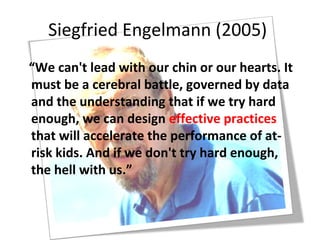
Siegfried Engelmann (2005)
“We can't lead with our chin or our hearts. It
must be a cerebral battle, governed by data
and the understanding that if we try hard
enough, we can design effective practices
that will accelerate the performance of at-
risk kids. And if we don't try hard enough,
the hell with us.”
NCTM suggests strategies for math
      aligned to the CCSS
1. Create worthwhile problems as a foundation
   for daily instruction.
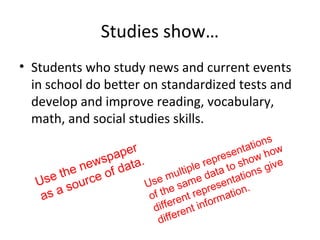
2. Use real data and current events to make
   mathematics more engaging and more
   relevant.
3. Ask quality questions that promote
                                             tion
   discourse.                            duca ?
                                    ial e egies
                                spec trat
                             can se s
                       How rt the
                        s uppo
3 levels of instructional supports:
  1) Task analysis for each skill
    2) Vocabulary instruction
      3) Journaling in math
Level 1: Task Analysis
• Task analysis is a process by which a task is
  broken down into its component parts.
• Each skill we teach must have steps. Even the
  seemingly small skills.
• Students must demonstrate a comfort with
  these steps before they can attempt problem
  solving.
Task Analysis: How does it work?
       1. Determine what task you want the student
          to perform
       2. Figure out what steps will be required to
          complete the task.
       3. Decide what order to teach the steps in
       4. Teach the student one step until the student
          displays mastery of it.
       5. As each part of the process is learned, add it
          to the chain until the task can be completed
          independently.
http://www.brighthubeducation.com/special-ed-learning-disorders/25800-how-task-analysis-works-for-students-with-special-needs/
Practice
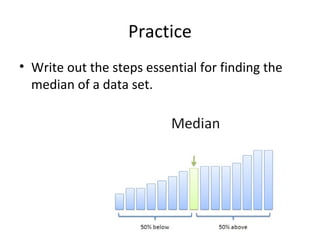
• Write out the steps essential for finding the
  median of a data set.
Level 2: Math Vocabulary
               and Number Sense
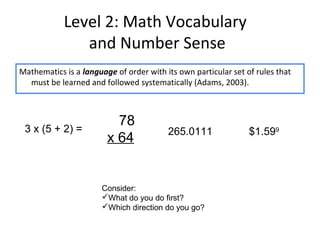
Mathematics is a language of order with its own particular set of rules that
  must be learned and followed systematically (Adams, 2003).


                          78
 3 x (5 + 2) =                           265.0111               $1.599
                        x 64


                       Consider:
                       What do you do first?
                       Which direction do you go?
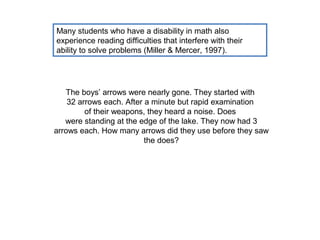
Many students who have a disability in math also
experience reading difficulties that interfere with their
ability to solve problems (Miller & Mercer, 1997).


   The boys’ arrows were nearly gone. They started with
    32 arrows each. After a minute but rapid examination
         of their weapons, they heard a noise. Does
   were standing at the edge of the lake. They now had 3
arrows each. How many arrows did they use before they saw
                          the does?
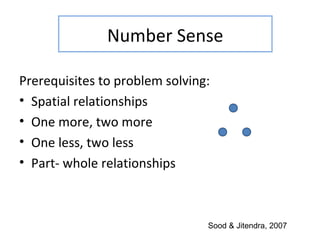
Number Sense

Prerequisites to problem solving:
• Spatial relationships
• One more, two more
• One less, two less
• Part- whole relationships


                                Sood & Jitendra, 2007
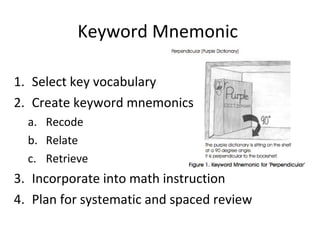
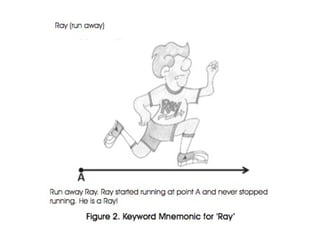
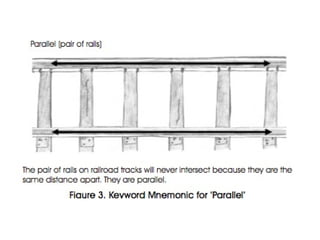
Keyword Mnemonic

1. Select key vocabulary
2. Create keyword mnemonics
  a. Recode
  b. Relate
  c. Retrieve
3. Incorporate into math instruction
4. Plan for systematic and spaced review
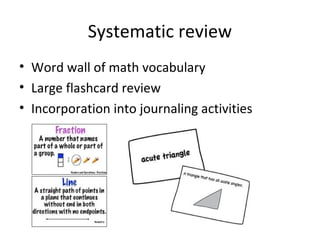
Systematic review
• Word wall of math vocabulary
• Large flashcard review
• Incorporation into journaling activities
Level 3: Journaling Activities
• Students practice reading and using the
  language of math
• Students practice using number sense.
• Students demonstrate comfort with skills/steps.
• Students justify and support answers with
  factual information.
Studies show…
• Students who study news and current events
  in school do better on standardized tests and
  develop and improve reading, vocabulary,
  math, and social studies skills.
                                                     s
                                                 tion w
                 p er                        enta w ho
              spa ta.                    pres sho
           new f da                le re ta to       give
        the ce o              ultip da         ions
   Use sour           Use m same sentat
    as a                  the t repre ation.
                       of ren
                           fe
                        dif rent in    form
                         diffe
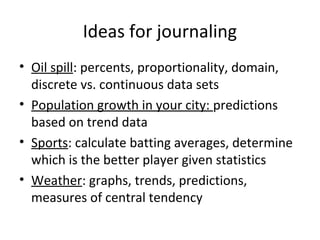
Ideas for journaling
• Oil spill: percents, proportionality, domain,
  discrete vs. continuous data sets
• Population growth in your city: predictions
  based on trend data
• Sports: calculate batting averages, determine
  which is the better player given statistics
• Weather: graphs, trends, predictions,
  measures of central tendency
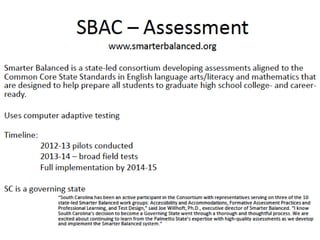
How can I prepare my students for
     the new assessments?
• Who is creating SC’s new test?
  – http://www.smarterbalanced.org
• Where can I get up-to-date information on
  CCSS?
  – Bill McCallum, University of Arizona
  – http://commoncoretools.me
Questions???

Can Special Be Common?

  • 1.
    Can special becomecommon? Offering math support in the common core classroom Julie P. Jones, PhD University of South Carolina Upstate JJones3@uscupstate.edu
  • 4.
    What are schoolsdoing to increase performance and motivate learners? • Early numeracy development (e.g. number sense) • Improved math curriculum • Formative assessment systems • Summer programs • Increasing after school tutoring programs • Improved parental involvement • After school tutoring or during school tutoring • Extrinsic rewards for improved performance • Variability in scheduling • Choice of instructional model
  • 5.
    Siegfried Engelmann (2005) “Wecan't lead with our chin or our hearts. It must be a cerebral battle, governed by data and the understanding that if we try hard enough, we can design effective practices that will accelerate the performance of at- risk kids. And if we don't try hard enough, the hell with us.”
  • 6.
    NCTM suggests strategiesfor math aligned to the CCSS 1. Create worthwhile problems as a foundation for daily instruction. 2. Use real data and current events to make mathematics more engaging and more relevant. 3. Ask quality questions that promote tion discourse. duca ? ial e egies spec trat can se s How rt the s uppo
  • 8.
    3 levels ofinstructional supports: 1) Task analysis for each skill 2) Vocabulary instruction 3) Journaling in math
  • 9.
    Level 1: TaskAnalysis • Task analysis is a process by which a task is broken down into its component parts. • Each skill we teach must have steps. Even the seemingly small skills. • Students must demonstrate a comfort with these steps before they can attempt problem solving.
  • 10.
    Task Analysis: Howdoes it work? 1. Determine what task you want the student to perform 2. Figure out what steps will be required to complete the task. 3. Decide what order to teach the steps in 4. Teach the student one step until the student displays mastery of it. 5. As each part of the process is learned, add it to the chain until the task can be completed independently. http://www.brighthubeducation.com/special-ed-learning-disorders/25800-how-task-analysis-works-for-students-with-special-needs/
  • 11.
    Practice • Write outthe steps essential for finding the median of a data set.
  • 12.
    Level 2: MathVocabulary and Number Sense Mathematics is a language of order with its own particular set of rules that must be learned and followed systematically (Adams, 2003). 78 3 x (5 + 2) = 265.0111 $1.599 x 64 Consider: What do you do first? Which direction do you go?
  • 13.
    Many students whohave a disability in math also experience reading difficulties that interfere with their ability to solve problems (Miller & Mercer, 1997). The boys’ arrows were nearly gone. They started with 32 arrows each. After a minute but rapid examination of their weapons, they heard a noise. Does were standing at the edge of the lake. They now had 3 arrows each. How many arrows did they use before they saw the does?
  • 14.
    Number Sense Prerequisites toproblem solving: • Spatial relationships • One more, two more • One less, two less • Part- whole relationships Sood & Jitendra, 2007
  • 15.
    Keyword Mnemonic 1. Selectkey vocabulary 2. Create keyword mnemonics a. Recode b. Relate c. Retrieve 3. Incorporate into math instruction 4. Plan for systematic and spaced review
  • 18.
    Systematic review • Wordwall of math vocabulary • Large flashcard review • Incorporation into journaling activities
  • 19.
    Level 3: JournalingActivities • Students practice reading and using the language of math • Students practice using number sense. • Students demonstrate comfort with skills/steps. • Students justify and support answers with factual information.
  • 20.
    Studies show… • Studentswho study news and current events in school do better on standardized tests and develop and improve reading, vocabulary, math, and social studies skills. s tion w p er enta w ho spa ta. pres sho new f da le re ta to give the ce o ultip da ions Use sour Use m same sentat as a the t repre ation. of ren fe dif rent in form diffe
  • 21.
    Ideas for journaling •Oil spill: percents, proportionality, domain, discrete vs. continuous data sets • Population growth in your city: predictions based on trend data • Sports: calculate batting averages, determine which is the better player given statistics • Weather: graphs, trends, predictions, measures of central tendency
  • 23.
    How can Iprepare my students for the new assessments? • Who is creating SC’s new test? – http://www.smarterbalanced.org • Where can I get up-to-date information on CCSS? – Bill McCallum, University of Arizona – http://commoncoretools.me
  • 24.

Editor's Notes

  • #10 Review board
  • #13 1) Math operates within a binary framework- you can only work on 2 numbers at a time - task seems easier - lessens anxiety 2) Order of operations- the order math is written in is not necessarily the order in which it is performed 3) Variations to the language are always popping up (telephone numbers with decimals, gas station prices)
  • #15 Spatial relationships- how many without counting Part-whole: 5 is made up of 2 and 3 This foundation is necessary before students can read a word problem and know if they are putting numbers together, or taking them apart. Is the answer a bigger number/ smaller number- what does that mean (+ - x ÷)
  • #20 Other words that are tricky : volume, graduated, product, net, ruler, plot, yard, mass, cubed, count, face, fair, range