Name _________________________________ Date _________________ 
Mrs. Labuski / Mrs. Pinto Period ___________ Module 2 Lesson 5 
Lesson 5: Creating Division Stories 
Student Outcomes 
 Students demonstrate further understanding of division of fractions when they create their own word 
problems. 
 Students choose a measurement division problem, draw a model, find the answer, choose a unit, and 
then set up a situation. Further, they discover that they must try several situations and units before 
finding which are realistic with given numbers. 
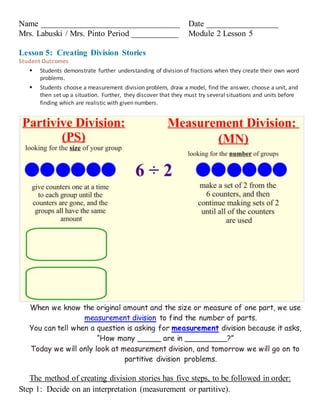
When we know the original amount and the size or measure of one part, we use 
measurement division to find the number of parts. 
You can tell when a question is asking for measurement division because it asks, 
“How many _____ are in _________?” 
Today we will only look at measurement division, and tomorrow we will go on to 
partitive division problems. 
The method of creating division stories has five steps, to be followed in order: 
Step 1: Decide on an interpretation (measurement or partitive).
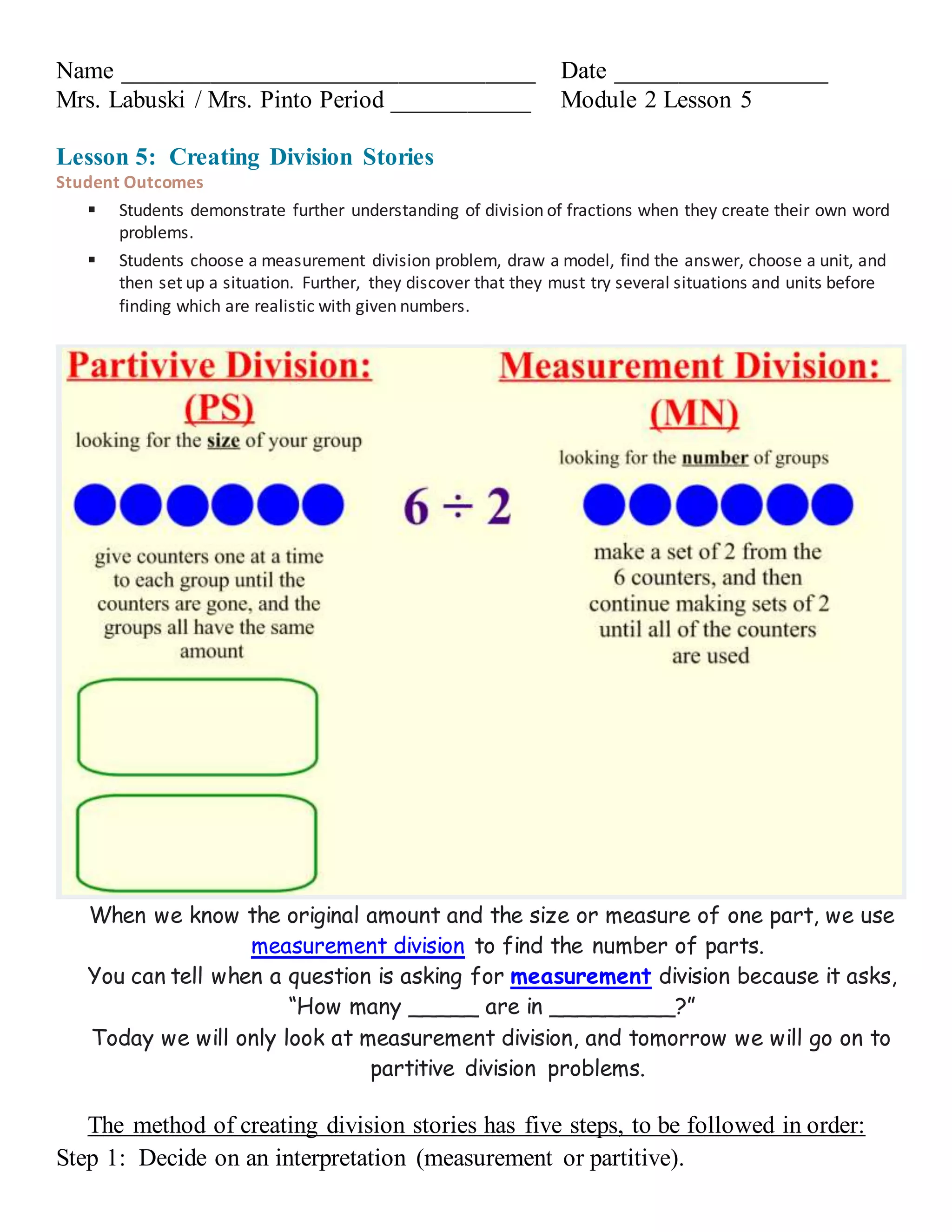
Step 2: Draw a model. 
Step 3: Find the answer. 
Step 4: Choose a unit. 
Step 5: Set up a situation. (This means writing a story problem that is interesting, 
realistic, short, and clear and that has all the information necessary to solve it. It 
may take you several attempts before you find a story that works well with the given 
dividend and divisor.) 
12 ÷ 3 
Step 1: Decide on an interpretation. 
Step 2: Draw a model. 
Step 3: Find the answer. 
Step 4: Choose a unit. 
Step 5: Set up a situation. 
Hint: Start with the quantity ~ what you ‘have’ 
Example 1
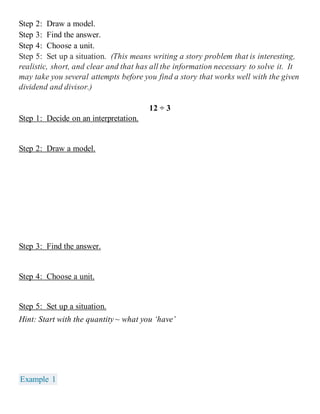
1 
2 
÷ 
1 
8 
Step 1: Decide on an interpretation. 
Step 2: Draw a model. 
Step 3: Find the answer. 
Step 4: Choose a unit. 
Step 5: Set up a situation. 
Hint: Start with the quantity ~ what you ‘have’
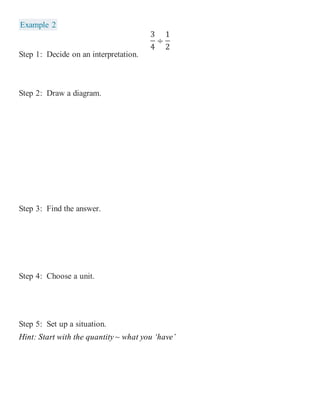
Example 2 
3 
4 
÷ 
1 
2 
Step 1: Decide on an interpretation. 
Step 2: Draw a diagram. 
Step 3: Find the answer. 
Step 4: Choose a unit. 
Step 5: Set up a situation. 
Hint: Start with the quantity ~ what you ‘have’

Module 2 lesson 5 notes

  • 1.
    Name _________________________________ Date_________________ Mrs. Labuski / Mrs. Pinto Period ___________ Module 2 Lesson 5 Lesson 5: Creating Division Stories Student Outcomes  Students demonstrate further understanding of division of fractions when they create their own word problems.  Students choose a measurement division problem, draw a model, find the answer, choose a unit, and then set up a situation. Further, they discover that they must try several situations and units before finding which are realistic with given numbers. When we know the original amount and the size or measure of one part, we use measurement division to find the number of parts. You can tell when a question is asking for measurement division because it asks, “How many _____ are in _________?” Today we will only look at measurement division, and tomorrow we will go on to partitive division problems. The method of creating division stories has five steps, to be followed in order: Step 1: Decide on an interpretation (measurement or partitive).
  • 2.
    Step 2: Drawa model. Step 3: Find the answer. Step 4: Choose a unit. Step 5: Set up a situation. (This means writing a story problem that is interesting, realistic, short, and clear and that has all the information necessary to solve it. It may take you several attempts before you find a story that works well with the given dividend and divisor.) 12 ÷ 3 Step 1: Decide on an interpretation. Step 2: Draw a model. Step 3: Find the answer. Step 4: Choose a unit. Step 5: Set up a situation. Hint: Start with the quantity ~ what you ‘have’ Example 1
  • 3.
    1 2 ÷ 1 8 Step 1: Decide on an interpretation. Step 2: Draw a model. Step 3: Find the answer. Step 4: Choose a unit. Step 5: Set up a situation. Hint: Start with the quantity ~ what you ‘have’
  • 4.
    Example 2 3 4 ÷ 1 2 Step 1: Decide on an interpretation. Step 2: Draw a diagram. Step 3: Find the answer. Step 4: Choose a unit. Step 5: Set up a situation. Hint: Start with the quantity ~ what you ‘have’