‘Developing primary teachers’ maths skills… educating not
training - a sample of the Primary Maths Programmes funded by
the London Schools Excellence Fund
Ruth Williams, Lampton School’
What is number sense?
The term "number sense" is a relatively
new one in mathematics education.
It is difficult to define precisely, but broadly speaking, it refers
to
"a well organised conceptual framework of number information
that enables a person to understand numbers and number
relationships and to solve mathematical problems that are not
bound by traditional algorithms"
(Bobis, 1996).
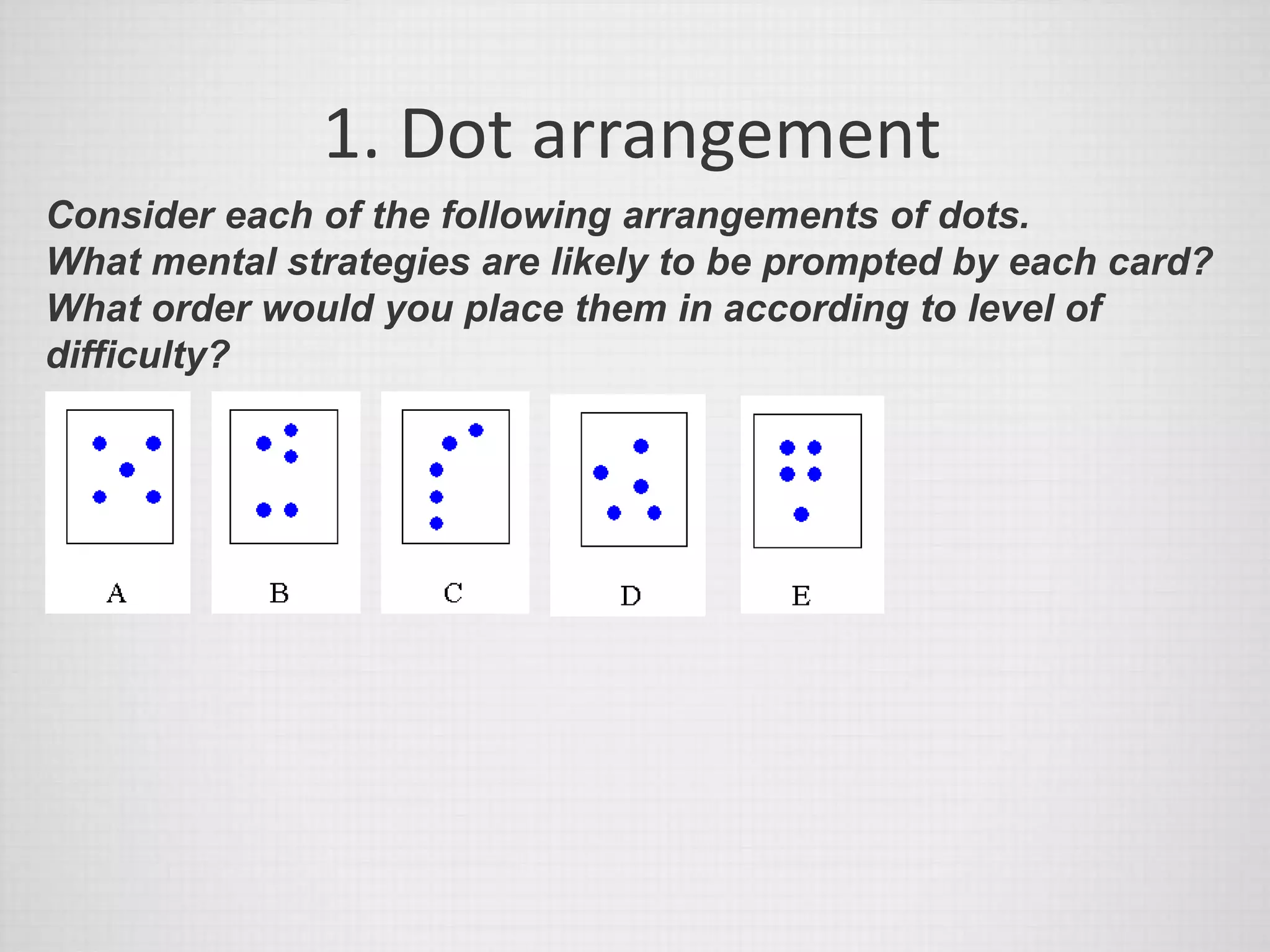
1. Dot arrangement
Consider each of the following arrangements of dots.
What mental strategies are likely to be prompted by each card?
What order would you place them in according to level of
difficulty?
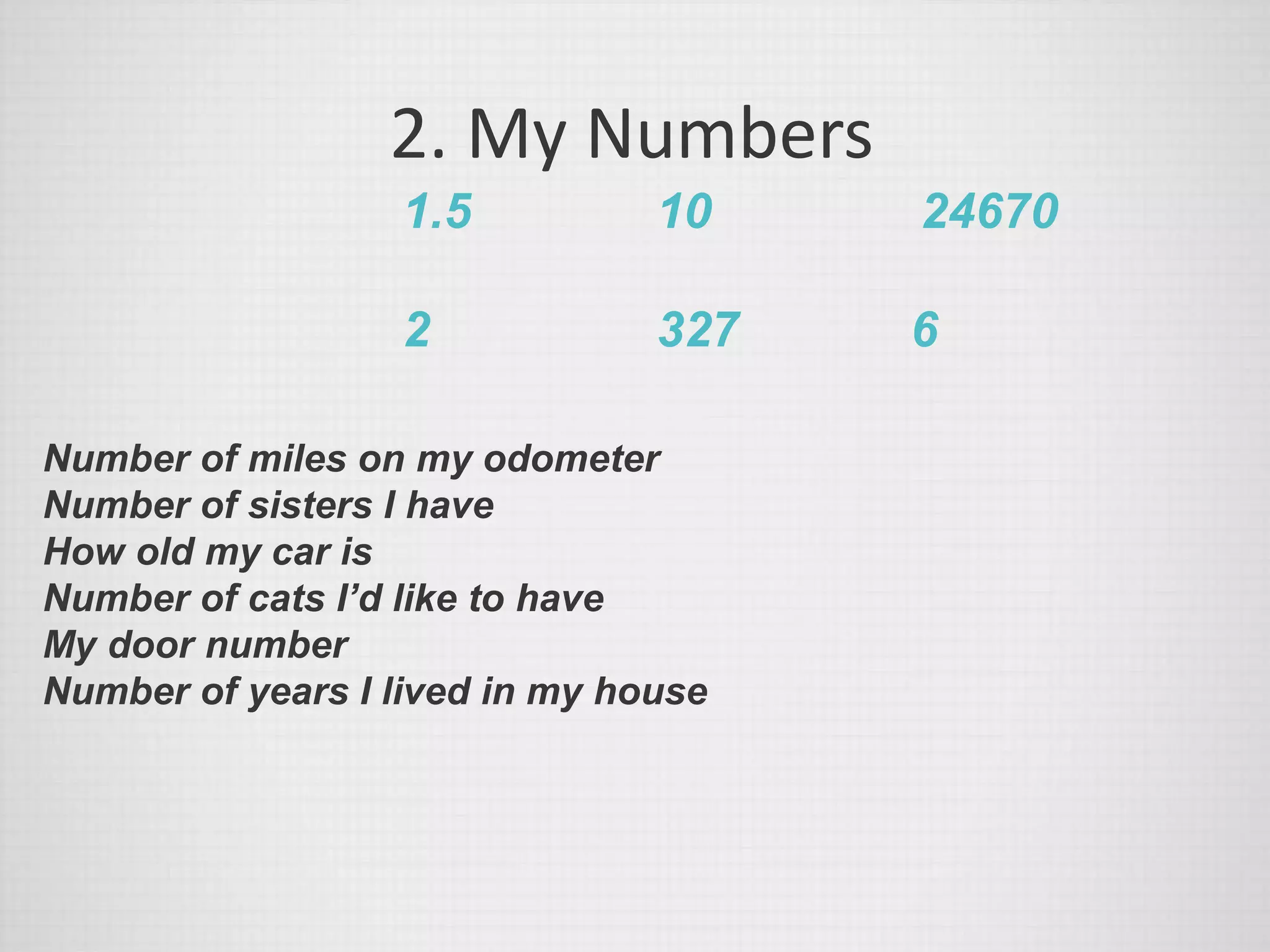
1.5 10 24670
2 327 6
2. My Numbers
Number of miles on my odometer
Number of sisters I have
How old my car is
Number of cats I’d like to have
My door number
Number of years I lived in my house
Arithmetic Proficiency
Arithmetic Proficiency:
achieving fluency in calculating with understanding
An appreciation of number and number operations, which enables mental
calculations and written procedures to be performed efficiently, fluently and
accurately.
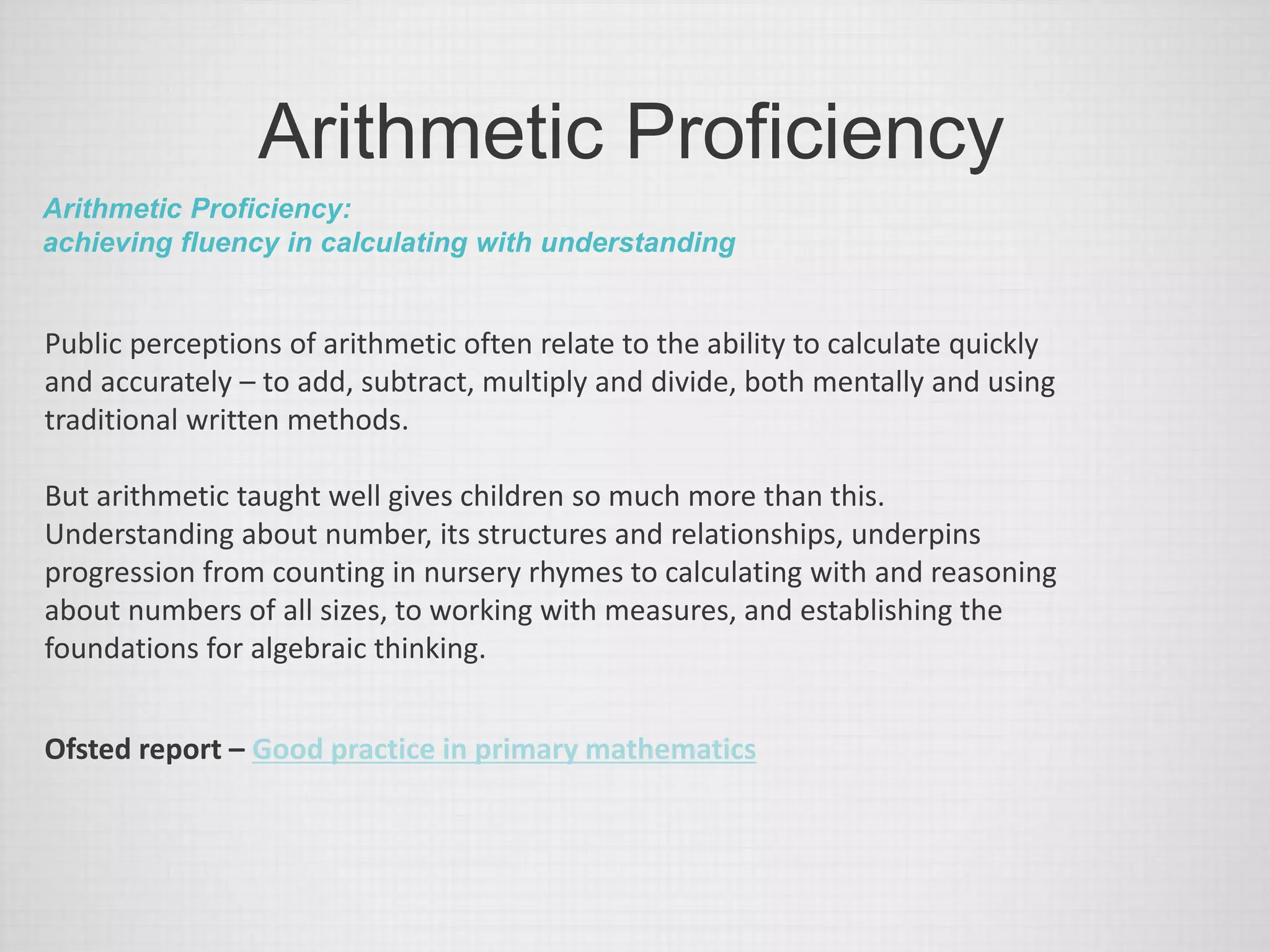
Arithmetic Proficiency
Arithmetic Proficiency:
achieving fluency in calculating with understanding
Public perceptions of arithmetic often relate to the ability to calculate quickly
and accurately – to add, subtract, multiply and divide, both mentally and using
traditional written methods.
But arithmetic taught well gives children so much more than this.
Understanding about number, its structures and relationships, underpins
progression from counting in nursery rhymes to calculating with and reasoning
about numbers of all sizes, to working with measures, and establishing the
foundations for algebraic thinking.
Ofsted report – Good practice in primary mathematics
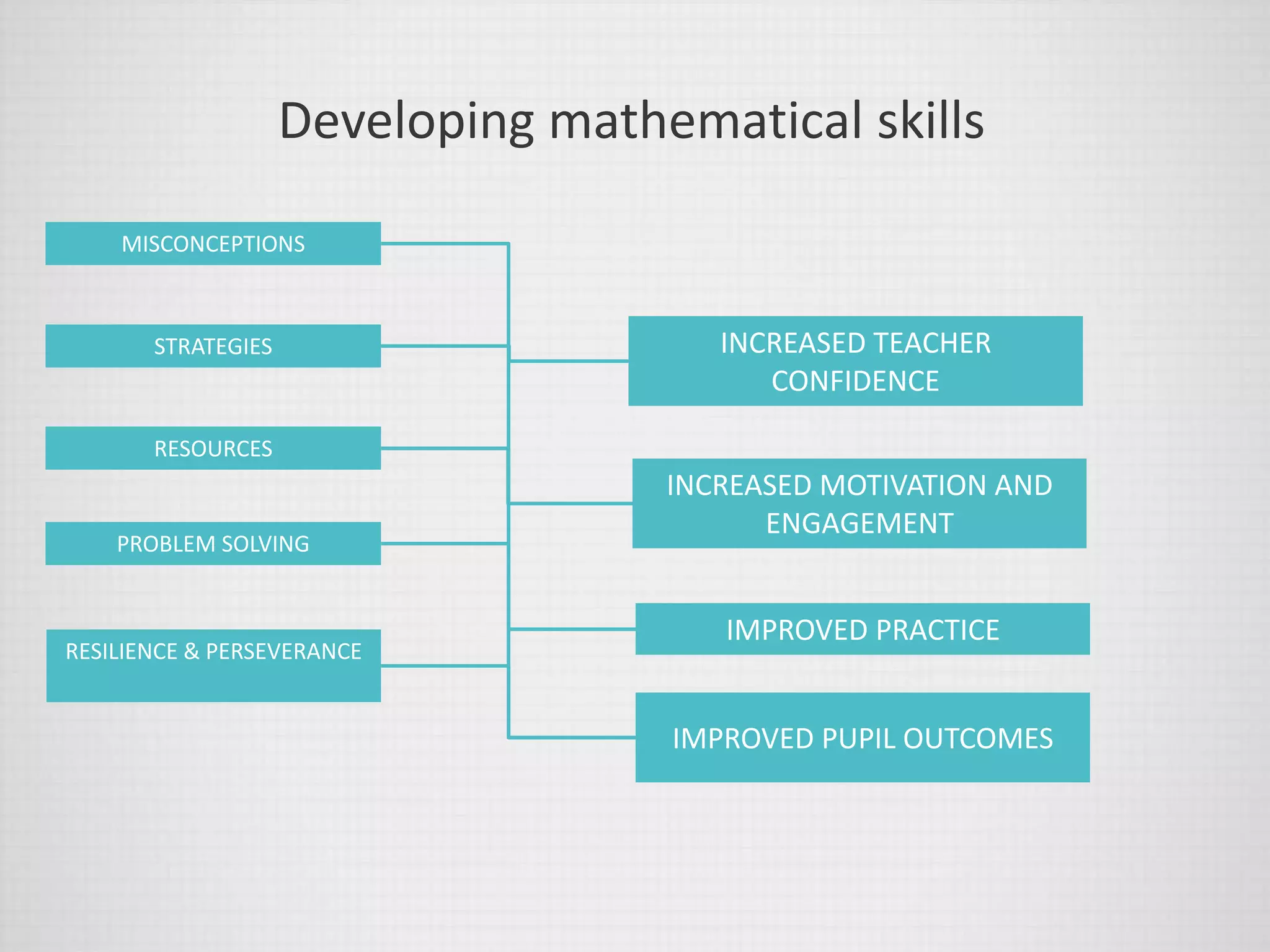
Developing mathematical skills
MISCONCEPTIONS
STRATEGIES
RESOURCES
INCREASED TEACHER
CONFIDENCE
IMPROVED PRACTICE
IMPROVED PUPIL OUTCOMES
PROBLEM SOLVING
INCREASED MOTIVATION AND
ENGAGEMENT
RESILIENCE & PERSEVERANCE
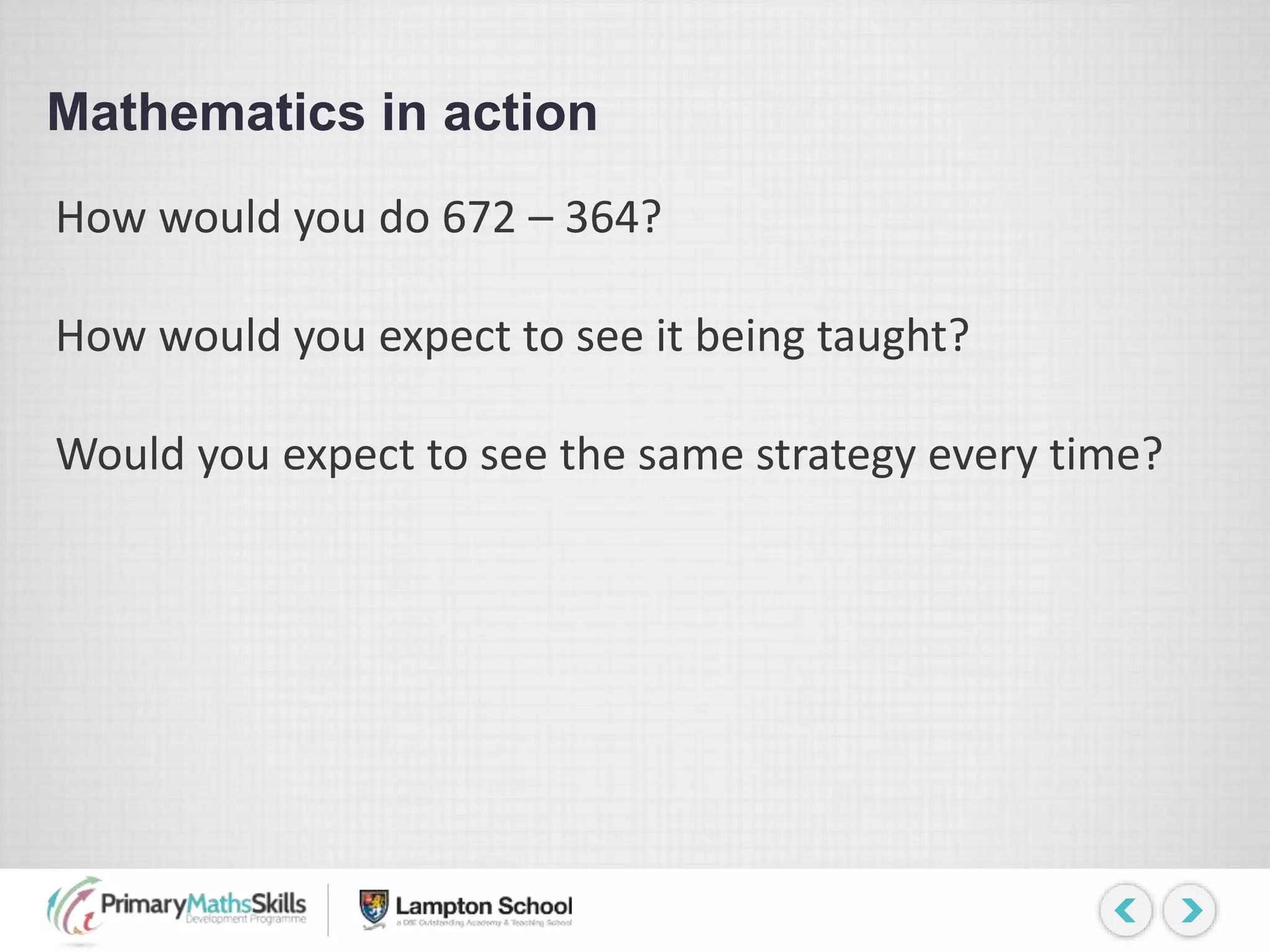
Mathematics in action
How would you do 672 – 364?
How would you expect to see it being taught?
Would you expect to see the same strategy every time?
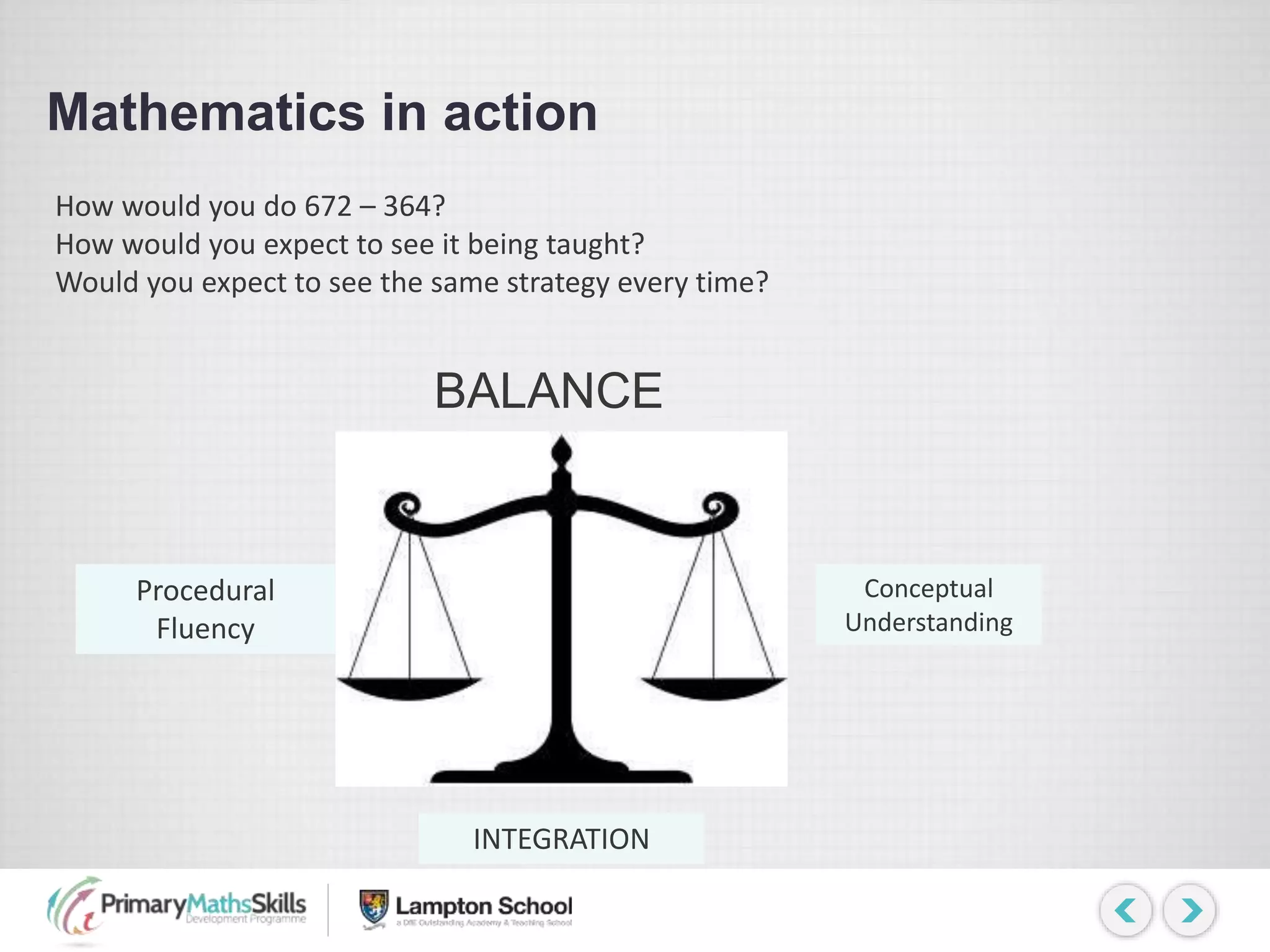
Mathematics in action
BALANCE
Procedural
Fluency
Conceptual
Understanding
INTEGRATION
How would you do 672 – 364?
How would you expect to see it being taught?
Would you expect to see the same strategy every time?
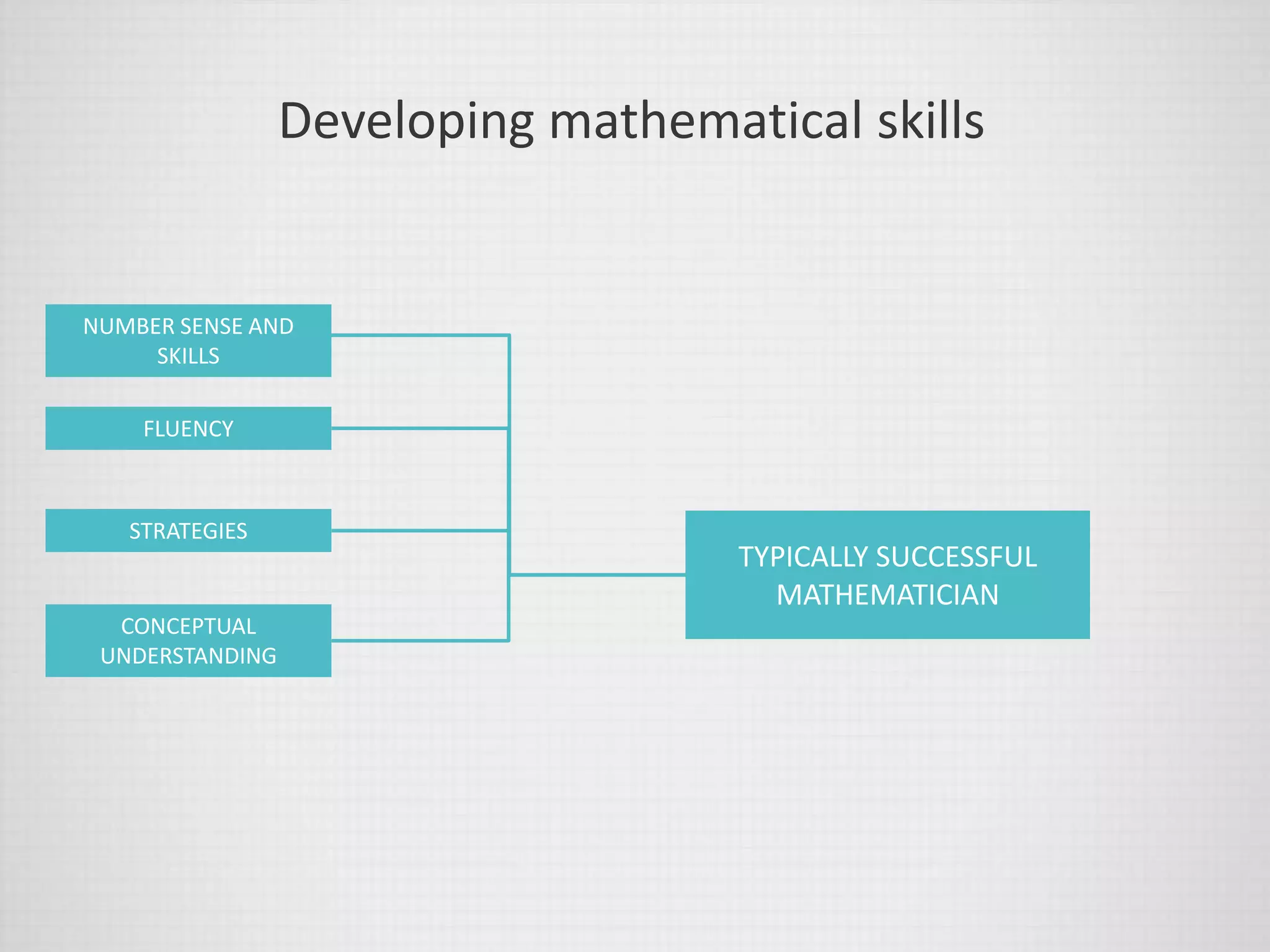
Developing mathematical skills
NUMBER SENSE AND
SKILLS
FLUENCY
STRATEGIES
CONCEPTUAL
UNDERSTANDING
TYPICALLY SUCCESSFUL
MATHEMATICIAN
Mathematics in action
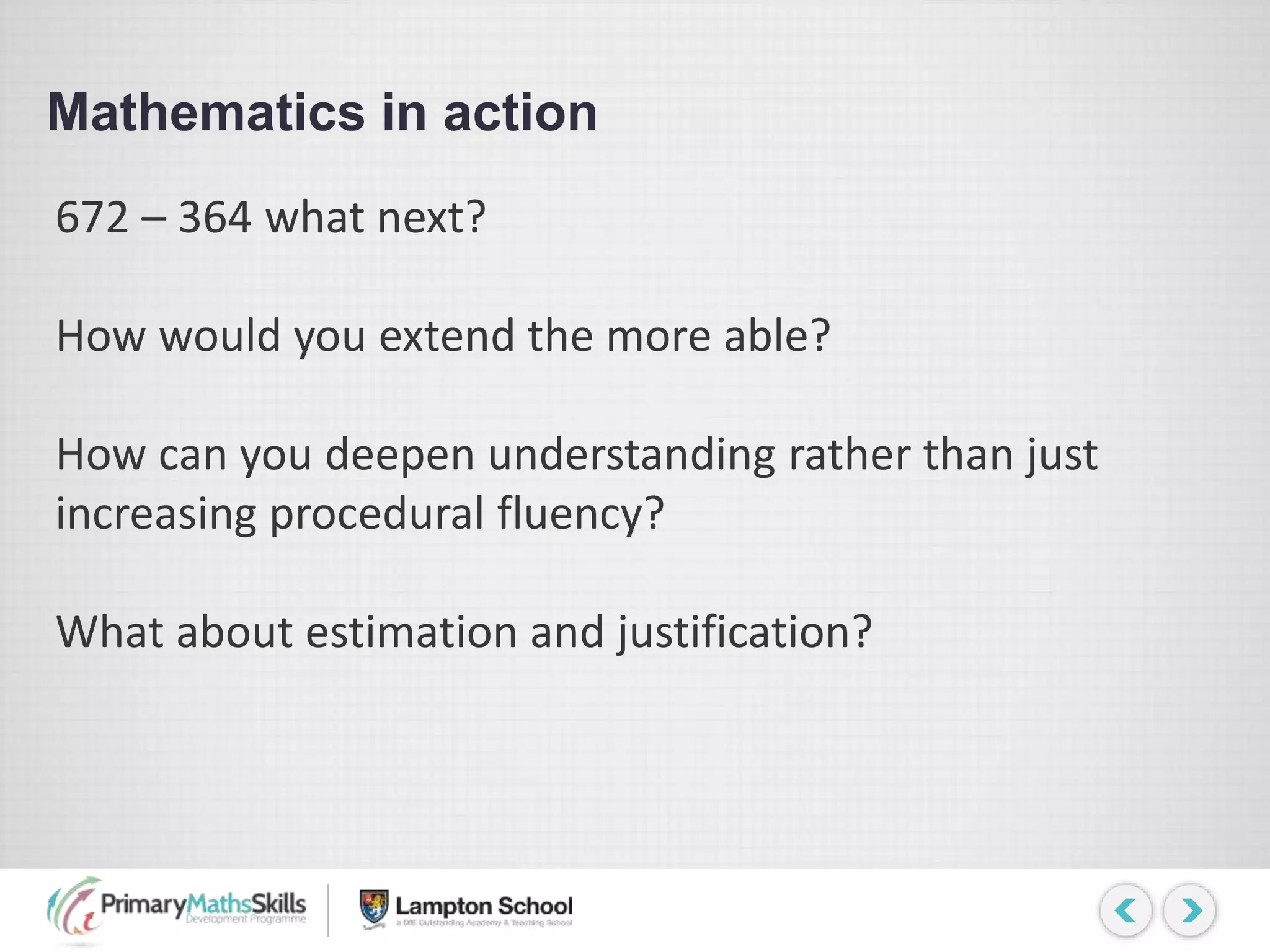
672 – 364 what next?
Mathematics in action
672 – 364 what next?
How would you extend the more able?
Mathematics in action
672 – 364 what next?
How would you extend the more able?
How can you deepen understanding rather than just
increasing procedural fluency?
Mathematics in action
672 – 364 what next?
How would you extend the more able?
How can you deepen understanding rather than just
increasing procedural fluency?
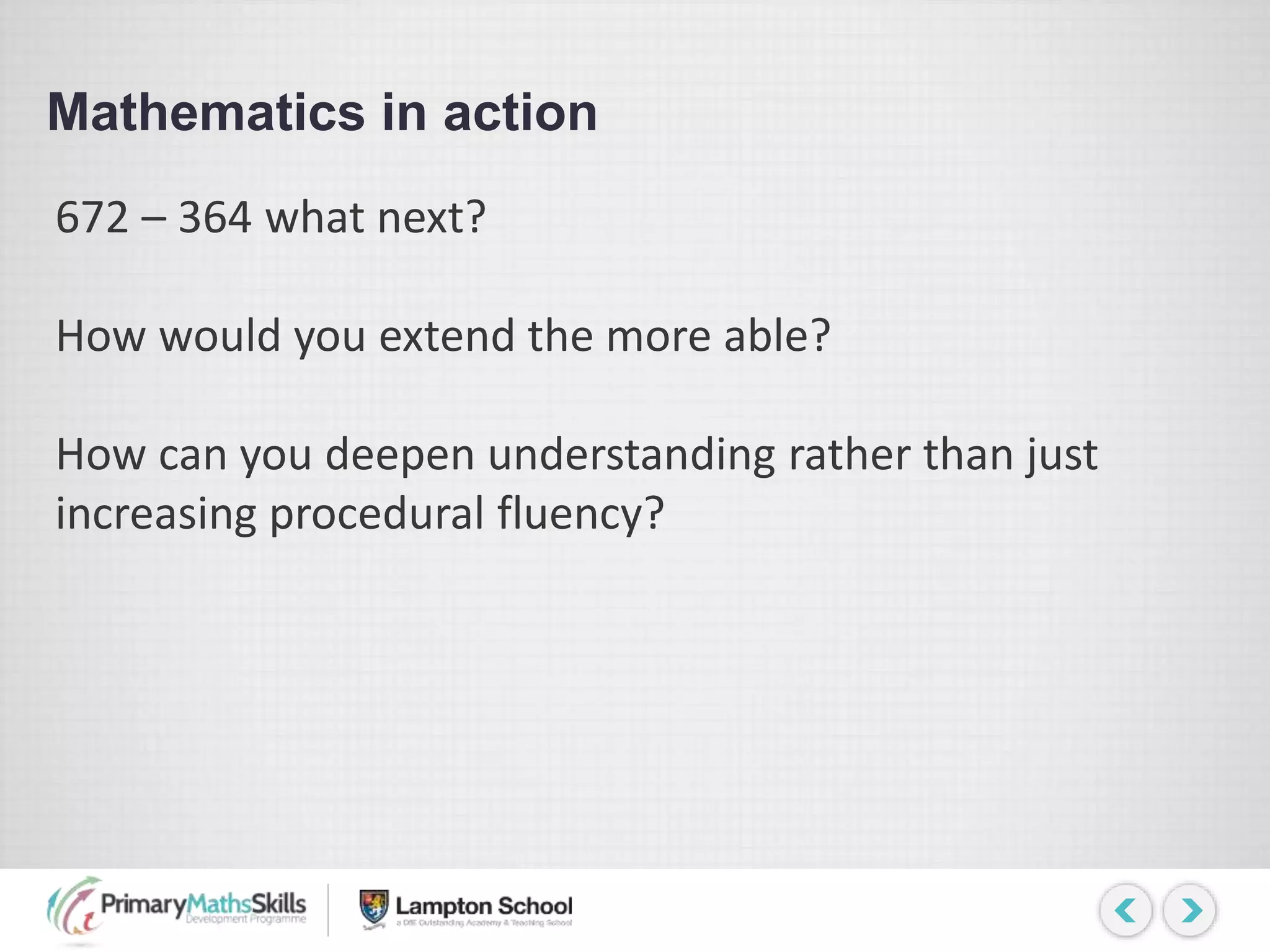
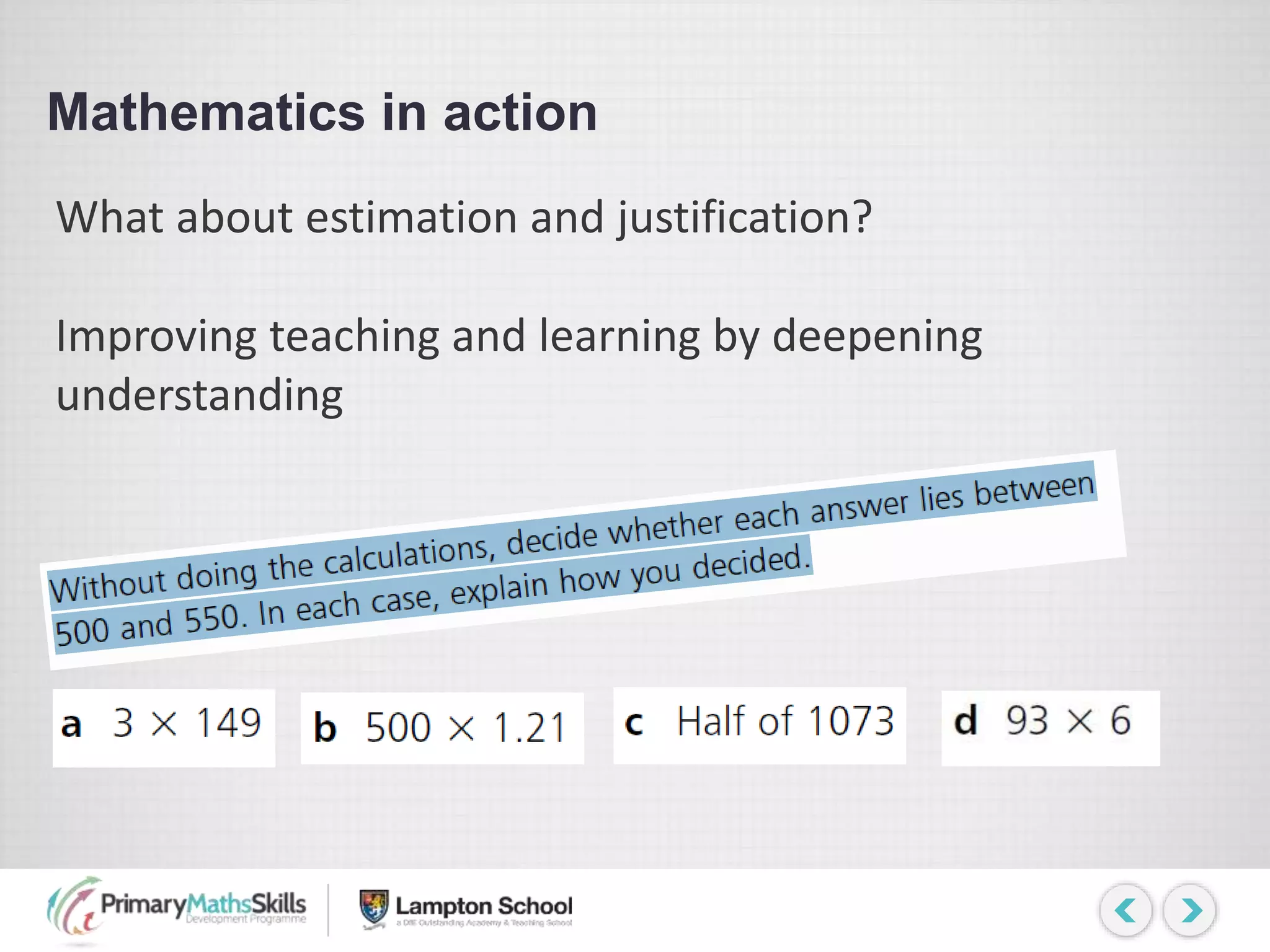
What about estimation and justification?
Mathematics in action
What about estimation and justification?
Improving teaching and learning by deepening
understanding
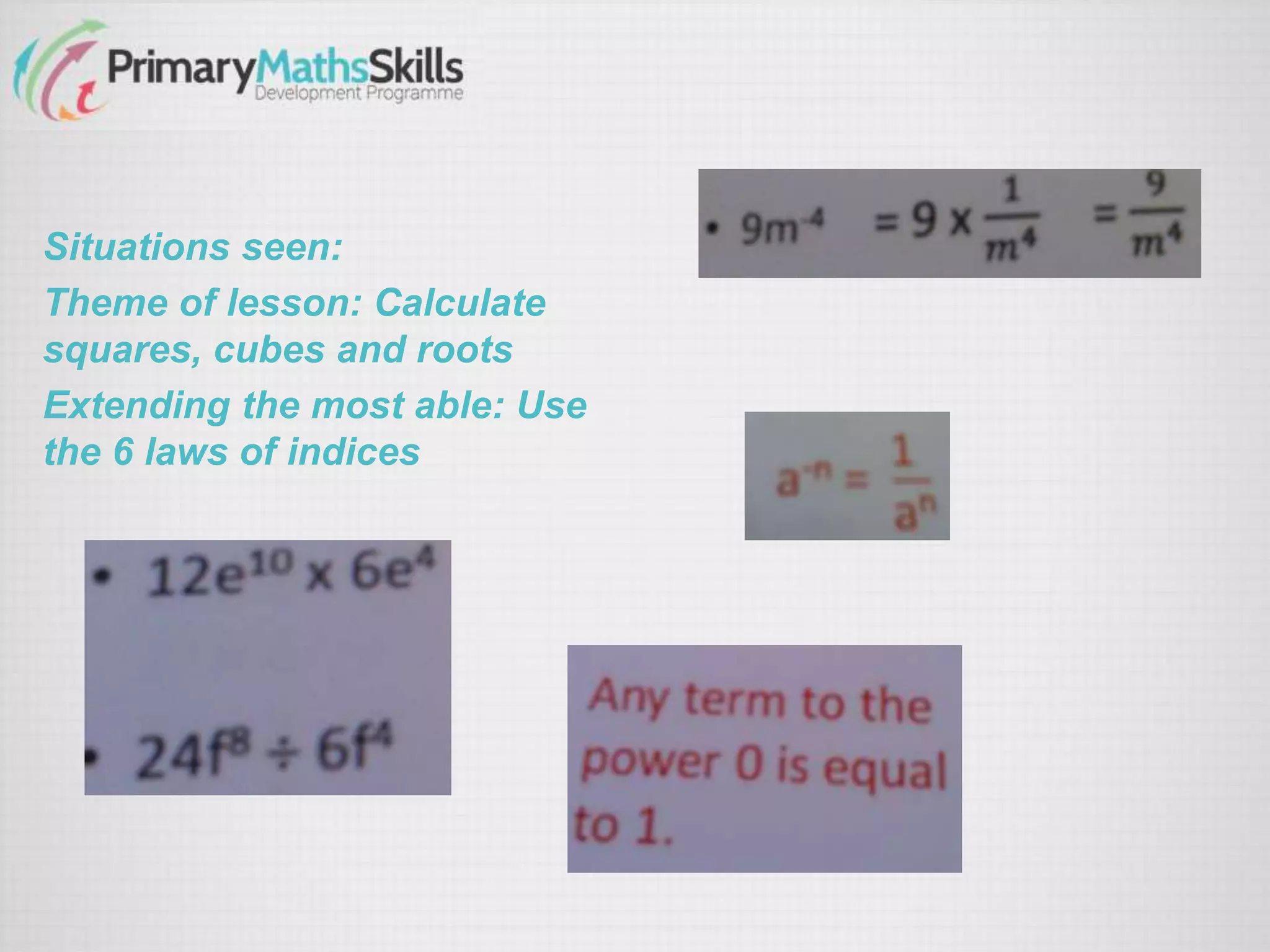
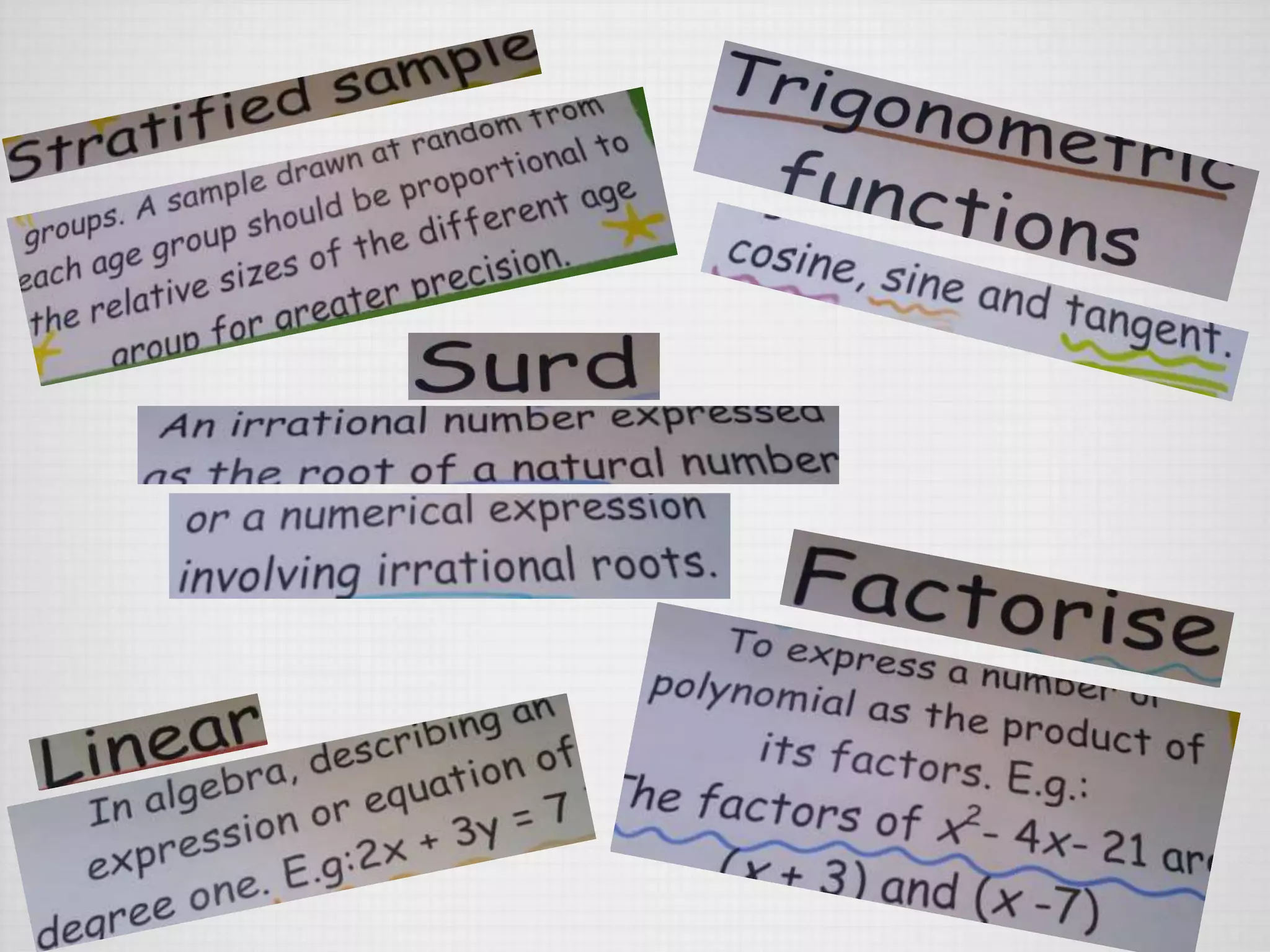
Situations seen:
Theme of lesson: Calculate
squares, cubes and roots
Extending the most able: Use
the 6 laws of indices
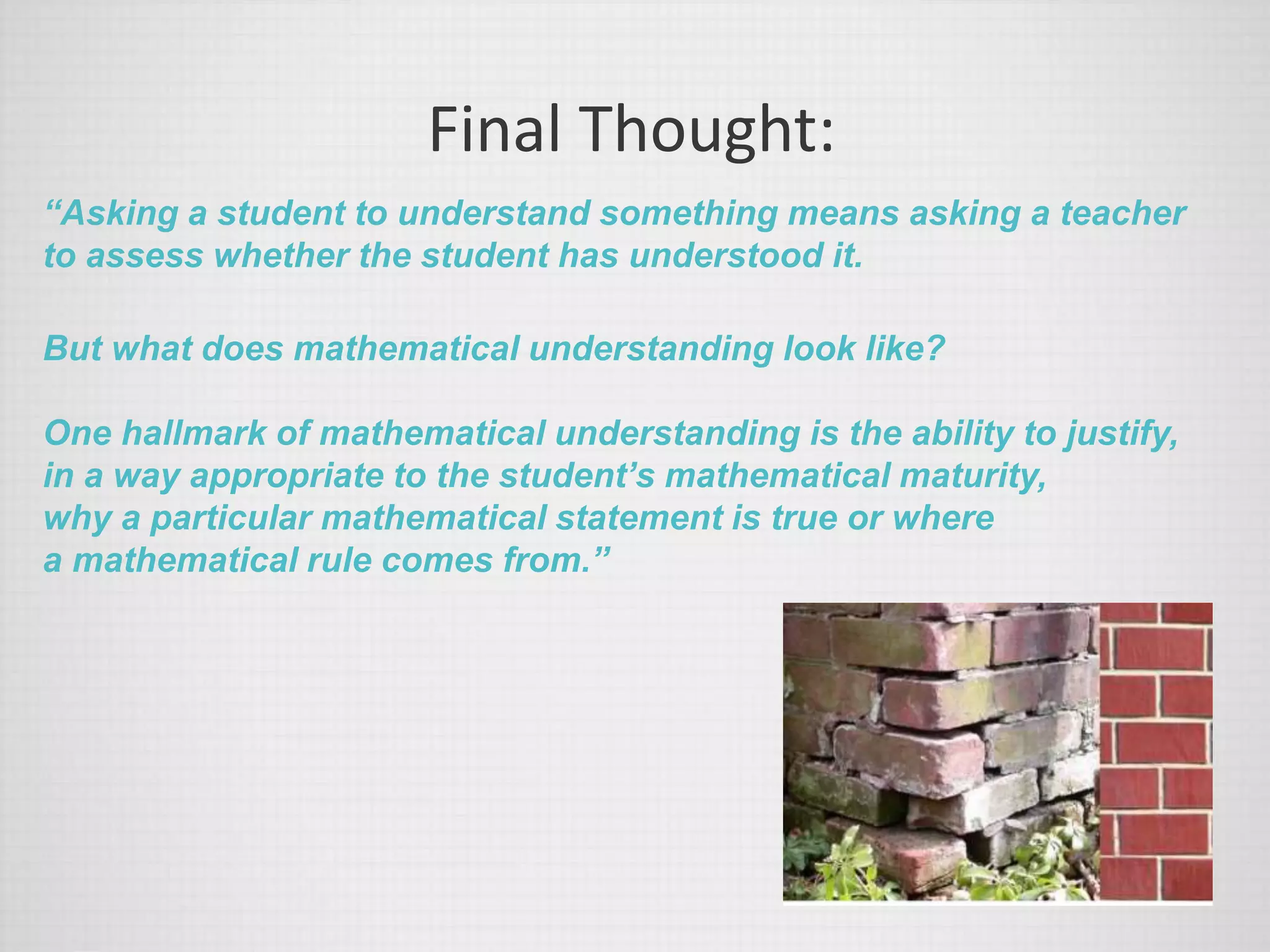
Final Thought:
“Asking a student to understand something means asking a teacher
to assess whether the student has understood it.
But what does mathematical understanding look like?
One hallmark of mathematical understanding is the ability to justify,
in a way appropriate to the student’s mathematical maturity,
why a particular mathematical statement is true or where
a mathematical rule comes from.”

Developing primary teachers' maths skills

  • 1.
    ‘Developing primary teachers’maths skills… educating not training - a sample of the Primary Maths Programmes funded by the London Schools Excellence Fund Ruth Williams, Lampton School’
  • 2.
  • 3.
    What is numbersense? The term "number sense" is a relatively new one in mathematics education. It is difficult to define precisely, but broadly speaking, it refers to "a well organised conceptual framework of number information that enables a person to understand numbers and number relationships and to solve mathematical problems that are not bound by traditional algorithms" (Bobis, 1996).
  • 4.
    1. Dot arrangement Considereach of the following arrangements of dots. What mental strategies are likely to be prompted by each card? What order would you place them in according to level of difficulty?
  • 5.
    1.5 10 24670 2327 6 2. My Numbers Number of miles on my odometer Number of sisters I have How old my car is Number of cats I’d like to have My door number Number of years I lived in my house
  • 6.
    Arithmetic Proficiency Arithmetic Proficiency: achievingfluency in calculating with understanding An appreciation of number and number operations, which enables mental calculations and written procedures to be performed efficiently, fluently and accurately.
  • 7.
    Arithmetic Proficiency Arithmetic Proficiency: achievingfluency in calculating with understanding Public perceptions of arithmetic often relate to the ability to calculate quickly and accurately – to add, subtract, multiply and divide, both mentally and using traditional written methods. But arithmetic taught well gives children so much more than this. Understanding about number, its structures and relationships, underpins progression from counting in nursery rhymes to calculating with and reasoning about numbers of all sizes, to working with measures, and establishing the foundations for algebraic thinking. Ofsted report – Good practice in primary mathematics
  • 8.
    Developing mathematical skills MISCONCEPTIONS STRATEGIES RESOURCES INCREASEDTEACHER CONFIDENCE IMPROVED PRACTICE IMPROVED PUPIL OUTCOMES PROBLEM SOLVING INCREASED MOTIVATION AND ENGAGEMENT RESILIENCE & PERSEVERANCE
  • 9.
    Mathematics in action Howwould you do 672 – 364? How would you expect to see it being taught? Would you expect to see the same strategy every time?
  • 10.
    Mathematics in action BALANCE Procedural Fluency Conceptual Understanding INTEGRATION Howwould you do 672 – 364? How would you expect to see it being taught? Would you expect to see the same strategy every time?
  • 11.
    Developing mathematical skills NUMBERSENSE AND SKILLS FLUENCY STRATEGIES CONCEPTUAL UNDERSTANDING TYPICALLY SUCCESSFUL MATHEMATICIAN
  • 12.
    Mathematics in action 672– 364 what next?
  • 13.
    Mathematics in action 672– 364 what next? How would you extend the more able?
  • 14.
    Mathematics in action 672– 364 what next? How would you extend the more able? How can you deepen understanding rather than just increasing procedural fluency?
  • 15.
    Mathematics in action 672– 364 what next? How would you extend the more able? How can you deepen understanding rather than just increasing procedural fluency? What about estimation and justification?
  • 16.
    Mathematics in action Whatabout estimation and justification? Improving teaching and learning by deepening understanding
  • 17.
    Situations seen: Theme oflesson: Calculate squares, cubes and roots Extending the most able: Use the 6 laws of indices
  • 19.
    Final Thought: “Asking astudent to understand something means asking a teacher to assess whether the student has understood it. But what does mathematical understanding look like? One hallmark of mathematical understanding is the ability to justify, in a way appropriate to the student’s mathematical maturity, why a particular mathematical statement is true or where a mathematical rule comes from.”