Tech Tools for Enhancing the
Standards For Mathematical
Practice
MACE 2014
Jennifer Gatz
Instructional Coach
SJSD
https://todaysmeet.com/TechMPS

Twitter @jenngatz
Pinterest: jenngatz
jennifer.gatz@gmail.com
Kahoot Ithttps://kahoot.it
8687

Web or App Based

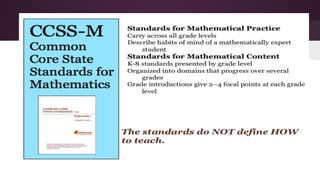
Getting to Know the Math Practice Standards
Presentation Resources - LiveBinder

http://goo.gl/LA5c5m
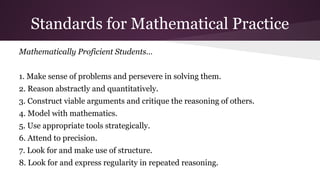
Standards for Mathematical Practice
Mathematically Proficient Students…
1. Make sense of problems and persevere in solving them.
2. Reason abstractly and quantitatively.
3. Construct viable arguments and critique the reasoning of others.
4. Model with mathematics.
5. Use appropriate tools strategically.
6. Attend to precision.
7. Look for and make use of structure.
8. Look for and express regularity in repeated reasoning.
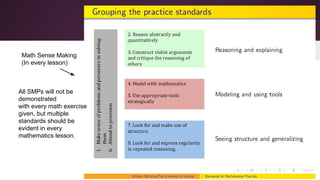
Math Sense Making
(In every lesson)

All SMPs will not be
demonstrated
with every math
exercise, but multiple
standards should be
evident in every
mathematics lesson.
Understanding the
Math Practice Standards
● Illustrative Mathematics
● Scholastic A Guide to the 8 Mathematical
Practice Standards
● Read Tennessee
● North Carolina Unpacking of Standards
The Standards for [Student]
Mathematical Practice
What are the verbs that illustrate the
student actions of each mathematical
practice?
Mathematical Practice #3: Construct viable
arguments and critique the reasoning of others
Mathematically proficient students:
• understand and use stated assumptions, definitions, and previously established results in constructing arguments.
• make conjectures and build a logical progression of statements to explore the truth of their conjectures.
• analyze situations by breaking them into cases, and can recognize and use counterexamples.
• justify their conclusions, communicate them to others, and respond to the arguments of others.
• reason inductively about data, making plausible arguments that take into account the context from which the data arose.
• compare the effectiveness of two plausible arguments, distinguish correct logic or reasoning from that which is flawed, and-if there is a
flaw in an argument-explain what it is.
• construct arguments using concrete referents such as objects, drawings, diagrams, and actions. Such arguments can make sense and be
correct, even though they are not generalized or made formal until later grades.
• determine domains to which an argument applies.
• listen or read the arguments of others, decide whether they make sense, and ask useful questions to clarify or improve the arguments.
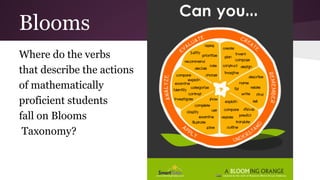
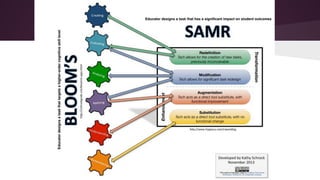
Blooms
Where do the verbs
that describe the actions
of mathematically
proficient students
fall on Blooms
Taxonomy?
It’s not about the Technology...
Educational researchers and practitioners alike assert that
the potential of new technologies for learning is likely to be
found not in the technologies themselves but in the way in
which these technologies are used as tools for learning
(Means & Olson, 1995; Owston, 1997; Valdez et al., 1999).

Very little mention of technology in CCSM.
Technology is a tool for learning!
Things to Consider
Does the math tech tool:
● foster understanding of core curriculum
content
● allow for practice of curriculum or skills of
value
● Create evidence of the students
understanding
You don't have to bring in an elephant to teach the color grey. -Madeline Hunter
Using Technology to...
Connect - Collaborate - Communicate- Create

Disclaimer:
The following slides suggest Apps, websites and projects that could be utilized
to help develop mathematically proficient students. Just because students are
using that technology doesn’t mean they are becoming proficient in that math
practice! This is just a starting point with the understanding that the practices
aren’t isolated and that projects/activities usually support many Math Practice
Standards.
Standards for [Student]
Mathematical Practices
• "Not all tasks are created equal, and different tasks will
provoke different levels and kinds of student thinking."
~ Stein, Smith, Henningsen, & Silver, 2000

• "The level and kind of thinking in which students engage
determines what they will learn."
~ Hiebert, Carpenter, Fennema, Fuson, Wearne, Murray, Oliver, & Human
1997
Math Sense Making
1. Make sense of problems and persevere in
solving them.
● Inside Mathematics
● Math Landing
● Math Performance Tasks
Math Sense Making
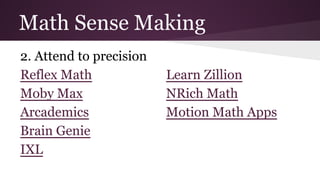
6. Attend to precision
Reflex Math
Moby Max
Arcademics
Brain Genie
IXL

Learn Zillion
NRich Math
Motion Math Apps
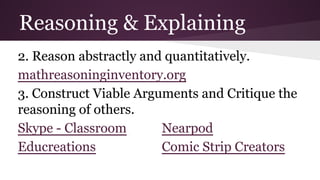
Reasoning & Explaining
2. Reason abstractly and quantitatively.
mathreasoninginventory.org
3. Construct Viable Arguments and Critique the
reasoning of others.
Skype - Classroom
Nearpod
Educreations
Comic Strip Creators
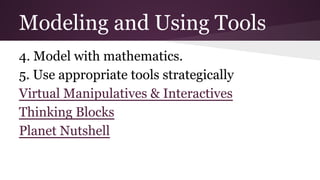
Modeling and Using Tools
4. Model with mathematics.
5. Use appropriate tools strategically
Virtual Manipulatives & Interactives
Thinking Blocks
Planet Nutshell
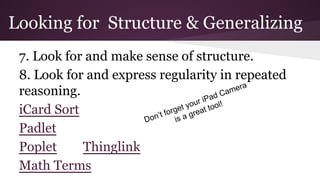
Looking for Structure & Generalizing
7. Look for and make sense of structure.
8. Look for and express regularity in repeated
a
mer
a
reasoning.
ad C
r iP
you t tool!
t
iCard Sort
orge grea
’t f s a
i
Don
Padlet
Poplet
Thinglink
Math Terms
Math Class Needs a Makeover
Dan Meyer Ted Talk
https://www.youtube.com/watch?v=NWUFjb8w9Ps
Reflections
My definition of a good teacher has changed
from "one who explains things so well that
students understand" to "one who gets students
to explain things so well that they can be
understood."
(Steven C. Reinhart, "Never say anything a kid can say!" Mathematics Teaching in the Middle School
5, 8 [2000]: 478)
Reflections
What I learned in school may be growing
increasingly obsolete today, but how I learned
to learn is what helps me keep up with the
world around me. I have the study of
mathematics to thank for that.
-Richard Schaar

Enhancing the Practice Standards with Technology

  • 1.
    Tech Tools forEnhancing the Standards For Mathematical Practice MACE 2014 Jennifer Gatz Instructional Coach SJSD https://todaysmeet.com/TechMPS Twitter @jenngatz Pinterest: jenngatz jennifer.gatz@gmail.com
  • 2.
    Kahoot Ithttps://kahoot.it 8687 Web orApp Based Getting to Know the Math Practice Standards
  • 3.
    Presentation Resources -LiveBinder http://goo.gl/LA5c5m
  • 6.
    Standards for MathematicalPractice Mathematically Proficient Students… 1. Make sense of problems and persevere in solving them. 2. Reason abstractly and quantitatively. 3. Construct viable arguments and critique the reasoning of others. 4. Model with mathematics. 5. Use appropriate tools strategically. 6. Attend to precision. 7. Look for and make use of structure. 8. Look for and express regularity in repeated reasoning.
  • 7.
    Math Sense Making (Inevery lesson) All SMPs will not be demonstrated with every math exercise, but multiple standards should be evident in every mathematics lesson.
  • 8.
    Understanding the Math PracticeStandards ● Illustrative Mathematics ● Scholastic A Guide to the 8 Mathematical Practice Standards ● Read Tennessee ● North Carolina Unpacking of Standards
  • 9.
    The Standards for[Student] Mathematical Practice What are the verbs that illustrate the student actions of each mathematical practice?
  • 10.
    Mathematical Practice #3:Construct viable arguments and critique the reasoning of others Mathematically proficient students: • understand and use stated assumptions, definitions, and previously established results in constructing arguments. • make conjectures and build a logical progression of statements to explore the truth of their conjectures. • analyze situations by breaking them into cases, and can recognize and use counterexamples. • justify their conclusions, communicate them to others, and respond to the arguments of others. • reason inductively about data, making plausible arguments that take into account the context from which the data arose. • compare the effectiveness of two plausible arguments, distinguish correct logic or reasoning from that which is flawed, and-if there is a flaw in an argument-explain what it is. • construct arguments using concrete referents such as objects, drawings, diagrams, and actions. Such arguments can make sense and be correct, even though they are not generalized or made formal until later grades. • determine domains to which an argument applies. • listen or read the arguments of others, decide whether they make sense, and ask useful questions to clarify or improve the arguments.
  • 11.
    Blooms Where do theverbs that describe the actions of mathematically proficient students fall on Blooms Taxonomy?
  • 12.
    It’s not aboutthe Technology... Educational researchers and practitioners alike assert that the potential of new technologies for learning is likely to be found not in the technologies themselves but in the way in which these technologies are used as tools for learning (Means & Olson, 1995; Owston, 1997; Valdez et al., 1999). Very little mention of technology in CCSM. Technology is a tool for learning!
  • 13.
    Things to Consider Doesthe math tech tool: ● foster understanding of core curriculum content ● allow for practice of curriculum or skills of value ● Create evidence of the students understanding You don't have to bring in an elephant to teach the color grey. -Madeline Hunter
  • 15.
    Using Technology to... Connect- Collaborate - Communicate- Create Disclaimer: The following slides suggest Apps, websites and projects that could be utilized to help develop mathematically proficient students. Just because students are using that technology doesn’t mean they are becoming proficient in that math practice! This is just a starting point with the understanding that the practices aren’t isolated and that projects/activities usually support many Math Practice Standards.
  • 16.
    Standards for [Student] MathematicalPractices • "Not all tasks are created equal, and different tasks will provoke different levels and kinds of student thinking." ~ Stein, Smith, Henningsen, & Silver, 2000 • "The level and kind of thinking in which students engage determines what they will learn." ~ Hiebert, Carpenter, Fennema, Fuson, Wearne, Murray, Oliver, & Human 1997
  • 17.
    Math Sense Making 1.Make sense of problems and persevere in solving them. ● Inside Mathematics ● Math Landing ● Math Performance Tasks
  • 18.
    Math Sense Making 6.Attend to precision Reflex Math Moby Max Arcademics Brain Genie IXL Learn Zillion NRich Math Motion Math Apps
  • 19.
    Reasoning & Explaining 2.Reason abstractly and quantitatively. mathreasoninginventory.org 3. Construct Viable Arguments and Critique the reasoning of others. Skype - Classroom Nearpod Educreations Comic Strip Creators
  • 20.
    Modeling and UsingTools 4. Model with mathematics. 5. Use appropriate tools strategically Virtual Manipulatives & Interactives Thinking Blocks Planet Nutshell
  • 21.
    Looking for Structure& Generalizing 7. Look for and make sense of structure. 8. Look for and express regularity in repeated a mer a reasoning. ad C r iP you t tool! t iCard Sort orge grea ’t f s a i Don Padlet Poplet Thinglink Math Terms
  • 22.
    Math Class Needsa Makeover Dan Meyer Ted Talk https://www.youtube.com/watch?v=NWUFjb8w9Ps
  • 23.
    Reflections My definition ofa good teacher has changed from "one who explains things so well that students understand" to "one who gets students to explain things so well that they can be understood." (Steven C. Reinhart, "Never say anything a kid can say!" Mathematics Teaching in the Middle School 5, 8 [2000]: 478)
  • 24.
    Reflections What I learnedin school may be growing increasingly obsolete today, but how I learned to learn is what helps me keep up with the world around me. I have the study of mathematics to thank for that. -Richard Schaar