Synergize for Student Success

         Jill T. Chapman
       SC CEC Conference
         February 2013
End In Mind
• Learn new skills
• Confirm what we know
• Remember old skills
End In Mind
• Use Covey’s 7 Habits of Highly Effective
  People as a framework for thinking about
  teams

• Who is your team?
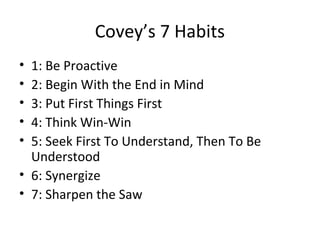
Covey’s 7 Habits
• 1: Be Proactive
• 2: Begin With the End in Mind
• 3: Put First Things First
• 4: Think Win-Win
• 5: Seek First To Understand, Then To Be
  Understood
• 6: Synergize
• 7: Sharpen the Saw
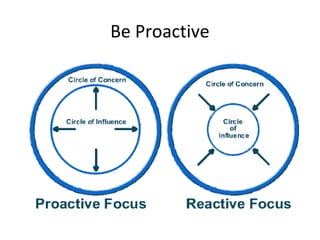
Be Proactive
• What can we control?

• What is out of our control?
Be Proactive
Begin With the End in Mind
• Quick thought…Education, Team,
  Achievement
Put First Things First
• How will we reach our goal?

• What activities help get us there?

• What activities distract us?
Think Win-Win
•   Common ground
•   Third alternatives
•   1+1=2
•   ½+½=1
•   Respect those who are absent
Think Win-Win
• Scarcity

• Abundance

• Where do effective teams focus?
Seek First to Understand
•   In statistics, a Type I error is the incorrect rejection of a true null hypothesis. A Type II error
    is the failure to reject a false null hypothesis.[1] A type I error is a false positive. Usually a type I
    error leads one to conclude that a thing or relationship exists when really it doesn't: for
    example, that a patient has a disease being tested for when really the patient does not have
    the disease, or that a medical treatment cures a disease when really it doesn't. A type II error
    is a false negative. Examples of type II errors would be a blood test failing to detect the
    disease it was designed to detect, in a patient who really has the disease; or a clinical trial of
    a medical treatment failing to show that the treatment works when really it does.[2] When
    comparing two means, concluding the means were different when in reality they were not
    different would be a Type I error; concluding the means were not different when in reality
    they were different would be a Type II error.
• Type I and Type II errors are also called errors of the first kind and errors of the second kind.
• All statistical hypothesis tests have a probability of making type I and type II errors. For
    example, all blood tests for a disease will falsely detect the disease in some proportion of
    people who don't have it, and will fail to detect the disease in some proportion of people
    who do have it. A test's probability of making a type I error is denoted by α. A test's
    probability of making a type II error is denoted by β.
(from Wikipedia.)
Seek First To Understand
• The greatest desire of the human heart is to
  be understood.

• A need that is satisfied no longer drives us.
(quotes from Covey)
Synergize
• Work together toward the common goal.

• What fosters synergy?

• What hinders synergy?

• What can you do to increase the synergy in
  your team?
Sharpen the Saw
•   Body
•   Mind
•   Spirit
•   Social
Put It All Together
• How can you use this framework to support
  the goal’s of your team?

• Questions?
Contact Me
• Jill T. Chapman
jchapman@lexington1.net

Saxe Gotha Elementary School
803-821-4800

Synergize for student success

  • 1.
    Synergize for StudentSuccess Jill T. Chapman SC CEC Conference February 2013
  • 2.
    End In Mind •Learn new skills • Confirm what we know • Remember old skills
  • 3.
    End In Mind •Use Covey’s 7 Habits of Highly Effective People as a framework for thinking about teams • Who is your team?
  • 4.
    Covey’s 7 Habits •1: Be Proactive • 2: Begin With the End in Mind • 3: Put First Things First • 4: Think Win-Win • 5: Seek First To Understand, Then To Be Understood • 6: Synergize • 7: Sharpen the Saw
  • 5.
    Be Proactive • Whatcan we control? • What is out of our control?
  • 6.
  • 7.
    Begin With theEnd in Mind • Quick thought…Education, Team, Achievement
  • 8.
    Put First ThingsFirst • How will we reach our goal? • What activities help get us there? • What activities distract us?
  • 9.
    Think Win-Win • Common ground • Third alternatives • 1+1=2 • ½+½=1 • Respect those who are absent
  • 10.
    Think Win-Win • Scarcity •Abundance • Where do effective teams focus?
  • 11.
    Seek First toUnderstand • In statistics, a Type I error is the incorrect rejection of a true null hypothesis. A Type II error is the failure to reject a false null hypothesis.[1] A type I error is a false positive. Usually a type I error leads one to conclude that a thing or relationship exists when really it doesn't: for example, that a patient has a disease being tested for when really the patient does not have the disease, or that a medical treatment cures a disease when really it doesn't. A type II error is a false negative. Examples of type II errors would be a blood test failing to detect the disease it was designed to detect, in a patient who really has the disease; or a clinical trial of a medical treatment failing to show that the treatment works when really it does.[2] When comparing two means, concluding the means were different when in reality they were not different would be a Type I error; concluding the means were not different when in reality they were different would be a Type II error. • Type I and Type II errors are also called errors of the first kind and errors of the second kind. • All statistical hypothesis tests have a probability of making type I and type II errors. For example, all blood tests for a disease will falsely detect the disease in some proportion of people who don't have it, and will fail to detect the disease in some proportion of people who do have it. A test's probability of making a type I error is denoted by α. A test's probability of making a type II error is denoted by β. (from Wikipedia.)
  • 12.
    Seek First ToUnderstand • The greatest desire of the human heart is to be understood. • A need that is satisfied no longer drives us. (quotes from Covey)
  • 13.
    Synergize • Work togethertoward the common goal. • What fosters synergy? • What hinders synergy? • What can you do to increase the synergy in your team?
  • 14.
    Sharpen the Saw • Body • Mind • Spirit • Social
  • 15.
    Put It AllTogether • How can you use this framework to support the goal’s of your team? • Questions?
  • 16.
    Contact Me • JillT. Chapman jchapman@lexington1.net Saxe Gotha Elementary School 803-821-4800