Selecting, Designing & Using
Mathematical Tasks in the K-5 Classroom
Unpacking/Analyzing a Task
 What does it mean to ‘unpack’ a task?
 What might you consider in your analysis as you

‘unpack’ a task?
 How do you use this analysis to make a decision
about whether a task is worthwhile (what does it
mean to say a task is worthwhile)?
Unpacking Task 1
You have a dozen cookies and
want to share them among the
members of your family at supper.
How many cookies can each
person have?
Analysis of Task 1
Context: Is it a reasonable problem context? Might

students ever need to solve such a problem?
Interpretation: What are children’s possible
interpretations of the problem?
Mathematics: What is the difficulty level of the
mathematics involved? Is it the same for all students?
Who controls the difficulty level
Analysis of Task 1
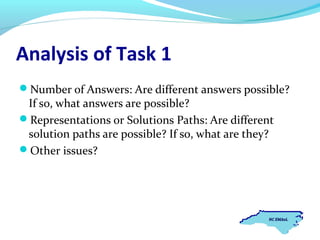
Number of Answers: Are different answers possible?

If so, what answers are possible?
Representations or Solutions Paths: Are different
solution paths are possible? If so, what are they?
Other issues?
Unpacking Task 2
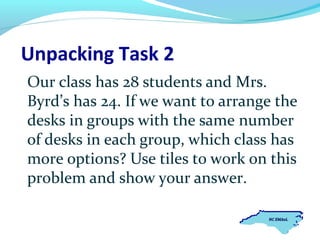
Our class has 28 students and Mrs.
Byrd’s has 24. If we want to arrange the
desks in groups with the same number
of desks in each group, which class has
more options? Use tiles to work on this
problem and show your answer.
Analysis of Task 2
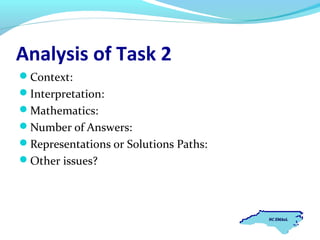
Context:
Interpretation:
Mathematics:
Number of Answers:
Representations or Solutions Paths:
Other issues?
Unpacking Task 3
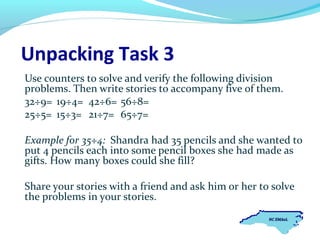
Use counters to solve and verify the following division
problems. Then write stories to accompany five of them.
32÷9= 19÷4= 42÷6= 56÷8=
25÷5= 15÷3= 21÷7= 65÷7=
Example for 35÷4: Shandra had 35 pencils and she wanted to
put 4 pencils each into some pencil boxes she had made as
gifts. How many boxes could she fill?
Share your stories with a friend and ask him or her to solve
the problems in your stories.
Analysis of Task 3
Context:
Interpretation:
Mathematics:
Number of Answers:
Representations or Solutions Paths:
Other issues?
Unpacking/Analyzing a Task
 What does it mean to ‘unpack’ a task?
 What might you consider in your analysis as you

‘unpack’ a task?
 How do you use this analysis to make a decision
about whether a task is worthwhile (what does it
mean to say a task is worthwhile)?
Reflect and Discuss
Examine Tasks H & L from the Place Value Task Card

Deck.
Unpack/analyze each task using categories suggested
by Ball’s work and/or adding your own additional
issues.
How does this analysis help you decide if Task H
and/or Task I are worthwhile?

What makesa mathtaskworthwhileemaol

  • 1.
    Selecting, Designing &Using Mathematical Tasks in the K-5 Classroom
  • 2.
    Unpacking/Analyzing a Task What does it mean to ‘unpack’ a task?  What might you consider in your analysis as you ‘unpack’ a task?  How do you use this analysis to make a decision about whether a task is worthwhile (what does it mean to say a task is worthwhile)?
  • 3.
    Unpacking Task 1 Youhave a dozen cookies and want to share them among the members of your family at supper. How many cookies can each person have?
  • 4.
    Analysis of Task1 Context: Is it a reasonable problem context? Might students ever need to solve such a problem? Interpretation: What are children’s possible interpretations of the problem? Mathematics: What is the difficulty level of the mathematics involved? Is it the same for all students? Who controls the difficulty level
  • 5.
    Analysis of Task1 Number of Answers: Are different answers possible? If so, what answers are possible? Representations or Solutions Paths: Are different solution paths are possible? If so, what are they? Other issues?
  • 6.
    Unpacking Task 2 Ourclass has 28 students and Mrs. Byrd’s has 24. If we want to arrange the desks in groups with the same number of desks in each group, which class has more options? Use tiles to work on this problem and show your answer.
  • 7.
    Analysis of Task2 Context: Interpretation: Mathematics: Number of Answers: Representations or Solutions Paths: Other issues?
  • 8.
    Unpacking Task 3 Usecounters to solve and verify the following division problems. Then write stories to accompany five of them. 32÷9= 19÷4= 42÷6= 56÷8= 25÷5= 15÷3= 21÷7= 65÷7= Example for 35÷4: Shandra had 35 pencils and she wanted to put 4 pencils each into some pencil boxes she had made as gifts. How many boxes could she fill? Share your stories with a friend and ask him or her to solve the problems in your stories.
  • 9.
    Analysis of Task3 Context: Interpretation: Mathematics: Number of Answers: Representations or Solutions Paths: Other issues?
  • 10.
    Unpacking/Analyzing a Task What does it mean to ‘unpack’ a task?  What might you consider in your analysis as you ‘unpack’ a task?  How do you use this analysis to make a decision about whether a task is worthwhile (what does it mean to say a task is worthwhile)?
  • 11.
    Reflect and Discuss ExamineTasks H & L from the Place Value Task Card Deck. Unpack/analyze each task using categories suggested by Ball’s work and/or adding your own additional issues. How does this analysis help you decide if Task H and/or Task I are worthwhile?