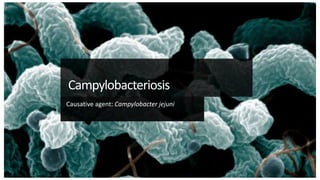
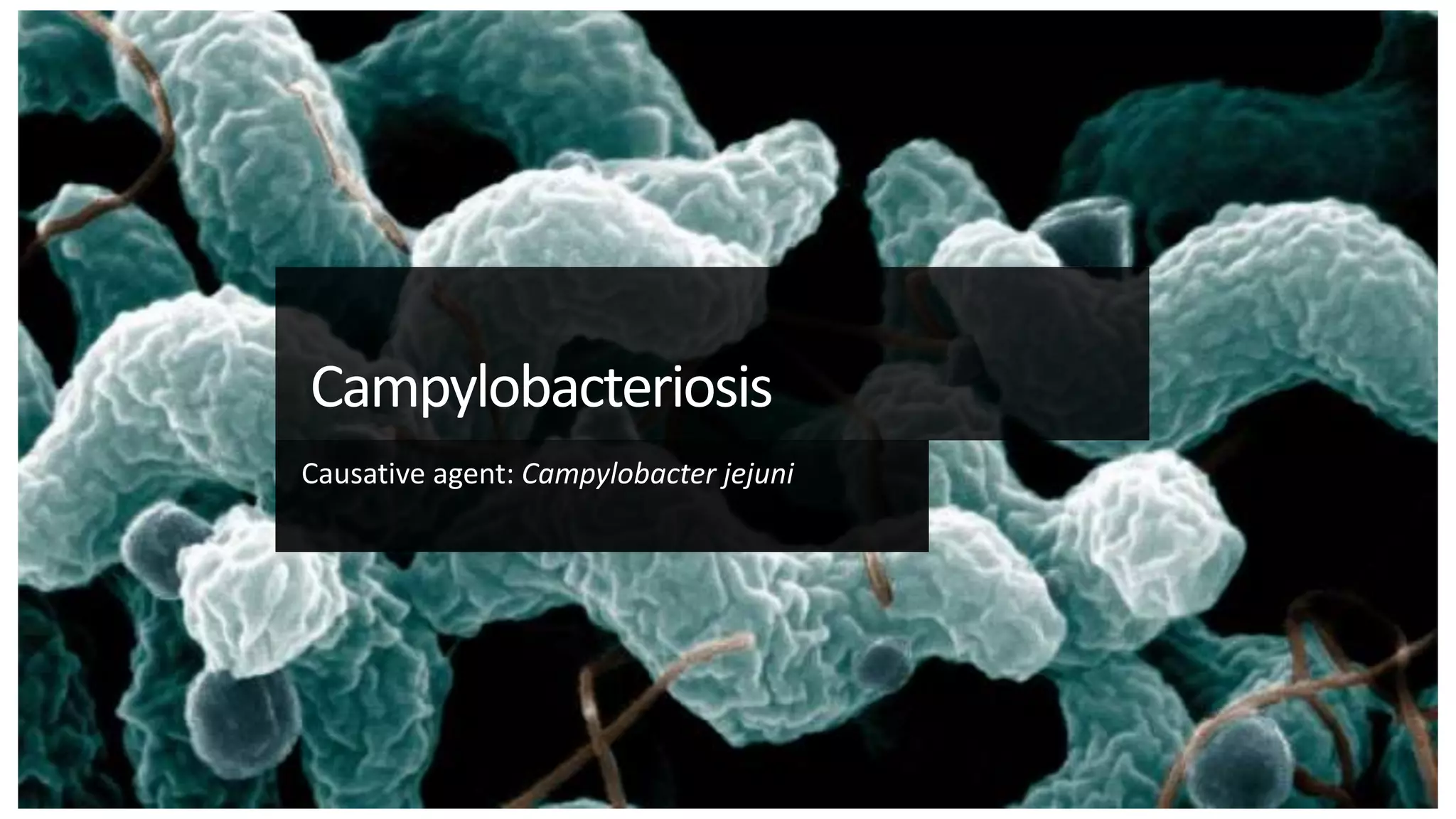
Campylobacteriosis
Causative agent: Campylobacter jejuni
Your Logo or Name Here
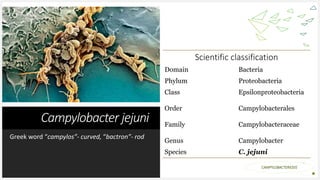
Campylobacter jejuni
Greek word “campylos”- curved, “bactron”- rod
CAMPYLOBACTERIOSIS
Scientific classification
Domain Bacteria
Phylum Proteobacteria
Class Epsilonproteobacteria
Order Campylobacterales
Family Campylobacteraceae
Genus Campylobacter
Species C. jejuni
Your Logo or Name Here
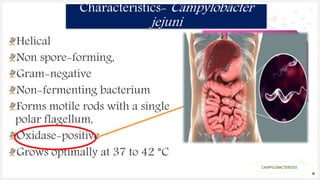
Helical
Non spore-forming,
Gram-negative
Non-fermenting bacterium
Forms motile rods with a single
polar flagellum,
Oxidase-positive
Grows optimally at 37 to 42 °C
Characteristics- Campylobacter
jejuni
The oxidase test is used to identify
bacteria that produce cytochrome c
oxidase, an enzyme of the
bacterial electron transport chain
CAMPYLOBACTERIOSIS
Your Logo or Name Here
• Campylobacteriosis is an infection by
the Campylobacter bacteria
• C. jejuni (most commonly)- in cattle, swine, birds
• also C. coli- in cattle, swine, birds
C. upsaliensis- in cats and dogs
C. lari- in seabirds
• It is among the most common bacterial
infections of humans, often a foodborne illness.
CAMPYLOBACTERIOSIS
4CAMPYLOBACTERIOSIS
Your Logo or Name Here
Meat, Meat Products
Milk, Milk Products
Water and
Beverages
5
• First 24 hours:
Prodromal symptoms- fever, headache, and myalgia
(which can be severe)
• After 1–5 days:
diarrhea (~ 10 watery, frequently bloody, bowel
movements per day)
or dysentery, cramps, abdominal pain, and fever [as
high as 40 °C (104 °F)].
• In most people, the illness lasts for 2–10
days:
invasive/inflammatory diarrhea, also described
as bloody diarrhea or dysentery.
CAMPYLOBACTERIOSIS
There are other diseases showing similar
symptoms.
Your Logo or Name Here
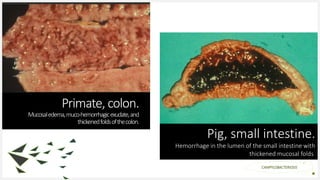
Primate, colon.
Mucosaledema,muco-hemorrhagicexudate,and
thickenedfoldsofthecolon.
6
Pig, small intestine.
Hemorrhage in the lumen of the small intestine with
thickened mucosal folds.
CAMPYLOBACTERIOSIS
Your Logo or Name Here
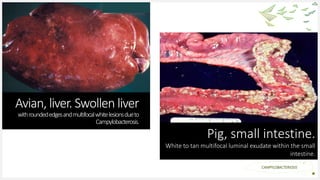
Avian, liver. Swollen liver
withroundededgesandmultifocalwhitelesionsdueto
Campylobacterosis.
7
Pig, small intestine.
White to tan multifocal luminal exudate within the small
intestine.
CAMPYLOBACTERIOSIS
Your Logo or Name Here
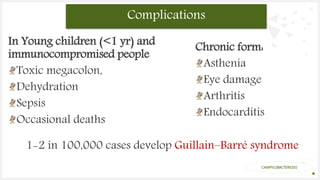
In Young children (<1 yr) and
immunocompromised people
Toxic megacolon,
Dehydration
Sepsis
Occasional deaths
Complications
The oxidase test is used to identify
bacteria that produce cytochrome c
oxidase, an enzyme of the
bacterial electron transport chain
CAMPYLOBACTERIOSIS
Chronic form:
Asthenia
Eye damage
Arthritis
Endocarditis
1-2 in 100,000 cases develop Guillain–Barré syndrome
Your Logo or Name Here
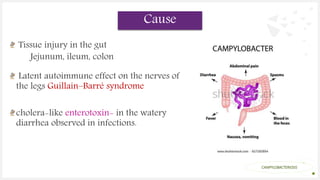
Tissue injury in the gut
Jejunum, ileum, colon
CAMPYLOBACTERIOSIS
Cause
Latent autoimmune effect on the nerves of
the legs Guillain–Barré syndrome
cholera-like enterotoxin- in the watery
diarrhea observed in infections.
Your Logo or Name Here
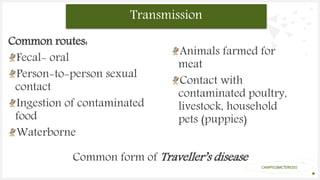
Common routes:
Fecal- oral
Person-to-person sexual
contact
Ingestion of contaminated
food
Waterborne
Transmission
CAMPYLOBACTERIOSIS
Animals farmed for
meat
Contact with
contaminated poultry,
livestock, household
pets (puppies)
Common form of Traveller’s disease
Your Logo or Name Here 11
Diagnosis
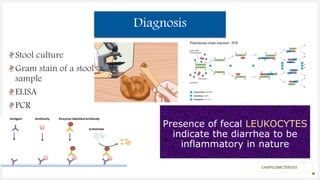
Stool culture
Gram stain of a stool
sample
ELISA
PCR
Presence of fecal LEUKOCYTES
indicate the diarrhea to be
inflammatory in nature
CAMPYLOBACTERIOSIS
Your Logo or Name Here
• Cooked and Hot food
• only pasteurized or boiled
milk and milk products
• ice from safe water.
• boil drinking water, or
disinfect it with chemical
disinfectant.
• Wash hands thoroughly and
frequently with soap, (after
using the toilet and contact
with pets and farm animals)
12
• Wash and peel fruits and
vegetables thoroughly
• Food handlers, professionals
and at home- hygienic rules
• Professional food handlers
should immediately report to
their employer any fever,
diarrhea, vomiting or visible
infected skin lesions.
CAMPYLOBACTERIOSIS
Your Logo or Name Here
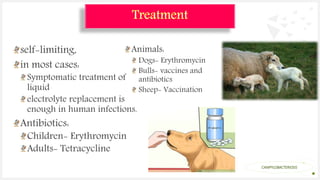
self-limiting,
in most cases:
Symptomatic treatment of
liquid
electrolyte replacement is
enough in human infections.
Antibiotics:
Children- Erythromycin
Adults- Tetracycline
CAMPYLOBACTERIOSIS
Animals:
Dogs- Erythromycin
Bulls- vaccines and
antibiotics
Sheep- Vaccination
Your Logo or Name Here
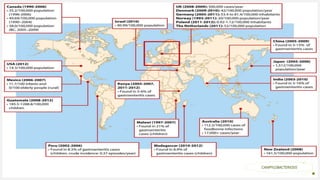
EPIDEMIOLOGY
CAMPYLOBACTERIOSIS
Your Logo or Name Here 15CAMPYLOBACTERIOSIS
Your Logo or Name Here
References
Webliography
CAMPYLOBACTERIOSIS
• [http://commons.wikimedia.org/wiki/Fil
e:A_large_blank_world_map_with_ocea
ns_marked_in_blue.PNG].)
• http://www.sinobiological.com/what-is-
elisa-mechanism.html
• https://www.news-
medical.net/health/Campylobacteriosis-
Symptoms.aspx
• https://en.wikipedia.org/wiki/Campylobac
teriosis
• http://parasites.ftz.czu.cz/food/parasite.p
hp?idParasite=52
• https://www.youtube.com/watch?v=NiPTc
CK9vX0
Thank You
Bhaktimala Suresh
Group V, Geomedi University

Campylobacteriosis

  • 1.
  • 2.
    Your Logo orName Here Campylobacter jejuni Greek word “campylos”- curved, “bactron”- rod CAMPYLOBACTERIOSIS Scientific classification Domain Bacteria Phylum Proteobacteria Class Epsilonproteobacteria Order Campylobacterales Family Campylobacteraceae Genus Campylobacter Species C. jejuni
  • 3.
    Your Logo orName Here Helical Non spore-forming, Gram-negative Non-fermenting bacterium Forms motile rods with a single polar flagellum, Oxidase-positive Grows optimally at 37 to 42 °C Characteristics- Campylobacter jejuni The oxidase test is used to identify bacteria that produce cytochrome c oxidase, an enzyme of the bacterial electron transport chain CAMPYLOBACTERIOSIS
  • 4.
    Your Logo orName Here • Campylobacteriosis is an infection by the Campylobacter bacteria • C. jejuni (most commonly)- in cattle, swine, birds • also C. coli- in cattle, swine, birds C. upsaliensis- in cats and dogs C. lari- in seabirds • It is among the most common bacterial infections of humans, often a foodborne illness. CAMPYLOBACTERIOSIS 4CAMPYLOBACTERIOSIS
  • 5.
    Your Logo orName Here Meat, Meat Products Milk, Milk Products Water and Beverages 5 • First 24 hours: Prodromal symptoms- fever, headache, and myalgia (which can be severe) • After 1–5 days: diarrhea (~ 10 watery, frequently bloody, bowel movements per day) or dysentery, cramps, abdominal pain, and fever [as high as 40 °C (104 °F)]. • In most people, the illness lasts for 2–10 days: invasive/inflammatory diarrhea, also described as bloody diarrhea or dysentery. CAMPYLOBACTERIOSIS There are other diseases showing similar symptoms.
  • 6.
    Your Logo orName Here Primate, colon. Mucosaledema,muco-hemorrhagicexudate,and thickenedfoldsofthecolon. 6 Pig, small intestine. Hemorrhage in the lumen of the small intestine with thickened mucosal folds. CAMPYLOBACTERIOSIS
  • 7.
    Your Logo orName Here Avian, liver. Swollen liver withroundededgesandmultifocalwhitelesionsdueto Campylobacterosis. 7 Pig, small intestine. White to tan multifocal luminal exudate within the small intestine. CAMPYLOBACTERIOSIS
  • 8.
    Your Logo orName Here In Young children (<1 yr) and immunocompromised people Toxic megacolon, Dehydration Sepsis Occasional deaths Complications The oxidase test is used to identify bacteria that produce cytochrome c oxidase, an enzyme of the bacterial electron transport chain CAMPYLOBACTERIOSIS Chronic form: Asthenia Eye damage Arthritis Endocarditis 1-2 in 100,000 cases develop Guillain–Barré syndrome
  • 9.
    Your Logo orName Here Tissue injury in the gut Jejunum, ileum, colon CAMPYLOBACTERIOSIS Cause Latent autoimmune effect on the nerves of the legs Guillain–Barré syndrome cholera-like enterotoxin- in the watery diarrhea observed in infections.
  • 10.
    Your Logo orName Here Common routes: Fecal- oral Person-to-person sexual contact Ingestion of contaminated food Waterborne Transmission CAMPYLOBACTERIOSIS Animals farmed for meat Contact with contaminated poultry, livestock, household pets (puppies) Common form of Traveller’s disease
  • 11.
    Your Logo orName Here 11 Diagnosis Stool culture Gram stain of a stool sample ELISA PCR Presence of fecal LEUKOCYTES indicate the diarrhea to be inflammatory in nature CAMPYLOBACTERIOSIS
  • 12.
    Your Logo orName Here • Cooked and Hot food • only pasteurized or boiled milk and milk products • ice from safe water. • boil drinking water, or disinfect it with chemical disinfectant. • Wash hands thoroughly and frequently with soap, (after using the toilet and contact with pets and farm animals) 12 • Wash and peel fruits and vegetables thoroughly • Food handlers, professionals and at home- hygienic rules • Professional food handlers should immediately report to their employer any fever, diarrhea, vomiting or visible infected skin lesions. CAMPYLOBACTERIOSIS
  • 13.
    Your Logo orName Here self-limiting, in most cases: Symptomatic treatment of liquid electrolyte replacement is enough in human infections. Antibiotics: Children- Erythromycin Adults- Tetracycline CAMPYLOBACTERIOSIS Animals: Dogs- Erythromycin Bulls- vaccines and antibiotics Sheep- Vaccination
  • 14.
    Your Logo orName Here EPIDEMIOLOGY CAMPYLOBACTERIOSIS
  • 15.
    Your Logo orName Here 15CAMPYLOBACTERIOSIS
  • 16.
    Your Logo orName Here References Webliography CAMPYLOBACTERIOSIS • [http://commons.wikimedia.org/wiki/Fil e:A_large_blank_world_map_with_ocea ns_marked_in_blue.PNG].) • http://www.sinobiological.com/what-is- elisa-mechanism.html • https://www.news- medical.net/health/Campylobacteriosis- Symptoms.aspx • https://en.wikipedia.org/wiki/Campylobac teriosis • http://parasites.ftz.czu.cz/food/parasite.p hp?idParasite=52 • https://www.youtube.com/watch?v=NiPTc CK9vX0
  • 17.
    Thank You Bhaktimala Suresh GroupV, Geomedi University

Editor's Notes

  • #6 acute appendicitis- abdominal pain and tenderness may be very localized. Helicobacter pylori (is closely related to Campylobacter)- peptic ulcer disease.
  • #9  Guillain–Barré syndrome, in which the nerves that join the spinal cord and brain to the rest of the body are damaged, sometimes permanently. This occurs only with infection of C. jejuni and C. upsaliensis.[2]
  • #10 Tissue injury in the gut- invading and destroying epithelial cells Guillain–Barré syndrome- ascending paralysis, dysaesthesias usually below the waist, and, in the later stages, respiratory failure. Some strains of C jejuni produce a cholera-like enterotoxin, which is important in the watery diarrhea observed in infections.  Some strains of C jejuni produce a cholera-like enterotoxin, which is important in the watery diarrhea observed in infections.  Some strains of C jejuni produce a cholera-like enterotoxin, which is important in the watery diarrhea observed in infections. 
  • #11 ingestion of contaminated food (generally unpasteurized (raw) milk and undercooked or poorly handled poultry), and waterborne (i.e., through contaminated drinking water).