1. What is audience research?

This book is designed for people working in communications organizations: radio and TV
stations, newspapers and other print media, arts companies, orchestras - any group that
communicates with the public. Whenever I refer to "publishers," "media," or "stations" I
mean all of these. And no matter what you call your audience - listeners, viewers,
readers, visitors, subscribers, passengers, or users - the book is about all of these.

Audience research is a systematic and accurate way of finding out about your audience.
There are two main things that audience research can do:

(1) estimate audience sizes, and

(2) discover audience preferences.

Radio and TV stations are unique in having a special need for audience research: this is the
only industry that cannot accurately count its audience. A factory will always count the
number of products it sells. A newspaper will (or could) always know its paid circulation.
An organization that provides services rather than products (e.g. a hospital) is able to
accurately count the number of people who walk through its doors. But radio and
television programs are given away free to their audiences, and there is no way of
measuring how many people tune into a program - without audience research.

For this reason, audience research was one of the first forms of market research. When
radio became popular in rich countries in the 1920s, audience research followed soon
afterwards. In countries where broadcasters depended on commercial revenue, such as
the USA, audience surveys were done to find out how many people would hear a particular
advertisement.

In countries with public radio, such as Britain and New Zealand, audience research began
in the 1930s, seeking information from listeners. New Zealand’s first audience survey was
in 1932. Postcard questionnaires were sent out to households with radio licenses, asking
questions such as "Do you listen on a crystal set or a valve set?" and "Do you dance to
broadcast dance music?"

Since those days, audience research has moved far beyond radio and television. The
current growth area is internet audience research. And, though printed publications have
readers rather than audiences, the same methods apply.

Methods of audience research

The most common method of audience research is the survey: a group of people is
selected, they are all asked the same questions, and their answers are counted. But as
well as surveys, there are many other methods of audience research, including
observation, mechanical measurement (people-meters) and qualitative research. The first
part of this book deals with surveys, and the second part covers most of the other
methods.

Audience research methods can be applied for any activity with audiences: not only radio
and television stations, but also print media, artistic activities, and (most recently) the
internet. The methods described in this book apply to all of these, as well as to the study
of societies (social research) and economic behaviour (market research).

Audience research, social research,and market research

Audience research, social research, and market research share a common body of
methods, with slight variations. So when you know how to do audience research, you will
also know how to carry out many types of market research and social research.

2.Audience research and management systems

The importance of feedback

For any activity to be carried out well, some form of feedback is needed. Try walking with
your eyes shut, and you will soon bump into something. Even without your thinking about
it, the feedback from your eyes is used to correct your steps. In the same way, any
organization that does not keep its eyes open is likely to meet with an accident.

In the media industries, the equivalent to walking is broadcasting the programs. The
equivalent of watching where you are going is audience research.

But when you are walking, you are doing more than simply move your legs, and watch
where you are going. You will also have decided where you are walking to. Depending on
what you see, you will adjust your steps in the desired direction. And of course, at any
time you may change your direction of walking.

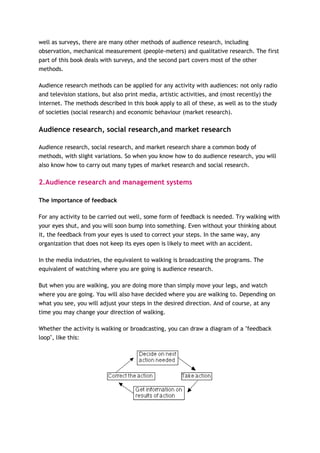
Whether the activity is walking or broadcasting, you can draw a diagram of a "feedback
loop", like this:
In recent years, the study of management methods has produced a system known as
"strategic management." It follows the principles shown in the above diagram. Notice the
bottom box, labelled "Get information on results of action". Audience research is part of
that box.

The importance of knowing what you're doing, and why you're doing it

Around the 1970s, some international aid programs had problems knowing exactly why
they were doing some projects. Though a project might seem like a good idea, what was it
actually achieving? To help answer this question, many aid agencies adopted a system
called the Logical Framework, or a similar system called Object-Oriented Project Planning
(ZOPP, in German).

The Logical Framework

The Logical Framework method (Log Frame for short) begins by creating a hierarchy of
goals. It works like this:

1. State the main goal that you want the project to accomplish.

        For example, to eliminate malaria in a region.

2. Then consider what other goals will need to be achieved to meet the first goal. In the
case of the anti-malaria project, the three objectives could be:

        a. to encourage people to avoid being bitten by mosquitoes;

        b. to make anti-malarial drugs readily available

        c. to eliminate malaria-carrying mosquitoes.

3. Now consider what must to be achieved to meet each of those goals…and so on. To
continue the anti-malaria example, the goals for 2a could include

        a1. making anti-mosquito equipment widely available

        a2. encouraging people to wear enough clothing at times when mosquitoes are
        feeding

        a3. advising people on how to avoid being bitten by mosquitoes.

The process continues, adding more and more levels. The highest levels are part of the
initial plan. The lower levels are activities rather than goals. At the lowest possible level,
a worker on the project might work towards goal a1 by visiting a particular school on a
particular day, and giving the teachers information that could be used in lessons..

The whole structure can be drawn like a tree, with the single main goal at the bottom,
and each branch dividing into more and more goals, objectives, strategies, aims, purposes,
or activities. No matter what these are labelled, they are all a type of plan. (With the tree
analogy, notice that the trunk is what you'd call the highest level - it's really an upside-
down tree.)

This tree-like approach works well for a project with a very specific goal, such as the anti-
malaria campaign. But organizations with audiences usually don't have a single main
purpose. Many of them have several purposes, which are not clearly defined: nothing as
simple and as measurable as "reduce the level of malaria in this region." For public
companies, it's a little easier: in many countries their stated goal is to maximize the value
of their shares. At least, that's what they say: but in many cases their shareholders could
do better if the organization was closed down and the money invested in a more profitable
concern. My own theory, after observing what really happens, is that the primary purpose
of any organization is to survive.

And for an organization with audiences, its primary purpose (after survival) is to be
creative: to provide enough entertaining, inspiring, informative, and educational material
that its audience will stay with it - and the organization will survive..

For example, a radio station may decide to broadcast a program about how to avoid
catching malaria. The program's purpose for the anti-malaria campaign is clear, but what
purpose does it serve for the station? The station could say "we are broadcasting this
program because we like to spend an hour a week on public health" - but why is that? In
fact, broadcasting a program will probably serve a number of different purposes, because
organizations with audiences usually have multiple, fuzzy, and overlapping goals.

To check that the tree-hierarchy makes sense, you can create an intent structure. This is
done in the opposite way from forming the hierarchy of goals. You begin at the top level
of the tree (the leaves, not the trunk). For each activity, consider "Why should we do this?
What will it achieve?"

For most organizations with audiences, their logical framework diagrams won't look like
trees, because each activity (program, article, etc) will serve several purposes. A tree
covered in cobwebs might be a better example.

To complete the Logical Framework, several questions have to be answered for each goal
and sub-goal:

- What resources are required to achieve this purpose?
- What constraints may prevent it; under what conditions will it succeed?

- How will its success be evaluated?

This last question is where audience research comes in. Most activities of an organization
with an audience can't be evaluated without doing audience research.

The need for audience research

If you have an audience, and you don’t do audience research, this is equivalent to walking
with your eyes shut. But many organizations (even those with audiences) survive without
doing audience research. How do they survive?

Audience research trees

  • 1.
    1. What isaudience research? This book is designed for people working in communications organizations: radio and TV stations, newspapers and other print media, arts companies, orchestras - any group that communicates with the public. Whenever I refer to "publishers," "media," or "stations" I mean all of these. And no matter what you call your audience - listeners, viewers, readers, visitors, subscribers, passengers, or users - the book is about all of these. Audience research is a systematic and accurate way of finding out about your audience. There are two main things that audience research can do: (1) estimate audience sizes, and (2) discover audience preferences. Radio and TV stations are unique in having a special need for audience research: this is the only industry that cannot accurately count its audience. A factory will always count the number of products it sells. A newspaper will (or could) always know its paid circulation. An organization that provides services rather than products (e.g. a hospital) is able to accurately count the number of people who walk through its doors. But radio and television programs are given away free to their audiences, and there is no way of measuring how many people tune into a program - without audience research. For this reason, audience research was one of the first forms of market research. When radio became popular in rich countries in the 1920s, audience research followed soon afterwards. In countries where broadcasters depended on commercial revenue, such as the USA, audience surveys were done to find out how many people would hear a particular advertisement. In countries with public radio, such as Britain and New Zealand, audience research began in the 1930s, seeking information from listeners. New Zealand’s first audience survey was in 1932. Postcard questionnaires were sent out to households with radio licenses, asking questions such as "Do you listen on a crystal set or a valve set?" and "Do you dance to broadcast dance music?" Since those days, audience research has moved far beyond radio and television. The current growth area is internet audience research. And, though printed publications have readers rather than audiences, the same methods apply. Methods of audience research The most common method of audience research is the survey: a group of people is selected, they are all asked the same questions, and their answers are counted. But as
  • 2.
    well as surveys,there are many other methods of audience research, including observation, mechanical measurement (people-meters) and qualitative research. The first part of this book deals with surveys, and the second part covers most of the other methods. Audience research methods can be applied for any activity with audiences: not only radio and television stations, but also print media, artistic activities, and (most recently) the internet. The methods described in this book apply to all of these, as well as to the study of societies (social research) and economic behaviour (market research). Audience research, social research,and market research Audience research, social research, and market research share a common body of methods, with slight variations. So when you know how to do audience research, you will also know how to carry out many types of market research and social research. 2.Audience research and management systems The importance of feedback For any activity to be carried out well, some form of feedback is needed. Try walking with your eyes shut, and you will soon bump into something. Even without your thinking about it, the feedback from your eyes is used to correct your steps. In the same way, any organization that does not keep its eyes open is likely to meet with an accident. In the media industries, the equivalent to walking is broadcasting the programs. The equivalent of watching where you are going is audience research. But when you are walking, you are doing more than simply move your legs, and watch where you are going. You will also have decided where you are walking to. Depending on what you see, you will adjust your steps in the desired direction. And of course, at any time you may change your direction of walking. Whether the activity is walking or broadcasting, you can draw a diagram of a "feedback loop", like this:
  • 3.
    In recent years,the study of management methods has produced a system known as "strategic management." It follows the principles shown in the above diagram. Notice the bottom box, labelled "Get information on results of action". Audience research is part of that box. The importance of knowing what you're doing, and why you're doing it Around the 1970s, some international aid programs had problems knowing exactly why they were doing some projects. Though a project might seem like a good idea, what was it actually achieving? To help answer this question, many aid agencies adopted a system called the Logical Framework, or a similar system called Object-Oriented Project Planning (ZOPP, in German). The Logical Framework The Logical Framework method (Log Frame for short) begins by creating a hierarchy of goals. It works like this: 1. State the main goal that you want the project to accomplish. For example, to eliminate malaria in a region. 2. Then consider what other goals will need to be achieved to meet the first goal. In the case of the anti-malaria project, the three objectives could be: a. to encourage people to avoid being bitten by mosquitoes; b. to make anti-malarial drugs readily available c. to eliminate malaria-carrying mosquitoes. 3. Now consider what must to be achieved to meet each of those goals…and so on. To continue the anti-malaria example, the goals for 2a could include a1. making anti-mosquito equipment widely available a2. encouraging people to wear enough clothing at times when mosquitoes are feeding a3. advising people on how to avoid being bitten by mosquitoes. The process continues, adding more and more levels. The highest levels are part of the initial plan. The lower levels are activities rather than goals. At the lowest possible level,
  • 4.
    a worker onthe project might work towards goal a1 by visiting a particular school on a particular day, and giving the teachers information that could be used in lessons.. The whole structure can be drawn like a tree, with the single main goal at the bottom, and each branch dividing into more and more goals, objectives, strategies, aims, purposes, or activities. No matter what these are labelled, they are all a type of plan. (With the tree analogy, notice that the trunk is what you'd call the highest level - it's really an upside- down tree.) This tree-like approach works well for a project with a very specific goal, such as the anti- malaria campaign. But organizations with audiences usually don't have a single main purpose. Many of them have several purposes, which are not clearly defined: nothing as simple and as measurable as "reduce the level of malaria in this region." For public companies, it's a little easier: in many countries their stated goal is to maximize the value of their shares. At least, that's what they say: but in many cases their shareholders could do better if the organization was closed down and the money invested in a more profitable concern. My own theory, after observing what really happens, is that the primary purpose of any organization is to survive. And for an organization with audiences, its primary purpose (after survival) is to be creative: to provide enough entertaining, inspiring, informative, and educational material that its audience will stay with it - and the organization will survive.. For example, a radio station may decide to broadcast a program about how to avoid catching malaria. The program's purpose for the anti-malaria campaign is clear, but what purpose does it serve for the station? The station could say "we are broadcasting this program because we like to spend an hour a week on public health" - but why is that? In fact, broadcasting a program will probably serve a number of different purposes, because organizations with audiences usually have multiple, fuzzy, and overlapping goals. To check that the tree-hierarchy makes sense, you can create an intent structure. This is done in the opposite way from forming the hierarchy of goals. You begin at the top level of the tree (the leaves, not the trunk). For each activity, consider "Why should we do this? What will it achieve?" For most organizations with audiences, their logical framework diagrams won't look like trees, because each activity (program, article, etc) will serve several purposes. A tree covered in cobwebs might be a better example. To complete the Logical Framework, several questions have to be answered for each goal and sub-goal: - What resources are required to achieve this purpose?
  • 5.
    - What constraintsmay prevent it; under what conditions will it succeed? - How will its success be evaluated? This last question is where audience research comes in. Most activities of an organization with an audience can't be evaluated without doing audience research. The need for audience research If you have an audience, and you don’t do audience research, this is equivalent to walking with your eyes shut. But many organizations (even those with audiences) survive without doing audience research. How do they survive?